Your ShelfYour Projects

Signs of the Times, Vol. 37, No. 8.

Christianity and Earthly Power
Earlier text: Christianity and Earthly Power

The Basic Principles of True Americanism

[By the late William Newton Glenn, formerly on the Editorial Staff of this Journal]

Liberty and the Declaration of Independence

THERE can be no true idea of liberty without a recognition of the equality of man. It is God's design that all men shall be free; for He gave His Son to die for that very purpose, and He "is no respecter of persons." "If the Son therefore shall make you free, ye shall be free indeed." John 8:36. But does not that refer to spiritual freedom, which any one may enjoy tho in bodily bondage to another? True; but the greater the degree of spiritual freedom among the people of any state, the more general will be the enjoyment of civil liberty. It is the Spirit of Christ that engenders a real respect for the rights of others, wherever and in whomsoever that sentiment may be found.
The Reformation that began in Luther's time indicated the solution of the problem of true civil liberty by proclaiming the doctrine of religious liberty. But the true idea of civil liberty did not develop into an actual governmental experiment until the Declaration of Independence was issued by representatives of the American Colonies of Great Britain. July 4, 1776, marked the beginning of a new order of things—"Novus Ordo Seclorum"—which was accomplished in the Revolution. The doctrine of that Declaration is thus expressed:
"We hold these truths to be self-evident; that all men are created equal; that they are endowed by their Creator with certain unalienable rights; that among these are life, liberty, and the pursuit of happiness. That to secure these rights governments are instituted among men, deriving their just powers from the consent of the governed; that when any form of government becomes destructive of these ends, it is the right of the people to alter or abolish it, and to institute a new government, laying its foundation on such principles, and organizing its powers in such form, as to them shall seem most likely to effect their safety and happiness."
One of the leading spirits in the framing and in the promulgation and establishment of the foregoing Declaration was Thomas Jefferson, who also enunciated the doctrine of "equal and exact justice to all men of whatever state or persuasion, religious or political."

Meaning of Equality

These are the basic principles upon which our Government is founded. Now if it is a fact that "all men are created equal," then no man or combination of men has a right to disturb this equality. In what does this equality exist? It is not in stature, nor in color, nor in intelligence, nor in disposition. However equal, or similar, these conditions might have been in all men had sin not entered to disarrange for the time the harmony of God's work in the earth, is not the question. Civil government is concerned with the best temporal good of man as he is. Then it is here and now that we hold, as self-evident truth, that "all men are created equal." So in the condition of man as he is here and now, there is but one point of view from which this God-designed equality is apparent, and that is in the matter ofrights. And here is the place where the framers of the Declaration stood when, in laying the foundation of this Government, they acknowledged as self-evident truth the proposition that “all men are endowed with certain unalienable rights.”
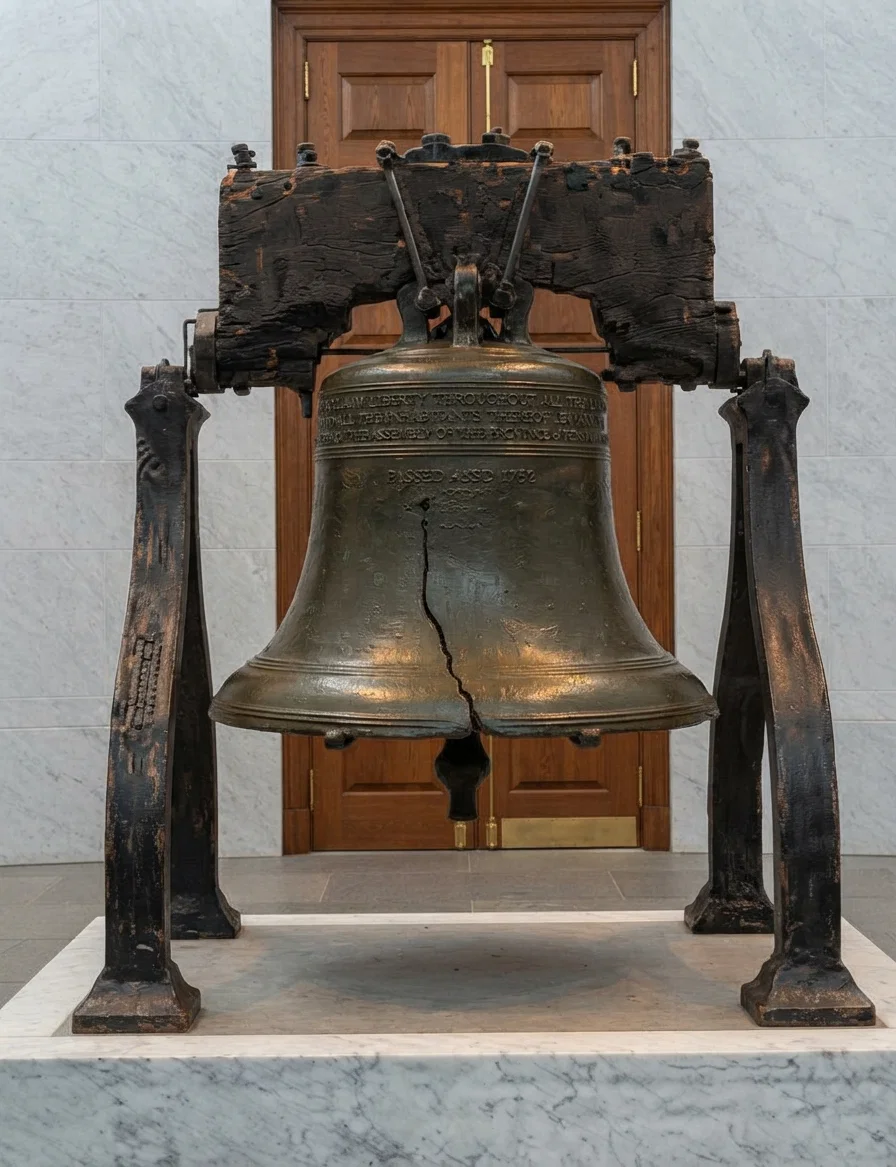
Liberty Bell, which rung out freedom to all the people of the world.

Not to Create, but to Secure

The government which they proposed to establish was not designed to create rights, but to “secure” the free exercise of the rights with which the Creator had already endowed them. The government to which the colonies were then subject was denying this exercise of rights; hence the colonists declared for “a new order of things”—a government having for its object to provide for the best good of all the people. The idea prevails to a great extent to-day that the government is designed to provide for the best good of the majority; but that is a perversion of the true spirit of government, for it ignores the rights of a part of the people. It is but a slight modification of the monarchical rule that government as established for the special benefit of rulers and their friends, be they ever so few in number.

The Individual

The particular feature of rights to which the Declaration pledges government security is included in “life, liberty, and the pursuit of happiness.” As the theory and the language of the Declaration guarantee such protection to “all men,” every individual citizen and every individual accepting the guarantee even temporarily, is under obligation to acknowledge and respect the right of every other individual. The Government is a compact of individuals for this purpose. In no other way can the rights of all be made secure in a selfish and consequently sinful world. For this reason, purpose, object, “the powers that be [civil government] are ordained of God.” Rom. 13:1. The obligation being mutual between individuals, the claim to security in what would ordinarily be deemed personal right is logically forfeited, or limited, when the individual fails to regard the rights of others. For instance, when a person’s actions become a menace to the lives and liberty of others (not when his “persuasion, religious or political,” is repugnant to them), it is the province and the duty of the government to restrain him, or to restrict his liberty of action (not of sentiment or conscience) to the extent that is necessary to the security of others in the exercise of their equal rights. “For rulers are not a terror to good works, but to the evil.” Verse 3.
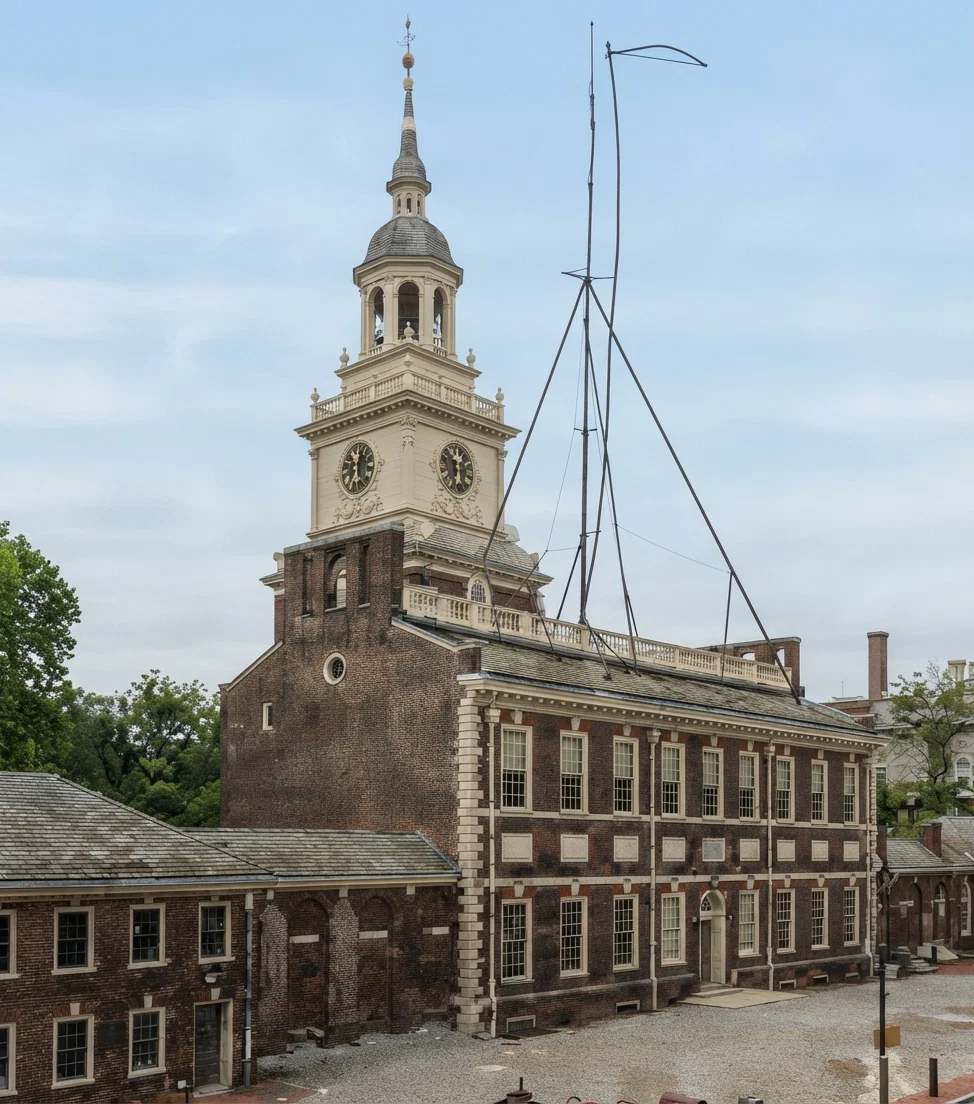
Independence Hall, where the Declaration was signed, July 4, 1776

Pursuit of Happiness

Perhaps in no sense was there a greater necessity for reformation in governmental function than in the protection of men in their right to the “pursuit of happiness.” And no element ever was so inclined to interfere with the free enjoyment of this right as the votaries of religion. Furthermore, this interference never has been carried to such an extreme as by those who have professed adherence to the Christian religion, this, too, in face of the basic Christian principle, “All things whatsoever ye would that men should do to you, do ye even so to them.”
Bartholdi's Statue of Liberty
It has been in the matter of the “pursuit of happiness” that the advocates of civil-law religion have ever deemed it their prerogative, through the machinery of government, to dictate bounds of action on the part of their fellow men. Religious zealots—whether Roman Catholic, professed Protestant, Greek Church, Mohammedan, or the generally recognized heathen of whatever name—have always deemed it essential to good government to restrain the non-religionist in his idea of pursuing happiness, and to compel him to acknowledge at least formally the essential importance of their religious dogmas. So extensively grounded had this idea become, that a government without an establishment of religion was indeed “a new order of things,” and in the Old World was deemed as near of kin to anarchy.
Many attempts have been made to establish government that would be void of tyranny, that would recognize the rights of all the people; but prior to A.D. 1776, all such attempts fell short, because some particular kind of religious faith was recognized in the civil law. The government, however liberal in other respects, would set up and endeavor to maintain at public expense some form of religion. And it has ever been a fact that the enforcement of the observance of religious creed by law has worked oppression and limitation of the exercise of civil rights by those who were conscientiously opposed to the state religion.
Witch House, where Roger Williams once lived, afterward used to try “witches” in
Gallows Hill, in Salem, Mass., where "witches" were hanged

The True Idea

But through the vista of history and experience by the light of true Gospel principle, there dawned the true idea of civil government—the complete separation of church and state, and the recognition of the equality of men. This was the perfect ideal as seen by the framers of the Declaration of Independence, and later by those who constructed and adopted the Constitution. That the ideal has not been fully put into practise is due to the innate selfishness and bigotry of individuals and classes who have been enabled to wield a certain degree of deteriorating influence. But the ideal was set up by our forefathers, in the providence of God, for the first time in the history of nations. And it is yet professedly held up in the letter of the Constitution, and in the formal heralding of the principles embodied in the Declaration of Independence.

“Be Gentle”

“WHAT a pretty girl!” said one observer.
“Not so pretty as she was a year ago,” said a quick-eyed one, “for her temper is beginning to show through.”
Five years later every one could see what he meant, for the “showing through” was too plain to be overlooked; and the pretty girl was a frowning, thin-lipped woman. We may be sure that what we are will write itself on our faces before we get through, no matter what the unformed outlines of youth may be.
Who has not seen the wrinkled and knotty temper “showing through”? “Be gentle.” —Anon.

The Final Test of God's People

By Mrs. E. G. White
IN the eighteenth chapter of the Revelation, the apostle-prophet John speaks of "another angel" whom he saw coming down from heaven, having great power, so that the whole earth "was lightened with his glory." With a strong voice the angel cried, mightily, "Babylon the great is fallen, is fallen, and is become the habitation of devils, and the hold of every foul spirit, and a cage of every unclean and hateful bird. For all nations have drunk of the wine of the wrath of her fornication."
It is the church of Rome which, thinking to prove itself not only equal to God, but above God, has changed the rest-day of Jehovah, placing the first day of the week where the seventh should be. And the Protestant world has taken this child of the Papacy to be regarded as sacred. This is called in the Word of God "her fornication." Thus the people of the world, in giving their sanction to a false sabbath and trampling under their feet the Sabbath of the Lord, "have drunk of the wine of the wrath of her fornication." Wherever the papal sabbath is honored in preference to the Sabbath of the Lord, there is the man of sin exalted above the Creator of the heavens and the earth.
The angels and the holy inhabitants of other worlds watch with intense interest the events taking place on this earth. Now as the close of the great controversy between Christ and Satan draws near, the heavenly host behold men trampling upon the law of Jehovah, making void the memorial of God,—the sign between Him and His commandment-keeping people,—setting it aside as a thing of naught, something to be despised, while the rival sabbath is exalted. They see men claiming to be Christians, calling upon the world to observe this spurious sabbath that they have made.

The Special Point of Controversy

When the Sabbath shall become the special point of controversy throughout Christendom, the persistent refusal of a small minority to yield to the popular demand will make them objects of universal execration. Satan will excite indignation against the humble remnant who conscientiously refuse to accept the customs and traditions of error. Blinded by the prince of darkness, popular religionists will see only as he sees, and feel as he feels. They will determine as he determines, and oppress as he has oppressed. Liberty of conscience, which has cost this nation so great a sacrifice, will no longer be respected. The church and the world will unite, and the world will lend to the church her power to crush out the right of the people to worship God according to His Word.
It will be urged that the few who stand in opposition to an institution of the church and a law of the state, ought not to be tolerated; that it is better for them to suffer than for whole nations to be thrown into confusion and lawlessness. This argument will appear conclusive; and against those who hallow the Sabbath of the fourth commandment will finally be issued a decree denouncing them as deserving of the severest punishment, and giving the people liberty, after a certain time, to put them to death.
Romanism in the Old World, and apostate Protestantism in the New, will pursue a similar course toward those who honor all the divine precepts. This is the mystery of iniquity, the devising of satanic agencies, carried into effect by the man of sin.

An Ancient Example

The decree which is to go forth against the people of God in the near future, will be in some respects similar to that issued by Ahasuerus against the Jews in the time of Esther. The Persian edict sprang from the malice of Haman toward Mordecai. Not that Mordecai had done Haman harm, but he had refused to flatter his vanity by showing him the reverence which belongs only to God.
The king's decision against the Jews was secured under false pretenses,—a misrepresentation of that peculiar people. Satan instigated the scheme in order to rid the earth of those who preserved the knowledge of the true God. But his plots were defeated by a counter-power that reigns among the children of men. Angels that excel in strength were commissioned to protect the people of God, and the plots of their adversaries returned upon their own heads.
History will repeat itself. In this age the test will be on the point of Sabbath observance. The same masterful mind that plotted against the faithful in ages past, is now at work to gain control of the falling churches, that through them he may condemn and put to death all who will not worship the idol sabbath.
Our battle will not be with men, altho it may appear so; we war "not against flesh and blood, but against principalities, against powers, against the rulers of the darkness of this world, against wicked spirits in high places." But if the people of God will put their trust in Him, and by faith rely upon His power, the devices of Satan will be defeated in our time, as signally as in the days of Mordecai.
The people of God will enter into no controversy with the world over this matter. They will simply take God's Word for their guide, and maintain their allegiance to Him whose commandments they keep. They will obey the words of Jehovah, "Verily My Sabbaths ye shall keep: for it is a sign between Me and you throughout your generations; that ye may know that I am the Lord that doth sanctify you. Ye shall keep the Sabbath therefore . . . for a perpetual covenant."
To every soul will come the searching test, Shall I obey God rather than man? The decisive hour is even at hand. Satan is putting forth his utmost efforts in a last despairing struggle against Christ and His followers. In this closing scene, false teachers are employing every possible device to stimulate the hardened sinner in his rebellious daring, to confirm the questioning, the doubting, the unbelieving, and by misrepresentation and falsehood to deceive, if it were possible, the very elect.
Who are prepared to stand firmly under the banner on which is inscribed, "The commandments of God and the faith of Jesus"?

Our Example

By E. F. Johnstone, LL.M.
To LIVE as lived the Son of Man Is surely gracious Heaven's plan For mortals, one and all; His character we should portray In all we think and do and say, In matters great and small.
His love and kindness we should show To sinners everywhere we go, His mercy and His grace; And His sublime unselfishness Our lives should mightily express To all the human race.
As He received the sinful wretch, So we our hands should gladly stretch To help the sinner rise; For we to Him as sinful came, With just as great a load of shame, And Jesus heard our cries.
Forgive our brother? Yea, forgive; If we expect with Christ to live, We never shall condemn; Who dares forgiveness to withhold Shall never walk the streets of gold In New Jerusalem.
Let every heir of God be bold To men God's message to unfold; And may his life agree With truth he preaches day by day; And, brother, as for you I pray, I beg you pray for me.

He Has Not Done So

SAYS a writer who endeavors to prove Sunday to be the original seventh day, "Would a God who delights in the unity of His children as our God does, so fail in definitely designating the day as to justify division regarding that day?" No, He would not so fail, and has not so failed. He has made it as plain as words could make it that the seventh day is the Sabbath (Ex. 20: 8-11), and that this is the day just before the first day of the week (Mark 16: 1, 2). We know of no attempted Biblical Sunday defense which is held by even a majority of Sunday-keepers. God's command and Christ's example are sufficient for those who keep the Sabbath of the Lord, the seventh day.

Greatness Under Affliction

The truly great and good, in affliction, bear a countenance more princely than they are wont; for it is the temper of the highest hearts, like the palm-tree, to strive most upward when they are most burdened. — Sir Philip Sidney.

The Morality of Law-Evading Business

ANY man, or any corporation, who conducts his business on the edge of the law, so to speak, is morally a lawless person, tho he never gets over the edge; and any person, firm, or corporation which conducts business in this way sets a very evil example in the community. An habitual law-evader is almost as bad as an habitual law-breaker.—Charles W. Eliot.

Equality of Rights

No man acquires any additional rights as a man by joining any society, association, or organization. The true civil government has no right to recognize any segregation of this kind.
John Smith is a man and a citizen. As a man and citizen under any just government he has equal rights with every other man and citizen. He may join the Methodist Church, or the Catholic Church, or any other religious denomination; but his church affiliations have given him no added right of recognition by the government, they have bestowed upon him no rights to which his fellow citizens outside of all church folds are not entitled. He may join every labor-union in America, every lodge,—social, beneficiary, or otherwise,—any political party; but these add not one iota to his rights as a citizen and as a man. The right to life, liberty, and the pursuit of happiness is still his equally, and only so, with all other citizens.
HE may feel that his labor organization is working for the uplifting of the laboring men, and that opposition to it is against the good of the laboring men; but his fellow citizens have the equal right to think and labor to the contrary. Whatever may be his belief—even tho it be wholly right—he has no right to impose it upon others without their free and full consent in profession and practise. And the converse of all this is true. The demonstration of these theories must be left to time, and their acceptance to the free will of the convinced citizen.
The right to believe and practise, or not to believe, the right to buy and sell, to labor for what and for whom and when one will, rests in every citizen equally. So long as he does not contravene the equal rights of his neighbor, he is free to believe, to teach, to practise, but not to compel.
Trades-unionists assume that he who opposes labor-unions, or he who maintains an absolutely neutral position, is a foe of labor and mankind. Let them hold it as a theory if they will, but they have no right to seek to enforce their theory upon others.
Other men may believe, and some doubtless do believe, that unionism as at present exploited is the most evil thing for the laboring men that ever found standing among them. They have the right to believe this and teach it as they will, but no right even to seek to enforce it upon others.
The devout, consistent Roman Catholic believes that all hope of salvation lies within the fold of the Roman Catholic Church, and that to reject that church is to abandon all hope. Some have believed this so consistently, supremely, and unwisely that they have sought to compel acquiescence in others; and the result has been untold persecution. The Roman Catholics have the right to believe as they do, even tho their belief be wrong; but they have no right to enforce their belief, or to seek to enforce it, upon others, be the others Protestant or heathen. The same is equally true of any religionist or non-religionist.
These propositions seem so self-evident that their mere statement is superfluous; and yet almost everywhere are they ignored — by capital and labor, in church and society. Still they are vital. On the maintenance of them in their integrity rests the stability and perpetuation of the Republic. Their destruction in the hearts of men, and their consequent elimination in public life, presages the utter ruin of this government, this nation, this world. And thus has the “more sure Word of prophecy” spoken. When things, institutions, mere materials, or the schemes, plans, or theories of men, are counted superior to men, wo betide. God has ordained civil governments to protect men from men who can not control themselves. God has placed His church here to save through Christ Jesus men who can not save themselves. But when the governments of earth refuse to do the one, and the church rejects the other, both state and church must be set aside, and Christ must come to render justice and judgment; and upon those who have ignored or rejected His way, will fall the destruction they have invited,—they will reap the fruit of their own sowing. But those who trust in Him shall be saved.

The Appeal to Law

GOD constituted man a self-governing agent. To this end He made him free morally to choose and do the good. This of itself involved freedom to do evil and receive the penalties of wrong doing. For God to make man free morally was to constitute man in a large sense like Himself. God both wills and does in accordance with the good pleasure of His will; and He gave man the same power to will and to do. It follows therefore that for God to make man like Himself in being free morally, gave man the possibility of willing against right, against God Himself, and of choosing evil.
Man has chosen evil. It is useless for us to say that Adam chose evil; for we are all either repeating his choice or rejecting it. But God again, through the great Gospel of Jesus Christ, has made it possible for man to be a self-governed being; and if we fail to govern self, if we fail to choose the right, if we fail to will and to do as God would have us, we are simply making the choice of Adam our choice, we are accepting the situation which he bequeathed to us. But if on the other hand we accept the power that Christ offers, or that Christ will be in us, then we reject the evil and choose the good.
And so still in the plan of God man is to be a self-governed being. He is to choose, he is to direct; and the victory is to be his.
But man does not always thus govern himself, more is the pity. Every man without Christ tends away from this self-direction, this self-power, this government of the soul, into a system of government that depends upon creeds, rituals, formal laws, rites, ceremonies, outward observances,—anything that will avoid his actual fight against evil and will save him from utter renunciation of all that is wrong.
History repeats itself. We can get multitudes of illustrations, exemplifications of this principle, from the history of the people who have lived before us. See how it was with the ancient people of God. Trusting in the lineal descent from Abraham, they supposed they were truly Israelites, and forgot, if they ever knew it, that character had anything to do with sonship. Trusting in blood relationship with Abraham, they ignored the sinful corruption of their lives, which contradicted everything but a material connection with the father of the faithful.
Christ said to them and of them, “If ye were Abraham’s children, ye would do the works of Abraham. But now ye seek to kill Me, a man that hath told you the truth, which I heard from God: this did not Abraham. Ye do the works of your father. . . . Ye are of your father the devil, and the lusts of your father it is your will to do.” John 8: 39-41, 44. Their trust in Abraham was really a trust in the flesh, for only through the flesh were they kin with Abraham. This was a trust in man, a trust in the flesh, notwithstanding the fact that God had pronounced a curse upon him who trusted in man and made flesh his arm.
Claiming to believe in the Word of God through Moses, they were really making that Word of no value whatever by their false interpretations and vain tradition. They really did not know what was God’s Word through Moses; they had misconstrued the Scriptures according to what they thought was true. Said Christ: “Do not think that I will accuse you to the Father: there is one that accuseth you, even Moses, in whom ye trust. For had ye believed Moses, ye would have believed Me; for he wrote of Me. But if ye believe not his writings, how shall ye believe My words?” John 5: 45-47.
“Moses in whom ye trust.” They were trusting in man, or rather in their own conceptions of that man, in their own ideas of what he taught; and so trusting in the purely human, they refused the divine. This is the constant result of substituting legalism for the power of God.
All Christ’s teachings are directed against the mistake made by the Jews. Over and over He shows them that they are trusting in pure ceremonialism, legalism, outward forms, rites, and ceremonies; and that only one thing in all this universe is acceptable with God, and that is a life conformed to God’s will.
Notwithstanding this terrible mistake and all its consequences, notwithstanding the plain lessons in the Word of God from the Christ of God, men in our day are attempting the same sort of thing, losing the power of the spiritual life, finding it vanishing from the earth. They think to bring in the blessing of God by a system of laws which will compel outward conformity to the certain principles which they believe are divine.
In the first place, the laws for Sunday observance are in no sense divine. There is no law for Sunday-keeping that originates with God. It is in every sense of the word man-made. Whatever power or authority or appearance of sanctity it may have, is put upon it purely by man himself. It is wholly a system of legalism, of ritualism, of ceremonialism.
And if the ritualism, the ceremonialism, the outward forms and practises which God instituted; we say, if these things which God gave were an injury when trusted to by God’s people, to the exclusion of a righteous life, will not the man-made ritualism and ceremonialism be as injurious and even more injurious than were those, when it leads away from that life which God would have a man live?
The state is ordained of God to prevent that which would endanger life and property, to give a place of ordinary peace and safety where man can live and establish character. Such a state is merely civil; but in matters that are strictly moral, there is absolutely no value whatever in anything but heart religion. All appeals to law and all reliance upon legal measures is but to founder upon the same rock that God’s people made shipwreck on two thousand years ago.
Why is it that the great men of the present age can not see the utter valuelessness of morality that is purely outward, that is mere conformity to legal enactments? Moral quality must emanate from the heart. Christ Himself has told us that from the heart proceeds all the evil that defiles man; and any system of civil enactments, all the laws that man can pile up, can not touch the heart, can not change its quality, can not affect the life.
But God has given the Gospel to reach the heart, to purify the soul, to cleanse the fountain of being, to make man a self-governed and self-governing creature who is at the same time absolutely in accord with the divine will.
God forbid that we should trust in laws of man, or in anything that pertains to man. God help us to trust in His Gospel, not to be ashamed of it. "I am not ashamed of the Gospel of Christ: for it is the power of God unto salvation to every one that believeth." Rom. 1:16. R.

Readings in Numbers 16–34

THE readings are all found in Numbers, chapters 16 to 34. The great central thoughts of these chapters are as follows: chapter 16, the rebellion of Korah; chapter 17, God's testimony to the call of Moses; chapter 18, duties of the priests and Levites; chapter 19, the purification of the unclean; chapter 20, Miriam's death, the smiting of the rock, the death of Aaron; chapter 21, the fiery serpents, and the songs of the wells; chapters 22, 23, 24, Balaam's curses turned to blessings; chapter 25, the curse of Baal-peor; chapter 26, the numbering of Israel at the end of the forty years (compare with chapter 1; note how some of the tribes fell off and how others increased); chapter 27, daughters' inheritance; chapters 28, 29, instructions concerning various offerings; chapter 30, vows; chapter 31, division of spoil taken in war; chapter 32, the inheritance of the two and one half tribes; chapter 33, the journeyings through the wilderness; chapter 34, the instructions concerning the division of the land.
Continue reading: Our Country — The Outlook