THOU knowest, Lord, our feet are prone to stray;
That we are only mortal, weak, and frail;
That strongest temptings oftentimes assail,
And leave us bruised and bleeding in the way.
Thou knowest all—our overwhelming debt,
Which we can never even hope to pay;
Still, Lord, have mercy for another day;
Bear with us for a little season yet.
The night is long—the night of human wo—
Yet shortly there will come the dawning day.
And when it comes, O Lord and King,
Remember us who've stumbled here below;
May not Thy face from us be turned away,
But hide us 'neath the shadow of Thy wing.
DELWIN REES BUCKNER.
Ambato, Ecuador.
Gospel Progress in Austria
By Editor
A note from one of our ministers in Austria tells us of good news in that Catholic country. He baptized fifty souls last year, altho religious organizations outside the Roman Catholic Church are prohibited by law. Prayer in public meetings is not permitted. Baptism and the Lord's Supper must be held in secret. In the capital of Moravia no public meetings are allowed at all. The chief of police, who once studied theology, declares that religious affairs should not be discussed in public. January 15 a day of prayer and fasting was held for our churches there in order that they might obtain more freedom; and the Lord heard the prayers and gave them the victory. Yet are they of good courage in spite of all the difficulties.
Christian Education Magazine
By Editor
There have come to our table three numbers of Christian Education, a magazine for the home and the school. It stands for the education of the whole man, "the harmonious development of the physical, the mental, and the spiritual powers." Its aim is to help teachers, parents, and educators everywhere to prepare the student for the best of service here and for eternal life hereafter. It has for its departments: General Articles, Editorial, Among the Schools, including the college, secondary school, primary school, home school, correspondence school. The editor is Frederick Griggs; associate editor, Warren Eugene Howell. It is published at Takoma Park Station, Washington, D. C. It seems to us that every teacher and trainer of the youth would want the magazine. Price, ten cents a copy.
The Morning Watch Calendar
By Editor
We have before referred to the little calendar 'The Morning Watch,' and would suggest again that it is a good thing for the young people, or older people, to use. It may be obtained from the young people's Missionary Volunteer Department, Takoma Park Station, Washington, D. C. Its suggestions are aids to personal Bible study and prayer, giving a text for each day, with suggestive thoughts regarding the purpose of life.
A View of the Pressroom
Pacific Press Publishing Assn
By Floyd Bralliar
BY FLOYD BRALLIAR
THIS new animal book for young folks is receiving an eager welcome by all nature lovers. ELO THE EAGLE is the first of a series of ten interesting stories of animals, wild and otherwise; being, with one exception, the life histories of boyhood friends of the author. Many strange and laughable anecdotes are related by Mr. Bralliar, all of which are strictly true and vouched for by reliable witnesses.
The book is lavishly illustrated by special drawings, with a full-page half-tone design printed in Luxotype at the beginning of each chapter. Two hundred pages, printed on egg-shell paper, beautifully bound in red cloth. Price, post-paid, $1.00.
Easily sold by young people. Agents wanted.
Pacific Press Publishing Assn.
Mountain View, California
Portland, Ore. Regina, Sask., Can. Kansas City, Mo.
Twenty Thousand Children
By Editor
are made happy each week by visits from "Our Little Friend." Not only are they made happy, but they are made sweeter and better boys and girls because of the character-molding influence of its stories and lessons on Bible, moral, animal, bird, insect, and other subjects.
Particular Parents
who know the value of clean, wholesome books and papers and are anxious about the moral and spiritual development of their children, will find "Our Little Friend" a great help in attaining desired results.
This eight-page paper is profusely illustrated with those pictures which appeal to the child and which convey helpful thoughts to his young, impressionable mind. Many too young to read sit on mother's lap or by her side and intently listen to every word as she reads of some noble deed of boy or girl perhaps, or of some beautiful creature of the forest.
A Boy Says:
"You are just the kind of paper to make boys want to be good, and we like you."
The yearly subscription price is but 60 cents; for six months, 30 cents.
About one-seventh actual size
Partial Contents
for 1910
Uncle Ben's Clover-Field Series — Birds of the Bible — Noble Men of Ancient Times — Women of Note in Bible Times — Simple Lessons in Present Truth — How to Care for Our Bodies — What a Boy Can Do — Some Things a Girl Can Do — Children of the Reformation — Stories of Missionaries — Recent Inventions — Some of Nature's Wonders — Heroes of History and Their Achievements — Simple Talks on Ethics — Reports from Missionaries — Help-One-Another Band — Mothers' Helpers — Fathers' Minute Men — Society for the Prevention of Cruelty to Animals — Animals, Birds, Insects, Fishes — How to Make and Care for a Missionary Garden — How to Raise Missionary Chickens — Children of Various Nations.
Costs Less Than One and One Fourth Cents a Week
Address Your Tract Society, or
OUR LITTLE FRIEND, Mountain View, Cal.
Liberty Magazine, First Quarter 1910
By Editor
"Liberty" for the first quarter of 1910 is an excellent number. It contains some striking articles on The Protestant Christian Nation, Purpose of a Federation, An Eminent Baptist Clergyman on Sunday Closing, The Intolerant Spirit Rising, Persecution a Good Thing, Shall We Have a Sunday Law, The Injustice of Sunday Laws, and many other equally interesting and important articles. The magazine is only ten cents. It stands for a complete separation of the church and the state. Address, Liberty, Takoma Park Station, Washington, D. C.
Wanted
By Editor
For missionary work, copies of SIGNS OF THE TIMES, Watchman, Life and Health, Liberty, etc., sent post-paid to—
W. H. Armstrong, Blythewood, S. C., R.F.D. 2.
Mrs. S. A. Williams, 15912 Park Ave., Harvey, Ill.
Tom. C. Hege, 129 Market St., Wilmington, N. C.
IN THREE DAYS
Overland Limited
TAKES YOU
To Chicago
ACROSS GREAT SALT LAKE
AND
HIGH SIERRA BY DAYLIGHT
Luxurious High-class Equipment
Electric Lighted Throughout
Pullman Drawing-room
Stateroom
Vestibuled Sleeping Cars
Careful and Attentive Dining Service
Parlor Observation Car with Library and Cafe
Ladies' Reading Room
Gentlemen's Smoking Room
Daily News Bulletins
Latest Papers and Magazines
SOUTHERN PACIFIC
Cooperation Corner
By Editor
THERE come to us now and then, in fact almost constantly, requests from our missionaries in various fields for the SIGNS OF THE TIMES, and we respond to them as far as we are able; but we are sure that there are those among our readers whose business and surroundings are such that they can do but little in personal missionary work, who would be glad to unite with us in work of this kind.
For instance, there comes to us a request for a club of ten SIGNS to be used in Peru, one of the great needy fields. Another which came in the same mail asks that two of our schools in the South should receive the paper. These schools are carried on by missionaries who are receiving less than nothing for their work. How many of our readers would like to have part in sending clubs of the SIGNS out to such needy fields as this?
A quick response will be greatly appreciated.
Science in the Bible
By Editor
"Science in the Bible," the A B C of teaching the Bible in Nature and Nature in the Bible. In this little book the Scripture references are alphabetically arranged so that the student of nature may readily find any text bearing on true science as founded in the Word of God. 113 pages. Cloth bound. Price, post-paid, 30 cents. Address this office.
The LORD'S DAY
A Brief but Comprehensive Treatise covering the History and Doctrine of the Sabbath and Sunday Controversy from Creation to the Present. Truth supported by Scripture, Historical Fact, and Argument.
The LORD'S DAY
The Test of the Ages
A Multum in Parvo on the Sabbath Question. Illustrated; 128 pp; price, 10 cents post-paid. PACIFIC PRESS, Mountain View, Cal.
Colds
Colds.—By G. H. Heald, M.D. A treatise on the causes, prevention, and cure of colds. White leatherette binding. 58 pages. 25c.
Address this office.
Helps to Bible Study
Helps to Bible Study. A series of Bible readings, simple and easy, designed as an aid to the personal study of the Scriptures, and adapted to the use of individuals or families; also a valuable assistant for Bible workers. 125 pages. Paper covers, 25 cents; cloth, net, 50 cents. Address this office.
A Garden of Weeds
By Frances M. Payson
By Frances M. Payson
HAVE met one woman in my life who was a genius. She was certainly an exposition of the time-honored saying, "Where there's a will there's a way." The way was like the proverbial road to Jordan, "a hard road to trabble," but there was certainly a will.
She was living in the country when I saw her, trying to settle herself cheerfully amid the unaccustomed surroundings of the backwoods you may almost say, to lift a bit on a year or two of poor business, and help out on saving a small, out-of-the-way farm from the hammer. Money was scarce, and comforts in the little town adjacent about as much so. What one got away off there in a perfect wilderness of lonely nature, as it seemed to me, one got by "grubbing." Life within her limited horizon was far from a bed of roses as regards garden possibilities.
Our train was late; Charles came to meet it, but missed me, and I walked (according to the good-natured directions of a passing farmer), "on over the next slope, by the left fork of the road," and into the pretty, wild, country path leading "round to the Irwin ranch."
Sallie and I had always been flower friends, and her flower-garden was always a species of mania, I used to tell her laughingly. Hers was an ardor of enjoyment in her beloved garden, that seemed to pine without it; a half feeling that she must have the things she so loved about her. My first thought had been, when I heard of her situation and prospects,
"What will Sallie do without her flowers?"
I had quite expected chickens and such country evidences; house-dogs barking, and farm-hands going about with milk-pails and bran-buckets, according to schedule; such things as frivolities like front gardens hadn't occurred to me till I turned the bend at the foot of the slope, and took in the side-hill ahead. I don't know that I was ever more astonished in my life. There lay before me the prettiest garden of dainty flowers — bright against the green of the side-hill — that ever set off to advantage a quaint little prim, white, antiquated farmhouse of nondescript pattern. One peculiarity I noticed, even in my astonishment, as an oddity; and that was the character of the flowers. They all seemed so dainty; not heavy and big as is usual in flower-gardens, but fine and small and delicate, different from my garden at home. And just then, as I stood with my mouth open, that genius of a woman that I spoke of before made her appearance. I bowed down to her at once.
"Well, for goodness' sake, Sallie!" I cried. "Where on earth'd you get them?"
The genius laughed — a little ingenuous way geniuses have of underrating themselves.
"Well, for goodness' sake, Mildred!" she mimicked. "Where could I go about here without getting them?"
With that I got down nearer the ground and gave them a good looking over.
"You don't mean," I gasped, "that those [I confess I lost so much femininity as to point to "those"] are — that those — a — a — that isn't a turnip or a radish, is it?"
The answer was terse; it was a return question.
"If they are, they're pretty, aren't they? Now aren't they?"
I certainly had to admit the claim, awfully plebeian as it was. A bed — a big one — all of wild radish blossoms — think of it! Well, now, I had to confess they were just as pretty as one half the flowers, new importations, the florists send out and make us pay a dollar for. Sallie had gathered the seed about the corners and fence edge where they had gone wild year after year, and set them in, and clipped them and watered them as tenderly as if they had been precious, blooming all trim and close in the rich earth of their beds; and there they were, not the long, scraggly, fady blooms of tall, gawky, common growth, but a close clipped mass of half a dozen tints, like mammoth gypsophila, grown in an oval, close bed, and blowing in the wind with the airs and graces of a florist's catalog.
There were deep bluish purples, and pale pinkish and soft lavenders, and dark blues, and bright rose tints, there were clear light yellows, and pale straw colors, whites, and a peachy salmon of lovely shade; a real bouquet, massed as they were.
Well, I was resigned to anything after that. I followed Sallie about among the flowers (for I began to respect this beautiful garden. It was "a garden," no mistake), and we looked at one kind and then at another, right on through the list.
"O, that's nothing!" she assured me complacently. "Come on over here and see my yellow violets, and my clover beds; they're great!"
Great heads of blue, and crimson, and pink, and white clover were nodding heavy in their beds, and small white and pink and yellows, so dainty, and sweet as honeysuckle, for the bumblebees to drone over. They were not the common flower; these were dream clovers, such as grow in the heaven where all good bumblebees go. I picked a big bunch of them — carefully, as became rare and uncommon plants like these — to take to my room.
Well, I couldn't tell you! There were golden poppies, and sweet pale "kingcups" and buttercups, and yellow violets from the hill-sides, and marsh-marigolds from the brook edges below. There were black splotched wild tiger-lilies, and Mariposa lilies, all pink and lovely; there were pale blue "babies' eyes," and wild red columbine, feathery brakes, and sword ferns, and wild running strawberries all in bloom; and fragrant yerba buena, green and lovely; and O, the lupines! Great high shrubs of pale and dark blue blossoms, and pink and crimson, and pure white, and light and clear dark yellow. They grew luxuriant and tall, and full of long, bright blooms. Talk of shrubs! Why, she had the lupines, and wild elderberries in bloom, and manzanitas trimmed as prim as oleanders, and they were just as fine as any at home in my garden of rarities. And she had them all massed in with bunches of the pretty wild "grass flower" and rafts of that lovely thing, the common sky-blue wild chicory, and deep blue California wild flag, stiff, and purple, and rich, and with the small bright yellow sort beside them in a border. Why! I've passed common lupines a hundred times, and wouldn't even look at them; I felt afraid to ask to pick Sallie's, they looked so rich and splendid, so just like flowers, you know, and beautiful, as tho you needed to be careful not to break the branches.
There comes a time to all lives when a sudden awakening takes place, and brings an instant knowledge of the accumulation of years, our own self-conceit. Such a time had come to me. Hitherto I had rather as a superior being in the flower line patronized Sallie; was wont to consider myself a sort of model in the way of giving nature her due. I had serenely fancied that I was the more appreciative of the two, and had a way of saving the overlooked odds and ends of the garden and stoutly defending the modest beauties of scraggly growths, and dull colors, that, I had fancied, became a true flower-lover; had cried, "Don't pull up the poor things; they are pretty if they aren't handsome!" So I had taken pride in saving a hidden corner for all the neglected old alyssums, and dull colored candytufts, and held on to and coaxed along the diminutive last blooms of the later summer's pansies, and spared the odds and ends of scrubby blooms, with a self-satisfied thought of my tender and artistic appreciation of nature's glories; and fancied serenely that I was her true disciple. But for once I had met quite my match, almost, you might say, my superior. If there be a Waterloo for a flower-lover, that was certainly mine. To see a woman who not only stood up valiantly for nature and unadorned, but who had nothing else in her garden but simple wild nature, right from the woods and hills, not the hint of a "collection," not a "novelty," not a sign of a florist in her whole place, and her garden beat mine and gave it a queen. Well!
As I say, it was my flower Waterloo. When I saw Sallie's radish beds, I came right down off my pedestal, and took off my hat to her and weeds in general, big and little. I've never since then been able to pass the commonest weed by the wayside without viewing it with an eye to garden possibilities. Whenever I find myself attempting to sneer at a common plant, I stop and remember Sallie's sweet little garden there in the wilderness.
Well, one man's meat is another man's poison! If Sallie hadn't been so desperately needing, I suppose I never should have known how much one can get out of nothing in the flower line. When you don't have anything to begin with, and have to invent a garden, you're a genius, you see. The Government is busy paying people to get in and do just what she was doing; it pays folks every day for producing new and improved varieties of things for the use of people. That's sort of creating a new commodity, you see; a something out of nothing.
Sally had just common weeds and uncommon ones, and pretty weeds and ugly ones, and weeds hanging down and weeds staked up; but they were all just common weeds, the insignificant things you pull up and throw away, and dig out of your real gardens, and tramp on, and run your wagon wheels over every day; only these were arranged to look attractive. They were watered and enriched and dug about, and the tall ones tacked up, and the low ones clipped close and neat. Just as soon as you get to that point, you haven't got weeds any longer; you're a second Burbank, and you're creating new varieties. Talk of Burbank! Why, he had something to begin on in the first place! Sallie didn't.
If that isn't a genius for getting on in the world, then I don't know what is, that's all! I did wish Mrs. McClernigan at home down street from our place, in her big stone house, could have seen that display — just once. It might have checked up a bit of the woful complaints I used to hear about her gardens and gardeners, and the "frightful expense" it all was. Maybe — I don't know. Some people can't do anything without spending a fortune, anyway.
I sat out there on the sunny side porch in the barrel chair (she made it) between the pets of waving brakes and long sword ferns, and looked15over at the wild canaries swinging in their wire netting cages between the hanging baskets of yerba buena and flowering wild morning-glory, white with long waving ends of bell-shaped blooms, and thought. Now do you know what I thought?
"Well, that woman!"
But underneath I was bowing down to an unspeakable genius, as I quoted, under my breath, Grey's immortal lines:
"Full many a gem of purest ray serene
The dark, unfathomed caves of ocean bear.
Full many a flower is born to blush unseen,
And waste its sweetness on the desert air."
Thoughts on the Sabbath
By Mrs. L. S. Wilkins
THIS is the Sabbath, day of rest,
Day of all the week the best,
The covenant sign 'twixt God and man,
To show He is the great I AM.
God, grant Thy Sabbaths here may prove
There is a rest for us above,
Where, from all care and sin set free,
We'll rest eternally, with Thee.
Lord, worthy of all love and praise,
Help us to count these Sabbath days
As mile-stones on this earthly way
That leads to realms of endless day,
Eternal rest with Thee, begun
By rest and praise to Thee upon
The day which Thou to man hast given,
Type of eternal rest in heaven.
MRS. L. S. WILKINS.
Pure Air and Correct Breathing—Their Value
By D. H. Kress, M.D.
By D. H. Kress, M.D., Physician in Washington (D. C.) Sanitarium
IV. Breathing Exercises
BREATHING exercises, in which the lungs are compelled to take in more air than is required, soon tire the lungs. Such exercises may even become injurious. Vigorously inflating the lungs may result in the rupture of a blood-vessel and cause hemorrhage. In their anxiety to develop the lungs, those having a tendency to tuberculosis should be especially careful not to overdo. The better and safer way is to create a natural demand, or thirst, for air by exercise sufficiently vigorous to make expansion of the lungs a necessity and delight.
Useful exercise connected with the ordinary duties of life, if properly taken, is far superior to any of the breathing exercises so highly recommended, in the development of lung capacity. Going upstairs, while keeping the body erect and the shoulders well back, and energizing the legs and trunk, may be made a most excellent exercise to encourage full and deep respiration. A brisk, cheerful walk in the open air, with an erect posture and chest well forward, is exhilarating, and affords one of the best of breathing exercises. An occasional run, hill-climbing, swimming, rowing, etc., are desirable ways of increasing lung capacity; but these may be exercises overdone. This danger does not exist in bringing physical culture into the performance of our daily duties. With a little intelligence the ordinary household duties may be performed in a way to encourage symmetrical development of all the muscles and organs of the body. Even those who are compelled to sit in offices will experience great benefit by keeping the body erect and energized while writing or doing other office work which they must do in a sitting posture. While sitting, full, deep inspirations of air may be taken at each breath. This will aid in keeping the blood pure and the brain clear, so that better mental work may be done.
Occasionally during the day, five minutes may be profitably spent before an open window, in some exercise that will create a demand for air, and will tend to develop lung capacity.
Deep abdominal breathing develops the abdominal muscles, which form a normal support for the viscera. The intra-abdominal pressure exerted by the well-developed abdominal walls upon the viscera and blood-vessels prevents congestion and disease of these organs. It also exerts a most beneficial influence upon the work done by the liver, stomach, and other abdominal viscera. If the abdominal muscles are well developed, each descent of the diaphragm causes a certain amount of extra pressure, which forces the impure blood out of the viscera and abdominal cavity, toward the heart and lungs, for purification; and each ascent permits a new flow of rich arterial blood, charged with life, to enter these organs. Thus the digestion is improved, and the liver and other organs are capable of doing their best work. Even the most wholesome food may cause indigestion if deep abdominal breathing is ignored.
Singing may be made of great value not only in lung development and in the prevention and cure of disease of the lungs, but in keeping the abdominal and pelvic organs free from congestion and disease, by encouraging a free flow of blood through them. Singing, properly executed, is one of the most important measures for the prevention and cure of congestive diseases of the liver, stomach, lungs, and other organs.
In conclusion: Maintain an erect posture, whether sitting, standing, or walking. In order to breathe properly, it is necessary to keep erect, and thus allow free expansion of the lungs and unrestricted movement of the diaphragm. The erect position, with full breathing, encourages a free circulation of blood through all the abdominal and pelvic organs, increasing the efficiency of their work, and thus preventing disease.
Physical toil should always be combined with mental effort. The time spent in exercise in the open air, is not time lost to the mental worker; for it increases mental power, so that better work may be done than could possibly be done without it. Especially is this important for the missionary worker. The success of such a worker will be greatly increased by physical toil. It tends to dispel feelings of depression, impatience, and pessimism. It is an aid in the cultivation of hopefulness, optimism, and good cheer.
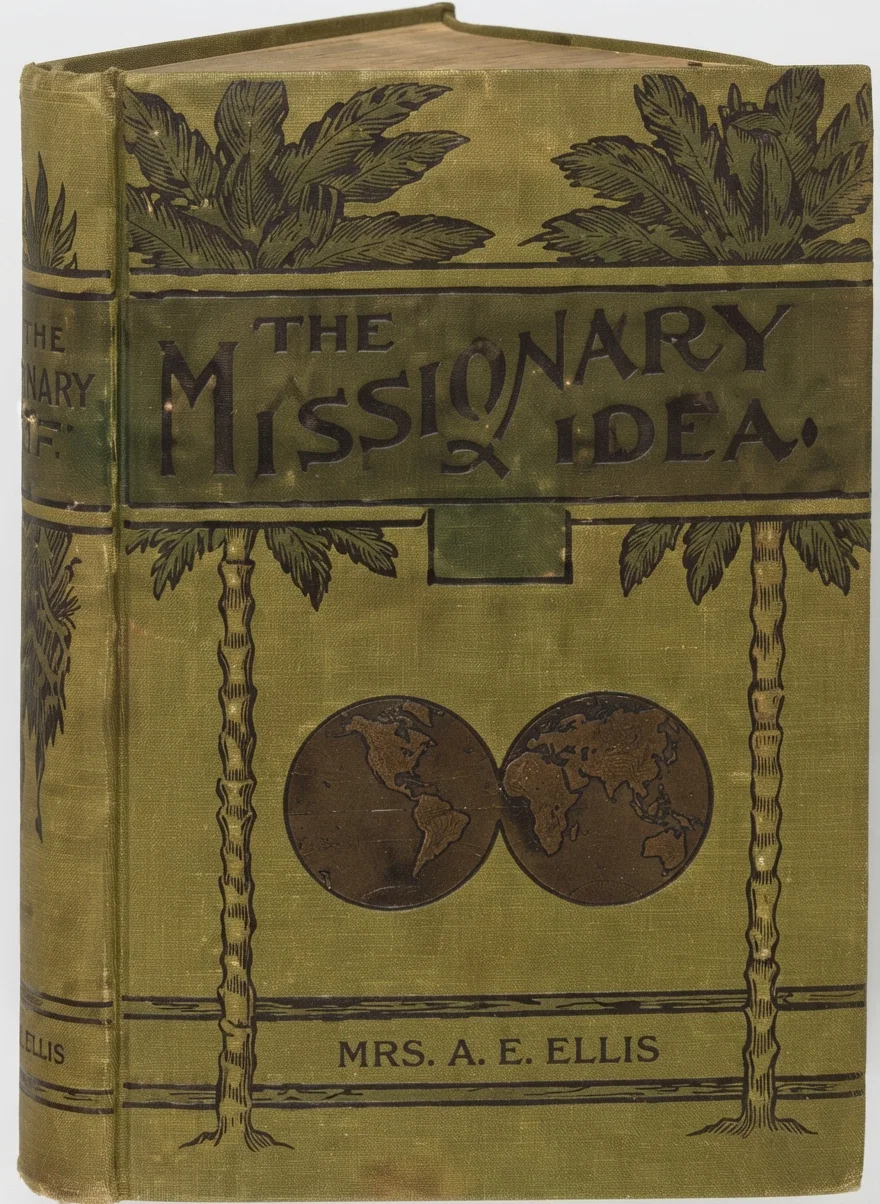
The Missionary Idea
By Mrs. A. E. Ellis
BY MRS. A. E. ELLIS
THIS little volume aims to be a suggestive help to every missionary worker whose heart has been touched with a sense of the world's need.
Part One is designed to stimulate a healthy interest in missionary work, both "Home" and "Foreign." Each of the 16 subjects is arranged in the form of a "Lesson" with carefully prepared questions.
Part Two consists of contributed, selected, and arranged matter which, besides its inspiring character, will suggest to the thoughtful reader ways in which missionary information may constantly be gathered and missionary sentiment encouraged.
Part Three gives an outline of the work done in mission fields since 1874, with a brief history of each mission and outline map of the more important.
317 pages in two handsome bindings. Paper covers 50c.
Cloth bound $1.00, post-paid
Pacific Press Publishing Association
Mountain View, California
Portland, Ore. Regina, Sask., Can. Kansas City, Mo.
California Medical Missionary and Benevolent Association
Annual Meeting
THE thirteenth annual meeting of the California Medical Missionary and Benevolent Association, for the purpose of electing four or more members of the Board of Directors, and transacting any other business that may properly come before the meeting will be held at Sanitarium, Napa County, Cal., on Wednesday, March 9, 1910, at 12 o'clock M.
L. M. BOWEN, President.
H. E. RANDALL, Secretary.
LIBERTY
By Editor
THE OFFICIAL ORGAN OF
THE RELIGIOUS LIBERTY BUREAU
AN illustrated, 48-page, quarterly magazine, published as an exponent and advocate of true religious liberty; defending Christianity and the rights of conscience; upholding the Bible as the infallible word of God; recognizing the church and state as ordained of Heaven for specific and distinct purposes, but vigorously protesting against the alliance of the church with the state in the attempt to advance religion and to promote the state.
Price 25 cents per year. Liberal terms to agents.
Address, LIBERTY, Takoma Park, D. C.
Life and Health
By Editor
A PRACTICAL health journal, published with a view of meeting hygienic needs in every home; teaching how to care for the health and how to preserve life; prescribing simple home treatments to assist nature in throwing off diseases rather than adding more poison by using drugs or unnatural stimulants as remedies; teaching how to avoid disease as far as possible, how to manage in the home when sickness does come, and how to combat the disease by simple remedies which nature provides.
Send for sample copy and special rates to agents. Price 10 cents per copy or $1.00 per year.
Address, LIFE & HEALTH, Takoma Park, D.C.
Thoughts from the Mount of Blessing
By Editor
Thoughts from the Mount of Blessing.—An exposition of Christ's Sermon on the Mount. It has 218 pages and six chapters: On the Mountainside, The Beatitudes, The Spirituality of the Law, The True Motive in Service, The Lord's Prayer, Not Judging but Doing. A new edition just printed on fine enameled paper, new type, and reillustrated with 27 beautiful half-tone engravings specially prepared for the book by eminent New York artists. It will be found full of comfort and blessing by all fortunate enough to obtain and read it. A beautiful gift book. Fine cloth cover, 75 cents.
Address this office.
Bibles
By Editor
Bibles.—Remember that we are headquarters for anything in the Bible line. We shall be pleased to send you our catalog of Bible selections on application. Pacific Press, Mountain View, Cal.
Help Wanted
By Editor
WE are desirous of securing the services of ten graduated or trained nurses at once. Apply St. Helena Sanitarium, Sanitarium, Cal.
Good Homes for Sale
Two good farms for sale in a rich section of the Northwest adjoining the new Cedar Vale Academy, conducted under the auspices of the Upper Columbia Conference of the Seventh-day Adventists. May be exchanged for city or suburban property in California. Prices and terms reasonable. For further information, address J. W. Shields, Viola, Idaho.
Beauty in the Wilderness
By Editor
In our Home Department is a selected sketch that it seems to us is worthy of reading. There may be expressions that some of our purists may object to. We are not printing it because of a few of such expressions that are therein found, but because of the real beneficial lesson that it teaches. Sometimes those who are taken away from the midst of civilization and cultivated lands, mourn because they are isolated, mourn because of unlovely surroundings. This little story tells how one woman in a wilderness took the plainest, commonest sort of things that were found on every side, and transmuted them into living loveliness; and it seemed to us that there was a lesson in it not simply in a horticultural way, or floricultural way, but in a spiritual way as well. God takes poor human, common mortals — weeds many of them seem to be — in this great garden of earth, places upon them His own loveliness, transfuses them with His own Spirit, and by His own mighty power transmutes them into marvelous beauty. With this thought in mind we hope that our readers will con the little sketch.
A New Menace to Torpedo Craft
One of the latest inventions, called "a new menace to torpedo craft," is a new pattern shell which when it bursts sets free hundreds of bullets, which continue in the same direction as the shell, but spread out fanwise, covering a wide angle and carrying destruction to whatever they may strike. These it is thought would pierce torpedo craft, the side plating of which is very thin, never exceeding half an inch in thickness, while the bullets of the new shrapnel shell will penetrate an inch of steel at 2,000 yards. The chances of a torpedo-boat's getting near enough to a ship for a direct hit in face of such a defense seems small. Thus far it has been made only in 4 7-10ths and 6-inch size calibers; in future it is to be made for and supplied to the guns of the largest calibers, even up to the 13 1/2-inch. The problem still is an armor-plate which will render nugatory any missile directed against it, and a missile which will pierce the strongest armor-plate.