IT is with no desire to reflect upon the United States of America that this issue of the "Signs of the Times" is sent forth to our fellow men. We are glad to recognize —
That this is a great and glorious country;
That the Government was founded on the blessed principles of equality and liberty as no other which ever existed;
That despite all its inconsistencies, despite the slavery in its borders, it has been the grandest, freest government that earth ever knew; and —
That its glorious flag has symbolized freedom and humanity to all the earth.
We do not wonder that the patriot's heart throbs with new joy and forceful impulses as he contemplates his country's past. We can understand that to any one less than Christian, one of the most beautiful, most thrilling objects upon which a patriot's eyes ever looked with kindling joy is the flag of this country — the Stars and Stripes — waving in the free winds of heaven. We respect the whole-souled ardor of the true, loyal citizen, as he responds to his country's call. All this we appreciate and heartily recognize. We have been there.
But friends, the true statesman and true friend of his country must make deeper research, must take broader view. It will not do to cover with the court-plaster of expediency the ulcers of the body politic, nor limit the view to the little valley of the immediate present and near future, even yet hidden in the glory of the past. He must probe the wounds for the cause of the rotting ulcer; he must extirpate the roots of the cancerous growth; the blood of the body must be purified before the death sores will heal. He must climb the mountain and get a better, larger view if he would know the condition and outlook of his country. He must know not a few details of a few localities; he must understand the working of the whole, the general tendencies of the system and habits of the patient. He must know that only by adhering to the law of its life, the reason of its existence, can it continue to exist.
The Christian, if he be true to his Master, must search deeper still. He must by the power of God's Word and Spirit look into the hidden springs of human action. Are the sources selfish? Then the end is death. Are they unselfish, consistent? There is continuance of life and vigor.
The Christian must get up into "the high mountain," even into the mountain of God; and by faith in prophetic ken, as set forth in the "more sure Word of prophecy," he must see as God sees. He must not look upon the land of his birth as the only land, or the land for him and his alone. He must see that all the lands are God's, bought by the blood of Jesus Christ. He can not, as a Christian, confine his interest, his love, to the men of the land of his birth. He will love all men, because all are the purchase of the blood of Christ. For the same reason, as he is one of the redeemed ones, he is debtor to all, "both to the Greeks, and to the barbarians; both to the wise, and to the unwise."
The Christian loves all lands, because "the earth is the Lord's." He loves all men, because they are the purchase of "the precious blood of Christ."
Not only so, but he looks beyond this life to the life to come. He believes God; he knows God. He knows that "the Most High ruleth in the kingdom of men, and giveth it to whomsoever He will;" that even the wrath of man shall praise Him, and the remainder of wrath shall He restrain; that when a nation will not work out His will, "He removeth kings and setteth up kings;" and that, finally, Jesus Christ the Branch will have gathered out of all the kingdoms of earth those who will eternally be loyal to Him, and who will share with Him His glorious universal kingdom, which is to come forth by HIS POWER ALONE from the ruin of all earthly powers. All this God has again and again foretold in His holy Word.
The Christian should know as no one else can know, be he historian or statesman, that a nation must be true to the law of its existence if it is to continue to exist. He knows that this is true of experimental Christianity. He knows it is true, because God declares it in His Word. The moment a church, or a nation, even as a man, departs from the law of its life, from that moment its decline is at hand.
Has this Government of the United States of America departed, or is she departing, from those principles which gave her existence? In the light of the evidence presented in this issue of this paper, in the light of much more that might be presented, could we answer otherwise than to say, "She is so departing"?
If the Christian sees this, is it not his duty to give warning? Can he be excusable to high Heaven if he gives it not?
Is this nation living her principles in yielding to the demand for religious legislation by federations and combinations of men, directed by a few who believe in religion by law? Upon this rock have many barks been wrecked; and he is not a true friend who will not lift warning voice.
O friends, fellow countrymen, will you not heed the warnings? Statesmen, legislators, judges, will you not, as did the fathers of the Republic (as stated by Madison), see "all the consequences in the principle," and avoid "the consequences by denying the principle"? Or will you be charmed by the siren voice of an apostate Christianity, and lured to ruin or be carried on to destruction on the almost resistless tide of a theocratic, plutocratic ambition?
What will be your choice?
Higher Prices
By Editor
THE matter of higher prices is agitating the nation. In all parts, in all the large cities, men are boycotting the butchers. The Anti-Food Trust League, organized in Washington, has grown by great leaps and bounds. Two weeks ago in Cleveland it numbered 25,000, representing at least 100,000 persons. In and near Pittsburg there were 75,000 signers; in Baltimore 50,000 buttons bearing the words, "I don't buy meat. Do you?" have been sold. Boston has 60,000 signers. In New York City there have been 200,000 applications to the Anti-Food Trust League for membership. Endless chains of postals are being used against the high prices of meat, while the stock drovers and cattle raisers are indignant.
It would be a blessed thing if people during this time of agitation could learn that there is a better diet than the flesh diet. Some will, probably; but the great mass will not. The New York Independent truly says, "Yet this is not a vegetarian campaign, for the boycotters love their meat." The boycott is not against beef, but against butchers. "When the butchers come down, they will go back to their old diet, except in so far as they have learned that with less meat they have fewer pimples and boils and more strength." It is to be hoped that they will learn, as The Independent suggests, that people "spend quite too much money on expensive food which is no more nourishing than that which grows out of the ground, and that their health is better than when they sat by the flesh-pots."
But high prices are not in meats alone. A great many of the necessaries of life are also affected. For instance, the National Shoe Wholesalers Association in convention the past week states that the existing high prices of leather and materials make it necessary that the price of shoes shall be raised; but when higher wages are asked, the workman is told that this can not be afforded. In the face of this a great railway strike is threatened. That is, railway employees in different positions to the number of one million or more, are threatening to strike. Such a thing as that would be indeed a calamity. It would paralyze the business of the whole country. The contention of the railways is that the demand of the men for more wages is a just one, but they can not afford to pay more wages with the profits which they now secure. Congress has taken the matter up, and investigating committees have been appointed. Whether anything of real benefit to the poorer classes will come out of it, is exceedingly uncertain.
The Manchurian Open Door Question
What will grow out of the attempt by Secretary Knox to make Manchuria an open door and place it under international control is hard to foretell. Both Russia and Japan are decidedly against it. The effort of the secretary was to secure a genuine open door; possibly to help China to hold that which belonged to her, and take from her northern border powers that really menaced her independence. It really looks as tho both Russia and Japan were determined to hold that old battleground for further use; and it is even now intimated that they are looking to a possible near future war with each other, or with China, in the same territory. An exchange remarks that "the refusal of the two powers is not reassuring."
Warning Against Caffein and Cocain Drinks
By Editor
Dr. Harvey W. Wiley, Chief of the Bureau of Chemistry in the Federal Government, has presented some startling facts connected with the cocain habit, and asserts that caffein and cocain are the most commonly used drugs in this country, and that the former is consumed in immense quantities through soft drinks at the soda-water fountains, where it is dealt out to children whose parents would not dream of letting them have strong tea or coffee; and he contends that these drinks ought to be prohibited, or else sold under their proper names. We pass this warning on to our readers.
Regeneration by Act of Parliament
By R. C. Porter
(By Our Own Correspondent)
SOUTH AFRICA is making very strenuous efforts to keep pace with the great nations of the world on the question of Regeneration by Act of Parliament. Rhodesia has passed a law very similar to the edict of Constantine A.D. 321.
The Orange River Colony has also recently attempted to pass a very drastic Sunday bill. The discussion both in the public press and in Parliament reminds one of the discussions during the Middle Ages, when it was customary to legislate upon religious questions.
Hon. A. C. Lyell, in moving the second reading of the bill, said "that this question would inevitably raise a discussion of a more or less religious character." "The bill now before the House was framed by a select committee, which had, however, not followed their own opinion in an arbitrary manner. The Synodical Committee of the Dutch Reformed Church, the Reformed Church, and the Evangelical Church Council of Bloemfontein, together representing all the Christian churches of the Orange River Colony, had been sounded as to their opinion on the matter, so that this bill did not only represent the opinion of the Select Committee, but that of the whole Christianity in the Orange River Colony. The tendency of all Sunday legislation was to give effect to one of the oldest laws in the universe, and originated in the work of the Creator. Nobody could dispute this fact, and that it was incumbent upon all creatures to comply with old law which could be traced back to the very beginning of all things, and again to Sinai."—Bloemfontein Friend, Nov. 16, 1909.
Just how the Lord, by working on the first day of the week and resting on the seventh day at the time of the institution of the Sabbath, and His commanding all people for all time to work on the first day of the week and rest on the seventh, in giving the Sabbath law at Sinai, gave a precedent for passing Sunday laws, the honorable member of Parliament never informed his hearers. Neither did he explain why God, who from the beginning gave to men the right of choice in matters religious to the extent that He permitted them to choose to go astray when all were originally made good, now favored compulsory religious laws. The fact is that God made and commanded the seventh day as the Sabbath, and He never authorized any one to compel its observance.
In replying to the speech of the Hon. Mr. Lyell, the attorney-general said: "The proposer of the bill has shown no reason why they should legislate in an endeavor to make people good." "Did the honorable member think that he would make people good by legislation? He [the speaker] could assure the honorable member that he would become old enough to know that there was no such thing as salvation by legislation."—Bloemfontein Friend, Nov. 16, 1909.
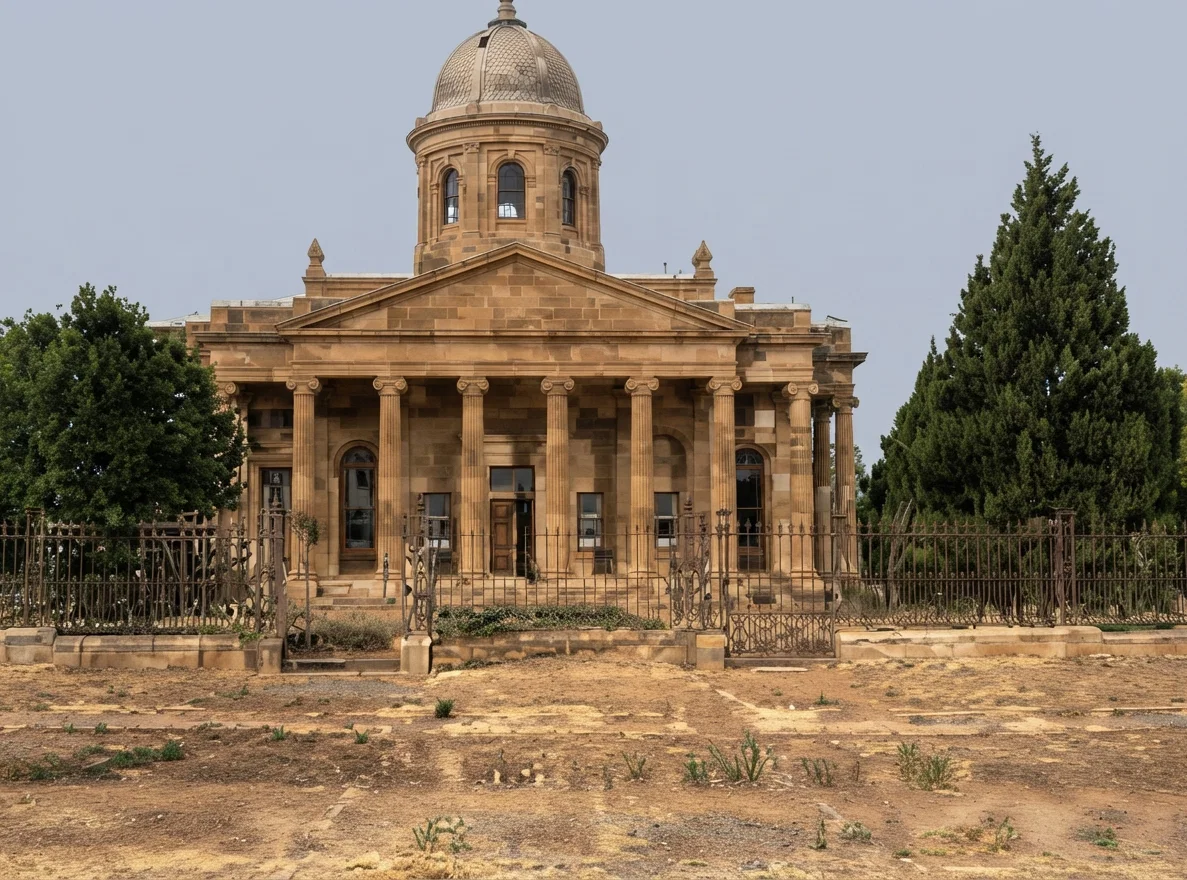
Old State House, Bloemfontein, O. R. C.
It was plain to the attorney-general that Sunday legislation was an attempt to regenerate people by law. The prime minister said, "Judge not, that ye be not judged." Then, speaking of the reason why the Huguenots came to Africa, he said: "They were one with the great majority here, in that they were Protestants, which meant that they protested against oppression and wanted freedom of conscience; let it rest between a man's conscience and his God how he looked at these things, and let not a third interfere. The Huguenots had not come to South Africa because they differed in certain dogmatical questions of creed, but because they wanted absolute freedom of conscience, and because they would not be under the authority of the pope. They had surely not done away with the great pope in order that a number of small popes might be set up afterwards over their heirs to interfere between them and their God." "The bill was only a clumsy attempt to make amendments on the eternal law of God." "Being a Protestant, he would protest against the bill now before the House."—Bloemfontein Friend, Nov. 17, 1909.
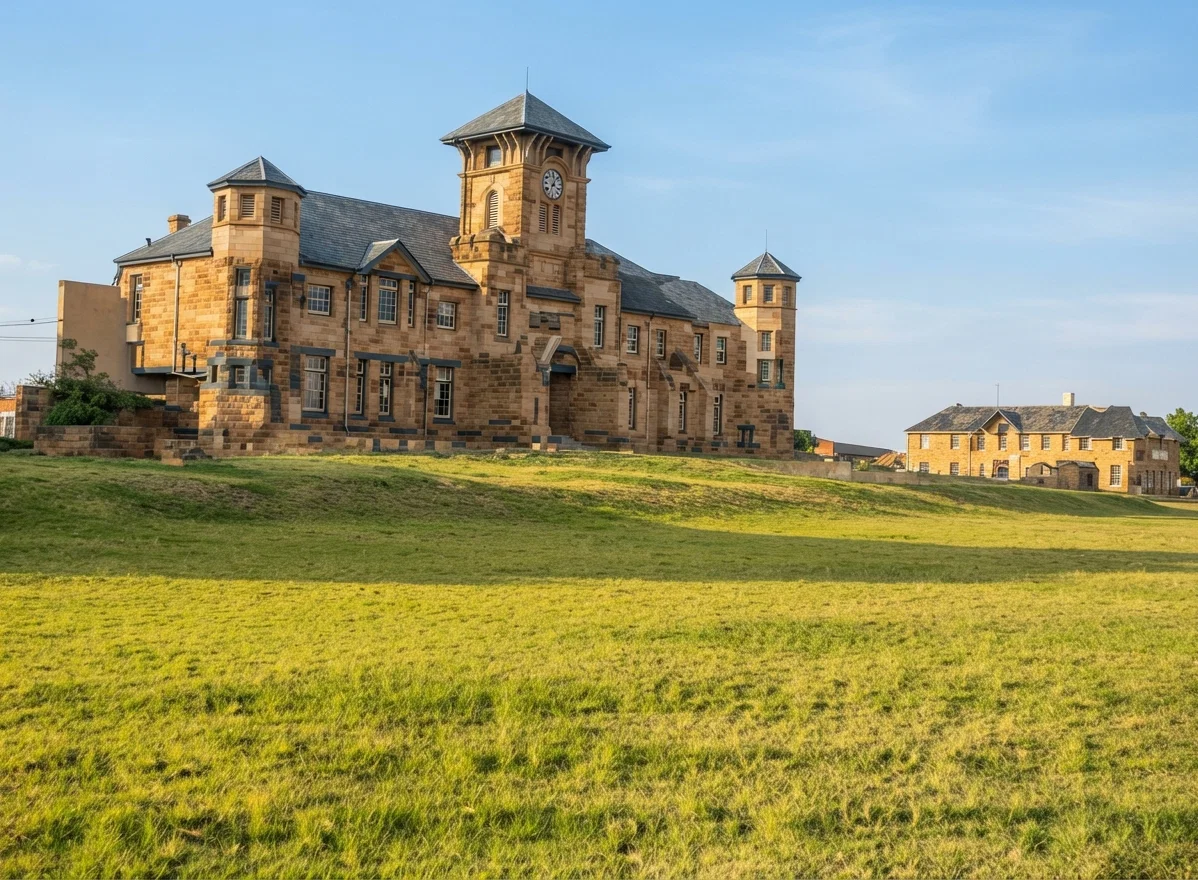
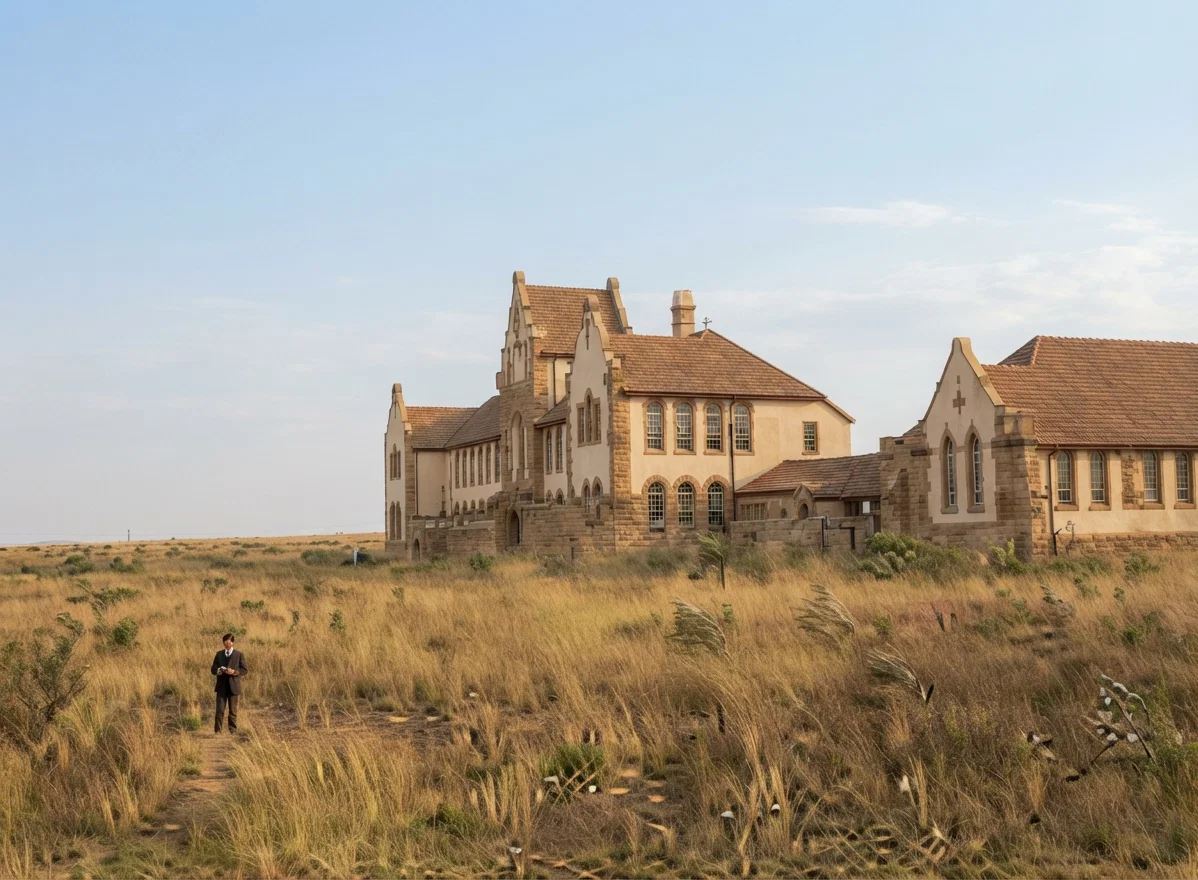
Grey's College, Bloemfontein, O. R. C.
Buildings of Grey's College
The prime minister as well as the attorney-general saw in the bill an attempt to re-establish popery. If the bill passed, it would bring a third party in between a man and his God in regeneration. It may be said, to the credit of these government officials, that they took the only legitimate stand that Protestants could take, and the bill was defeated. Regeneration is a birth from above. Any attempt to make it a matter of human force is antichristian. Let every Protestant stand true to his principles.
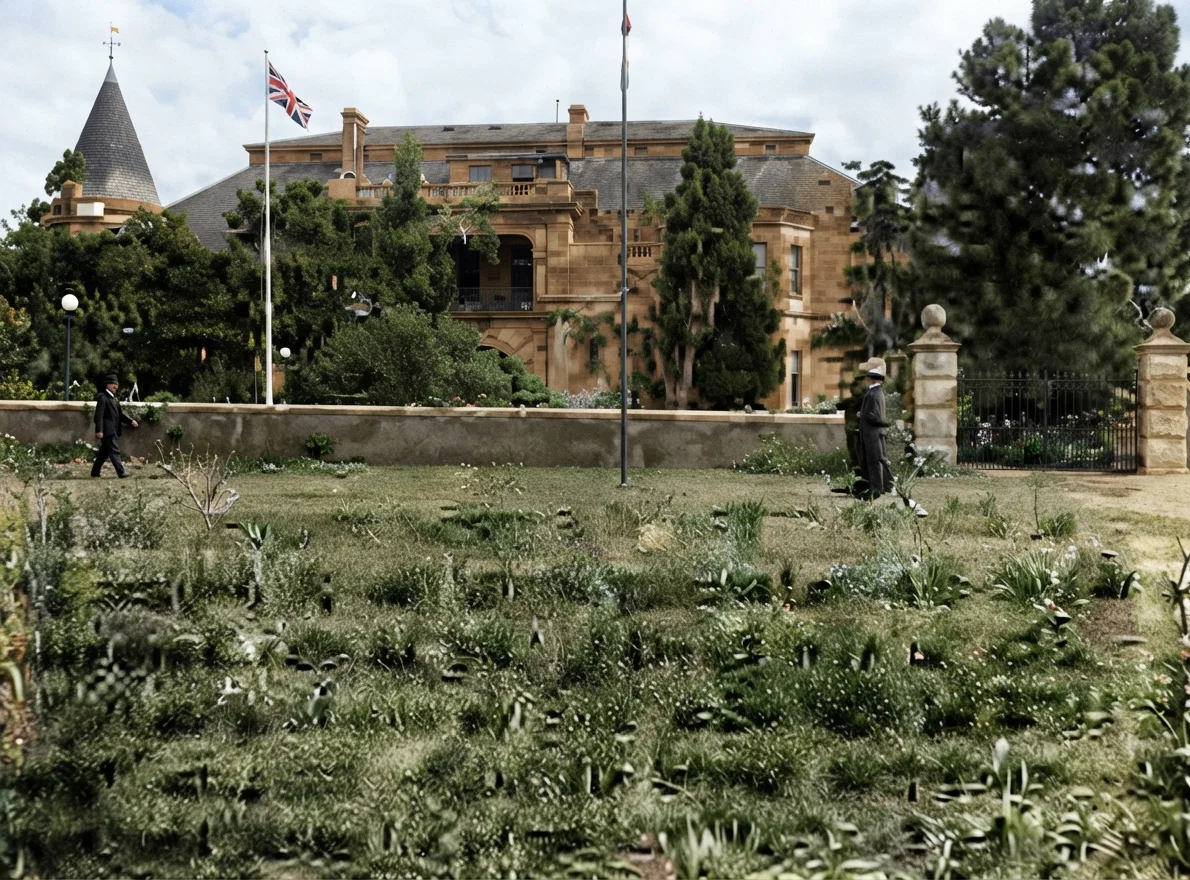
Governor's Residence, Bloemfontein, O. R. C.
Then and Now
By ABDIEL
Sunday Legislation
If one wishes to see confusion worse confounded, let him read the discussion in the Senate of the United States over Senate Bill No. 404, called the Johnston Sunday Bill for the District of Columbia, as that discussion is recorded in the "Congressional Record" of January 26, 27.
The measure was religious in its conception, religious in its requirements, religious in its exemptions, religious in its phraseology. Senator Johnston, its sponsor, practically admitted as much.
There were mild protests against religious legislation, but the ground of the protests seemed to be as clear in the minds of the protestants as a London fog. The phraseology was changed in a few instances, and lo! the religious measure became a "police regulation."
Several times grave senators spoke of keeping Saturday for Sunday. The word "Sunday" to them is sacred evidently, and identical with the religious term "Sabbath." Yet they voted for the Sunday law.
Again and again it was stated that the District of Columbia ought to possess a Sunday law, as every state in the Union possessed one. Nor did it seem inconsistent to them to plead for a Sunday law in the District as a "police regulation," and use as an argument the fact that Sunday laws, intensely religious, elsewhere existed. They do not believe in religious legislation, O no; but they demand a Sunday law in the District of Columbia, because all the states have Sunday laws, some of which are relics of the most intense union of church and state. These gentlemen did not know that the "Golden State" was an honorable exception. Evidently while many of these able senators had visited California, the awful "godlessness" of this state — without a Sunday law — had not particularly impressed their minds. California must have been remembered as a commonwealth of average respectability. The Mormon state has a Sunday law.
These gentlemen did not see that this mild measure, the author of which was willing to accept any amendment to his bill only so that it passed a Sunday law, was but an opening wedge for full-fledged religious legislation, without exemptions for any religious class, whatever their conscience or rights.
Eighty Years Ago
How clearly, keenly, strongly, different, gleams out the Senate action on the same kind of measure eighty-one years and eight days before — Jan. 19, 1829. The Senate at that time reported through Mr. R. M. Johnson, senator from Kentucky. We wish we had space for that whole report, adopted by11the Senate; but we can only give a few excerpts:
"The proper object of government is to protect all persons in the enjoyment of their religious as well as civil rights, and not to determine for any whether they shall esteem one day above another, or esteem all days alike holy."
"The committee would hope that no portion of the citizens of our country would willingly introduce a system of religious coercion in our civil institutions; the example of other nations should admonish us to watch carefully against its earliest indication."
"It is not the province of the legislature to determine what religion is true, or what false. Our Government is a civil and not a religious institution."
"Among all the religious persecutions with which almost every page of modern history is stained, no victim ever suffered but for the violation of what government denominated the law of God. . . . Extensive religious combinations to effect a political object are, in the opinion of the committee, always dangerous. . . . If admitted, it may be justly apprehended that the future measures of the government will be strongly marked, if not eventually controlled, by the same influence. All religious despotism commences by combination and influence; and when that influence begins to operate upon the political institutions of a country, the civil power soon bends under it; and the catastrophe of other nations furnishes an awful warning of the consequence."
"If the principle is once established that religion or religious observance shall be interwoven with our legislative acts, we must pursue it to its ultimatum."
"What other nations call religious toleration, we call religious rights. They are not exercised in virtue of governmental indulgence, but as rights, of which government can not deprive any portion of citizens, however small. Despotic power may invade those rights, but justice still confirms them."
Would God that our present Senate could have had the clear vision of that Senate of four fifths of a century ago. If I may be pardoned the parody,
"Ill fares the land to hastening ills a prey,
When bigots dictate laws and men decay."
ABDIEL.
Sunday Laws and the Federation Movement
By Editor
ONE of the great aims of the Protestant Federation Movement is the unification of churches, not simply for religious purposes, but for political purposes as well. As one speaker declared in the meeting held in New York City when the great movement was fully launched: "I trust that one of the practical results of this conference will be the organization of A FORCE THAT LAWBEAKERS AND LAWMAKERS WILL RESPECT AND HEED when great questions of morals are involved. OUR GOSPEL is the FULFILMENT of the LAW. It is our province in the name of our supreme King, and seeking the good of mankind, to ask rulers to respect the code of our kingdom. Rulers may ignore sects, but they will respect the church. THIS FEDERATION WILL COMPEL AN AUDIENCE and it will speak with power if it will put aside its differences."
There is one thing upon which it will put aside its differences, and that is in favor of a Sunday law. Upon this, national, state, and municipal federations are united. Contrary to the very essence of Christianity itself, it seeks to COMPEL where it can not persuade. The observing citizen must have noticed that during the last two or three years there has been wide-spread agitation over Sunday laws. At its last session the New York Legislature had twenty measures before it involving the Sunday. Nearly every legislature, so far as we know every one, had some measure of that sort during the last year. Where Sunday laws exist there are efforts to make them more rigid, more comprehensive. Where there are no Sunday laws, any kind or sort of measure is submitted if it can only give promise of success.
We have just now before us a successful attempt in the Senate of the United States in the passing of the Johnston Sunday Bill. Senators saw the danger of religious legislation; they passed it as a "police" measure. Just as tho a change of name changed its nature! One of the arguments used to push the inconsistent thing through, was that every state had Sunday laws. Yet some of the Sunday laws of the states are so decidedly religious that the most sophistical advocate of civil Sunday legislation could not quibble over them. The matter will now come before the House of Representatives.
Advocates of Sunday law in California are determined to push one through the next legislature of this state. They are laying their plans in a broader way than ever before, and are using every means in their power to secure any kind of measure as a root upon which they can graft more decided and drastic laws in the future.
From the Middle West comes news that in various towns and cities the same question is up for settlement. For instance, in the city of Leavenworth, Kansas, there was a short time ago a decided movement on. One of the arguments presented by a member of the ministerial alliance was that "this is a CHRISTIAN nation and must have CHRISTIAN LAWS." "Law enforcement is necessary for the perpetuity of the nation." "The state must undertake to ENFORCE all of ITS LAWS, and SUNDAY OBSERVANCE IS ONE OF THEM."
Another advocate declared: "CIVIL LAW IS BUT A REFLECTION OF DIVINE LAW. The man who lives in defiance to civil law will naturally live in defiance to divine law which is its inspiration." And "the ultimate object of our work in this city is to BRING MEN INTO HARMONY WITH THE DIVINE LAW." Right in this connection it is well to remember the words of Richard M. Johnson, whose report on the Sunday question was unanimously adopted by the United States Senate in 1829: "Among all the religious persecutions with which almost every page of modern history is stained, no victim ever suffered but for the violation of what government denominated the LAW OF GOD. To prevent a similar train of evils in this country the Constitution has WISELY WITHHELD FROM OUR GOVERNMENT THE POWER OF DEFINING THE DIVINE LAW. It is a RIGHT RESERVED TO EACH CITIZEN, and while he respects the rights of others HE CAN NOT BE HELD AMENABLE TO ANY HUMAN TRIBUNAL for his conclusions."
And yet the Church Federation proposes to define what the divine law is, and to enforce that divine law by civil statute. It might be well to remark upon this that no true servant of Jesus Christ, no one who truly knows the spirit of Christianity, will ever attempt to enforce divine law; and secondly, that as divine law is spiritual it can not be enforced; and thirdly, the laws that are enforced are invariably traditional and not Christian.
We wish to say as we have said many times before, that we have no desire to prevent any soul on earth from keeping Sunday if that soul feels it his duty or desire so to do. This is a matter of religion, and religion is a matter between the soul and God. But we do protest, and we appeal to every true lover of liberty, whatever his theological belief, to join with us in protesting, against any enforcement of religious dogmas, by whatever name called by civil law.
What the Amendments Did
By Editor
THE exemption clause of the Johnston Sunday Bill as it was presented by its author read thus:
"Provided, That persons who are members of a religious society who observe as a sabbath any other day in the week than Sunday shall not be liable to the penalties prescribed in this act if they observe as a sabbath one day in each seven as herein provided."
When the Senate got through with its amendments it read as follows:
"That persons who observe as a day of rest any other day of the week than Sunday shall not be held to have violated the provisions of this section, if they observe as a day of rest one day in each seven as herein provided."
We print in bold-face, in both the original and the amended, the omissions and changes. The changing of "sabbath" to "day of rest" was Senator Smoot's amendment. It makes a mighty broad exemption, and would fit the infidel who rested on Wednesday as well as the seventh-day man. It is impossible to frame a just and consistent Sunday law.
Columbia, Where Leadest Thou?
By C. M. Snow
By C. M. Snow, Editor of "Liberty"
GOD set a nation on a hill. He trimmed
The light He put within it; and He set
A guard to keep it day and night. Undimmed
It shone for one full century; and yet
That beacon burns no more. The guard is old
And broken with the weight of years. The greed
For conquest, subject people, and for gold,
Has drowned the finer sense of noble deed
In those who follow him. He strives again
To keep his charge, and trim anew the light;
For ships drive on with freight of living men—
He fails, the breakers roar, and all is night.
The storm is on; the beacon light is dead;
And round the lighthouse surge a careless host.
The ships before the gale are swiftly sped,
And fog shapes mock them like a taunting ghost.
"Where is the light?" the storm-tossed voyager cries.
"Where is that beacon lit by hand divine?"
A crimson glow lights up the leaden skies.
Columbia, blush! That beacon is not thine.
Thy guard is old; thy children have forgot
The glorious doctrines of thy liberty;
Forgot the boon for which their fathers fought,
And slumber long beneath the upas tree.
The fog-draped ships that speed toward thy shore
Shall stranded lie upon the wreckers' beach;
Thy voice be hushed amid the breakers' roar,
And foreign tongues thy children's course impeach.
Land of the free, where is thy Bill of Rights?
Where is that compact framed without a flaw—
That sacred writ which every wrong indicts,
And makes amenable unto the law
The children of the prince as well as they
Who speed the plow and labor till the lights
Of heaven are trimmed to guide their homeward way?
O land we love, where is thy Bill of Rights?
The nations once had looked and wavered. Thou,
Columbia, their ensample, couldst have led
Them then to nobler heights—but canst not now.
In every land I hear the measured tread,
The hoof-beats of the charger, and the fife,
The blare of trumpets, and the rumbling wheel
Of moving cannon. 'Tis the voice of strife,
The tongue of war, the argument of steel.
Thy soldiers battle on a foreign shore;
Thou givest gyves to men who would be free;
And in the forum of unreasoning war
Thou smitest those who had appealed to thee.
Men longed, O Freedom, that thy budding flower
Might bloom for aye; but ere its petals ope'd,
A worm was gnawing in the bud; by power
Of good example men had fondly hoped
To see the world affirm thy fair control,
And everywhere beneath the vaulted sky
Mankind be free. Alas, the sacred scroll
Thy hand had penned is now proclaimed a lie!
Farewell, great Constitution of the free,
And Declaration of the rights of men;
Thy thankless offspring would be rid of thee,
And turn to king and colony again.
Views from China
By Editor
An Unfortunate Fire
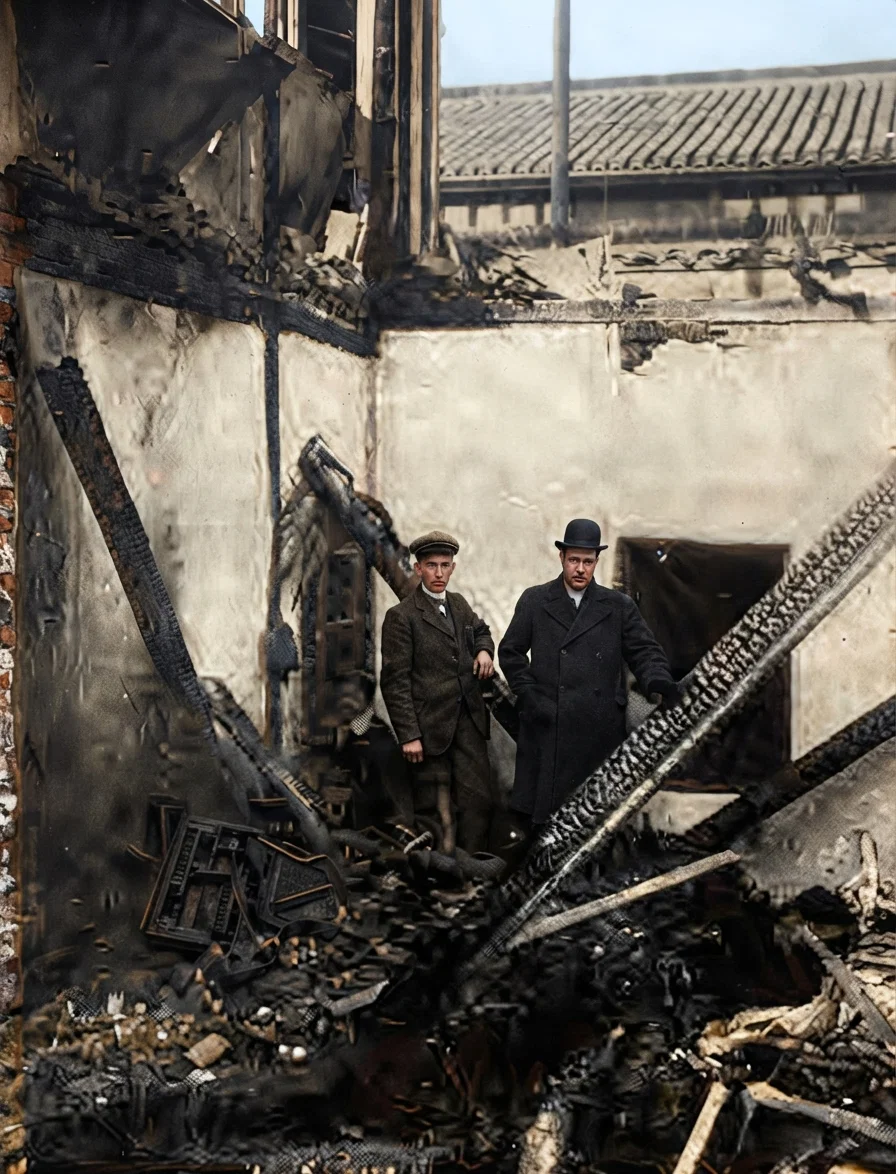
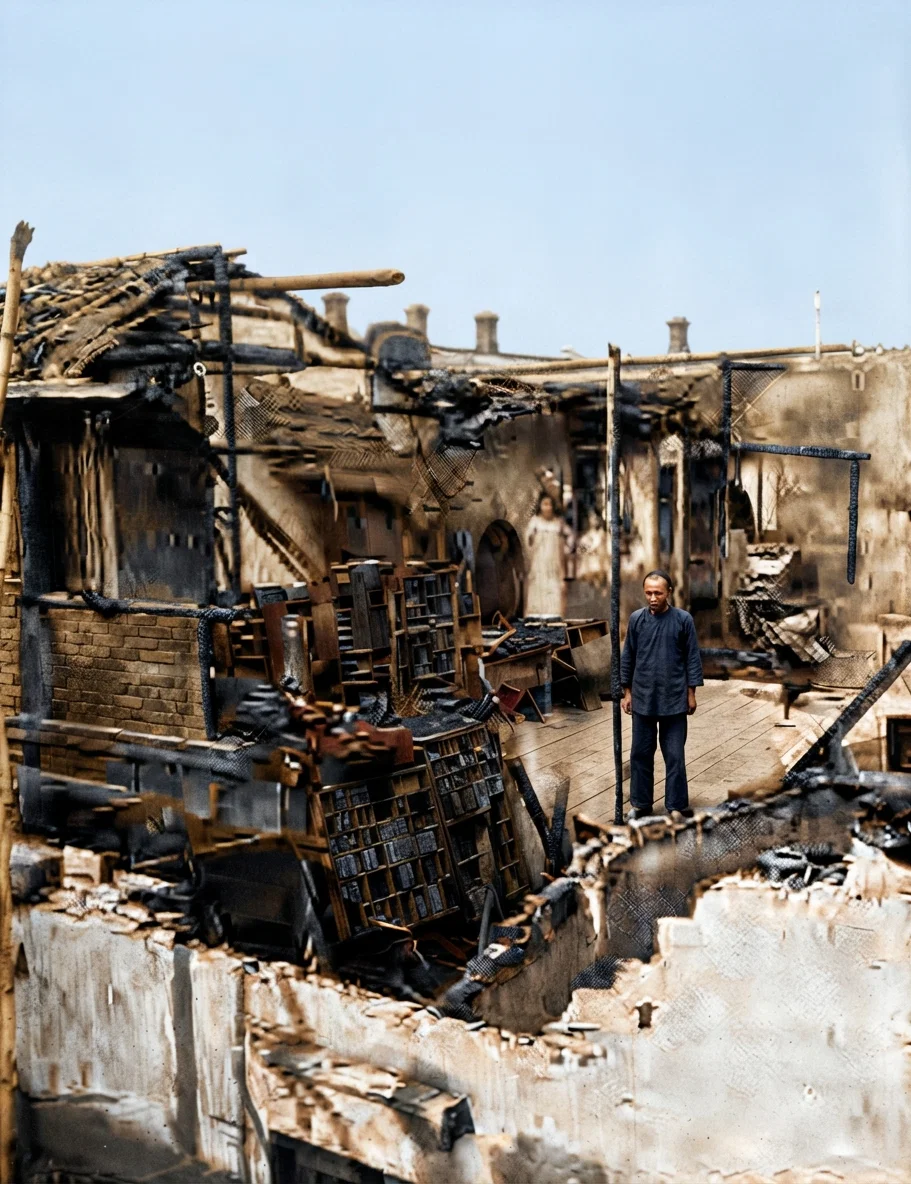
As intimated in our last, the office of our Chinese press in Shanghai was recently destroyed by fire. Fuller particulars have come to hand. The typeroom and pressroom of our printing plant are not located in our own building, but in rented buildings, buildings belonging to the Commercial Press. Neither did the fire start on our own premises, but on adjoining premises. The Chinese buildings are generally very inflammable, and the means for putting out fire was quite inadequate. This has given our workers much anxiety in the past; and therefore tho insurance was high, it was carried on the machinery and stock, yet every precaution possible being exercised to prevent a fire.
The fire occurred the 27th of December, and it looked for a time as if the whole great establishment of the Commercial Press would go. Fortunately the night was very still, and the little water that could be gotten through the nearest hydrants succeeded after a time in checking the flames. The Chinese type was a total loss; it melted. The English type was saved. A large stock of paper was also saved. The presses were somewhat injured, but it is thought that they can be easily restored.
Pressroom. Typeroom was above. F. E. Stafford and B. A. Roberts, "perplexed, but not in despair."
Dr. Miller writes us that at the present time he does not feel justified in buying new fonts of type and placing it in such dangerous buildings; and surely we sympathize with him in this respect. A building ought to be erected separate from others, airy, sanitary, clean, and practically fire-proof. Land is already secured for the erection of such a building, and what is needed is means. The financial loss to the printing plant is not considerable, but the hindering of the work is very great. Already the Chinese monthly Signs of the Times had reached a circulation of over 15,000. One of the presses was kept busy all the time in printing the covers for this edition. Colporteurs in the field were waiting to sell it when the fire came.
We wish here to thank Brother Stafford for sending us the pictures of the fire. He also writes that the work there is onward, and that those who have left this office for China—Brother and Sister Roberts—have hands and hearts full in working for those in need.
General view; composing-room with English type-cases left standing
The accompanying photographs will give something of an idea of what the fire did. Dr. Miller writes very encouragingly concerning the help that was arriving. Elder J. N. Anderson, for instance, had returned, and with him Mr. and Mrs. G. Herald, and Mr. and Mrs. O. J. Fisher. He soon expects Dr. and Mrs. Kay, and also Elder Westworth and wife. The aim is to as soon as possible place two in every province in China. The work which has already been done in getting out literature which the Chinese can read is having its effect, and good news comes in from all parts where the literature has been circulated. Surely if there is a need anywhere in this great world it is in China, where live—some barely exist—one fourth of all the inhabitants of the world. The one great agency above all others to reach them is literature, the printed page, telling the story of the cross and the power of Christ to save. Any of our readers who may wish to give to the Chinese press fund may forward it to us, and we shall be glad to see that it is used for its designed purpose. May God bless our workers in China.