My father thought a college or even an academic education unnecessary; so after my younger sister and I had finished the work of the country school, he gave each of us one hundred and seventy-five dollars with which to complete our education, saying if we desired to take up further work in school we could do so, provided we earned our own money.
We had a large huckleberry marsh on our place, and father agreed to give us what berries we picked, with the understanding that we were to use the money derived from their sale for our clothes and schooling.
It was July, and the berries were ripening fast. My sister and I decided to begin picking on the morrow. As the days were very warm, it was necessary to get an early start; so before going to bed that night we made sure that the boxes, baskets, and pails necessary to hold our berries were cleaned and in the buggy ready for use, and also that hay and grain for the horse, our rubber boots, and huckleberry attire were in the buggy.
The next morning our work was soon done, and sister hitched up our old horse which sometimes balked, while I put up our lunch. By this time my older sister, who lived but a short distance away, had come, to accompany my mother, sister, and me to the swamp. We had gone but a short distance when we saw a big rattlesnake, which so frightened one of my sisters that she returned home.
Upon reaching the swamp we unhitched the horse, donned our working clothes, and then joined my brother and his wife who were already picking berries. We had been at work but a short time when I heard a familiar voice call me, which I instantly recognized to be that of my other sister-in-law, who also lived near by and had come to pick berries. In our eagerness to get all we could, we were soon separated, and before I was aware that it was noon I heard some one call, “Let’s have dinner.”
After enjoying a good meal, a refreshing drink, and a few minutes’ rest in the shade, we were again ready for work. Just as I was entering the swamp I saw a streaked snake, but my faithful dog snapped it into pieces before the snake had time to suspect danger. This time I took one of the paths which led out into the middle of the swamp, where the berries were plentiful. I found a large patch with berries nearly as large as cherries, and was soon so busy picking them that I did not notice it was growing dark; but rumblings of thunder sent me out where it was more open, and I saw that in the west the clouds were thickening fast, and that the sky was streaked with lightning. The thunder was becoming heavier every minute. There I was in the middle of the swamp, fallen trees on every side of me, and I did not know where the path was. With my two baskets of berries I started for the edge, climbing over fallen trees, and pushing my way through the brush the best I could. Before I had gone very far I stumbled over an old log, and left part of my berries on the ground. Just then I heard a voice calling, “Ethel, hurry up, or you will get wet.”
By the time I reached the edge of the swamp my mother and sister were both out. After hitching up the horse, storing our berries in the buggy, which was no easy task, as each of us had over two bushels, we took possession for ourselves of the space left, but our horse refused to go. After feeding her corn, petting her, and telling her what a good horse she was, we finally succeeded in persuading her to move on. Then she made up for lost time. Just as we were within a few feet of the barn the rain began to pour, but no serious harm was done, as our berries were well covered.
Some days we picked as many as four bushels apiece. When the season was over, I found that my six weeks’ work had brought me one hundred and fifty dollars. By such effort each year I earned money enough for three years’ school work at one of our academies. ETHEL DEAN.
Wayfarers
By Eugene Rowell
DEAR LORD, I would not ask to see
The way by which thou leadest me.
Could I discern the depths below,
Maybe I would not dare to go
Its steep and narrow course along,
Above the awful gulfs of wrong.
Nor would I ask of thee that thou
Shouldst show me all the journey now.
Its far-stretched course, its dreary length,
Might overcome my faltering strength;
And seen today, its farthest height
Might seem too distant to my sight.
But grant me, Lord, this one heart-prayer:
My daily journey with me share;
By rugged hill or quiet vale,
When burdens press or waters fail,
Be my close comrade of the way,
Defense by night and strength by day.
—Eugene Rowell.
Lost His Job
A YOUNG man through no fault of his own apparent to him lost his job. At first he was indignant and rebellious. He had done his best; he had been faithful; he had seemed to be meeting all the requirements of his position. Still he was dropped. It was monstrous. He was in the state of mind that makes one an anarchist.
Then, either because he lacked the recklessness of consequences required of an anarchist in fact or had too much sense to attempt warfare upon society, he began to reflect. From that moment dated his salvation. It dawned upon him that he had lost his job not because of anything he had done, but because of the many things he had not done. In an age of keen and quickening competition he had been satisfied with old methods. While others were pondering, figuring, studying new processes and gaining mastery of new and better ways, he had been drifting along. Faithful he had been, but unprogressive, unalert, and therefore costly. When a new man appeared with ideas that should have occurred to him, loss of his position became the penalty of his indifference.
Because realization of his shortcomings had made a new man of him, he quickly secured a new job. Without a day's delay he began to study its possibilities, study the business he was engaged in, study a course dealing with problems to be solved at once and in months to come. Within a year he was a foreman; in two years he was superintendent; in less than five years he was general manager and regarded as indispensable by his employers. What had brought the change?— Time improved. Spare time improved. His time improved.—Ambition.
Faith That Right Makes Might
LET us have faith that right makes might, and in that faith let us to the end dare to do our duty as we understand it.—Abraham Lincoln.
Righteousness Keepeth Him That Is Upright
“RIGHTEOUSNESS keepeth him that is upright in the way.”
Interesting Things About Great Musicians
By Margaret Weir
MARGARET WEIR
The lover of music finds many interesting incidents in the lives of famous musicians which tell of the hardships endured in childhood in their struggle for a musical knowledge, and the criticism, rebuff, and opposition received during manhood. It was an intense desire to rise higher in a knowledge of their beloved art that enabled these masters to endure poverty and hunger.
Of Bach we learn that when he was but ten years old his passion to study the masters was so great that he obtained, against his brother’s wishes, a book of manuscript from their library, and one moonlight night, long after the others had retired, began the task of copying out the pieces contained in the book. It was not until the moon had shifted her position, so that the little fellow could no longer work, that he returned the book to its proper place.
For six months, whenever the moon shone brightly, Sebastian continued his task. But, alas! he had become so accustomed to his nightly vigils that fear of discovery had ceased to haunt him, and one time he failed to remove the traces of his work. His brother, thinking he heard sounds in Sebastian’s room, came to seek the cause. His glance fell upon the open books, and angrily seizing both manuscript and copy, he hid them where the boy could not possibly find them.
But there was one thing of which Bach could not be robbed, and that was “the memory of the beautiful music he had copied with such infinite pains.” This same spirit of industry is seen throughout his entire life; in fact, he could not be idle, and it seemed the one idea of his whole life was to be of the greatest use to his fellow men.
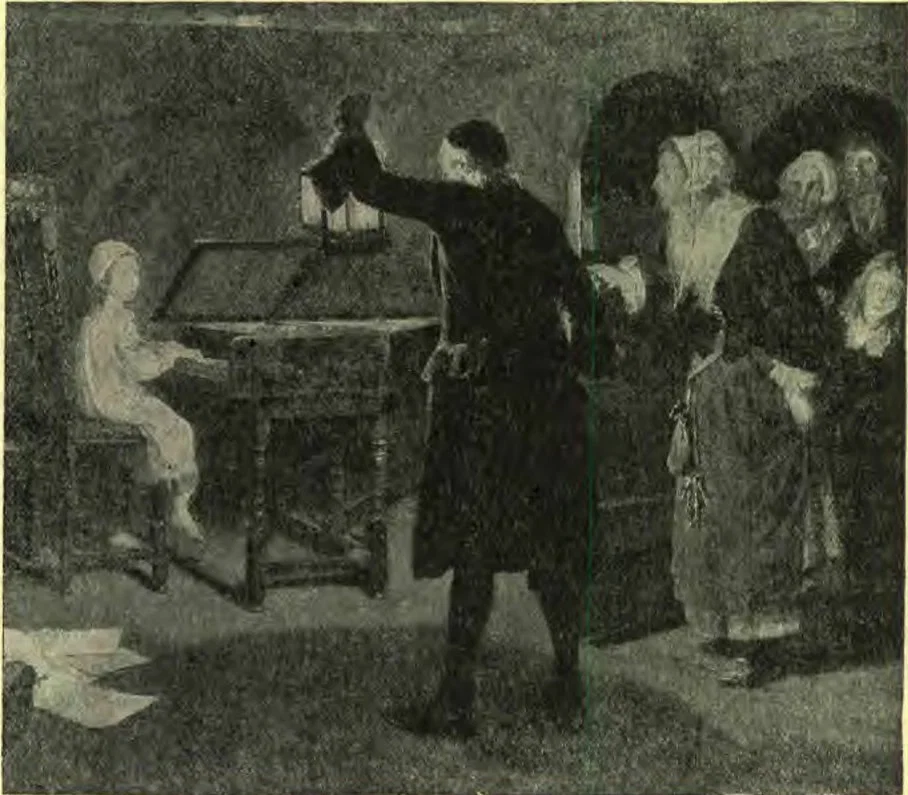
Handel also in his childhood met with serious objection on the part of his father, who regarded the art with contempt. It was Handel’s greatest delight when five years old to steal away to his garret, where had been concealed a dumb spinet, “a small harpsichord having its sound deadened by strips of cloth tied around the strings.” For some time he secretly continued to practice, but one night he was suddenly missed. The servants and parents started in search. “Great was the father’s surprise, on reaching the topmost landing, to hear faint musical sounds proceeding from behind the closed door. Noiselessly retracing his steps, he summoned the rest of the household, and then, ascending the stairs in a body, they paused outside to listen. Sure enough, the old garret was full of melodic sounds! The master softly lifted the latch, and, having peeped into the room, beckoned silently to the rest to follow him. It might have been one of the angel choir itself whom these good people of the underworld had stumbled upon unawares! for there, seated before the spinet, was the white-robed figure of the child.” The discovery did not seem to embitter the father, for Handel continued his practice.
When Handel was seven years old, his father planned a visit to the Duke of Saxe-Weissenfels to see his son, a valet to the duke. George was most anxious to be allowed to accompany his father, as he had heard of the musical delights of the duke’s home, but his father refused his consent. Seeking the seclusion of his garret, George muttered, “I will go, even if I have to run every inch of the way.” He did not know that it was forty miles to the duke’s castle, and that the roads were muddy, so when his father started in a closed carriage, the boy did his best to keep pace with it. At last his strength failed, and he called to the coachman to stop. “At the sound of the boy’s voice his father thrust his head out of the window, and was about to give vent to his anger at George’s disobedience; but a glance at the poor little bedraggled figure in the road, with its pleading face, melted the surgeon’s heart. They were too great a distance from home to turn back, and so Handel was lifted into the carriage and carried to Weissenfels, where he arrived tired and footsore, but supremely happy at having won his point.”
“There, seated before the spinet, was the white-robed figure of the child.”
Handel was rewarded for his perseverance, for the organist of the household was impressed with the boy’s genius, and he decided to “surprise the duke by letting Handel play His Highness out of chapel” the following Sunday. The duke arose when the music began, but he was instantly attracted by the melody pouring forth from the organ, and instead of walking out of the chapel he remained standing. He at once sent for the boy and inquired who he was. When the duke was told that the “boy’s father had refused to let him follow his musical studies,” he cried, “What! is it possible that he can contemplate anything so foolish and unjust as to stifle the genius of his own son?” Then he sent for the surgeon and10pointed out to him very strongly that he was doing his son a great wrong in opposing him in his studies. The father then reluctantly consented to Handel’s pursuing his work. And to the duke much credit is due for the wonderful anthems and oratorios of the great musician, including the “Messiah,” which is said to have been completed in twenty-four days.
An amusing but disastrous incident is told of Haydn, another famous musical master, when he was a youth attending a singing school. In those days it was the fashion for boys to wear pigtails, and one day Haydn’s attention had been distracted by the movements of a pigtail belonging to the boy who sat in front of him. He had secured a pair of scissors, and “the itching to cut something was too strong to be resisted, and the next moment, ere the owner of the scissors could realize the crime he was committing, the once active pigtail lay as dead as any doornail upon the floor.” For this offense Joseph was to receive a caning on the hand, before the whole school, but rather than submit to the disgrace he decided to leave school; however, he was compelled to take the caning, and then received his dismissal. For days and months that followed, Haydn battled with poverty; but later, fortune smiled on him, and music lovers the world over are grateful to him for what he accomplished for the symphony, quartet, and the sonata.
One must be impressed with the merry side of Mozart’s nature. Even during times of adversity he retained the sunshine of his boyish days. One winter evening a friend called at his home and found him and his wife dancing around the room. Upon the friend’s remarking how light-hearted they were, Mozart pointed to the empty stove and said they were dancing to keep warm, “as they had no money to purchase fuel.” Horror-stricken, the caller darted from the house, and returned in a few minutes with his arms laden with logs.” Many were Mozart’s financial embarrassments because he had a leaning toward extravagance in dress, and a weakness for lace and watch chains.
There is much of interest in the life of Ludwig van Beethoven. In 1781, when he was only ten years of age, he made his first attempt at breadwinning for the family. His father was of intemperate habits, and it devolved upon young Ludwig to help in the support of the family. He and his mother undertook a tour through Holland, in the hope that his playing at the houses of the rich might bring in money. They were not disappointed in this respect, but the boy did not carry away pleasant recollections of his visit. He remarked afterward that “the Dutch are very stingy, and I shall take care not to trouble them again.” His life is characterized by a rare personality; he had a temper that was apt to explode at the slightest provocation; he was rude and abrupt; “but his great genius, combined with the absolute simplicity and straightforwardness of his character, won him his way everywhere.”
Strangely enough the emotion that his wonderful expression produced in his hearers, found no response in Beethoven himself. Often when he saw how deeply he moved his audience, he would burst into laughter; while at other times it stirred him to angry resentment, and he would exclaim, “We artists don’t want tears; we want applause!”
His absent-mindedness was the subject of many a joke. “He often forgot to go home to dinner—a fact which, seeing that he was a man, deserves to be recorded; and it is even said that on one occasion, he insisted on tendering money for a meal which he had not ordered, under the belief that he had dined.”
It was Beethoven’s practice to keep his sketchbook by his bedside, and curious was the origin of some of the suggestions in it. One night he was awakened by the knocking of a neighbor who had accidentally been locked out of his house. The neighbor knocked four raps at a time, with a pause at the end of every fourth rap. The rhythmic regularity of the rapping suggested a musical idea to Beethoven’s mind, and arising, the composer entered the idea in his sketchbook. The next morning the jotting was included in one of his most striking compositions, the “Violin Concerto in D,” where the passage, given to the drums, is many times repeated.
With all his peculiarities, this great master was not devoid of noble qualities; his faults were of the head, not of the heart. His compositions are numerous, but his powers of playing is shown to greatest advantage in his adante movements.
To Grandma’s House
By Ennis V. Moore
It seems that spring just won’t appear,
Of all the times to me most dear;
For that’s the time I go to spend
A season with a boy’s best friend.
At grandma’s house I do my part;
I carry pails, and pull the cart.
I feed the pigs, who then lie down
In big mudholes an’ waller ’round.
To grandma’s house I’d rather go;
’Tis there I play with cousin Joe.
We fly our kites, and chase bullfrogs,
And find mushrooms around old logs.
We drive old Shep all ’round the farm,
We never did a bit o’ harm.
We ride gray Kate to gather sap,—
This is sport for a little chap.
To play in grandpa’s stable loft,
And hear the mice sneak ’round so soft,
To hear rain patter, and eaves run,
Appeals to me as best o’ fun.
The best o’ times we have together,
We never mind the rainy weather;
’Tis then we seek the haymow high,
And play, and laugh until we cry.
What shall I do when grandma’s gone?
Spring then for me shall never dawn.
Her smiling face I’ll never greet,
Till on the heavenly shore we meet.
Dear boys, to grandmamma be kind,
A truer friend you’ll never find.
No place to spend your summers fair,
For there will be one vacant chair.
— Ennis V. Moore.
Calling for the Bible
“THERE is a phenomenal demand just now for the Scriptures from all the races and tongues of this polyglot country [Persia]. The two colporteurs of the British and Foreign Bible Society go out, expecting to stay several weeks, taking all the books they think they can dispose of in that time, and return in a few days all sold out and asking for more. The Armenian pastor, who does not know Turkish well enough to use it fluently, conducts the Armenian services, and is very useful, while the Rev. Abram Moorhatch, who is a fine preacher in Turkish, but does not know Armenian, has charge of the services in Turkish and Syriac, and is also active in Moslem evangelization. We have a good attendance of Moslems at the Turkish service, and some who come talk about Christianity.”
Watch Locates Neighboring Farmers
By W. F. French
BOX 41, R. F. D. 1, Bloomfield, Colorado (all the address he had), was what Farmer J. B. Plato wrote to Eastern buyers when they advised that they intended visiting his farm to purchase certain registered live stock. He tells of this experience in this way:
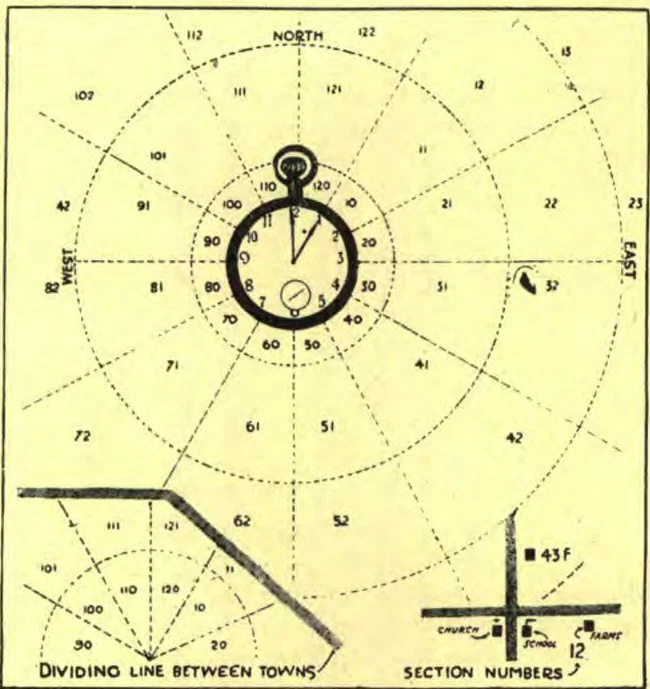
DIAGRAM OF MR. PLATO'S INVENTION
“The week passed and no buyers appeared. Then I got a letter—delivered as promptly as you like. It was from the men I had expected. They had made the trip to Bloomfield, and asked everybody about the town where my farm was located, and found that, except to the postmaster, I was a total stranger. This individual volunteered the information that ‘Plato gets his mail through this office, all right. Don’t know where his place is. It’s out on Bill’s route somewhere. Bill’s gone for the day though, and you’ll have to wait till morning to see him.’”
“My buyers, however, weren’t the kind to wait till morning. They took the afternoon train back to Denver and went on their merry way. They put a polite paragraph on the end of their letter, saying that they regretted being unable to make a deal with me, but that ‘it takes time to find your place,’ and they were not able to wait.
“That killed a profitable bargain for me.”
“Naturally, this experience set me thinking about rural addresses—if you can call them that. Always having lived in the city I could not realize how any farmer, back-to-the-lander, or country estate owner could submit to having his place lost under an R. F. D. alias, that only he and the mail carrier could decipher. So far as actual location was concerned my address would just as well fit on to the box of any farm within the radius of about fifteen miles. It irritated me, and set me devising new methods of numbering farms. I didn’t know anything about mapping, but I did know that if the problem was to be solved through mapping, as it is done by the experts, the big map houses would have had the answer long ago. So I realized that it could be mastered only by the introduction of an entirely new element of location, one that would be applicable without the use of a map or chart of any kind and that would, at the same time, be universal. What could furnish universal location?—The compass. Surely, but even that was too technical for the average farmer to work from. Besides, I wanted a key that would be instantly available to every one. ‘Takes time to find your house.’ That kept running through my mind. And, of course, every time that phrase came to mind there appeared a mental picture of a watch or clock—and that was my solution. I realized it one day, when my own watch had stopped. As I stood scowling into its face it smiled back my answer—the solution of my problem. It was a key that every one carried, it was familiar to the smallest child.
“Turn the figure twelve to the north—there you have the universal key. Twelve then points straight north, three straight east, six straight south, and nine straight west. The other figures give the intermediate points. For instance, one is northeast by north, five is southeast by south, ten is northwest by west, eleven northwest by north, etc. Instantly I had my basic key—the rest was easy.
“I had the directions—next thing was to get the distances. That was simple enough. If a man lived a mile out, I would give him number one for distance. I would combine the figures for direction and distance to get the man’s house number, or location number. The direction would come first, the distance next. Thus if a man lived four miles west of his post office, his number would be 94 (nine for west and four for distance). If he lived two miles south, his number would be 62. When I struck upon this combination, I knew I need look no farther—that I had made it possible for the American farmer to shake his R. F. D. lottery hoodoo. So I set about without hesitation to perfect and patent my discovery.”
Mr. Plato accomplished his work and now holds a basic patent on the “Clock System” of rural address, which, with the addition of the lettering scheme that he later devised, will enable a man to determine, from its rural number, the exact location, within a few hundred feet, of a house situated in another State, or country for that matter. The letter affixed in the numbering scheme divides a mile into various parts. A to L are used for houses in the first half mile and M to Z for houses in the last half-mile. Thus 32A would mean that the house was just two miles east, 32K would mean it was about two and a half miles east, 32T would mean it was about three quarters of a mile beyond the two-mile mark, and 32Z would mean it was at the very limit of the two-mile division, or practically 33—three miles east from the courthouse of the town.
When Mr. Plato brought his invention before the government, a post-office official told him that he had exactly what the Department had been looking for for years, and that they would be glad to incorporate it in their system.
Of course, however, the chief advantage derived from this invention will not be to Uncle Sam, but to the rural residents who are given the numbers. It individualizes their farms, summer homes, mines, or whatever they may have in the country. For instance, when a farmer wants to sell some stock, he12need only put his rural address number at the bottom of his advertisement. The prospective purchaser knows, from the description contained in that number, within a hundred yards of where the farmer’s house stands, and knows it without pulling down a map, too.—W. F. French, in Illustrated World.
Machine Control for Subway Trains
THE new municipal subway in New York can handle twenty per cent more traffic than any other tube in the world, and handle that terrific amount of travel more safely than any railroad system, because the automatic train-control system has eliminated the human element. There are now on the market eight or ten different inventions which guarantee that, no matter what may happen to the engineer of a train, no wreck can occur except on a faulty roadbed.
In other words, with the device now in use a train cannot be hit by the train following. The engineer cannot make the trains collide. A little instrument concealed in the cab will slow the train down and stop it before it can strike any track obstruction. The human factor is done away with.
Statistics show that seventy per cent of wrecks on American roads could have been prevented by an automatic train-control device. These accidents were caused by illness of the engineer, neglect of orders, excessive speed under bad conditions, or similar human faults.
The instrument in the subway cab records every act of the motorman. When he passes a block signal, he must acknowledge it by pressing a button. If he does not, a shrill whistle blows until his eardrums threaten to split. Meanwhile a little paper tape records his neglect.
The control system is operated by a current running through the rails, which is picked up by a special shoe for that purpose only. This shoe also serves to notify the dispatcher's office of the whereabouts of all trains. The dispatcher cannot send two trains into the same block, because purely mechanical interlocking levers prevent him from signaling to permit it. The blocks are made very short, however, and for this reason trains may follow each other very closely and a greater load may be placed on the road than under the old method of block signaling. In addition, a revolving ruled sheet of paper traces the run of each train, so that the dispatcher's efficiency may be accurately determined as well as the accuracy of the work of the motormen.—Every Week.
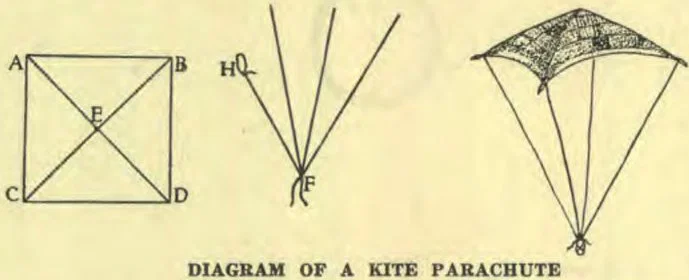
DIAGRAM OF A KITE PARACHUTE
A Kite Parachute
ANY boy who can make and fly a kite, can send up all the parachutes he has the patience to make.
In order to soar steady and far, the parachute must be well balanced and made to exact proportions. Take a piece of newspaper about two feet square, fold and crease it one way diagonally, then unfold it and crease in the other way, as in Fig. 1. Next take two white twine strings of equal length, each about six inches longer than twice the diagonal A D in Fig. 1, and tie them together at their middle with another piece of twine about eight inches long, as in Fig. 2 at F. At each of the four ends tie a slipknot, as at H, and make sure that the ends of the string left over are the same on each knot. Pinch the corners of the paper and pull a knot tight over each corner, as in Fig. 3. Tie a small weight—such as a nail or a stone—to the single string just below F, then spread the parachute out in your hands and let it fall. If the weight is too heavy, the parachute will drop too fast; if too light, the paper will tip over and not stay open. The weight should be just heavy enough to keep the parachute steady. Bend a pin and stick it through the middle of a half-inch square of cardboard. Then stick the pin through the center of the parachute, E, Fig. 1, with the cardboard on the underside of the paper and the hook of the pin above.
Now you are ready to fly your kite. To have sufficient lifting power it should be at least thirty inches tall. Be sure that there are no knots in the string to keep the parachute from climbing. Choose a day with a moderate breeze, and get your kite up as high as you can. Have some one else take the folded parachute, put his arm over the kite string, and slowly bear it down for about fifty feet. Then let him hook the pin over the string, and, still keeping his arm over the string, walk carefully back to you. At that height the wind will soon catch the parachute and carry it up the string.
When it nears the kite, with the end of the string in your hand run very fast about thirty feet toward the kite, which, in consequence, will drop a little. The parachute will spread and lift itself off the string. Do not jerk the string, or the parachute may swing and tangle. Be sure that the pin is not bent too much; if it is, the parachute cannot get away, and will slide into the kite and wreck it. A few trials will show how to set it free.—Youth’s Companion.
A Condor’s Quill
FEW women who wear the quill of a condor in their hats are aware that they are helping to exterminate a magnificent and useful bird. When Mr. Frank M. Chapman was in South America, he met a man who had hunted condors for years in the Argentine Andes. Some he shot, some he trapped in nets, others he bought. According to his estimate, he had killed sixteen thousand birds. As a result of such unremitting pursuit, the condor is now comparatively rare in an area more than two thousand miles long, and further killing may exterminate it in western Argentina. Only the feathers of the wings and of the tail, says Mr. Chapman in Bird Lore, have a commercial value. A condor usually has eighty-four of them. Before the war the marketable feathers of a condor sold in Paris for twenty dollars. Now the hunters can get only half that amount; and since our Federal law prohibits the importation of condors’ feathers, as well as those of other wild birds, the market is virtually closed. It is to be hoped that other nations will follow the example of the United States in forbidding the traffic.—Selected.
Education as the Support of Democracy
By Lotus D. Cauffman
THE chief support of an autocracy is a standing army. The chief support of a democracy is an educated people.—Lotus D. Cauffman.
For the Finding-Out Club
By F. E. Cary
Answers to Questions in “Instructor” of April 3
PART I
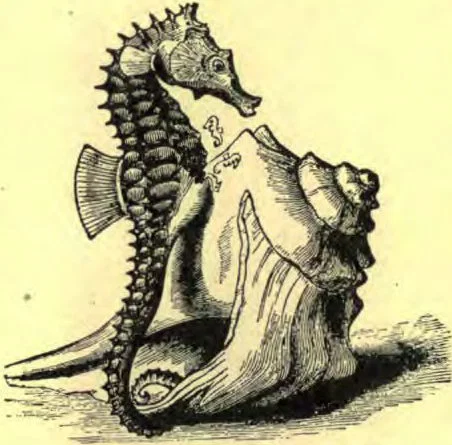
THE SEA HORSE AND ITS YOUNG
1. Sea horses are small marine fishes, a cousin to the pipefish. The configuration of the fore part of the body, as well as the peculiar manner in which the head is joined to the necklike part of the trunk, bears a striking resemblance to a horse’s head. The body is compressed and more or less elevated, and the head terminates in a long tubiform snout, at the end of which is a small mouth. The tail is long and curved like a monkey’s, and, like the rest of the body, encased in a dermal skeleton. They are poor swimmers and unable to resist currents. There are about forty known species of the sea horse, and on the coral banks of the Indo-Pacific Ocean they vary from two to twelve inches in length. The common species of the American Atlantic coast is usually about three inches long. Around Australia is a species which is decorated with numerous spines, terminated by leaflike appendages.
A peculiarity of the sea horse as well as of the pipefish, is that the male receives the eggs from the female, and carries them in a small pouch on the breast. By simple pressure of its tail, or by rubbing against some fixed object, as a shell, it forces the fry, to the number of about a thousand, out of its brood pouch. The young at this time measure less than one-half inch.
2. Talcum powder is made of talc, a mineral which in its compact forms is known as steatite, or soapstone. Steatite is usually a white, gray, greenish, or brown substance, occurring in veins or nodular masses, or in lenticular bedded deposits. When first raised, the stone is soft, but hardens on exposure. The ease with which steatite may be worked, coupled with its power of resisting heat, has led to its employment for vessels for household use. When ground, it is used as a filler for paper, for leather dressing, for covering steam pipes, as an ingredient in soap, for toilet powder, for certain paints, and as a lubricant. Four million dollars’ worth of talcum powder was used last year.
3. The break with Germany, February 3, occurred because of the question of neutral maritime rights. After the sinking of the “Sussex” the United States government announced that it would break off diplomatic relations with Germany unless she abandoned her methods of submarine warfare. But Germany declared her purpose, January 31, to resume these methods, and the United States had “no choice but to follow the course laid down in its note of April 18, 1916,” when the German note was delivered to the Secretary of State announcing a campaign of ruthless submarine warfare against neutral as well as belligerent ships.
4. The German ambassador, Count Johann von Bernstorff, was given his passports by our government, and the American ambassador, James Watson Gerard, was recalled from Germany, when diplomatic relations were broken between the two countries.
5. Dr. Paul Ritter, Swiss minister, now has charge of Germany’s interests at Washington. The Spanish ambassador at Berlin takes over American interests.
6. The stickleback is an interesting member of the finny tribe which constructs a nest for its prospective mate, and then mounts guard over it until the mate comes along. “The home is built from seaweed, twigs, and aquatic plants which are ingeniously woven together. There are two entrances to the home, which are never left unguarded by the master of the house until the lady of his choice signifies her willingness to enter.” Sticklebacks are short-lived animals, and are said to reach an age of only three or four years. There are no scales developed on any part of the body.
7. The water of the Caspian Sea is salt because it has no outlet. Owing to the large volume of fresh water flowing into the sea it is not, as a whole, so salt as the main ocean, and still less so than the Mediterranean Sea. It is claimed that there is sufficient evidence to prove that the Caspian Sea was once joined to the Black Sea.
8. The United States ambassador to Mexico is Henry P. Fletcher, and the ambassador from Mexico to the United States is Ignacio Binollas.