IN “Forty Years Among the Zulus,” the Rev. Josiah Tyler, a missionary of the American Board in South Africa, tells the following story of a hen which greatly disturbed the peace of a native in church.
One Sunday morning a man walked into church carrying a beaver hat of which he was very proud, the gift of some European, and his only article of civilized dress. He seated himself, the hat by his side, and listened attentively to the introductory exercises. Then a hen took occasion to walk in, fly up, and lay an egg on one of the boards overhead. The egg rolled over to one side, and then fell directly into the beloved hat.
The Zulus have a great repugnance to eggs. They will not touch one if they can possibly help it. The man’s disgust was indescribable as he arose, took up his hat, and holding it at arm’s length, walked out of the chapel. It completely upset the gravity of the audience, and he did not return to service that day.— The Missionary Review of the World.
Adversity and the Making of Lincoln's Character
“IF Lincoln had been born in a Fifth Avenue mansion and had gone through college, he might never have been heard of. It was his dissatisfaction with adverse conditions that urged him on in heroic struggle, and developed the giant within him.”
Goethe on Moving Forward
He who moves not forward goes backward.— Goethe.
Reasons for Trusting God
By M. E.
(Texts for May 20-26)
THESE are times that test religion and try the hearts of men. Everywhere hearts are sick and sad; for each night groans with uncertainties and each day trembles with fears of coming events. There is great distress and confusion among nations because of the open foes without and the hidden foes within; there are perplexities on every hand because of the shortage of food products and the consequent high cost of living; and in addition to these we all have our own peculiar trials, and usually they seem harder to bear than our neighbors.’ Surely, if God could ever countenance worry, it would be in such distressing times as these. But he does not.
The Christian’s heart may ache with sadness; but it must not give room to worry. If you and I cannot prove in our Christian experience that the religion of Jesus Christ saves us from worry, how can we tell the fearful ones about us not to worry? How can we pass on to troubled hearts the Master’s “Peace, be still”?
The Morning Watch texts this week are good “worry breakers,” if we will employ them to break up our own worries and not try them on our neighbors’. In these texts, the psalmist declares what voices in all ages and in all walks of life have confirmed. He declares that the Lord has never forsaken them that seek him. He will protect those who trust him, from “the pride of man” and from “the strife of tongues.” Think what that means! He will build a fence of mercy around them, “keep them alive in famine,” be their “help” and “shield” at all times, and strengthen their hearts for all that they may have to meet. All these promises, and still others, come to us this week. And if we will prove these promises in our lives, we shall receive power to live above worry and to lift others out of despair.
Surely, with your hand in his, you may go anywhere without worry. He is wise enough to deal with all your perplexities—from the little ones that annoy to the large ones that crush. He loves you enough to shield you from all harm and to work out all things for your highest good. The loving Father who clothes the bear for the arctic frosts, and equips the bird for soaring in the air, will prepare you for what you must meet, for he knows just what is coming.
God does not permit hard and unpleasant things to come to us in order to worry us; they are the material we need for building strong, kind, heroic characters. Life is a school in which you and I are to develop heroism. It requires no heroism to be calm and patient when nothing tries us; to be courageous and trustful when no dangers are seen; or to be cheerful and optimistic when nothing tends to depress us. Each of us must learn to trust God and deal heroically with our own peculiar trials. There lies the victory. And he who learns to live day by day the don’t-worry life—the serene, patient, trustful, cheerful life—is greater than he that taketh a city.
MEDITATION.—Only to the extent that I learn to trust God can he trust me with power to bless others. I do not want to fail to be what he wants me to be. If I meditate much on his goodness, on his power as manifested in nature, and on his dealings with myself and others, I shall become better acquainted with him; and to know him is to trust him.
SPECIAL PRAYER.—Father, I thank thee for thy wonderful goodness to us all. Help me to learn to leave all with thee, to obey thee, and to trust thee “just for today.”
M. E.
Missionary Volunteer Society Programs for Week Ending May 26
THE programs for this date, with notes, illustrations, and other helpful material, will be found in the Church Officers’ Gazette for May.
May 26: Nehemiah 8; 13. Ezra reads the law to Israel; reforms.
A Leader Who Inspired Others with Courage
Only a few weeks ago the newspapers gave stirring accounts of how the exiles in Siberia heard with great rejoicing that the rule of the czar had been overthrown, and how they hastened away, even without sufficient preparation for a journey, in order to go back home. Doubtless, however, there are those who, for one cause or another, could not return. Perhaps a few have entered into business and have become so well settled that they will prefer to live in the land of their exile.
The Jews had been captives in a strange land for seventy years. They had established homes and entered various lines of work. Some were in the employ of the government. And when the time of the promised return drew near, and Cyrus made his decree, doubtless there were many who did not care to return to Canaan. There were others whose hearts were in the movement to restore and rebuild Jerusalem, but who could not go back. Undoubtedly Nehemiah belonged to this class, for although he was in the court at Shushan,—“a king’s favorite, a brilliant, wealthy15young man of affairs,”—he was intensely interested in all that pertained to the return of his people to their own land and to the rebuilding of Jerusalem. He counted these things of greater worth than pleasant work in a Persian palace.
How eagerly he inquired about everything of some who had been to Jerusalem! He wept bitterly when he learned that the walls of Jerusalem were broken down and that everything was in a bad condition. But Nehemiah was not a man to spend much time crying, but to do something about it. What was the first thing he did? Some people, when an idea pops into their heads, hurry right off to carry it out. But Nehemiah sought counsel and help from the Lord. And the Lord, who controls the hearts of all men, wonderfully caused the king to favor Nehemiah’s plan.
Do you think that was a very small journey across the plains? I suppose that one could now prepare and go half way round the world with less trouble and inconvenience than Nehemiah could make that trip to Jerusalem. How long did it take Ezra and his company to go there? Look up on a map the route Nehemiah probably took. Why couldn’t he go on a straight course from Shushan to Jerusalem?
When he arrived at Jerusalem his hardest work was before him. Things were in a deplorable condition. The people must have been discouraged, and there were enemies about who were determined that Jerusalem should not again become a fortified city. Nehemiah did not begin to tell what big things he was going to do. But he carefully studied the work before him; and doubtless he prayed much, for he was a man of prayer.
Picture to yourself that moonlight ride around the walls. In one place the ruins so blocked his way that he had to get off and lead his animal. Then notice how he inspired the people with courage to again undertake the work. Some people do not believe in reporting; but when Nehemiah reported how wonderfully the Lord had blessed and led him thus far, and then told the people what should be done, they all said, “Let us rise up and build.” And under the courageous leadership of Nehemiah, they did in fifty-two days what they had not been able to do in years.
This was one of the great achievements in the history of God’s people. How was it done?—By prayer and hard work. Nehemiah began his campaign away there in Persia, upon his knees. A great missionary once said, “Let us advance upon our knees.” That is the way Nehemiah advanced. But he worked, too. He prayed as if it all depended on the Lord, and he worked as if it all depended on him. During those anxious days of wall building and guarding neither he nor his immediate associates took off their clothes except for bathing. Nehemiah believed in both praying and watching. When great perplexity over a threatened invasion came, he says: “Nevertheless we made our prayer unto our God, and set a watch against them day and night.”
Nehemiah was interested not only in getting the walls built. That was only a means to an end. The worship of God and the righteousness of the people was the great aim. Notice how the law was read to the people and the reformation it caused. Then in the last chapter you will see how Nehemiah reproved the people for Sabbath breaking and marrying among the heathen.
The Lord needs heroes now like Nehemiah, who will do right because it is right, and inspire others with courage to do right. M. E. K.
MEMORY VERSE: “Then Agrippa said unto Paul, Almost thou persuadest me to be a Christian.” Acts 26: 28.
Questions
1. To what did Paul say he was not disobedient? Where did he begin his labor for Christ? What city did he afterward visit? Through what region did he travel? For whom did he then begin to labor, and what did he teach? Acts 26: 19, 20. Note 1.
2. For what cause did Paul say the Jews arrested him? What did they wish to do with him? Who had helped the apostle thus far to witness for Jesus? On what did he base his teaching? Verses 21, 22.
3. What do Moses and the prophets say about Christ? Verse 23.
4. As Paul was speaking, who interrupted him? What did Festus say? Verse 24. Note 2.
5. What was Paul’s reply? What did he say King Agrippa knew? What shows that the work of the gospel was widespread? Verses 25, 26.
6. Whom did Paul then address? What question did he ask the king? What was Paul’s reply to his own question? Verse 27.
7. What did Agrippa say in response to this appeal? What did Paul reply? Verses 28, 29. Note 3.
8. How did the royal persons present then show that they did not wish to listen longer? When they were alone, what did they say concerning Paul? Verses 30, 31. Note 4.
9. What did Agrippa say to Festus? Verse 32.
Notes
1. Had Paul not learned to obey his parents and his God when a youth, it would have been much more difficult for him to obey the Lord Jesus when he appeared to him near Damascus. He was told to do the very thing he did not wish to do. He believed he was doing right when persecuting the Christians. It must have been very hard for the popular, proud young Pharisee to change his life and become one of a people whom he had despised. With Paul, to know his duty was to do it.
2. A gentleman saw a man riding by, whipping his horse which was almost ready to drop with exhaustion. The gentleman rushed after him expecting to have him arrested for cruelty to animals. He found the poor horse standing near a doctor’s office. When he went inside he found its rider pale and trembling, telling the doctor that his little child was at the point of death. This changed the gentleman’s feelings in an instant. He helped the man secure another horse, and soon they were hurrying away to his home. The man who rode so madly was merely intensely in earnest. So Paul was not mad; but only earnestly seeking to save the souls of men. To him it was even more a matter of life and death whether those who heard him believed in Jesus, than it was to the father who rode so madly to save the life of his child.
3. “Deeply affected, Agrippa for the moment lost sight of his surroundings and the dignity of his position. Conscious only of the truths which he had heard, seeing only the humble prisoner standing before him as God’s ambassador, he answered involuntarily, ‘Almost thou persuadest me to be a Christian.’”—“The Acts of the Apostles,” p. 438. There will be many people who will be almost saved. But there will be some sin they think will be excused, some habit they cannot break, some idol cherished, and so they will be “almost saved, but lost.”
4. How little King Agrippa, Festus, and proud Bernice thought that eternal life or death depended on whether they accepted or rejected what Paul said in court that day! Agrippa was almost persuaded to be a Christian. Festus told the apostle he was beside himself. It is said that in the railroad yards in Paris there is a switch which, moved two inches in one direction, sends trains north to Belgium and Holland. If moved two inches in the opposite direction it sends trains south to Italy and other countries. Two inches is such a little space to bring about such opposite results. Often eternal consequences rest upon the decision boys and girls make in their Sabbath school class, when in company with others, or in the quiet of their own rooms.
Prohibition Progress
THE prohibition movement is spreading so rapidly throughout the world that one has to be alert to keep up with its forward strides.
Less than six months ago there were only nineteen dry States in this country. Today there are twenty-five, and Congress has enacted prohibition laws for Alaska, Porto Rico, and the District of Columbia. Hawaii is expecting to receive the same favor. There are fourteen other States that are recognized as near-prohibition States. Two of these, Missouri and California, would have been in the prohibition list had it not been for the vote of the two cities, St. Louis and San Francisco.
Congress, by a vote of 319 to 72, recently passed the Jones-Randall “Bone-dry” Anti-advertising law, which forbids any person depositing in the United States mails any post card, circular, newspaper, pamphlet, or publication of any kind advertising or soliciting orders for spirituous liquors; and it forbids any carrier delivering such matter. This regulation carries the penalty of a fine of not more than one thousand dollars, or imprisonment of not more than six months.
The Reed “Bone-dry” Amendment, making it a criminal offense to ship liquor into dry States, passed the Senate by a vote of 45 to 11.
The Supreme Court decision of January 8 sustained the Webb-Kenyon law, prohibiting the shipment of liquor into any dry territory.
National prohibition seems to be but a short distance away.
But not alone in America has the prohibition movement been making progress. Denmark on March 1, under a temporary order, stopped the sale of all spirits and other alcoholic liquors.
On March 8, the Berliner Tageblatt asserted that as a war measure the suspension of all beer brewing in northern Germany was imminent.
On the walls of every post office in France the government has ordered the following declaration, signed by the president, to be exhibited:
“To French Women and to Young Frenchmen:
“Drink is as much your enemy as Germany.
“Since 1870 it has cost France in men and money much more than the present war.”
Canada is dry except Yukon and Quebec, and Quebec expects to join the prohibition list in the near future.
Such phenomenal progress is being made that the temptation comes to quietly sit by, and let the movement carry itself on to victory. But it cannot do that. Even should legislation be enacted granting national prohibition, there would still be abundant opportunity and necessity for earnest service. The people must individually be educated, else the victories gained will prove of mushroom strength, and will collapse under fresh assaults from the enemy. If we would gain new ground and hold what has been gained, we must be vigilant in the educational work that alone can withstand the most vigorous assaults of the frenzied liquor traffic. Let us keep at the work of distributing educative literature, of talking, preaching, and practicing the principles of true temperance, that permanent victory may result to the prohibition cause.
Help Me the Slow of Heart to Move
“Help me the slow of heart to move
By some clear, winning word of love.”
Missionary Volunteer Leaders, Notice
By Editor
IN the Missionary Volunteer programs for week ending April 28, printed in the Church Officers' Gazette for April, four references are made to an article entitled “Two Early Pioneer Missionaries,” to appear in the INSTRUCTOR of April 17. For some inexplicable reason the article was published in the issue of May 1, instead of April 17, and under the caption “Patrick the Scot, and Columba of Ireland,” instead of the one advertised. This article is both instructive and interesting, so we hope our Missionary Volunteer Societies will make use of it, despite these errors of publication.
Shielders Regarded as Traitors
YOUTH is prone to regard it dishonorable to reveal another's wrong-doing. Whether this is so or not depends upon circumstances, and upon the spirit in which the revelation is made.
At the present time not only may “bomb plotters be gripped with an iron hand,” but any one who has knowledge of treasonable acts and fails to make known the facts to the authorities may be sent to prison for seven years, or fined $1,000, for treason. President Wilson recently issued a proclamation calling attention to the laws that make the withholding of such information a national crime.
A young woman felt that an associate had betrayed her confidence by revealing to proper authorities the insubordination and inefficiency that her own words had revealed. The question in this case was not so much of faithfulness to an associate as it was of faithfulness to the work of God, and of faithfulness to all concerned in that work. To reveal information in such a case surely is not a betrayal of friendship. Silence under such circumstances might have worked ill to others, if it did not make one an accomplice in the wrong.
We must, however, take great care to reveal against another only that which needs to be told for the good of the person, or for the good of another. Otherwise we become mere gossipers and tattlers, instead of patriots or friends to a larger cause.
Forgetting Self in Remembered Service
“It is when we forget ourselves that we do things that are remembered.”
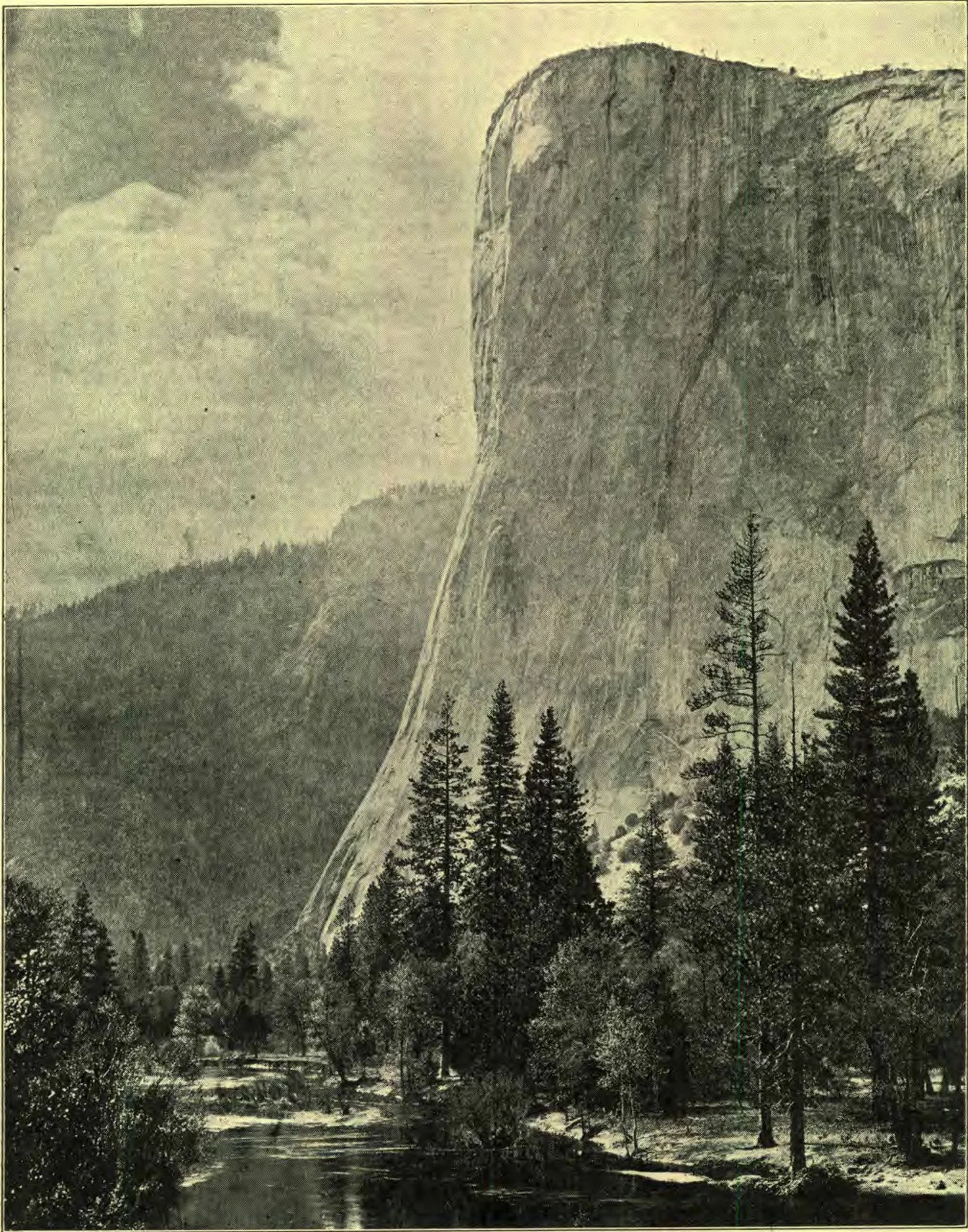
EL CAPITAN, YOSEMITE VALLEY, THIRTY-THREE HUNDRED FEET HIGH.
THE EARLY MORNING OFTEN FOUND JESUS IN SOME SECLUDED PLACE, MEDITATING, SEARCHING THE SCRIPTURES, OR IN PRAYER.