The Youth’s Instructor, Vol. 50, No. 29.

The Story of Our Matabeleland Mission

The Youth’s Instructor

Jul 17, 1902

Review and Herald Publishing Company · Battle Creek, Mich. · Jul 17, 1902

The Story of Our Matabeleland Mission

Beginning the Journey
The halo of romance which once encircled even the very idea of missionary labor among the heathen is now gradually disappearing, and in its stead the real facts—the condition of the people and their needs, their response to missionary effort, and the wonderful transformation which the gospel has made among them—are leading earnest Christians to devote themselves to this most interesting work. The dark continent of Africa has long appealed to Christian people, because of the dense ignorance and superstition that abounded, and the wretched condition of the natives, as a result of the slave trade and liquor traffic, for which the white man is responsible.
Our first mission to the heathen in this continent was practically begun on May 7, 1894, when five brethren in South Africa were finishing the preparations necessary for a journey which they were to begin the evening of that day. All was interest. For some time the Foreign Mission Board had contemplated the starting of a mission in Central Africa; and when the Chartered Company obtained control of Matabeleland, the way was opened, and the opportune time seemed to have arrived. The South African Conference kindly gave five hundred pounds to the enterprise.
At the close of the day the little company of Sabbath-keepers in Cape Town met at the church for consultation and prayer, before good-by was said. As they sang “God, Be with You Till We Meet Again,” tears dimmed the eyes, and sobs choked the voices; yet hope and courage filled the heart of every one; for all were confident that the Lord was leading those who were to go, and that he would abide with those who remained behind. Nearly all the congregation followed the party to the station; and even the trainmen were interested in the journey, and wished them success.
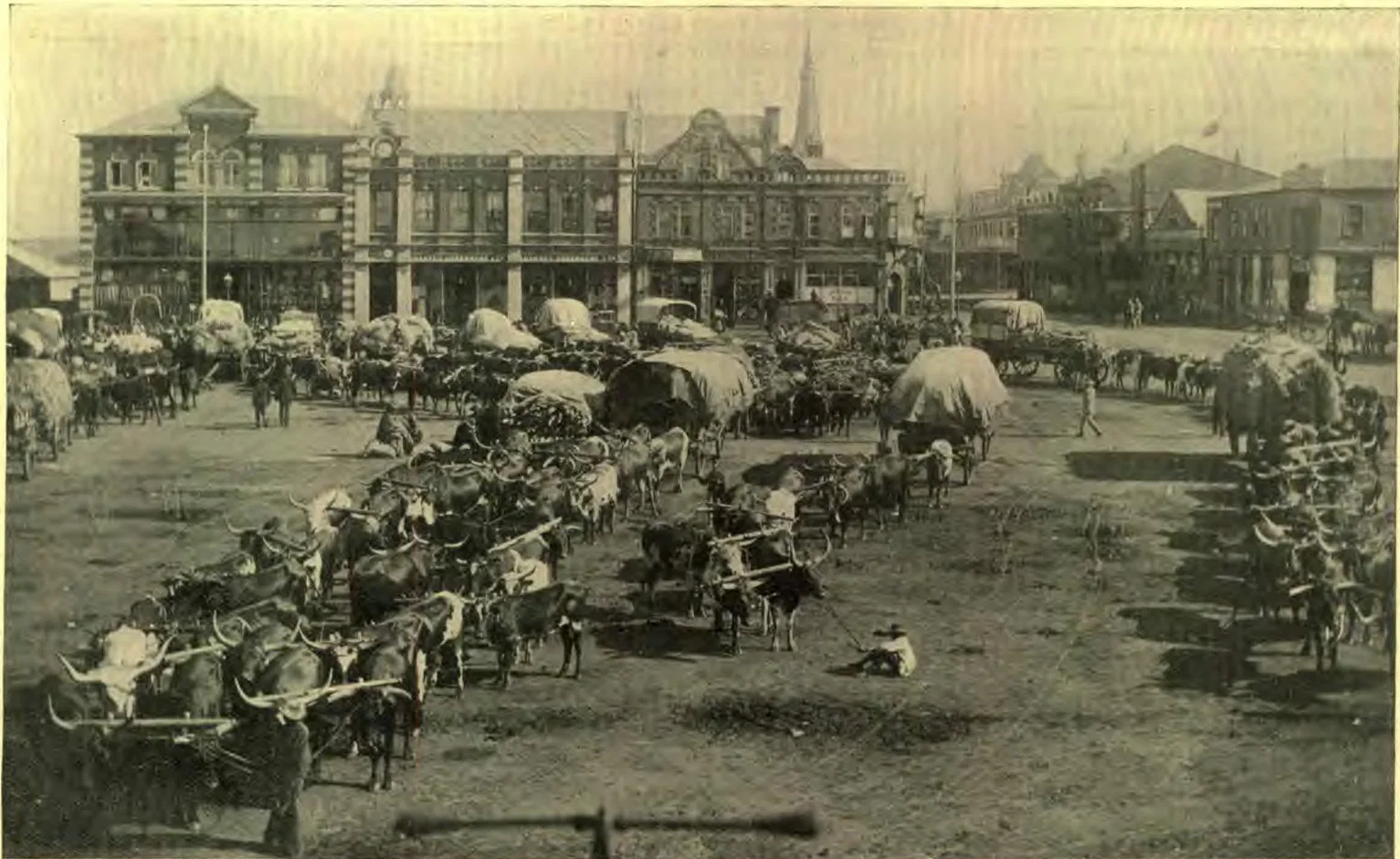
READY FOR THE “TREK”—A SCENE IN THE MARKET-PLACE, JOHANNESBURG
At 9 P. M. the station bell rang. The last good-by was spoken, and the party, consisting of A. Druillard, F. J. B. Wessels, F. Sparrow, E. J. Harvey, and L. Gopp, were on their journey.
After a ride of two nights and one day on the train, they reached Beaconsfield, about six hundred and forty miles from Cape Town. The company of the brethren and sisters from that place met them at the station, wishing them Godspeed. About four hours were spent in purchasing necessities for the journey, and in attending to other business matters, and they were again on their way.
The next stop, at 9 P. M. Wednesday, was at Vryburg, one hundred miles farther on, where they made a stop of one hour at the Vaal River diamond mines. Here they saw many searching for earthly treasures. During this part of the journey they passed through some of the richest diamond fields in the world. As the train was going no farther, they remained in the car overnight. At six o’clock the next morning the making-up of the train for Kimberley was begun, as Vryburg was the end of the road, and our brethren had to make quick work of leaving the train. Their farming implements, two wagons, supply of foods, together with the mules and ponies, attracted much attention. But as soon as the people learned that they were on their way to Mashonaland to teach the natives, they became interested, and spoke kindly, wishing them success in their mission.
They were compelled to remain here several days, until the arrival of the rest of their goods, which had been sent by freight, and were delayed by an accident to the train. After an almost hopeless search for a room in which to sleep, they were about to arrange to camp in the street, when a customs officer, learning of their mission, kindly gave them a written request to the station-master, asking him to permit them to occupy a room adjoining the station. The latter had told them again and again that there was no room which he could let them have; but on receipt of the note, he gave them a very comfortable one. This customs officer aided them in many other ways. They remained here six days, and spent a part of two days looking for bullocks. As soon as it was known that they wanted to buy, the price of these animals doubled. A Christian native, learning of their desire, told them that his chief had some bullocks to sell, and through him they were able to get just what they wanted. On Sabbath, their first from Cape Town, they held a Sabbath-school and meeting. The next day they began to gather up their freight, which had arrived Friday. They were disappointed, however, to learn that Monday was a bank holiday, and they would have to remain at that point until Tuesday, as it would be impossible to persuade the railroad men to let them have their goods on a public holiday.
Finally everything was prepared, and they were ready to proceed, when they learned that they would be compelled to secure a permit from the magistrate, before they could take their guns and ammunition with them. The written petition had to go first to the governor, and this was supposed to require two days. Seeking the help of the Lord, they decided to go to the house of the governor personally, and tell him who they were, and what they desired. In this they were successful beyond their expectations. He was very kind, took the number of their guns and the amount of cartridges. He laughed heartily when he saw the small amount of ammunition they were carrying, and advised them to take a larger supply. But as their armor, weapons, and ammunition were to be the word of God, they did not take the governor’s advice in the matter. It seemed that he had read of our work in America, and was much pleased that we were ready to enter this new country so soon. He wished the brethren Godspeed, and advised them to settle near Buluwayo. In less than twenty minutes after they had seen him, the permit was ready, so that everything could be passed through the customs, and at 4:30 P. M. on Tuesday they started from Vryburg, glad to be once more on the road.
They drove about ten miles, and outspanned at seven o’clock, letting the horses and mules and oxen feed for three hours. They then inspanned again, and traveled until eleven o’clock, when they stopped for the night. After worship, in which they committed themselves to God, believing that he had sent his angels to guard them, they were soon asleep. At two in the morning they again began their journey. Soon after starting, they drove into a mud-hole, and worked until seven o’clock before they were able to extricate themselves. At nine they stopped for breakfast and fed the teams, and then reloaded their wagons, as they found from their experience in the early morning that the wagons had been too heavily loaded. At three in the afternoon they were again on the road, and traveled until nine at night. The roads were heavy with sand, and the land was very poor; but they had plenty of water, such as it was, for it was full of insects. And thus they went on, traveling at night, and letting the teams eat and graze a part of the day.
On Thursday morning they had a little meeting with three Dutch farmers. One had read “Thoughts on Daniel and the Revelation,” and said that he believed the seventh day is the Sabbath.
That night in crossing a stream they broke the tongue of their mule wagon; but, equal to the emergency, only a few minutes was required to transform their tent-pole into a wagon-tongue.
They traveled all the next day without finding water. As it began to draw toward the Sabbath, they were all very tired and thirsty, and became anxious to find water, where they might camp and pitch their tent. Just as the last rays of the sun were going down behind the distant hills, they came in sight of a small stream trickling here and there from under the stones in the sand. This called forth a shout of joy; and in less time than it requires to write it, six mules and two horses were in the water, drinking as only famished animals can. But to the dismay of the brethren, a man soon appeared upon the scene, and ordered them away, making them pay four shillings for the water the animals had drunk. It was no use to beg him to permit them to stay near the stream, as he would have required them to pay more money than they felt they could expend in this way. So they had to start on their journey again.
ESTELLA HOUSER.

Out of Her Bondage

THERE was something about the odd, rebellious, sullen little countenance that drew Miss Caroline toward her from the first. Miss Caroline’s heart was always tender. “She’s in trouble,” the good woman thought, instantly, “and perhaps I can help her.”
The girl was sitting with a row of others in a city employment office. Miss Caroline singled out the little figure in the corner, and seemed somehow indifferent to all the rest. She could not have told herself the reason of her preference; for there was nothing attractive about the defiant, brown little face. But she was young, for one thing, and that fact alone appealed to Miss Caroline’s motherly heart.
She wore a gay flower-garden of a hat over a mass of curly locks, not any too tidy, and her shoes were low, with great gaudy buckles. Her silver bracelets—Miss Caroline noticed she wore four—tinkled defiantly as she moved about, and there were many cheap rings on her ungloved, rough little hands. There was a stormy look in the dark eyes that would have repelled any one but Miss Caroline. “She’s so young, and she needs help,” she thought, “and perhaps—who knows but God has sent me to her?”
Miss Caroline’s health had declined of late. The household tasks in which she had been wont to take such pleasure heretofore, grew too heavy.
Miss Caroline lived alone in a substantial brick house on one of the quiet streets. Within, it was a model of exquisite neatness. The curtains were spotless, the china and silver fairly shone, so beautifully were they washed and polished, while the damask tablecloths and napkins were always in a state of immaculate freshness. On the old-fashioned mahogany furniture not a speck of dust was permitted to gather. Into this haven of neatness and order she dreaded to take a helper; but Dr. Farraday, the old family physician, had said she must take a rest, and a long one.
Miss Caroline was small and slender, and no longer young. There was a little stoop in her shoulders, and her hair was quite gray. Perhaps the most pleasant thing about her was her voice. It was still singularly sweet and musical; for in her youth Miss Caroline had been a sweet singer, and she often sang now about her work.
She walked over to the little figure in the corner, and looked down upon her with her mild eyes.
“Would you like a place?” she asked, gently. There was an obstinate look in the uplifted face, a don’t-care expression that did not, however, discourage Miss Caroline. “That’s what I’m here for,” the girl answered, curtly. “I’ve about come to the conclusion, though, I’ll not do housework any more. I think I’ll go in a store.”
“I need some one to stay with me,” went on Miss Caroline in her sweet voice, ignoring the latter part of the answer. “Would you like to come and stay with me for a while? There’s only just myself, and the work’s not hard.”
The girl stared at the kind face framed in its bands of silver hair.
“I’ll come,” she said, indifferently, after a minute’s silence.
“Very well, then,” was the answer; “we’ll consider it settled.”
A few minutes later they left the office together. Miss Caroline led her charge upstairs to a neat little room. In the corner stood a white bed. There were ruffled curtains at the windows, matting was on the floor, and the modest dresser was covered with a white scarf embroidered with forget-me-nots.
“You must tell me your name,” said Miss Caroline, smilingly, turning to face the small, silent figure.
“Lorraine Wilson,” was the answer.
“Have you any mother?”
“No, she died when I was eleven years old.”
“You poor child!” was Miss Caroline’s involuntary answer. “I was forty when my own dear mother was taken from me, and it seemed to me then that I could not give her up. Now you must consider this your home, and I hope you and I shall get along nicely together.”
As Miss Caroline left the room, the girl looked after her, with a puzzled face.
“She hopes we’ll get along nicely,” she repeated, grimly. “Well, she’s different from any one I’ve seen yet. However,” the obstinate look creeping into the small face again, “I suppose she’ll be like all the others; work me till I’m ready to drop. Folks that hire girls think they haven’t any souls. I never lived with any one yet that treated me half-way decent. It was do this and do that, with never a kind look, but she—well, she’s given me a pretty room to stay in, anyway. I’ll watch her and see. I haven’t lived among folks seven years without learning a few things.”
But Miss Caroline wasn’t like the rest. Even stubborn little Lorraine had to acknowledge that.
The very first day she was there, she broke a cut-glass dish. Miss Caroline heard the crash and hurried out. She found the girl with the pieces in her hand, looking more rebellious than ever. “I suppose you’ll want me to leave now?” she burst out, her lips twitching a little.
“By no means,” was the quiet answer. “Accidents will happen, you know, and I’m sure you’ll be more careful another time. Don’t think any more about it, Lorraine. If nothing was ever broken, the china merchants would have to go out of business.”
Miss Caroline was sorry about the dish, for she prized it greatly, but it was not her way to get angry. Miss Caroline was not that kind of Christian.
The girl looked after her again. For the first time, the hard expression of her young face softened. “She isn’t like others,” she whispered, wonderingly. “It’s the first time I ever broke anything and didn’t lose my place, or get scolded, or something. I wonder what makes her so different.”
Miss Caroline had much to bear with in her new helper, as time went on. There were moods, sullen, silent periods, with which she did not know how to cope. There were angry words, too, sometimes coarse ones that gentle Miss Caroline had never heard. Often she slighted her tasks, sometimes she spoke impatiently, even impertinently, and yet, through it all, Miss Caroline would not give her up. “She never had a chance,” she would tell herself, compassionately, “and she has no mother.”
Miss Caroline noticed, too, as the girl stayed on, that she had very few clothes. She seemed to have invested her small earnings in gaudy hats, cheap jewelry, and gay ribbons.
All this distressed Miss Caroline a good deal. “Wouldn’t you like to have me make you a nice gingham dress for afternoons, Lorraine?” she suggested one day as Lorraine went about her work, clad in an old faded waist and ragged skirt.
The girl stared. “You make it?” she questioned, surprised.
Miss Caroline smiled. “Yes, why not?” she answered. “I would like to help you, my dear.”
“You’re the first person that ever offered to help me!” the little girl cried. “I’ve been in lots of places, but I never had any kindness shown me before. It was all work, with never a good word.”
“That was unfortunate,” said Miss Caroline, gently; “but you must not let it harden you, my dear. There are a great many good, kind people in the world, God’s people, who seek to serve him, and to do only his good pleasure.”
“I never saw any before,” the girl answered, rebelliously. “If I had, I’d ’a’ been a better girl. If you had been treated the way I have, I guess it would have made you bitter, too.” The silver bracelets tinkled unmusically.
Miss Caroline hesitated a little, and then began again.
“I wonder if you would please me in one thing, Lorraine?” she said. “I’m an old woman, and I have my own ideas about things. It’s about your rings and bracelets. It doesn’t look well to wear so many, my dear. I wish you wouldn’t. Will you take some of them off, if only to humor me?”
Lorraine’s small face flushed. “I’ll take them all off if you want me to,” she answered. “I’ve been thinking ever since I’ve been here how nice you always look, and you don’t wear any. I ain’t a-going to refuse anything to the only person that’s been good to me,” she added, huskily.
“Thank you,” answered Miss Caroline, quietly; “and I hope there’ll be a great many people kind to you from now on, and I believe that there will be.”
From that day there was a perceptible change in the girl. She grew happier, less moody, and more cheerful. She left off her tawdry clothes, and adopted the clean, substantial ones with which Miss Caroline had provided her. One by one she fell into her gentle mistress’s ways. She worked better, took more interest, and grew more quiet. Before long she kept the house as neat and shining as Miss Caroline had done in her best and younger days. Once in a while Miss Caroline would hear her singing the words of her favorite song. The girl had caught the melody from her.
“Jerusalem, Jerusalem, lift up your gates and sing, Hosanna to the Highest, hosanna to our King.”
Miss Caroline would smile over her crocheting, well pleased. “The child’s happier,” she would tell herself, “and better. I’m glad I had patience with her. I want to do all I can for the dear Master’s sake.”
One morning Miss Caroline found Lorraine sitting quietly in the kitchen. The work was done, and the sun came in, making a bright square on the white, scrubbed floor. There was a new expression on Lorraine’s face, something unlike any look that had ever before marked it.
“My dear,” said Miss Caroline, in her sweet way, “what is it?”
For answer the girl threw her apron over her head. “I’m so wicked, Miss Caroline,” she sobbed. “I’ve been such a disobedient girl; I’ve said and done things I’m sorry for now. I’ve blamed it all on other people, when it was partly my own sinful heart. Maybe if I’d have been better to them, they would have been better to me. Since I’ve been here, I see things in a different light, and it’s come to this, Miss Caroline: I want to be a Christian, like you. What must I do?”
Miss Caroline laid a gentle hand on the curly head. The curls were tidy now. Her motherly heart was thrilled.
“Not any great thing, Lorraine,” she answered. “Just take Christ into your heart, and love him and believe in him. We may find it hard, Lorraine, most of us do; but if we keep our lives pure, our hearts free from all evil, some day we shall see him. You don’t know how happy you have made me. I’m an old woman now, and I haven’t very many years left, and it’s sweet to me to know I’ve helped some one.”
She went into her room and closed the door. Then she knelt down. In the kitchen Lorraine was singing tremulously the chorus of “The Holy City.” Somehow, the words of the song seemed to float into her prayer, and become a part of it. For the thought of her heart was in the words:—
“Jerusalem, Jerusalem, lift up your gates and sing, Hosanna to the Highest, hosanna to our King.”
—Selected.

AGNES H. BROWN

Rest

REST in the Lord! ’Tis joy to know That I may rest wherever I go,— May rest encircled by his arm, Assured that naught his child can harm.
Rest in the Lord! How calm the hour In which I rest, Lord, in thy power,— Rest midst my labor it may be By breathed thought of prayer to thee.
But O, how sweet to rest at last, When all my earthly toil is past, Should death these mortal eyelids seal Till Christ, my rest, himself reveal!
Or should he bid me tarry here Until in glory he appear, It matters not. Where’er I be, I’ll rest in Jesus’ love for me.

AGNES H. BROWN

Talks with Our Boys

Boys who wish to be successful will cultivate the acquaintance of their parents. Many boys are better acquainted with almost any one else in their neighborhood than with their own father and mother. Yet there is no one in the world who could and would help them as much, or sacrifice as much to their interests. Boys, open your heart to your father, and he will open his to you. You will not only find that he sympathizes with your plans and ambitions, but that he feels a pride in them. Besides, he has acquired, by years in the school of experience, a fund of wisdom and hard-headed common sense that will be of the greatest benefit to you.
Too few boys show any real affection for their mothers. The lot of many a mother is hard enough at the best. From early till late she toils for her children, and often her heart goes hungry for the love and confidence of her boys. Nothing lightens the burden of a mother so much as to have her big, manly boy put his arm around her, and give her a hearty, loving kiss; nothing makes her burdens seem as nothing so surely as to know that she is tenderly loved by those whose love means most of all the world to her.
But we are looking at the question from the boy’s side, rather than from the mother’s. And there is nothing that so ennobles and refines a boy as an intimate, devoted acquaintance with, and love for, his mother. The world, too, honors the boy who honors his mother,— who is quick to see her need, prompt to share her burdens, and steadfastly loyal to her wishes. It is refreshing to see a big-hearted, awkward farmer’s boy come into the house after his long day’s work, and look about for the things to do whereby he may save mother a few steps,— bringing water from the well, filling the woodbox, even wiping the dishes, and helping sweep and straighten the kitchen. It is not the work that is doing this boy good—it is the character developed by his loving thoughtfulness of his mother.
But, boys, do not think your work is done when you know and honor and love your parents. That is one of the steps on the highway to true success, and a very important one. Never forget that you must use every moment to the best of your ability in order to improve the talents that the Master has intrusted to your care.
FLOYD BRALLIAR.

A Puzzle

SAMSON once propounded this riddle: “Out of the eater came forth meat, and out of the strong came forth sweetness.” Judges 14:14. The answer is given in the eighteenth verse: “What is sweeter than honey? and what is stronger than a lion?” Some time before this, Samson had slain one of these ferocious animals, and passing by later, found honey in its carcass.
Sometimes the most disastrous things prove most beneficial in the life. Fire destroys. It is fierce and strong; but what sweetness it imparts in winter; and what assistance it gives in preparing food. Water drowns and devastates. It destroys ships, and washes away barriers made by human hands. But to the parched earth, the thirsty beasts, and human beings, how refreshing! Without it there would be no rain, no dews, indeed no life at all. Temptations cause unhappiness. They come in strength when we least expect them. But what sweetness to him who overcomes! “Blessed is the man that endureth temptation; for when he is tried, he shall receive the crown of life, which the Lord hath promised to them that love him.” Afflictions are fierce. They eat away the vitality of one’s being. Yet what sweetness is there in this: “Whom the Lord loveth he chasteneth.” We do not understand God’s ways till we view circumstances in God’s light.
My friend’s barn was on fire. There was no fire company, no hose, little water. It was only a few moments before the farmers around were aroused from their sleep, but they could render little assistance. The owner ran to the shed, and set the cows free, and then ran to the stall where his favorite horse was stamping and snorting with fear. The smoke was intense. Thrusting out his hand to unfasten the halter, he grasped the hand of another. Instantly came the thought that it was the hand of the incendiary. His anger rose, but mercy prevailed. He dragged the person from the burning building, and as the light of the lantern and flame fell on the face, lo, it was his own-daughter. She had rushed to the stall before him, but had been overcome by the smoke. He was happily mistaken in his captive.
How true it is that some things which look appalling and destructive to us, seem altogether different when viewed in the light of God’s face. Do not be hasty in your decisions. Jump not quickly at conclusions; for many things, like the lion that Samson slew, may be blessings in disguise, imparting sweetness to your life.
Wm. P. Pearce.

A Kind Word

A KIND word was spoken, the fetters were broken, A captive went happily free; And were you, my brother, less blest than the other,— As happy as happy could be?
Would ever you rue it if you would but do it,— Cheer somebody else every day? Do something for mother, help some one or other? If you would just live as you pray,
The skies would be brighter, and hearts would be lighter, And earth as by bird carols stirred; For too rare is the blessing, I'm humbly confessing, Too seldom we hear a kind word.
B. F. M. SOURS.

The Folly of Oversensitiveness

OVERSENSITIVE people are usually very fine-grained, highly organized, and intelligent, and, if they could overcome this weakness, would become capable, conscientious workers. This failing—for it is a failing, and a very serious one, too,—is an exaggerated form of self-consciousness, which, while entirely different from egotism or conceit, causes self to loom up in such large proportions on the mental retina as to overshadow everything else. The victim of it feels that, wherever he goes, whatever he does, he is the center of observation, and that all eyes, all thoughts, are focused upon him. He imagines that people are criticising his movements and his person, and making fun at his expense; when, in reality, they are not thinking of him, and perhaps did not see him.—June Success.

An Empty Phrase

“No,” said Miss Henrietta, “I shouldn’t say that Sarah belonged to the church. I know that’s the usual way to put it; but if words mean anything at all, it doesn’t seem fair to twist their meaning. Sarah belongs, first and always, to herself, and when she joined the church, she had no idea of actually belonging to it, whatever. Her time doesn’t belong to it, her spending money doesn’t belong to it, her friendships and ambitions and desires don’t belong to it. If she does church work, she does it as a favor. If she gives a little more than usual, she thinks herself truly generous. There isn’t one inch of Sarah, not even the tip of her little finger, that really belongs to the church, to-day.”
“Sarah wouldn’t like it if you told her so, though. She thinks that those who don’t join any church are not quite what they ought to be in the way of propriety and good form. She doesn’t believe in ‘religious excitement,’ or ‘too much enthusiasm,’ or ‘old-fashioned strictness,’ but she is very particular about religion, she will tell you. Whenever religion doesn’t interfere with any other plans she has for her life, she considers it, and accepts it. That is what she calls belonging to the church, and to doubt her position never occurs to her.”
“I wonder how Sarah would feel if anything that belonged to her was only hers in the same sense. Suppose her money refused to be spent by her, and her time reduced itself to five minutes a day, and her feet and hands wouldn’t move the way she wanted them to, but did exactly what they chose, instead? A deaf and dumb pauper, and crippled at that, would be about as useful a belonging for any church to have as Sarah is to it. It’s lucky that some members do belong, and know what the word means, and live up to it, or things would be in a bad way. I’m not saying that I belong, myself, to the church as much as I ought to; but the more I look at Sarah, the more I want to belong, through and through, to my religion, and not slip out of all my obligations, instead,” and Miss Henrietta shook her head and opened her Bible to the Beatitudes. — Selected.

Closer Is the Lord's Protection

“Closer is the Lord’s protection Than a near-investing wall; Closer than a moat about me, Closer than a tower tall; Closer than a suit of armor, Or my hands or feet can be; *For against mine own assailing, His protection keepeth me.*”

A Unique Fourth of July

A HAPPY company of about fifty young people of the Battle Creek Young People's Society gathered in the Review and Herald chapel, on the morning of the Fourth of July, to sew for our mission in Nyassaland, East Central Africa. The church in this place is supporting Brother and Sister Booth in this mission, and is planning to send them soon a shipment of about two thousand garments for their converts, as one of the first evidences that a man's heart is being touched by the gospel in that benighted land is his request for clothes.
The young people have taken hold of this work enthusiastically, and already have collected a sufficient amount of money to purchase cloth for about one hundred and fifty garments. These were cut out and begun on the morning of the Fourth.
While the young men measured and cut the loin-cloths and sashes and neatly folded the hems for the machine, the young ladies were grouped around the eight sewing-machines in merry companies, either stitching the hems already prepared, or basting and stitching dressing jackets for the women, or little shirting suits for the boys, or slips for the little girls.
The national colors were prominent in every part of the room; but instead of simple merry-making, nimble fingers were rapidly transforming the red, white, and blue—for these were the prevailing colors—into garments that would make happy the hearts that were just awakening to the glorious liberty of the children of God.
ESTELLA HOUSER.

Battles between Truth and Falsehood

Study Prepared for the Young People's Meetings

Lesson XIV — The Son of Man

(July 20-26)
How to Study These Lessons.—(1) Read the lesson story; (2) try to recall or find scriptures in proof of each statement; (3) study the texts; (4) see how many missing links you can supply; (5) give the lesson to some one else. You will keep only what you give away.
Never forget that our champion—He who fought so bravely for our liberty—is ours now, just as much as he was nineteen hundred years ago.
God did not simply loan his Son to us for a short time. God gave his Son to us. God's dear Son lived a perfect life on earth as a man. As a man, he suffered weariness, pain, and sorrow. He worked at an earthly trade, thus dignifying all honest toil. As a man, he bore our sins on the tree. As a man, he triumphed over death. As a man, he went to our Father. There is a man at the royal court of heaven. A man sits enthroned at God's right hand. As a man, he will judge the world. As a man, he will come again to take his family home, that we may live with him.
We have a Friend at court—yes, more than a Friend. Our Brother is there, and he has taught us to say, “Our Father who art in heaven.”
“Thanks be unto God for his unspeakable gift!”

Outline

God gave his Son to us. John 3:16.
Jesus gave himself to me. Gal. 2:20. Can you say it truly?
Jesus was a child of man, of Abraham. Heb. 2:16.
He was tempted just as you are. Heb. 4:15.
He knew all the sorrows of men. Isa. 53:3, 4.
He was a humble carpenter. Mark 6:3.
He was the same man—Jesus—after his resurrection. Luke 24:36-43; Matt. 17:9.
As a man, he is now at the right hand of God. Acts 7:56; Heb. 12:1, 2.
God will judge the world by that man. Acts 17:30, 31; John 5:22, 27.
As a man, he will come for his people. Matt. 24:30, 31, 44; 25:14, 31.

Notes

I hope none of our young people will be satisfied with the study of the few texts that are given in these lessons. Take your concordance, and look up such expressions as “the Son of man.”
When we have a clear idea of God's plan for saving men, then we shall be prepared to understand the prophecies, the three messages, and other present-day truths. We must see the truth as it is in Jesus. May God give every one of us a love for him, who is the truth, till we shall reflect him to others. LUTHER WARREN.

What Will You Do without Him?

I COULD not do without Him! Jesus is more to me Than all the richest, fairest gifts Of earth could ever be; But the more I find him precious, And the more I find him true, The more I long for you to find What he can be to you.
You need not do without him, For he is passing by. He is waiting to be gracious, Only waiting for your cry; He is waiting to receive you, To make you all his own! Why will you do without him, And wander on alone?
Why will you do without him? Is he not kind indeed? Did he not die to save you? Is he not all you need? Do you not want a Saviour? Do you not want a Friend, One who will love you faithfully, And love you to the end?
Why will you do without him? He calls and calls again: “Come unto me! Come unto me!” O, shall he call in vain? He wants to have you with him; Do you not want him, too? You can not do without him, And he wants—even you —Frances Ridley Havergal.

A. HUENERGARDT

From Ashland, Oregon

WE have a Society consisting of eighteen members; two others have promised to join soon. We hold our meetings every Sabbath afternoon, using the programs given in the INSTRUCTOR. At roll-call each responds with a verse of Scripture. Our missionary meeting last Sabbath was very interesting, nearly all present taking part. The attendance at the meetings of the Society is excellent.
Last month part of our members went to a neighboring Sabbath-school one Sabbath; and as their attendance is very small, and with no young people at all, they were more than pleased with the visit. One dear sister said: “I feel just as if a minister had been here, and am very glad to see the interest taken in us by our young folks.”
As our church here has no library, we decided to try to get up one, and have several books now. We are thankful for every opportunity the Lord gives us to work for him.

A. HUENERGARDT

Continue reading: How the Nyassaland Mission Work Began in the Battle Creek Church School