How the Nyassaland Mission Work Began in the Battle Creek Church School
By One of the Teachers
“Good morning, Doctor! what brings you here this morning? None of us are ill.”
“O, it is the Nyassaland Mission. The women of Africa are in need of clothes, and do you not remember the promise made Mr. Booth when he told us about them?”
Indeed I did remember that, for my own part and also the children’s, we had offered to do something for those poor women who will walk miles and miles to get something to wear. The preaching of the gospel has just this influence upon people,—it leads them to change their garments. Even the heathen, who often, among themselves, are contented with nothing but a string of beads to cover their nakedness, are glad to put on the simple clothes which Christianity provides.
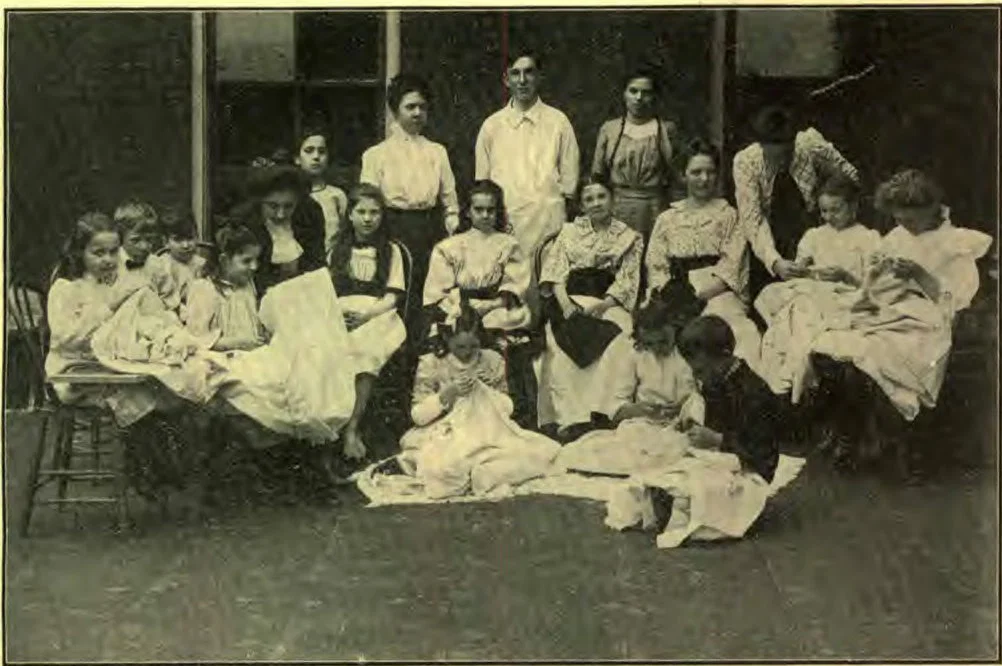
ONE OF THE SEWING CLASSES
“We already have on hand a small mission fund of about twelve dollars; I am certain that our boys and girls will be glad to give this money toward the work. How many clothes do you think it will provide?”
“Let me tell you our plan,” said Dr. S——. “There are ten districts in our church in Battle Creek, and each one ought to have a set of garments for patterns. Let us read this letter from Sister Booth; you will see from it what garments we ought to make:” —
“LONDON, May 16, 1902.”
“Dear Mrs. Prescott and all the Sisters of the Battle Creek Church: “Though we have never met, and clasped each other’s hands, yet we need not feel strangers to each other; for are we not one in faith, in purpose, and in a desire to be banded together, that by us and through us and in us the Lord’s will may be done, and the advent message be carried throughout the earth? The very kindly welcome given us by Dr. and Mrs. Waggoner and others of the brethren and sisters here assures us that this is so; and as the days go by, though we may not look into each other’s faces, still may we not come to know each other by correspondence?”
“I wish to take this opportunity to speak of the clothing for the natives,—in particular that of the African women,—this being a part of the work in which I trust all the sisters will take a deep interest.
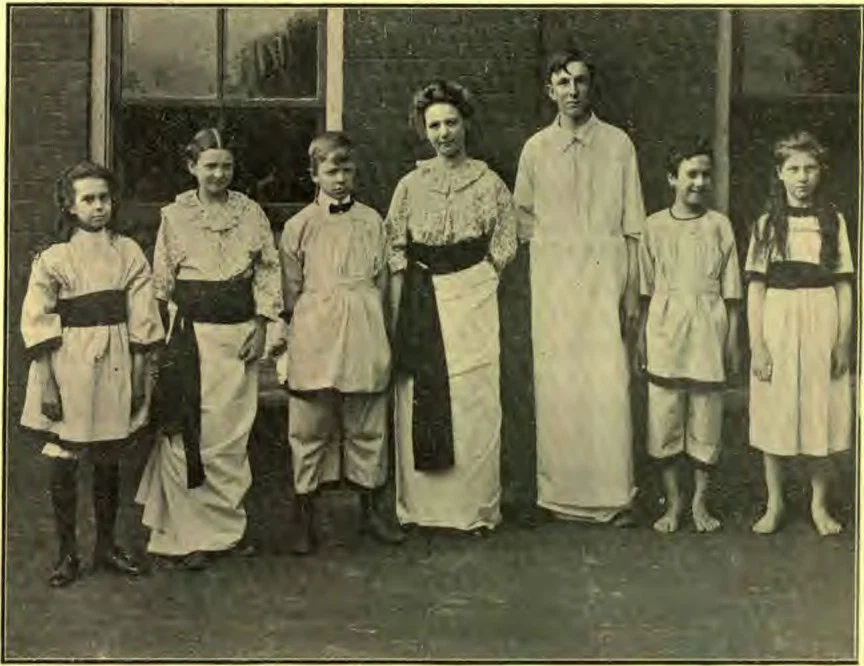
“The calico or muslin loin-cloth, with the sash and simple waist or blouse,—in all cases made with short sleeves,—is intended to take the place of the goat-skin or girdle of bark cloth, which is the only covering of the great majority of African women.
“The samples sent by Elder Spicer [Elder Spicer went to New York City at the time the Booths sailed] are intended to give a general idea of what is needed. The waist-cloth is always the same, not to be joined round as a skirt—simply left to wind round the body. These may be in different sizes, the smaller ones being useful for the children. A garment much like a child’s nightdress, with or without a yoke and with short sleeves, is also needed for the little girls. The boys wear a loin-cloth and a little vest or shirt, when they are fortunate enough to get one. . . . Good, strong shirts in all sizes are always needed.
“It would be well if the Dorcas societies would enter into this work with real good will, and go right on till enough garments are ready to fill several good-sized boxes or barrels. We can never have too many.
“Yours in Christian bonds,
“ANNIE S. BOOTH.”
SHOWING SOME OF THE FINISHED GARMENTS
The letter was plain enough. A little girl’s dress, a small boy’s shirt and trousers, a woman’s sack and loin-cloth with sash, and a man’s shirt and loin-cloth,—these were the garments suggested, eight pieces in all, and costing not over two dollars. Just think, a family of four clothed for two dollars!
Well, we went to work. Twelve dollars was not enough, so we asked for more. Our funds finally amounted to about eighteen dollars, and this bought our cloth. Sixty yards of sheeting for the loin-cloths, fifty yards of unbleached muslin for shirts and little girls’ dresses, thirty-five yards of seersucker for the boys’ trousers and shirts, thirty-five yards of pink calico for the women’s sacks, and fifteen yards of turkey red for trimming,—this was indeed a lot of cloth for school-children to make up, and that during the closing days of school!
Of course this work made a change in our program: we could not sew and recite too. Therefore we sewed for two whole days. The loin-cloths were turned over to the little people. There were twenty of them, each three yards long and a yard and a quarter wide. The children turned the hems and basted them, while one of the small boys, whose mother had taught him to use a machine, stitched them. Every boy and girl in the school had a hand in this work. Some cut out the garments; others basted them together and stitched them; while still others finished off, hemming, overcasting, and making buttonholes.
“Do you think there will be enough clothes for them all?” asked Helen, one day, as we were sewing. Before I could answer, there flashed into my mind a glimpse of our high commission, “Go ye into all the world, and preach the gospel;” and as I thought how abundant and free the gospel is (surely “freely” we have received, and freely, too, we should give), I answered, “Yes, indeed; there will be enough clothes for all those dark people who accept their Saviour.230What we lack, some one else will make up,—and get the blessing, too!”
Two days by no means finished the work. In all, there were seventy-five garments to be cut and made, and even at close of school there was still much finishing to do.
The work was indeed heavy; but the children were willing, and “many hands made light work.” Early they came, and late they stayed, to sew on the Nyassaland Mission garments. For one week nearly every morning two or three children were on hand as early as half-past seven, and we seldom finished work before six at night.
We could not have done the work without our boys; they indeed filled a good place. As for their sewing,—just come and see for yourselves. It is better than many girls can do. During the first term of our school year all the boys learned to sew, and now they have given us a good return. Of course they did not all like sewing at first, and some even never really thought it just the thing for boys; but when the Nyassaland Mission demanded their help, who was going to stand back?
Sometimes we forget our privileges and do not see our opportunities. Nothing of the whole creation liveth unto itself, except the selfish heart of man. Every tree, every shrub, gives its life to God’s creatures. Even the life-blood, as it courses through the body, does not stop to nourish the channels through which it flows, but hastens on to other parts, afterward to return and give to the vessels which carried it. “Cast thy bread upon the waters, for thou shalt find it after many days.” ONE OF THE TEACHERS.
’Twas Our Father
By William A. Spicer
Little beam of silvery light,
Who has made you shine so bright?
’ Twas our Father.
Little bird with golden wing,
Who has taught you how to sing?
’Twas our Father.
Little blossom, sweet and rare,
Who has made you bloom so fair?
’Twas our Father.
Little streamlet in the dell,
Who has made you—can you tell?
’Twas our Father.
Little girl with face so bright,
Who has made your heart so light?
Who has made your voice to sing
Like the merry birds of spring?
’Twas our Father.
ALL:
’Twas our Father, God above;
He has made us; he is love.
W. A. SPICER.
Where the Honey Went
“Don,” said Mama Howe, “I wish you'd take those boxes of honey that are up in the back attic, and put them in the tin cake-box in the old cupboard. I want to keep them till Aunt Ruie comes. She's so fond of honey!”
“All right, mama,” responded Don. And he started up the attic stairs. But just then he heard Bert Dunn's merry whistle as he drove past. He thought of something about which he wished to see Bert, and turned and hurried out to stop him. And they had so many plans to make together that he thought no more about the honey that day. Several times afterward it came into his mind, but always when he could not conveniently attend to it.
A fortnight passed, and Aunt Ruie came. The table was set for tea.
“Run now, and get the honey, Don. You know where you put it,” said mama.
Don gave a sudden start, and turned very red in the face; but mama did not notice. He hurried up to the attic. There were the honey boxes on the old blue platter on a table. O, nothing had happened to them after all! He gave a sigh of relief as he took up a box. Why, what made it so light? A little brown ant dropped out of it, and scampered off. He held it up to the light. Not a drop of honey was left. He picked up one after another. All had been served the same way. The little thieves scattered in all directions.
It seemed to Don at first that he could not go down and tell mama and Aunt Ruie. But he did, bravely and manfully. And he took money out of his bank to buy more honey. That came hard, when he was trying so hard to save money for a microscope, but he did not feel nearly so bad about that as he did about losing his mother's confidence.—Epworth Herald.
Weaving with Warp and Woof
By J. Edgar Ross
(Continued)
JUST before the weaving reaches the end of the place where the warp was first wrapped around it. This will be readily understood when you come to try the work.
Fig. 17
In making short pieces of this kind of work, it is best to select, for the wool, threads of hair that are long enough to finish it without splicing. But in covering canes, whips, or other articles of considerable length, this will be impossible; for, it will be remembered, a thread will weave only about one fourth of its length. Under such circumstances splicing will be necessary, and it is well to try splicing a few threads before the actual necessity arises. Where it is known that splicing must be resorted to, it is best to select threads of different lengths, so that they will not all have to be spliced at the same time. Otherwise the introduction of all the threads of the wool near the same place will make a bulge in the finished article that will detract from its appearance.
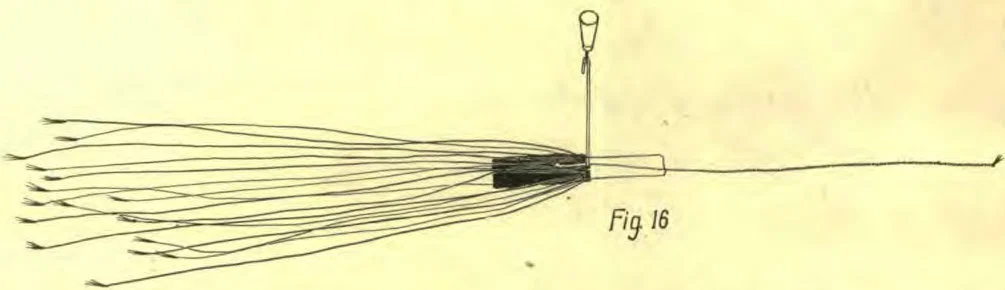
When there remains only about three inches of a thread, it is time to introduce a new one to take its place. To do this, place the thread parallel with the base, and pass one end under the warp and up between the latter and the finished work, as shown in Fig. 16. Then continue the weaving just as if the new thread were not there, until only about an inch of the old one remains. By that time the new thread will be so firmly held against the base by the warp that has been repeatedly wound around it that there will be no danger of its pulling out. Now when you come to the old thread, instead of taking a stitch with it, bring the new one up between the warp and the woven work. Then leave both, and continue the weaving till you come to them again. Make the regular stitch with the new thread, and then pull the old one down under the warp, between the latter and the woven work. Proceed with the weaving till the old thread is nearly covered; then cut off what remains of the end of the latter, and the splicing will be complete. In this manner, it will be seen, one end of every thread that is introduced after the work begins will be left projecting on the outside of the weaving. After the work is finished, these ends are drawn out slightly, and cut off with a sharp knife. The elasticity of the hair will draw the ends back into the weaving, so that the sharpest eye can not detect where the splice was made.231
Fig 16
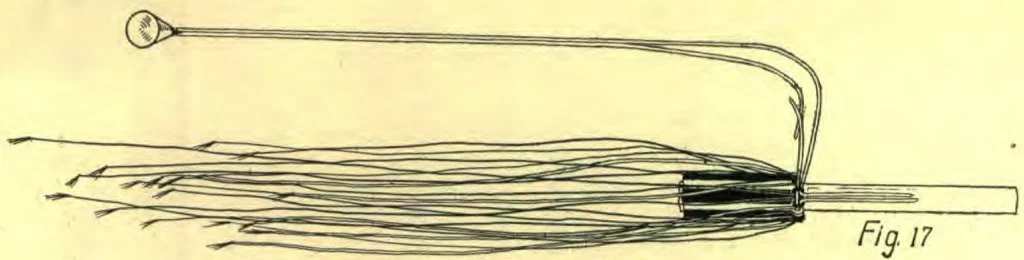
The warp ought by all means to be long enough to finish the work; but if, through carelessness or accident, it is necessary to splice it, both the old and the new warp must be divided in halves for a short distance. Discard half of the old warp, and bring half of the new into its place, as shown in Fig. 17. Continue the weaving a little more than one revolution, when the remainder of the old warp may be changed for the new in a similar manner.
There are two ways of hiding the ends of the threads where this kind of work is finished. One is to cover them with needlework. The other and better way is to pass each thread through a needle, draw it down between the base and the weaving, then up through the latter, cutting off the part that remains exposed.
J. EDGAR ROSS.
The Boy Who Deceived His Teacher
THE boy who used to boast of getting the best of his teacher has been heard from. The same traits of character which tempted him to deceive his teacher into believing that he had solved his problems and completed his tasks himself, led him to cheat his employer, to idle whenever his back was turned, and to clip his day’s work, until he finally lost his position.
His lack of education — the result of cheating his teacher — has proved a perpetual handicap, and has lost him many a good situation. His dishonesty, which started in the schoolroom, has grown until nobody will trust him, and he has no credit nor standing in his community.
As a boy, he thought himself very clever in being able to dodge his lessons and impose upon his teacher; but he realizes now that the person cheated was himself. In those precious days of youth, he robbed himself of pearls of great value which he never will be able to recover.
The thief of time and opportunity often thinks he is enriching himself, but he awakes one day to the truth that he is poorer and meaner for the theft.—Success.
What Ailed Dicky Dill?
You have heard the story of Dicky Dill
And the singular ailment he had, no doubt?
It was hardly a case for powder or pill,
And just what it was that made him ill,
Nobody ever could quite find out.
For every day, when his school-time came,
With barely a dozen rods to go,
His back grew weak, and his legs grew lame,—
Though he always could run to the football game
That was ten times farther away, you know!
And, whenever he weeded the garden-bed,
Poor Dicky, it made him fret and frown!
For he found that the stooping hurt his head,—
Though he always could hang from a beam in the shed
For more than a minute upside down!
And nobody knows just what to do,
Nor why he should be so strangely ill!
What do you say, boys, such of you
As read his singular story through,—
Were you ever troubled like Dicky Dill?
— Junior C. E. World.
Hide Thou Thy Griefs: Verses on Faith and Life
By Dr. Oliver Huckel
Hide thou thy griefs,
But let thy joys be known;
Doubts will be brief
If faith shall claim its own.
Pain is a gain,
Sorrow a glorious strife;
Death is a breath,
And love is lord of life.
— Dr. Oliver Huckel.
THE YOUTH’S LESSON
IV—The Captives in Babylon
(July 26)
MEMORY VERSE: “Though Noah, Daniel, and Job were in it, as I live, saith the Lord God, they shall deliver neither son nor daughter; they shall but deliver their own souls by their righteousness.” Eze. 14:20.
1. When did the king of Babylon first besiege Jerusalem?
2. Who gave Nebuchadnezzar the victory over Jehoiakim?
3. What trophies also fell into his hands?
4. Into what land did he carry them?
5. Where did he put them?
6. From among the captives in Babylon what selection did Nebuchadnezzar request the master of his eunuchs to make?
7. What were the special tests to which these captives were submitted?
8. For what purpose did Nebuchadnezzar choose them?
9. What was the nature of the language which he wished them to learn? Jer. 5:15 and Eze. 3:5.
10. How many years did he allow them in which to learn it?
11. About how old was Daniel at this time? See note.
12. According to the educational systems of to-day, how long would it take you to learn as hard a language as the Chaldean, so as to be able to converse with a king?
13. What kind of training must Daniel have had, to pass such an examination as was given him by the master of the eunuchs?
14. Where did Daniel get this training? See note.
15. What special provision did Nebuchadnezzar appoint the captives whom he wished to educate?
16. What verse shows that Daniel and his fellows were not the only princes of Israel chosen?
17. What names were given to them instead of their own?
18. In honor of whom were these names given? Dan. 4:8. See Bible Dictionary.
19. What do the names Daniel, Hananiah, Mishael, and Azariah mean? See Bible Dictionary.
Notes
1. “Daniel was but eighteen years old when brought into a heathen court in service to the king of Babylon; and because of his youth, his noble resistance of wrong and his steadfast adherence to the right are the more admirable.”—“Testimonies for the Church,” Vol. IV, page 570. At the time Daniel was taken captive, the educational advantages in Jerusalem were very few. There is a Hebrew maxim which says that Jerusalem was destroyed because the education of her children was neglected. The history of that time certainly confirms this. From the days of Hezekiah, all the kings of Judah, except Josiah, patterned after the heathen, and so educated their children. In Josiah’s reign only do we find a school in Jerusalem (2 Chron. 34:22); but during the years that followed, the Lord’s prophets long were mocked and derided, and finally put in prison. Such was the case with Jeremiah, while the prophet Ezekiel, when very young, was sent to prophesy to the people of Israel, captives in the land of the Chaldeans. Eze. 1:1.
2. At the time Daniel was taken captive, the educational advantages in Jerusalem were very few. There is a Hebrew maxim which says that Jerusalem was destroyed because the education of her children was neglected. The history of that time certainly confirms this. From the days of Hezekiah, all the kings of Judah, except Josiah, patterned after the heathen, and so educated their children. In Josiah’s reign only do we find a school in Jerusalem (2 Chron. 34:22); but during the years that followed, the Lord’s prophets long were mocked and derided, and finally put in prison. Such was the case with Jeremiah, while the prophet Ezekiel, when very young, was sent to prophesy to the people of Israel, captives in the land of the Chaldeans. Eze. 1:1.
MEMORY VERSE: “God is our refuge and strength, a very present help in trouble. Therefore will not we fear though the earth be removed, and though the mountains be carried into the midst of the sea.” Ps. 46:1, 2.
(The chapter given as the Lesson Scripture is the lesson to be studied. Read this carefully every day, and think over it until you know just what it teaches. Then the following notes, which should be read carefully several times, will help to a fuller understanding of the lesson. Lastly, go over the questions carefully, and be sure that you can answer each one in the words of Scripture.)
When the ark was finished, and Noah and his family were safely inside, and everything had been done for the people that God could do to save them, “the Lord shut him in.” No man can open the door that God shuts, and so there was no longer any opportunity for any one else to come into the ark.
Yet it was seven days more before the flood came. No doubt the wicked people outside laughed at Noah and mocked him, as day after day passed, and not a drop of rain fell from the sky.
But after seven days the rain poured down from heaven, and the waters gushed up from the depths of the earth, and the sea overflowed the land. Then the waters covered the face of the earth as they did in the beginning before God divided the waters above from the waters below the firmament, and gathered the waters below unto one place.
We learned that it was by his word that God gathered the waters together, and by his word that they were held up in the sky and kept in the sea. But the people had not thought of God, and thanked him for his loving care. They had lived as if there were no God, and had made the earth corrupt.
Then the word of God that was holding the waters let them go again over the earth to cleanse it. And every living thing was swept off the face of the earth; for the waters covered the tops of the highest mountains. But the ark went safely upon the face of the waters.
After the flood, the waters were again divided and gathered together by the breath of the Lord. Some of the water was carried up again into the sky, and some was gathered into the seas.
The earth was quite changed by the flood. In the beginning its depths were stored with water, for God “stretched out the earth above the waters.” But the surface of the earth was all broken up when “the mountains of the great deep” burst up from beneath.
The word of God tells us that all things are not now as they were in the beginning; for “the world that then was, being overflowed with water, perished. But the heavens that now are, and the earth, by the same word, have been stored with fire, being reserved against the day of judgment and destruction of ungodly men.” 2 Peter 3:7, Revised Version, margin.
Through the breaking up of the ground, and the mighty wind that blew the waters back to their appointed place, great forests were buried under the earth. These have since been changed to coal that is now dug out of the earth, and used for the comfort and service of man. In this we see how merciful God is, even in his anger.
But large quantities of oil come from the coal-beds underneath the earth, and the coal and oil take fire, and burn in the heart of the earth, heating the rocks, boiling the water, and melting the metals, which are thrown up by burning mountains. So since the flood, the earth has, as God’s word tells us, been “stored with fire.” These fires in the earth cause volcanic eruptions and earthquakes. And so the flood brought a heavier curse upon the earth because of man’s sin.
Not the earth only, but the heavens—the air—also was changed at this time. It is much more heavily loaded with moisture than in the beginning, and these vapors form heavy clouds, such as were never seen before the flood. The lightnings which dart from the clouds, sometimes doing great damage, show that the heavens also are “stored with fire.”
The fires with which the heavens and earth are stored will be used by God to destroy the wicked and cleanse the earth again. In the days of the flood, the waters above joined the waters below, and changed the earth into a great sea. In the day of judgment the fires within the earth will burst forth, and join those that come from the heavens, until the whole world is melted into a lake of fire. This will cleanse the earth, and prepare for the new heavens and new earth, where God’s people will dwell forever.
Questions
1. How many human beings went into the ark? Verse 13. Why did God save the family of Noah?
2. How were they made secure in the ark? When once God had shut the door of the ark, what hope of salvation was left for those outside?
3. Did the flood come as soon as the door of the ark was shut? What did this give the people outside opportunity to do?
4. What took place after seven days? Did the waters come only from above?
10. What is keeping it to-day in its appointed place? 2 Peter 3:7.
11. How do we know that all things are not now as they were in the beginning? 2 Peter 3:6.
12. Tell some of the changes that the flood made in the earth.
13. With what are the earth and heavens now stored? 2 Peter 3:7, Revised Version.
14. What use will be made of this fire in the day of judgment?
15. What will come forth from the lake of fire? 2 Peter 3:13.
Keep at Work
Do not stop work to become an expert stenographer. We successfully teach by correspondence the Graham System of Shorthand by a new method, which enables the stenographer more quickly to attain practical speed than by any former method. Easy to learn, easy to retain. Highly recommended by oldest official court reporters. Complete course for beginners. Special course for advanced writers, who desire to become expert. Write to-day for full particulars to the—
FIRESIDE CORRESPONDENCE SCHOOL,
Battle Creek, Mich.
SOLID THROUGH TRAINS OF WIDE VESTIBULE COACHES and PULLMAN SLEEPING CARS BETWEEN
Battle Creek and Chicago, Buffalo, New York, Philadelphia, Toronto, Montreal, Boston
For time-tables, descriptive matter, and information, apply to any representative of the company.