The Youth’s Instructor, Vol. 50, No. 29.

The Story of Our Matabeleland Mission
Earlier text: How the Nyassaland Mission Work Began in the Battle Creek Church School

“In Partnership with the Sun”

The great problem before the mechanical world to-day is how to secure power in the most economical manner. The utilization of the unlimited power which is constantly going to waste in the movement of ocean waves has been the subject of a great deal of experimentation; and no doubt the day is not far distant when some of this enormous force will be transformed into electrical energy, and it, in turn, changed into mechanical energy to run the machinery of our factories, the trains on our railroads, and be utilized in a thousand other useful ways. There can be no doubt that most of us will live to see this actually realized; for the obstacles to be encountered are no greater than those which have already been surmounted in the achievement of other mechanical triumphs by the inventive genius of this wonderful age.
For a number of years the sun’s rays have been utilized for the purpose of heating water. A window somewhat resembling a skylight, is placed in a roof, and the sun’s rays are centered upon the water below, thus serving to heat, in a short time, a large quantity of water to a temperature from sixty to eighty degrees higher than the surrounding atmosphere. This is a very economical means of heating water, as there is absolutely no expense connected with it except the small amount required to set up the solar water-heater.
FIFTEEN HORSE-POWER SOLAR MOTOR
Some idea of the amount of energy stored in the sun’s rays may be gathered from the statement of an eminent scientist, that every four square feet of sunshine, as it covers the earth’s surface, contains latent energy equal to one horse-power. If all the energy of the sun’s rays falling upon one square mile of the earth’s surface could be utilized, this would be equivalent to nearly seven million horse-power. For generations it has been the dream of the aspiring inventor successfully to convert this enormous energy into mechanical power; but until very recently all the contrivances that have been produced for this purpose have been little more than toys.
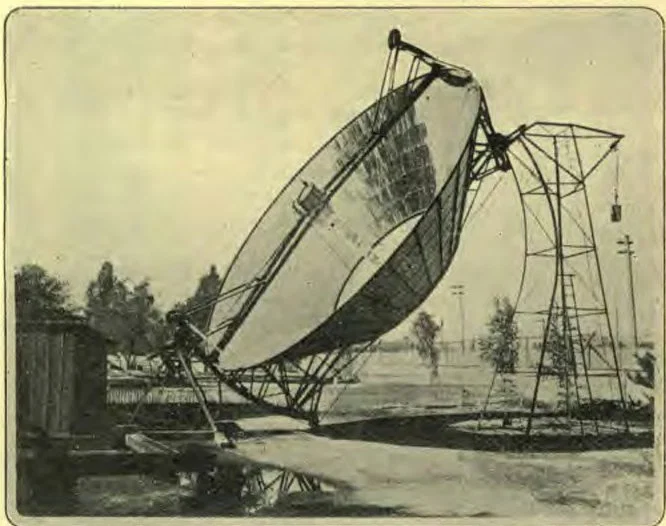
During the last two or three years, however, the problem seems to have been practically solved, and a number of solar motors are now in successful operation. One of the best known is that which pumps the water for the ostrich farm near Pasadena, California. This motor develops eleven horse-power, and pumps fourteen hundred gallons of water every minute. This is said to be sufficient to irrigate three hundred acres of oranges. The accompanying picture gives an idea of its general construction. The basin-shaped reflector concentrates the sun’s rays upon the boiler, which is in the center. Imagining the basin to be an inverted umbrella, the boiler corresponds to what would be its handle. The interior of the reflector is lined with seventeen hundred and eighty-eight small mirrors, so placed as to reflect the sun’s rays upon this boiler. Thus sufficient heat is generated quickly to convert the water into steam. A piece of wood placed near the boiler will burst almost instantly into flames. This gives a fair idea of the intense amount of heat produced by centering upon a small area the sunshine that falls upon the space represented by the reflector.
It is evident that this basin-shaped reflector must constantly face the sun in order for the reflected rays to fall directly upon the boiler in the center. In order to effect this, it is constantly being moved by an electric clock-work arrangement similar to that employed in keeping a large telescope constantly focused upon a star in spite of the earth’s rotation upon its axis, which tends continually to carry the telescope out of line with the star under observation. In the construction of this solar motor, not only must the continual motion of the earth upon its axis be taken into consideration, but also that rotation of the earth which causes the sun to appear to be near the zenith in summer, and to recede toward the south in winter.
The solar motor is especially intended for desert areas, where fuel is scarce, and sunshine plentiful. Some of these arid districts would be the most productive agricultural tracts in the country if they could only be supplied with the necessary water, but they are too far from the mountains to be irrigated. It has been predicted that erelong solar motors will be “seen all over the desert as thick as windmills in Holland, and they will make the desert to blossom as the rose.” In Nevada, Utah, Arizona, and Southern California, the sun shines almost uninterruptedly, ninety per cent of the days being clear. The solar motor is an effort to use the surplus sunshine above the earth to bring up the surplus water from its depths to water the arid lands. In some localities, nature has settled this matter satisfactorily by bringing the water to the surface in the form of flowing wells.
We are living in an age when the problem of constructing a boat that will successfully travel under water, of building a machine that can be safely steered in mid-air, and of overcoming the blighting effects of continued drought are rapidly being solved. Has the thought of what God is enabling others to do in this age ever inspired you with a desire to do some great deed for the benefit and the betterment of humanity? You may never be able to invent a labor-saving device of such value as to cause your name to be inscribed high on the scroll of fame by appreciative humanity; but you have the wonderful opportunity of being among those whom the Master of all the Universe will finally commend because of their willingness cheerfully to give a cup of cold water, an encouraging word, and a smile, to the least of his disciples.
David Paulson, M. D.

Breaking Habits Cord by Cord

“Habits are easier untied than broken. One should unloose them by long-continued daily denials, not expecting to be rid of the temptation, the struggle, at once, but willing to continue putting off cord by cord, slowly, patiently, prayerfully, till the last strand of evil has been laid aside.”

WHAT IS GOING ON IN THE WORLD.

Breathing the Same Air Over.—French investigators have discovered a way to “regenerate” dead air so that it may be breathed again. The discovery is claimed to have value for divers, firemen, and others who must enter unbreathable atmosphere. But the ordinary individual has no need to carry about with him a device weighing twenty-six pounds, in order that he may breathe the same air over. He may have plenty of fresh air if he will—and all he needs to do is to breathe it. The trouble is, a great many don’t even take time to breathe—properly. Some one has said that if every one had to pay a cent for each full, deep breath, no one would forget to take them. But fresh air is a free gift; is that why its blessings are so neglected and despised?
Repairing the White House.—During the summer the White House will undergo a thorough renovation. For some time there has been a good deal said about entirely remodeling the structure, or of adding wings at either end, or of modifying it in various other ways, to make it fill the demands made upon it for space. Now the question of office room for the president has been settled by building a new office structure to the west of the White House, and connected with it by a covered walk. The rooms heretofore occupied as offices in the executive mansion will be remodeled into sleeping rooms. The whole building will be put in a state of thorough repair.
New Forest Reserves.—The Senate has passed a bill providing for the purchase of four million acres of forest land in the Southern Appalachian Mountains, the same to become a national forest reserve. The price to be paid is not to exceed ten million dollars. If these lands are purchased, measures will be taken to preserve the hardwood forests which they bear. After five years the efforts of the advocates of the national park at the headwaters of the Mississippi seem to be crowned with success. A bill providing that two hundred and fifty thousand acres of the Chippewa reservation shall be reserved, the merchantable timber cut and marketed, and the tract “reforested,” has been approved. “The spruce, birch, hemlock, and tamarack trees can not be touched, and the islands in the lakes, containing perhaps twenty-five thousand acres of primeval forest, including matured pines fully three hundred years old, must be undisturbed.”
The friends of the forest reserve at the source of the Mississippi River sought to have the entire Chippewa reservation of six hundred and fifty thousand acres retained, but succeeded in reserving only two hundred and fifty thousand acres.

You have reached the end of this edition.

The Youth’s Instructor · Jul 17, 1902