FROM the viewpoint of office routine, punctuality is the great dominating characteristic of the present occupant of the White House, if we may trust the statements of his secretaries as embodied in an article on “The Working Habits of the President of the United States,” contributed to the American Magazine for January, by James Hay, Jr.
Not only is President Wilson punctual himself, day in and day out, but he requires punctuality from others, including members of Congress and heads of departments. Senators and Representatives calling at the White House by appointment, find that each conference is expected to last from three to five minutes. After each caller leaves the office, Mr. Wilson himself makes a shorthand note of the caller’s business. (It is stated, by the way, that the President is himself an expert stenographer, and that a page from his notebook is “as clear and clean-cut as a piece of engraving.”)
Following is the daily program of this very hard-worked and very punctual man:—
His personal stenographer, C. L. Swem, who was with him in New Jersey, reports at the study in the White House proper at 8:55 A. M., at which time the President dictates replies to the important letters which have been received at the White House offices the day before. At ten o’clock he takes his place at his desk in his private office in the White House offices. Between ten and ten-thirty he attends to whatever routine work is possible before he begins to keep the appointments he or his secretary made several days before. Each caller usually gets five minutes, some of them three, and a few fifteen. He keeps a card on his desk showing the list of appointments, and checks off with his own hand each appointment as it is kept. (I saw one of these cards on which he had run his pencil through the name of a prominent politician, and had written after the name, in blue pencil, “He did not come.” That, “He did not come,” looked ominous.)
At 12:59 the President, having concluded the appointments, leaves the office for his one-o’clock luncheon.
At two o’clock he receives in the East Room delegations of tourists who want to shake his hand, and, if it is necessary, he has a long conference with some member of the Cabinet or a diplomat. After that he plays golf, takes a walk through the shopping district of Washington, or goes for an automobile ride.
At seven o’clock he has dinner.
He goes to bed between ten o’clock and midnight, never after midnight.
The President’s office methods are described as remarkable for accuracy and exactness. He files all his important papers with his own hands in a filing case just back of his chair in the White House study. His powers of concentration are great, and after devoting his mind entirely to a single subject, on dictating a speech or a state paper, or writing it out in shorthand and then reading it to his stenographer, practically no changes are required.—The American Review of Reviews.
Which is the Largest City in the World?
By Clayton Keiser
If you ask an Englishman which is the largest city in the world, he will say London; but if you ask an American, he will say New York. According to the World’s Work, the largest city is “the city which houses the most people subject to the jurisdiction of one municipal government.” Taking this as a standard, let us draw our comparisons.
The Chinese fooled us in making us think that Peking is the largest city in the world, because we took for granted what they said. London also fooled us, but in a different way. According to the foregoing definition, London is that part of England which is governed by the city council, just as New York is that part of America which is governed by the aldermen and mayor.
According to this definition, London has a population of 4,522,964, and New York of 5,585,772 persons. The census for New York was taken in 1915 and for London in 1911. The Englishman, no doubt, will say that that isn’t fair. But it is very generous for London, because the census shows a decrease in population in 1911 over that of 1901. Probably it is smaller now than in 1911. You will ask, Where, then, are the 7,200,000 people claimed for London?
There are really three communities known as London: the old medieval city, the county which includes London, and the city of today. This will account for the 7,200,000. If New York followed the example of London, taking in everything within a radius of fifteen miles, she would have a population of 7,500,000. Figuring this way, she is still 300,000 to the good.
Mayor Mitchel is in charge of as many people in one place as many kings have in their whole realm. Denmark has a population of about one half that of New York City. The population of Sweden is just about the same as the “Great City.” The vast Dominion of Canada comes within 300,000 persons of reaching that of New York and her adjacent towns.
The number of people in the metropolis is greater than the combined population of Colorado, Wyoming, South Dakota, Nebraska, Kansas, New Mexico, Arizona, Utah, and one half of Texas. In the last ten years there has been an average annual increase of 135,000 persons. Think of adding a city like New Haven, Connecticut, every year to New York! In the ten years from 1900 to 1910, New York added enough people to make a city about as large as Philadelphia. One borough, Manhattan, is nearly as large as Chicago, and Brooklyn will almost come up to Berlin. Chicago, Los Angeles, and Seattle can boast of their growth, but none of them can compare with modest New York, whose growth has been double that of Chicago in the same period of time. One thirteenth of the population of the United States live in the metropolitan district. Yes, New York is the largest city in the world. CLAYTON KEISER.
Don’t Look for Flaws
Don’t look for flaws as you go through life;
And even when you find them,
It is wise and kind to be somewhat blind,
And look for the virtues behind them.
For the cloudiest night has a hint of the light
Somewhere in the shadows hiding;
It is better far to hunt for a star
Than the spot on the sun abiding.
The world will never adjust itself
To suit your word to the letter.
Some things must go wrong your whole life long,
And the sooner you know it the better.
It is folly to fight with the Infinite,
And go under at last in the wrestle.
The wiser man shapes himself into God’s plan
As the water shapes into the vessel.
— Selected.
She was “Losted”
By Anna F. Burnham
“I’m losted; could you find me, please?”
Poor little frightened baby!
The winds had tossed her golden fleece,
The stones had scratched her dimpled knees.
I stooped and lifted her with ease,
And softly whispered, “Maybe;
Tell me your name, my little maid;
I can’t find you without it.”
“My name is ‘Shiny-eyes,’” she said.
“Yes, but your last name?” she shook her head:
“Up to my home ’ey never said
A single word about it.”
“But, dear,” I said, “what is your name?”
“Why didn’t you hear me told you?”
“Dust Shiny-eyes.” A bright thought came:
“Yes, when you’re good; but when they blame
You, little one; is it just the same
When mamma has to scold you?”
“My mamma never scolds,” she moans,
A little blush ensuing.
“’Cept when I’ve been a-frowing stones,
And then she says [the culprit owns],
‘Mehitable Sapphira Jones,
What has you been a-doing?’”
— Anna F. Burnham.
Marie’s Narrow Escape
By Pearl Reed Petersen
PEARL REED PETERSEN
Photo by F. O. Rathbun
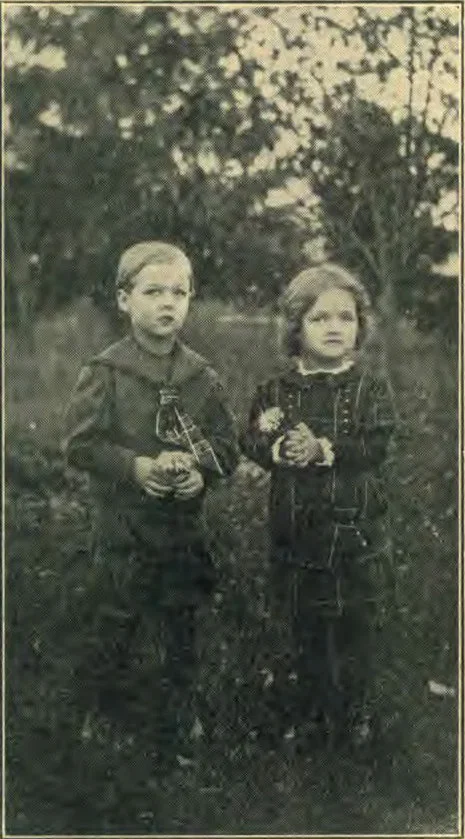
Other Interested Camp Meeting Attendants
The time which I had been looking forward to for many weeks came at last. My father, mother, and I were going to camp meeting. Although I was only five years old, I enjoyed going to camp meeting; therefore when the time arrived for us to leave, I was very happy. We usually had a tent on the camp ground, but this year, because of the wet weather, my parents decided to rent a room. Like most children, I did not like being in a room so well as in a tent.
One day when my parents were about to go to the camp ground, I begged them to let me stay at home. They very seldom left me, but after a moment’s thought my father said, “You may stay if you will be a good little girl.” I promised that I would be real good. Just as father and mother went out of the door, father said, “Now, Marie, don’t go out of the yard.” I promised that I would not, and they left.
Almost as soon as they had gone, I went downstairs to play with the little girl who lived in the house. We played with our dolls in the house for a while; then we decided to go out to the playhouse. After a while we began to tire of playing house, and my little playmate said, “Let’s go over and play in the sand pile by the railroad track.” The track was near the house, but in order to get to the sand pile we must cross the cattle guards.
I said, “No, I cannot go, for father told me that I must not leave the yard.” She teased and teased, but still I said, “No,” although I was beginning to think that it would not do any harm if I did go. The sand pile looked very tempting, as the sand was fine and white, and I thought what a good time we could have playing in the sand. At last I consented to go, although I knew I was not doing right.
When we got to the cattle guards, I did not know how to get across them. My feet were too small to keep from slipping between the guards. My playmate was more used to going across them, so she got across easily. I tried to hurry, but my feet kept slipping between, and finally I could not get them out. My playmate came to my assistance, but all in vain.
Just then we heard the whistle of a train. It frightened us so that for a second neither of us could move or make a noise. Then I called as loudly as I could for help. I did not know whether any one would hear me or not. I did not know my parents had come home, but they had come while we were playing in the playhouse.
My father heard me call, and going to the window he saw me on the track. It took him but an instant to get down the stairs and out on the porch. And just then what did he hear? It sounded like the whistle of a train; yes, it was, he could even see the smoke. He ran to me and pulled at my feet, but could not get them out.
We could now see the big black engine coming toward us with lightning speed. In an instant he broke my shoe strings, pulled my feet out of my shoes, grabbed me in his arms, and ran off the track. He had just gotten off the track when the train whizzed by us. I was so frightened I scarcely knew anything. By this time a large number of persons11had reached the place where we were. After the train had gone by, my father pulled my shoes out from between the cattle guards.
Although I was only five years old when this happened, it is as fresh in my mind as if it were yesterday. I can see the big black engine coming toward us. I never to this day cross over cattle guards but that this whole event passes through my mind. And although this happened several years ago, I have never forgotten the lesson I learned.
Dick
By W. L. Avery
WHEN I was a boy in my early teens, I was among the fortunate ones who live in the country. My younger brother and I spent many happy hours roaming through the woods and paddling up and down the river which crossed our farm. We were very much interested in birds and their nests, and kept mental record of dozens of the latter along the river. We visited them frequently to watch the habits of the old birds and see the little ones in the nests.
One day my brother came home from a trip to the river with another boy, and told me that there was a crow’s nest across the river near the place where we went swimming in summer. Of course I went to see the nest and the eggs as soon as possible. On one of our visits we found four little black crows in the nest. They were about as ugly-looking little birds as I ever saw. Their mouths were always stretched to the widest extent. But we saw great possibilities in those crows, for we had heard many stories of tame crows.
We visited them frequently, and on one of these visits we brought one home with us. He had scarcely any feathers as yet, and was homely indeed. It seemed as if he was formed of only two parts,—a black shapeless body, and a great red mouth always clamoring for food. This fellow was too young when we brought him home, and so he did not live. We had set our minds on having a pet crow, and so we decided to bring the remaining three from the nest before they were able to fly. Farmers consider crows a pest, and our parents did not object to our taking these from the nest.
One afternoon we decided that as the crows were nearly feathered out, it was time to secure them. We took an old wooden pail, and placing a little straw in it for a nest, we started for the birds. When we came to the tree, we concluded to use a grapevine instead of a rope to lower the pail of crows. We thought that the vine would be more woodsman-like than the rope; but this, as you will see, was a bad decision for me.
I helped my brother into the tree, and then with the vine he pulled the pail after him. He put the crows into the pail, and after twisting the vine around the bail of the pail, began lowering it to me. I stood looking up, waiting to take the pail as soon as it was low enough. When the pail was still several feet above my upturned face, the vine became loosened, and before I had time to realize what was about to happen the pail of crows struck me squarely in the face. For a moment it seemed as if my face must be as flat as the bottom of that pail. My mouth and face were bleeding, but I had to laugh in spite of it all to see how surprised those young crows looked to find themselves dumped so unceremoniously on the ground. After I had bathed my face in the river, my brother pronounced it not seriously injured, with the exception of a corner broken from a tooth. We brought the crows home and cared for them in the best way we knew. We fed them bits of meat from the market and scraps of moistened bread. They always seemed hungry, and I think that two of them overate.
We called the remaining one Dick. The baby of our family called him “Ole Stwak,” no doubt from the way he had of coming to the screen door and calling for food when he was hungry. Dick was a sly fellow, with beady black eyes that did not seem to miss anything that was going on, especially if it concerned things eatable. To see him perched quietly on the ridge of the house or on a fence post, one would hardly think of accusing him of mischief; but from the tricks he played, it seemed as if he was only planning something new.
Dick was always around on wash day. He would hop about, looking very innocent; but if mother happened to place a partially used cake of soap on the wash bench, Dick would seize it if he could. With the soap in his beak, he would start around the corner of the house, making the biggest hops possible, and evidently hoping to get away before he was discovered. When mother gave chase and seemed about to catch him, he would drop the soap and fly away.
Dick seemed to take especial delight in tormenting mother hens with little chicks. If he saw a hen with chicks fussily crossing the yard, he would swoop down from his perch and almost brush the old hen with his wings. This would put the chicken family all into confusion, and almost distract the hen. Dick would quietly wait till the hen had her family together again, and then repeat the performance. He did not seem to tire of the fun, but I never knew him to harm the little chicks. Sometimes when Dick was walking on the ground, a cross old hen would suddenly fly at him, but he was equal to the occasion. He simply keeled over onto his back, with talons and beak ready for battle. No hen dared to come near him then.
If we scattered corn for the chickens, he dodged about among the hens, picking up corn so fast that one would wonder how he could swallow it. He did not stop to swallow it, but filled his mouth till it could hold no more, and then flew to the roof of the house and ate the corn at his leisure. If any corn was left, he tucked it under the shingles for future use.
The bird never learned to talk, as some crows do, but I used to think that he had a queer language of his own. The shingles on one part of the house were loose, and many of these he pulled off. While working at a shingle, he jabbered and chuckled to himself in a very funny way.
When winter came, Dick roosted in some grapevines near the house, and one morning we found his mangled body on the ground beneath. We supposed that a hungry cat had caught him. We were sorry to lose our interesting pet. W. L. AVERY.
Sorrows and the Wings of Willingness
By Phillips Brooks
THERE'S many a sorrow
Would vanish tomorrow
Were we but willing to furnish the wings;
But, sadly intruding
And quietly brooding,
It hatches all sorts of horrible things.
—Phillips Brooks.
Canvassers' Institute, Santa Clara, Cuba
The Work of the Young People in Cuba
By Herbert S. Mould
HERBERT S. MOULD
As our message takes its onward march throughout the world, we are glad that the islands of the sea are not forgotten. If we could have the privilege of visiting some of these islands, we should find the language, climate, customs, and manners of life very different from those of our land. But nevertheless, in some of these very islands a most successful work is being carried on.
Here in Cuba, the “Pearl of the Antilles,” the Lord is greatly blessing the work, and a good beginning has been made, although up to a few years ago Catholicism reigned supreme. When we think that it was only a little over a decade and a half ago that the United States sacrificed many of her noble sons to free the Cuban people from the iron rule of Spain, and then look at the country as it is today, we are struck with the progress that has been made during such a short period. At the present time the country is in a most prosperous condition, and the outlook for the future is very bright. Not only are the people peaceable and content, at peace with all the world, but there seems to be a new era of prosperity dawning on this beautiful isle.
Under such good conditions our work has an excellent chance to progress, especially the canvassing work, as our colporteurs have had remarkable success. We have been glad to welcome the young men from our colleges in the United States who come down each year during their vacation to earn their scholarships.
As Spanish is the language that is spoken almost entirely, the success of our work will depend largely on the training of native workers. A goodly number of young people have been gathered out, and it is to them that we look to a great extent to spread the third angel’s message through the cities of Cuba.
These young people, on hearing the glad tidings of salvation, left their all, and are devoting their lives to the Master’s service.
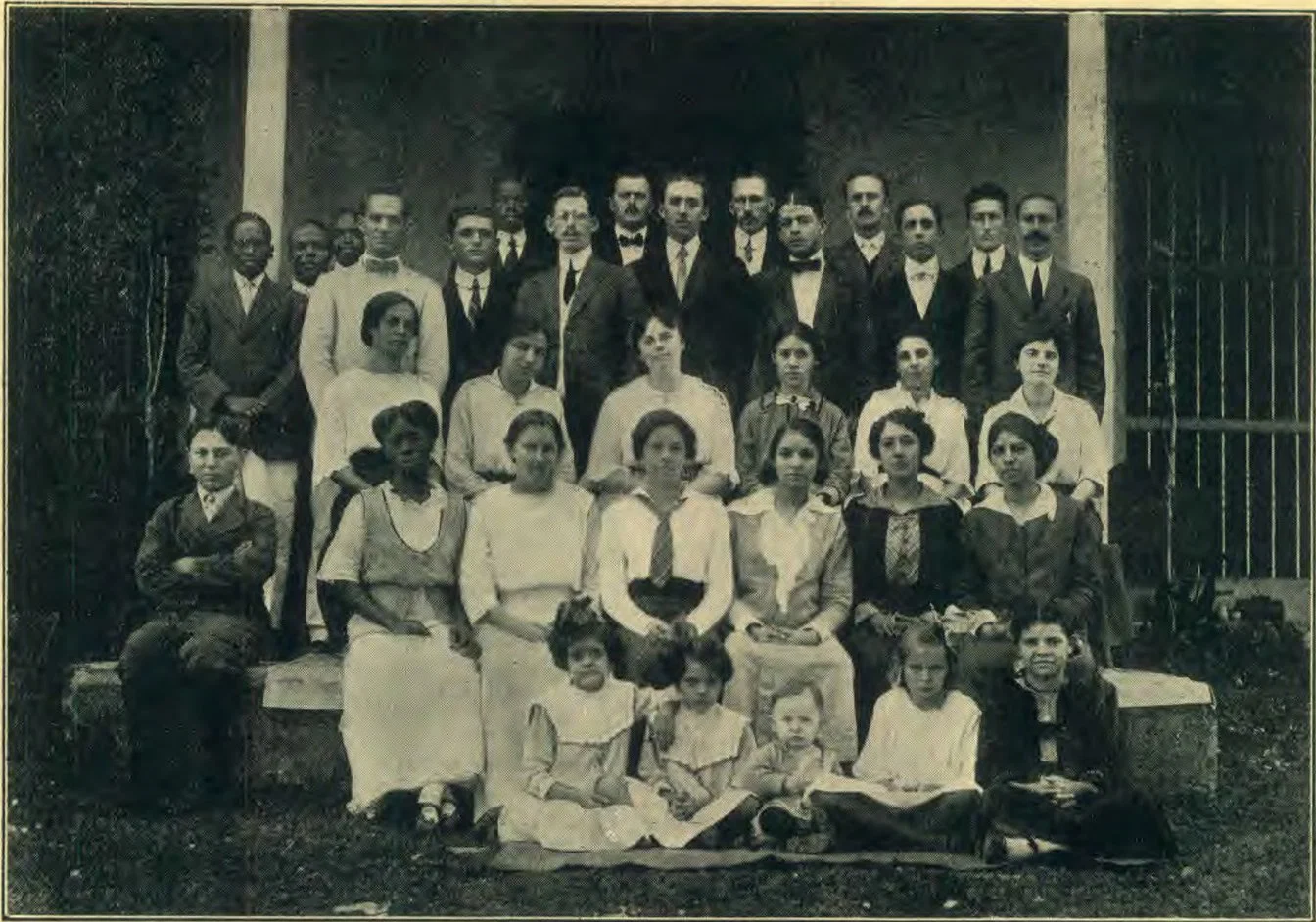
Last year many entered the canvassing work, and nearly all earned scholarships and entered our mission training school, where they spent four months receiving special instruction in order to become better workers for the Master. At the close of the school a canvassers’ institute was held, at which the accompanying picture was taken.
At the beginning of this year our young people once more went out into the field, some to do ministerial work, others Bible work, and the rest, scattered throughout the island, are devoting their time to canvassing.
Our young women also, under the direction of a preceptress, go to some large city, where they sell our truth-filled books. In Cuba, for a young woman to canvass is a strange thing; but nevertheless God has blessed all the sacrifices that our girls have made, and has given them success.
This year we look to see the work prosper greatly, and we trust that we may have the prayers of God’s people, not only for the work in Cuba, but also for that in other islands, where a great work still remains to be done.
Santa Clara, Cuba.
Living Up to Our Best Intentions
By J. R. Miller
If our best moods continually dominated our whole life, we should all live well. We all mean to live well; at least, there are times with all of us when we resolve to do so. New Year's Days, birthdays, communion Sundays, and other times, when the realities of life stand out in clearer relief than ordinarily, and13impress us with unusual vividness, start in most of us serious thoughts, and inspire in us lofty aspirations and noble intentions. We are apt then to make excellent resolutions, and to start off in new and higher planes of living. It would be well for us if there were some way of perpetuating these better moods, and living up to these good intentions. Too often, however, the serious impressions are but transient, and there is too little vitality in the good intentions and resolutions to make them really potent impulses for many days, or to give them permanence among the motives and forces of our life.
Of course, we cannot make our lives beautiful merely by alternately adopting resolutions of amendment and wailing out dolorous confessions of failure. Life runs deeper than words. Beauty is not fashioned by evanescent good intentions. Blemishes and stains are not covered up, nor are flaws mended, by penitential sighings of regret. Mere transient spasms of true living do not give grandeur to a life. If a temple is to be stable and stately, every stone from foundation to dome must be cut and set with care. If the texture of the fabric is to be beautiful and strong, every thread of web and woof must be bright and clean, and the weaving must be done with uniform skill and care. If a life is to be admirable when finished, its periodical good intentions must become strong, self-sustaining principles, shaping its every act, and ruling all its days and hours.
It ought not to be impossible to live up to the impulses of our best moods, or at least to do so to a much greater degree than most of us realize. In many of these good intentions, one element of weakness lies in their vagueness or indefiniteness. We simply resolve to be better this year than last, or to do more good in the future than in the past; but we have no clear and distinct conception in our minds of the points in which we will be better, or of the particular ways in which we will increase our usefulness. Our ideas of living better and doing greater good are nebulous and undefined.
We should be much more apt to succeed in our new purposes if we reduced them to definite and practical shape. In what respects shall we amend our ways? This question starts another. What are our faults? Wherein do we fail in living? What are the mistakes we have been making? The answers to these questions will indicate to us the particular ways in which we need to live better. Then, in what definite ways shall we strive to be more useful? To what new Christian work shall we put our hands? Upon what new lines of service shall we enter? Just what old mistakes are we to avoid? If we would bring our vague, hazy ideas of greater usefulness down into some practical form, and then enter at once upon the execution of our resolutions, they would be much more likely to become permanent and to grow into our life.
There are many people who sigh over their poor Christian living and their far-awayness from Christ, and pray much, and earnestly, too, for more faith, more love, greater nearness to the Saviour, who, after all, have no well-defined conceptions of the better things they would like to attain. Their sighings are little more than a vague and indolent discontent. They think they are sincere; but they are not, for they really do not want to be any better, or to have more of Christ, or do more in his service; if they did, they would soon be out of their poor, unsatisfactory condition. Truly earnest longings heavenward have a wondrous lifting power. There is a great deal of only imagined spiritual aspiration. Very much of our singing, “Nearer, my God, to thee,” is only the weakest kind of religious sentimentalism. Such vapid good intentions come to nothing, because there really are no good intentions to begin with. When the spiritual daydreaming gets vigor enough to be worthy the name of desire or purpose, the higher attainments longed for will soon be reached. We must want what we ask in prayer, or we shall never get it. Then we must help to answer our own prayers, by reaching after and struggling toward what we want, and by climbing the steep paths that lead to the radiant heights.—J. R. Miller, in “Silent Times.”
Encouraging Song in the Home
Do you encourage song in your home?
It matters not whether you are especially gifted. With few exceptions, singing is a common gift capable of cultivation. Many persons could sing acceptably, could derive much pleasure themselves and give pleasure to others, if they did not have the idea that every one who sings must be a professional or possess a remarkable voice. Singing is a natural outlet for joyousness. Little children sing spontaneously, with no thought of effect. It is only as they grow older and are hampered by the opinions and traditions of their elders that this impulse for song is stifled.
In foreign countries, folk songs are largely indulged in and much enjoyed. Men, women, and children sing, as the birds. Nature intended it to be so. Why is it not so in our own land? Unfortunate, indeed, are the little ones brought up in a home where there is no song in the family circle, where singing is not encouraged. The happiest families I know are those much given to song, although not all the members have rare voices. They love to sing, and they have sung from babyhood. The mothers sang soft lullabies, and played them on the piano, until the baby lips began to lisp them for themselves.
In one household I know, every member of the family fairly awakes with song. All over the house can be heard snatches of singing as the little ones dress for the day. The mother and daughters sing at their tasks. The boys come home whistling. In the evening they all gather around the piano and sing song after song,—college songs, patriotic songs, the best folk songs of the different countries,—and on Sunday, sacred songs and hymns in honor of the day. Friends join them. They are happy, healthy, full of song at all times. The blessing that singing is to them, to their home, to their friends, it can be to you.
Books can be found with songs for all occasions, from rhymes for the little tots to the finest collections of part songs for the older ones. Songs to suit every voice and every taste can be procured in collections for a trifling sum, and you cannot realize the pleasure they will yield until you have tried them and seen for yourself.
Cultivate this power of song. In many cases all that is needed is a little cultivation. Don’t be afraid to sing because you have not a voice like Patti’s or Caruso’s. Do the best with what you have, and sing for the pleasure of it and for the sunshine it will make in your home and for your children, and teach them likewise. It will transform your home and make it a place of joy and cheer. Try it and see! — The Etude.14
Alaska’s Needs
TUBERCULOSIS is working havoc among the Indians of Alaska. Dr. Stuck, Archdeacon of Alaska, says Congress has neglected this country. The missionaries, without the aid of Congress, have set about to improve the condition of the natives.
Alaska has great industrial possibilities. Juneau, one of the gold-producing centers, has doubled in population in the past three years. What Alaska needs is more permanent development. Most of the people who go there now take the money away instead of using it to build up the country. Dr. Stuck says there are many opportunities to build churches, schools, hospitals, and other educational centers.
The Indian and Eskimo Christians are very sincere and eager to learn. The schools do best that are away from the influence of the white people. We do not want to make “white” Indians, but rather teach the natives to be useful to themselves and others. A great deal depends on Congress as to the progress of Alaskan civilization.
One of Alaska’s greatest drawbacks is a scarcity of water. This is why the natives are uncleanly. One of the blessings of the cold is that it kills odors. Even the white people do without bathing a great deal of the time.
The fur and fishing industries of the natives have been almost entirely paralyzed by the war.
E. D. HANSON.
Missionary Volunteer Society Programs for Week Ending April 22
THE programs for the Missionary Volunteer Societies, Senior and Junior, for this date, with notes, illustrations, and other helpful material, will be found in the Church Officers' Gazette for April.
For helps and suggestions on this assignment, see the Review of April 13.
To Bible Year Members
ALL who began to read the Bible through in 1915, enrolling in the Bible Year, and who for any reason were unable to finish in 1915, but who faithfully complete the reading at any time during 1916, will be sent a copy of the William Miller Bible Card. This card shows a clear picture of the little Bible that William Miller used in his study of the prophecies of Daniel and the Revelation. On the reverse side is a facsimile poem by Mr. Miller, written shortly after the disappointment in 1843.
In order to secure this card, those who enrolled in the Bible Year in 1915 should send a letter to their conference Missionary Volunteer secretary stating that fact, and also that they have completed the work.
M. E
By M. E.
Perfection
(Texts for April 16-22)
MEDITATION.—The world is crowded with people who are seeking great things for themselves. But I have orders from my Master not to do so. Jer. 45:5. The only way I can follow my Master is through self-denial (Matt. 16:24), “for even Christ pleased not himself.” Rom. 15:3. It is treason for a soldier to spend his time promoting personal interests; and since I am in Prince Immanuel’s army, I must remember the instruction given in Gal. 5:16, 17. Each day I want to learn more fully how to say no to self and yes to Christ.
SPECIAL PRAYER.—Let us pray earnestly for the officers of our home church and local and union conferences. They all have heavy burdens, and need our prayers. May they count on us? Let us pray that they may be greatly blessed in their plans and efforts to make May 6 the best Missionary Volunteer Day we have yet enjoyed. Every church may have it. Will you pray for it?
MEMORY VERSE: “Watch and pray, that ye enter not into temptation.” Matt. 26: 41.
Questions
1. After the supper, where did Jesus go with his disciples? Matt. 26: 36, first part. Note 1.
2. Arriving in the garden, what did he ask his disciples to do? Verse 36, last part.
3. Who of the disciples were privileged to go farther with Jesus? Verse 37, first part. Note 2.
4. What were the Saviour’s feelings? Verse 37, last part.
5. How did he speak of his great sorrow to his disciples? Verse 38, first part.
6. What did he ask of the three who had accompanied him thus far? Verse 38, last part. Note 3.
7. Repeat the words of the prayer the Saviour offered. Verse 39.
8. What did he find on returning to his disciples? What did he say to Peter? Verse 40. Note 4.
9. What did he say further to them? How did he seek to excuse their weakness in sleeping? Verse 41.
10. What did he then do? What was his prayer at this time? Verse 42.
11. On returning the second time to his disciples what did he find? What reason is given for this? Verse 43. Note 5.
12. What did the Saviour do the third time? What prayer did he again utter? Verse 44. Note 6.
13. Who came to strengthen him? Luke 22: 43. Note 7.
14. When he came back to the disciples the third time, what did he say? Matt. 26: 45.
15. Who did Jesus say was now at hand? Verse 46.
Notes
1. Gethsemane was an inclosed garden, or olive grove, east of Jerusalem, and across the brook Kidron, at the foot of the Mount of Olives. Jesus had often visited this place for meditation and prayer; here he had often taught his disciples, speaking words of cheer and courage to them.
2. “Near the entrance to the garden, Jesus left all but three of the disciples, bidding them pray for themselves and for him. With Peter, James, and John, he entered its secluded recesses. These three disciples were Christ’s closest companions. . . . Now in his great struggle, Christ desired their presence near him. . . . He desired them to spend the night with him in prayer.”—“The Desire of Ages, p. 686.”
3. “He went a little distance from them—not so far but that they could both see and hear him—and fell prostrate upon the ground. He felt that by sin he was being separated from his Father.”—Ib.
Jesus felt the agony those will feel who are finally lost. The weight of the sins of the whole world were resting upon him. Upon him, who had never sinned, was laid the iniquity of us all. Our sins were in the load that Jesus carried that night in Gethsemane.
4. Peter had said a short time before this that though he should die, yet he would not deny his Lord, and “likewise also said all the disciples.” Now when Jesus had told them to watch with him, and when he longed for their prayers and sympathy, they slept. Whole nights he had prayed for them, but they left him in his great sorrow to pray alone, failing even to watch with him one hour. The disciples had lost the opportunity of ministering to Jesus. We shall do no better if we neglect to watch and pray.
5. “For their eyes were heavy.” How often when God has special blessings for us, the enemy seeks to make us drowsy so that we shall not discern them. “They did not intend to forsake their Lord, but they seemed paralyzed by a stupor which they might have shaken off if they had continued pleading with God.”—Id., p. 688.
The denial of the disciples and their flight was the result of their failure to watch. In the shaking time just before us it will be the “earnest, praying ones” who will stand every test and gain the victory.
6. “What does consecration mean?” is a question often asked by young Christians. We find the answer in these words of Jesus, “Thy will be done.” Consecration means the complete surrender to God of our will. The thought of the consecrated soul is, What wilt thou have me to do? The soul controlled by self says, What shall I do?
7. Three times Jesus offered this prayer. He shrank from the bitter cup of suffering; but when he remembered our helplessness and that we must die if left to ourselves, he resolved that he would not turn from his mission, but would save us at any cost to himself. After the third prayer an angel was sent from heaven to strengthen him, and to comfort him with the thought of all who would be saved as the result of his sacrifice.