I
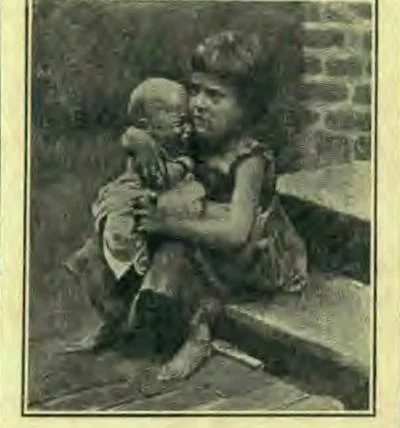
ON THE curb of a city pavement,
By the ash and garbage cans,
In the stench and rolling thunder
Of motor trucks and vans,
There sits my little lady,
With brave but troubled eyes,
And in her arms a baby
That cries and cries and cries.
II
She cannot be more than seven;
But years go fast in the slums,
And hard on the pains of winter
The pitiless summer comes.
The wall of sickly children
She knows; she understands
The pangs of puny bodies,
The clutch of small hot hands.
III
In the deadly blaze of August,
That turns men faint and mad,
She quiets the peevish urchins
By telling a dream she had—
A heaven with marble counters,
And ice, and a singing fan;
And a God in white, so friendly,
Just like the drug-store man.
IV
Her ragged dress is dearer,
Than the perfect robe of a queen!
Poor little lass, who knows not
The blessing of being clean.
And when you are giving millions
To Belgian, Pole and Serb,
Remember my pitiful lady—
Madonna of the Curb!
— The Ladies' Home Journal.
The Mother Age
TWO little girls were talking one day. “How old is your mother?” the blue-eyed one asked.
“Why, she’s just the age all mothers are,” replied the brown-eyed one.
Blue-eyes was full of scorn.
“They aren’t all one age, goosey! There’s your mother and mine; but there’s old Mrs. Ray, and she’s Miss Althea’s mother, and she’s awful old.”
Brown-eyes meditated upon this.
“No,” she replied, “you couldn’t go to her and tell her things the way you can to real ones. The mother has all gone out of her. She’s just an old lady.”
Poor old Mrs. Ray, who had lost her motherhood somewhere down the years! For the child was right. The mother had gone out of her. She had grown querulous, exacting, self-centered, indifferent to the pulsing life about her. And when a woman reaches that place, no matter what glory her past may have held, she has lost it; she is no longer a mother in the great and splendid fulness of the word.
But there is another side to it. The child was speaking deeper truth than she could know. True motherhood is ageless, because its essence is love, and love is eternal; once a mother, always a mother, to those who have the mother heart. The hair may grow white and thin and the figure bent and frail, but the children know, and, careless of outward appearance, go straight to the heart of the matter. So do many others—all the little neighborhood, whatever it may be. She has her finger upon its pulse — joys with its joys, sorrows with its sorrows, holds them all in her heart. There is no age for such as these.
The truth goes deeper still. There are mothers in the world — many of them — who never have known the touch of children of their own; so they mother others. They are “old maids,” some of them,—born too early to know the freedom of a generation that has discarded the label; they are women whose lives have put duty before the woman dream; women imprisoned by hard circumstance. Yet, if they carry a mother heart, they always come to their own, because the world needs them so much. There never are mothers enough to “go round.” All, from the “little mother” of the tenements to the oldest and frailest, are so terribly needed! They meet hardships, sorrows, perplexities, but always, too, they meet great joy; and, as the child said, they have nothing to do with age. Years cannot touch those who understand because they love. — Youth’s Companion.
How the Boys’ Brotherhood Class Kept Mother’s Day
By Mrs. Lee McWilliams
It was Sabbath morning early in April, and the Boys’ Brotherhood Class was just finishing the Sabbath school lesson when a tap at the door of the classroom sounded, and in came the superintendent.
After pleasantly greeting their teacher, he said: “Boys, I have a proposition to make to you. We have had several programs given on special subjects lately in the school. Only a few weeks ago, you remember, we had a fine program on Home Missions given, as most of the other exercises have been, by the Junior girls and smaller boys. You boys haven’t helped on a program since you were promoted to this class. Now May 9 will be Mother’s Day this year, and we must by all means observe this day in our school. I want this class of boys to take entire charge of the program, and do anything you and your teacher, Miss Willie, see fit. It seems to me that a boy would be glad of a chance to do honor to his mother, if there was much real manhood in him. What do you think about it?”
Now this almost took away the breath of these boys who had been feeling of late that “they were getting too big to do anything in public any more,” and yet the way the superintendent put it, it did seem as if, to use their own words, “it was up to them” to do what he asked. They looked at one another with questioning faces, and then a fine, earnest-faced boy, the only one of them who did not have a mother, with a little tremble in his voice, said: “Mr. Smith, you can count on us to do the best we can to honor our mothers by giving that program, can’t he boys?” and they readily assented, nodding their heads in approbation.
The superintendent thanked them, and later announced to the school that “the Boys’ Brotherhood Class would give a Mother’s Day program on the second Sabbath in May, and that all were urged to be present that day to honor the memory of mother.”
This announcement caused several teachers to gasp in astonishment and relief. They were the ones upon whom the work and responsibility of getting up most of the special programs rested.
The boys plied Miss Willie with questions as to what they should do first.
She answered, “Boys, let’s be thinking about it for a few days, and then you meet at my house next Tuesday night and I will lay before you my suggestions, and we will consider yours.”
Each boy when he went home that day looked at his mother in a new light. To think that one day should be set aside all over the country to talk of10mother and what she means to us! Why, heretofore they had just taken mother for granted! Of course everybody had mothers to wait on them, and do hundreds of little things for them every day,—that’s what mothers are for; and then suddenly each one thought of Jack. He didn’t have any mother. What would it be like not to have a mother? That afternoon more than one mother of the brotherhood boys wondered what had come over her own boy that he was so thoughtful and gentle with her. Already the leaven was beginning to work as the wise superintendent had intended it should.
The next Tuesday night, when they gathered at their teacher’s home, every boy was present. Then Miss Willie began to talk with them about the program.
“Boys,” she said, “you know we have had Mother’s Day programs before, consisting of recitations and songs by the smaller children; but as you are boys, and older, suppose we have something a little more substantial and more suitable to you. You know there are so many fine incidents in history of the honor paid to mothers by their illustrious sons. For instance, you remember about President Garfield’s inauguration; how after he had taken the oath of office as chief executive of this great nation, he went over and kissed the brow of a little gray-haired woman, and gave all the honor to her, his mother. We can find numbers of such stories as these. We will have these interspersed with several songs. Jack, you have a good voice, and I want you to sing ‘My Mother’s Prayer.’ Fred, you read well, and you must give a beautiful poem entitled, ‘The White Carnation.’ By the way, you know that the white carnation is the flower for Mother’s Day, and we must order some flowers, so that each one of you may have two, one for yourself and one for your mother, and each boy must see to it that his mother comes with him that day. I am sure that we can arrange a delightful program, and we must all be on the lookout for anything that will add to the interest.”
The boys consented to all this, and after a pleasant social evening, they separated for the night. As the days slipped by, each boy thought often of the approaching service, and carried the part assigned him on the program in his breast pocket so that he could consult it daily and be well prepared.
And in their awakened interest in the subject, many little poems and stories about the devotion of mothers in all ages and countries held their attention, and unconsciously deepened their appreciation of what their own mothers meant to them.
Several evenings before the eventful day, they had met at Miss Willie’s to rehearse together, and they began discussing the other programs that had been given, and the various activities of the Sabbath school. Frank Brown, one of the liveliest boys in the class, then remarked: “Miss Willie, you know we have had ‘Work Day for Thornwell,’ ‘Work Day for Missions,’ and ‘Clean-up Day’ for the Woman’s Club, and I’ve been thinking and wondering why we couldn’t have ‘Work Day for Mother.’ I think some of our mothers would be ’most paralyzed if we were to go and actually suggest working for her a whole day, but let’s try it for once. What do you boys say?”
Frank was the one who was always proposing some mischievous prank, which they usually assented to; and now the boys all agreed that if Frank wanted to do this, they would stand by him.
One fat, lazy-looking boy muttered something about its “being too hot in May to work,” but the boys turned on him indignantly. “Why, Ralph,” they said, “you know your mother is the best woman in town about letting us boys come into her house any time we want to and play games and make candy, and here you try to sneak out of helping her just one day!” Ralph flushed and said all right he would “work like a Turk” if they said so.
So the boys all “shook hands on it,” that they would devote themselves entirely to their mothers the following Thursday, and would dispense with their usual afternoon baseball game. They all agreed, however, that they would say nothing about it to any one, only Miss Willie would know, because they were not doing it for notoriety or for praise from others.
It was just to be a spontaneous effort on the part of each boy to show his mother that although he might have seemed unappreciative and selfish in his demands upon her, at heart he loved and honored her more than any one else in the world.
So on Thursday morning bright and early each of the ten boys bounded from their beds, eager to begin for one day at least, willingly and gladly to do anything he could for her whom he was just beginning to appreciate.
We have not time to tell of all that happened in the various homes. Joe Carter found his mother regretting the fact that though getting late in the season she had not been able to get a garden planted. Joe said, “Mother, behold a farmer lad,” and putting on his overalls and getting a horse, he plowed and planted all day long. He showed so much pluck and intelligence in laying off the garden and in overcoming difficulties that his mother’s heart swelled with pride, that she had such a self-reliant, capable son. It seemed as if that day together strengthened the tie between mother and son as nothing had ever done.
Fred White rose to find his mother suffering from one of her frequent attacks of sick headache. But this time, instead of thoughtlessly leaving her as usual, not realizing that a boy could do anything to help, he went softly into her room, closed the blinds, brought her some crushed ice, and rubbed her aching temples with soft, regular strokes, which proved very soothing. He then picked up his noisy little two-year-old brother, who was fretting and clambering over his mother’s bed, and said:
“Now, mother, I am going to take the baby and go down to grandpa’s and get our old horse and buggy. You try to go to sleep. When we come back, if you are better we will go out to Mineral Spring and spend the afternoon. You need fresh air; you stay in the house too much anyhow.”
And as he leaned over to kiss her hot forehead, she reached up her hand to his head and said, “Bless my dear boy, what should I do without you?”
But as he went out of the house with the fretful little brother, he thought to himself, “How mean and selfish I have been never to have done this before for her when she has been sick.”
He put the baby astride of his shoulders, where he was soon laughing and driving and clucking to his “orsie.”
Passing a group of boys playing ball they taunted, “Hey there, nurse, want a cap and apron?” But Fred answered good-naturedly, “No, thank you, fellows, I’m a horse, not a nurse.”
A couple of hours later, returning with the old11family horse and buggy, he found his mother just waking from a long and refreshing sleep, and the headache very much better. With Fred’s help she was soon dressed, a simple lunch packed, and they were out on a country road leading to Mineral Spring, a delightfully cool, quiet little spot, about three miles from town.
Here the mother rested, made comfortable with pillows by Fred, and lovingly and smilingly watched her big boy so unselfishly entertaining her little one, and her heart also swelled with pride, that in her widowhood she had a son on whom she could look for the same care and protection his father would have given her.
During the long afternoon the mother unburdened to her boy, as she had never done before, all her anxieties about the future of her two boys, and Fred confided in her also the hopes and plans that were just forming in his mind. And both were helped by the loving interest of the other.
These are only two examples of the joy that came this day into the hearts of the Brotherhood boys and their mothers,—to the boys, the sweet consciousness of service to the one they loved best; and to the mothers, the greatest happiness that can come to any woman, the knowledge that she has a noble, honorable son. When the boys met in the evening for some final arrangements each one’s face shone with a smile, and Miss Willie, who had quietly slipped from home to home that day and caught the light in each mother’s eyes, was quite as happy as the boys themselves, for, next to mother, the faithful Sabbath school teacher is responsible for molding the character of the boy, and rejoices when he proves worthy. Sabbath morning was as fair and bright as only a May morning can be.
It must be confessed that some of the older members of the school felt a little apprehensive, and some a little skeptical, as to what the boys could do. But when those ten manly boys marched in on the eventful morning, each with a white carnation in his buttonhole, and took his place, every one realized that these boys were “masters of the situation.”
They had chosen the most interesting selections about mother to be found, and gave them in clear, unfaltering voices, and everything was in perfect harmony; and when at the close they grouped themselves under a white banner with the words, “Mother, Home, and Heaven,” upon it, and in their sweet, boyish voices softly sang, “Home, Sweet Home,” there were tears in many eyes.
The superintendent was much elated over the morning’s exercises, and pronounced this the best program ever given in this school. “I want you people,” he said, “to give these boys a rising vote of thanks, though from the expression on their faces I think they have already had their reward.”
The school arose as one person to show its appreciation, and then each boy went and sat beside his mother during the morning sermon.—Mrs. Lee McWilliams, in the Christian Observer.
Cherries for the Boy Who Rode
By Mary S. Stover
Everybody worked on the farm where Roy Anderson lived. Roy himself brought in the kindling, gathered the eggs, and helped to feed the chickens and water the garden.
Now that it was cherry time, Roy climbed far up in the big trees to pick the fruit that grew too high for heavier people to venture after. Of course every boy likes to climb trees; but lately Roy had got to thinking that he worked too hard, so he even grumbled about picking cherries!
This afternoon he had climbed to the top of the very tallest cherry tree on the place. Roy did not admire the fine view nor the thick clusters of luscious ripe cherries that hung all around him. He was watching a boy in a pony cart, who was riding along the road.
“That boy doesn’t have to pick cherries or do any other kind of work. I’ve seen him ’most a dozen times now,” muttered the cross little cherry picker. “He just rides and rides and rides anywhere he wants to in that cute brown pony cart with the jolly-looking black boy to drive for him. He can keep his hands clean.”
Roy’s own hands were brown and scratched and a little stiff now, and dirty looking where they had clung to the rough bark of the cherry limbs.
“I say, Roy, can’t you break off that long branch that hangs so full?” called his father. “I’d like to have you bring it down carefully and take it out to that boy in the pony cart. Stay and visit with him awhile if you want to.”
The jolly-looking black boy saw Roy coming and stopped the pony. He and the other boy both smiled and stared at that limb of great black cherries.
“Oh, but those look good! I saw you when you were away up in the tree. It must be great fun to pick cherries and climb about like that,” said the little white boy. “My name is Donald, and this is Chester,” he added.
Roy bowed shyly. “It is sort of fun to pick cherries, and they taste lots better when you eat them up in the tree. Don’t you want to get out and go up there with me?”
“Yes, I want to,” said Donald with a funny, twisty smile. He jerked the dust robe from his knees, but he didn’t start to climb out of the pony cart.
“Oh,” was all that Roy could say, but he thought a great deal. It looked as if the queer steel box on one of those thin legs must hurt. Anyway, it didn’t let a fellow climb trees or run or do any one of the dozens of things that Roy could do any minute.
“The rest of me’s pretty much all right,” spoke up the boy in the pony cart cheerfully. “I can do lots of things with my hands.”
“That—that’s good,” said Roy. He couldn’t make his voice sound very hearty, because even Donald’s hands looked thin and weak beside his own sturdy brown fists.
“You stop next time you come by and I’ll bring down another branch of cherries,” he said, slowly.
“Thank you, we will,” promised Donald gayly. “Maybe I can stay and watch you for a while if we don’t take such a long drive next time. We’ve been clear to the river today.”
Roy hadn’t been to the river for more than a month. But he felt no envy of the boy who had been there today. “He gets tired just from riding!” was what Roy thought as he clambered back to his tree top.
That night Roy Anderson surprised his mother by something new that he put in his prayer. He said, “Dear God, I thank you for good hands and feet.” “That is a wise, true prayer, son,” said his mother.12
“It is going to take a whole lifetime for you to learn how wonderful your hands and feet are. They are four priceless gifts.”—Mary S. Stover, in the Sunday School Times.
Who is He?
By L. E. C.
TWO farmers stood outside the general merchandise store in the little town of West Branch, Iowa, discussing crops, the weather, and neighborhood happenings.
“Wall, I say it’s too bad Bert’s father died. Now he’ll have to be a farmer instead of a blacksmith!”
“Yes, he’s a right hefty lad, and would ’a’ made a good blacksmith under his father’s trainin’.”
Thus the kindly, sympathetic country folk disposed of the future for a little lad who, with his brother and sister, was left alone in the world at the age of ten.
Bert was rather a quiet youngster, and had spent many hours by the old forge playing “traveling round the world.” In imagination he visited Europe, Asia, and Africa, as well as the islands of the sea. But with all his daydreaming he was cheerful and energetic, and always on hand when there was work to do.
After his father’s death the blacksmith shop was sold for $300 and the money divided between the children. Then the family was scattered among various relatives, and Bert, with his little fortune of $100, went to live with a farmer uncle. He worked hard and faithfully; and as the years passed, the prophecy of his agricultural career seemed certain of fulfilment. But Bert had other ideals. Never for a moment had he planned to be either a blacksmith or a farmer, but he said very little about his aspirations, and worked steadily at the task in hand, looking forward to the time when his dreams might come true.
Now it takes money to travel, and this was Bert’s ambition. Therefore he saved every penny.
“Yer a regular miser,” complained his schoolmates.
“Ain’t a miser,” stoutly declared Bert. “I’m saving my money to go out West!”
When he was fourteen, he decided to start on this long-anticipated journey.
“Uncle, I’m going West.”
“All right, Bert. If you get stranded, you always have a home here.”
“I don’t think I’ll get stranded,” answered the boy. For in four years he had saved enough money to pay his railway fare to Salem, Oregon, and support him for a week or so while he looked for work.
“Oh, you’ll come trampin’ back all the way afoot,” prophesied his schoolmates; but they were sadly in error, for when Bert did come back to the old home town he had plenty of money in his pockets, and all his daydreams had come true. He had been around the world, had had adventures numerous and varied, and had fraternized with royalty.
Arrived in Salem, Bert secured work as errand boy in a real estate office, where he was able to spend part of his time in school. He still saved all the money he could spare above actual necessities, and gradually the purpose to become a mining engineer took hold of his ambition.
Leland Stanford University, near San Francisco, California, was an infant institution in those days, but it offered a substantial course along the lines of his interest; so the boy packed his few belongings in a little black valise and is said to have been the first student to arrive at the great Western university. As most of his money was used in the journey, he immediately went out to look for work. The job of waiting table for his meals filled the inner man but was not particularly remunerative, so Bert cast about for something better.
There was need for a laundry at the university, and he was prompt to grasp this opportunity. His outfit consisted of two tubs, some soap, a clothesline, and three flatirons. The enterprising young student had no notion of doing the work himself, for Chinese help was plentiful and cheap. Soon his laundry was bringing in a good income, and he had cornered all the university work and enlarged his borders.
This laundry enterprise brought to him local fame as an organizer, and he was asked to organize the university publication and athletic teams. Then the need appeared for a leader of the student body, and Bert suggested that some one be appointed to look after student interests and handle the money for different funds, being paid a salary for this work. His colleagues chose him for the position, and he accepted, but refused the salary, though his successors have all received remuneration.
Bert was graduated with honors as a mining engineer, and spent a year and a half in actual mining work. Then he went to San Francisco and applied to an engineer of national reputation for employment.
“All I want is a typist,” said the great man.13
“Give me the typewriter,” answered the ambitious applicant.
His promotion was rapid, and by the time he was twenty-seven years of age he was reckoned a millionaire, though he has never in his life been ambitious for wealth. He has superintended mining and engineering projects in almost every country in the world, and at one time while engaged by a London firm had 125,000 men under his control.
When the tempest of the European war broke upon the world this man was in London, and his genius for organization manifested itself in the material aid he gave thousands of his fellow countrymen who were stranded abroad and anxious to get home. Then came the invasion of Belgium, and his name became a household word in connection with the relief work which was carried on in that stricken country under his direction. When the United States declared war upon the Central Empires, this loyal son was called by the Government to a position which made him the best-known and most-respected man in our country, next to the President himself. This capable dollar-a-year man is serving in an international capacity at the present time, using his wonderful powers of organization and attainment to conserve the food of a hungry world. Rumor has it that he will retire to private life this coming July, but be that as it may, his name will ever after be a synonym for thrift and economy. And it is —? Now who can say dreams do not come true? But everything depends upon their practicability. L. E. C.
Answers to Questions Printed March 25
1. “THAT the United States should avoid entangling itself in the politics of Europe was a policy recommended by Washington. The counterpart of this, that European powers should be prevented from taking a controlling share in the politics of the American continents, grew gradually as the importance and influence of the United States increased. This American attitude toward the European powers became crystallized in what is known as the Monroe Doctrine, since it was first announced officially in a concrete form, though not originated, by President Monroe. His declaration was the result of American apprehension that the combination of European powers known as the Holy Alliance, would interfere in South America to restore the Spanish colonies, which had asserted their independence of the crown of Spain.”
The League of Nations is a plan for settling international difficulties by adjudication or arbitration rather than by war. The fundamental principles of the league guarantee the maintenance of peace through a community of interests among the nations without impairing the sovereignty of any nation. This international agreement provides that there shall be a “common standard of right and privilege for all peoples and nations, and that the military power of any nation, or group of nations, shall not be suffered to determine the fortunes of peoples over whom they have no right to rule except the right of force.”
The Fifth Liberty Loan is known as the Victory Loan, and the money thus raised will be used to pay our national debts of honor. The Government is spending at the rate of two billion dollars a month to meet its commitments. “The Victory Loan will bring our boys back from France, pay our national outstanding bills, take care of our widowed, our orphaned, and our wounded, and set us straight with the world and ourselves.”
The Bolsheviki are “Russian Socialist Democrats. They are not a new party, but, on the contrary, one of the older political factions of Russia. The men who now call themselves Bolsheviki were originally the very radical element of the Russian Socialistic Democratic party, representing, in a broad way, the political principle that the proletariat [the lowest class] must rule, and that the fight of the proletariat was not merely against an autocratic government, but that it was also against the middle class — the class that, wishing to cling to its own possessions, even though these might be meager, must necessarily always oppose the proletariat’s demand for communal ownership.” You will be interested to read in this connection the definition of Bolshevism written by C. P. Bollman, printed on page seven of this issue.
The Army of Occupation is made up of various units of the Allied troops, stationed at present in German territory, known as the Area of Occupation.
The Peace Conference, consisting of the Allied delegates, convened at Versailles shortly after the signing of the armistice, for the purpose of dictating terms of peace to the Central Powers. As a supplementary issue the delegates are drafting the covenant of the League of Nations.
2. Carter Glass is Secretary of the Treasury.
A. Mitchell Palmer is Attorney General; during the war he was Custodian of Alien Property.
James R. Mann has been the Minority leader in the House of Representatives for several years, and was recently defeated in the race for the Speakership of the Sixty-sixth Congress.
Walter V. Hines is director-general of the railroads.
Champ Clark is the ex-Speaker of the House of Representatives.
Samuel Gompers is the president of the American Federation of Labor.
Frederick H. Gillett has been chosen by the House of Representatives as Speaker for the next session of Congress.
3. The Sixty-fifth Congress came to an end through Constitutional limitation on March 4, 1919. It left the calendar crowded with unfinished business, and the Government seriously embarrassed through the failure of several important appropriation bills.
4. The Sixty-fifth Congress “passed the greatest tax law in parliamentary history, levying $10,000,000,000 in taxes in two years; passed the selective service law, and raised by draft the greatest American army; was addressed by President Wilson nine times, more than any other Congress; authorized Government control of railroads and communication agencies; created Federal control of food and fuel; and conducted twenty-six Congressional investigations.”
5. Because of the part the country which he represents took in the great World War, and because he outlined the “fourteen points” upon which the armistice was based, and as the suggester and promoter of the League of Nations, President Wilson is attending the Peace Conference in response to the earnest invitation of leading European statesmen.
Mother: The Bigger Little Girl Who Understands
By Strickland Gillilan
Mother
MOTHER is a little girl who trod my path before me;
Just a bigger, wiser little girl who ran ahead—
Bigger, wiser, stronger girl who always watches o’er me,
One who knows the pitfalls in the rugged road I tread.
Mother is a playmate who will always treat me kindly—
Playmate who will yield me what true happiness demands.
She will never let my feet stray into brambles blindly—
Mother’s just a bigger little girl who understands.
Mother is an older little playmate who’ll befriend me—
Yesteryear she traveled in the path that’s mine today!
Never need I fear a foe from which she might defend me—
Faithful little pal who ran ahead and learned the way!
— Strickland Gillilan, in Good Housekeeping.
Bible Quiz
By Ellen Oxley
1. WHAT prophet said to Israel: “God forbid that I should sin against the Lord in ceasing to pray for you”?
2. How many left-handed warriors could sling stones at a hairbreadth and not miss the mark, and of which tribe were they?
3. Under what circumstances was this statement made to Israel: “I am the Lord that healeth thee”?
4. What man had four virgin daughters who prophesied?
5. In the time of a certain harvest the Lord sent thunder and rain to convict his people of what great sin?
6. Who is considered the first founder of a system of idolatry?
7. Whom did the Lord command to portray Jerusalem upon a tile?
8. Whose three daughters were the fairest women in all the land?
9. The captivity of what king fulfilled two apparently contradicting prophecies?
10. Who stood upon a pulpit of wood, and read the law of Moses to the people? ELLEN OXLEY.
God's Singers Upon Earth
By Longfellow
GOD sent his singers upon earth
With songs of sadness and of mirth,
That they might touch the hearts of men,
And bring them back to Heaven again.
— Longfellow.
Are Scriptures Alone Sufficient? The Spirit of Prophecy
By G. B. Thompson
A CORRESPONDENT sends in a letter containing the following questions:
“Are the Scriptures alone sufficient to guide those who believe the special truths for this time?”
Yes. The apostle Paul says: “All scripture is given by inspiration of God, and is profitable for doctrine, for reproof, for correction, for instruction in righteousness: that the man of God may be perfect, thoroughly furnished unto all good works.” 2 Tim. 3:16, 17.
The Lord has given in his Word full and complete instruction concerning the plan of salvation, and how by faith in Christ we can avail ourselves of the great provision made for our eternal redemption. But being made dull of comprehension by sin, we are slow to lay hold on all that God has provided for our perfection.
To aid in understanding the truths of his Word, the Lord has given to the church the spirit of prophecy. By means of this gift of the Spirit, great light is thrown upon the teaching of the Word. By means of a magnifying glass the smallest object is made clear and plain to the human eye. The magnifying glass does not create the object; it simply enables us to see it more clearly. A telescope will bring a distant object to our feet, so to speak, and enable us to see and examine it in detail. But the telescope does not bring the object into existence. So with the spirit of prophecy. It is not new or additional light from what is found in the Bible, but it enlarges, or magnifies the wonderful truths of the Word so that our minds can see the truth. The Testimonies themselves state this:
“The Word of God is sufficient to enlighten the most beclouded mind, and may be understood by those who have any desire to understand it. But notwithstanding all this, some who profess to make the Word of God their study, are found living in direct opposition to its plainest teachings. Then, to leave men and women without excuse, God gives plain and pointed testimonies, bringing them back to the Word that they have neglected to follow.”—“Testimonies for the Church, Vol. V, p. 663.”
We must dig in the Word for light, and in our study of the Word we should study carefully the Testimonies; they are the greatest commentary in the world upon the Holy Scriptures.
The Bible is the sword of the Spirit. The writings of the Spirit help greatly in understanding this Word.
“When the spirit of prophecy speaks of the ‘Bible,’ are the sixty-six accepted books alone referred to, or are the Apocryphal books included?”
Whether in the spirit of prophecy or in any other writings, when the Bible is mentioned, it means simply the sixty-six books, known as the “Bible” or “Holy Scriptures.” If it is desired to refer to the Apocryphal books, special mention is made of this.
“How may we avoid being in the Laodicean condition mentioned in Revelation 3:14-18?”
The Bible and the spirit of prophecy warn us against this last-day condition which is to prevail everywhere. Men who are professedly looking for the Lord to come have fallen into this cold, backslidden condition. True faith in God, and a forsaking of all known sin, and being faithful and active in the work of God will deliver us from this condition. Read “Testimonies for the Church,” Volume IV, pages 81-89; Volume III, pages 252-260. G. B. THOMPSON.
Modesty in Boys and Girls
By Dr. Francis E. Clark
Modesty
IF I were asked to name one quality above all others, which older people like to see in boys and girls, I should say it is modesty. There are many names by which the opposite quality is called in these days. A young person is said to be “brazen,” “cheeky,” or “fresh;” and though these names sound slangy, they are very expressive, and are easily understood by all boys and girls. If there is any quality most older people detest, it is this, just in proportion as they like modest and deferential young people.
I remember very well an American boy I once met in traveling. He felt his importance so much that on all occasions he would break in upon the conversation of older people with his own observations. He always had an opinion, and was always ready to express it. He could never take a hint or understand that his room was better than his company and his silence better than his speech.
His parents were more to blame than he, for they thought his impertinences were smart, and encouraged him in them. At last he got so unbearable that one of the passengers threatened to box his ears if he said anything more. This was an extreme case, but a good many American boys might well take from him a lesson of how not to act.
If boys must be modest in order to commend themselves to older people, still more must girls cultivate this quality. An immodest girl is an abomination. She is laughed at by her companions, and pitied or disliked by her elders. A girl who puts herself in the way of boys, who allows herself to be caught and held by them, even in play, who shows that she has no maidenly dignity and reserve, is not only lowering herself in the eyes of all, but running grave risk of moral evil. The bloom cannot be brushed off a peach nor a rose leaf be crushed more easily than the bloom can be carelessly rubbed from the heart of a young girl.
Immodest dress is another means of lowering a girl in the eyes of people whose opinion is worth having. Even if society women do set the fashion of immodest dress, it is no reason why it should be followed by pure young girls. It is so much the worse for society women, and is only something to be avoided.
I need not speak of immodest talk or anything that verges on it. This is a sin in the sight of God, as well as an offense in the eyes of every decent man, and is the extreme act of bad manners. Remember the historic anecdote about General Grant when a brother officer was about to tell an immodest story. He began by saying, “There are no ladies present.” “But there are gentlemen,” replied General Grant, and walked out of the room.—Dr. Francis E. Clark.