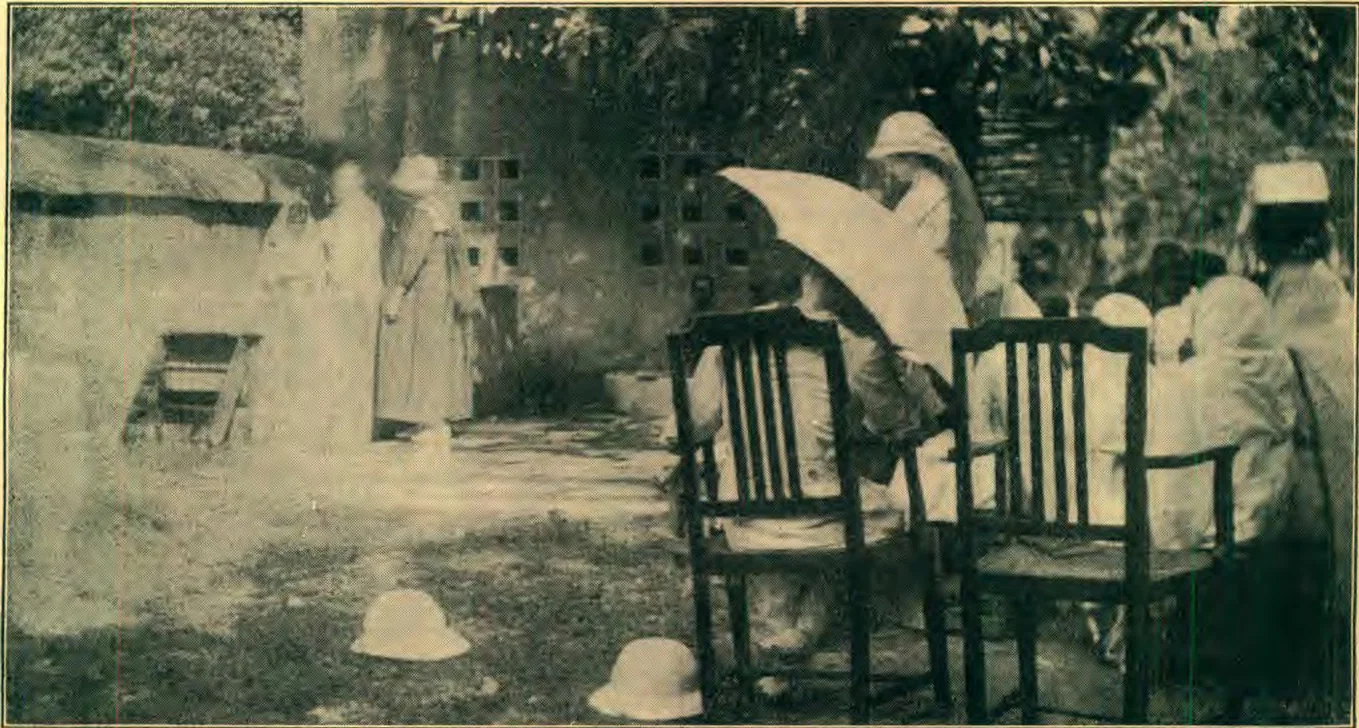
Sir William Crookes, the famous chemist and physician, died in London on April 4.
Pike’s Peak will be ascended by a battle tank as an advertising feature of the Victory Liberty Loan before the loan campaign opens.
President Poincaré has commuted to ten years’ imprisonment the death sentence imposed upon Emile Cotton, who attempted to assassinate Premier Clemenceau.
According to the Associated Press, the Koreans are confident that President Wilson will come to Korea in an airplane, and listen to their pleas for independence from Japan.
Announcement has been made that Mr. Rockefeller contributed $250,000 to a fund being raised by the national committee of Northern Baptist laymen to care for aged ministers and missionaries.
By a majority twice as large as that by which they voted the State “dry” in 1916, Michigan voters recently rejected a constitutional amendment modifying the State’s prohibition laws to permit the sale of beer and wine.
When the duke of Monmouth lost his head on the scaffold after a vain attempt to wrest the throne of Great Britain from his uncle, James II, his widow, Duchess Anne of Monmouth and of Buccleuch, caused the top of every oak in the great park to be lopped off in sign of mourning.
Army nurses are to demand military rank, under threat of refusing to serve in another war. They base their demand upon the fact that without rank they had great difficulty in having hospital orders carried out and even in obtaining satisfactory living conditions for themselves.
Government officials find that moonshining is rapidly shifting from its traditional habitat in the mountain fastnesses of the South to the homes of the people in the cities of the East. The surest and quickest way of preventing the extension of this evil is by educating the people. If there was ever necessity for scattering temperance literature broadcast, it is now.
Baron Roman Romanovitch Rosen, former Russian ambassador to the United States and Russian delegate at the Treaty of Portsmouth, arrived here recently on the Swedish liner “Stockholm.” The baron, with his family who accompanied him, fled from Russia last May, and made his way to Sweden on a British steamship.
A Beautiful Christian Service
By F. D. C.
SABBATH, April 5, will be long remembered by many of the congregation of the Takoma Park church, not merely because on that day eleven young persons were received into church membership, for there have been times when a much larger number of persons, a larger number of young people, have joined the church; but never a day when the receiving of people into the church was made so impressive, so ideal.
Sometimes a person is received when only an announcement of the name and a formal vote to receive him, constitute the entire ceremony. There is no hand of fellowship, no word of real welcome given. Sometimes the candidate is asked to rise in his seat, that those who can see him may have some idea who it is that is joining the church. But neither of these methods are indicative of the real true Christian love and fellowship that should be felt and manifested on such an occasion.
At the service referred to in the opening paragraph the young people who had been baptized the previous evening were asked to occupy the front seats. Then the acting pastor left the platform, and taking his place beside the candidates, presented each in turn to the church, accompanying the presentation by a brief personal sketch of the candidate’s experience, an earnest word of exhortation to him, and a warm handshake that betokened a full welcome into the service of the church.
First, two sisters were asked to rise. The few words sketching their experience at once brought the church into sympathetic relation with them. The young women were living in Florida, when, at the beginning of the war, they answered our country’s call for war workers, by coming to the national capital and securing work in a department of the Government. When they were children, their parents kept the Sabbath, but some years ago gave up the truth for this time.
The young women were invited by former acquaintances to attend the lectures being given by Elder C. B. Haynes at a theater in the city of Washington. These, with the Missionary Volunteer meetings which they attended, soon led them to give themselves to Christ and his service. They hope to be able to reclaim their parents.
After the pastor had passed down the line, with an appropriate word concerning each, and had himself extended to all the right hand of fellowship in behalf of the church, the congregation sang while elders, deacons, deaconesses, and all other officers of the church, with the parents of the young people, passed to the front and spoke an encouraging word and gave a general welcome to the new members.
Surely this method is worthy of being substituted in all our churches for the cold, formal method now in vogue in many places. Its virtue is apparent, for there is no doubt that the young people so received are bound by firmer cords to the church than when received in the more formal way. F. D. C.
Young People in the World's Work
By Genevieve E. Hansen
GENEVIEVE E. HANSEN
Nature in spring brings forth her choicest gifts—the flowers arrayed in their brilliant robes, and the trees adorned with buds and blossoms. At this season the birds sing their sweetest, and the old earth seems fairly radiant with happiness.
Youth is the springtime of life. It abounds in vigor, and possesses a keenness of mind, with varied channels of thought which lead to marvelous discoveries in all realms of knowledge. Then, as at no later period of life, does the heart overflow with joy and throb with zeal and enthusiasm.
It is to this enthusiasm of youth that the world owes a lasting debt of gratitude. “The world in all its affairs,” says Geikie, “is mainly what young men have made it. Manhood and age have taught, but it is the youth that makes the disciples and spreads the doctrines.”
Like the romanticists of literature, youth is dominated by an adventurous spirit and a dislike for set rules. Combined with courage and fearlessness, these characteristics urge them to depart from old traditions and explore new fields. The youth are easily influenced, either for good or evil. This is proved by the fact that more persons take their stand for Christ during the period of youth than at any other time in life.
What can be accomplished by youth who put forth the effort is exemplified in the lives of great men of the past. Cortez was only thirty when he conquered Mexico. Dr. Chalmers was famous at the age of thirty-seven. When only thirty, Reynolds was the greatest portrait painter in England. Ruskin tells us that nearly all the beautiful masterpieces of art were accomplished during the youth of the artists. Not only are there many individual examples, but the lines of activity represented are numerous.
Leadership
King Josiah at about the age of twenty brought about a reformation in Palestine. Joseph as a youth, by his splendid spirit and brilliant statesmanship, guided Egypt through a national crisis, at the same time saving the lives of his kinsmen. Daniel in his youth, though a captive, was appointed third ruler of the kingdom of Babylon. Alexander the Great crossed the Dardanelles and conquered Asia at the age of twenty-one. George Washington was a major in the army at nineteen, and acquired a power of leadership which enabled him to create the Union. Farragut was but a boy of fourteen when he took part in a battle where he performed “the duties of captain, quarter gunner, and powder boy.” Napoleon Bonaparte had revolutionized the map of Europe at the age of twenty-eight.
Music
Many musicians became famous in youth. At the age of seventeen Mozart had gained distinction in the courts of Germany. Beethoven's name was a household word when he was twenty-one. Frederic Chopin was only nine years old when he captivated the great lords and ladies of Poland; and although he died at the early age of forty, he contributed more to the musical world than many who have long outlived him.
Science
The name of Rudolph Hertz ranks high in the world of physics. In spite of his early death at the age of thirty-seven, he made notable contributions to the theoretical phase of this science. James Watt invented the steam engine when only thirty-two, and the inventor of the cotton gin was only twenty-eight when he made his discovery. And there is Thomas Edison! In youth, by his accuracy and persistent toil, he began to give to civilization the greatest number of valuable inventions contributed to the cause of progress by any man.
Literature
Milton, the “sublime poet,” produced many of his great works while young. Shelley is counted a great poet, though he died at thirty. Byron lived only thirty-six years. At the age of nineteen Ruskin had reached the heights of fame in literature. Before John Keats finished his life at the age of twenty-four, he had written poetry which immortalized his name.
Religion
In this, the most important field of all, are found numerous examples of high youthful achievements.4
Luther, at the age of thirty-five, had kindled the fires of the Reformation throughout Germany. The first missionary society in this country was founded as the result of a haystack prayer meeting held by Samuel Mills and three other young men. His work still lives, though he died at the age of thirty-five, on board the ship which was to take him to his mission field. Zwingli, when only nineteen, became convinced that the church needed a reformation. His fearlessness and boldness in expressing his views had far-reaching results. William Carey, “the consecrated cobbler,” is a striking example of fidelity to God. He was a poor young man, and it was necessary for him to cobble shoes for a living, but on one side of his workbench he kept a New Testament, and on the wall a map of the world. He recorded on this map, which he himself had made, all the information he could gather concerning the different countries. Thus, when the opportunity came for him to go to a foreign land,—India,—he was well acquainted with his field. His words, “My business is to save souls; I cobble shoes to pay expenses,” show his earnestness, and his whole life was significant of the spirit which prompted him to say, “Expect great things from God; attempt great things for God.”
The Call to the Youth Today
Christ, the Master Missionary, completed his life work at the age of thirty-three. He it is who today is knocking at the heart of every young person, pleading for a dedicated life. How can we resist his pleading? The greatest thing in the world is the third angel's message; and the highest service is the giving of that message. The opportunities which this service offers are world-wide, and we are told that the youth must be the burden bearers and carry the heavy responsibilities. But the one requisite for effective service is a Spirit-filled life. John says: “I have written unto you, young men, because ye are strong, and the word of God abideth in you, and ye have overcome the wicked one.”
Answering the Call
Never were there greater opportunities or possibilities before the youth than now. The men and women who achieved success in the past were not prodigies. They merely grasped opportunity and turned possibilities into realities by actual accomplishment. Now, as the work of God is reaching its culmination, and the world is entering upon the most enlightened period of its history, God is opening avenues of usefulness hitherto unknown. This is the day of opportunity for us as young people. Let us grasp the strong hand of God and work valiantly, saying with David Brainerd: “I care not where or how I live, or what hardships I go through, so that I can but gain souls for Christ.”
A Dream
By Addie F. Davis
A STATELY church was at my right,
And at my left, a cottage small;
The air was calm, the sky was clear,
And sunshine flooded all.
Above me, in an apple tree,
A little bird was fluttering;
One moment still, the next astir,
With restless, tireless wing.
Just then, from out the church door, came
The peal of music, full and grand;
Sweet voices, loudly chanting words
I could not understand.
I raised my eyes; the tranquil air
Above my head had not been stirred;
The little bird was restless still,
It had not heard a word.
And then this knowledge came to me:
Vile hidden discords lurk within
Those singers’ hearts, and as they sing,
A jarring chorus din.
And so their songs which, otherwise,
Would rise, like morning mists in air,
Fall fainting to the earth, and die,
Nor leave an echo there.
A moment, and from out the door
Of that small cottage, floated low
A tender song — a lullaby,
Sung lovingly and slow.
A flutter overhead! and lo!
The little bird began to sing!
The clear notes bubbled from its throat
Like water from a spring.
And looking up, behold! the gates
Of distant heaven were opened wide,
And white-robed angels thronged to hear
The songs from every side!
And then I heard a sweet voice speak:
“Full well, today, thou hast been shown
How hardly songs can rise to God,
With one discordant tone.
“If thou wouldst sing, first let thy heart
Be free from envy, pride, and hate;
For they are discords which will cause
Thy songs to jar and grate.
“But welcome love; for when love dwells
Within a heart, it can but sing:
And when it sings, e’en heaven itself
Bends earthward, listening.”
— Addie F. Davis.
The Soul of a Bell
By Harold L. Graham
Of all heroic deeds none can compare with the voluntary yielding of a life to save that of another. In the past the apparent apathy of the superstitious Chinese to assist in saving the lives of strangers in peril was due to a belief that to do so would interfere with Fate, that elusive and heartless thing by which the lives of all are ordered, and conflict with which would result in bringing dire calamities upon the head of the would-be rescuer. Even in recent years the government of Hongkong has found it necessary to insert a clause in the junk-clearances issued in that colony, by which the boatmen are bound to assist to the utmost in saving life.
The Tower That Contains the Bell
However, Chinese history and tradition have preserved stirring instances of personal sacrifice, especially when the one in danger was a near relative. The paragraphs which follow give an outline of a fascinating story preserved and narrated by the priests in the famous Bell Temple of Nanking.
A little more than five hundred years ago the Yuan dynasty was succeeded by the famous Ming dynasty in China. The first Ming emperor, a wise and efficient ruler, extended the boundaries of the Middle Kingdom to their widest extent, and through his wise policies of government, caused the empire to prosper.
At one time this emperor conceived the desire of having several immense bells made. Accordingly, he ordered from a famous bell maker of Nanking, at that time the nation's capital, three bells, which were to be larger than any bells that had ever been cast in the empire. The bell maker hastened to fulfil his emperor's wishes, but on account of their great size, repeated attempts to turn out perfect bells were fruitless. At last, fearful of the spoiling of his property, or perhaps of the loss of his head, he petitioned the gods for aid in his endeavor. He was advised by the local priests that in a case where the bells were so large the gods would require the sacrifice of one of his daughters for each perfect bell completed.
He returned to his home, prepared again his molds, heated the metal, and at the right moment opened the sluices which carried the glowing stream from the furnace to the first mold. According to tradition,5which is firmly vouched for by the Chinese to this day, one of his daughters, standing near by watching the fiery liquid with its attendant column of smoke and hissing gases, suddenly leaped to the edge of the mold and cast herself headlong into the molten mass, quickly to be carried by it into the forming bell.
Two more bells of the same size were cast, and in like manner two other daughters of the bell maker voluntarily sacrificed their lives that their father might have success in his endeavor to meet the demands of the emperor.
In later years one of the gigantic bells was carried down the Yangtze River to the sea, there to be cast in as an offering to the gods. The second bell was destroyed during one of China's revolutions. Today, inside the great walls of Nanking stands the Da Djung Ting temple, in the courtyard of which is a bell tower. Here may be seen the third of the large bells which, if we can rely on Chinese tradition, contains a human sacrifice. It is constructed after the peculiar pattern of all Chinese bells, which custom has decreed shall be of uniform width from top to bottom, not increased in size at the lower end, as are those with which we are familiar. Sixteen feet in height, eight feet in diameter, and approximately eight inches in thickness throughout, the mammoth bell testifies that its construction was a difficult and wonderful piece of workmanship.
Of more interest than the bell, perhaps, is a small room in the temple before mentioned. Here are three wax figures, life-size, representing the girls who gave their lives to save their father. They are dressed in royal apparel and have crowns upon their heads. They present a most dignified appearance as they sit before a table upon which is kept an abundant supply of food and fresh fruits. To this room come the Chinese women to bow down before the images and worship the spirits of these who verily lived up to the tradition of filial piety, so dear to the Chinese heart.
To these simple worshipers, and the countless millions in China, who worship they know not what, are we sent to tell the story of the love of God and the great sacrifice of his Son, Jesus Christ; and the part of the story which appeals the most is, “For when we were yet without strength, in due time Christ died for the ungodly. For scarcely for a righteous man will one die: yet peradventure for a good man some would even dare to die. But God commendeth his love toward us, in that, while we were yet sinners, Christ died for us.”
And the gospel is finding a response in the hearts of many of these dear Chinese people, who after long years of serving their wooden gods, are for the first time finding that real joy and peace which comes to those who serve Jehovah, the God of love. Friends, pray earnestly that in the short time remaining, this saving message may be carried to every soul in this dark land who is seeking for light, and that the workers may have divine wisdom and strength to labor in the most effective way. HAROLD L. GRAHAM.
Fruit of Our School Work
By Della Stevens
DELLA STEVENS
HAPPY indeed was the New Year’s Day that ushered in 1919. The boys and girls of our Bengali school assembled at the baptismal font in the girls’ school compound to witness the baptism of several students.
After a very helpful New Year’s sermon by Pastor Burgess, six girls and one boy were buried in baptism.
During the past two years thirteen girls and fourteen boys have been baptized. Other girls are waiting for their parents’ consent before taking this step.
BAPTISM AT THE SEVENTH-DAY ADVENTIST BENGALI GIRLS' SCHOOL, CALCUTTA
This year two of our young men have been sent out as evangelists. Last year one was sent out as a colporteur, in which work he has proved a real success. Another has been employed in our tract society office. One of our girls went to our Karmatar dispensary to help in the work. Thus our schools are already bearing fruit.
We feel to praise God when we remember that three6years ago our Bengali young people were growing up without a knowledge of present truth. Our girls were lost to us through marriage, whereas this year one of the schoolgirls married a young man engaged in the printing work at Lucknow.
By the blessing of God we hope many of our young people will receive a training that will fit them to give the message to their own people.
Lessons from the Storm
By Grace E. Bruce
ONE rainy day in early spring, while walking along an old abandoned wood road that wound its way through the dripping forest, I became deeply interested in reading, as from an open book, a few of nature’s testimonies to the presence of One whose wisdom is revealed in his created works.
The tiny life-giving raindrops, falling so thick and fast, and making a soft pitapat, as if millions of little feet were tripping through the evergreens and over the dead brown leaves, testified that a God “great in power,” whose “faithfulness is unto all generations,” “who giveth rain upon the earth, and sendeth waters upon the fields” (Job 5:10), had opened the windows of heaven. Each pearly drop contained a blessing, and a promise for seedtime and harvest.
As I stood alone in the dim lights and deep shadows of the rain-swept forest, listening to the voices of the storm, wonderful and marvelously beautiful seemed the works of this great Master Artist. With heart filled to overflowing with gratitude to the Author of every created thing, I softly repeated the words of the psalmist: “O Jehovah, how manifold are thy works! In wisdom hast thou made them all: the earth is full of thy riches.” Ps. 104:24.
Balanced on the topmost branch of a vine maple that stood far up on the mountain side, an early bluebird began singing his spring song in notes so loud and clear that the gloomy aisles of the wood fairly rang with sweet melody. The wind was cold, and I knew that ice would yet spread a thin covering over the still pools, and that probably white snowflakes would whirl thick and fast through the fields and meadows and load the evergreens once more. Yet swinging there in the chilly breezes, this little songster bravely lifted his head to the dripping heavens, and poured out his soul in a ringing testimony to the tender love and watchcare of Him upon whom “the eyes of all wait,” who opens his hand and satisfies the desire of every living thing. (See Ps. 145:15, 16.)
It is easy to sing when the sun is shining, but quite a different matter when the low-hanging clouds of trouble or discouragement shut out the brightness.
The noisy mountain stream dancing down the hillside gave testimony of the One who “sendeth out his word” and “causeth . . . the waters to flow.” Ps. 147:18.
Standing beside an old log that was covered with thick green moss, I gathered several long, dainty pussy-willow whips, and these testified of the love of Him who first planted the “willows by the water-courses.”
The wonderful book of nature contains rare treasures. Let us study it more frequently, and learn more and still more of the wisdom and love of the Creator.
GRACE E. BRUCE.
Honesty
By Ruth M. Everett
DID you ever let a drop of black ink fall into a glass of water? If you have not, try it. You will find that the ink spreads slowly until the entire glass of water is colored. Add another drop of ink. The water gets darker. Two or three more drops will make the water appear as black as the ink itself.
It is the same with dishonesty. One small dishonest act may appear very small indeed, yet it makes a mark on our characters. Another dishonest act makes a greater mark. Two or three more will have the same effect as the drops of ink in the glass of water.
There were once two little boys who lived next door to each other. They were great friends. They went to school together and played together. Apparently they had the same opportunity for a very successful life, for they were both bright lads.
One day on their way home from school they passed a fruit stand, where many kinds of fruit were attractively displayed. Neither of the boys had ever stolen anything, or had even thought of doing such a thing, but the temptation to eat one of the big oranges they saw was too strong to overcome. They waited until they were sure no one was looking, and each of them took one, and ran around the corner as fast as he could go.
The boys waited until they reached home to eat the stolen fruit. Thinking they were safe there, they were not careful where they threw the peelings, and their mothers found them. One mother laughed, and called her son clever. The other took her son back to the fruit stand and made him tell the owner what he had7done, and pay for the orange. It was a lesson he never forgot. Whenever he was tempted to steal again, he thought with shame of the time he had paid for the orange he had stolen, and of the attitude his mother had taken toward dishonesty.
Many years later a prisoner was on trial. He was brought into the courtroom and sentenced to twenty years' imprisonment for attempting a daring robbery. After pronouncing the sentence, the judge looked at the prisoner, who was a very young man, and asked him if he would tell how he first learned to steal.
The prisoner looked at the judge, and then at the people in the courtroom who had assembled to hear his trial. This was his testimony: “When I was a boy, I stole an orange. I was called clever. I have been stealing ever since.”
His mother never knew the result of her attitude toward that little dishonest act. But it had its effect, and that boy's life, which might have been an honor to the world, was ruined and made worthless.
To be honest is to be sincere, fair, frank, and open, not only in the big things, but in the little things as well. We admire honesty in every one, but we do more than admire it; we consider it an essential trait of character which every one must have. If we know any one who is guilty of a dishonest act, even though it be small and no one else knows it but ourselves, we do not trust that person very far, do we? Therefore we should be honest ourselves.
Our lives are like that glass of water. Every dishonest act adds a drop of ink, and soon our lives become darkened by the many little dishonest acts we allow to creep in. Perhaps we would never steal, but we might do other things that are just as dishonest.
Dishonesty is always found out; if not at the time, it will be later. Be honest at all times. Be sincere. Be true. If you are honest, sincere, and true to yourself, you will also be to others.
RUTH M. EVERETT.
The Dedicated Threepence
By W. A. Spicer
THESE believers in the islands have the spirit of sacrifice for the work of God,” said Mrs. George L. Sterling, at the Australasian Conference. Then she told the story of a sister of the Cook Islands and her dedicated threepence for missions.
“Papa, was her name,” said Mrs. Sterling, giving the a the short sound. “She was a sufferer from elephantiasis. It was hard for her to walk.
“She was poor; and the care of three children was a heavy burden upon her. Some friend gave her threepence.
“‘I am going to put this away for the Sabbath school,’ said Papa.
“But her little girl was hungry one evening.
“‘I want some bread,’ said Ruth; ‘give me the threepence.’
“‘No, my child,’ said the mother; ‘that threepence is to go to the Sabbath school for missions.’
“The little girl cried.
“‘Don’t cry, Ruth,’ said the mother. ‘I cannot help it. That money is given to the Lord. You just go to sleep, and the Lord will send us some bread.’
“So little Ruth went to bed, and early next morning the missionary came along to visit them, bringing a loaf of bread. When old Papa saw it, she burst into tears.
“‘The Lord sent it to us,’ she said; and then she told the experience of the night before and of her prayer to God for some way of getting the bread without having to touch the money dedicated to the missionary collection.”
As our missionaries talk of the newly found brethren and sisters of ours in the island fields, it is plain that the plant of genuine faith grows strong and hardy wherever rooted in hearts in these regions where the isles have been so long waiting for his law.
W. A. SPICER.
A Definition of Bolshevism
By C. P. Bollman
BOLSHEVISM is derived from the Russian bolsheviki, meaning the majority, as contrasted with the mensheviki, or minority. These terms began to be used in a political sense in Russia in 1903, when the Social Democratic party split into two factions. The radicals being in the majority were the bolsheviki, while the conservatives, or state socialists, being in the minority, were the mensheviki.
Bolshevism instead of being anarchistic, as many have imagined, is the very antithesis of anarchism. “Anarchy” means without a head; and as applied to a political philosophy, it means opposition to all government. Bolshevism is a political doctrine of philosophy that teaches that government should be administered by the majority; and further, that as the proletariat, or the whole body of the working people, constitute the majority, they, and they only, should administer government. Further, Bolshevism, which is the most radical form of Socialism, teaches that the only way to avoid class rivalry and strife is to abolish classes, and so have but one class, necessarily the proletariat, or working class. It is to the ruthless determination of the Bolsheviki to put into practice this particular tenet of their philosophy that the reign of terror in Russia is due. They believe that the end justifies the means, therefore they stop at nothing that seems to them necessary to destroy the middle and upper classes, that only the proletariat, or working class, may remain.
This does not necessarily mean the death of the bourgeoisie individually, nor even of the aristocrats, for either or both may join the working class, but it does mean the utter extinction of the middle and upper classes, as classes.
As Leon Trotzky himself explains it, to do less than this would be to fail utterly of changing conditions. He says: “If Socialism [by which he means Bolshevism] should attempt to create a new human nature within the limits of the Old World, it would be only a new edition of the old moral Utopias. The task of Socialism [Bolshevism] is not to create a socialistic psychology as a prerequisite to Socialism, but to create a socialistic condition of human life as a prerequisite to a socialist psychology.”
In other words, Mr. Trotzky would by reducing human society to a single class, set the whole world to thinking in the terms of that class. This he believes would forever abolish class rivalry, and make life not only tolerable but easy for all. C. P. BOLLMAN.
When We See and Understand
By Eugenia Ralston
A LITTLE noisy stream,
Whose waters dance and whirl;
A little stretch of wood;
A little boy and girl.
Beside them on the grass
A trap most deftly set,
To catch within its walls
A squirrel for a pet.
One saucy frisker's play
They watch with eager eyes.
O what a joy to them
To capture such a prize!
With nuts and grains and things
That surely squirrels love,—
Sir Frisker watching all
From leafy bough above,—
They bait their trap with care;
Then hide themselves awhile,
In hopes the tempting feast
The creature will beguile.
A little clicking sound —
So faint it scarce was heard;
But when they went to see,
They found they'd caught a bird.
A prison flutter wild,
And sharp, distressed cries,
Confront their eager haste
To view their captured prize.
“O brother, hear it cry!”
The little maiden said.
Her tender loving heart
In quick compassion bled.
“Do let it go again!
It trembles, too; just see!
What if some great big man
Should shut up you and me!”
Another clicking sound —
And off had flown the bird,
With quite the gladest notes
That they had ever heard.
The scene was still the same:
The brook went dancing on;
But boy and girl were changed,—
Their selfish plans were gone.
And Frisker overhead,
So happy and so free,
Just whisked his bushy tail
And chattered in his glee.
EUGENIA RALSTON.
Daddy’s Money
By Anna Kilpatrick
SOMETIMES my daddy likes to tease,
And takes me by surprise;
I can’t always tell his jokes,
Unless I watch his eyes.
The other day he said: “My boy,
Where did you get those clothes?
Who bought that hat that you have on,
Who gave you the shoes and hose?
“Who bought the food that gives you life?
Who bought this house and lot?
Who paid for furniture and rugs?
Who gave you your little cot?”
“Why, you did, daddy,” I answered back;
You bought it all—and more.”
“Then—don’t you love me better’n mother?”
But I looked down at the floor.
Then I looked up at mother,
And she looked back at me;
And, somehow, before I knew it,
I was up on mother’s knee!
And daddy’s eyes just crinkled up—
I saw he would understand—
’Cause he had a mother once, himself;
He ain’t always been a man.
’Course, I don’t love my mother best;
I love them just the same.
But there’s something ’bout a mother
That a boy just can’t explain.
It’s something sorter tender—
You can’t tell it if you try.
It’s things that mothers do for boys
That daddy’s money cannot buy!
— Anna Kilpatrick, in Christian Observer.
A Mother's Day Meditation
By Charles Dehaven Bulla
I do not remember when my eyes first looked upon her beautiful face. I have heard that she went down to the valley of deep darkness to bring me from God's everywhere into the here. When I found myself in the country home, she was with me. She drew me close to her warm bosom and spoke gentle words. I have not found those words in my books; but I knew their meaning from the first, and they comforted me.
I soon learned that a low cry brought her to me; and when she came near, hunger and cold and fear vanished. Often, when she looked down into my eyes as I lay in the cradle, her lips moved, though I heard not a word. Whether baking or sewing or spinning or reading, she was never out of reach of the high chair. It is written: “He shall give his angels charge over thee.”
For a long time I was not farther from her than the length of her apron string. It reached to the yard. She watched me from the porch as I played on the carpet of soft grasses and gathered posies and listened to the song birds in the trees that shaded our home. That narrow strip of gingham reached to the schoolhouse across the bridge. She gave me a basket lunch, and I walked through the snows in the little boots with red tops and copper toes. Seated near the teacher's desk, for reasons good to the pedagogue, I looked through the windows of the “Elementary Spelling-book,” by Noah Webster, LL.D., into Wisdom Land.
That apron string stretched out to the village church. When the great bell rang on Sunday morning, she took me to the services. Sometimes, as the good man prayed or the people sang, she shouted. I did not know why she said “Glory” and “Hallelujah,” but her face was bright, and she said she loved everybody. At such times I thought she might go away into the blue skies, and was glad when she became quiet and put her arms about me, saying: “God bless my boy!” She gave me money with which to buy a New Testament. My sister taught me the “Blesseds” by heart; and, because she did, I know more about humility and penitence and mercifulness and singleness of purpose, for those gracious words spoken by Jesus on the mount have never left me.
The time came when I heard somebody say: “A fellow shouldn't always be held by an apron string.” I was sorry to hear anybody say that, because, at the other end of one apron string, was the best friend I ever had. The slightest pull at my end of the string brought her to my side, day or night. She bound with soft bandages and balm all my hurts of hand and head and heart.
Later on I heard about a land of gold and sunshine and flowers, beyond the village and church steeple, on the western sky line. One foggy day, when I did not see clearly, I slipped my hand from the loop of the apron string and wandered far in that twilight country. I saw many strange and interesting things, yet I was not happy. I had money in my purse, but it did not buy the things I needed. When I prayed, the only answer was a voice saying: “They love and miss you at home.” Something kept tugging away at my trunk until I started back to the home of my childhood. It was bright and cheery at the old fireside. A new life began to course through my veins. I slipped my hand into the loop of the apron string, to remove it again never, please God. Since then, I have journeyed far at the call of duty, but again and again a slight tightening of the apron string has brought me into companionship with the guardian angel of my whole lifetime.
As I write, she sits in an easy-chair in a sunny room in my home, reading the church hymn book. It is her ninety-third birthday. The Lord has been her sun and shield. He has given her grace. He will give her glory. Soon she will leave me to visit again the old homestead. If the switchman should turn the train into the air-line tracks, I shall find her by the gentle drawing at my heart. Of course I have been thinking about my mother. I do not forget that my children have a mother. I am almost sure there will be a Mother's Day in that sweet and blessed country. —Charles Dehaven Bulla, in the Adult Student.