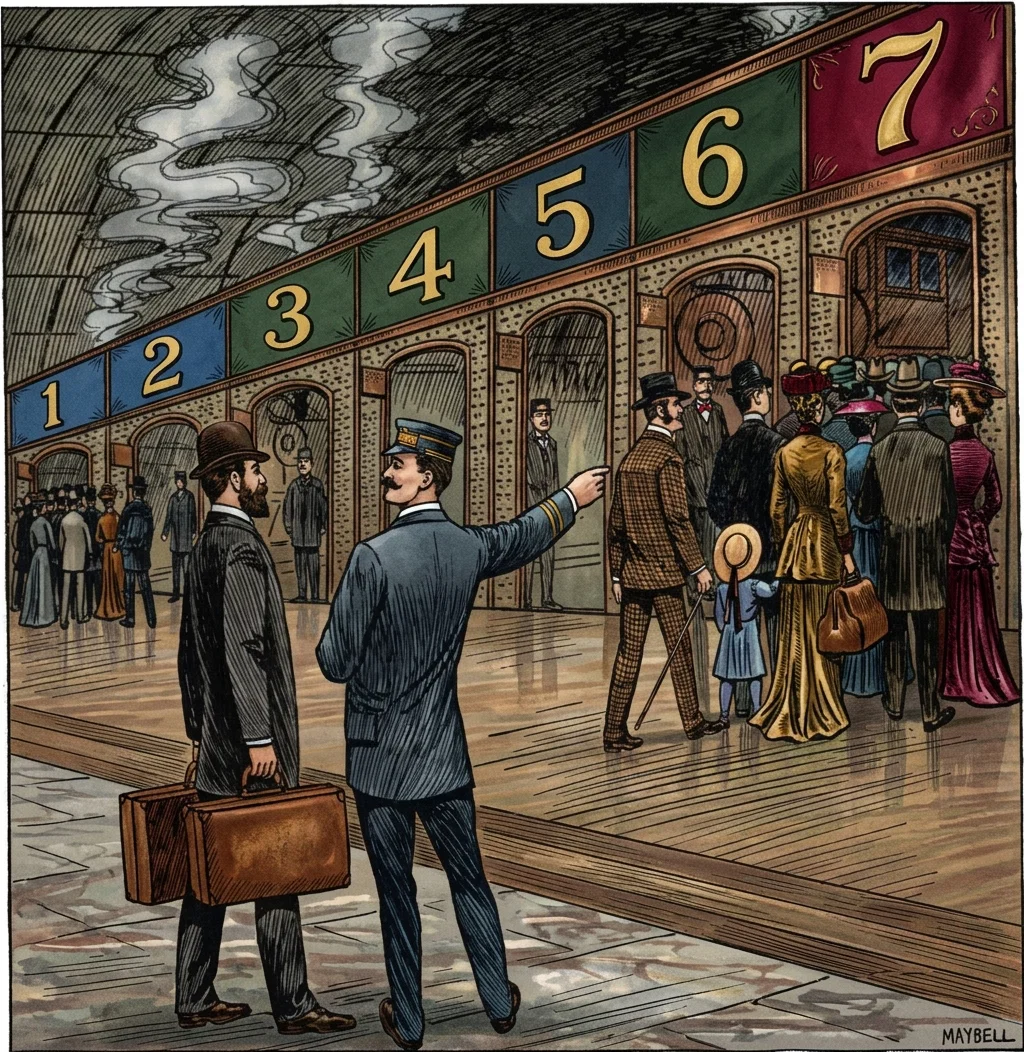
A REVEREND gentleman has just finished a sermon on the Sabbath question, in which he has told the people “that the seventh day, mentioned in the fourth commandment of God’s law, which the Lord hallowed and sanctified, is one day of the week, but no particular day. It is just owing to where we begin to count. If we begin with Sunday, then Saturday becomes the seventh day; but if we begin with Monday, then Sunday is the seventh day. We begin to count with Monday, hence Sunday becomes our seventh, or Sabbath day, and we hallow it.”
THE SEVENTH OR A SEVENTH.
Now this man’s conclusion is not far from the truth after all.
He says, “We begin to count with Monday, and hence Sunday is our seventh, or Sabbath day, and we hallow it.” Observe that it is “we,” the people, not God, that call Monday the first day of the week, and hence Sunday does become man’s sabbath, not God’s; and man hallows the Sunday sabbath, not the Lord. How much better to begin to count with Sunday, God’s first day of the week, and then Saturday becomes the Lord’s seventh day, or Sabbath, the day which the Lord has hallowed, or made holy. We are not told to hallow the day but to keep it holy. God has hallowed it, and He only can make anything holy. How much better to remember and keep holy the day of God’s appointment, the day He has sanctified and made holy. To do so would be obedience to God, while to do otherwise would be obedience to man, or
To further illustrate the one-day-in-seven-and-no-day-in-particular theory, suppose there are seven married women sitting together in one pew, before the reverend gentleman above referred to; one of them, the first one, counting from the aisle is the minister’s own wife. The others are the wives of other men in the congregation. At the close, the minister announces his next appointment as follows: “I will preach from this pulpit next time at 11 A.M. on, ‘One day in seven, but no particular day.’ Be sure to all come.” Instantly after the benediction is pronounced, six men rush to the front pew where the seven women are sitting. Mr. A steps up to the woman next the aisle, the
minister’s wife, saying to her with much feeling, “Come, my dear wife, let us now go home.” Instantly the minister exclaims, “Stop, Brother A, that is my wife, how dare you call her yours? Your wife is the seventh in the pew.” Brother A replies, “Surely, my dear pastor, you have forgotten the important lesson you taught us to-day. I am so glad I was here to learn that the seventh is no particular thing, all owing to where you begin to count. Before I heard your beautiful sermon I thought my wife was indeed the seventh in this pew. But after the sermon, I see that the seventh was determined by just where we begin to count. And I was glad, and I said, I will begin to
practise your teaching at once. I saw your wife sitting next the aisle as number one, but by beginning to count with number two, I found this dear sister was number seven, and I was so glad, for the number seven whom I had always called my wife is rather old-fashioned and not at all popular, but I always admired this seventh one, for she is popular, and generally esteemed.”
The other five men were in like trouble in the attempt to make a practical application of the pastor’s theory. Only confusion would be the result of a practical carrying out of such a theory in all the affairs of life. In like manner the practical application of the one-day-in-seven-and-no-day-in-particular theory of Sabbath observance would result in endless confusion in the service of God. Is God the Author of confusion?—He surely is if that theory is applicable to the fourth commandment.
Now it must be apparent to every sound mind, that if one of the seven women in that pew is the minister’s wife, that person is a particular woman as surely as he is a particular man. His wife would be the particular woman that the Lord gave him to be his wife, ever to be loved and cherished as the gift of God. In like manner if one day of the seven days of the week is the Lord’s holy Sabbath made for man, by him to be loved and cherished as the gift of God, it must be a particular day, or it is no day at all.
How could the Lord hallow one day in seven and no particular day? Could we make a present to one of seven persons but to no one in particular? Could one of seven children die, unless it was a particular child? If no particular child died, would it not be a fact that no child died? Most assuredly. Hence it follows irresistibly, that if ever the Lord hallowed or sanctified a day at all, it was a particular day. And as it is a fact that God did bless and sanctify the seventh day, it must be a particular day.
Furthermore, it would seem obvious that the sermon above mentioned would prove the minister’s farewell, if the people remembered the appointment afore mentioned, for how could they ever know when to go to hear his next sermon at 11 A.M. on one day in seven, and no day in particular?
We can not learn too soon that when God speaks He means what He says, and that His word is not to be trifled with or lightly regarded. Implicit obedience to His word will never cause confusion, but the most beautiful harmony. All friction and confusion are the results of transgression. When Elijah was accused by King Ahab of troubling Israel, Elijah instantly replied, “I have not troubled Israel, but thou and thy father’s house, in that ye have forsaken the commandments of God.” Thus it always is, and always will be, that transgression, sin, is the root of all trouble in the world, of whatever name or nature. And the Gospel of Jesus is the only remedy.
H. A. St. John.
Are You Sowing to the Flesh?
1. What eternal law of moral conduct is continually demonstrated in nature?
“Whatsoever a man soweth, that shall he also reap.” Gal. 6:7. “To every seed his own body.” 1 Cor. 15:38.
2. What will he reap who sows to the flesh?
“He that soweth to the flesh shall of the flesh reap corruption.” Gal. 6:8.
3. To what is the flesh contrary?
“For the flesh lusteth AGAINST THE SPIRIT, and the Spirit against the flesh; and these are contrary the one to the other.” Gal. 5:17. “The carnal [fleshly] mind is enmity against God; for it is not subject to THE LAW of God, neither indeed can be.” Rom. 8:7.
4. What are the works of the flesh?
“The works of the flesh are manifest, which are these: Adultery, fornication, uncleanness, lasciviousness, idolatry, witchcraft, hatred, variance, emulations, wrath, strife, seditions, heresies, envyings, murders, drunkenness, revelings, and such like.” Gal. 5:19-21.
5. What will be the result of such sowing?
“They which do such things shall not inherit the kingdom of God.” Gal. 5:21. “He that soweth to the flesh shall of the flesh reap corruption.” Gal. 6:8. “To be carnally minded [fleshly minded] is death.” Rom. 8:6.
6. In this respect, what does a man truly do?
“They eat of the fruit of their own way” and are “filled with their own devices.” Prov. 1:31. “The backslider in heart shall be filled with his own ways.” Prov. 14:14. “He that soweth iniquity shall reap vanity [nothingness, death].” Prov. 22:8. “Hear, O earth; behold, I will bring evil upon this people, even the fruit of their thoughts, because they have not hearkened unto My words, nor to My law, but rejected it.” Jer. 6:19.
7. That we may be saved from such a fate, what faithful warning does God give us?
“Be not deceived; God is not mocked; for whatsoever a man soweth, that shall he also reap.” Gal. 6:7.
The Bible versus Socialism
By Geo. E. Vadney
IN making the statement that “before Socialism can triumph, religious faith must be destroyed,” Robert Blatchford, editor of the Clarion, a Socialist paper of London, Eng., and one of the most prominent of present-day teachers of Socialism, uttered one of the most truthful statements ever made concerning that doctrine, for Socialism and the Bible stand as directly opposite to each other as do darkness and daylight.
Socialism is merely a theory based on evolution, impracticable in its every conception,—a theory which is the invention of a finite mind discontented with its environments. It is espoused by dreamers, while the Bible is composed of the master-thoughts of an infinite mind endowed with the power to bring about the creation of innumerable planets and to fix the destiny of the living souls upon them.
It contains the fundamental principles of every code of laws, both theological and secular, in Christendom; and its truths have carried the children of God through trials and tribulations which the pen is inadequate to picture or the tongue to describe.
The ultimate aim of Socialism is to bring about universal government in which there will be no distinction between capital and labor, all the great industries will be owned and operated by the people, and envy, strife, and contention will be eliminated from the world. The desire is commendable.
Yet by reading the history of the world, we find that from the earliest dawn of creation down to the present day there has never been a time when the human race has not been torn and tossed by the jealous passions of mankind; and the only prophetic account of such a time that can be found in the Bible, is the description of life in the new earth, beginning at the close of the millennium and lasting throughout eternity.
Then, and then only, does it say that “the mean man shall be brought down, and the mighty man shall be humbled, and the eyes of the lofty shall be humbled. Then shall the lambs feed after their manner, and the waste places of the fat ones shall strangers eat.” Isa. 5:15-17.
And even this is vastly different from the socialistic dream; for in the new earth we will be subjects of the kingdom of God, subject to the laws of God, and shall have a king upon the throne in the city of the New Jerusalem in the person of our Lord and Saviour Jesus Christ.
We learn from the Scriptures that if we would in any degree attain that blissful state of existence which it is claimed will be the culmination of the present Socialist propaganda, each and every one of us must come into harmony with God and have the ways of God.
But instead of this harmony now, we find in the holy word that God Himself has said: “For My thoughts are not your thoughts, neither are your ways My ways, saith the Lord. For as the heavens are higher than the earth, so are My ways higher than your ways, and My thoughts than your thoughts.” Isa. 55: 8, 9.
The fact that the adherents of Socialism make the assertion that under a Marxian form of government, there would be no contention between capital and labor, and that there would be no rich or poor, but that all men would be upon an equal basis, and each one receive the wealth that he produces, should of itself be conclusive proof to every student of God’s word that Socialism is an impossibility; for the Bible positively states that when the great day of the Lord’s wrath is come, “the kings of the earth, and the great men, and the rich men, and the chief captains, and the mighty men, and every bondman, and every freeman,” shall hide “themselves in the dens and in the rocks of the mountains.” Rev. 6: 15. There are all the classes still.
That avarice, envy, and strife will not be eliminated from the world is prophesied by the apostle Paul, in his second epistle to Timothy, in which he states “that in the last days, perilous times shall come. For men shall be lovers of their own selves, covetous, boasters, proud, blasphemers, disobedient to parents, . . . lovers of pleasures more than lovers of God.” 2 Tim. 3: 1-5.
Instead of being inspired by the words of Christ, “Blessed are the meek: for they shall inherit the earth” (Matt. 5: 5), the hearts of many Socialists of to-day are filled with envy and bitterness toward their neighbors who have been more fortunate in gathering unto themselves a store of worldly goods. This is in direct opposition to the admonition which says, “Be patient therefore, brethren, unto the coming of the Lord.” James 5: 7. The present increasing impatience and envy and discontentment, will, if continued, inevitably involve the world in the horrors and bloodshed of universal war, which will not end until the living wicked are destroyed by the brightness of Christ’s coming. 2 Thess. 2: 8.
The Socialists inform us that the next fifty years will bring about the realization of their dreams; but the Lord states that many and various signs, as recorded in Matthew 24 and many other scriptures, are sure forerunners of that great and awful day of God, and that this generation is the last that this earth in its present condition shall know. Therefore, instead of looking for a time of peace and prosperity as predicted by Socialism, we should look for the glorious appearing of our Lord in the heavens, and prepare ourselves to inhabit a heaven on the earth made new.
While we all may yearn for a time when there shall be no trusts and combines, no perplexing question of capital and labor, where there shall be no strikes or wars, and where the flag of anarchy will never wave, and where the hand of tyranny has been stilled by the stroke of an everlasting death, those of us who study God’s word should know that the only confederacy, the only union, or the only party that God recognizes, is the one that accepts for its platform the unchanged and unalloyed word of the living God.
The only ones who shall live in that glorious kingdom, which will be lighted by the glory of God, where the nations of those who are saved shall walk in the light of it, where there shall be no night, and where there shall in nowise enter anything that defileth, neither whatsoever worketh abomination or maketh a lie, are those who are written in the Lamb’s Book of Life (Rev. 21: 23-27), those who have kept the commandments of God and have observed every precept of His word.
GEO. E. VADNEY.
In the World, But Not of It
By F. G. Peabody
TO RUN away from the tendencies of modern life, that is easy enough; to yield to its evil, that is still easier. But to be in the world, yet not of it, molding its material, yet not defiled by it—that is the real problem of the modern Christian.—F. G. Peabody.
No Antagonism Between Mind and Matter; Christian Science
By R.
THE great foundation of Christian Science may be put in three words: “All is mind.” All that Christian Scientists believe is embodied in this statement; all that they deny is excluded by it.
On the expression, “All is mind,” Christian Science must stand or fall.
Assuming that all is mind, they exclude matter, and deny its existence. Having thus disposed of matter and things material, they are bound to give some sort of explanation of material phenomena, and this they do by declaring that it is all a myth and an illusion of mortal mind.
The references that follow are from Mrs. Eddy’s book, “Science and Health,” paragraphs seven and eight of the chapter “Science of Being.”
In paragraph seven she states that either everything is matter or that everything is mind, and asks, “Which one is it? Matter and Mind are antagonistic, and both have not place and power.”
The statement that matter and mind, per se, are antagonistic is not correct; it is not true. Neither the Scriptures nor nature teaches such a thing. But it is true that matter does not have power, it is not an originator of force. Matter is inert. But matter is always entirely responsive to power. And in this response of matter to power or mind lies the agreement and harmony between the two.
By acting obediently under the impulse of invisible power and invisible thought, the invisible is made manifest through the conduct of the visible. “For the invisible things of God, His divine power and character, from the creation of the world, are clearly seen, being understood by the things that are made.” Rom. 1:20 (literal rendering). Creation brought the invisible to light; the visible, the things that are made, manifests the invisible, the things of God.
Matter is obedient to the word and thought of God; that is, it is obedient to the mind of God. “Harken unto Me, O Jacob and Israel, My called; I am He; I am the first, I also am the last. Mine hand also hath laid the foundation of the earth, and My right hand hath spanned the heavens: when I call unto them, they stand up together.” Isa. 48:12, 13. This word shows how completely obedient matter is when once God speaks; matter obeys the mind and word of God. “By the word of the Lord were the heavens made; and all the host of them by the breath of His mouth.” “For He spake, and it was done: He commanded, and it stood fast.” Ps. 33:6, 9. If this does not present a picture of perfect obedience to God on the part of the material world, it presents nothing. Here is another view of a similar work: “The waters stood above the mountains. At Thy rebuke they fled; at the voice of Thy thunder they hastened away (the mountains rose, the valleys sank down) unto the place which Thou hadst founded for them. Thou hast set a bound that they may not pass over; that they turn not again to cover the earth.” Ps. 104: 6-9, A.R.V.
Against these plain statements of the word of God, we have Mrs. Eddy’s statement that “matter and mind are opposites. One is contrary to the other in its very nature and essence.” We beg leave to say on the authority of the scriptures given above and on the authority of many others of the same import which might be given, that mind and matter are not opposites; matter always obeys mind, some mind, for without mind, it is inert, impassive; when the Master Mind speaks, it responds.
There is no antagonism between mind and matter, because matter is the servant of mind. It is vibrant with power. The whole material creation is marvelously elastic, and moves with every impulse of force. A dozen electric currents may be sent over the same telegraph wire without confusing them or interfering with the individuality of any one of them. Rigid glass will rise to meet the touch of your blood-warmed finger.
But some one will here interpose the query, “Then why does not man, a material being, obey Him?” The query is a good one, and the answer should be given. Whenever God speaks to matter, pure matter, it always obeys Him. In proof of this we have but to recall the texts already given, and to further refer to the work of Christ. The material world always obeyed the word of Christ, whether it were wave or storm, whether water or bread, whether bodies weak with disease or still with death. Matter, as matter, is not in conflict with spirit; no example of such conflict can be given.
Where is the conflict? Where is the disobedience? It lies in the conflict of human mind against the divine mind. The conflict is not of matter against mind, but of one mind, the perverted mind, the carnal mind, in opposing the divine mind. Not the slightest evidence from reason or revelation or the world of fact can show any opposition between mind and pure matter. The matter of my body in obeying my mind, may not obey the divine mind, but this is because the divine mind does not speak directly to the matter of my body; it speaks to my mind, and bids me to order the matter of my body in conformity with the divine mind. If I refuse, it is not matter opposing the divine mind; it is my mind opposing the divine mind. The conflict is between the two forms of mind; not matter against mind. “The carnal mind is not subject to the law of God, neither indeed can be.”
The divine mind does not speak to the matter of my body as it spake at Creation, or as it spake to the Red Sea and caused it to obey. The divine mind has placed the matter of my body into subjection to my mind, and the matter of my body obeys me; therefore, I, my mind, must bear the responsibility for failure to obey in having ordered so perversely. But this subjection is only for a time; the material world has been thus subjected, but it is in hope that it shall some day be delivered from this bondage of corruption into the glorious liberty of the children of God. “For the creation was subjected to vanity, not of its own will, but by reason of him who subjected it, in hope that the creation itself also shall be delivered from the bondage of corruption into the liberty of the glory of the children of God.” Rom. 8: 20, 21. This explains fully the warfare that is going on in the world; it is a warfare of wills, of minds, not of matter and mind. The material body which the divine mind has subjected to my mind, has been made obedient to my mind, and I find that it obeys me completely; and in its subjection and obedience I find myself able to subject it even to the bondage of corruption; but even so, matter is not disobeying the mind of God, for God ordained that it should obey my mind, and it obeys my mind, for this is the only way in which I can have an existence; but if now I cause it to obey evil behests, my mind is the seat of the rebellion, and it is my mind that God holds responsible.
How remarkable it is that a person can arise in these days, and by making statements devoid of reason or revelation, yet because the teaching is pleasing, draw away thousands of believers after them. God in the great day of accounts (I know that Christian Science has done away with the Judgment Day, but it awaits nevertheless,—“It is appointed unto all men once to die,9and after this the judgment.” Heb. 9: 27) will say, You have taken the word of poor, fallible mortal for the plain word I had given you. What will you say, how will you excuse yourself for choosing the mere statements of a fallible mortal for the incontestible word of God?
R.
All for Christ
MANY decide for Christ, or think they do, to save themselves from punishment.
Many decide to follow Him because others do.
Some of these seem to make fair progress so long as they have company.
Such are going with the company instead of following Christ. They have never seen Him. They do not know Him. If they had, they would have started alone with Him whether any one else entered His service or not.
The only true decision for Christ Jesus is to give all to Him, for life or death, in poverty or riches, alone or with the multitude. It is to choose Him and Him alone in preference to all others and all things else beside. All we see and all we do not see must be forsaken. Says the apostle Paul: “But what things were gain to me [the things that he saw], those I counted loss for Christ. Yea, doubtless, and I count all things [seen or unseen] but loss for the excellency of the knowledge of Christ Jesus my Lord.”
Those who thus do will pursue the Christian race with Christ Jesus tho every other one turns away; for they will see in Christ more than all.
If we endure at all, it is because we have forsaken all for Him, and find His presence more precious than all else.
Protestantism—Its Drift
God’s Message Rejected, Accepted
THE great Gospel message with its present truth for to-day was God’s means for healing all the divisions of Protestantism. That message with its present truth—its special truth for to-day—includes the preaching and acceptance of His word with its fulfilled and fulfilling prophecy, the omens and heralds of Christ’s second coming, the restoration of every down-trodden truth by the apostasies of the past, and the separation of the church from the world and from the state.
Before that message creeds would have crumbled. Denominational barriers would have been burned away in the glory of the light of God’s truth. The broken and divided church, scattered in Babylon, would have become one in Christ Jesus, one in doctrine, in teaching, in purpose.
True, it would have laid the glory of man in the dust, but it would have exalted God and His word. Human organizations with all their elaborate machinery, their ornate rituals, their systems of caste, their voluminous creeds, would have fallen before the simple Gospel church of Jesus Christ. There would have been demonstrated in the sect-weakened Christian church, as God desired to demonstrate in the sect-weakened Jewish church, the power of that double prophetic message recorded in Isa. 40:6-10.
“The voice of One saying, Cry. And one said, What shall I cry? All flesh is grass, and all the goodliness thereof is as the flower of the field. The grass withereth, the flower fadeth, because the breath of Jehovah bloweth upon it; surely the people is grass. The grass withereth, the flower fadeth; but the word of our God shall stand forever.
“O thou that tellest good tidings to Zion, get thee up on a high mountain; O thou that tellest good tidings to Jerusalem, lift up thy voice with strength, lift it up, be not afraid; say unto the cities of Judah, Behold, your God! Behold, the Lord Jehovah will come as a mighty One, and His arm will rule for Him: Behold, His reward is with Him, and His recompense before Him.”
God’s Spirit would rule in His church through His word, if this message were received by His people, and they would thus be prepared to meet their Lord.
But the churches as churches did not receive the healing remedy. Rather it was shut out of their churches. The preaching of Christ’s coming, the upholding of His entire word, the advocacy of an obedient faith to His holy law in its entirety, have been largely confined to tents, to halls, to street corners, to publications. Men who were followers of Jesus have been tried by the creeds and not by the word.
In the place of the Gospel in the churches came in the teachings of geological hypotheses, undermining faith in the books of Moses. Evolution followed, undermining faith in creation, regeneration, the new birth. “Higher criticism” grew apace, till now “advanced Protestantism” has no standards. As the Independent of June 24, 1909 declares, this drift “sends us back to human reason with such divine guidance as may be allowed; the authority of the Bible and the authority of the church both to be validated only by human reason.”
What naturally follows this backsliding?—Union with the state, state-enforced dogmas, religious tyranny, and the recrudescence of the Dark Ages.
For this very thing—state enforcement of church dogmas and institutions—the National Reform party has been working for years. Organizations for the better observance of Sunday have been working for the same thing. And now we have the Federation of the Churches of America rapidly becoming a world-wide movement, working to control in politics, and to enforce Sunday by law. That the day has no sacred authority behind it matters little to men who have repudiated the word for “science falsely so-called,” and for tradition.
Thank God there are still men in these great professed Protestant bodies who believe the word. Tho they have not seen and are not following God’s last great message, they believe the Bible, and are loyal to its claims. If faithful to principle, they will yet see the full light of God’s message. They will know the Sabbath-keeping of Christ Jesus.
Still tho the message has been rejected by the churches as such, God has demonstrated the power of the everlasting Gospel by calling out a people from all churches, from all creeds,—from Catholicism and Protestantism, from Judaism and Mohammedanism, from Spiritism and Buddhism,—who hold His word above all human authority, and are content to place their feet on the simple platform, “the commandments of God, and the faith of Jesus.” Rev. 14:12.
To that people the great Threefold Message of Revelation 14 inevitably leads. The first part of that message is a positive Gospel truth, calling God’s children back to the pure worship and service of the Creator of the heavens and the earth. Logically, it leads to the Bible and to the teachings of the Bible in the light of the offering, teaching, priesthood, and reign of Jesus Christ—“the commandments of God, and the faith of Jesus.”
The second part of that message is the sad announcement that the Babylon of churches which have rejected this message have fallen, and gone into fornication, illicit connection with the world.
The third part is God’s strong protest against that great system of union of church and state, denominated the “beast and his image.”
When Christ shall come, may both reader and writer be found standing on the divine platform of truth.
No Controversy Over the Day
The Bible student knows that there was never in New Testament times any controversy over the day of the Sabbath. The Decalogue settled that question for all time, and the early disciples found no Bible ground for controversy. “The Seventh day is the Sabbath of Jehovah thy God,” the law declares, and on this our Lord and the Pharisees were agreed, as were the apostles.
Never once in all our Lord’s ministry did He intimate that the Sabbath day was to be changed or modified in any way, or that it was to be observed less sacredly. He expressly declared that He came not to change the law; on the contrary, He came to fulfil the law, and to show how it should be observed. As one writer remarks:
“His works of love and mercy, never performed for His own profit or benefit, but only for the good of others, even to His own loss, were done, not to show disregard of the Sabbath day, but were, on the contrary, the highest possible honor that could be shown it, in that they presented it as the sign of the greatest blessing that God has in His power to bestow.”
Such is God’s Sabbath to-day. Why not accept it as He has given it, a memorial of His creative power, a sign of His redeeming love?
It Is in Love
IT is frequently said, “If God is love, why does He threaten such terrible punishment upon the disobedient?”—He does it because He is love. The punishment is the result, the fruitage, the working out of sin. It would come whether God warned us or not. In His love He reveals the terrible consequences which inhere in the very transgressions, in order that we may escape them. “As I live, saith the Lord God, I have no pleasure in the death of the wicked; but that the wicked turn from his way and live; turn ye, turn ye, from your evil way and live; turn ye, turn ye, from your evil ways; for why will ye die?”
Why Not Make the Exchange?
It means self-denial, sacrifice, humbling of pride, breaking of human ties, to turn away from the practise of generations and accept truth on the simple word of God. But there is no other right way. An honest man would not seek to pass a counterfeit bill when once assured of its falsity. A wise man would gladly exchange a paste diamond for a genuine if he had the privilege. For every error we hold, God offers priceless truth; for every sin, His own righteousness; for every counterfeit, His own eternally genuine.
Steamer Ohio Wrecked in Fog
The steamer “Ohio,” with 219 souls on board, en route from Seattle to Alaskan ports, struck a reef at the southeast entrance to the Keikish Narrows, during a dense fog, on the morning of August 27. The wireless operator stuck to his post till he died. Five were drowned, others were saved with difficulty.