(From Our Own Correspondent, Editor of “Present Truth”)
BRITISH HOUSES OF PARLIAMENT
The past few weeks have been interesting ones in this country. Many important conventions have been held, such, for instance, as the International Congress on Alcohol, at which it was made abundantly evident that indulgence in that intoxicant means a lowering of vital forces, both for the individual and for the nation. Important plans also are being laid for the improvement of our educational system, and for the wider extension of its benefits to all classes of the community. But the paramount interest, unfortunately, has been the military one. In a time when science is bringing new and valuable boons to civilization, and visions of advancement open before us in every direction, the spirit of war perverts almost every blessing and fills the nations with suspicion and hatred in the place of amity and cooperation. Public opinion is gradually settling down to an inevitable competition with Germany for the first place amongst the great naval powers. It is a very unfortunate situation, and one extremely likely to precipitate a conflict over the slightest occasion, when each of two nations resigns itself to the settled conviction that the other is its enemy, and only awaits a favorable moment to strike a deadly blow. Such an attitude must necessarily embitter the relations of the two powers in question, and greatly heighten the jealousy and suspicion with which each watches the other. A sinister meaning is read into every move, innocent as its purpose may be.
The Great Military Demonstrations
It was doubtless with a view to increasing the confidence of the people of England, and quickening their ardor to maintain their naval position, that the recent unparalleled demonstration of fighting vessels was made at the mouth of the Thames. One hundred and forty-four of these destructive monsters of every class, ranging from the “Dreadnought” to the submarine,—twenty miles of iron-clads,—were brought together off Southend. The fleet was manned by 40,000 officers and men, and its total tonnage was 771,200. Four hundred and fifty million dollars of the wealth of England had been expended on the construction of this mighty Armada, the most powerful collection of war-ships our world has ever seen. Yet the pride of those who watched these massive engines of destruction was tempered with the thought that the strength they embodied was only a fleeting one. Xerxes, reviewing the mighty forces that he had gathered together for the invasion of Greece, is said to have wept at the thought that within a hundred years the last vestige of his magnificent army would have disappeared. Those who watched the naval demonstration in the Thames, had to reflect that at the present rate of progress in the building of war-ships the newest vessels before their eyes would be fit only for the scrap-heap in another ten years. Yet money is being poured out like water to maintain these transitory defenses.
A few months ago the Prime Minister promised that if it should become necessary, he would ask the House of Commons to vote an additional four “Dreadnoughts” beyond the four then asked for. Now it has seemed imperative to the government that the other four war-ships should be put in hand, and Parliament, with hardly a protest, has authorized the laying down of four more “Dreadnoughts,” at a cost for construction and armaments of nearly forty million dollars.
An Evil Way
In asking for these extra ships, Mr. Asquith did not attempt to conceal his dislike for such barren expenditure. He said:
“I don’t believe there is at this present moment a more unproductive or wasteful form of expenditure going on in the world, or one which in the long run is more likely to arrest the course of progress, and, I am sorry to add, to promote bad instead of good feeling among the nations. That is an opinion which I sincerely hold.”
These are striking words, coming from one who occupies the position of Prime Minister. They are a frank admission that no good can come from this enormous expenditure, but only harm. Mr. Asquith sees in the militarism of the age an influence that will be potent to render null and void all the progress that might otherwise be achieved by reason of the rapid development of science and art and the spread of education. If Mr. Asquith is right in his forecast, there is but a gloomy outlook before the nations, for certainly there never was such an intensity of militarism in time of peace as there is to-day.
Commenting on the words of the Prime Minister, the “Daily News” of the next morning said:
“What road are we traveling? It is certainly not the road to peace. It is a horrible result if the outcome of all our science and material prosperity is only to be a continued increase of all the guns, ships, aeroplanes, and men destined for the slaughter of other peoples. There is no doubt that the spirit of international hostility has developed, not among the races themselves, but among the classes that govern them, within the last forty years.”
Lord Roseberry has also called attention to the same ominous feature of our time in language that will bear repeating. In his speech to the Press Conference, he said:
“I do not know that in some ways I have ever seen a condition of things in Europe so remarkable, so peaceful, and in some respects so ominous, as the condition which exists at this present moment. There is a hush in Europe, a hush in which you may almost hear a leaf fall to the ground. All is peace. And yet at the same time, combined with this total absence of conflict, there never was in the history of the world so threatening and overpowering a preparation for war. That is a sign which I confess I regard as ominous. For forty years it has been a platitude to say that Europe is an armed camp. Now, without any tangible reason, we see the nations preparing new armaments. They can not arm any more men on land, so they seek new armaments at sea, piling up these enormous preparations as if for some great Armageddon. . . . I feel uneasy at the outcome of it all, and wonder where it will stop, or if it is going to lead Europe back into a state of barbarism.”
A Bitter and Exhausting Struggle
Germany and the other nations of Europe are finding the struggle for a place in the front rank an exhausting and bitter one. Mr. J. H. Ross, author of “The Development of the European Nations,” declares that in Germany and in Italy the attainment of national unity has not been attended by the blissful results foretold by the promoters of that unity, and he goes on to point out the principal reason for this disappointment:
“After struggling for a generation through a wilderness of plots and punishments, those two peoples11reached the Promised Land, only to find it a parade-ground.
“Chief among the influences that drain away the vital strength from the brain to the muscles of the body politic, we may reckon that portentous growth of armaments, themselves an outcome of the national struggles of the nineteenth century. No strain is so continuous, exacting, and hopeless as this.”
“Viewing the matter broadly, we must admit that the present state of armed truce combines many of the worst evils of war and of an emasculating torpor. It is neither a state of rest which builds up the fabric of humanity nor a time of heroic endeavor such as sometimes mitigates the evils of war. The powers of the race and of the individual are quickened either by healthful repose or by a strenuous struggle on behalf of some great cause. Neither of these conditions has fallen to the lot of the great nations of Europe since 1878.”
“The newly made peoples, after leaping at one bound to manhood, have had to bow the neck to burdens heavy to be borne, and from which they see no other relief than the far-off glimmering hope that the increase of their own load may perchance discourage their adversary and prolong the armed truce. This state of things begets no joy in life, nothing but a feverish resolve to snatch at passing sensations.”
“The individual is crushed by a sense of helplessness as he gazes at the armed millions on all sides of him. To a free man in the constitutional sense of the term, he has entered into a state of military serfdom. There he is but a bondman, toiling to add his few blocks to the colossal pyramid of war, which imposes respect on some enemy away in the desert. From that life there can come no song.”
The Training of Boys
One of the most popular movements in this country at the present time is the formation of companies of “Boy Scouts” in every district. The boys range in age from ten to sixteen, wear a uniform, and spend their leisure time in mimic military maneuvers. The organization has practically covered the whole land, and is leavening the country with a sentiment that is thoroly preparing the way for compulsory military service. The advocates of this are growing noticeably bolder. The House of Lords lately spent two days in debating a proposal for the introduction of conscription, which shows that the time has quite gone by when the idea of compulsory military service was regarded as absolutely foreign to English conceptions of the rights of free men.
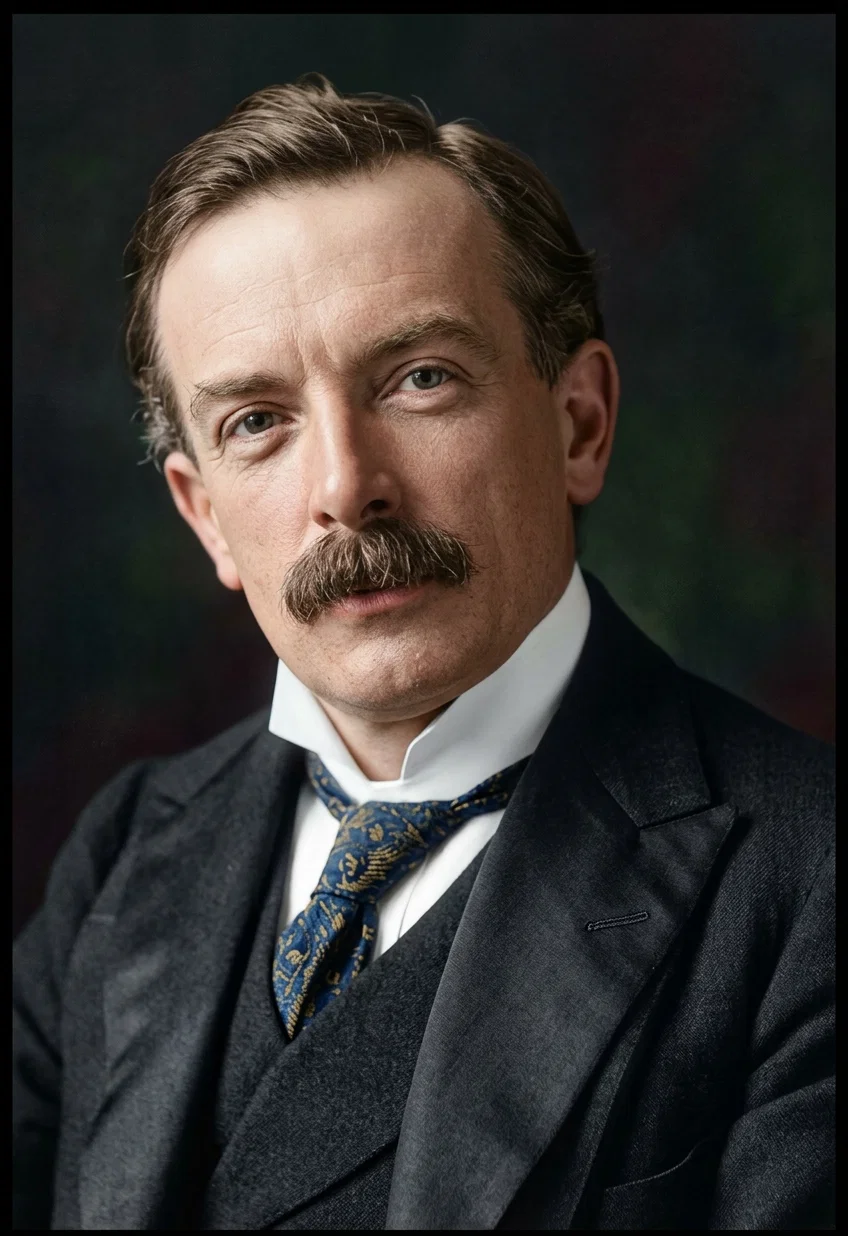
Rt. Hon. David Lloyd-George, Chancellor of the Exchequer.
Additional Fields for Taxation
The heavy increase of expenditure on our navy, with the certainty of still further increase in the future, has made it necessary to find additional sources of revenue. It is true that Old Age Pensions and other excellent reforms have meant an increase of expenditure, but the military burden is by far the heaviest. The Chancellor of the Exchequer, Mr. Lloyd-George, is proposing to find a portion of the required annual income in quarters that have been but lightly tapped by past budgets, and over this policy a great conflict is now raging. Mr. Lloyd-George is planning to place a large additional duty on tobacco and spirits, to increase the tax on unearned incomes, and to place a super-tax of sixpence in the pound on all incomes that exceed £5,000. The features of the budget which are arousing the greatest opposition, however, are the proposals to levy a small tax on the annual value of all land that is not agricultural. This tax would, of course, lead the owners to assess the value of such land at the lowest figure; but the budget also proposes that any increase in the value of such land which is of the nature of unearned increment should bear a tax of twenty per cent. This means that the lower the figure at which the land is valued for the purpose of annual taxation, the greater will be the apparent profit if there is a rise in values and the land is sold; and of this profit twenty per cent will go to the Exchequer. There is also to be a tax of ten per cent on the gains to the landlord by the falling in of leases.
Violent Opposition
The powerful landed interests of the country are violently opposed to these measures, and are using all their influence to enlist popular support for their opposition. But the general public views with complacency an attack on the purses of the wealthy, and is quite content that they should bear a larger proportion than before of the burdens of the country. Since the introduction of this budget, the popularity of the government, which was distinctly on the wane, has increased amazingly. The turn in the tide may be dated from a remarkable speech made by Mr. Lloyd-George. In his eloquent and convincing way, he set before his audience and the nation at large the manner in which great fortunes have been built up through the increase in value of landed estates, at little or no trouble to the owner, but entirely by reason of the labor and intelligence of the masses of the people. Many instances were given of this process. The rise of prosperous towns and cities makes an enormous difference in the value of the adjacent land, and the owners of this land have hitherto reaped all the benefits of the increase in value brought about by the enterprise of others. In his speech Mr. Lloyd-George also cited a number of remarkable and impressive facts to show the rapacity of ground landlords and their readiness as a class to take every possible advantage of those who were in their power. The facts adduced were indisputable, but the landowners of the country stood amazed at the spectacle of a Chancellor of the Exchequer delivering such an onslaught on what they had always regarded as their unquestioned rights and vested interests. Were they not the pillars of the commonwealth? Did not they furnish the capital, without which labor must starve?
There is little doubt that the budget will pass in triumph, and there is also little doubt that the people, having once grasped the idea that landowners may be called upon to contribute according to their wealth to the national revenue, will before long decide that the great fortunes have been too lightly dealt with, and must be made to contribute a little further to the public interests. The result of such a feeling will be a growing embitterment of the relations between the owners of property and the masses whom they employ.
In many lands there seems to be coming a condition of strife, not only between the nations, but also between the different ranks of society that compose the nations, and this condition is growing more and more visible in England. It does not require very much faith to-day to believe that the words addressed by the apostle James to the rich men of the last days are soon to meet their fulfilment: “Go to now, ye rich men, weep and howl for your miseries that shall come upon you. . . . Ye have heaped treasure together for the last days. Behold, the hire of the laborers who have reaped down your fields, which is of you kept back by fraud, crieth: and the cries of them which have reaped have entered into the ears of the Lord of Sabaoth.” James 5:1, 3, 4.
Dark Days Before
In that time the people of the Lord are to be patient, and to look to Heaven for redress, instead of taking matters into their own hands. Verses 6-9. This counsel implies that those who do not submit to the divine guidance will no longer submit quietly to the wrongs that have been inflicted upon them, but will seek by violence to possess the riches held by the wealthy,—riches which the workers believe to have been created by their own unrequited labors.
There are many omens that the days before us will be dark and full of trouble. It is high time that every servant of the Lord was at his post, doing with all his might the work entrusted to him, before the winds of strife shall be loosed and the day of human probation come to its close. While we pray that the winds may be held yet a little longer, we should show the sincerity of our prayers by using well the precious moments that remain to finish the work committed to our hands. Rev. 7:1-3. W. T. BARTLETT.
Growing Infidelity
UPON this subject at the meeting of the Bible League, the Detroit Sunday News Tribune has the following:
“The Rev. A. T. Pierson, D.D., said he almost felt it impossible to speak calmly on the subject under consideration. He knew from experience that the baneful evil was growing, not only in England, but also in America. Quite recently, just before he left Brooklyn for this country, he had heard of seven candidates for the ministry, five of whom had no firm belief in either the miraculous birth or the miraculous resurrection of the Lord Jesus Christ. He was surprised and appalled at the apathy he witnessed on all sides. There should be a council of war. Christians should congregate in their tens of thousands to consider the situation and to devise means of attacking the errors of those who were attacking the word of the living God.
“Dr. Pierson was evidently greatly moved as he spoke of those who ‘had taken away his Lord,’ the Master whom he loved, and whom he had endeavored to serve for sixty years. It was useless for the critics to say they were not attacking the very Founder of Christianity. All attacks upon the written Word were attacks upon the living Word—they could not in the nature of things be otherwise. He had a godly impatience with the whole business. Preachers and professors of divinity were talking utter nonsense. They were exalting their private judgment above the revealed word of God and making such judgment the final court of appeal.
St. Louis Church Day Celebration
St. Louis, Mo., is to have a Church Day October 3, at the beginning of a seven days’ celebration of the 100th anniversary of the incorporation of the city. “Church Day” is the title of the opening day, and all the bells of the city will be rung, and there are 444 churches. All of these religious organizations have accepted the invitation,—Catholic, Protestant, “Christian Science,” and all others. The principal thing about it, probably, will be the noise.
A Day at Suva, Fiji
By G. B. Starr
At five o’clock Monday morning, February 22, we were in sight of some of the high, mountainous outlines of the Fijian group of islands. They were on both sides of us, and the visitor is at once impressed with the extensive and elevated lands connected with this group. As we sailed toward Suva the view became more interesting and charming. Sailboats gliding swiftly over the waters, and beautiful white cottages or villas nestled in the hills, presented a pleasing picture. We reached Suva about 10:30 A.M., just in the wake of the “Maitai,” the old “Mioweara” rechristened “Maitai,” which had arrived from New Zealand with a large number of passengers for our vessel, bound for Vancouver and the States.
The sight we most enjoyed was that of the group of our dear and tried friends and fellow workers upon the wharf. There we saw Brother C. H. Parker and Romona, Brother and Sister Andrew Stewart, Brother and Sister G. E. Marriott, and several native boys and men, among whom were Alapati and Methusala, and Rose and Ruth, native girls. These were all soon with us on the deck of our good ship “Makura,” and hearty greetings were exchanged, for we were quite as glad to see them, right on their field of labor, as they were to see us.
After viewing the vessel, and getting the many parcels and letters we had for them, we accompanied them to the town of Suva and posted our letters back to Australia. And how we wished they weighed more, for here we could post one ounce for a penny. This is how it should be all over Australia and the world of universal postage.
Mission Workers and Native Fijians
After a short walk through the town and up some of its very picturesque streets, we took a rowboat out to our own sailboat and sailed across the bay to Suva Vou (new Suva), where our mission is healthfully and pleasantly located. Here we had the experience of being carried ashore on the backs of our dear native brethren, who would not permit us to walk over the sharp coral, altho we desired to do so, for fear of cutting our feet. The water where we left the rowboat was about knee deep. We enjoyed the experience, however, only one feels so very heavy when being carried by another.
The walk from the landing up to the mission house where Brother and Sister Marriott live, is one of the prettiest we ever saw. It is only about six or eight feet wide, but so grassy and so lined on both sides with shrubs and flowers and fruit trees that it seems a veritable Eden way. We were very pleased with the location of the mission and the church. It presents a delightful appearance, being surrounded by a rich growth of hybiscus, banana, and breadfruit trees, loaded with their fast ripening fruit, and beneath our feet a rich carpet of grass.
The native village was the next item of special interest, and here we were introduced to mothers and children and men in their native life. We were surprised to see their grass houses so near together, and yet it all seemed very nice. We met one of the most aged of the brethren, a man of seventy-five, who carries, in his face, the credentials that he has met and become acquainted with Jesus of Nazareth. He at once wished to know our choice as to the place we would have the native dinner served, which they had prepared for us. We told them our preference would be to set it where they would select, and they at once decided on one of their largest houses. And here we ate taro (boiled), and yam, and a dish of the finest greens, made from taro leaves and cocoanuts, which, with the addition of a little salt and lemon juice, was to be preferred to any dish of spinach we ever tasted. We thought they had given us too large a helping, but we asked for more, which it gave them great pleasure to help us to. We ate in native fashion, sitting down on the clean mat floor, the table also being on the floor. Two of the brethren insisted on keeping the fans going to keep off any flies that might get in. All waited until our party had finished eating; not one mouthful would they take until we had finished, for that is their custom. Then the men ate, and the women and children waited until they had finished. One of the most impressive scenes we have ever witnessed was their reverent and quietly bowed attitude while Brother Parker offered thanks in their language. All bowed their faces between their hands to the very mat before them.
We expressed the wish that we might have had a snap-shot of the company at dinner, and Brother Parker at once assured us that that was possible as there was a camera at the boat. One of the boys soon brought it, and the photo was taken, which I am sure we shall prize.
At the vessel we met a number more of the boys from the Buresala school; also the son of Ambrose, who with his father is one of the Rombolas, or governors. God has given him a kingly bearing, and we urged him to meet us at the gates of the New Jerusalem, where as princes we shall all enter in, and he said he would try to meet us there. As the company of workers left us, we could but express gratitude to God that He had raised up such faithful and experienced workers for this field. May His richest and choicest blessings rest upon them all, and upon Fiji.13
We must not omit to mention the after-dinner song-service, in which we sang to them with the guitar accompaniment, which they seemed to enjoy. They sang their native song, which we enjoyed. We also appreciated their gift to us of the best bananas they had, and young cocoanuts, to take on shipboard, and also the fine large bunch of bananas which the brethren brought us from Buresala. All we had to give in return was our love and all the apples we had, nearly a half bushel, which the brethren had given us. As we had apples on board, and were going where there were plenty more, we felt we could do no less than to let those have them who lived where apples were threepence each, and scarce at that.
G. B. Starr.
God’s Providence
By Gertrude Palmer
He knows of each bud of the flowers of the grass;
He cares for each blossom that grows,
Yet planned where the turbulent rivers should pass,
And a way between mountains disclose.
He made on those mountains a reservoir pure,
He gave them the wealth of the mine,
And wonderful grandeur for e’er to endure
Above stately forests of pine.
He strengthened the heart of the sturdiest oak,
For a ship to sail over the sea,
And it stood strong and firm when the mighty storm
broke
And the wild winds were shouting with glee.
His hand formed the loam of the wide, level plain,
That labor might make it a field
To give to the sower the well-winnowed grain,
The reward of a bountiful yield.
He knows if each one of His song-birds at night
Wings its way to its little home nest;
His children sleep well for His angels of light
Are guarding them. Sweet is their rest.
He points to the sunset, retouching the skies,
Till the mountains reflecting its gold
Oft dazzle the sight of the onlooker’s eyes
With glories that can not be told.
Thus He by His wonderful labor sublime
Shows ever a care for His own,
That they, while they walk on the borders of time,
May know they are never alone.
GERTRUDE PALMER.
The Vegetarian Cook Book
By E. G. Fulton
By E. G. FULTON
THE author has had years of experience in vegetarian cookery and in the management of vegetarian cafes, and cafeterias. With its aid the chef, cook, or housewife is able to prepare appetizing, healthful meals without the use of any flesh food.
This book contains 226 pages, including a handy and well-arranged index of all the recipes given.
Tastily bound in cloth, price, post-paid, 75 cents
Pacific Press Publishing Assn.
Mountain View, California
Portland, Ore. Regina, Sask., Can. Kansas City, Mo.
Our Work and Workers
BROTHER B. L. HOUSE reports three new Sabbath keepers as the result of meetings held in Fairmount, Va.
Two persons have recently begun to observe the seventh day as a result of readings held by Sister Anna C. Rice in the state of Virginia.
A NUMBER are accepting the truth as a result of the meetings now being held at St. Johnsville, N. Y. One man who has held a lucrative position in the mill for fifteen years is willing to give it up for the sake of the truth. This he plans to do as soon as the owner of the mill comes.
THE meetings being conducted in Norfolk, Va., by Brethren Muntz and Rogers are growing in interest from night to night, so that most of the time the tent is about full. As elsewhere, the brethren find that the house-to-house work is what counts in their work. At these meetings seventeen have taken their stand for the truth and are awaiting baptism. For the past two weeks the attendance has packed the tent, often to overflowing.
SABBATH, August 14, at the close of the service of the West Philadelphia church, opportunity was given for testimonies from those who have recently begun the observance of the Sabbath. The statement from a lady who was a high Episcopalian, was the keynote of all. She stated that she had been a member of the Episcopal Church for fifteen years, but she had had more joy and peace in the last three weeks since she had begun to keep the Sabbath than she had known during all the previous fifteen years.
A SABBATH-SCHOOL of eighteen adults and twelve children has been organized at Mansfield, Mass., and the interest in the meetings continues unabated. One of the workers reports: “Ministers advise the people not to come; the papers make unpleasing changes in our articles; rowdies threaten to pull the tent down over our heads; and the wind would have done it but for prayer; yet Satan is thwarted on every hand. One preacher is to speak on the ‘Nature and Destiny of Man’ in answer to us, and God, unknown to us, has stirred up a good lady here to hold a temperance rally in our tent. When she spoke for the tent we could not refuse, for we saw God’s hand in it to strengthen our work. This lady, who is president of the W. C. T. U. here, will have speakers from Boston. She has chosen the same day for the rally that the preacher chose for his talk. We will follow it by a deep temperance talk, to let the people know where we stand.”
The Lord is richly blessing definite effort with the Signs Monthly magazine. Fifty-three thousand copies of the July number were sold. One young lady of five weeks’ experience, working in Stockton, Cal., writes: “I sold one hundred copies a day every day last week. The Lord is wonderfully blessing my work.”
The Spirit World and a Future Life
By Prof. Geo. W. Rine
BY PROF. GEO. W. RINE
Can We Communicate with the Spirits of the Departed?
This is the question that is agitating the great minds of the scientific and theological world to-day. Our success in this life and our prospects for the life to come depend to a great extent on the answer to this question.
In this pamphlet of 96 pages Professor Rine has clearly shown the origin and nature of Spiritualism and other occult phenomena. Many quotations from original documents vouch for the truth of the author's statements. The basis of our hope in a future life is also plainly set forth.
Read and see for yourself.
Price, post-paid, 10 cents
Address your tract society, or
Pacific Press Pub. Assn.
Mountain View, Cal.
Portland, Oregon Kansas City, Missouri
Regina, Sask., Canada
Colds
By G. H. Heald
Colds.—By G. H. Heald, M.D. A treatise on the causes, prevention, and cure of colds. White leatherette binding. 58 pages, 25c. Address this office.
IN THREE DAYS
Overland Limited
TAKES YOU
To Chicago
ACROSS GREAT SALT LAKE
AND
HIGH SIERRA BY DAYLIGHT
Luxurious High-class Equipment
Electric Lighted Throughout
Pullman Drawing-room
Stateroom
Vestibuled Sleeping Cars
Careful and Attentive Dining Service
Parlor Observation Car with Library and Cafe
Ladies’ Reading Room
Gentlemen’s Smoking Room
Daily News Bulletins
Latest Papers and Magazines
SOUTHERN PACIFIC
Bible-Readings for the Home Circle
Bible-Readings for the Home Circle. This book comprises 162 readings for public and private study, and answers nearly 3,000 questions on religious topics—practical, historical, and prophetical. It contains 600 octavo pages, printed on a superior quality of tinted paper, embellished with 57 full-page engravings and 170 ornamental headings, together with 10 full-page Scriptural and prophetic diagrams, 3 colored plates, and other attractive features. The bindings are elegant and substantial, the styles and prices being as follows: Cloth, gilt side title, marbled edges, $2.75; library, marbled edges, $3.75; full leather, marbled edges, $4.75. Cheap edition, 400 pages, solid type, no illustrations or colored plates, no poetry, thin paper, brown cloth, plain edges, $1.25. Address this office.
“THE worst that can befall a boy,” says a contemporary, “is to have the liberty to remain out late at night.” This is too often a fatal privilege, because it is mostly during the night that all the mischief is planned and executed. The boys who are permitted the freedom of our public streets at all hours of the night are the boys who fill our work houses, and bring sorrow upon their relatives and friends. All parents should keep their boys off the streets and at home at night.
But are not the boys who work in shops and factories all day entitled to some recreation and amusement? — Most assuredly they are; and it is a poorly managed home that can not provide these. Music, singing, reading,— can not young people have these amusements at home? And what more does the street offer? Parents, look at it! Do not think that because the boys bring their earnings at the week-end, they are free to do as they please and go where they will. By no means. You are always supreme in the home, and God will hold you responsible for the conduct of your children as long as they live under your roof. It is simply outrageous to witness the actions of some youngsters on the public streets. And what of young girls? Many of them conduct themselves no better.—Detroit News Tribune.