LAW, technically speaking, is a rule of civil conduct prescribed by legislative authority, but is a word illimitable, in both its popular and its technical sense. In a constitutional form of government all rules and enactments promulgated by legislative authority emanate from the supreme charter or constitution. They may be laws, but are not the fundamental law. They are authoritative, but not absolutely authoritative. They are superficial, not supreme. They possess only delegated or limited authority, and are subject to the constitution. The constitution is, therefore, the supreme law, and possesses the only absolute authority. The righteousness and breadth of the law depend upon the wisdom and disposition of the legislators. The universal weakness of the human race and the unrighteousness of individuals give rise to the liability of unrighteous laws, and it is expedient at times to repeal them. In a constitutional form of government this is permissible, due to the fact that legislators possess only delegated authority; while in an absolute monarchy, the decision of the king or emperor is final, and from that there is no appeal.
The proper purpose of law is easily understood. The only basis of any law is the general good of the community which is to be governed by it. The Supreme Court of the United States has expressed its opinion on this point: “All laws, all political institutions, are dispositions for the future, and their proposed object is to afford a steady and permanent security to the interests of society.” (Rector, etc., of Christ Church vs. Philadelphia County, 24 Howard, 302.) An edict purporting to be law, but working “injury of the persons and property of its subjects, is not law.” (Hurtado vs. California, 110 U. S., 536.)
Bearing these thoughts in mind, let us turn our attention to the law of God.
The Ten Commandments
The decalogue is the most comprehensive code ever written. It holds first place in the collection of legal documents, and is absolutely universal. It took material form when ancient Babylonia was yielding to Egypt its place as the great law-developing nation; but it is evident, for various reasons, that the ten commandments are not the outgrowth of Babylonian jurisprudence. It is true there is a striking similarity between the law of Moses and the code of Hammurabi, but there are strong reasons for believing that Babylonia would never have been the great law-developing nation that it was had it not been for the principles of the ten commandments, which, no doubt, had been committed to the people of God from the beginning.
It was a very remarkable occasion when the divine code was delivered to the children of Israel. “The Lord came from Sinai, and rose up from Seir unto them; he shined forth from Mount Paran, and he came with ten thousands of saints: from his right hand went a fiery law.” Deut. 33:2. “The Lord spake unto you out of the midst of the fire: ye heard the voice of the words, but saw no similitude; only ye heard a voice. And he declared unto you his covenant, which he commanded you to perform, even ten commandments; and he wrote them upon two tables of stone.” Deut. 4:12, 13.
It will be observed that this royal document came not from any earthly potentate, but from the King of kings. “Ten thousand saints,” or angels, were present when it was delivered to the Israelites, but for all people. So important was the divine law, that not even the angel Gabriel was permitted to write or even deliver it to God's representative on earth. It is not strange that this law is so comprehensive and explicit in revealing the divine will to men. It is the revelation of the infinite mind, the supreme source of legislative authority.
This divine document is law in the broadest sense of the term. It is supremely authoritative, being the divine charter of God's kingdom on earth. The Author of this distinct code was and is infinitely wise and just; and because it is the mind of God toward us materialized, the document is infinitely comprehensive and just. God is God because he is infinite: and any deviation from infinity would reduce him to the level of the finite, and rob him of the Godhead. This is infinitely impossible.
The ten commandments, being the direct representation of the infinite mind, are necessarily infinite, infinitely comprehensive. Then, because they are infinitely comprehensive, it is absurd to say they are limited in power, authority, or to any dispensation. To do so would place them on an equality with the laws of men, which would be an insult to the Majesty of heaven. It would virtually be changing “the glory of the incorruptible God into an image made like to corruptible man.”
The law of God, being infinitely comprehensive, is also universal. “Let them be confounded and troubled forever; yea, let them be put to shame, and perish: that men may know that thou, whose name alone is Jehovah, art the most high over all the earth.” Ps. 83:17, 18. His jurisdiction extends to the ends of the universe, and he rules over all kingdoms of men. All nations owe allegiance to the government of heaven and are subject to the requirements of God's law, but are not authorized to legislate in favor of or against it. The governments of earth are limited in this respect the same as the State legislatures are limited by the federal Constitution. The laws of men become obsolete, and it is expedient at times to change them; but the law of God is applicable in all ages and under all conditions.
Men are prone to treat the decalogue with a great deal of disrespect. When a rule of law is settled, the courts are not at liberty to disregard it, even though they consider it inconvenient or unjust. The remedy in such a case is to be found in the legislative department; but men seem to feel at liberty to disregard the claims of the ten commandments, and set them aside with impunity. If they consider them inconvenient or unjust, they should refer them back to the legislative department—to God and the “ten thousand saints” who handed them down.
There is one other way by which the no-law advocates can seek to evade the law of God, according to a ruling of the Supreme Court of the United States. In Hurtado vs. California (110 U. S., 536) it is said that “arbitrary power, enforcing its edicts to the injury of the persons and property of its subjects, is not law, whether manifested as the decree of a personal monarch or of an impersonal multitude.” Those who desire, are at liberty to seek to evade the obligations of the ten commandments on this ground. But it is incumbent upon them to prove, first, that God is arbitrary; and, second, that he enforces his law to the injury of his people and their property. Where is the man that will so speak against God?
Statutory Documents
Having shown that the ten commandments are authoritative, it seems advisable to study their relation to certain statutory documents. Some Bible students seem to be unable to observe the difference between the ten commandments and the legal writings of Moses. It is not incorrect to speak of the statutory documents of Moses as the Mosaic law, for statutes are laws in a certain limited sense; but it is decidedly incorrect to speak of these statutes as the distinct law of God. They grew out of certain conditions existing under the theocracy8immediately after the children of Israel had left Egypt, and were distinctly characteristic of their forms of worship. Their faith in the living God was so nearly destroyed by their association with the idolaters of Egypt, that they were unable to look away from the material things of earth for the fulfillment of spiritual promises; and to overcome this difficulty, they were authorized to use various symbolical representations in their worship.
To regulate the various ceremonies in this theocratic system of worship, it was necessary to give definite legislative instruction. The Pentateuch abounds with statutes written by Moses for this very purpose. These statutes were inspired, and were the Lord's expressed will toward the children of Israel for that particular time and because of local conditions peculiar to themselves, as I have shown. These statutory documents were recognized as the law of Moses, but they came to be spoken of as the law of God, which was not incorrect; but they were not the fundamental law.
These laws were in no sense universal, but were designed to meet local conditions. When these conditions changed, when type met antitype, the statutes relating to the ceremonies pertaining thereto became obsolete; but the student makes a fatal mistake when he confuses these writings with the ten commandments, which were in no sense typical or figurative. Since no change of the law is anywhere intimated, but strong statements to the effect that the law can never change were frequently used by the Saviour, we must conclude that all arguments to the contrary are vain, and that “all his commandments are sure. They stand fast forever and ever, and are done in truth and uprightness.” Ps. III: 7, 8.
Greenfield, Ind.
Bible Holiness
By M. C. GUILD
M. C. GUILD
“But as he which hath called you is holy, so be ye holy in all manner of conversation; because it is written, Be ye holy; for I am holy.” 1 Peter 1:15, 16.
HOLINESS is an attribute of God denoting wholeness and perfection; and in heaven above it is considered of so much importance that angels emphasize it as they stand in his presence, crying, “Holy, holy, holy, is the Lord of hosts.” Isa. 6:3.
Our Heavenly Father desires that we shall be “partakers of his holiness.” Heb. 12:10. The exhortation of the apostle Peter is definite and clear that Christians should live holy lives. And nothing short of true holiness will enable men and women to stand before that pure and holy Being who dwells in the high and holy place in heaven above.
The servant of God, in seeking to impress this great truth upon God’s remnant people, said, “Let all remember that God is holy, and that none but holy beings can ever dwell in his presence.” —“Early Writings.”
The teaching of the Bible concerning holiness has been obscured and neglected because of the ignominy and reproach cast upon it by certain persons who make a great profession of holiness, yet who refuse obedience to God’s law, and reject with scorn some of the plainest truths of the Bible.
It is certainly important that every child of God should understand what it is that makes us holy, and how this desirable and necessary condition can be attained. So emphatic was Paul concerning this matter that he was led to declare that without holiness “no man can see the Lord.”
The Presence of Divinity Makes Holy
As Moses stood before the burning bush in the wilderness, he heard a voice which called to him and said, “Draw not nigh hither; put off thy shoes from off thy feet, for the place whereon thou standest is holy ground.” Ex. 3:5. The presence manifested at the burning bush was none other than the Lord Jesus Christ. Acts 7:37, 38. It was, therefore, the presence of Christ that made that ground holy.
When Joshua stood before the Captain of the host of the Lord, as the children of Israel were about to possess the land of Canaan, “the Captain of the Lord’s host said unto Joshua, Loose thy shoe from off thy foot; for the place whereon thou standest is holy.” Joshua 5:15. The captain of the Lord’s host is Christ, for he is the leader of the armies of heaven. Rev. 19:11-14. It was his presence that made the ground on which Joshua trod “holy ground.” The presence of Christ between the cherubim in the sanctuary made the second apartment the “most holy place.” At whatever place, or in whatever object, Christ deigns to dwell, that place or object thereby becomes holy.
The Holy Scriptures
That which exalts the Bible high above all other books in the world is the fact that Christ is found in the sacred page. This stamps it as a holy book and marks it as divine. He is hidden in the Old Testament, where he can be found by those who seek; and he is revealed in the New Testament in all his matchless splendor.
“Sweet book! in thee my eyes discern
The image of my absent Lord;
From thy instructive page I learn
The joys his presence will afford.”
This holy book should be handled with reverence, and studied with diligence and great care. As we feed upon the Word, we shall become more and more like Christ, and his holy life will be seen in us.
God’s Law Is Holy
“Wherefore the law is holy, and the commandment holy, and just, and good.” Rom. 7:12. Of Christ it was written, “Thy law is within my heart.” Ps. 40:8. “Out of it [the heart] are the issues of life.” Prov. 4:23. This holy law, then, is the character of Christ in written form. His life on earth was a living example of what the law requires.
He could truthfully say, “I have kept my Father’s commandments.” John 15:10.
“In his life the law appears,
Drawn out in living characters.”
The man who lives a holy life will be in harmony with this holy and righteous law, and will gladly conform to its requirements. No one can justly claim true Bible holiness while knowingly violating one of the precepts of God’s law.
The Sabbath Is Holy
God calls the Sabbath, “My holy day.” Isa. 58:13. We are commanded to “remember the Sabbath day, to keep it holy.” The sweet repose and sacred, holy calm found in the Sabbath by those who observe it, can only be accounted for by the fact that the presence of Christ is in the seventh day above all the other days of the week.
In ancient times the showbread was brought into the sanctuary fresh and new every Sabbath day. Lev. 24:7, 8. It was a symbol of Christ, that “living bread which came down from heaven.” John 6:51. And now, as in the days of old, the special presence of Christ is renewed to his humble children upon the Sabbath. They find in the Sabbath that which can be found in no other day, for his presence makes it holy.
Of the servants of God it was said, “They shall teach my people the difference between the holy and profane.” Eze. 44:23.
God is greatly dishonored when men teach that there is no difference between the Sabbath and the other days of the week. He says, “Her priests have violated my law, and have profaned mine holy things: they have put no difference between the holy and profane, neither have they showed difference between the unclean and the clean, and have hid their eyes from my Sabbaths, and I am profaned among them.” Eze. 22:26.
The Tithe Is Holy
“All the tithe of the land, whether of the seed of the land, or of the fruit of the tree, is the Lord’s: it is holy unto the Lord.” Lev. 27:30. We belong to our Saviour both by creation and by redemption. He preserves our lives day by day. We honor our Redeemer when we bring our tithe as an acknowledgment of his sovereignty over us. The tithe belongs to God, and is used for the support of those who are engaged in the ministry of bringing souls to Christ. It is, therefore, holy. Nothing brings greater leanness of soul than robbing God of this holy money and using it for selfish purposes. “It is a snare to the man who devoureth that which is holy, and after vows to make inquiry.” Prov. 20:25.
We Are to Be Holy
“Know ye not that ye are the temple of God, and that the Spirit of God dwelleth in you? If any man defile the temple of God, him shall God destroy; for the temple of God is holy, which temple ye are.” 1 Cor. 3:16, 17. He in whom Christ abides will keep his body pure, a fit temple for the indwelling Saviour.9
Of all that God created upon the earth, man is the masterpiece. Says the psalmist, “I will praise thee; for I am fearfully and wonderfully made.” Ps. 139:14.
As Christians we are exhorted to “cleanse ourselves from all filthiness of the flesh and spirit, perfecting holiness in the fear of God.” 2 Cor. 7:1. It is now generally conceded that strong drink shortens life. It rouses the animal propensities in man, inflames the passions, debases the moral nature, produces criminals, and increases the number of paupers, idiots, and insane. It is contrary to all that is holy and pure. The use of tobacco does not comport with a holy life. Its effect on the body is that of a poison. Nearly all who use it acknowledge that it is a filthy habit. The children of God who seek holiness should put away not only liquor and tobacco, but also tea, coffee, and every harmful stimulant and narcotic. Those forms of amusement that tend to impurity of thought and action will be avoided. The body and mind should be kept in the best possible condition for the abiding presence of Christ.
Christ Enthroned Within
It is a wonderful thing that Christ, the Holy One of God, should deign to dwell in the human heart. But so it is; for he says, “I dwell in the high and holy place, with him also that is of a contrite and humble spirit.” Isa. 57:15. As the Father and the Son occupy the throne above (Rev. 3:21), so they will jointly dwell with him who is obedient to God’s commandments. “Jesus answered and said unto him, If a man love me, he will keep my words; and my Father will love him, and we will come unto him, and make our abode with him.” John 14:23. To all who yield and allow him admittance, he will come in and dwell.
My brother, my sister, his life lived in you will be the same holy life as when he lived a man among men; for he is the same yesterday, today, and forever. You can then say with Paul, “I live; yet not I, but Christ liveth in me: and the life which I now live in the flesh I live by the faith of the Son of God, who loved me, and gave himself for me.” Gal. 2:20. Those who truly enjoy the presence of Christ in their daily lives are never heard boasting of their own holy or perfect or sinless condition. Their praise will continually be of him. Seeing his perfection, they will find nothing in themselves of which to boast.
The Church to Be Holy
God designs that his entire church shall answer his description of it: “A glorious church, not having spot, or wrinkle, or any such thing; but that it should be holy and without blemish.” Eph. 5:27. The dross of sin is to be destroyed by the fires of the judgment day. Only that which is holy and pure will endure. “Seeing then that all these things shall be dissolved, what manner of persons ought ye to be in all holy conversation and godliness.”
The characters of those who perfect holiness in the fear of God will finally be sealed for all eternity. No more will Satan be allowed to cause defilement and sin, for the last decree will be, “He that is holy, let him be holy still.” Rev. 22:11.
Saginaw, Mich.
Asleep in Jesus
By Mrs. D. W. Myers
MRS. D. W. MYERS
Our dearly beloved Sister White is gone to her rest. Our hearts have been grieved beyond measure. Sorrowfully we have laid her in her resting place. A little mound, a tombstone, a few lonely flowers are all that mark the place of the sleeping one. But, thank God, that mound will not always be the prison house of our loved one. Some glad day God will call her forth to receive her reward. She will come forth clothed with immortality. Though silent, she still speaks to us. The books which are a part of her life's work are still with us, as a token of her faithfulness to God. O, may we also live and die as did our dear sister — trusting in Jesus and faithful to the last.
The Blessed Hope of the Resurrection
If it were not for the hope of the resurrection, what wretched mortals we should be! And if our hope were not based upon the Word of God, how vain our hope!
“For if the dead rise not, . . . your faith is vain.” 1 Cor. 15:16, 17. But the Scriptures also say, “If we believe that Jesus died and rose again, even so them also which sleep in Jesus will God bring with him.” 1 Thess. 4:14. “God hath both raised up the Lord, and will also raise up us by his own power.” 1 Cor. 6:14. “Knowing that he which raised up the Lord Jesus shall raise up us also by Jesus.” 2 Cor. 4:14. Jesus said of himself, “I am the way, the truth, and the life.” John 14:6. “I am the resurrection, and the life.” John 11:25. “The gift of God is eternal life through Jesus Christ our Lord.” Rom. 6:23.
What wonderful, precious promises! “And this is the promise that he hath promised us, even eternal life.” 1 John 2:25. As we read these promises, our hearts are filled with joy, faith, and hope, —with joy because we believe that some day we shall meet our loved ones again; with faith, because we believe that God can fulfill his promises; with hope, because we have the assurance that God cannot lie. Heb. 6:18.
God Works in a Mysterious Way
THE Pittsburgh Gazette tells a story which began during the Civil War, and was not completed until a short time ago, when the sequel appeared on board a steamer bound for Europe.
It was Sunday evening, and the passengers had met in the cabin to sing hymns. One gentleman, hearing a very rich and beautiful voice behind him, and having his memory stirred by it, turned round suddenly, and asked the singer if he had been in the Civil War.
“Yes,” was the answer. “I was a Confederate soldier.”
“Were you at —— on a certain night?”
“Yes, and a curious thing happened that night. The hymn recalls it to my mind. I was posted near the edge of a wood, on sentry duty. It was dark and cold, and about midnight, when everything was still. I found myself homesick , tired, and afraid. To comfort myself I began to sing this hymn:—
“All my trust on Thee is stayed,
All my help from thee I bring;
Cover my defenseless head
With the shadow of thy wing.’
“It brought me into a better frame of mind. Peace came down upon me, and all the rest of that long night I felt no more fear.”
“Now,” said the other man, “listen to my story. I was a Union soldier, and I was in the woods that night with a party of scouts. I saw you. My men had their rifles focused upon you. They were waiting for the word to fire. But when you sang—
‘Cover my defenseless head
With the shadow of thy wing,’
I said, ‘Boys, lower your rifles! We’ll go home.’”
Test of Discipleship
By D. H. KRESS, M. D.
D. H. KRESS, M. D.
“We have forsaken all, and followed thee.” The very first step in discipleship is the forsaking of all that we possess, whether we have little or much. Jesus said, “Whosoever . . . forsaketh not all that he hath, he cannot be my disciple.” There are those in the Christian church who have not taken this first step. Many are attempting to drag their fish nets full of fish after them. Perhaps they ease their consciences by the payment of a tithe, by making offerings to missions and sustaining the temple service. All this is good as far as it goes, but it does not go far enough. This alone will not do. The true Christian mariner does not launch out into the deep with his eye on the vanishing shore line.
“Whosoever . . . forsaketh not all that he hath,” cannot take even the first step in discipleship. The very first step is to renounce ownership and accept a stewardship. Peter and James and John had taken this first step. Peter could say, “We have forsaken all, and followed thee.” This is the beginning, not the end, of the Christian life. It is the entrance requirement into the school of Christ. It is useless to talk about the development of a Christlike character without having passed the entrance examination into the school of Christ. The reason why so few church members make advancement in the Christian life is because they have never really entered Christ’s school. They have been unwilling either to count the cost or, having counted the cost, are unwilling to pay the price.
To the Discouraged Worker
By JOSEF W. HALL
JOSEF W. HALL
You have given your service freely,
faithfully you have worked,
And in the Master's service no man can
say you have shirked.
But give of your lives more freely, ask
nothing in return;
The life that sets fire to others is the
life that itself doth burn.
It is sympathy more than power; 'tis
authority less than love;
It is how much you give of living, of
the life that's inspired above.
Though your heralds were a mighty army,
though you preached with the voice
of God,
You might miss the men you are seeking
down on the common sod.
Men are awed by a mighty tumult, but
awe is a mingled strain,
Which repulses while it attracts men,
like the rush of a hurricane.
Freely the Master blessed you; freely ye
have received.
When you give your life as freely,—not
the thought, but the blood and the
deed,—
The despair that tugs at your heartstrings,
and the failures, shall come
to their end,
And the loving part of each selfish heart
shall blossom beneath your hand.
He gave you a message to preach, and,
more, he gave you a life to live;
But this is your dower and your ministry's power,
“He sent you forth to give.”
Takoma Park, D. C.
Victories in Spain
By FRANK S. BOND
FRANK S. BOND
I came to Baeza April 1, and have held a meeting each evening with the believers and other interested persons. The attendance is increasing. Some who had never attended Protestant meetings before were out last evening, and were very favorably impressed.
The meetings are held at the home of a believer. Victories are being won. Just this morning, six pictures of the saints and the Virgin were removed from the walls of the room where the meetings are held, and three large Bible texts now adorn the walls. The ten commandments also occupy a prominent place on one of the walls.
When the law of the true God is given its rightful place in the lives of men and women, and in the home, all false gods are cast down. Yesterday, a woman who began to keep the Sabbath when my brother Walter was laboring here, just before his death, took down her crucifix from the wall, and gave away her rosary. She has decided to walk, by God's grace, in all the light of the precious truth.
Two young men have declared that, come what may, they will keep the Sabbath. These are meeting strong opposition in their homes, and may be disinherited by their parents. Other persons are interested in the truth and think of obeying it.
I am rooming in the home of a Catholic family. On the walls of my room are a crucifix, four pictures of the Virgin, a guardian angel, and a sacred heart. On the wall above the table in the dining room are pictures of San Antonio, San Jose with the child Jesus, San Francisco, and Santa Eulalia. The mistress of the house, and a neighbor woman who lives below, have tried to convince me that I should confess to some priest of Baeza, and partake of the "sacred form." I am endeavoring to convince them of the importance of confessing their sins to Jesus, and turning away from all saint and priest worship.
Usually at meal time the mistress of the house listens reverently as I invoke God's blessing upon the food. Pray, dear readers, that the Spirit of the Lord may impress these hearts with the importance of turning to the living Saviour.
The city of Baeza is situated on the top and at the edge of a high mountain. Almost the whole of the mountain and the surrounding hills and valleys are under cultivation. At the foot of the mountain, about a league from the city, flows the beautiful river Guadalquiver. This has been an unusually wet winter in Spain, and excellent crops are anticipated.
One seldom sees more picturesque scenery than we have here at this season of the year. Yesterday, Sabbath, was a beautiful, sunshiny day. In the forenoon we wended our way down the mountain side about two kilometers to a beautiful spring of crystal water, and there we held our little Sabbath school; and in the afternoon two dear souls followed their Lord in baptism.
In the evening, when we returned to the city, we found that the news of the baptism had been quite widely circulated. The mistress of the house came to my room and informed me that the owner of the house told her that if I remained there that night, the police would come the following morning and put her furniture into the street. I persuaded her to interview the owner and see if I could not remain until the following day. This permission was granted, but after that I must get out.
On Sunday morning the brother who was baptized entered a store, with the thought of interesting the proprietor in our missionary paper, but the proprietor ordered him to leave, stating that the women had threatened that they would not come there any more to buy, should our brother enter the store. But I am glad to say that in spite of the persecution, several other persons at Baeza plan on being baptized soon.
While in Andalucia, I visited the interesting city of Seville. It was here that many Christians, in Inquisition times, rather than renounce their faith in God's Word, were called upon to lay down their lives. Here are still to be seen, in the Alcazar,—a building of Moorish construction, used today as the king's palace,—dungeons where many martyrs were tortured. Seville is a city of 155,000 inhabitants. Oh, how great is our need of additional workers in Spain! We have two sisters in Seville. They moved there from Cartagena, and are endeavoring to hold up the light of God's truth in their new home.
Pray that more laborers may soon be found for this great field. Only one ordained minister for nineteen million inhabitants!
Caracas, Venezuela
By S. A. OBERG
S. A. OBERG
SINCE our last report, we have moved. The Lord heard our prayers, and gave us just what we needed, with reduced rent. We had been paying thirty-six dollars a month, while here the rent is only twenty-eight.
The agent from whom we secured the house is the same one from whom we rented the other one. When we visited him with regard to renting our present place, he said there would be no objection to Protestants, and he sent a clerk to the owner, to ask if he would have any objection to renting the house to Protestants. However, knowing the difference that exists between simply renting to Protestants, and renting a house for holding Protestant services or carrying on a propaganda, I thought I would better see the owner myself. I found that he had no objection to any renter who would pay the rent. The same agent told us a year ago that there would be no objection to our holding services in the house, but evidently he did not know that the brother of the owner of that house was a priest, and that as long as we continued propaganda on the premises the owner could not be pardoned, nor his family receive divine attention. I quote the following from a tract recently put out here:—
“What sin do Catholics who favor Protestantism, commit?”
“The Catholics who take part in the services of Protestants, or through curiosity listen to their discourses, or rent to them houses for their services, or in any other way favor them in their propaganda, commit the gravest sin, and incur excommunication.”
You can see by this what it means to these blinded souls to be cursed by having their house turned into a house of worship. I cannot feel to condemn the11poor people, but the priests will surely come to a day of reckoning.
It is really necessary that we should have a mission property here if aggressive work is to be done, not only because of the rent (now the mission and I must bear it alone, since Brother Greenidge goes into the book work out of the city), but because there will never be any peace for us as long as the property in which we live and carry on our work is not our own.
The church begins to realize that we are here to stay, and is instituting a campaign against us. Brother Charles, one of our canvassers, on returning from the interior, told me that one man whom he canvassed told him that he had been warned not to take that book because it was Protestant, and was a propaganda. However, Brother Charles insisted on his looking it over carefully, to see if it was tainted with Protestantism, and not finding any diseases that were Protestant,—it was a health book,—the man took it.
There are two small lots which can be secured at a very reasonable figure that I feel we ought to have, and I am praying that the Lord will open the way for us to secure them.
Among the Karens, Burma
By G. A. HAMILTON
G. A. HAMILTON
You will be glad to know that we have secured our mission land. The money is paid, and the deed signed, so we can go ahead and build up our station. We are buying material for the house now. If you find Moulmein on the map of Burma, and measure up the Salween River, you will find our station seventy-five miles up in the jungles, and fifteen or twenty miles from the border of Siam. There are big mountains all around us, and we are right on the bank of the mighty Salween River, facing east to the Siamese frontier. I am convinced that the Lord guided us to our land. The situation is very beautiful, and very suitable to our needs.
Our work is very strenuous these days. We are busy also getting out our first literature for the Karens. I had the privilege of baptizing two Karens recently. It was our first baptism among these people. Brother Votaw had baptized two others before in the same place. We have organized our first Sabbath school among the Karens, and our first month's offering was about three dollars.
We are well, and full of faith and courage. Remember the Karens when you pray.
Port of Spain, Trinidad
By M. B. BUTTERFIELD
M. B. BUTTERFIELD
Our boat cast anchor, Nov. 18, 1914, in the harbor of Port of Spain. We had enjoyed a most delightful voyage, but were pleased to come in sight of land once more. Elder N. H. Pool met us, and saw to getting our baggage through the customs. How glad we were to see the faces of Brother Pool’s and Brother F. C. Hutchinson’s families, whom we knew in the States. Every other face was strange, and for once we felt the truth of the old song, “I am a stranger here, within a foreign land.”
Everything is so different from the homeland that we seemed to have dropped into another world. Near here is the famous asphalt pitch lake, and this city takes pride in its beautifully paved streets, serving for cab and foot passengers alike, as you find few sidewalks. The streets are not so wide as at home, and each house is fenced in by a hedge or high fence. Most of the yards are graveled, instead of having a green lawn, and are laid out in flower beds. Nature has provided lovely locations for homes in the valleys and on the hills, and, surrounded by palms, lime, orange, banana, and mango trees, native flowers, and roses, it is a veritable garden of Eden. There are many beautiful homes, belonging to English, Scotch, Germans, and a few Americans.
But alongside all this wealth is found extreme poverty. Families of from three to seven live in one room, many of them hungry so much of the time that hunger becomes second nature.
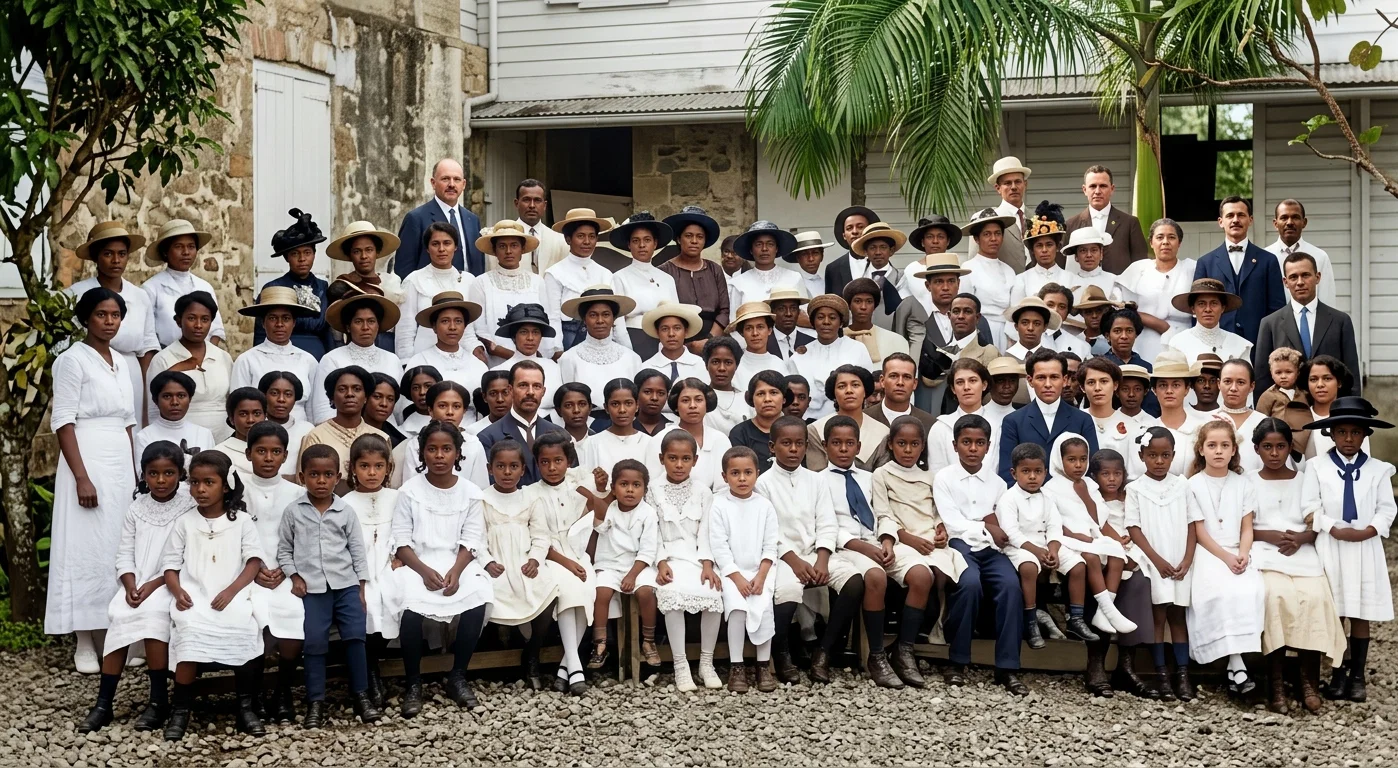
We have a nice church here, and they gave us a hearty welcome. In January we began a series of meetings, continuing seven weeks. During this time the members distributed 20,000 bills for advertising. We never worked where the members took hold more willingly than here. The average attendance was from three hundred and fifty to four hundred. Cards were passed in the congregation for those to sign who desired reading matter, and three hundred and fifty names were handed in. This was too much for the workers alone to do, and the members responded readily to the work of putting literature into the homes. In this way we came in touch with many nice persons. The last week of the effort Elder S. A. Oberg, of Venezuela, rendered valuable help.
CHURCH IN PORT OF SPAIN, TRINIDAD, WEST INDIES
Nearly all the expense of the meetings was met by the collections. Though many of the people are poor, we find them ever ready to sacrifice for the cause of God. These meetings resulted in two baptismal classes, and seventy-three precious souls have been buried with their Lord in baptism and united with the church. This is Catholic soil, and many of these new believers are meeting severe persecution, some from their own families and some from pretended friends. To be stamped a Seventh-day Adventist in this country means very little sympathy from the people, and few chances of obtaining work. But in spite of persecution, they who accept this truth are happy, and they thank God from the depths of their hearts for it.
We have a nice company of young people here who are good home missionaries. Oftentimes we think they would be a beautiful example to our young people in the homeland who are not improving their opportunities.
We hope that as your prayers ascend to the throne of God you will remember the work and workers in Trinidad, that when the harvest is gathered we may all be found among the redeemed and join with them in singing the song of Moses and the Lamb.