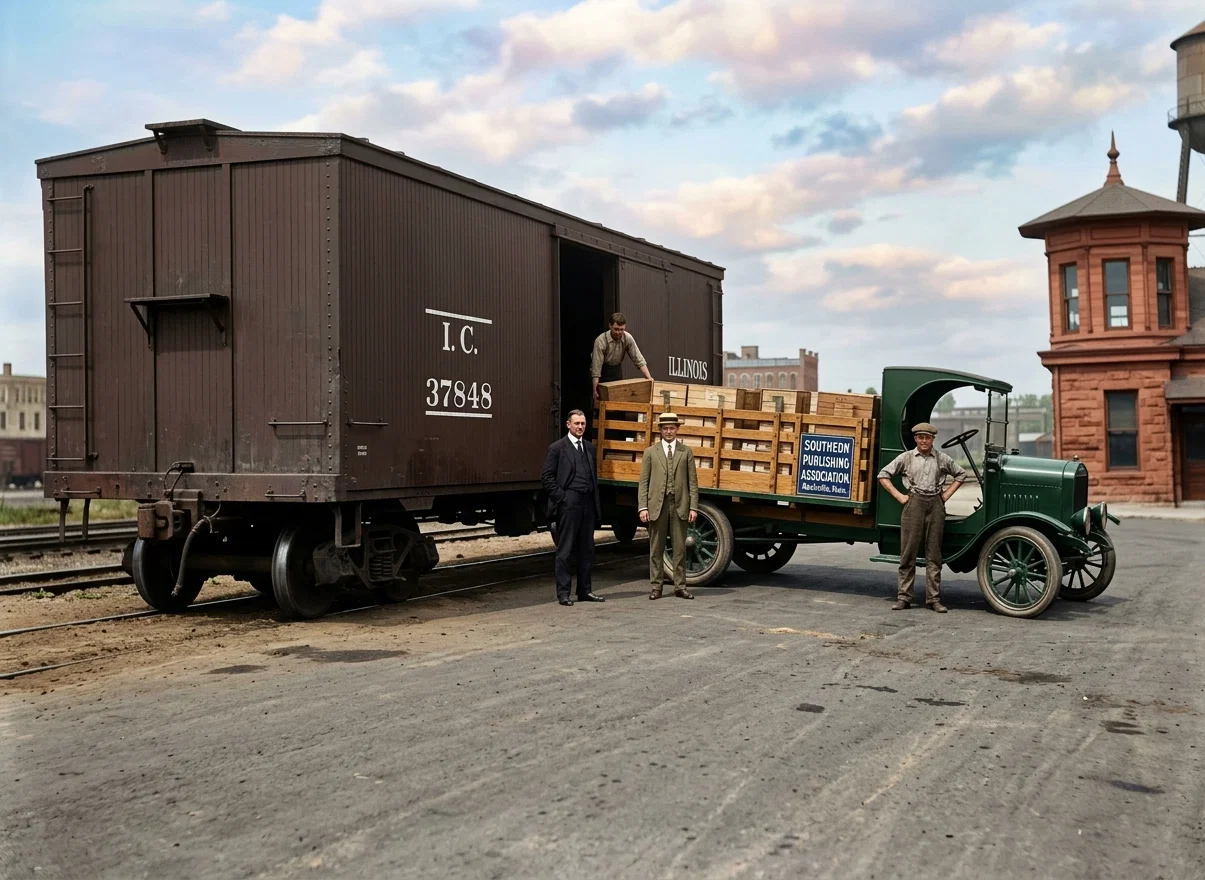
The publishing work in the territory of the Southern Publishing Association is onward, notwithstanding the heavy depression in the cotton market caused by the war. When this depression was first felt, it affected our work to a considerable extent, but since then our workers have been adapting themselves to the situation, and the Lord has blessed their efforts accordingly.
A CARLOAD OF BOOKS
Shipped by the Southern Publishing Association, Nashville, Tenn., to its Western
Branch, at Fort Worth, Tex.
Last year the home office of the Southern Publishing Association shipped two carloads of books from its factory in Nashville, Tenn., to its Western Branch at Fort Worth, Tex., for distribution throughout the Southwestern Union Conference. However, on account of the poor deliveries last fall caused by the tremendous drop in cotton, quite a large number of these books were carried over. Therefore, it is expected that only one car will be called for this year, of which the accompanying illustration is a photograph. This was taken at Nashville, August 6, and shows the car as it was being loaded. It also shows the publishing house truck, upon which at the time there were three tons of books.
In the car there were 105 cases, or boxes, containing 7,422 volumes, and weighing 30,000 pounds, with a value of something over $25,000. Perhaps, however, the most encouraging feature of this large shipment is that practically the entire carload consisted of large books, which is evidence that the sale of our health- and message-filled books is not so dependent upon good crops, high prices, and favorable financial conditions as upon the consecration and devotion of the individual colporteur.
During the past year the circulation of the Watchman has greatly increased. The June issue of last year had a circulation of only 20,000, while the sales of the June number this year were 50,000. The sales for July were 57,289, and the August number has had a sale to date of approximately 70,000, of which 15,000 have gone to the Atlantic Union Conference. During this time the regular mailing list has increased from 6,000 to over 14,000.
The readers of the REVIEW will doubtless be interested also in a new book which has just been issued by the Southern Publishing Association, entitled “The Vatican and the War.” To many, and particularly to those who have been reading his articles in the Watchman, the only recommendation necessary is to state that the author is Dr. Percy T. Magan. It is gratifying to us as publishers to report that the orders have been coming in for this book in a most encouraging manner. In fact, before the first form was ready for the press, we had orders for more than 10,000 copies, and before the first edition of 25,000 was completed, it was found necessary to order a second edition of the same number.
In size, prices, and discounts, “The Vatican and the War,” is similar to “The World’s Crisis.” However, the matter it contains is entirely different, and offers our people an exceptional opportunity for giving the warning against the beast and his image in a way that will appeal to the better classes. The book is all the more timely and valuable in view of the universal interest in the war.
Some of the tract societies are ordering as many as 2,000 copies at one time, and we look for the book to have a very large sale. It is so written as to appeal to Catholics as well as to Protestants, and as a result it is hoped that it may be the means of bringing the message to a large number whom it might otherwise be difficult to reach.
The outlook before our work was never brighter. A great work is being accomplished with our literature in the South as well as in other places. The workers in this field are of good courage, and determined to press onward in giving the message until the Master says, “It is enough.”
SOUTHERN PUBLISHING ASSOCIATION,
R. L. PIERCE, Manager.
Missouri Camp Meeting
By C. S. LONGACRE
THE Missouri State camp meeting was held at Columbia in a beautiful grove at the northern end of the city, August 5-15. Many were heard saying as they left, “Well, this is the best camp meeting we ever attended.” The Lord came very near and poured out his Spirit upon the congregation, not only upon both Sabbath day services, but also during the weekly services at stated times. Upon several occasions the whole camp was divided into sections, and each went apart by itself to seek the Lord for the forgiveness of sin and the baptism of the Spirit for service.
About three hundred and fifty of our17people were in constant attendance, and over four thousand dollars was subscribed in cash and pledges for foreign missions, about half of this amount consisting of pledges subject to the sale of property. The Missouri Conference stands at the head of all the conferences in the Central Union in paid-up offerings to missions to date. Since the North and South Missouri Conferences were united ten months ago, the tithe has increased over two thousand dollars for the ten months of the current year over the total tithe of the entire previous year. It is estimated that the total gain in tithe for this year will be over five thousand dollars.
The past ten months also have witnessed a larger ingathering of souls than any previous year. The workers reported over two hundred new Sabbath keepers for this period of time, twelve of whom were baptized at the camp meeting. A large amount of literature was sold to our people for missionary work during the camp meeting. Practically every family subscribed for the REVIEW.
A very good outside interest from the city was developed during the evening services. On the first Sunday night there were about fifteen hundred present, and on the last Sunday night about two thousand. About four hundred were in daily attendance at each evening service. A very successful temperance rally was conducted by our people on the last Sunday afternoon. The ex-mayor of the city, the leading Methodist minister, a prominent W. C. T. U. reader, and one of our own workers took part in the program. Dr. P. T. Magan also delivered a lecture on “The Vatican and the War,” to the Knights of Luther, at a public mass meeting of about five hundred on the courthouse steps in the heart of the city. It was highly appreciated by those present.
The workers present from outside the local conference were: Elders R. A. Underwood, J. W. Christian, and W. W. Ruble and J. H. McEachern from the Central Union. During the first half of the meeting Dr. Paulson, from the Hinsdale Sanitarium, rendered valuable assistance. His talks were much appreciated. Dr. Magan and I attended the latter half of the meetings.
The president, Elder J. S. Rouse, was unanimously reelected for another year, as were practically all the rest of the former conference officers. Everybody seemed happy and of good courage, and went home revived spiritually, and determined to witness for God and his saving truth.
C. S. LONGACRE.
Three Days’ Harvest Ingathering
By Wm. Covert.
RECENTLY Brother A. C. Park and I devoted three days to soliciting in the vicinity of Viola, Ill., in the interest of our foreign missionary work. Having nearly one hundred papers left over from last year’s campaign, we concluded to distribute these, before the papers for this year came out.
During the three days’ work we made about 120 calls and succeeded in getting 93 contributions which amounted to $51.75. The money was cheerfully given by members of various denominations and persons of no church connection. The effort demonstrated the fact that persons not of our denomination are ready to join with us in raising money to meet the expense of giving the third angel’s message to the world. We also proved that we can get money at other than the regular appointed time.
I believe our people should use one million papers during our next campaign. The papers are doing much good and the money gathered will help while the missionary visits will be a great blessing to those who work and also to those who are judiciously visited.
WM. COVERT.
Annual Meetings in Sweden
By J. C. Raft
SWEDEN, with its five and one-half million inhabitants, has nine hundred and twenty-five members belonging to our denomination. Of these, six hundred and eighty-six belong to the Swedish Conference (central Sweden), one hundred and eighty-one to the South Swedish Mission, and fifty-eight to the North Swedish Mission. This year, as last, we had two yearly meetings in Sweden, one in the Swedish Conference and one in south Sweden.
The Swedish Conference
held its annual meeting in the city of Orebro, June 16-20. This meeting was the largest and best of its kind ever held in that conference. It was held in a nice spacious hall in the center of the town, and was well attended by outsiders. Of ministers from abroad who preached the word may be mentioned Elders E. Rosenwold, of north Sweden; O. Nelson and J. A. Settergren, of south Sweden; and A. G. Christiansen, of Denmark.
The report rendered by the president, Elder L. Muderspach, showed an encouraging advancement during the last year both as regards the evangelical work and the financial phase of conference business. Several of the conference laborers have been having fair success in their efforts to lead souls into the truth, and the outlook in this respect is considerably better than it has been of late years.
Some two hundred and twenty-five of our people attended, and the Lord blessed us greatly. The good spirit prevailing throughout the meeting testified to the fact that our brethren and sisters in Sweden are awake to the solemnity of the times, and see the necessity of being wholly on the Lord's side; and it is also an evidence that the work in the Swedish Conference will be making more rapid advancement. Elder Muderspach was again elected president of the conference.
The South Swedish Mission
had its yearly meeting in the city of Hesselholm, June 24-27. This meeting was well attended, about one hundred and twenty of our people being present. Brethren L. Muderspach, E. Rosenwold, and A. G. Christiansen were in attendance to speak the word. The Spirit of God gave power to the messages spoken. The same gentle spirit that characterized all our annual meeting made itself manifest here. The interest our people of this mission are showing is a source of joy and encouragement.
The South Swedish Mission is under the direct auspices of the Scandinavian Union Conference. If the brethren and sisters here continue as they have started, however, the time may not be very far off when south Sweden will be organized into a conference. The tithe has more than doubled since the mission was organized three years ago. Elder O. Nelson was reelected superintendent.
J. C. RAFT.
Copenhagen, Denmark.
Concerning the Work of Sister White
By GEO. O. STATES.
ON receiving the REVIEW containing the sad news of the death of our beloved Sister White, my mind reverted to the long ago, when I was but a child, and some meetings were held in the summer of 1853 for the believers in Jackson County, Mich.
My mother had but recently begun to keep the Sabbath. The work in Michigan was comparatively new, and most of the Michigan ministers were present. Our people had heard considerable about a sister in the East to whom the Lord was making wonderful revelations through visions, and were very much divided on the question, some being bitterly opposed to anything of the kind, others thinking more favorably of the idea.
On this occasion Sister White was taken off in open vision, and was shown some things relating to the work in Michigan. On coming out of this vision she related the wrong course that some were taking, which was marring the Lord's work. Things were shown her that the people knew were true, and they knew that Brother and Sister White had no way of knowing about them only as the Lord presented them to her in this vision.
Among other things, she was shown that some of the ministers were using tobacco, and they were reproved for so doing. These meetings brought things to a crisis, and some were thoroughly convinced that the visions were from the Lord, and took their stand as firm believers of this wonderful gift in the remnant church. Others rejected the light and soon began to oppose the work.
To our acceptance of the gift and work of the spirit of prophecy we owe our present system of organization. There is no question but that enough has been given and written out to take this people through if it is studied and lived out.
It has been my lot to watch the result of not heeding the counsel given through this gift in the remnant church. Some say that the Sabbath and other parts of the message are all right. They declare how firmly they will hold to all but the writings of Sister White, but they soon give up every point of the message. “Believe in the Lord your God, so shall ye be established; believe his prophets, so shall ye prosper.”
GEO. O. STATES.
Field Notes
Elder J. C. Stevens reports that as the result of meetings held recently at Syracuse, N. Y., fifteen have accepted present truth, and others are deeply interested.
In April the first German church and Sabbath school were organized in the Australasian field. Thirteen adults and three children joined this school, and there were seven charter members of the church.
Efficiency in Our Sanitarium Work
By George Thomason, M. D.
EFFICIENCY is defined as “power that accomplishes a desired or designed work. The state of possessing adequate skill or knowledge for the performance of a duty or calling.”
The sanitarium work was established by this denomination for a very definitely desired and designed work. Efficiency in accomplishing this work is the state of possessing adequate skill or knowledge for the performance of this calling. And as it was distinctly in the line of God’s providence that sanitariums were established and for a specific purpose, they can be fully efficient only as they accomplish God’s design and purpose. This purpose has been said to be the reaching of all classes in general, and, in a special sense, “the higher classes,” with the principles of truth.
Involved in an efficient sanitarium work is,—
First, its board.
Second, its buildings and equipment.
Third, its staff.
Fourth, its results.
To deal with these more specifically—first, the board: It would seem apparent and self-evident that the board of control of an efficient sanitarium, as of any other institution, must of necessity be composed largely of men actually engaged in the work and responsible for its conduct and success, or at least of men having a working knowledge of the developmental needs of such an institution. “Where the burden of labor rests, there should largely rest the burden of control.”
Buildings and equipment: If a sanitarium is efficient financially and otherwise, as it is expected to be, the buildings, and especially the equipment, must be adequate and reasonably modern and efficient. The rapid progress of the world makes demands upon us that cannot be satisfied with inadequate and shabby buildings, furniture, and equipment. As to rooms and furniture, aside from a little increased original investment, it costs no more to maintain and care for well-furnished, higher-priced rooms than it does for cheaper ones. With all that is necessary to be done for patients in our sanitariums, and the necessarily great expense in doing it, the price charged for the cheaper rooms barely covers the actual outlay, and if an institution is made up practically altogether of this grade of accommodations, there can be no hope of financial gain. The financial difference between a forty dollar and a twenty dollar a week room is a gain of twenty dollars. And not only so, but very few patients who are looking for a chance to pay forty or fifty dollars a week will come into the institution and be satisfied with anything else. Many, even in quite ordinary circumstances, now look for private telephone service, stationary hot and cold water basins, and, many of them, private baths in connection with their rooms. Most of our sanitariums in California are woefully lacking in proper rooming facilities for patients; and efficiency in our sanitarium work suggests radical changes in this particular.
Our institutions are primarily hydropathic, and certainly the bath and treatment rooms of our sanitariums ought to be modernly equipped for efficient service. However, as a matter of fact, the deficiencies of most of our sanitariums are painfully, if not, in some cases, disgracefully, apparent in this department.
While it is true our institutions are not primarily for the purpose of making money, it is only reasonable to expect them to pay and keep free from debt if properly and efficiently equipped. And while it takes more than buildings and equipment to make an efficient sanitarium work, it still takes buildings and equipment.
The staff: To do efficient work the staff must be composed of experts in every department—spiritual, medical, surgical, nursing, domestic, culinary, business, and executive. For lack of time, confining ourselves to the efficiency of the medical and surgical staff, we would intimate that it should be large enough to make possible the careful examination and study of patients’ individual cases; ready and sufficient accessibility of physicians to the patients; the periodic trip away from the institution for research and postgraduate work; the careful preparation of lectures for delivering in the institution and various communities; and some means of more directly forming the connecting link between the institution and the homes of the people. The aim of the minister, canvasser, colporteur, and teacher is the homes of the people; and it should be none the less so with the physician. There is no class of workers to whom homes are so widely open and accessible as to the physician, and perhaps there is no one more capable of rightly influencing homes than the Christian physician. Access to the homes of the people by the sanitarium staff means a very marked increase in the patronage of an institution, and thus an increase in its scope and field of usefulness and efficiency.
The staff efficiency is greatly increased, also, by a proper division of the work and specialization. The field of medicine is altogether too extensive to be covered by one man or by a group of men, unless it is made departmental. Institutions not of sufficient size to justify the formation of a staff of specialists devoting their entire time to the institutional work could, with great advantage, arrange for definite visiting hours for this purpose. This feature is becoming more and more recognized as a necessary factor in the most successful clinical work, and ought not longer to be ignored in our efforts to render efficient sanitarium service.
Our medical and surgical service has not been and is not now nearly so efficient as it should be. Patients coming to an institution conducted on Christian principles and under divine guidance, both by right and reason expect superior and expert service. Divine help, unremitting effort, and study are essential to make this possible. Daniel and his companions were found ten times more skillful and efficient than their classmates. The angel could consistently come to Daniel and say, “I have come to give thee skill and understanding,” because Daniel had contributed his part, by sacrifice, study, and hard work. Inspiration is essential, so also is hard work, in developing efficiency.
Results: And what is the measure of efficiency in our sanitarium work? May it not be that that which we look upon as successful and efficient is but very feebly so in the light of God’s standard of attainment and efficiency? Certainly, merely financially successful institutions may be the least efficient in God’s sight. In our shortsightedness, we sometimes congratulate ourselves as having been very successful when we have patched up a number of wealthy and influential individuals, and been well paid for it, but perhaps at the same time, have given but scant attention, or entirely overlooked, some who to the human eye looked less promising and attractive. Is it not a bit inconsistent for us to pray God to send us patients, and then when he sends them to accept those who are well able to pay and who will be a financial asset to the institution, and at the same time turn away from treatment or surgical operation some, none the less sent of God, but too poor in this world’s goods to count for more than an expense to the institution? True, this may involve being imposed upon if we open the door to all who knock, but we must leave the answering of our prayers in this respect to God, trusting him to send us those who ought to come, and to restrain from coming those who cannot be helped and who would unduly impose upon the institution if they came. Christ, the great Medical Evangelist, must have been terribly imposed upon, often receiving scant thanks for his ministrations, yet every appeal brought from him his helpful and efficient response. Probably very few soul-winning enterprises are financially successful.
The financial phase of the annual report of an institution is not an index of its real efficiency. An institution may show financial gain and be estimated by man as efficient and successful, but, in God’s sight, be barren of results that will count in eternity. Another institution may show a financial balance apparently on the wrong side of the ledger because of a large amount of real charitable philanthropic and educational work, but with results as enduring as eternity.
God’s estimate of efficiency in sanitarium work is based upon results in turning men from darkness to light, from the power of Satan to God, receiving forgiveness of their sins and a place among those who are sanctified. We shall attain efficiency in our sanitarium work as we more and more fully realize, appreciate, and personally experience the power and efficiency of God’s grace in our own hearts, and become ever increasingly efficient in soul service and successful as soul winners.
Live for Something
“Live for something, have a purpose.
And that purpose keep in view;
Drifting like a helmless vessel,
Thou canst ne’er to life be true;
Half the wrecks that strew life’s ocean,
If some star had been their guide,
Might have now been safely riding,
But they drifted with the tide.”
Medical Missionary Department
W. A. Rublee, M. D. — General Secretary
A. A. Hansen — Assistant Secretary
H. W. Miller, M. D. — N. Am. Div. Secretary
The Home Missionary Work in the Southeastern Union Conference
By E. M. GRAHAM
IN response to an invitation from Elder Montgomery I left Washington, D. C., for Atlanta, Ga., July 8. Plans had been laid to hold two conventions, one July 9-11 in the Atlanta No. 1 church (white), and the other July 16-18 in the No. 2 (colored), church.
The first meeting was on Friday evening, when Elder Willess presented the congregation the real meaning of this home missionary movement, both to our own people and to the world. Sabbath morning and afternoon were devoted to considering the proper methods and value of organization for work, and the different lines of work church members can use in their soul-winning work. The thought was brought out that as God so loved the world that he gave his only Son, and Christ so loved the world that he gave his life, so those who really love the Lord will give themselves in service to win sinners to Christ. All successful home missionary work grows out of this love of the members for the Father and the Saviour.
The question box was an interesting feature, and was well filled with questions which showed a real interest and desire to do successful work. The last hour on both Sabbath and Sunday afternoons was devoted to answering questions.
Sunday morning and afternoon subjects relating to organization and methods of work were still further considered. It was made clear to all that by careful organization, dividing the members into bands, dividing the territory into districts, and districts into small lots, more definite work could be done than by undirected individual efforts.
The instruction during Sabbath and on Sunday morning and afternoon was given by the Southeastern Union Conference home missionary secretary, Brother W. H. Hayes, and the writer. On Sunday evening Elder Montgomery closed this convention with an address on the events which show that the end is rapidly approaching and that therefore the need of haste in our work is great.
Though this ended the convention as planned, the interest manifested by the members was so strong that on Monday, Tuesday, and Wednesday evenings meetings were conducted by Brother Hayes on home missionary topics.
Monday morning, in the union conference office, a few zealous home missionaries gathered: Elder Montgomery, Brethren, W. H. Hayes, L. D. Randall, D. W. Dillen, J. K. MacMillan, and Elder Williams, pastor of the colored church; also Miss Anna Knight, the union conference home missionary secretary for the colored people. This company and I spent Monday, Tuesday, Wednesday, and part of Thursday in a close and careful study of the duties of home missionary secretaries, union, local, and church; and of the principles of organization, need of loyalty to conference committees, to departments of work, and to one another; and of other topics connected with this great home missionary movement. I believe the time was well spent, and personally I enjoyed the interchange of thought, experience, and plans.
On Sabbath and Sunday following we carried out the same program at the colored church, Brother Hayes and I being the instructors. Again the questions came in thick and fast, and considerable time was devoted to answering them.
The Sunday evening meeting was taken by Brother Hayes, as Elder Montgomery had left for the Cumberland camp meeting. Both these Atlanta churches are full of live home missionaries, and they expressed their determination to do more, and more thorough work, in the future, so as to bear their share in the finishing of the work.
From there Brother Hayes and I went to the Cumberland camp meeting. It was held in Cleveland, Tenn., a town of some 8,000 inhabitants, taking in surrounding districts within easy reach. There were about two hundred persons camped on the grounds.
Tuesday and Wednesday mornings and Thursday and Friday afternoons an hour was given to the home missionary work, when different methods of work were explained and practical demonstrations were given in how to meet people and introduce literature. Volunteers were called for to go out and give away and sell literature and invite people to the meetings. Every afternoon saw some eager companies, each with a leader, set off for an hour and a half's work. The children caught the spirit and went also and helped. At the close of the meeting, it was said that every home had received some literature and an invitation to the meeting.
Each night the pavilion was packed with interested listeners; seats were placed all around outside and filled, and still more people were sitting in automobiles, buggies, wagons, and other conveyances. We feel sure that the invitations given by the personal workers helped to bring about this result, and I believe that souls will be gathered in to build up the church in this place.
Though the war has badly affected parts of the Southeastern Union Conference, the prospects are bright. Workers and people are united in a determination to win souls and to do their share in the finishing of the work. Such a spirit will surely bring upon it the blessing of God.
E. M. GRAHAM.
News and Miscellany
Notes and clippings from the daily and weekly press
— On July 26 the attendance at the Panama Pacific Exposition passed the 9,000,000 mark.
— Postmaster-General Burleson has issued an order that the use of bicycles in the rural delivery mail service be prohibited after Jan. 1, 1916. His reasons are that such methods of transportation are too limited in their capacity, and do not afford necessary protection for the mails in bad weather.
— Some expert at figures has estimated that the 260,000,000 cubic yards of material handled in building the Panama Canal would make a solid wall nine feet high and six feet thick around the whole earth at the equator.
— The capture of Warsaw by the Germans, officially announced August 5, ended more than a century of Russian domination of the Polish capital, a city of about 800,000 people and sometimes referred to as the Paris of Russia.
— Secretary of the Interior Lane recently called attention to the fact that the United States is paying out $105,000,000 a year pensions to ex-soldiers and ex-sailors, while our navy is costing us $147,000,000 a year and our regular army $125,000,000.
— On August 14 a large portion of the north side of Kingston, Jamaica, was washed away by heavy seas and tidal waves. Hundreds of persons were rendered homeless, and houses and wharves demolished. Banana plantations suffered greatly. Fifteen persons are known to have been killed.
— There are more than 18,000 regularly established public libraries in the United States, containing over 75,000,000 volumes. The increase of 20,000,000 volumes since 1908 indicates the scope of the reading habit of the country. These figures were compiled by the United States Bureau of Education.
— After more than 400 years, Spain has officially declared her doors open to the Jews of all nations. Announcement has just been made to the Jews of the United States by Senor Juan Riano, Spanish ambassador to this country, that they will be welcomed to full citizenship in Spain, with all bars of inequality and disfranchisement removed.
— Vesuvius, Mt. Etna, and Stromboli, three of the world's greatest volcanoes, have suddenly become active, and are belching forth great clouds of steam and smoke. Lava is pouring down the eastern slope of Mt. Etna from two new craters, threatening the destruction of Sicilian villages. The whole population of Naples and of Messina and other Sicilian cities is in a state of terror.
— New York City is working out a plan for providing religious instruction for the children in the public schools. Last year one school in the Bronx, with 1,600 children, dismissed its pupils for eighty minutes three times each week, allowing them to go to the churches of their choice for religious instruction for that period. The same plan will be tried in one school in each of the three boroughs—Brooklyn, Manhattan, and the Bronx—this year.
— By about 15,000 majority the Canadian province of Alberta voted recently that the sale of liquor shall be prohibited throughout that domain after July 1, 1916. According to the direct legislation act of Alberta, the next legislature must put the law on the statute books without substantial alteration. The new act abolishes 320 hotel, club, and wholesale licenses throughout Alberta. Under the law all liquors handled for medicinal, scientific, and sacramental purposes after July 1 will be handled by dispensaries under control of the government.20
— The government henceforth will transport all its money and securities by mail, relieving the express companies of $500,000 annual income.
— During the year ending last June 30 not a passenger out of 180,000,000 carried was killed in a train accident on the entire Pennsylvania Railroad system.
— Three bushels of jewels, purses, and other small pieces of personal property which belonged to victims of the “Eastland” disaster were recovered when the ship, just three weeks after the catastrophe, was restored to even keel, on August 14. The property was found on the upper decks, which were the first available to search. Exploration of the hull will follow. No bodies were found in the hold.
— Plans have been submitted to the Ontario government involving the expenditure of $10,000,000 on the development of 100,000 additional horsepower, with provision for the eventual generation of 600,000 horsepower, on the Canadian side of Niagara Falls. Whether this will affect the natural beauty of the falls is another question. On the American side so much has been deviated from the cataract that widespread protest has been made against the further harnessing of Niagara.
— Carrying with it almost three acres of hard clay, the immense power plant of the Knickerbocker Cement Company, near Hudson, N. Y., recently was almost swallowed in what is supposed to be a bed of quicksand, killing five men and injuring several others. Just before the change of the laboring shift the workmen felt a rumbling under their feet, then came a cloud of dust. Almost instantly the immense plant disappeared from sight, carrying with it 40,000 tons of trap rock stored for winter use, the weight of which undoubtedly served to cause the disaster. The plant, built four years ago at a cost of $250,000, was situated on an almost level piece of land one mile from Hudson; it employed nearly 600 men.
Home Missionary Department
E. M. GRAHAM - - - - General Secretary
F. W. PAAP - - - N. Am. Div. Secretary
NOTICES AND APPOINTMENTS
Camp Meetings
ATLANTIC UNION CONFERENCE
Northern New England, White River Junction, Vt. .......... Aug. 26 to Sept. 5
Maine, Dover and Foxcroft, Aug. 26 to Sept. 5
Eastern New York, Schenectady ........ Sept. 2-12
CENTRAL UNION CONFERENCE
Kansas, Emporia .... Sept. 2-12
COLUMBIA UNION CONFERENCE
West Virginia, Weston .... Aug. 26 to Sept. 5
Virginia, Newport News (colored) Sept. 9-19
LAKE UNION CONFERENCE
North Michigan, Mount Pleasant ................. Aug. 26 to Sept. 5
Northern Illinois, Joliet .... Aug. 26 to Sept. 5
Southern Illinois, Springfield .... Sept. 2-12
PACIFIC UNION CONFERENCE
Southeastern California, Huntington Beach ................. Aug. 26 to Sept. 5
South Texas, Corpus Christi (local) ..... Sept. 16-26
SOUTHERN UNION CONFERENCE
Mississippi, Jackson (white) ..... Sept. 9-15
Maine Conference Association
By Homer W. Carr; Willard O. Howe
THE first meeting of the regular annual session of the Maine Conference Association of Seventh-day Adventists will be held on the camp ground in Foxcroft, Maine, at 10 A. M., Tuesday, Aug. 31, 1915, in connection with the Maine Seventh-day Adventist camp meeting. At this meeting, the vacancies occurring on the board of trustees will be filled, and such other business transacted as may properly come before the association.
HOMER W. CARR, President;
WILLARD O. HOWE, Clerk.
New Mexico Conference Association
By R. B. Coberly; W. R. Goss
NOTICE is hereby given that a meeting of the Seventh-day Adventist Conference Association of New Mexico will be held at 9 A. M., Wednesday, Sept. 8, 1915, on the camp ground at Clovis, N. Mex., to elect officers, and to transact such other business as may come before the association.
R. B. COBERLY, President;
W. R. GOSS, Secretary.
Kansas Medical Missionary and
By W. D. MACLAY; R. L. CARSON
Benevolent Association
The Kansas Medical Missionary and Benevolent Association will hold its regular annual meeting in connection with the conference at Emporia, Kans., Sept. 2-12, 1915, to elect a board of trustees, and to transact such other business as is deemed necessary. The first meeting will be held at 10:30 A. M., September 9. All accredited delegates to the conference are delegates to the association.
W. D. MACLAY, President;
R. L. CARSON, Secretary.
Kansas Conference Association
By W. D. Maclay; E. Harris
The next annual meeting of the Kansas Seventh-day Adventist Conference Association will be held at Emporia, Kans. The purpose of this meeting will be to elect the board of directors for the coming year, and to transact such business as may be necessary at that time. The first meeting will be held at 10 A. M., Tuesday, Sept. 7, 1915.
W. D. MACLAY, President;
E. HARRIS, Secretary.
Seventh-Day Adventist Book Society of West Virginia
By S. F. Ross; J. S. Barrows
THE fourth annual meeting of the Seventh-day Adventist Book Society is called to convene at 10 A. M., Sept. 2, 1915, on the camp ground at Weston, W. Va. Officers for the ensuing year will be elected, and such other business transacted as may properly come before the society.
S. F. ROSS, Vice President;
J. S. BARROWS, Secretary.
Mississippi Conference Association
By C. S. Wiest; Ben C. Marshall
The fifth annual session of the Mississippi Conference Association of Seventh-day Adventists will be held in Jackson, Miss., in connection with the State conference and camp meeting. The first meeting will be called at 3 P. M., Friday, Sept. 10. Officers will be elected for the coming year, and such other business transacted as may properly come before the association. All duly accredited delegates to the Mississippi Conference are delegates to this association.
C. S. Wiest, President;
Ben C. Marshall, Secretary.