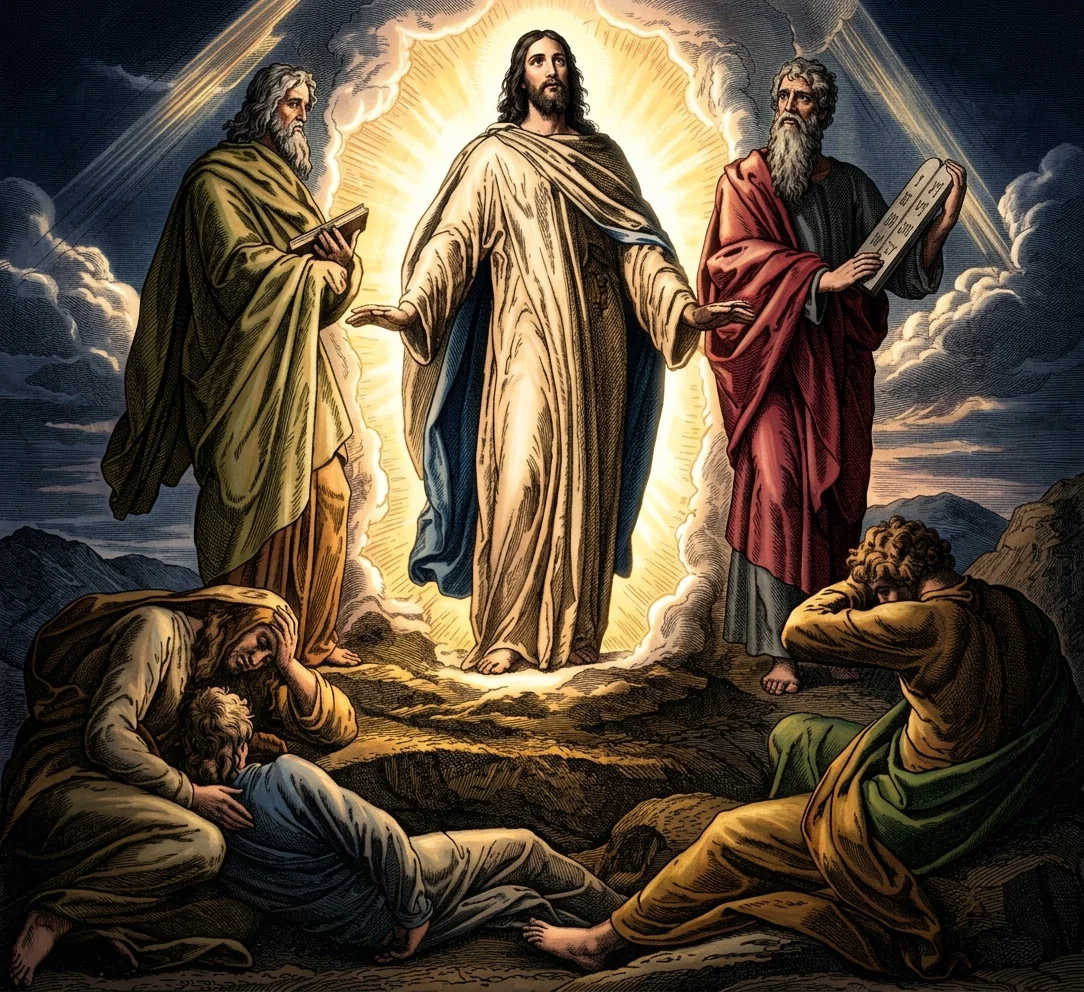
In speaking with people who believe that all mankind go to their place of punishment or reward at death, I often find them using as an illustration the scene on the mount of transfiguration. They say, “Here was Moses, who was buried, safe in the kingdom, and Elias, a translated man, with him, rejoicing in the glories which we expect to receive as soon as the Lord sees fit to place the finger of death upon us.”
How often I have said, and more often thought, What an awful door you have by which to enter heaven! Then you make no distinction between the door to heaven and the door to hell. Christ says plainly, “I am the Door of the sheep.” John 10:7. Christ is not death, but life; for in him was life, and his life was the light of men. John 1:4; 8:12. Peter, one of the witnesses, says: “For we have not followed cunningly devised fables, when we made known unto you the power and coming of our Lord Jesus Christ, but were eyewitnesses of his majesty.” 2 Peter 1:16. What did Christ receive when in the mount at this time?—“For he received from God the Father honor and glory.” Verse 17. By what declaration was this honor and glory made known?—There came a voice from the excellent glory, “This is my beloved Son, in whom I am well pleased.”
It is very evident that Peter had reference to the honor and glory shown Christ by the voice; for he says in verse 18, “And this voice which came from heaven we heard, when we were with him in the holy mount.” “We were eyewitnesses of his majesty”—power of authority. What power of authority had they seen?—His power over the works of Satan.
Christ came to destroy the works of the devil. 1 John 3:8; Heb. 2:14. Argument is hardly necessary to show that sin is the work of Satan. “The wages of sin is death.” Rom. 6:23. Death, then, being part of Satan’s work, Christ came to destroy it. Would it not be a strange destruction of death if his stronghold were not broken open and the captives set at liberty? The grave, we have every reason to believe, is the prison-house of death; and we find that Christ came to open the prison-house. Isa. 61:1; 42:7.
Did he do it?—His own words declare that he did. Rev. 1:18; John 5:28, 29. How was Christ’s majesty (power) made manifest in the mount? We find here a man who had died and was buried, and another who had been caught up into the skies without dying. Let me ask those who would have all go to heaven or hell at death, If both of these were worthy of heaven, why did one have to die first, and be buried? Is God a respecter of persons? Elias was a man subject to death, since he was of the offspring of Adam. It was therefore, undoubtedly, by the virtue vested in Christ that Elias was present.
But how did Moses get there, since we know he was buried? Ah, here is where the power of Christ is manifested to open the prison-house of death! We read of no trouble with reference to Elias. He never had been in the prison-house of death, and therefore could be removed from this earth without any trouble, for those who are of faith, as faithful Abraham, are pilgrims and strangers. Moses, however, had been overcome by death, and we read that there was a dispute over the body of Moses (Jude 9), and why?—For the reason that in God’s purpose he was to represent the power of Christ in the resurrection, when an exposition of the kingdom of Christ was to be given to Peter, James, and John. Matt. 16:28. The same exposition of Christ’s kingdom will meet our eyes at the coming of Christ, only on a larger scale. Paul describes it in the following language: “Behold, I show you a mystery; we shall not all sleep, but we shall all be changed, . . . for the trumpet shall sound, and the dead shall be raised incorruptible, and we shall be changed.” Many texts might be given to show that those of the past are waiting the resurrection, but let these suffice: Job. 19:25-27; Ps. 17:15; 2 Tim. 6-8.
Brethren, let us be “strangers and pilgrims” on the earth, “sanctified wholly” to the Lord; that should we enter this prison-house of death, it may be with a “full assurance of faith” and hope in the first resurrection. Remember our Lord will call all such forth unto the resurrection of life. John 5:29.
LOUIS K. MORGAN.
FREEDOM AND LOVE.
DID not Christ buy us with his own blood that we might be free from the bondage of sin? This fact should lead us to give to him the deepest affection of our soul and the best service of our life.
There is a story told by a man who, years ago, was taken captive in the Mediterranean by one of the corsairs which used to sweep those seas. He was sold as a slave, and endured the rigors of Mohammedan bondage. One day an Englishman came on board the vessel where he was, and talking with his owner, made a bargain for him, paid the price and bought the slave.
The poor captive bitterly reproached his purchaser: “You, a free-born Englishman, buy me for a slave!”
But the purchaser said, “I have bought you to set you free.” At once the captive’s sorrow was turned to joy and his reproach to gratitude; and falling at the feet of his new master, he said, “I will be your servant forever.”
Thenceforth nothing was too hard for him to do for a master who had bought him with a price, that he might set him free. So Jesus has bought us, and so ought we to serve him.—Selected.
THE GOSPEL IN ETERNITY.
By H. F. PHELPS
“For my thoughts are not your thoughts, neither are your ways my ways, saith the Lord. For as the heavens are higher than the earth, so are my ways higher than your ways, and my thoughts than your thoughts.” Isa. 55:8, 9.
This being so, when we read this: “For I am not ashamed of the Gospel of Christ; for it is the power of God unto salvation to every one that believeth” (Rom. 1:16), and this, “Christ the power of God” (1 Cor. 1:24), we are reading thoughts of God, which are as far above our thoughts as are the heavens above the earth. And this being so, no one should expect that he himself has seen all there is in these thoughts, for it is not in man to exhaust the thoughts of God. Much has been said concerning the Gospel, and much more can be said; much more will yet remain to be said, and that will be said through the eternal ages; and its immeasurable fulness will not yet be fully understood or comprehended. Then let us study the Gospel for a little while.
What is the Gospel?—“It is the power of God.” And so is “Christ the power of God.” And the Gospel being the power of God and Christ being the power of God, Christ has ever been and ever will be the Gospel of God unto salvation to every one that believeth. And so it is called the “everlasting Gospel.” Rev. 14:6. Of course the Gospel, the power of God, Jesus Christ, is everlasting; for his “goings forth have been from old, from everlasting.” “The Lord possessed me in the beginning of his way, before his works of old. I was set up from everlasting.” Micah 5:2; Prov. 8:22–30. These are the words of Christ concerning himself. And this is what we might expect; for it is “even his eternal power.” Rom. 1:20. Then as he is from “everlasting,” and that power is “eternal power,” and Christ is that power, even the Gospel of God, it follows that the Gospel embraces the eternal past and the eternal future. It further follows that the Gospel, Jesus Christ, the power of God, is not and never was a newly-devised plan, devised to meet an emergency—the emergency of sin—in this small world, whose inhabitants are accounted “as the small dust of the balance” (Isa. 40:15), in comparison with all the other worlds and their inhabitants. Then for whom was the Gospel ordained as a means of life? And to whom was that Gospel, that power, that Christ, first manifested? Evidently, the Gospel, which is the power of God, Jesus Christ, was ordained as a means of life to every created intelligence, and that by believing in Him who alone could perpetuate life. And that Gospel, Jesus Christ, the power of God, was first manifested to the first created being; and offered to that one if he would believe. The inhabitants6of other worlds believed, and therefore they live. This world did not believe; and the sin was not in believing the tempter, but in disbelieving God; and so this world is lost in sin. Yet, inasmuch as “the Gospel is the power of God” to all that believe, and as Christ is that power, that Gospel, it is still offered to every sinner who will believe.
Yet again, whenever or wherever that power is, or has ever been manifested, that power itself being a manifestation of the Gospel, the manifestation of that power has ever been, and ever will be, the proclamation of “the everlasting Gospel.” It has in itself been preaching the Gospel to every intelligent creature. It therefore follows that, whenever that power was made known to an intelligent being through creation, that power, or Gospel, was made known to them “unto salvation,” a salvation to eternal life through obedience; for we read, the man that doeth them, shall “live in them” (Rom. 10:5), and that through faith in their divine Instructor, even faith in Jesus Christ, the power of God, the inhabitants of other worlds did believe, and do “live in them.” This world refused to believe, and so does not “live in them”—the commands of their Creator. Nevertheless this same power, Jesus Christ, is pledged for salvation from unbelief of all who will yet believe in Christ as their Saviour. And so it is “Christ in you, the hope of glory” (Col. 1:27), for Christ dwells in the heart by faith (Eph. 3:17). And as it is “Christ in you,” the believer, who has sinned, so also it is Christ in the believer who has not sinned; for God is no respecter of persons, and requires no more of one than of another. And so we can easily see that the power of God in Jesus Christ, who is the power of God, the Gospel of God, began to be made known in the eternal past, when creation first began, as a means of an eternal existence, “that ye [they] might be filled with all the fulness of God,” and thus be made eternally happy in the enjoyment of that blessed, immeasurable, everlasting fulness. This was the purpose of God; was and is the purpose of the Gospel of God; not for a lost world only, but for all the worlds, that they may at last all be one great family of God. Eph. 3:15; 1:10.
Once more: The Gospel of Christ being the power of God, as revealed to him and through him in creation, it follows that creation and creation’s work has ever been proclaiming, and still proclaims, and ever will proclaim, that power, that Gospel, that Christ, who will soon be crowned King of kings and Lord of lords. And so every created being and thing, both animate and inanimate, has ever been and ever will be preaching the Gospel of Jesus Christ. And this they do in unmistakable language; in the very fact of their organization and existence they speak of the power of God, which is offered, and ever has been offered, “unto salvation to every one that believeth.” And so David, by the holy Spirit declares that “the heavens declare the glory of God; and the firmament showeth his handiwork. Day unto day uttereth speech, and night unto night showeth knowledge. There is no speech nor language, where their voice is not heard. Their line is gone out through all the earth, and their words to the end of the world.” Ps. 19:1–4. And this language of the heavens declaring the power of God, the Gospel of Jesus Christ, will be heard to all eternity. Not only this, but that language, the voice of the heavens, has been heard by every intelligent creature, so that the unbeliever is without excuse; for his own existence tells him to his face that he is a monument of the power of God, and may be a monument to all eternity if he will only believe.
Therefore we see that the Gospel of Christ is no new thing; it is not a newly-devised scheme to meet the emergency of sin; but it is “the everlasting Gospel,” even the “eternal power” of the “Almighty God” (Gen. 17:1), the “everlasting Father, the Prince of Peace” (Isa. 9:6), made known to all the worlds on high. That power, that Gospel, that Jesus Christ as creator, was offered to every intelligent creature in all the universe of God, unto salvation, upon the one condition of believing in that power. It is that same power of God that was offered to the representatives of this race; made known to them in creation and in creation’s work, and in their own creation; the which, if they had believed and received, this world never would have fallen.
Inasmuch as it is the same power, even Jesus Christ the power of God, he is able to carry on to perfection that which he has begun, because he alone has the power to finish it. He is the Author and therefore the Finisher of our faith, and of our salvation if we believe. And notwithstanding the channel of creation (by which life was to have been given to our race as well as to other worlds) has been broken by sin, it is to be renewed by a recreation in all who will believe; and to us it is salvation from sin and all its consequences.
While the sinless inhabitants of other worlds have ever believed, acting out that faith by works, by obedience, they are justified by works; the reward of life is reckoned to them of debt; they live in Him, through Him, and by Him; and Christ lives in them, and is one with them. Yet this same power of God in Christ may be accepted by sinful man, that he too may work works of righteousness; and this too, by Christ dwelling within by faith. But because of sin, he can not be justified by these works; yet he may be justified by his faith in the perfect life of another, even the life of his Creator, the perfect life of his Saviour, his recreation. Thus God requires perfection, a perfect life in all intelligences, requiring no more of one than of another. Those who never have sinned can present that perfect life in themselves, by and through the power of God in creation; and those who have sinned can present the perfect life of Jesus Christ by faith just as tho it were their own. And so, while the perfection of character that is required can never be found in the sinner himself, because of his sins, that perfect life is found in the Creator, offered freely, to be accepted by faith. And therefore we see that while God requires no more of the men in this world than he does of the inhabitants of other worlds, even of angels, yet he has done infinitely more for this world than for any other; and this because of his infinite power by which he could do it, and because of his infinite love that led him to do it. And all his saints can, and ever will, praise his holy name that he has done it, that having begun it, he is able to finish it. H. F. PHELPS.
Success
By J. G. Woolley
Success.—Success is surrender, that is the meaning of the word, and that is the mystery of Christ. “Sub,” “cedo;” I go under.
I “succeed” in Christian work when “I go under;” when “the old man,” Ego, is ordered to the rear, and I say to the “new man,” “O Lord, open thou my lips, and my mouth shall show forth thy praise!”
Jesus said, “I am the way, the truth, and the life,” and so it is the most severely simple logic to say that if one surrenders to “the way,” he is bound to “get there” if “the way” does. If he surrenders to “the truth,” he can not lack wisdom until truth turns liar. If he surrenders to “the life,” he is sure of immortality unless life dies. In short, and without any apology for repetition, to surrender to Christ is to get a hold on the helm of Omnipotence.—J. G. Woolley.
JEWISH CUSTOMS AND TRADITIONS.
By F. C. Gilbert
(By an Israelite.)
The Sanctuary and Its Services.—Continued.
The account of the erection of the court and the pillars which supported it is recorded in Ex. 27: 9–19 and 38: 9–20. The material used for the former was fine-twined linen, save the gate or entrance into the tabernacle, and it was made of blue, purple, scarlet, and fine-twined linen. The area of the court was about 150 feet long by 75 feet wide. We all know that fine linen represents the righteousness of the saints. Rev. 19:8. But the only way the saints can obtain righteousness is by having Christ; for he “is made unto us wisdom, and righteousness, and sanctification, and redemption.” Cor. 1:30. And the prophet Jeremiah says that his name shall be called “THE LORD OUR RIGHTEOUSNESS.” What, therefore, can we learn from this part of the sanctuary of the righteousness of Christ?
This place was where all the people could go, and thus it could be seen by everybody. The fine linen was so delicately wrought that any person could look through it. In relation to the other part of the tabernacle it was so prominent that it could not be hidden from view. True, some could turn their eyes in the opposite direction and not see it, but all who chose to could see it very plainly. And is it not true that in the righteous life of Jesus there was not one part of him through which the people could not look, and see him on every side the same true and lovely Saviour? Even his enemies had to admit that they could find no fault in him, and “never man spake like this man.” He never said anything that would have been better left unsaid, and never missed the opportunity of saying something that would do people good. Neither could any one convince him of sin. While the Jews, as a people, do not believe him to be the Messiah, and while, in many of the Talmudic writings, he is denounced, he is yet regarded by the multitude of the Jews as a good man, and they know not of one wrong thing he ever did. His life was not a shallow one; it was not one side different from the other; it was the same on every side,—the beautiful fine linen of righteousness. Some of them did not want him to rule over them, and they cast him aside; but all who chose to see him as he is, and look at him, the righteous One, had the privilege of doing so.
When the people were bitten anciently by the serpents, Moses was told to make a brazen one, that all who would look might live. So it was said of Jesus that as the serpent was lifted up in the wilderness, even so would the Son of man be lifted up, that whosoever believed on him should not perish, but have eternal life. A look at the cross would give the life. A touch of the garment would make the person whole. What a truly righteous and glorious Saviour he is, and with the same power to give to his children to-day the fine linen which made him the righteous One! What a glorious example he is to have as an ideal! A Saviour who is altogether righteous, and in whom is no guile, and no fault whatever to be seen in him even by his bitterest enemies!7
And the apostle tells us that “as he is, so are we in this world.” Christians are here as a spectacle to the world, to demonstrate to all that Jesus Christ can make their lives so righteous by his own omnipotence that even the most bitter enemies of Christianity can look on any side of a Christian, or take a position from any point of view, and see the fine linen. Truly, our calling is a holy and exalted one. Yea, it is a heavenly, born from above, and begotten by the Word of truth, which liveth and abideth forever.
The fine linen was supported by the sixty pillars, each proportionately distant from the other. The tops of them were covered with silver, and stood in sockets of brass. The hangings were supported by hooks from the pillars, and were just high enough not to touch the ground. What a beautiful lesson we here learn as to how the life of Christ was made righteous! As these hangings were supported by these pillars which stood erect, so the life of Christ was supported by upright and noble principles, which were always true, and never gave him occasion to lean one way or the other. He was true to his Father, and to the work he came here to do. No influence from the Pharisees could induce him to do otherwise; no curiosity of Herod was able to make him swerve; no pretended piety of the priests could make him leave the truth and follow the traditions of men. No, not even the kingdoms of all the world and the glory of them, all of which were presented to him by the devil, could make him swerve one bit from the allegiance he owed to his Father. It was these honest principles which he lived out in his entire life here that made him “THE LORD OUR RIGHTEOUSNESS.” And as a result he was able to give man his salvation, which is beautifully represented by the silver hangings connecting the pillars with the fine linen. All through the Bible silver is spoken of as typical of redemption. Anciently each man was required to bring a half shekel, which was the price of his redemption. It was for thirty pieces of silver the Master was sold, which was said to be the price they valued him at.
But how blessed is the truth that Christians are redeemed with something infinitely better than silver! While used to represent redemption, it was not in itself able to redeem. For we read: “Forasmuch as ye know that ye were not redeemed with corruptible things, as silver and gold, . . . but with the precious blood of Christ, as of a lamb without blemish and without spot.” 1 Peter 1:18, 19. Neither were the curtains of the court allowed to trail in the dust. No impurities whatever were allowed to contaminate his pure life; for he was the sinless One, “without spot, or wrinkle, or any such thing.” And, Christian, should not you and I keep ourselves from the corruptions that are in this world, and not allow the blessed garment of his righteousness to be defiled by the sins and iniquities all around us? No defilement will affect it that can be thrown upon it; but when we of our own accord allow it to trail in the dirt of corruption, then it becomes soiled, and we are put to shame. So the Saviour exhorts us, just at the time he is to appear: “Behold, I come as a thief. Blessed is he that watcheth, and keepeth his garments, lest he walk naked, and they see his shame.” Rev. 16:15.
On the east side of the court was a beautiful hanging called “the gate,” or as the Hebrew word has it, “the door.” But who is the Door through which all the children of God enter? It was through this door that the priests entered into the tabernacle, to minister unto the Lord. But, thank the Lord! we live in a day when every one is a priest. “For ye are a chosen generation, a royal priesthood, an holy nation, a peculiar people.” Thus every one has the privilege of entering into the temple through the Door. The apostle John tells us that Jesus is the Door, and that by him any one who enters shall be saved, and shall find plenty to eat. And this is the new and living way that he has made for us, that is his flesh, through which we can enter into the holiest of all, whither our Forerunner has gone, even Jesus, set down at the right hand of the throne of the majesty on high. John 10:9; Heb. 10:19, 20; 6:20; 8:1.
Let us ever keep our garments clean, that all who may see us can behold the righteousness of him in our lives; and this we shall do if we ever enter into the holy place by that new and living way.
“O let me walk with Thee, my God,
As Enoch walked in days of old;
Take Thou my trembling hand in Thine,
And sweet communion with me hold.”
F. C. GILBERT.
THE LIGHT OF LIFE.
By H. L. Rawson
WHAT is light?—We may answer in a general way, it is the opposite of darkness. Light and darkness are utterly opposed to each other, and can not dwell together. Where darkness reigns, light is absent. When light enters, darkness flees. Again, light is that which enables us to see and know our surroundings, or course of action. “Whatsoever doth make manifest is light.” Eph. 5:13.
All who are not blind recognize these truths in the physical world, and only the mentally blind fail to recognize them in the world of thought. As the sun, the moon, or a lamp is light in the physical world, so wisdom, knowledge, or understanding is light in the mental world.
Many people fail to understand the true source of mental and spiritual light, or to realize what it comprehends. Paul points out the fountain-head of this light when he says that in God, and in Christ, “are hid all the treasures of wisdom and knowledge.” Col. 2:2, 3.
In singing the praises of God, the psalmist said, “Thy Word is a lamp unto my feet, and a light unto my path.” Ps. 119:105. Meditation upon God’s Word, and obedience to its precepts, bring knowledge, wisdom, and understanding, which is true light. Ps. 119:98–100, 104; Prov. 2:1–11. All who sincerely desire this light may have it by seeking it, and allowing it an entrance into their heart. See James 1:5; Ps. 119:11, 130.
As darkness is the opposite of light, so ignorance is the opposite of knowledge. Knowledge of God’s Word is true wisdom, the opposite of which is folly; hence true wisdom, the knowledge of God’s Word, is true mental and spiritual light, while ignorance of God’s Word is folly, and spiritual darkness.
But what is that Word, the fulness of light?—The Bible; “all Scripture is given by inspiration of God” (2 Tim. 3:16), through holy men (2 Peter 1:21). That Word is the expression of the will of God. It came to man by Christ (1 Peter 1:8–11), and he is the Word incarnate. See John 1:1–3, 14; Eph. 3:9–11. The Word and Christ are inseparable. The Word is in Christ, and the Spirit of Christ is in the Word. 2 Peter 1:20, 21; 1 Peter 1:10, 11. We receive the Word by faith, and thus bring Christ into the heart. John 17:8, 21–23; Col. 1:27; Eph. 3:17–19.
Since “all the treasures of wisdom and knowledge” are hid in Christ, and “all the fulness of the Godhead” dwells in him (Col. 2:9), Christ is the true mental and spiritual light in its fullest sense. See John 1:9; 1 John 1:5. Christ in the heart is the source of the Christian’s light, and the living power of that light is the life of Christ. That light of living power is the life of the Christian (John 8:12; Rom. 8:2; John 17:3), and all who have not a true knowledge and understanding of the Word of God are in darkness, are alienated from the life of God which is in Christ, and are subject to death. See Eph. 2:1–18; 4:17–24; Jude 10–12; John 3:19. When Christ the Light is in the heart, all the wisdom, all the knowledge, all the power, all the righteousness, and the life of God are ours. 1 Cor. 1:24–30; Matt. 28:18. All that remains for us to do is to exercise them by faith; for “all things are possible to him that believeth.” Mark 9:23. Wonderful thought! Finite comprehension can not fully grasp it; and, alas! very few realize that it is true.
But when we have received the light, we must walk in it (by obedience) or the light we have will become darkness to us. John 12:35; Luke 11:34, 35. The heathen who are now in such dense spiritual darkness, became such by failing to follow in the light they had. Rom. 1:20–32. And many people to-day are doing the same thing, with the same result. They do “not like to retain God in their knowledge,” and will not receive the light, “lest their deeds should be reproved.” John 3:19, 20. Such persons will seek light concerning God and the future, from human reason, from Spiritualistic mediums (emissaries of Satan), and from any source except the true one, viz., Christ, through the Bible. Instead of Christ, they receive Satan into the heart, whose presence brings darkness to them. Eph. 6:12; 2 Cor. 4:3, 4; Matt. 13:24–28, 38, 39. And because they love not the truth, they will believe a lie. 2 Thess. 2:11, 12.
Those who really love the truth, come to the light that they may learn the character of their deeds (John 3:21), and gain a true knowledge of God and the future. God has promised such that they “shall not walk in darkness, but shall have the light of life.” John 8:12. They do not at first comprehend all the light, but they will grow in knowledge, or light, till the “perfect day.” 2 Peter 3:18; Prov. 4:18. They will see light and glory in the face of Jesus Christ (2 Cor. 4:6), shining in all of God’s Word. The commandments of God will not be a dead letter to them, but full of light and life. See Prov. 6:23. Then they will say with the Master, “I delight to do thy will, O my God; yea, thy law is within my heart.” Ps. 40:8. The prophecies of the Bible will be precious to them, as “light that shineth in a dark place” (2 Peter 1:19), till the day of Christ shall dawn. They will see that all things brought to view in “the Revelation of Jesus Christ” (Rev. 1:1) are understood at the proper time, and must be observed (verse 3). They will know that none who reject God’s final message of warning can hope to be saved. See Rev. 14:9–11. They will joyfully walk in the light as Christ is in the light (John 1:7), and, beholding the glory in the face of the Lord, will be changed into his image from glory to glory (2 Cor. 3:18; Phil. 3:21). They will be among that happy number to whom the Lord will give eternal life (1 John 2:25), and will see Jesus, their beloved Master, as he is (1 John 3:2); for to such the Lord has said, “I will come again, and receive8
you unto myself; that where I am, there ye may be also.” John 14:3.
To those who scorn his message, and reject the light, but one result can come, in the very nature of things, even that which God has decreed, everlasting destruction, shame, and contempt (2 Thess. 1:9; Dan. 12:2), in blackness of darkness (Jude 10–13). Reader, which will you choose, darkness or the light?
H. L. RAWSON.
[The writer earnestly requests the reader to carefully study the texts referred to, for in them is light and life.]
MARY OR CHRIST?
By Francis Hope
BEFORE me lies “A Little Book of Indulgenced Prayers,” issued by the Catholic Truth Society. In it is quite another Gospel proclaimed than the one known by Paul and set forth in the Word of God, and in all kindness to Catholic friends I would make a few comparisons of these two Gospels, and show what the little prayer-book says, and then what the Bible says.
1. The little book presents “Mary” as the saving name: “O Mother of Perpetual Succor, grant that I may ever invoke thy most powerful name, which is the safeguard of the living, and the salvation of the dying. O purest Mary! O sweetest Mary! let thy name henceforth be ever on my lips.”
But Peter (the claimed foundation of the Roman Church), when filled with the Holy Ghost, presented the name of Jesus, and added, “Neither is there salvation in any other; for there is none other name under heaven given among men, whereby we must be saved.” Acts 4:12. And this is also the Word of God. Which is true?
2. Mary is said to be our life: “Hail, holy Queen, Mother of Mercy, hail our life, our sweetness, and our hope.”
But the Word of God says of Jesus, “In him was life; and the life was the light of men.” John 1:4. And again, “When Christ, who is our life, shall appear, then shall ye also appear with him in glory.”
3. The little book then says it is through Mary that we obtain eternal life: “Grant, we beseech thee, that through His mother, the Virgin Mary, we may obtain the joys of everlasting life.”
But Jesus in the Word says, “For God so loved the world, that he gave his only-begotten Son, that whosoever believeth in him should not perish, but have everlasting life.” John 3:16.
4. Mary is said to be our advocate: “Turn, then, most gracious advocate, thine eyes of mercy toward us; and after this our exile show unto us the blessed fruit of thy womb, Jesus. O clement, O loving, O sweet Virgin Mary.”
The Bible says, “If any man sin, we have an advocate with the Father, Jesus Christ the righteous;” not Mary.
5. Mary is presented as our intercessor: “Defend, O Lord, we beseech thee, us thy servants, through the intercession of the Blessed Mary, ever Virgin Mother of God, the Blessed Apostles, Peter and Paul, and all Saints, keep us, Thy servants, and our abodes in all holiness; cleanse us, our relations, kinsfolk, and acquaintances, from all vices.”
But the Bible says, “There is one God, and one mediator between God and men, the man Christ Jesus;” also 1 Peter 3:22.
6. Mary is the one presented who will keep us: “Virgin most holy, Mother of the Word Incarnate, Treasurer of graces, Refuge of us poor sinners, . . . into thy most holy hands we commit the keeping of our hearts.”
But Peter exhorts us, “Wherefore, let them that suffer according to the will of God commit the keeping of their souls to him in well doing, as unto a faithful Creator.” 1 Peter 4:19.
Again we read in this little book: “O blessed Aloysius, adorned with angelic virtues, I, thy most unworthy suppliant, recommend specially to thee the chastity of my soul and body, praying thee by thy angelic purity to plead for me with Jesus Christ, the Immaculate Lamb, and his Most Holy Mother, Virgin of virgins, that they would vouchsafe to keep me from all grievous sin.”
But Paul wrote, “I know whom I have believed, and am persuaded that he is able to keep that which I have committed unto him against that day” (2 Tim. 1:12)—without the help of Mary—good woman tho she was. See also Jude 24.
7. Then Mary is presented as the seat of wisdom, who is to bring all into the only place where salvation is to be found, that is the Catholic Church: “O Mary, Mother of mercy and refuge of sinners, we beseech thee to look with pitying eyes on heretical and schismatical nations. Do thou, who art the seat of wisdom, illuminate their minds, wretchedly involved in the darkness of ignorance and sin, that they may know the Holy, Catholic, Apostolic, Roman Church to be the only true church of Jesus Christ, out of which no sanctity or salvation can be found. . . . That we may thus, O glorious Virgin, all sing exultingly forever, ‘Rejoice, O Virgin Mary, alone thou hast destroyed all heresies in the whole world.’ Amen.”
But the Word says of Jesus: “In whom are hid all the treasures of wisdom and knowledge. . . . For in him dwelleth all the fulness of the Godhead bodily. And ye are complete in him, which is the head of all principality and power.” Colossians 2.
And now, dear friend, which Gospel do you think is the true one? In whom will you trust, Jesus or Mary? Will you look to him for salvation or to the Catholic Church?