“THINK not that I am come to destroy the law, or the prophets; I am not come to destroy, but to fulfil. For verily I say unto you, Till heaven and earth pass, one jot or one tittle shall in no wise pass from the law; till all be fulfilled.” Matt. 5:17, 18.
In what way does Christ fulfil the law, according to the above text? How is it done? Is it by doing away with it, as some claim? It would seem not by the reading: “Till heaven and earth pass, one jot or one tittle shall in no wise pass from the law; till all be fulfilled.” To fulfil the law can not mean to do away with it, to annul, to abolish, it.
Then we must understand that the whole law, in all its completeness, in each one of its separate articles, and in every one of its requirements, is to be fulfilled by Christ. We also infer from the context that the law spoken of here that Christ came to fulfil is the law of commandments; for we read in the verse immediately following: “Whosoever therefore shall break one of these least commandments, and shall teach men so, he shall be called the least in the kingdom of heaven; but whosoever shall do and teach them, the same shall be called great in the kingdom of heaven.”
In verse 21 we have distinctly mentioned one of the commandments, “Thou shalt not kill.” Again another in verse 27, “Thou shalt not commit adultery.” From the above texts, as well as from the tenor of the whole chapter, we justly conclude that it is the moral law, the Ten Commandments, that is here meant. These being the foundation of all law (both divine and human) is another very strong reason toward this conclusion.
Our Saviour says he came not to destroy this law, but to fulfil it (to make it complete, to accomplish its design, its purpose, its plan). How does he do it? In other words, what is fulfilling the law? Paul says, “Owe no man anything, but to love one another; for he that loveth another hath fulfilled the law. For this, Thou shalt not commit adultery, Thou shalt not kill, Thou shalt not steal, Thou shalt not bear false witness, Thou shalt not covet,” etc. “Love worketh no ill to his neighbor; therefore love is the fulfilling of the law.” Rom. 13:8–10. Here Paul mentions five of the Ten Commandments in connection with the fulfilment of the law, thus giving us further proof that the law spoken of is the law of commandments.
In the above texts we are plainly told what the fulfilling of the law is. Christ says he came to fulfil it. How? We read that “God was in Christ, reconciling the world unto himself,” etc. (2 Cor. 5:19), and, “God is love” (1 John 4:8, 16). Therefore Love (God) was in Christ reconciling the world unto Love (God). Then God and Christ, being of the same Spirit and substance, Christ is Love also; and when Christ comes into the heart of the believer, Love comes in, and “Love is the fulfilling of the law.” Love begets love, “for Love [God] so loved the world, that he gave his only-begotten Son,” etc. John 3:16. The Son and the Father being one, he, too, so loved the world that he gave his life to save it, and was lifted up from the earth that he might draw all men unto him.
No greater love than this has ever been known; by this he has drawn the hearts of men unto himself in love, and they do not keep the law because it is written on tables of stone, “Thou shalt” and “Thou shalt not,” but because it is written in the heart by Love, as he says, “Behold, the days come, saith the Lord, that I will make a new covenant with the house of Israel, and with the house of Judah.” And this shall be the covenant: “I will put my law in their inward parts, and write it in their hearts.” Jer. 31:31, 33.
As the law under the old covenant was written by the finger of God on tables of stone, so under the new covenant that same law is written by the finger of God (Love) in the hearts of men; and that which is in a man’s heart will be lived out in his life, “For as he thinketh in his heart, so is he.” Prov. 23:7. Thus the law will be fulfilled. Who fulfils it?—Christ; Christ dwelling in the heart by faith causes men to be so rooted and grounded in love that they are constrained to keep all the law of God.
Who is it then that fulfils the law?—Christ. So it is written: “For what the law could not do, in that it was weak through the flesh, God sending his own Son in the likeness of sinful flesh, and for sin, condemned sin in the flesh.” What for?—“That the righteousness of the law might be fulfilled in us, who walk not after the flesh, but after the Spirit.” Rom. 8:3, 4.
So they who have the Spirit and mind of Christ (for the carnal mind is not subject to the law of God, neither indeed can be), they who actually and truly belong to him (for if any man have not the Spirit of Christ he is none of his), in whose hearts he dwells, filling them with himself (Love), will live out, and accomplish the purpose and design of the law, by and through him. Is not this the way Christ fulfils the law? And so it is written, “This is the love of God, that we keep his commandments.” 1 John 5:3. F. H. TRIPP.
HOW WE ADOPTED THE TITHE.
When Dennis mentioned the matter for the first time, I was almost indignant. We were sitting at the fireside one evening—he had been reading the paper, and I was almost dozing over a dull book—when he looked up quite suddenly, and said, “I have been thinking, Clara, that you and I should begin giving systematically.”
“Giving systematically to what?” I asked in genuine surprise, and endeavored to look wide awake and interested.
“Why, to the church and missions, and so on,” explained Dennis.
“Give what?” I asked again, setting my lips a trifle firmer, and making it just as hard for poor Dennis as I could.
“Money, of course,” he answered. “You know what I mean, dear. Suppose we keep a tithe box. At present we really give nothing worth speaking of.”
“Whatever are you thinking of, Dennis,” said I, “to talk so soberly of giving, when you know we have not nearly enough to live on as it is? It is more of a problem every day, with our income, to make ends meet.”
I looked meaningly around the plain little room, with its modest, lonely-looking furniture, and reminded Dennis of the rent which was overdue, and the many things we both needed. I even quoted scripture to the effect that if any provide not for his own he is worse than an infidel; and, being fairly started, soon talked both him and myself into a very dissatisfied frame of mind. It all ended in Dennis saying, “O well, no doubt, as you say, what is impossible is impossible, and that ends it. But I do wish we were able to give something.”
A serious illness came to me, and, as I needed constant care, Dennis, who was very busy in the office, proposed that we send for a young girl in whom we had become interested as a child, in the orphan’s home. I knew she had experience in attending the sick, and rather unwillingly consented. Maggie was a capable, well-trained girl, and had a peculiarly gentle and pleasing voice. I loved to hear it so well that during my convalescence I kept her talking on one pretext or other most of the time. In this spirit I asked her rather languidly one day what she kept in a little pasteboard box I had several times noticed in her hands.
“This is my tithe box,” said Maggie, turning her honest blue eyes full on me. “I was just counting the money over to see how much I have for the missions next Sabbath.”
“Why, child,” said I, “come here, and sit by me; I want to talk to you. Do you mean to tell me that you give a tenth to the Lord?”
The girl was rather surprised at my vehemence, but she answered simply: “Why, yes, ma’am. I am very sorry it is so little I can give, having only my earnings. Sometimes I think it would be nearer right if I, whose whole is such a trifle, should give one-fifth. There is so much need of money, you know. It is different with rich people; one-tenth of their money is a great deal, and so much good can be accomplished with it.”
I winced under Maggie’s ingenuous argument—such a decided inversion of mine—but she, sweet child, all unconscious of my thoughts, went on to tell me of the good matron at the home; who had taught her, as a little child, that she had a Father in heaven ready to be more to her than the father or mother she had lost. “She told me,” said Maggie, “that when Jesus left the earth, after his resurrection, he put the missionary work he had been doing for three years—and for that matter, all his life, the matron said—in our hands to do for him; and he said plainly that every one of us who love him will show it by what we do of the work he loved. If we can not preach or teach, or give up all our time to him here or over the seas, we can at least give a part of our money to him. She liked to give a tenth, because that was God’s own plan for the people he loved, and so must be the division of one’s money that pleases him best. ‘It is all right,’ the dear matron said one day, ‘to give a tenth of our all; and after that, if we spare more, we can call it a gift.’ She gave us a tithe box, and the very first money I earned, all my own, I put a tenth in it.”
“So your matron thought that everyone should give a tenth to the Lord, Maggie?”
“No, ma’am,” was the quiet answer. “She did not say we ought to; she did not think of it in that way. But she said that, like the other plans the good Lord has made for our every day living, it is really all to make us good and happy. We are so glad when once we begin to give in that way, and the nine-tenths which we keep are blessed of him with the one he accepts; so it is lifted above being ordinary money, and does us far more good.”
My mind was busy with those sweet words long after Maggie had left me, and the question came, “If she can give out of her pitiful poverty, what is my excuse?” Yes, I saw clearly now. I had been in the wrong, and a stumbling-block to my husband. So, in the evening, as we sat cosily by the fire again, both happy in my returning strength, I said to Dennis: “I have learned a lesson which makes my illness a blessing, dear. Shall I tell you of it?” And then I told him of Maggie’s ministering to my soul as well as to my body, and showed him a little box on which was written, “Tithes.” Dennis did not speak at first, but a glad look shone in his eyes, and he clasped my hand very tenderly.
“The Lord’s hand is in this, Clara,” he said at last. “We will pledge a tithe of all God ever gives us, over this little box, won’t we?”
It would be but a half truth to say that we never miss that money. It has brought us a blessing. Tho we are not rich, and probably never will be, we are content, which is far better, and fret about matters no more. “O, Dennis,” I said the other day, “how well worth heeding that suggestion of yours has proved?”
—Selected.
SUNDAY LAWS.
By Editor
Not a Question of Majorities.
The Gilroy Advocate of February 27 comes to our table with the following item marked:—
“The will of the majority of the Christian people and of all other people who enjoy rest and recreation on Sunday, is not set aside in the Old World or in the Eastern States of this country by the minority represented by Seventh-day Adventists, Orthodox Jews and a few atheists. In California the minority rules the majority. A marked copy of the Signs of the Times, published in Oakland, comes to us, protesting against the proposed Sunday law in California, and declaring the whole Christian world and all believers in this day of rest from labor, as intolerant and unjust toward the Saturday people. The real spirit of the times is against the position of the blind fellows who have charge of the Oakland paper, and this is their own acknowledgment. The most intelligent sentiment of this State is in favor of a Sunday law, and it will yet assert itself and have sway.”
We are sure that the editor of the Advocate has given little thought to the principle of our protest and the nature of Sunday laws, or he would not have thus written. In the first place, there is no man in California, so far as we know, who is prevented from observing Sunday as he desires, either in rest or recreation. The only ones who desire a law to limit his methods of recreation are Sunday people. As yet no law prevents him. He may go to church, to the fields, or groves, or stay at home if he will. Ought not this to satisfy every unselfish fairminded man? When he has had the privilege of observing a day as he will, why should he desire to compel his neighbors to observe the day as he will? Is not the will of A as sacred in his relations to God as is the will of B in his relation to God?
So far as Seventh-day Adventists are concerned they do not believe in coercing any one, nor in being coerced. The Sabbath is a religious institution and its observance is a matter which lies between man and God alone. Neither majorities nor minorities have any voice in saying who shall and who shall not keep Sunday or Sabbath. He who does this puts himself in the place of the Arbiter of conscience, and thus usurps the place of the Most High. It is to save all men from this that we protest. We have no desire to rule. The State of California has no more right to endeavor to enforce the observance of the seventh day than the first. Whenever any people, however good or sincere they may be, put themselves in the place of God and attempt to enforce religious dogmas, they of necessity become intolerant. Logically they must be, or else prove disloyal to principle. This would be true whether those who assume such authority were Methodists, Roman Catholics, Baptists, or Seventh-day Adventists.
But the Sunday law will come, for the prophecy of God’s Word has so declared, but woe worth the day. We would, and we would that the Gilroy Advocate and all others would, protest for the sake of all men against such legislation.
A SAD THING IF TRUE.
The Lincoln, Neb., Evening Call of February 24 has the following item of news:—
“During a discussion in the English Parliament the fact was brought to light that the only currency in the delta of the African river Niger is rum and gin, which the missionaries are compelled, much against their will, to use as such for all purchases from the natives, thereby promoting the demoralization of the latter. Meanwhile, King Prempeh, the ex-ruler of Ashanti, has been transferred from his prison at Elmina to Sierra Leone, where, according to letters from Freetown, he is drinking himself to death with benedictine.”
Well, if we were a missionary there we would not use it. Would Christ have done it? Better to beg or starve than to place in the hands of men that which we know will prove a curse and only a curse. Certainly God has some better means or medium of exchange, and we believe his wisdom would solve the problems for the natives if they would seek him.
WEAK THINGS CONFOUND THE MIGHTY.
By ADA D. WELLMAN
How FRAGILE, forsooth, is a thought!
Affection is lighter than air;
Nor are there dimensions of hope;
And none are found weight in a prayer.
But it is not powder, in truth,
That rends massive rocks from their bed;
'Tis gases, so light and unseen,
Yet fraught with a potency dread.
A million is no more than one,
If zeros are reckoned for naught;
But all that is seen, says the Word,
Was sometime from nothingness brought.
ADA D. WELLMAN.
FOR BOYS.
Six things a boy ought to know:—
That a quiet voice, courtesy, and kind acts are as essential to the part in the world of a gentleman as of a gentlewoman.
That roughness, blustering, and even foolhardiness are not manliness. The most firm and courageous men have usually been the most gentle.
That muscular strength is not health.
That a brain crammed only with facts is not necessarily a wise one.
That the labor impossible to the boy of fourteen will be easy to the man of twenty.
The best capital for a boy is not money, but the love of work, simple tastes, and a heart loyal to his friends and his God.—Texas Christian Advocate.
Maintaining Dirt Roads
ANNUAL repairing is too seldom for a dirt road. It should be looked after whenever it gets out of shape.—L. A. W. Bulletin.
POMPEII AND MOUNT VESUVIUS.
Dr. O. G. Place and wife, who went last winter to India to engage in medical missionary work, passed through Italy on their journey. We give here a letter from Mrs. Place, published in the New York Indicator, which is both interesting and instructive:—
“Naples, Italy, Jan. 12, 1897.
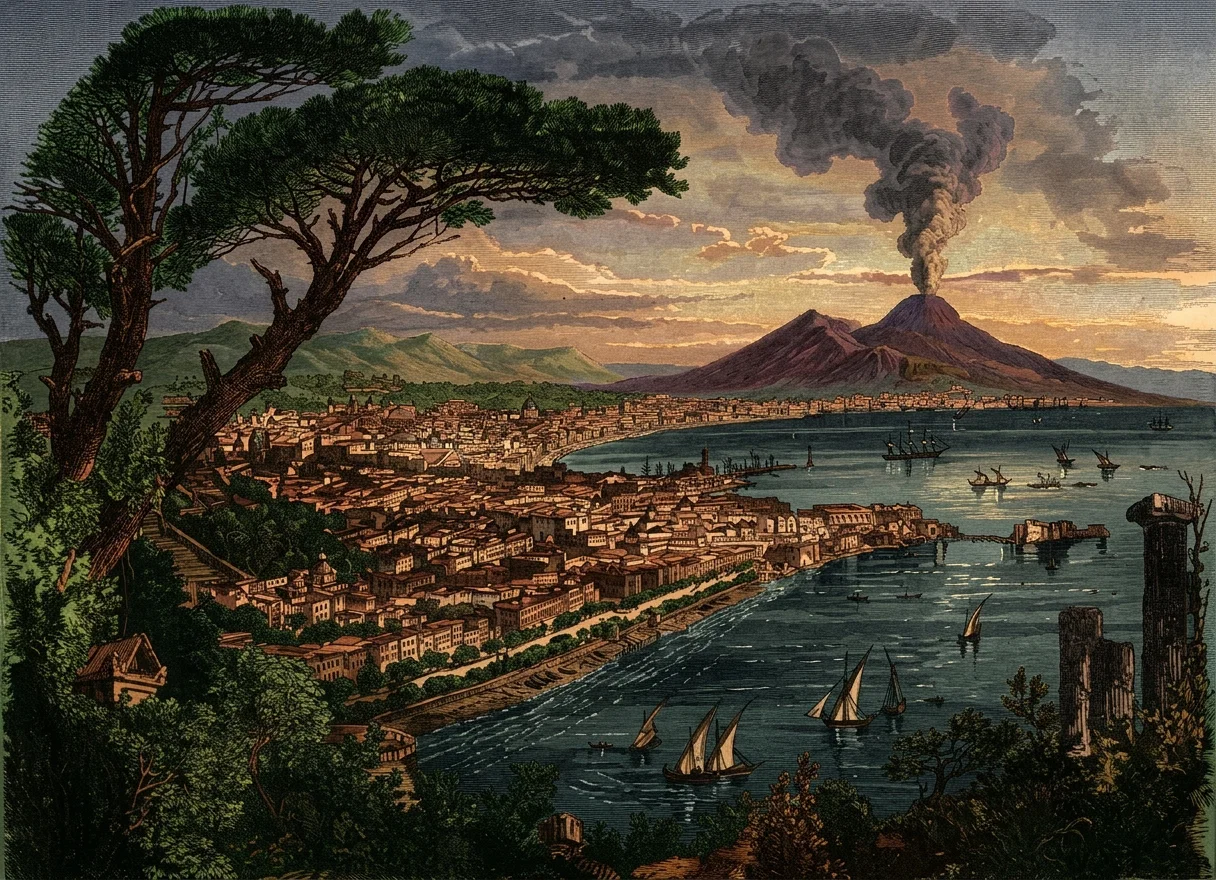
“We arrived at Naples last evening, after a five hours’ run from Rome. Italy is not all sunshine. We have been waiting two days to visit Vesuvius, but thus far it has been too cloudy and rainy for us to start out. I am not very desirous of taking the trip to the top, but the doctor is quite anxious to go. I should about as soon view the scene from the distance, and watch the old crater smoke his pipe, as to climb up his cheek and peep into his mouth. It is one thing to read about volcanoes, but quite another to see their awful grandeur with our own eyes.
“Sunday we visited Pompeii. The reality here is also much grander than the pictures. We went first to the museum, where we saw petrified bodies of men and women, some of them almost perfect, who 1,800 years ago were buried here in the awful avalanche of burning lava from Vesuvius. The bodies are placed in glass cases on tables down the center of the room. Some of these bodies show the agony of fright, and are in heart-rending attitudes as they were when they were suffocated in their great houses. Several had evidently thrown themselves upon the floor, with the forehead resting on the back of the hand, to keep the sand and ashes out of their faces. Little did they know what an avalanche that was, or that eighteen centuries would pass, and then men and women would gaze upon their petrified forms.
THE CITY AND BAY OF NAPLES; MOUNT VESUVIUS IN THE DISTANCE.
“It was fascinating to walk about the streets of this exhumed city, and turn aside into houses and rooms, the walls of which in many instances were as intact as 1,800 years ago. In some places these walls are only two or three feet high, and in other places they rise over one story high. The streets are very narrow and paved with lava. In some places we could see the ruts made evidently by the wheels. Along each side of the street is a single foot-path, elevated a foot or two above the level of the street, and two or three stepping-stones occasionally for crossings. The rooms of the houses are nearly all very small, but were evidently richly decorated with paintings. Nearly all the statuary and the finest paintings have been removed to the city museum; but one large house is left just as it was found, but covered with a roof and kept under lock and key, and supplied with gates in the doorways so none but officials can enter. But slight restoration has been made in this house. They have planted flowers and shrubbery in the garden, which is an enclosure in the middle of the house. A broken marble table has been pieced together, and other little touches of like nature here and there.
“Here in the ‘Women’s Department, is a petrified body, on an elevated bank of earth, where probably was a bed, and in another room several skeletons lie in the loose dirt. In the garden of this house are two fountains, and several pieces of statuary, and in the kitchen we saw the old brass and bronze utensils.
“We visited the old temples, Forum, and theaters, and they seem so real and wonderful. I would have gladly spent more time there.
“At 7:45, January 13, we left Naples by train for Brindisi [pronounced Brin’de-ze]. Coming out past old Pompeii, we had one more view of the grand old ruins, then on close by the base of Vesuvius, descending the range through miles of tunnels, whizzing out into the light for a little glimpse of beauty and again back into the darkness. Our trip to Brindisi was pleasant, where we arrived at 18:10 (or ten minutes past eighteen o’clock). This is the way the Italian guide-books reckon time, from midnight to midnight, instead of A. M. and P. M.; 18:10 therefore would be to us 6:10 P. M.
“Brindisi is a small place, and the principal business is at the docks; but we must wait here four days for our boat to take us to Port Said, Egypt.”
The doctor adds a note concerning the customs of the people of Naples and vicinity, as follows:—
“Speaking of the customs of the people, we will note that women work like men, and men about the same. Boys smoke, and girls knit and sell trinkets. In the lower town one can not imagine the awfulness of the filth. There is a perfect medley of poor donkeys, cripples, goats, fish, priests, more filth and creeping things, in the hair, on the body, and almost everywhere. Street scenes are common which would not be right to speak of before decent people. It is indeed a sad picture. I am not at all a believer in Darwinism; but if he had turned his argument the other way around, and endeavored to prove that men created in the image of God were degenerating themselves to the level or below, of the dog, ape, etc., he could have demonstrated his theory in even street scenes in some of these Italian cities, and I could have agreed with him. These scenes constitute a very black daub on the fancy pictures of the temporal millennium.
“Among the poorer classes the women and children mostly go barefooted. Some wear toe sandals, but no stockings. It is very important not to go to a baker or a meat shop, for it has a depressing effect upon the action of the salivary glands when one comes to eat. It is astonishing, this influence of mind over matter, and perhaps especially in this warm climate.
“The teams consist of anything that can draw. We have seen oxen, dogs, cows, donkeys, mules, men, women, and children acting the part of teams. The mules and donkeys, however, seem to predominate. Once in a while we saw a horse. These are all driven without any bits.
“I must tell you about the milkmen. In all southern Italy the cows are driven through the streets from house to house with their calves following, that the people can know by the age of the calf how long the cow has been milked. Any one who wants milk comes out with a goblet, cup, jar, or bottle, and the milkman milks the amount wanted, and then goes on to the next house. This same practice is followed with the goats, except the kids do not go with the goats through the streets.”
CONSULTING SOOTHSAYERS IN CHINA.
By E. Faber
The Chinese do not undertake anything of importance without first consulting the decisions of fate in the matter contemplated. In the more important affairs they go to a temple, in domestic concerns to the ancestral hall to divine by lot. For this purpose they have bamboo tablets in a receptacle which, after sacrifice and prayer, is shaken until one drops out. The number on this tablet refers the suppliant to a sentence or verse in plain writing containing the answer to his petition. Inasmuch, however, as the connection between the writing and the petition is usually vague, numberless soothsayers have tables and booths in the temples and on the streets, in which the poor dupes turn for assistance in deciphering their fate. In minor affairs they go to the soothsayer direct, who draws upon all ages and sexes for his support. Unsuccessful scholars and blind men engage in this calling.—E. Faber.
Training Boys for Church
A WRITER in the Homiletic Review accounts for the comparative irreligiousness of the masculine sex by the neglect of the training of boys in childhood. Parents consider it necessary to protect the girls from evil influence; but the same care is not exercised over the boys. Many boys, the writer thinks, might as well have no fathers at all for all the attention they give to their moral training. And again, “while there are many parents who make some attempt to guard and train their boys, their efforts are too feeble and fickle to accomplish much good.” The result is that boys show an aversion to the Sunday school and then to the church. The conclusion is that if we would have more men at church we must begin early with the boys.
Knowing What One Is Good For
By L. A. W. Bulletin
THERE is many a good man who would be puzzled to tell what he is really good for.—L. A. W. Bulletin.
EASTWARD BOUND.
By W. C. White
[The article below is a continuation of the account of Elder W. C. White's journey from Australasia to the General Conference, at Lincoln, Neb. The first article appeared in the SIGNS of February 11. The arduous duties of General Conference and preparatory meetings prevented Brother White from writing sooner. But even at this late date the account will be appreciated by our readers.—ED.]
Our voyage from Samoa was uneventful. The heat was intense, and all who could do so spent their time on deck. We avoided going below, as much as possible, and often lunched on deck, from the fruits and biscuits that we had brought with us, thus shunning the heat of the dining saloon and the monotonous round of the ship's fare. For ten days I slept on deck. Some nights it was windy, and often it was wet, for this was an unusually rainy passage, and tho my rugs and clothing were wet, and sometimes the rugs would not dry out during the day, I slept well, and did not take cold.
We entered Honolulu harbor about noon, Thursday, January 7. Numerous ships were in the harbor, and we had to wait for a big Japan steamer to get out of the way, before the Monowai could come to dock. Soon Dr. P. S. Kellogg, of the Honolulu Sanitarium, came on board, and took us ashore in a rowboat. On the wharf we were met by Brethren Brand, Covell, and Burgess, and after arranging how we would spend the seven hours we were to have on shore, we went to the sanitarium for dinner.
The Honolulu Sanitarium, which is located about two miles from the docks and the center of the city, was reached by street-car. It is on one of the main thoroughfares, and as we pass the palaces, government buildings, and palatial residences, with their ample lawns and tropical trees and shrubbery, we wished that time would permit us to walk, that we could longer enjoy the beauties of the place. We found the sanitarium to be a fourteen-roomed house, with broad verandas, situated in the center of an acre lot. The lawns, the shade, and the surroundings give the place a restful appearance. The plan of the house was well suited to its present use, and everything about the place was clean, orderly, and wholesome.
The patronage of the place has been good from the beginning, and is steadily growing. Dr. Kellogg is assisted by four trained nurses. They are all kept busy, and their faithful work is making many friends for the institution among the business people of Honolulu.
In the afternoon we visited the home of Brother H. H. Brand, where a school for Chinese is conducted forenoons and evenings. The school is conducted in a large quadrangular tent, built for the purpose, and simply, but comfortably, furnished with chairs, tables, an organ, blackboards, and other school appliances. At the time of our visit, 108 were in attendance daily. Something about this school, its teachers, and its methods, seems to have taken a deep hold of the hearts of influential Chinese in Honolulu, and they urge that the school be enlarged and put upon a broader and more permanent basis. Some are offering to assist financially if immediate steps are taken to enlarge the accommodations and the scope of the school.
The importance of Honolulu as a center for missionary and educational work was deeply impressed upon my mind. Here are thousands of Chinamen, progressive in spirit, representing all degrees of refinement and financial prosperity. Their separation from the home influences of China, and their contact with peoples of other nations, tend to make them liberal in thought. Some of them wish their children to study the Christian religion, and they prefer to have it taught in the simplest way, from the Bible itself, rather than from what theologians say about the Bible. Shall we overlook this open door, and send missionaries to China, to find an opening?
The Hawaiian Islands are rapidly filling up with Japanese. There are 30,000 of them there already, and we have every reason to believe that schools opened for them would meet with hearty response and support. The Japanese are the most progressive of the nations of the east. Why may we not open schools for them in the Hawaiian Islands.
After our visit with Brother and Sister Brand, and a brief interview with some influential Chinese gentlemen about school work, I made short visits to several old friends in Honolulu, and then hurried over to the sanitarium for a short talk with the workers there. Time for leaving came too soon, and we were pleasantly surprised on reaching the steamer, to find a score of our friends there, and that the delays occasioned by the loading of some thousands of bunches of bananas gave us two more hours for visiting.
And here the question comes forward, Why are we making no effort to help the Hawaiians? Through the wealth getting and the political maneuverings of the sons and grandsons of the missionaries and their associates, the natives have lost their former confidence, and many are drifting. Can not we do something to restore their confidence in the Word of God, by teaching it in its simplicity?
It is to be regretted that in our Polynesian work we have left these islands to one side, unvisited, and unthought of, for so long a time. Will it not be vastly more practical for us to devote our missionary energies of the Polynesian Mission, during 1897, to the establishment of missionary training schools in Apia, Tahiti, and Honolulu, than to place lone white missionaries on distant islands, to work amid overwhelming disadvantages?
At these training centers, natives can be instructed and prepared to do good work among their fellows, and a score of these native workers, with the assistance of a few white missionaries, can do as much to spread the Gospel as the same number of white men. Educate! educate! is to be our motto. Let us establish schools without delay. W. C. WHITE.
RELATION OF INTEMPERANCE TO MISSIONS.
By Mrs. Hester Griffith
“Go to one of our great opium dens.” I went, and saw men in hundreds, and saw that under one roof 2,000 were smoking at one time. He then said to me, “These object lessons were unknown until they saw the white face. Do you expect that we can have faith in Christianity?”
Do you know how opium came to be introduced into China? This good statesman gave me the history. I read with amazement how this vice was thrust upon a heathen land by a Christian country, at the point of the bayonet. A Christian nation sent opium as a merchandise. The Chinese began to feel that this would blight and destroy the lives of the people, and in a mild way they protested, but no attention was paid to their protest, and finally they arose and seized the opium vessel with 28,000 chests of opium. A large portion was burned, and the ashes scattered on the Canton River. “That plunged that heathen country in war with one of the greatest Christian nations of the world. A great Christian enemy came over with its gunboats and soldiers, and shot and shell were poured heavy and fast into this empire until it resulted in victory for the English, and China had to take the opium, and when some of the wise men went to the emperor and said, ‘Well, after all, perhaps it would be a good thing; we will put a heavy tax upon it, and we will have a great revenue,’ and do you know what that old heathen emperor (we all call him an old heathen emperor) said? ‘I would rather see this empire perish than to know that it was supported by a revenue derived from the vices of our kingdom.’ Some of that heathen emperor’s sentiments might be imported to our legislative halls with profit to-day.
The people of China found that wrong was being done to them, and the second time they protested—another war—a second time the Christian nation said, “China, you shall take the opium.”
I went to India, and thought I would see what the opium traffic was like. I was told on the best authority that 12,000 acres of the most fertile land was set aside for the cultivation of the poppy. I felt it necessary to talk to these Indian folk about using opium, and while I was speaking to four or five thousand of the educated, high-class people, such questions were asked from the floor as rendered me speechless.
A barrister arose and said, “Can you tell me why it is that to England’s white-skinned subjects this opium is a poison, and to its dark-skinned subjects it is sold as a food?”
The day I sailed from Australia one of the principal and most influential Chinamen tendered me a farewell. He was a wealthy merchant. He arose and said: “I want to say something before this woman sails to her home. The Chinamen are being degraded—hundreds of them—through the opium fiend. I do not say anything about the Chinese, because some of the Christian people seem to think that they have no souls, so I will not plead for them; but I do want to ask that something be done for the white people of Australia, for opium smoking is spreading among these people until I know at least 150 women who smoke opium in this city alone.”
The echo of the cry of other nations is only redoubled many times as it comes back to the hopeless and helpless hearts of those who sit in the shadow of these monstrous evils in our own land. Is it any wonder the Seminole Indians are puzzled about the white man’s method of dealing with strong drink? They say: “They first license a man to distil it, then license another to sell it, then they pay a policeman to catch those who drink it, and take them to jail, and when they come out they put them in again. Don’t understand.”
“It is our strong young men who are tempted,” says the Indian on the home field. An old Indian mother, out of the fulness of her heart, said: “When my sons are at town, I listen all the time for the footsteps of some one who will tell me that some great evil has come upon them because of whisky.” This finds an echo in many a white mother’s heart.
The boulder of the saloon lies right in the path of progress of all home mission work, lies over against the fairest things, and the best we know, and it entombs the hopes and happiness of 65,000,000 of people. It rests against the door of every home. What mother is sure her boy will return to her untainted and unharmed? In order to recruit the saloon it must rob 100,000 homes annually. It lies against the financial prosperity of the country, and politicians are disputing about the tax of $5.00 apiece for the running expenses of the government, forgetting that it costs each person $15 apiece for liquor and 15 cents apiece12for missions (foreign), $800,000 for paupers, $40,000,000 for crime, courts, and jail, $220,000,000 waste in industrial power, $100,000,000 for the insane, $1,500,000,000 for drink. It is said that the total amount of money circulating in the United States, gold, silver, and greenbacks, passes through the liquor dealer’s till every twenty months. Reflect upon the unspeakable poverty and misery for home missionary workers, to cope with unclothed multitudes of hungry children, and can you not see how much faster the curse makes home missionary work than the combined efforts can alleviate?—Mrs. Hester Griffith, in Pacific Christian.
TRUST IN GOD.
By Martha J. Gates
Father, wilt Thou ever lead me
Up the rough and toilsome way?
Help me, Lord, to love and trust Thee,
That I may not from Thee stray.
Let me feel Thine arms supporting
When temptations here assail:
Give me, Lord, that blest assurance
That Thy love will never fail.
May I trust alone Thy merits,
Thou who sittest on Thy throne;
O, look down, O Lord, upon me,
Make me Thine and Thine alone.
Then within Thine arms of mercy
Ever sheltered I may be,
Till Thou comest in Thy kingdom;
Then, O Lord, remember me.