Your ShelfYour Projects

Signs of the Times, Vol. 23, No. 12.

The Deliverer
Earlier text: The Sabbath School

The Sunday School

International Series.

Lesson II.—Sunday, April 11, 1897.

CONVERSION OF CORNELIUS.

Note.—The church of Jesus Christ, filled with the new wine of the Gospel, the life of God, continuing to grow, receives the Gentiles on equal footing with the Jews. One who is conversant with the history and customs of the Jews will readily understand what a great question was involved in this broadening of the church, and in putting away the traditional customs with which the history of the Jewish people was saturated. The Jewish narrowness was not of God but of men. He is no respecter of persons. Chapter 10 and chapter 11:1-18 should be read in connection with the lesson. Commit verses 36-38.
Lesson Scripture, Acts 10:30-44, R. V.
30 “And Cornelius said, Four days ago, until this hour, I was keeping the ninth hour of prayer in my house; and behold, a man stood before me in bright apparel, and saith, Cornelius, thy prayer is heard, and thine alms are had in remembrance in the sight of God. 31 Send therefore to Joppa, and call unto thee Simon, who is surnamed Peter; he lodgeth in the house of one Simon a tanner, by the sea side. 32 Forthwith therefore I sent to thee; and thou hast well done that thou art come. Now therefore we are all here present in the sight of God, to hear all things that have been commanded thee of the Lord. 33 And Peter opened his mouth, and said, 34 “Of a truth I perceive that God is no respecter of persons; but in every nation he that feareth him, and worketh righteousness, is acceptable to him. 35 The word which he sent unto the children of Israel, preaching good tidings of peace by Jesus Christ (he is Lord of all)—that saying ye yourselves know, which was published throughout all Judæa, beginning from Galilee, after the baptism which John preached; 36 even Jesus of Nazareth, how that God anointed him with the Holy Ghost and with power; who went about doing good, and healing all that were oppressed of the devil; for God was with him. 37 And we are witnesses of all things which he did both in the country of the Jews, and in Jerusalem; whom also they slew, hanging him on a tree. 38 Him God raised up the third day, and gave him to be made manifest, not to all the people, but unto witnesses that were chosen before of God, even to us, 39 who did eat and drink with him after he rose from the dead. 40 And he charged us to preach unto the people, and to testify that this is he which is ordained of God to be the Judge of quick and dead. 41 To him bear all the prophets witness, that through his name every one that believeth on him shall receive remission of sins. 44 “While Peter yet spake these words, the Holy Ghost fell on all them which heard the word.”
Golden Text.—“Whosoever believeth in Him shall receive remission of sins.” Acts 10:43.

SUGGESTIVE QUESTIONS.

(1) In answer to Peter’s question in verse 29, what did Cornelius say he had been doing? Verse 30, first part. (2) What appeared to him? Ib., last clause. (3) What assurance did the angel convey to Cornelius? Verse 31. Note 1. (4) What directions did he give to Cornelius? Verse 32, first part. (5) What part was Peter to have in answering the prayer of Cornelius? Ib., last clause. Note 2. (6) How did Cornelius show the earnestness of his petition? Verse 33, first part. (7) What showed the readiness of Cornelius and his company to hear and heed the Lord’s instruction? Ib., last part. Note 3. (8) What lesson had all these circumstances taught to Peter? Verse 34. Note 4. (9) What did this characteristic of God make possible for all? Verse 35. Note 5. (10) What word did Peter say God had sent to the children of Israel? Verse 36. (11) Where did that word begin? Verse 37. (12) From what did it date? Ib. (13) How well was it known? Ib. (14) What else did they know of Jesus Christ? Verse 38. (15) What reason did he give for the power Christ exercised? Ib., last clause. (16) What relation did he sustain to the work of Christ previous to the crucifixion? Verse 39, first part. (17) Notice Peter’s characteristic accusation of the slayers of his Lord in verse 39, last clause. (18) In what had God shown his acceptance of Christ’s work? Verse 40. (19) To whom was this resurrection made manifest? Verse 40, 41. (20) What command was Peter now fulfilling? Verse 42, first clause. (21) What testimony were the followers of Christ to give? Ib., last part. (22) How did Peter link Christ’s work with the scriptures with which his hearers were familiar? Verse 43, first clause. (23) Upon what condition is remission of sins granted? Ib., last part. (24) To how many is salvation offered? Ib. Note 5.

NOTES.

1. Thy prayer is heard.—Cornelius was a centurion, a captain of one hundred men; but unlike most men of his calling, he was devoutly religious, a worshiper of the true God, whom he served according to Jewish custom. His prayer was offered at the ninth hour, a regular hour for prayer among the Jews. That his religious duties were not secretly performed is shown by the fact that his kinsmen and near friends were assembled to hear the words of Peter; and his almsgiving was an outward token of his piety. Having lived up to the best light he had, and being anxious for greater light, the Lord answers his prayer in the remarkable manner here recorded.
2. Who . . . shall speak unto thee.—The angel could have told Cornelius all he wished to know; but God has given to mortals the glorious work of proclaiming the Gospel of Jesus Christ. This work has not been given into the hands of angels. The heavenly messenger’s part of the work was accomplished when he had put Cornelius in communication with Peter; and Peter’s work was to “preach” and to “testify.”
3. We are all here present before God.—There was nothing that Cornelius had left undone that he might receive the light which God had for him. It has often occurred that when prayers are answered, the petitioner is surprised, or has not acted as though he expected the prayer to be answered. Cornelius expected the word of the angel to be fulfilled, and would have been surprised if circumstances had not shaped themselves as they did. He did not wait for Peter to arrive and make an appointment, and then gather in his friends and relatives; but the appointment was made and the gathering of the congregation had taken place before Peter arrived, as is shown by verses 24 and 27.
4. God is no respecter of persons.—The vision of the sheet let down from heaven and the injunction accompanying that manifestation had revealed to Peter something that it seems he had not fully understood before,—God’s willingness to save all men everywhere; the fact that salvation was a free gift to others than the Jews. It would seem from the narrative that Peter saw something in the faces of Cornelius’ company which showed him that the blessing of God was abiding with them. This truth was contrary to the traditions of the Jews. It was one of the things which made Christ’s teachings obnoxious to them, and even the disciples had not learned it at the time of his crucifixion.
5. But in every nation.—The truth contained in this verse is an amplification of the statement that God is no respecter of persons. If he were, salvation could not be free. The door of salvation stands open for every one. Every one who, believing in Christ, enters that Door (Christ), abiding within the Door, “is accepted with him.” Those who do not accept the conditions will never receive the Christian’s reward.

HOW TO GET GOOD BOOKS CHEAP

Special Offers to “Signs” Subscribers.

Steps to Christ.—By Mrs. E. G. White. This most valuable work has been published in six different languages in the United States alone, while chapters from it have been issued in tract form in some countries. Only those who have carefully read its contents can estimate its great worth. Neatly bound in cloth, 75c.
The Rights of the People.—An up-to-date pamphlet on religious liberty, and of permanent value for reference and study. Paper covers, 40c.
Testimony of History to Truth of the Scriptures.—By Geo. Rawlinson, M.D. An excellent and instructive pamphlet on recent archaeological discoveries. Paper binding, 25c.
Dictionary of the Bible.—By Wm. Smith, LL.D. A very complete dictionary of the Bible, although small. 467 pages of closely written matter, well and attractively bound, Jewish calendar, map of Palestine, and other valuable features. Price, 85c.

Special Combination Offers.

The Signs of the Times one year, and “Steps to Christ” or “Bible Dictionary,” $1.50.
The Signs of the Times one year, and “Rights of the People,” or “Testimony of History to the Truth of Scripture,” $1.25.
Address
SIGNS OF THE TIMES, Oakland, Cal.

CHRIST AND THE SABBATH:

Or Christ in the Old Testament and the Sabbath in the New, by Elder James White. Paper covers, fifty-six pages, sent post-paid for ten cents.
Address. PACIFIC PRESS, Oakland, Cal.

BIBLE SANCTIFICATION: A CONTRAST OF TRUE AND FALSE THEORIES.

By Mrs. E. G. White.
This is a pamphlet of only 84 pages, but its value is not to be judged by its size. It is just what its title indicates: a faithful presentation of Bible truth on this important subject, and an exposure of the false theories prevailing in regard to it. Every believer in Bible truth should read it. Buy it, read it, and lend it to your neighbor. Price, 10 cents.
Address, PACIFIC PRESS. Oakland, Cal.

Closes April 30

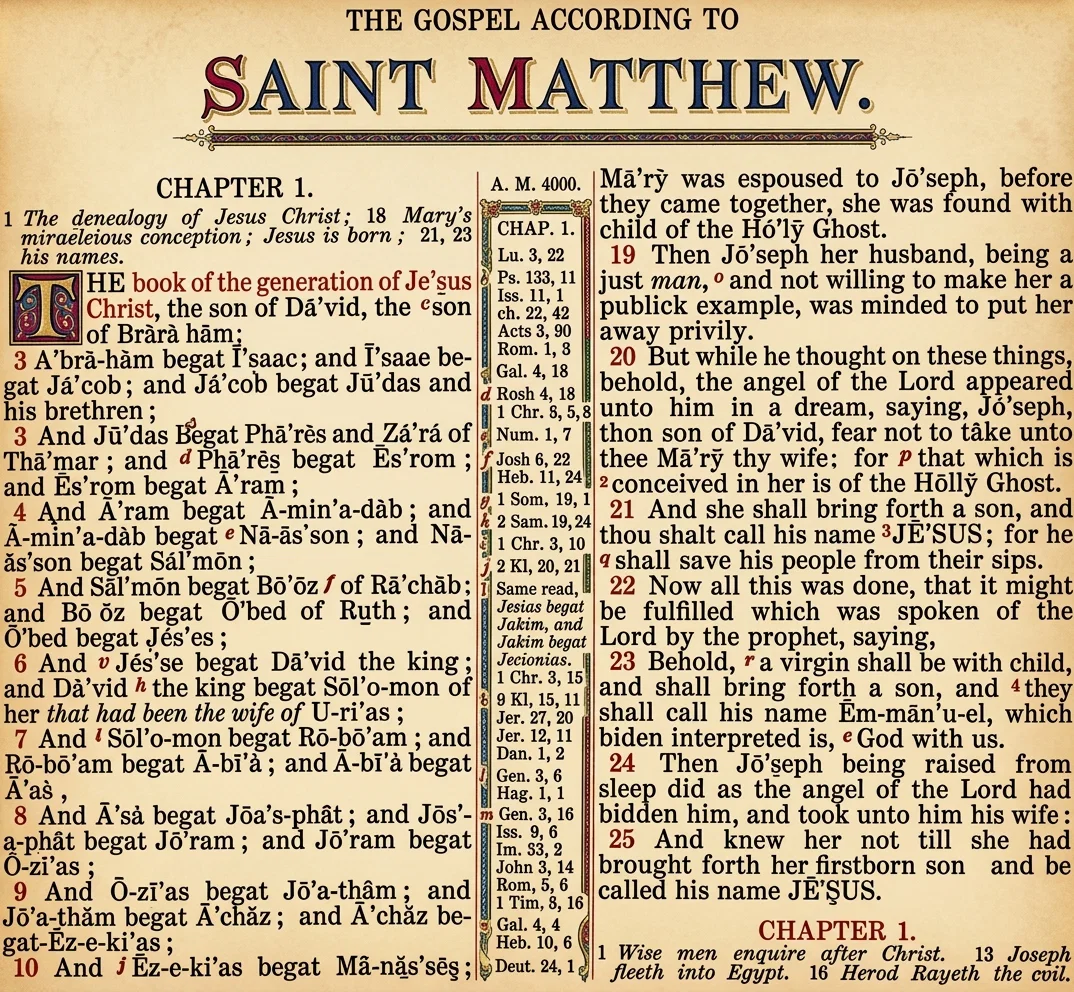
(This sample is an exact reproduction of a half page of our Premium Bible and shows size of type.)

The Opportunity for Securing Our

Magnificent, Self-Pronouncing Teachers’ Bible

With the SIGNS OF THE TIMES will last only a few weeks longer. The offer will positively expire April 30, 1897. Until that date, the SIGNS OF THE TIMES offers with each new yearly subscription, a Self-Pronouncing Teachers’ Bible.

At a Remarkably Low Figure

This Bible is not a cheap reprint, but a copyrighted edition from new type-set plates. It contains a complete series of Helps with illustrations, and a “Word Book” which embraces a Concordance, Subject Index, Gazetteer, Bible Dictionary, etc., all in one alphabetical arrangement. By consulting the Word Book you can find at once what you want, and do not need to look in half a dozen places for it. Every proper name is so marked as to indicate at a glance its proper pronunciation. It is thus absolutely Self-Pronouncing.
This new Bible has Minion type; is bound in American Morocco; has silk head bands, a silk marker, a silk-finish lining, and red under gold edges.

OUR OFFER

a. The Bible and a year’s subscription—new name—to the SIGNS OF THE TIMES, ordered before April 30, 1897, for $2.50. Both Bible and paper sent post-paid.
b. The Bible FREE to any one sending us six new names and $6.00 at the same time. The Bible will be sent also, as above, to any one or all of the six by including $1.50 extra for each Bible.
N. B.—This Bible will be sent ONLY as a PREMIUM with a YEAR’S subscription and for a NEW name. No other Bible substituted for the one offered herewith. Send us a new name and $2.50, and we will send the Bible to you or to whomsoever you may indicate, post-free.
The Time Is Short, Improve It
Address, SIGNS OF THE TIMES, OAKLAND, CAL.

GRAND TRUNK RAILWAY SYSTEM

Californians GOING EAST

WILL FIND THAT THE FACILITIES OFFERED BY THE

GRAND TRUNK RAILWAY SYSTEM

From Chicago to Eastern Points are Unexcelled
Vestibuled train service, Chicago to New York, via the famous St. Clair Tunnel, Niagara Falls and the beautiful Lehigh Valley. Through coaches, Pullman sleepers, and superior dining car service.
Chicago to Montreal, Portland, and Boston with elegant through car and Pullman service.
Summer Tours, via the Grand Trunk System, through the finest scenery in America, embracing Niagara Falls, the Thousand Islands and Rapids of the St. Lawrence, Muskoka Lakes, the White and Green Mountains, and the Atlantic seacoast.
See that Your Tickets from Chicago East Read via the Grand Trunk System
CHAS. M. HAYS, Gen. Manager, Montreal; W. E. DAVIS, Gen. Pass. Agt., Montreal
E. H. HUGHES, Asst. Gen. Pass. Agt., Chicago.
L. R. MORROW, City Ticket Agt., 103 Clark St., Chicago.

PACIFIC PRESS PUBLISHING CO.,

“The Eastern Question, What Its Solution Means to All the World,” by Alonzo T. Jones. While this great question is absorbing the attention of millions on both hemispheres, we wish to call your attention to the importance of reading and circulating something treating the subject from a Biblical standpoint. This tract contains the following subheadings: The Seven Trumpets; The Rise of the Turkish Power in Prophecy and History, Fulfilled to the Very Day; The World's Crisis; Daniel's Visions; “At the Time of the End;” The King of the North and His End; When He Comes to His End; The Plagues of God's Wrath, and Need for Watching and Praying. It contains 16 pages; price, 2 cents.

PACIFIC PRESS PUBLISHING CO.,

New York City, N. Y. Oakland, Cal. Kansas City, Mo.

Baptist Principles of Religious Liberty

Religious Liberty Library, No. 46, is entitled “Baptist Principles of Religious Liberty,” and contains 47-pages; price 6 cents, subject to regular discount to the trade.
It is written by Geo. B. Wheeler, who has been a Baptist clergyman for fifteen years, and has full knowledge of what he writes. The cover page illustrates an incident in the life of Roger Williams while in exile. He is kneeling in a deep forest in the midst of a snow-storm, and asking God’s blessing upon the plain fare of which he is about to partake. In this connection we find these expressive lines:—
“Father of mercies, thou the wanderer’s guide! In this dire storm along the howling waste, Thanks for the shelter thou dost here provide, Thanks for the mercies of the day that’s past, And for the frugal fare thou hast supplied; And O, may still thy tender mercies last! And may thy light on every falsehood shine, Till man’s freed spirit owns no law save thine!”
PACIFIC PRESS PUB. CO., Oakland, Cal.
39 Bond Street,                 18 West Fifth Street, New York City.                     Kansas City, Mo.

This Rock, or the Foundation of the Church

“This Rock, or the Foundation of the Church.” (Spanish.) Showing that the Rock of Matt. 16:18 is Christ, and not Peter; 4 pp.; 50 cents per 100. Address, PACIFIC PRESS PUBLISHING Co., Oakland, Cal.

Union Pacific System

Shortest Line and Quickest Time
3 ½ Days to Chicago
4½ Days to New York

SOLID VESTIBULE TRAINS

Personally conducted excursions to the East without change, in new Upholstered Tourist Sleepers, Lighted by Gas and Heated by Steam.
Tickets and sleeping car reservations at No. 1 Montgomery Street, San Francisco
D. W. HITCHCOCK, General Agent
or, H. V. BLASDEL, Ticket Agent
1010 Broadway, Oakland, Cal.

The Gospel Primer

Over 300,000 Copies Already Sold
Published in GERMAN SWEDISH DANISH PORTUGUESE SPANISH
SIMPLE Gospel truths told to youthful readers in connection with the learning of the alphabet. Thus the mind receives the beautiful thoughts of the Scripture while learning to read.
Every chapter is an outline of a subject which may be enlarged upon by the parent or teacher.
Just the book to assist in guiding the little feet in Gospel paths.

Very Fully Illustrated

And Neatly Bound, as follows:—
Cloth, embossed in ink . . . . 50c
Board Covers, Cloth back . . . . 35c
Heavy Board, in four colors . . . . 25c
Address,
PACIFIC PRESS PUBLISHING CO.
Kansas City, Mo. OAKLAND, CAL. New York City

CHRIST, OUR ADVOCATE

His Ministry in the True Tabernacle
An up-to-date pamphlet on the work of Christ in the sanctuary in Heaven. Bible Students' Library No. 128. Fully illustrated. Paper covers. Price, 10 cents.
Address,
PACIFIC PRESS PUBLISHING CO.
OAKLAND, CAL.
*Kansas City, Mo.
New York City, N.Y.

Wisdom of the World versus Faith.

Says the Young People's Weekly:—
“Blind obedience to Bible commands is apt to get people into trouble. Thoughtful, intelligent obedience is surely far more pleasing to God.”
That is, it is more pleasing to God that we should interpret his command than to take it as it is. Our “thoughtful, intelligent obedience” means the setting aside of the explicit command of God; for this is what is meant. The above words were written with direct reference to the Sabbath commandment. It is “blind obedience” to keep the fourth precept of the Decalogue as God has given it; it is “thoughtful, intelligent obedience” to ignore God’s command and keep a day he has not commanded! Is it, Christian? Is human wisdom to be preferred to implicit faith in God? Nadab and Abihu thought in their wisdom that blind obedience was foolishness, and the result is recorded in Lev. 10:1–10. Naaman thought in his wisdom that it was blind obedience to dip in Jordan, while worldly wisdom dictated a better way. (See 2 Kings 5.) But the “blind obedience” was necessary. When Abraham was called of God, “he went out not knowing whither he went.” When the word came to Israel by the Red Sea, “Go forward,” blind obedience led to certainty. Only be sure of one thing, reader, Does God command it? Knowing that, we can trust him and obey.
“Nothing before, nothing behind, The steps of faith Fall on the seeming void, and find The rock beneath.”

Proselyting

Proselyting.—Minister of Christ, by whatever name you may be called, do not be alarmed at the charge of “proselyting.” Preach the message that God bids thee, whether among Roman Catholics, Methodists, Baptists, Seventh-day Adventists, Disciples, or pagans. Have you truth that they have not?—Minister it to them as good stewards of the manifold grace of God. If they are desirous of knowing the right way, they will gladly receive it. No true minister of Christ labors for souls simply to get numbers; it is to convert the sinner, to impart to the believer some richer blessing. “Preach the Word” to all believers or unbelievers. It was to professed children of God that Jesus Christ preached almost wholly for over three years. His commission to his disciples was to begin at Jerusalem. God’s messages always first come to his people. If they accept them, they have the precious privilege of bearing them to others. If they count themselves unworthy of the message of life, it passes on to souls in darkness. “Preach the Word” wherever God bids thee.

Men Versus God

Men versus God.—Much is made now-a-days as to what learned men may have to say concerning a doctrine or belief. The majority of Christian scholarship, it is said, is against the “Higher Criticism.” What of it? Suppose they were for it? Would that affect the truth? It may be that one man knows a fact, and 1,000 others do not believe it; does that change the fact? So far as the Gospel of Jesus Christ is concerned the men of worldly wisdom have always been found against its work for their day. The children of the Exodus doubtless believed in God’s work through Abraham and Joseph, but not through Moses. The Pharisees and scribes and learned doctors of the law in the time of our Lord’s sojourn on earth believed in God’s work through Moses, or thought they did, but they rejected Him whose coming Moses predicted. Many learned men will tell us to-day that they believe in the work of Jesus and the apostles for their day, but they do not believe the things which Christ and his apostles taught for our day. The only true faith is a present living faith, which lays hold of a present Saviour, a present truth, a present Gospel. “All flesh is grass, and all the goodliness thereof is as the flower of the field; . . . the grass withereth, the flower fadeth; but the word of God shall stand forever.” “Ye have plowed wickedness, ye have reaped iniquity; ye have eaten the fruit of lies; because thou didst trust in thy way, in the multitude of thy mighty men.” “For ye see your calling, brethren, how that not many wise men after the flesh, not many mighty, not many noble, are called; but God hath chosen the foolish things of the world to confound the wise; and God hath chosen the weak things of the world to confound the things which are mighty; and base things of the world, and things which are despised, hath God chosen, yea, and things which are not, to bring to naught things that are; that no flesh should glory in his presence.” But those who trust in God will find him in Jesus Christ “wisdom and righteousness, and sanctification, and redemption.” “He that doeth the will of God [not of men] abideth forever.”

General Conference Reports Pending

The good General Conference is in the past, so far as the work of the whole body of delegates is concerned. Much detail work is left to the general committees and boards there elected and which have since been elected at Battle Creek. Full reports of these we have not yet received, but hope to receive them next week, when we will give our readers a synopsis of the same.

Baptist Principles of Religious Liberty

Number 46 of the Religious Liberty Library is before us. It is a neat pamphlet of nearly fifty pages, entitled “Baptist Principles of Religious Liberty,” by Geo. B. Wheeler, for fifteen years a Baptist clergyman. It presents in a graphic and interesting way just what the principles of religious liberty are, and how nobly Baptists have stood for them, and appeals to them to still stand by the right. The pamphlet is embellished by a cut of Roger Williams kneeling alone in the wilderness, as also other illustrations of interest. The price of the Library, quarterly, is only 25 cents a year. Address, International Religious Liberty Association, Battle Creek, Mich.; 39 Bond St., New York; or Pacific Press, Oakland, Cal., or any of our state tract societies or branch offices.

More Light Beyond.

The Examiner (Baptist) of March 11 reports President Weston as saying in an address before a conference of ministers:—
“There are great stretches lying before us. Calvin and Luther did not say the last word. ‘There is much light yet to break forth from the Word.’”
This is true, and it is what God has taught us in his prophetic Word. That light is summed up in the great threefold message of Revelation 14, and in fact in the book of Revelation. It is a fuller opening of the Gospel of Christ which will lead us on to Christ’s fulness. “The path of the just is as the shining light, that shineth more and more unto the perfect day.”

Not Man, but God.

The work of the Christian is not to be measured by man's opinions, approval, or disapproval, but by the consecration and love put into it. But as this is known only to God, it is true that only God can rightly judge of its value. Oftentimes that which the world and even the church lauds most is founded on the veriest selfishness. It is wrought for the praise of men, and men praise. The doer has his reward in the evanescent applause. The human instrument is praised and takes the glory, while God is left out of the question. Many of the great “philanthropic” works are of this sort. While they do much good in relieving distress and alleviating suffering, they cost no real sacrifice or self-denial on the part of him who promotes them and who receives all the praise. Frequently the deeds are performed on an ostentatious scale, and are used as advertisements of the man or the organization with which he is connected. Large organizations, large forces of laborers, certainly ought to do much work, and when a year or two of it is summed up in a little tract, an article, or a speech or two, it sounds large, and straightway the people idolize the man at the head of it all, and wonder why others do not do something for humanity. Well, others do. There are God's scattered ones all up and down the earth who do not let one hand know what the other does, who do not know that they are doing for Christ; it looks so small (Matt. 25: 37–39), whose faces shine with the love of God, but they do not know it. Such are the salt of the earth, unappreciated of men, but whose work in the day of judgment will tell, because Christ is in it all. Workers in the harvest-field, look not to men, but to God.

The Name “Lord.”

A correspondent in Kansas writes us that the word “Lord” whenever printed in small capitals thus—LORD—has reference to the Father exclusively. Our correspondent better study the matter further. Whenever the word LORD is printed in small capitals it comes from the Hebrew word “Jehovah,” “Javah,” or “Jah,” spelled variously by various scholars. But this is the name of the Son as well as the Father. It was by this name that God revealed himself to Moses (Ex. 34: 6, 7), but he also declares of Christ or Michael, the angel of his presence, that “My name is in him” (Ex. 23: 21). And speaking of Christ, Jeremiah declares: “And this is the name whereby he shall be called, THE LORD OUR RIGHTEOUSNESS [Jehovah-tsidkenu].” Jer. 23: 6. Compare also Ps. 102: 1, 22-28 with Heb. 1: 10. These and passages in Isaiah and elsewhere show conclusively that the name of the Son is also Jehovah. Perhaps it is needless to say that the effort is put forth to evade the truth of the Sabbath question.

Business Is Business

“Business is Business.”—On the above the Presbyterian well says:—
“One of the most vicious and ensnaring maxims of the day is the expression, ‘Business is business.’ Under its influence things are done against which the conscience revolts. As the result, a dual character is developed, one for the store or office, and the other for the church or the Sabbath school. People often wonder how so good a man as Elder A, or Deacon B, or Superintendent C seems to be, can conduct his business in the way in which he does. It is hard to reconcile the inconsistency, but whatever may be said in extenuation or justification of the course pursued, the injury to himself and to the cause of religion is none the less potent.”
And yet it is not a “dual character” after all. A true Christian, one connected with the life of God through Christ, will be a Christian everywhere, in the bank, the store, the shop, the church. If he can do business on other than Christian principle, his Christianity is a hollow sham, a cloak, not a life.

You have reached the end of this edition.

Signs of the Times · Mar 25, 1897