Your ShelfYour Projects

Signs of the Times, Vol. 36, No. 50.

2995.— Beginning and Closing of Sabbath

Signs of the Times

Dec 29, 1909

Pacific Press Publishing Association · Mountain View, California · Dec 29, 1909

2995.— Beginning and Closing of Sabbath

When does the Sabbath begin and close? Does the last clause of Lev. 23:32 refer to the weekly Sabbath? I. S.
1. The Sabbath day in all logic and order begins and closes just the same as the other days of the week. “The evening and the morning were the first day,” and second day, and third day, and so on. So also the evening and the morning were the seventh day. Genesis 1.
2. The instructions given concerning days all the way through the Scripture begin the day at evening. Lev. 23:32 does refer to a ceremonial sabbath, which sometimes came upon the true Sabbath; but the day began just the same as the seventh day does. “From even unto even, shall ye celebrate your Sabbath.”
3. In the reform which took place under Nehemiah, who was God’s servant, and, of course, reformed according to the law of God, the Sabbath began at evening. See Neh. 13:19. “It came to pass that, when the gates of Jerusalem began to be dark before the Sabbath, I commanded that the doors should be shut, and commanded that they should not be opened till after the Sabbath.” When the gates of Jerusalem began to be dark, would be when the heavy shadows of the setting sun from the wall fell upon the gates.
4. The same truth is taught in the Gospels. The Jews had an altogether wrong idea of the Sabbath. It was to them a mechanical observance. They had really made it a burden instead of a blessing; they would not even heal upon that day. So when Jesus healed they accused Him of breaking the Sabbath. They would not bring their sick upon that day. Those who were bound by the tradition, waited until the Sabbath day was over before they brought their sick. See Matt. 8:16. “And when even was come, they brought unto Him many possessed with demons.” Mark tells us when that even was: “And at even, when the sun did set, they brought unto Him all that were sick, and them that were possessed with demons.” Mark 1:32. If you will read the context, you will see that this was the evening after the Sabbath, Mark 1:21. Luke reads, “And when the sun was setting.” Luke 4:40. From these scriptures it is very plainly to be seen that the day began at evening and closed at the same time the next evening; that the evening itself began with the setting of the sun; consequently from sunset to sunset is the Sabbath; reckoning in our time, from Friday evening at sunset, till Saturday evening at sunset.

2996.— Sign of the True God

As fire, falling from heaven, recorded in the 18th chapter of 1 Kings, was a sign between the prophets of Baal and the prophet of God, will that sign ever be required again? If so, where and by what people? W. J. A.
It is one great characteristic of the work of God that He never exactly duplicates His work. His work always meets the need of the times. Baal, to whom many of the children of Israel had turned, was the sun god, the god that presided over fire. The test was upon their own ground. Surely if they worshiped the god who presided over fire, and he were a true and living god, he would answer them by fire in the consuming of their sacrifice. The Lord only did in that sacrifice what He had done many times before in the history of the children of Israel. He has given us some instances of this. One is recorded in the life of Gideon, Judges 6:21; another in the experience of the children of Israel, Lev. 9:24. So when fire descended from heaven and consumed the sacrifice which Elijah had made ready, God was not acting in a new and strange way; He was simply revealing Himself to His people again as the God who would accept every true-hearted offering that was made. All sacrifices for sin were offered for man when our Lord Jesus Christ died upon the cross. Satan in his masterly working in “the deceivableness of unrighteousness,” will in the last days seemingly, at least, bring fire from heaven, endeavoring to connect his devotees with the Elijah of old. Rev. 13:13. In the first place, that is not among the signs which God has given for the last days; in the second place, sacrifices and offerings for sin are forever abolished; in the third place, the truest signs of the true God are the souls that are recreated by His power, who are keeping the commandments of God and the faith of Jesus. See Rev. 14:12.

2997.— What of the Comma? Matt. 27:52, 53

In Matt. 27:52, 53, Common Version, should not the comma be after “graves” instead of “arose”? E. E.
No; we do not see anything wrong with the punctuation. If the comma were changed the text would still bear the same construction that is now placed upon it. “Many bodies of the saints which slept arose, and came out of the graves.” Evidently our querist would understand that they arose before Christ’s resurrection. But it seems very clear that He was the first-fruits in this respect. The graves were opened at the time of the great earthquake when He died, but the bodies did not rise until Christ Himself had arisen. The Revised Version reads: “And behold, the veil of the temple was rent in two from the top to the bottom; and the earth did quake; and the rocks were rent; and the tombs were opened; and many bodies of the saints that had fallen asleep were raised; and coming forth out of the tombs after His resurrection they entered into the holy city and appeared unto many.” You will see that the construction is quite uniform throughout. Christ was then the first-fruits even in point of time, as He was in preeminence; and His resurrection assured the resurrection of all, of whom those then raised were a pledge.

What Some of the Many Say

Listen to this from No. 444: “Have read the dear old Book according to schedule the last two years up to the present time. Am learning it more and loving it better all the time. Am anticipating a new treat in reading it by the new schedule.”
No. 352, a lady seventy-nine years of age, writes: “I am a life member of Our Bible Band; can not afford to lose one lesson. Every time I go through the Bible I get new and beautiful thoughts. Am sorry that some get tired and drop off by the way. May every lover of Bible truth so read the Word that he may be able to say in 1910, ‘Thy Word have I hid in mine heart, that I might not sin against Thee.’”
Another, No. 300, in her eighty-third year, a teacher of languages, a valued contributor to this journal, an author of several books, busy every hour, but with heart ever young, mind ever fresh, interest ever keen, renews her connection with the Bible Band and wonders that there are not many more to follow so delightful a course of reading.
And there are many others from younger ones, but we have not the space.
Send us ten cents and your name to join our band. We will send you a card (if a new member), a schedule of daily readings for the year, and a silk book-mark with valuable information printed on both sides.
Much fuller instructions will be given with the weekly schedule in the SIGNS in 1910 than heretofore.
As far as consistent and convenient, the chronological order of the books of the Bible will be followed.
Come with us, friends. It is a delightful, instructive, mightily helpful journey through the paths of the Word. From ten to thirty minutes a day are sufficient if that is all we can spare.
We ought to have ten thousand readers. Come, and go with us.

Notes

We begin again with the year the interesting journey through the great highways and byways of the Word of God. We may not expect to see all its beauties, smell of the fragrance of all its beautiful flowers, gather of all its delicious fruit, or quaff the word of life from all its varied streams and branches. We have not time for that; but we can gather more than sufficient for each day’s need, and add to the store of wealth which we have already garnered.
We will begin, of course, with the “book of beginnings,” Genesis—for that is what the word “Genesis” means. This book was written, without question, as all the traditions state, by “Moses the man of God.” There may have been documents previous to this. There are some things in the book which would seem to show that there were records written before; but this has naught to do with its inspiration. We have the testimony of Paul and others that the Holy Scriptures were divinely inspired, or “God-breathed.”
The book has been severely dealt with by the higher critics; but the damage is all on their part, and on the part of the souls who have followed them. The book has not suffered. It still stands. Every new discovery in archeology seems to confirm it, and we have the testimony of our Lord Himself to its veracity.
The first chapter deals with the creation and making of this earth, bringing it into the form in which it existed at the close of the week’s record, recorded in the chapter. All the steps in which this was brought about are logical, and all of them consistent with an infinite, personal God who was laying the foundation for an inheritance of His children for future ages. While “days” many times is used in a figurative sense in the Bible, there is no reason why we should give it other than the literal sense in the first chapter of Genesis. In fact, the fourth commandment—Ex. 20:8-11—and other scriptures which refer to the creation, demand that it should be given this sense and no other. The first chapter also marks the beginning and the close of the day at sunset.
The great topic of the second chapter is the creation of the first pair in particular. The first chapter is general; the second chapter from verse4 onward deals in particulars. The first three verses of the second chapter reveal the making of the Sabbath, and show us on what great facts God founded it. In this second chapter are brought out two great institutions which antedated sin, and which are great conservative factors in the preservation of the race and the perpetuation of godliness: the Sabbath, the sign of the Creator; and marriage, the bond of the home.
Chapters 3 and 4 give us the story of the fall, the promise of the Seed, the difference between the characters of Cain and Abel, and the descendants of Cain, showing us that men were skilled in the arts and crafts of metal-working at that early date, as well as in music.
Chapter 5 is the genealogical record of the great heads of families in the direct line of Seth before the Flood.
The story of the universal Deluge, traditions of which are found among tribes and nations all over the world, is recorded in chapters 6 to 8.
The genealogy of the sons of Noah, and the scattering of his descendants throughout the earth, are given in chapter 10; man’s futile attempt to reach heaven, and the beginning of Babylon—confusion—are revealed in chapter 11.
Chapters 12 to 27 tell the wonderful story of the father of the faithful to the second generation following. There are two things to which we would call the attention of our readers: first, God’s care for the Seed which He had promised, and the demand of the revelation concerning it; and secondly, His providential dealing with His children. He does not always say at the time the sin is committed, that it will be punished, or that evil consequences will follow it; but we need only to follow the career of those who committed the sin, to find sooner or later that they surely reap its fruitage.

To Our Bible Band Members

APPLICATIONS are still pouring in, and some are asking, “Why have I not received my schedule and book-mark?” The reason is just this: We have not been able to get our book-marks printed. But we have begun, and hope that all who have ordered and many more yet to order will receive both schedule and book-mark before Jan. 1, 1910. Please be patient. We hope we shall miss none, tho the order is mixed with other business. If we do, write us.

Beginning Again

Many are beginning for the first time to read the Bible through. Many who have started and failed are beginning again. Good. The one who ultimately fails will be the one who will sometime refuse to try. Let us not be “quitters” in such a good work. Let us not fear to become beginners.

OUR BIBLE BAND

Schedule for January 1 to 8 Inclusive

Sabbath, Jan. 1 — Genesis 1-4
Sunday, “ 2 “ 5-8
Monday, “ 3 “ 9-11
Tuesday, “ 4 “ 12-16
Wednesday, “ 5 “ 17-19
Thursday, “ 6 “ 20-22
Friday, “ 7 “ 23,24
Sabbath, “ 8 “ 25-27

Object-Lessons

God has ever used objects, types, symbols, figures, in the instruction of His children in all ages. This was especially true before our Lord came to this earth. When man fell, two great facts faced him: the awfulness of sin, and the hopelessness of the future. Sin ended in death. Death, to human sight, seemed to end all.
Into this gloom period of doubt, despair, and death, shone the light of God’s love. One member of the Godhead, the eternal Son of God, “gave Himself”— a voluntary sacrifice for all. The infinite Father gave His Son. But not then was the great sacrifice demonstrated; it was an offering for the ages, for eternity. Centuries must roll their dreary round before the culmination, the depth of the sacrifice, could be reached.
But man must not forget the meaning of sin nor the love of the Redeemer. Therefore the sacrifice of the lamb from the days of Adam. Every time a lamb was offered, it told that the result of sin was death, that he who offered it was worthy to die, but that One who was innocent had yielded Himself in behalf of the guilty, in order that the guilty might be accounted innocent. The first-born spotless lamb, offered by Adam, by Abel, by Enoch, by Noah, by Abram, typified the blameless Lamb of God who taketh away the sin of the world. John 1 : 29.
The lamb did not atone for the sin. It paid no penalty. It remitted no guilt. Its shed blood washed away no sins. Yet the testimony of the Word is that “without shedding of blood there is no remission” (Heb. 9 : 22), and yet again, “It is not possible that the blood of bulls and of goats should take away sins” (Heb. 10 : 4). These sacrifices, these object-lessons, were types or figures of the spotless Lamb of God, slain in purpose before the foundation of the world, manifested in fact when Jesus died upon the cross. 1 Peter 1 : 18-20.
The more elaborate services of the sanctuary were but enlargements, fuller object-lessons, of the great evil of sin, and the great fact of a Saviour. They point out the holiness of God, the utter inadequacy of man to meet that holiness by his own efforts; but that God has met man’s needs in His own plan, His own purpose, His own goodness, His own sacrifice of love, His perfect righteousness, and His indissoluble life. These meanings will be more fully developed in the articles which follow.

Antitype of Sacrifice and Priest

By C. L. Taylor
WONDERFULLY beautiful to him who hungers and thirsts for the knowledge of God, is the story of the Christ as told in the types and symbols of the earthly sanctuary. In the record of the shadowy service of the long ago, the seeker after truth finds a vivid pen-picture of both the person and work of the Lord Jesus—of Jesus the Sin-bearer, of Jesus our great High Priest. Evidently the writer of the epistle to the Hebrews so regarded the matter; for, after reviewing the work of the past, he said: “Now of the things which we have spoken this is the sum: We have such an High Priest, who is set on the right hand of the throne of the Majesty in the heavens; a Minister of the sanctuary, and of the true tabernacle, which the Lord pitched, and notman. For every high priest is ordained to offer gifts and sacrifices; wherefore it is of necessity that this Man have somewhat also to offer.” Heb. 8:1-3.
God’s Word is sure. “The Scriptures can not be broken.” Just so truly as on earth there were typical offerings for sin, and priests to minister, so truly in heaven there are both Offering and Priest for the sons of men.

Jesus Our Sacrifice

From the day that sin first entered this fair world of ours until now, our heavenly Father has been striving to lead men to look upon Jesus as their sacrificial Substitute. “Blessed be the Lord God of Israel; for He hath visited and redeemed His people, and hath raised up an horn of salvation for us in the house of His servant David; as He spake by the mouth of His holy prophets, which have been since the world began.” Luke 1: 68-70. Jesus is the “Lamb slain from the foundation of the world.” Rev. 13: 8. In the ecstasy of divine assurance, John the Baptist cried out, “Behold the Lamb of God, which taketh away the sin of the world.” John 1: 29.
The story of Jesus, our Sacrifice, is so blessedly simple that even a child can understand. In that terrible day when sin first intruded itself into man’s life, the Son of God looked down from His holy habitation and saw that “there was none to help,” and “wondered that there was no intercessor; therefore His arm brought salvation unto him.” Isa. 63: 5; 59: 16. That day He gave Himself up in man’s behalf; the iniquity of all was laid upon Him (Isa. 53: 6), and all heaven’s agencies were at once set in operation for the accomplishment of His will. By patriarch, priest, and prophet, man was instructed concerning the Lamb that was to come; and “when the fulness of time was come, God sent forth His Son, made of a woman, made under the law, to redeem them that were under the law.” Gal. 4: 4, 5.
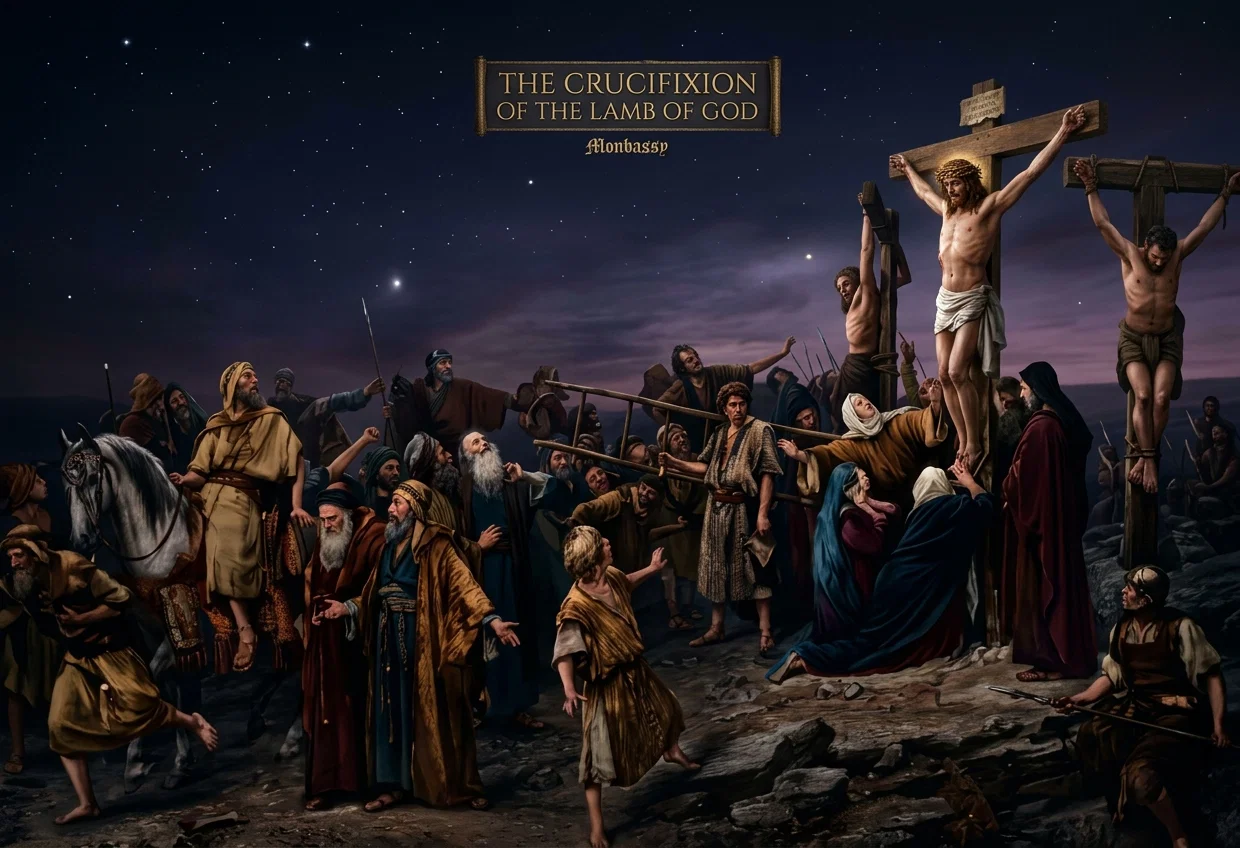
Calvary came. In harmony with that which was “determined before to be done” (Acts 4: 28)—namely, “that He by the grace of God should taste death for every man” (Heb. 2: 9)—Jesus was there “brought as a lamb to the slaughter” (Isa. 53: 7). He “who knew no sin” (2 Cor. 5: 21), the “Lamb without blemish and without spot” (1 Peter 1: 19), there “offered up Himself” (Heb. 7: 27).

But Why Must He Die?

Ah, it was that God “might be just,” and yet “the Justifier of him which believeth.” Rom. 3: 26. All had sinned (Rom. 3: 23); “sin is the transgression of the law” (1 John 3: 4); and “the wages of sin is death” (Rom. 6: 23). That God’s holy law might be satisfied and upheld, and still sinful man be saved, Jesus, the Author of the law, threw Himself into the breach. He put Himself into man’s place, taking all that man deserved, that the man might have all Christ deserved. He took man’s death, that man might have His life. “Who His own self bare our sins in His own body on the tree, that we . . . . should live unto righteousness.” 1 Peter 2: 24. “He hath made Him to be sin; . . . that we might be made the righteousness of God.” 2 Cor. 5: 21.
By His death the Son of God made possible reconciliation between God and man. Rom. 5: 10. He “abolished in His flesh the enmity . . . to make in Himself of twain one new man.” Eph. 2: 15. By the gift of Himself, He broke down the wall of sin which shut man away from heaven.
But this is not all. The Scripture says (Heb. 9: 22), “Without shedding of blood is no remission.” As in the type, so here, the blood is the medium by which sin is transferred to the sanctuary on high, the channel through which, by prayer, man can find access to Jehovah’s throne. Heb. 10: 19. The blood of the cross makes peace. Col. 1: 20. And blessed indeed is the glorious truth that “the God of peace . . . through the blood of the everlasting covenant,” makes man “perfect in every good work to do His will.” Heb. 13: 20, 21.

Jesus Our High Priest

“Seeing then that we have a great High Priest, that is passed into the heavens, Jesus the Son of God, let us hold fast our profession.” Heb. 4: 14. Having completed His earthly ministrations, our Lord took His departure to the courts above, there to “appear in the presence of God for us.” Heb. 9: 24. He is there as our Advocate (1 John 2: 1), seated with the eternal Father upon the throne of mercy and grace. Heb. 4: 15, 16. Surrounded and assisted by those who ascended with Him to heaven (Matt. 27: 52, 53; Rev. 5: 6), He there, by a specific and a well-defined service, completes what Calvary had begun.
And let all remember that our High Priest in the heavenly temple must “have somewhat . . . to offer” for sin, even as did the priests on earth. Heb. 8: 1-4. Of the earthly service the Scripture says, “For if the blood of bulls and of goats, and the ashes of an heifer sprinkling the unclean, sanctifieth to the purifying of the flesh; how much more shall the blood of Christ . . . purge your conscience from dead works to serve the living God?” Heb. 9: 13, 14. And this makes the story plain. To-day Jesus Christ pleads His own “precious blood.” In behalf of His lost ones on earth, He stretches forth His hand to the Father, and asks that for His own blood’s sake the Father have mercy upon those who by the broken law are condemned to death. His constant word is, “Father, remember the blood, remember the blood!” And as the prayers and confessions of His believing children come up before God, He mingles with them the fragrant incense of His righteousness (Rev. 8: 3, 4), the merits of His own blood. This is a glorious truth; and thus the Master graciously reminds us that, “having an High Priest over the house of God, let us draw near with a true heart in full assurance of faith, having our hearts sprinkled from an evil conscience.” Heb. 10: 21, 22.
“The sprinkled blood is speaking.” Does it speak for you and for me?—It does, if we have chosen that it shall. The work of the atoning sacrifice can be wrought out in us only by our cooperation. Man must yield his will in order that God may work. Man’s part is to make the offering of Jesus Christ his own personal offering. Says the Lord, “Thou shalt make His soul an offering for [thy] sin.” Isa. 53: 10.
Jesus is our Priest forever (Heb. 5: 10); His priesthood changes not (Heb. 7: 24); and because of this, “He is able also to save them to the uttermost that come unto God by Him, seeing He ever liveth to make intercession for them.” Verse 25. Blessed hope! And this hope “we have as an anchor of the soul, both sure and steadfast, and which entereth into that within the veil; whither the Forerunner is for us entered, even Jesus, made an High Priest forever after the order of Melchizedek.” Heb. 6: 19, 20.

The Conqueror and Deliverer

By A. O. Tait

Resisted Unto Blood

In exhorting us to the perfection of the example of Christ, an apostle says, “Ye have not yet resisted unto blood, striving against sin.” In this scripture the conflict that the Master waged in the Garden of Gethsemane is brought vividly to mind.
The Lord Jesus entered into the sufferings of men, and made Himself a partaker in the conflict that we are called upon to wage against sin, by taking upon Himself the sinful flesh of humanity. Upon this point read the following soul-helpful scripture:
“Since then the children are sharers in flesh and blood, He also Himself in like manner partook of the same; that through death He might bring to naught him that had the power of death, that is, the devil; and might deliver all them who through fear of death were all their lifetime subject to bondage. For verily not to angels doth He give help, but He giveth help to the seed of Abraham. Wherefore it behooved Him in all things to be made like unto His brethren, that He might become a merciful and faithful High Priest in things pertaining to God, to make propitiation for the sins of the people. For in that He Himself hath suffered being tempted, He is able to succor them that are tempted.” Heb. 2:14-18.
“The children are sharers in flesh and blood,” says the apostle; and then he adds that the Master “Himself in like manner partook of the same.” He “partook of the same;” and He partook of the same “in like manner.” Then we may be encouraged in our conflict with the flesh against sin, since the Master took upon Himself this same flesh that we find so much difficulty in bringing into subjection to the right. Our encouragement is heightened and deepened by the further knowledge that the Master assumed the same flesh and blood with us so “that He might become a merciful and faithful High Priest.” “For in that He Himself hath suffered being tempted, He is able to succor them that are tempted.”
The only way that we mortals can be enabled to enter fully into sympathetic touch with one that is in deep grief or distress, is to have passed through the same thing, and in the same way. But having had the samesuffering ourselves, we can come to the afflicted one and say, “I know just how you feel; I have passed through it all.” And when the suffering, distressed one is thus met by a person that has had actual experience in the things that he is now suffering, he can feel the “touch” of sympathy, even tho no other word is uttered aside from the statement, “I have passed through the same thing.”
Such is the law of sympathy and helpfulness among men. And the Master recognized that, even tho He was the Son of God Himself, yet He could not be a perfect sympathizer with humanity unless He actually tasted in His own person of the conflicts, the griefs, and the woes that are suffered by the sinful race. Thus does the Son of Man take infinite pains to give to the subjects of His salvation the strongest and at the same time the most delicate touches of sympathy.
He partook of the same flesh with humanity; and with the same handicap that enthralls sinful man, the Master fought the battle of overcoming sin completely. He met every temptation that we have to meet. For doth not the Scripture say:
“Having then a great High Priest, who hath passed through the heavens, Jesus the Son of God, let us hold fast our confession. For we have not a high priest that can not be touched with the feeling of our infirmities; but One that hath been in all points tempted like as we are, yet without sin. Let us therefore draw near with boldness unto the throne of grace, that we may receive mercy, and may find grace to help us in time of need.” Heb. 4:14-16.
He has fought the battle clear through; He has met sin at every turn. He “hath been in all points tempted like as we are.” And He was successful in every conflict, for He came out of the battle “without sin.”
His whole life, from the manger to Gethsemane and Calvary, was a part of the plan to fit Him to “touch” humanity with His heart of infinite sympathy. His life was the very life that He is seeking to lift us into. His whole life was lived to show how to link humanity with divinity so as to actually conquer sin and to live the real life of the righteous.
And, O, how bravely and unswervingly and unyieldingly He fought. He gave sin no quarter, and He allowed it no place anywhere in His life. It came surging against Him with its great temptations until in the supreme conflict of Gethsemane it forced from His agonized and agonizing person the death agony and blood sweat. But still He could not be forced to yield. O masterful Conqueror! O hero of heroes! Thou hast not called us to resist sin in the fires of such indescribable agonies, but we humbly pray Thee to strengthen us to resist in the same spirit of unconquerable courage.
What an uplifting help it is to mankind when we are made aware of the fact that we have such a sympathetic, such a courageous, such an unconquerable High Priest in the heavenly sanctuary for our Mediator and Redeemer!
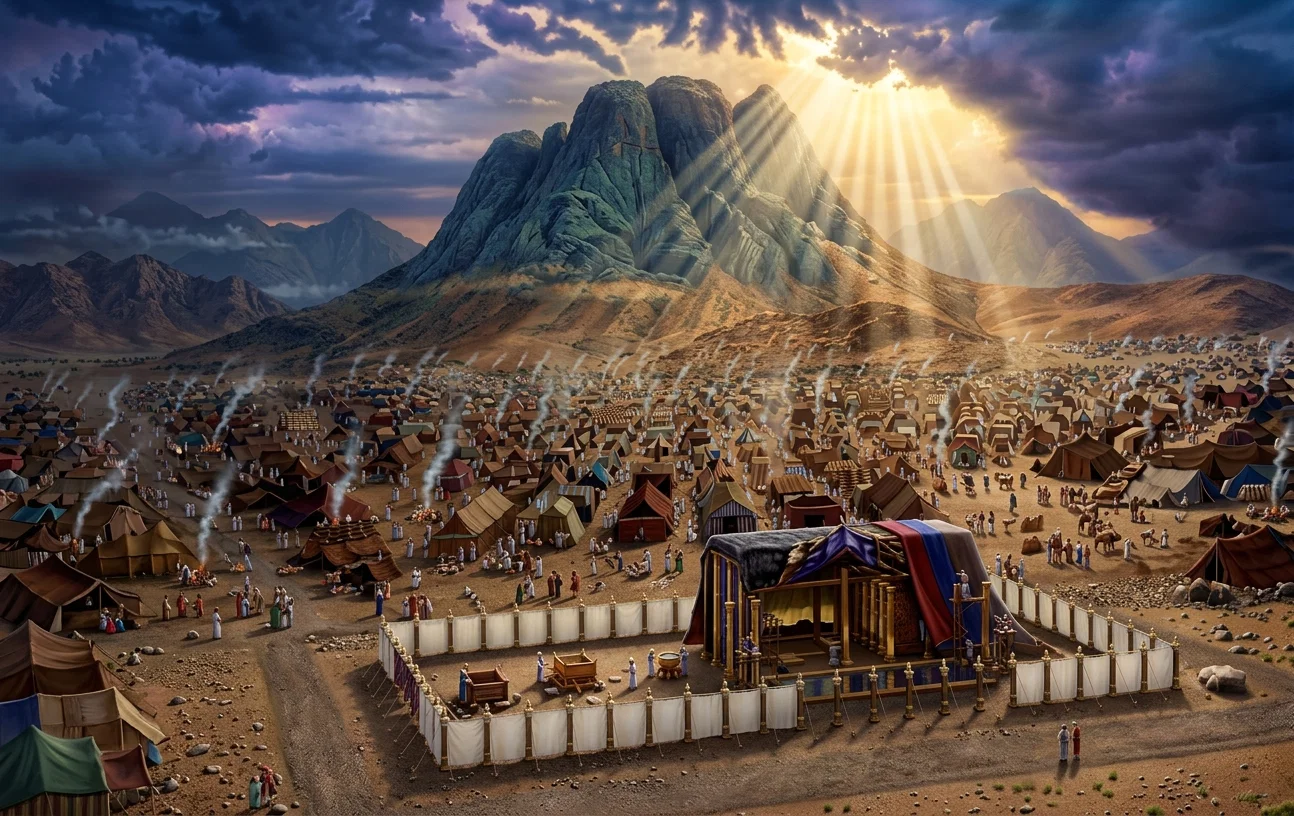
THE SANCTUARY AND COURT IN PROCESS OF ERECTION BEFORE MT. SINAI
Continue reading: The Dominion Restored