TOWER of the flock, the stronghold of the daughter of Zion, unto thee shall it come, even the first dominion.” God’s original purpose in the creation of the earth is fulfilled as it is made the eternal abode of the redeemed. “The righteous shall inherit the land, and dwell therein forever.” The time has come to which holy men have looked with longing since the flaming sword barred the first pair from Eden,—the time for “the redemption of the purchased possession.” The earth originally given to man as his kingdom, betrayed by him into the hands of Satan, and so long held by the mighty foe, has been brought back by the great plan of redemption. All that was lost by sin has been restored. “Thus saith the Lord . . . that formed the earth and made it; He hath established it, He created it not in vain, He formed it to be inhabited.”
A fear of making the future inheritance seem too material, has led many to spiritualize away the very truths which lead us to look upon it as our home. Christ assured His disciples that He went to prepare mansions for them in the Father’s house. Those who accept the teachings of God’s Word will not be wholly ignorant concerning the heavenly abode. And yet, “eye hath not seen, nor ear heard, neither have entered into the heart of man, the things which God hath prepared for them that love Him.” Human language is inadequate to describe the reward of the righteous. It will be known only to those who behold it. No finite mind can comprehend the glory of the Paradise of God.6
In the Bible the inheritance of God’s children is called a “country.” There the heavenly Shepherd leads His flock to fountains of living waters. The Tree of Life yields its fruit every month, and the leaves of the tree are for the service of the nations. There are ever-flowing streams, clear as crystal; and beside them waving trees cast their shadows upon the paths prepared for the ransomed of the Lord. There the wide-spreading plains swell into hills of beauty, and the mountains of God rear their lofty summits. On those peaceful plains, beside those living streams, God’s people, so long pilgrims and wanderers, shall find a home. “My people shall dwell in a peaceable habitation, and in sure dwellings, and in quiet resting-places.” “Violence shall no more be heard in thy land, wasting nor destruction within thy borders; but thou shalt call thy walls Salvation, and thy gates Praise.” “They shall build houses, and inhabit them; and they shall plant vineyards, and eat the fruit of them. They shall not build, and another inhabit; they shall not plant, and another eat: . . . Mine elect shall long enjoy the work of their hands.”
There, “the wilderness and the solitary place shall be glad for them; and the desert shall rejoice, and blossom as the rose.” “Instead of the thorn shall come up the fir-tree, and instead of the brier shall come up the myrtle-tree.” “The wolf also shall dwell with the lamb, and the leopard shall lie down with the kid; . . . and a little child shall lead them.” “They shall not hurt nor destroy in all My holy mountain,” saith the Lord.
Pain can not exist in the atmosphere of heaven. There will be no tears, no funeral trains, no badges of mourning. “There shall be no more death, neither sorrow, nor crying, . . . for the former things are passed away.” “The inhabitant shall not say, I am sick: the people that dwell therein shall be forgiven their iniquity.”
There is the New Jerusalem, the metropolis of the glorified new earth, “a crown of glory in the hand of the Lord, and a royal diadem in the hand of thy God.” “Her light was like unto a stone most precious, even like a jasper stone, clear as crystal.” “The nations of them which are saved shall walk in the light of it: and the kings of the earth do bring their glory and honor into it.” Saith the Lord, “I will rejoice in Jerusalem, and joy in My people.” “The tabernacle of God is with men, and He will dwell with them, and they shall be His people, and God Himself shall be with them, and be their God.”
In the city of God “there shall be no night.” None will need or desire repose. There will be no weariness in doing the will of God and offering praise to His name. We shall ever feel the freshness of the morning, and shall ever be far from its close. “And they need no candle, neither light of the sun; for the Lord God giveth them light.” The light of the sun will be superseded by a radiance not painfully dazzling, yet immeasurably surpassing the brightness of our noontide. The glory of God and the Lamb will flood the holy city with unfading light. The redeemed will walk in the sunless glory of perpetual day.
“I saw no temple therein: for the Lord God Almighty and the Lamb are the temple of it.” The people of God are privileged to hold open communion with the Father and the Son. Now we “see through a glass darkly.” We behold the image of God reflected, as in a mirror, in the works of nature and in His dealings with men; but then we shall see Him face to face, without a dimming veil between. We shall stand in His presence, and behold the glory of His countenance.
There the redeemed shall “know even as also they are known.” The loves and sympathies which God Himself has planted in the soul, shall there find truest and sweetest exercise. The pure communion with holy beings, the harmonious social life with the blessed angels, and with the faithful ones of all ages, who have washed their robes and made them white in the blood of the Lamb, the sacred ties that bind together “the whole family in heaven and earth,”—these help to constitute the happiness of the redeemed.
There, immortal minds will contemplate with never-failing delight the wonders of creative power, the mysteries of redeeming love. There will be no cruel, deceiving foe to tempt to forgetfulness of God. Every faculty will be developed, every capacity increased. The acquirement of knowledge will not weary the mind or exhaust the energies. There the grandest enterprises may be carried forward, the loftiest aspirations reached, the highest ambitions realized; and still there will arise new heights to surmount, new wonders to admire, new truths to comprehend, fresh objects to call forth the powers of mind and soul and body.
All the treasures of the universe will be open to the study of God’s redeemed. Unfettered by mortality, they wing their tireless flight to worlds afar,—worlds that thrilled with sorrow at the spectacle of human woe, and rang with songs of gladness at the tidings of a ransomed soul. With unutterable delight the children of earth enter into the joy and the wisdom of unfallen beings. They share the treasures of knowledge and understanding gained through ages upon ages in contemplation of God’s handiwork. With undimmed vision they gaze upon the glory of creation,—suns and stars and systems, all in their appointed order circling the throne of Deity. Upon all things, from the least to the greatest, the Creator’s name is written, and in all are the riches of His power displayed.
And the years of eternity, as they roll, will bring richer and still more glorious revelations of God and of Christ. As knowledge is progressive, so will love, reverence, and happiness increase. The more men learn of God, the greater will be their admiration of His character. As Jesus opens before them the riches of redemption, and the amazing achievements in the great controversy with Satan, the hearts of the ransomed thrill with more fervent devotion, and with more rapturous joy they sweep the harps of gold; and ten thousand times ten thousand and thousands of thousands of voices unite to swell the mighty chorus of praise.
“And every creature which is in heaven, and on the earth, and under the earth, and such as are in the sea, and all that are in them, heard I saying, Blessing, and honor, and glory, and power, be unto Him that sitteth upon the throne, and unto the Lamb forever and ever.”
The great controversy is ended. Sin and sinners are no more. The entire universe is clean. One pulse of harmony and gladness beats through the vast creation. From Him who created all, flow life and light and gladness, throughout the realms of illimitable space. From the minutest atom to the greatest world, all things, animate and inanimate, in their unshadowed beauty and perfect joy, declare that God is Love.
Inspired by Love and Consecrated to Service
By Robert MacArthur
It is marvelous what a man of comparatively little ability can do if all his powers are inspired by love of God and man, and consecrated to a given purpose. Dissipation of one's powers is destructive of one's possibilities. An invincible determination becomes irresistible action. When a man's heart is wholly set on God's service, neither man nor devil can thwart his purpose or resist his energy.— Rev. Robert MacArthur.
Object-Lessons of God’s Mercy
Types, Shadows, Symbols
1. What is the condition of all mankind?
“For all have sinned, and come short of the glory of God.” Rom. 3:23.
2. What is the sure result of sin?
“Sin, when it is finished, bringeth forth death.” James 1:15.
“The soul that sinneth, it shall die.” Eze. 18:4, 20.
3. Yet for what does mankind, good or bad, continually long?
“What shall it profit a man, if he shall gain the whole world, and lose his own soul [life]?” Mark 8:36.
NOTE.—The above is the true diagnosis of man’s case. Proud man does not like to believe it. It is not flattering to the strong, the wise, the proud. They would rather believe, “I am, and there is none else beside me.” They prefer to believe that man did not fall; that he is not a sinner; that he is not subject to death, but rather a child of nature on his upward way. Yet all of life, all relationships of life, all man’s best consciousness of himself, go to show that he is a sinner, one who has “missed the mark,” and therefore he has come short of the glory, or goodness (Ex. 33:18, 19), of God. “In the way of righteousness is life; and in the pathway thereof there is no death.” Prov. 12:28. God can not die, because He is absolute righteousness. Man does die, ever dies, because he is a sinner. Why not, then, accept of God’s diagnosis of our case, when there is so much in our own experience to confirm it! Man’s longing for life, man’s fear of death, are the evidences of his instincts, whatever his theories, that man is a sinner and subject to death. Satan declared what is everywhere obvious, when he said, “Yea, all that a man hath will he give for his life.” Job 2:4.
4. Can not our brother, or friends, or great men, help us?
“None of them can by any means redeem his brother, nor give to God a ransom for him.” Ps. 49:7.
5. In whom alone can man be saved?
“Neither is there salvation in any other; for there is none other name under heaven given among men [save that of Jesus Christ], whereby we must be saved.” Acts 4:12.7
6. Whom does He undertake to save?
“This is a faithful saying, and worthy of all acceptation, that Christ Jesus came into the world to save sinners.” 1 Tim. 1:15.
7. How early was His sacrifice?
“Redeemed . . . with the precious blood of Christ, as of a lamb without blemish and without spot: who verily was foreordained before the foundation of the world, but was manifest in these last times for you.” 1 Peter 1:18–20.
“The Lamb slain from the foundation of the world.” Rev. 13:8.
8. Why did God thus give His Son?
“For God so loved the world, that He gave His only-begotten Son, that whosoever believeth in Him should not perish, but have everlasting life.” John 3:16.
9. What part had the Son in this giving?
“Who gave Himself for us, that He might redeem us from all iniquity, and purify unto Himself a peculiar people, zealous of good works.” Titus 2:14.
10. What was the worth of this offering?
“For He [the Father] hath made Him [the Son] to be sin for us, who [the Son] knew no sin; that we [the sinners] might be made the righteousness of God in Him.” 2 Cor. 5:21.
“He was wounded for our transgressions, He was bruised for our iniquities: the chastisement of our peace was upon Him; and with His stripes we are healed.” Isa. 53:5.
11. How may the sinner avail himself of the benefits of Christ’s sacrifice?
“Testifying both to the Jews, and also to the Greeks, repentance toward God, and faith toward our Lord Jesus Christ.” Acts 20:21.
“I acknowledge my sin unto Thee, and mine iniquity have I not hid, I said, I will confess my transgressions unto the Lord; and Thou forgavest the iniquity of my sin.” Ps. 32:5.
12. How did men formerly show faith in Christ’s offering?
“And Abel, he also brought of the firstlings of his flock and of the fat thereof. And the Lord had respect unto Abel and to his offering.” Gen. 4:5.
“By faith Abel offered unto God a more excellent sacrifice than Cain, by which he obtained witness that he was righteous, God testifying of his gifts: and by it he being dead yet speaketh.” Heb. 11:4.
13. What was there in Abel’s offering which recognized sin and the sacrifice of the Son of God for the sinner?
“Without shedding of blood is no remission.” Heb. 9:22.
“For the life of the flesh is in the blood: and I have given it to you upon the altar to make an atonement for your souls.” Lev. 17:11; Gen. 9:4.
14. But does the blood of beasts take away sin?
“For it is not possible that the blood of bulls and of goats should take away sins.” Heb. 10:4.
15. What did this blood typify?
“The precious blood of Christ, as of a lamb without blemish and without spot.” 1 Peter 1:19.
“Unto Him that loved us, and washed us from our sins in His own blood.” Rev. 1:5. See also Heb. 9:14; 1 John 1:7.
NOTE.—The above scriptures, and many others which might be given, if we had the space, clearly show that all God’s appointed offerings were made in faith in Jesus Christ. Every lamb offered in faith for sin in the past was offered in virtue of “the Lamb of God, which taketh away the sin of the world.” John 1:29. The blood represented the life. The blood of Jesus shed for man represents His life. “The good Shepherd giveth His life for the sheep.” John 10:11, 15. Whenever a sinner brought to the altar a lamb, he laid his hand upon the head of the innocent beast, and confessed his sin before God; he presented that offering as standing for himself, who was worthy to die; the lamb was slain, and its blood offered in the sinner’s behalf. The sinner by faith saw through that sacrifice God’s offering on his behalf; and God accepted him, counting his faith for righteousness.
16. When Israel was called out of Egypt, what center of worship was built?
“And the Lord spake, . . . Let them [the children of Israel] make Me a sanctuary; that I may dwell among them.” Ex. 25:1–9.
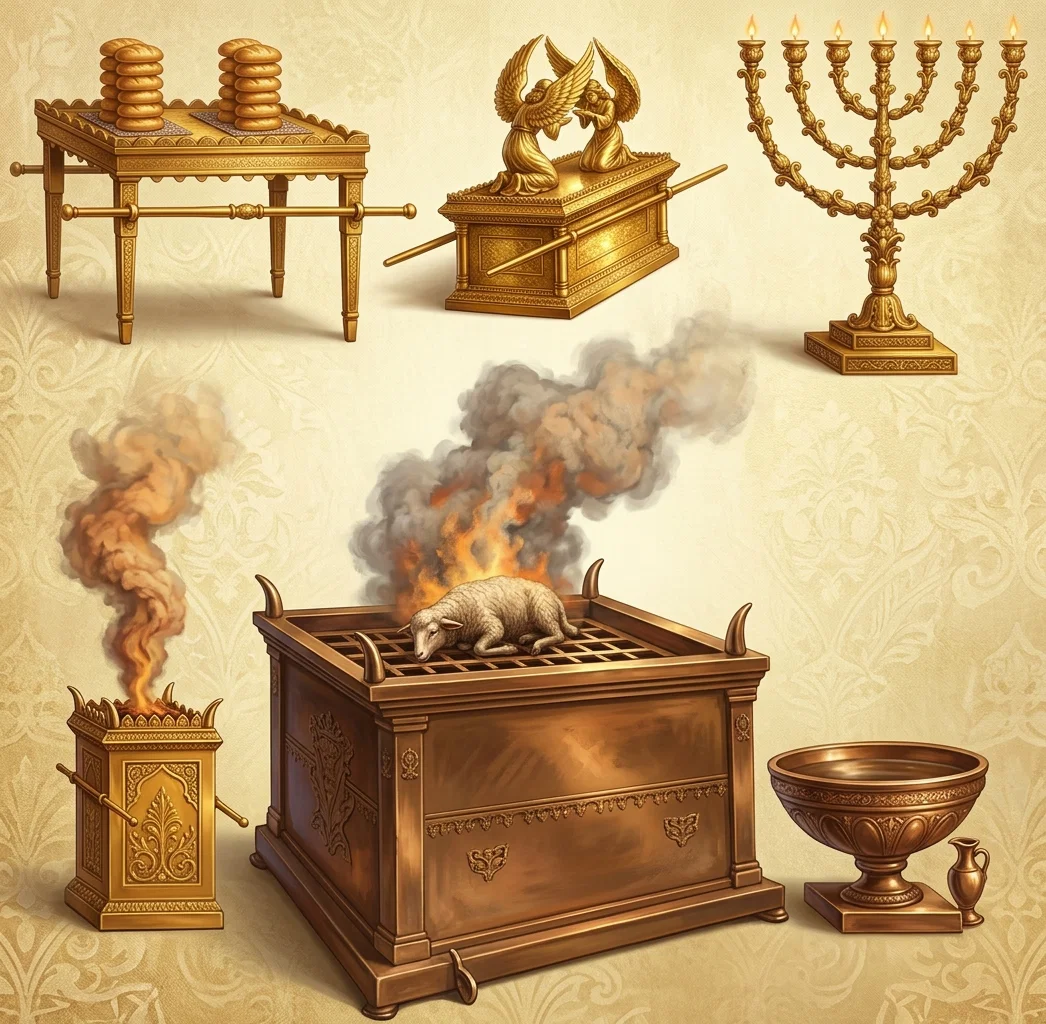
NOTE.—The making of this sanctuary and its furniture is described in Exodus, chapters 25 to 30, 36 to 40. A brief description (see engraving) is as follows: It was an oblong building 30 cubits long, 10 cubits high, and 10 cubits wide, made of upright boards of acacia wood, overlaid with gold without and within. It was divided into two compartments, the holy place and the most holy, separated by a heavy curtain, or veil; the former twice the size of the latter. Ex. 26:33. It opened toward the east, so that the priest in his ministrations faced to the west. Num. 3:38.
Before the sanctuary was the altar of burnt offering, where the victims were slain, and the laver where the priests washed. Ex. 27:1–8; 30:18.
On the right as one entered, the north side, was the table of showbread, representing the Word of God. Ex. 25:23–30; John 6:48, 56, 63. On the left, the south side, was the seven-branched candlestick, representing the fulness of the Spirit of God. Ex. 25:31–40; Rev. 4:5. In front of the veil separating the holy places, was the altar of incense, the incense representing the grace of God which makes His people’s prayers effectual. Ex. 30:1–10; Rev. 8:3.
Within the second curtain, or veil, was the most holy place. Here was the holy ark. In that ark were the tables of stone upon which God had written with His own finger His holy law of Ten Commandments. Ex. 24:12; 32:15, 16; 25:21; Deut. 10:1–5. The transgression of this law is sin. 1 John 3:4; Rom. 7:7. The cover of this ark was the mercy-seat, upon which abode the glorious shekinah over which spread the wings of the covering cherubim. This was symbolical of God’s throne between the cherubim (Ex. 25:17–22; Ps. 99:1), where mercy and truth meet together, and righteousness and peace kiss each other (Ps. 85:10).
Over all the sanctuary was a richly woven linen curtain, blue, purple, and scarlet, in which were wrought, with gold, figures of cherubim. This formed the ceiling. Over this curtain was one of goats’ hair; and as a tent over the sanctuary were placed two curtains of ram skins and badger, or seal skins. All these were made after a heavenly pattern, which the Lord showed to Moses. Ex. 25:40; Heb. 8:5.
Holy garments were prepared for the priests, and very particular rules were given for their ministrations.
17. What did all these sacrifices, the priests, and the priestly services, typify or symbolize?
“An High Priest . . . holy, harmless, undefiled, separate from sinners, and made higher than the heavens; who needeth not daily, as those high priests, to offer up sacrifices, first for his own sins, and then for the people’s: for this He did once, when He offered up Himself.” Heb. 7:26, 27.
NOTE.—All these things are object-lessons of the God who “delighteth in mercy,” and who “taketh pleasure in them that fear Him, in those that hope in His mercy.”
[The meaning of these symbols, and what they symbolized in Christ’s work, will be our next study.]
Love for Your Brother
(Sir Wm. M. Ramsey in S. S. Times)
The right line of conduct will be determined by love. You may feel that a meat is not made unclean because the animal was sacrificed to a pagan god; but do not wound a brother’s feelings while you display your freedom of mind by eating it. Christ died to save him: will you not deny yourself in this small matter to help him? Will you put a strain on his conscience, and perhaps lead him into doing what he thinks wrong? Any matter of food and drink belongs in itself to mere human life, and is not a part of the kingdom of God; such matters are temporary, evanescent, and unreal.
We should live in and for the kingdom of God, that is, for what is eternal, enduring, and real; and to that category belong righteousness, peace, and joy in the Spirit, not meats and drink. These greater things we shall attain by seeking always to do what will tend to produce peace among our brethren, and to build them up in goodness of character. In itself wine, like meat, is not evil; but it is evil in its effect on the character and life of society. Do not for the sake of a mere drink overthrow the work of God; for you do that if you help by your example to spread the habit of drinking wine. Hold your own beliefs, as far as you can justify them to God; but let your beliefs be between God and yourself. In your action and life think of your neighbor—and show your love for him. It is not your beliefs, but your conduct and your love and your self-sacrifice, that make your life. These are the things that stand the test, and last through time into the eternal kingdom of God.
Only a Little Word
How much meaning is often thrown into one little word in the Scriptures. Take, for instance, the little word “also” in the question asked Peter by the damsel who kept the door of the high priest’s palace, “Art not thou also one of this Man’s disciples?” John 18:17. Peter went in with John. Verse 16. John before this had gone in with Jesus. Verse 15. His going in with Jesus had revealed to the girl that John was Christ’s disciple. She did not need to ask John the question; his acts revealed his discipleship. All this is shown in that little word “also.” “Art thou also, as well as this man with thee, this Man’s disciple?” Had Peter been with Jesus, he would not have denied his Lord. When he had to be asked the question to ascertain his discipleship, he was in danger of falling. It is just as true in the case of every one. When our discipleship of Christ can only be ascertained by direct inquiry, it is unworthy of the name; it ought in honesty to be denied.
One Refuge in Adversity
In the day of prosperity we have many refuges to resort to; in the day of adversity, only one.—Horatius Bonar.
Man’s Mightiest Argument with God
GOD is love. He loves His only-begotten Son. This is self-evident: He loves the good, the pure, the lovely. They are in harmony with His nature.
But God loves the sinner, not because the sinner is lovely or lovable, but God loves in order that He may make the sinner lovable. God loves everything capable of being transformed by love.
Man was not made to be a sinner. He was made to glorify God, to reveal in his own life some of the many excellencies of God’s goodness, to be a prism through which the pure white light of God should be refracted in varied beauty. But man sinned. The design of God was marred. The prism became opaque. The beauty of character was lost. The luster of holiness vanished.
Yet God sees within the wreck the possibilities of restoration. He looks upon the longing heart and restless mind, and pities with infinite pity. He sees that selfishness has perverted every good in man, and He longs to set him right. God loves. God pities. God longs to save the poor sinner from himself.
The desire of God to help is measured by the infinite Gift He has bestowed. “For God so loved the world, that He gave His only-begotten Son, that whosoever believeth in Him should not perish, but have everlasting life.” John 3:16. “For when we were yet WITHOUT STRENGTH, in due time Christ died for the ungodly. For scarcely for a righteous man will one die. But God commendeth His love toward us, in that, while we were yet sinners, Christ died for us.” Rom. 5: 6-8.
No Hope in Himself
Such man was, such he is—“without strength.” He has no power to lift himself above himself. Restless as the sea, ambitious as Lucifer, aspiring to the highest, if not the worthiest, man has no power to lift himself up. Never did a nation elevate its standard, of itself. Never did man of himself improve motive and morals. Some power from without must undertake the work, or take hold of the soul. Invariably it has been the influence and power of religion which has improved the man or the people. On the other hand, there are numerous examples of men and nations drifting to degradation and ruin while trusting in themselves.
Yet the consciousness of sin and weakness on the part of man has also brought the conviction that something must be done to save him, some mighty effort put forth, some great sacrifice made. Out of this have grown all the awful sacrifices of heathen worship. Women have given themselves to deified depravity worse than death; men have imposed upon themselves, in the name of the thing they worshiped, all sorts of torments—wearing of hair shirts, fastings, scourgings, burning, broiling, torturing in a hundred ways—in the hope of appeasing Deity and silencing an accusing conscience. The first-born son has been offered a victim to horrible deaths, and nations have offered multitudes of humans to appease the gods.
A Sacrifice Demanded
The conviction is true. Sin demands a Sacrifice or Substitute. It demands, first, the death of the sinner, not as arbitrary payment, but as existing potentially in the sin itself, as the fruit in the seed. “Sin, when it is full-grown, bringeth forth death.” “The soul that sinneth, it shall die.” “The wages of sin is death.” And the payment of the wages leaves the soul in death. It has no claim upon the life beyond. Human conduct can no more than fill the present moment; it can by no manner of means lay up a stock of righteousness for the future. Hence the human, erroneous effort to do extraordinary things, to make extraordinary sacrifices. But the more men have multiplied their vain means and cruel devices to buy God’s favor, the worse they have grown. Yet sin still demands the life; and, if saved from the sin, the sinner must have the Substitute.
God’s Love
The Substitute has been provided in the love of God. It was no forced substitution. God “GAVE His only-begotten Son.” His Son “GAVE Himself.” The Substitute became the Sacrifice—freely offered for all; and all who break partnership with sin, and place themselves upon the side of God and righteousness and love, shall know of God’s power to save.
Choose—Taste
Men may criticize the plan of God. They may belie wisdom. They may scoff at His power to save, and go down to eternal death. God will not argue with them. He reveals man’s mighty need. He tells of His infinite fulness to meet the need. He declares, “If any man willeth to do His will, he shall KNOW.” And He invites, “O TASTE and SEE that the LORD IS GOOD.” His love for you compelled His substitution and sacrifice; but in His love He will not, can not, COMPEL you to accept His free grace. If you are determined to drift on to death, He must let you go. If you will to do His will, His grace abounding over sin is freely bestowed. And all the types and sacrifices of lambs and goats and bullocks described in His Word, are but the remembrancers, the index fingers, of faith pointing to the Lamb of God who taketh away the sin of the world, who is able to save TO THE UTTERMOST all those who come to God by Him.
There is one mighty twofold argument we may use—the argument which moved the heart of the infinite God in our behalf—our NEED, and His fulness of love and power.
The Abundance of Peace
MANY are longing for peace who know naught but strife. Many are prophesying peace who have no grounds for their prediction save the wish of their own hearts.
Is the longing vain? It need not be. There is not one longing in the human heart for any good thing, that God does not desire to grant. But God must do it in His own way and in His own time.
The opposite of peace is unrest or strife, and a most miserable condition it is. It brings misery to the one who possesses it, and like a fretting leprosy it spreads misery all around. Its primal cause is sin; and sin is missing the mark which God has set up, going out of God’s way, transgressing His holy law, coming short of the glory of God. 1 John 3: 4; Rom. 3: 23. In other words, it is being out of harmony with God; it is following the carnal mind. “Because the carnal mind is enmity against God: for it is not subject to the law of God, neither indeed can be.” Rom. 8: 7.
There is no rest in enmity or hate. Every one who has hated knows that. As long as the hatred or enmity is active, there is misery in the heart. The one hated may be entirely unconscious of this, but the one who hates suffers. His soul is stirred in proportion to the intensity of his enmity and hatred. Hatred preys upon his very vitals. It poisons every holy sentiment. It brutalizes all his finer sensibilities. It makes a man a demon. It is a blighting curse to all it touches; it is a deeper curse to him who cherishes it. It exists in varied forms, and always has its roots in selfishness. O, how many there are who cherish it in their heart! How many there are in whom envy and strife and evil-speaking, and the whole foul brood of evil passions, bear sway! Tossed to and fro are they continually, “like the troubled sea, when it can not rest, whose waters cast up mire and dirt. There is NO PEACE, saith my God, to the wicked.” Isa. 57: 20, 21.
And yet to you, troubled, restless soul, we bring a message of peace, “from the God of peace.” He declares, “I have seen his ways, and will heal him: I will lead him also, and restore comforts unto him and to his mourners. I create the fruit of the lips; Peace, peace to him that is far off, and to him that is near, saith the Lord; and I will heal him.” Isa. 57:18, 19. Truly, it is a comforting message to the panic-stricken, sin-poisoned, fever-tossed child of strife. Yet it is true, God’s message to such an one is the message of peace. The very ones whom He sends, His chosen servants, must have their “feet shod with the preparation of the Gospel of peace.”
How may peace be obtained? How does the rebellious province obtain peace with the government from which it revolted? How does the disobedient child obtain peace with the righteous, faithful, yet merciful parent?—Why, they do it by surrendering, yielding. That is all. And that is all the sinner, the wicked, has to do to obtain peace. Here is God’s law which he has hated, against which he is in rebellion. Here is God’s simple plan by which he may come into complete harmony with that law. That plan is to give up all of self, to surrender self, to yield to the law’s demands, and to accept, by faith, the righteousness of that law as wrought out in Jesus Christ. You can not win peace; for you can not pay for the past rebellion nor live a righteous life of yourself in the future. It would still be strife and unrest, even as you have proved it in the past. And, friend, Jesus Christ has purchased peace for YOU. He lived that law which you could not live. He met its every requirement. Or, to put it another way, He gave up everything of Himself to God, emptying Himself, and God filled Him by the presence and fulness of the Holy Spirit; so that all the works wrought by Jesus were the works of God. Now if you will give up all your own ways, yield your sin, your evil heart, all you have, good or evil, Christ will come into your heart as God did into His. He will live the same in you that He did in Jesus of Nazareth.
HOW can He do it?—Never mind that. You can never understand just how the mighty power of God can change a heart that loves sin, to one that hates sin; from one that does evil, to one that does righteousness. Yet He is able to do it. You can not tell why and how one seed brings forth large red flowers, and how a very similar seed in appearance, planted in the same soil, warmed by the same sun, watered by the same rain, will bring forth a tiny white flower. It is the power and wisdom of God which thus transmutes soil to flower. So God will take you, all unlovely as you are in His sight, and make you “to the praise of the glory of His grace.” “Let the wicked forsake his way, and the unrighteous man his thoughts: and let him return unto the Lord, and He will have mercy upon him; and to our God, for He will ABUNDANTLY pardon.” Isa. 55: 7.
Then there is peace, isn’t there? God has naught against you. Christ died to save you.9And when you yield all to Him, when you come into agreement with Him, there is peace between you. But you do not FEEL it, you say. Never mind if you do not. Your peace with God does not depend upon your feeling, but upon God’s Word, and your acceptance of that Word. That is all. Have you unreservedly accepted of His Word, His terms of peace? Then rejoice, not for the feeling, but for the condition of peace between your soul and God; and the rest, the enjoyment, will come with the rejoicing. “Therefore being justified by faith, we have peace with God through our Lord Jesus Christ.” Rom. 5:1.
But Christ gives increasing peace, even as He gives more grace. “By whom also we have access by faith into this grace wherein we stand, and rejoice in hope of the glory of God. And not only so, but we glory in tribulations also: knowing that tribulation worketh patience; and patience, experience; and experience, hope; and hope maketh not ashamed; because the love of God is shed abroad in our hearts by the Holy Ghost which is given unto us.” Rom. 5:2-5. The world can give peace only in the midst of quiet. But God gives peace in tribulation, in persecution, in trial. The stream of life, righteousness and peace, which flows “as a river” (Isa. 48:18), “which passeth all understanding” (Phil. 4:7), is from above, and its mighty current can be cut off only by our unbelief; it can not be turned aside by the world. In Christ we have peace; in the world, tribulation. John 16:33. Before He went away, He said: “Peace I leave with you, My peace I give unto you: not as the world giveth, give I unto you. Let not your heart be troubled, neither let it be afraid.” John 14:27.
The strife and turmoil of the world need not destroy the peace of him who has cast all into the great, loving arms of an infinite Saviour. The world may even end our present life; it can not destroy us. Christ is Lord of life and death. He can save us from it if He will. He can save us out of it and in spite of it, if that pleases Him best. Men may wrong us; we may rest in the assurance that God will make all things right. Let us have peace in Him, perfect peace; for “Thou wilt keep him in perfect peace, whose mind is stayed on Thee; because he trusteth in Thee.” Isa. 26: 3. This is the assurance of the Christian; this is what God will do.
But this is not all. The “peace which passeth all understanding,” which is “as a river” in its onward flow, is but the foretaste of the peace which Jesus Christ will give to His own. While He gives peace now in the midst of the world’s unrest and strife and war, that peace is mingled with sadness of heart because of others’ unrest, misery, and wo. But there is coming a time when Christ shall reign, when all of strife, and war, and tumult, and mourning, and distress, and pain, and death, will be forever banished, because sin is no more. All tyranny, oppression, and wickedness will be blotted from the universe, and nothing shall mar God’s fair creation. Jesus Christ, the King of Kings and Lord of Lords, will have taken to Himself His great power, and reigned “from sea to sea, and from the river unto the ends of the earth.” Then, “in HIS days shall the righteous flourish; and ABUNDANCE OF PEACE so long as the moon endureth.” It is to this peace now and forevermore that God calls us by His grace.
The Chinese
“The Chinese.” By John Stewart Thompson. Illustrated from photographs. 442 pages. Price, $2.50 net. The Bobbs-Merrill Company, Indianapolis, Ind.
This is a book which one wishes to read clear through from beginning to end when its reading is once commenced. It covers in condensed form what one wishes most to know about the Chinese. Incidents of daily life among them, Chinese wit and humor, political and picturesque China, Chinese art and literature, modern commerce and business in China, climate and diseases of South China, Chinese religion and superstition, Japan’s commercial example and its effect upon China, the life of foreigners in China, and many other things are covered and elucidated in Mr. Thompson’s work.
We know of no book which gives in the same space so much information on China. It, too, is a timely work. Just now is China coming to the front among the nations of the world. Her seclusion for centuries has been cast off for some time; and yet people are just beginning to learn the Chinese character, the wealth and resources of the great empire, and the real worth and stability of a civilization which has existed so long, mixed tho it may be with a religion which is of no worth in moral regeneration of character.
Mr. Thompson’s book ought to have a tremendous circulation, and, if it is read, will give very much information on the empire. The illustrations are typical, helpful, and illuminating. The book is well printed, and invites the reader continually on. There is also an excellent map of the Chinese Empire.
Infant Mortality
It is estimated by competent medical authorities who have investigated the matter, that from 30 to 75 per cent of the deaths of children below two years could and should be prevented. Among the causes are diarrhea and enteritis, 60 per cent; broncho-pneumonia, 30 per cent; croup, 75 per cent; diphtheria, 70 per cent; diseases directly the outgrowth of vice, 70 per cent. Surely there should be a waking up on the part of parents.