By Fremont Rider. Illustrated from photographs, copious index, 372 pages. Fixed price, $1.75. B. W. Dodge & Company, New York.
This book is the outgrowth of a series of articles which appeared in The Delineator last year under the same caption as the title of the book, “Are the Dead Alive?” The object of the book is the statement of “the problem of physical research that the world’s leading scientists are trying to solve, and the progress they have made.” Statements of personal belief are given from Sir Oliver Lodge, Tolstoy, Lombroso, Dr. Maxwell, Professor Barrett, Wm. T. Stead, Andrew Lang, Sir William Crookes, Dr. Chas. Richet, Dr. Bottazzi, Flammarion, Professor James, and others. The author does not express an opinion. He presents no theories; does not argue on either or any side of the question. His aim is to give a selection of typical observed facts and unbiased inferences which may logically be drawn from them. He endeavors to sum up past achievement.
When the articles in an abbreviated form first appeared in The Delineator, they called forth a tremendous flood of letters from the readers. The publishers say that no subject introduced recently by that magazine aroused so much comment, both of approval and of condemnation. Many personal experiences were given corroborative of the articles as they there appeared.
The book consists of 15 chapters, in which are discussed the Mediumship of Home and Palladino, Obsession, Clairvoyance, Clairaudience, Ghosts, Materializations, Telepathy, Premonitions, Mediumship, Telepathy versus Spiritualism. There are more than a score and a half of illustrations, which number among them portraits of noted investigators, as well as reproductions of photographs of various phenomena connected with the investigations, as, for instance, “spirit photographs,” “table levitation,” etc.
Some of the investigators endeavor to explain the phenomena of Spiritualism by telepathy, “the subliminal self,” “dual personality,” etc.; and yet their investigations have carried them so far that none of these hypotheses can explain the phenomena. With some it is considered to be a proof of life after death, or to answer in the affirmative the title of Mr. Rider’s book, “Are the Dead Alive?” Some of the noted writers who have been quoted declare that “the dead have never really died,” as Alfred Russell Wallace; or, “I am convinced that after death man does not perish entirely,” as Bottazzi; or, “I do not believe the dead depart,” as Stead. While others, like Richet, declare that “Survival is improbable.” On the contrary, Prof. Wm. James says that “psychical research has bridged the chasm.” Therefore the conclusion to which some of these investigators have come is that the dead are proved to be alive in the phenomena of Spiritualism,—a conclusion to which all will be bound to come if they follow their investigations along that line alone. The only true solution of the problem lies in the truth of the Scripture. This is not even touched upon in this book. A portion of a chapter is entitled, “Spiritualism and the Bible,” but the Bible basis for Spiritualism is not even mentioned. What the Bible has to say regarding man in death is not even referred to. In that Book we are repeatedly told in different words that “the dead know not anything,” that a resurrection is absolutely necessary if he is to live again. The Bible also explains the good and the evil spirits; the malefic and the beneficent influences which have to do with mankind; angels who kept their first estate and who are still in harmony with God and His purposes; angels who kept not their first estate, and are among the fallen, discordant, degenerated spirits which come to us in the guise of the spirits of the dead and are manifest through the phenomena of modern Spiritualism.
As a summary of opinions Mr. Rider’s book is admirable. We have here some of the very best things that investigators in these lines have to offer us. One reads the book almost in agony to think that men will stumble on as they do over a problem that never can be satisfactorily solved by science, and which to those who deem that they have solved it, gives no basis of soul rest, no hope of a blessed future, no elevation of character beyond the veil. Not so the Bible.
Corporation Laws of California, 1909
“Corporation Laws of California, 1909.” Compiled by C. F. Curry, Secretary of State. Published by the Superintendent of State printing, W. W. Shannon, Sacramento; also “The Constitution of the United States, and of the State of California, and Other Documents,” from the same source.
Since Mr. Curry has been Secretary of State, he has done most excellent work in the compilation of the various codes of California. He has placed them in most convenient shape, with copious indexes, making the facts easy of access, so that not only the lawyers may understand what is said upon the various topics which are included within law, but the facts are open to the laymen of ordinary education as well. The “Corporation Laws of California” makes a book of 859 pages, printed in eight-point type, in regularly numbered sections, with sub-heads in bold-face, giving the date of the law and the amendment, whichever it may be, with whatever cross references are needed for complete understanding of the subject in question.
The second book referred to above includes the proposed act for the protection of the flag, history of the colonial and revolutionary flags, and of the national flag of the United States, Magna Charta in both Latin and English, rights of American colonies 1765 and 1774, Declaration of Independence, Articles of Confederation, Constitution of the United States, Treaty with Mexico, General Riley’s Proclamations 1849, act of admitting California into the Union, Constitutions of California in 1849 and 1879, and proposed amendments to be voted upon in November, 1910. It is certainly a valuable compilation, and we are sure that we will voice the sentiments of thousands in expressing our thanks to Mr. Curry for his work.
California School Law for 1909
We have received from Mr. Edward Hyatt, Superintendent of Public Instruction, “The School Law of California for 1909,” and this also is a valuable compilation. About 50 changes and additions were made to the school law by the last legislature—more than at any time within recent years. It certainly was time that a new edition of the School Law should be issued; and this has been put in presentable shape in a new and attractive cover, with an original design, and a large edition of 20,000 copies has been issued so as to supply county superintendents, school clerks in the various counties, and for others who may be interested in school laws. It includes, of course, the anti-fraternity law, found on page 50; law authorizing trustees to provide for transportation of pupils within certain limits; law forbidding principals, teachers, or school officers to cause children to purchase any supplementary book or books. It is a valuable compilation.
“Anti-Saloon League Year Book for 1909.”
Bound in Manila, 50 cents; cloth, 60 cents. This is the regular official year book of the Anti-Saloon League of America, bringing down facts, figures, maps, and charts to January 1, 1909. It is compiled and edited by Ernest Hearst Cherrington, managing editor of the Anti-Saloon Press Bureau, and associate editor of The American Issue. Many portraits are given of noted men connected with the Anti-Saloon League. Maps showing just what progress has been made in county option and prohibition up to the present time, what has been done in the various states and territories throughout the country, facts and figures in regard to the manufacture of liquor of various kinds, taxes paid, United States drink bill, and a great many other facts and figures in the great question of temperance, are given in this year book. There are 256 pages, closely packed with very important facts, with a copious index, making these facts easily accessible. Surely it would seem as tho every temperance worker would wish the book.
War Preparations
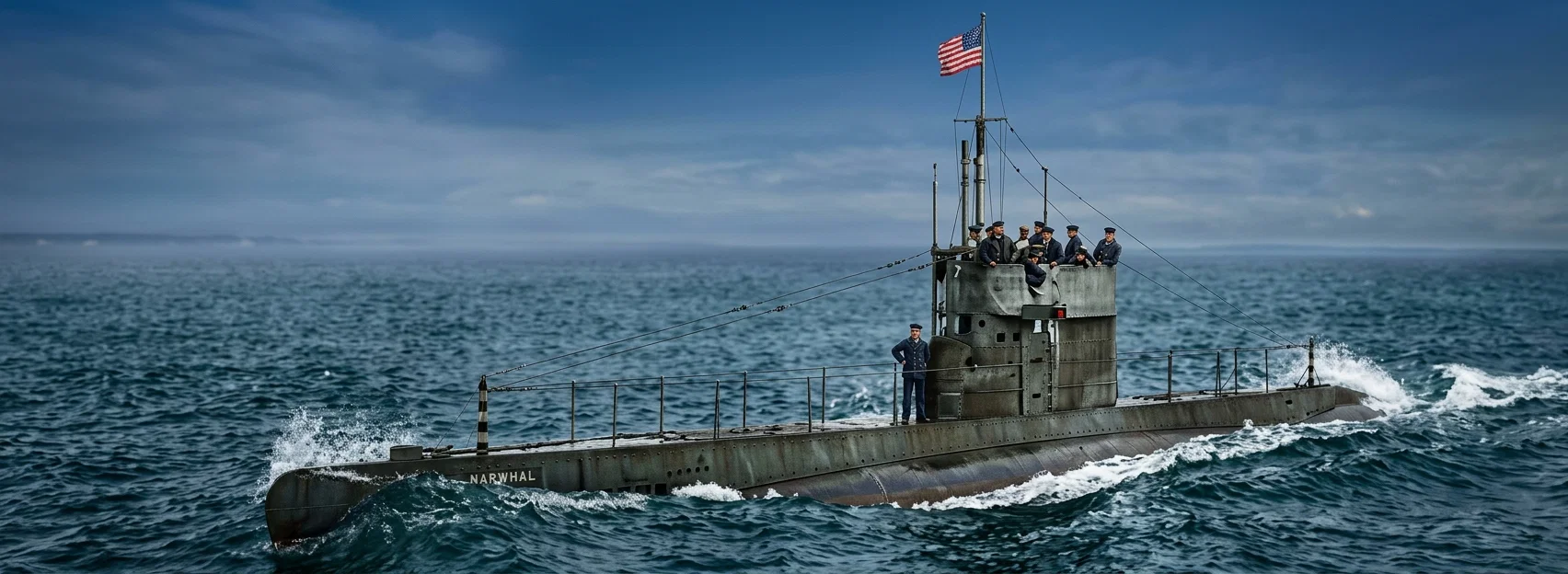
The Latest United States Submarine, "The Narwhal"
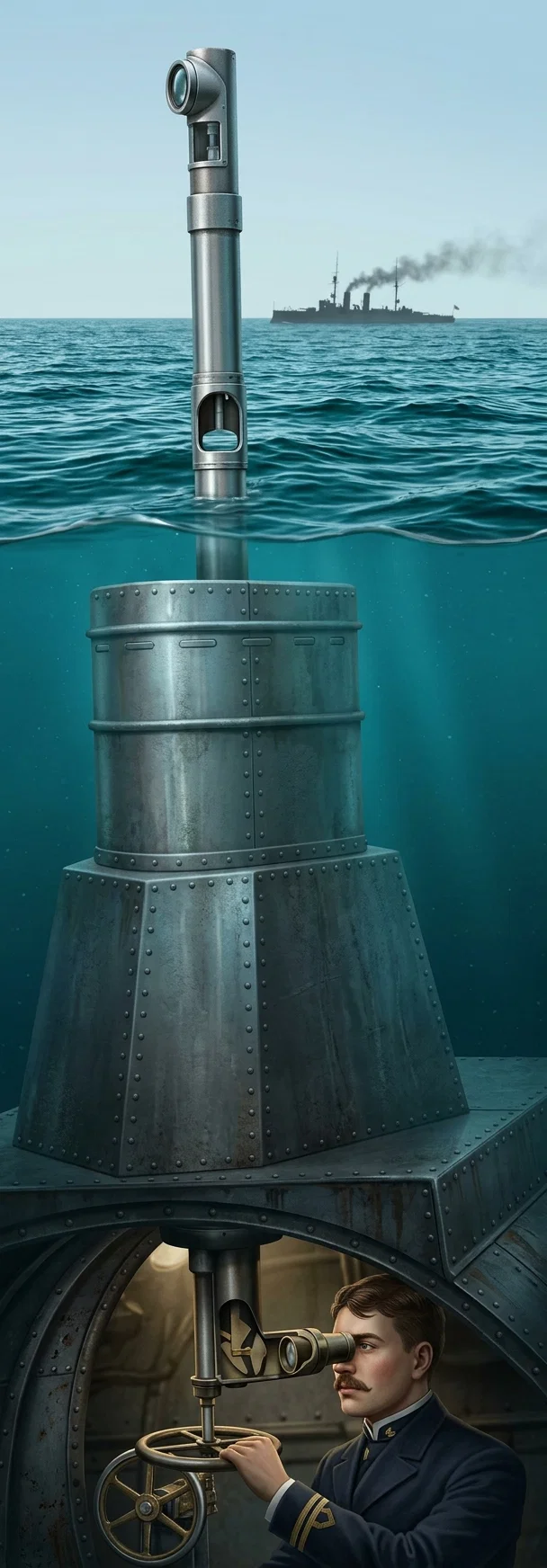
Submarine Periscope in Common Use
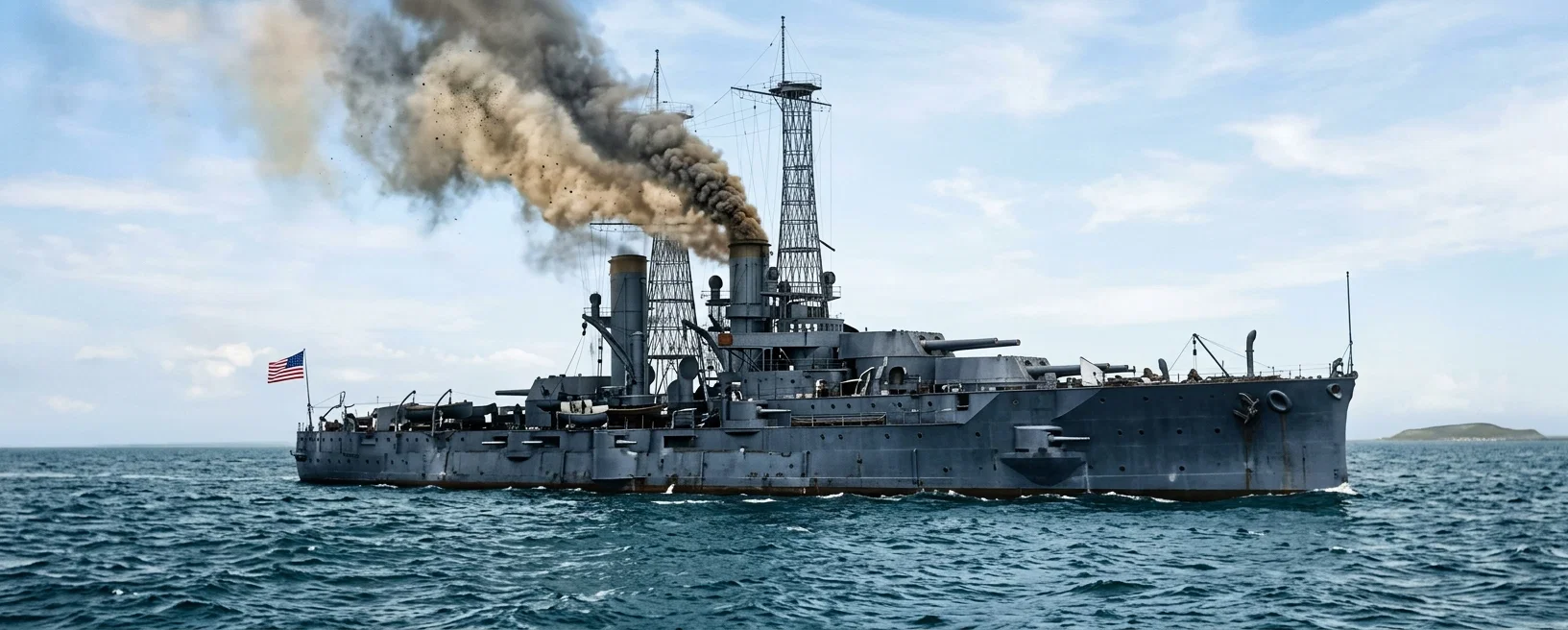
United States Battle-ship North Dakota, of the Dreadnought Type
The preparations for war among the nations go on apace. We note for the benefit of our readers some of the items which indicate this.
Battle-ships
First, we note the building of immense and expensive battle-ships, of which the United States battle-ship North Dakota is a type. This is built after the Dreadnought pattern, and has proved herself to be the fastest afloat. Her length is 518 feet, 9 inches; beam, 85 feet, 2½ inches; mean draft, 27 feet; displacement on trial, 20,000 tons; her trial speed, 21.86 knots. She has 33,875 horse-power; is capable of carrying 2,500 tons of coal. Her main armor belt is 10 to 12 inches thick, and 7 feet, 6 inches wide. The upper belt is 10 inches to 8 inches thick, and 8 feet wide; her barbettes and turrets have 11 inches armor. Her armament is 10 12-inch, 45-caliber guns, and 14 5-inch, 50-caliber guns. She could probably meet the whole 16 battle-ships which America sent around the world, and come out victorious. Other nations are striving to excel.
Submarines
The latest and largest of the United States submarines is called the Narwahl. It is a descendant of the original Holland torpedo-boat, but far in advance of it. The hull is cigar-shape, built of the best quality of mild steel, with workmanship of the highest order, every seam and rivet perfectly tight. Required to navigate the depths of the sea as well as its surface, the pressure of the water is tremendous, and the ship must be built sufficiently strong to withstand it. Its surface speed is about 14 knots an hour. For its submerged work, large storage batteries are provided, which furnish energy sufficient to drive the boat from 10 to 11 knots an hour for over an hour. In other words, she is capable of sailing under water from 12 to 15 miles in an hour. The extent of her sailing on the surface is indefinite. She can sail, when completely submerged, at about 5 knots speed for 150 miles, with nothing visible above water. One of the means which the navigators have of seeing things is what is called the periscope. The one in general use is shown in our illustration. One has been devised, however, which is called an all-seeing periscope, in which views may be obtained from every direction by those in the submarine beneath the water. The little tube which projects from the water is scarcely visible. The submarines bid fair to be weapons of great potency.
Bigger Guns
We also give in connection with this article a picture of one of the big naval guns devised and manufactured by this country. The bore of this gun is 14 inches in diameter; the weight, nearly 64 tons, or 10 tons more than the 12-inch rifles of the North Dakota. Its total length is 53½ feet; the capacity of the powder-chamber, 15,848 cubic inches. It requires 365 pounds of smokeless powder for a charge to hurl the enormous projectile, which weighs 1,400 pounds. This huge shell will travel a distance of 542 inches in the bore of the gun, and after leaving the muzzle is good for a 25-mile flight; altho the battle range would be about 9,000 yards, or 5 miles. The muzzle velocity, or the rate at which the shell leaves the gun, is 2,600 feet per second; and its muzzle energy will be 65,600 foot-tons. That is, it would strike with that force, 13,000 foot-tons energy more than the latest 12-inch guns. When fired with a full charge, it will penetrate 22 8-10 inches of the best Krupp steel armor at the muzzle; and at the range of 9,000 yards, or about 5 miles, would pass through a piece of armor 13 inches in thickness.
All these facts we gather from the “Scientific American.” The cuts which we reproduce of the gun are taken from the San Francisco “Examiner.” The figure of a boy six years old stands by the shell, thus showing the length of the projectile. It may be seen that the gun itself would enclose within its barrel 13 such boys lying lengthwise of the gun.
British Battle-ship
The newest British type is the Dreadnought Neptune, the displacement of which is 20,000 tons; the speed, 21 knots. The armament is what increases the power of this ship over the original Dreadnought. In the original Dreadnought the 10 12-inch guns were mounted, 2 on the forecastle deck, a pair on each beam midship on the main deck with a superstructure between them, and 4 in 2 turrets on the main deck astern and on the center line of the ship. The Neptune, however, places the two-wing turrets diagonally, with sufficient distance between them in the fore-and-aft direction to permit the guns of both turrets to fire on the same broadside; so that the Neptune can fire 6 guns ahead, 8 astern, and 10 on each broadside, as against 6 ahead and astern, and 8 on each broadside, in the original Dreadnought.
The Neptune also carries a new 50-caliber wire-wound 12-inch gun; besides this, a battery of 4 7-inch guns mounted in a lofty central armor redoubt which surrounds the smoke-stacks, will protect both the guns and the smoke-stack bases.
Battle-ship Cruisers
The improved Inflexible has also increased size; 25 feet more length and 2 feet more beam, and 2,000 tons more displacement than Admiral Seymour’s flag-ship. The new Inflexible is called the Indefatigable. This also is not a battle-ship, but a cruiser. Really it is a battle-ship cruiser. She is just now laying down on the ways where the Indefatigable was built, another ship of the same type, but far larger. She is to be 600 feet in length, and equipped with turbine machinery of even greater horse-power than that installed in the fast ocean liners Lusitania and Mauretania. These liners exert over 70,000 horse-power when making their maximum speed of 36 knots; but the new battle-ship, to secure 28 knot speed, must run up to 80,000 or more; and it is believed that in her trial she will exceed that by 2 knots or more. She has a battery of 8 12-inch guns; and it is thought she will be able11to carry that battery for a short spurt across the high seas at a speed of 30 knots an hour; higher than the average speed of the torpedo-boat destroyers.
New Zealand has passed her bill in Parliament authorizing the building of the Dreadnought which she promised in the Empire Defense Council in London. Measures to the same end will be carried through in Australasia, and this will probably be true also in Canada.
Vessels of the Air
Among the things that are now troubling the nations is the question of what part the aeroplanes and dirigible balloons will act in the matter of the future battles. When these air-ships were first demonstrating their success, there were no guns manufactured which could successfully cope with them. That is, the gun did not swing high enough. Its angle was too low to war with the people of the air; but that is not the case at the present. Three types of gun are manufactured by the Germans for this purpose. One of these types is for the sea, mounted on a battle-ship; one for a field-gun for air-ship attack; and one mounted on a motor-car of 50-horse-power with an average speed of 30 miles an hour. The weapon can be brought to a maximum elevation of 75 degrees. The projectile emits a train of smoke which marks the path of its flight, so that the gunner can see how close he came to the air-ship. We give a cut of the 3-inch, 12 pounder Krupp field-piece mounted on a motor-car.
Other Nations
Austria has a deficit of $10,000,000; yet she expends the vast sum of $64,000,000 on battle-ships. This is characteristic of the war fever. Not a nation in the world but that is infected by the same disease. Germany and Austria seem to be working together. Russia also is putting forth vast expenditures. The extent to which Japan is building war-ships is probably not known among the other nations. She knows how to keep her war secrets. Eminent critics tell us that in case war should break out to-morrow, for instance, between the United States and Japan, the strong probabilities are that Japan would sweep the entire Pacific.
America has what one eminent critic calls a battle line, and no more. She has no colliers, no transports of account; none of the necessary auxiliaries to make a navy what it ought to be. These things are building, of course, as rapidly as the men of war can secure funds for that purpose.
Think of the millions upon millions that are expended for battle-ships now! Think of the hundreds of millions expended in our own country alone in a time of peace for war! Think of the vast number of cottages that this would build; of the vast number of schools that it would permanently endow; of the great highways from the Atlantic to the Pacific that it would build, and give employment to the men who are tramping the country for labor.
The Instigator
The spirit of war is the spirit of the devil; and the Word tells us the literal truth when it tells us that all this strife, this spirit of unrest, this preparation for war, foretold by the prophet Joel, is aroused and nourished by the spirits of demons working miracles, going forth to the kings of the earth to prepare them for the great war of Armageddon.
America has an influence now as a world power; but her influence for good and for the upbuilding of the nations of the world would have been a thousand times greater had she remained at home and pursued the arts of peace and justice and equity within her own land. All this is in the history of the past; the great future lies before us; and in the prophetic vision as revealed again and again in the Word of God (Jeremiah 25, for instance, Joel 3, Revelation 16, and many other passages), world-wide war and then the coming of the King of Kings. Men will have demonstrated their utter unworth in ruling the world, and He whose right it is shall reign.
In the meantime there goes to the nations of the earth the blessed Gospel of peace; peace built in righteousness, the righteousness of our God in our Lord and Saviour Jesus Christ. That peace He gives to us not as the world gives. Blessed is the man that knows His righteousness and its consequent peace.
Exorbitant Interest.
Something of the vast amount of interest that is charged by the Shylocks of the country is indicated by the petition that the Russell-Sage foundation which has the administration of the great Sage fortune, is presenting before Congress, asking Congress to provide a law permitting men to pay back loans at one cent a month, 12 per cent per annum. This is double the legal rate of interest in New York and most other states. Still this benevolently founded organization says that if Congress will permit charitable institutions to collect the 12 per cent a year on salaries it will save the poorer class of borrowers throughout the country something like 25 per cent. That would mean that some of them are paying about 37 per cent interest. In this probably the pawn-shops are involved as well as money-brokers.
Trusts Under Government Investigation
The Government department of justice is now investigating the Electrical Trust which has connection with the Westinghouse Company and also the Water Power Trust; and perhaps connected with that, the American Telephone and Telegraph Company. It seems that the same group of men are controlling all. For instance, the Water Power Trust has a dominating interest in thirteen companies which control a total of 1,827,000 horse-power. The water-power plants in the United States are estimated at 5,300,000 horse-power. So the trust controls more than a third of the horse-power. More than that, because it represents a majority of the best power sites. Surely it would seem as if there ought to be some power in the Government to hold in check for the people and common industries some of the mammoth combinations which would swallow them all.
The French Navy
The French Navy.— The new naval program of France proposes two Dreadnoughts in 1910, two in 1911, and two in 1912, differing to some extent in their arrangement from either the American or the British navy. This will give France, by the time 1915 is reached, 19 armor clads, of which 12 will be Dreadnoughts. The cost of the vessels is now estimated at $14,800,000 each; thus the cost of these six battle-ships alone, saving nothing of the smaller vessels which will be built in the meantime, and all the other war expenses, means over two and one fifth dollars for every man, woman, and child in the republic.
Short Hours and Profits
One of the big colliery companies, the Lindy Colliery Company, declares that it must close its extensive coal mine, in which three hundred miners will be thrown out of work; that with the eight-hour day, it is mining coal at a loss; so that it is useless to continue the business, because continued loss is accruing.
The Proteus Microbe.
Gastro-enteritis, the disease which destroys ten thousand infants yearly, is caused by a microbe named the proteus, found in fruits and vegetables, butter and cheese. Professor Metchnikoff declares that the great remedy is soap. Nursing-bottles should be thoroly cleaned, and should not be handled by soiled fingers. Fruits and salads should be plunged into boiling water before eating them, and cheese should be scraped. Referring to the latter food, in the case of most kinds of cheese, it would be well to scrape it all away. It is one of the most indigestible foods known.
A New Firearm.
A new pistol has been invented, using cartridges containing a little gunpowder, burned cayenne pepper, and lycopodium, a substance extracted from moss. The fumes cause the persons fired at to lose consciousness for a time, but do not materially injure them.
A Fearful Storm.
The great storm of December 8 in the East killed 59 persons and laid waste more than $1,000,000 worth of property on the Great Lakes. Most of the damage done was on Lake Erie.
Appealed
Appealed.— Samuel Gompers, John Mitchell, and Frank Morgan, labor leaders, have appealed to the Supreme Court of the United States in the contempt case decided against them.
The Word of God in Spain
By Frank S. Bond
IN my last article on Spain, some of the principal elements which caused the rapid decline in Spanish power, were dealt with. One of the chief causes discussed was the union of church and state, or the influence exerted by the Roman church upon this people.
At the time of the Reformation the Spanish government was at the height of its glory, and it is said of Spain at that time that the sun never set on her possessions. But her cause was an unjust one, and she could not longer prosper. Thousands of the very flower of the Spanish people embraced the teachings heralded to the world by the Reformers of the sixteenth century.
At one time it seemed that Spain would become a Protestant nation, but such was not to be her lot. The tide of affairs was turned; and under the direction of “her invincible Inquisition,” those who had acknowledged the truths of God’s Word, were hunted down as tho they were wild animals, and were tortured with inexpressible cruelties in dark Romish dungeons, founded for that express purpose. Some of those identical dungeons are still to be seen in the Alcazar of Seville, and also in Barcelona.
The work of getting God’s Word into the hands of the Spanish people, has at all times met with great opposition and almost innumerable hindrances. One of the first to bring any considerable quantity of the Spanish Bible across the Pyrenees into Spain, was Julian Hernandez, a Spanish proof-reader of Geneva. Those Bibles were published in Germany.
It was in the month of November, 1556, that Julian Hernandez and a companion, each having a good pack-mule and two burros, crossed the wilds of the Spanish frontier and proceeded down to Seville. They traveled as dry-goods merchants, always manifesting a willingness to expose their goods when confronted by civil guards. Because of this willingness they were permitted to go their way unmolested. Within their packs were concealed those precious treasures, goodly quantities of God’s Holy Word, which was strictly prohibited by the Spanish government at that time.
Referring to about the same time, the historian says, “There existed, in Medina del Campo and in Seville, a permanent depository for the sale of prohibited books.” Unpublished documents give the following information: “From the publishing houses of Germany, they [Bibles, etc.] were sent out to Flanders and from there to Spain, at first by way of seaports, and later, when there was greater vigilance on the part of the government, they were sent to Lyons, France, from whence they were introduced into the peninsula by way of Navarre and Aragon. One Vilman by name, a book-dealer of Amberes, conducted a store in Medina del Campo, and in Seville, where he sold Protestant works published in Spanish and Latin. These books from Frankfort were sold at a low figure, so that they might circulate with greater facility.”
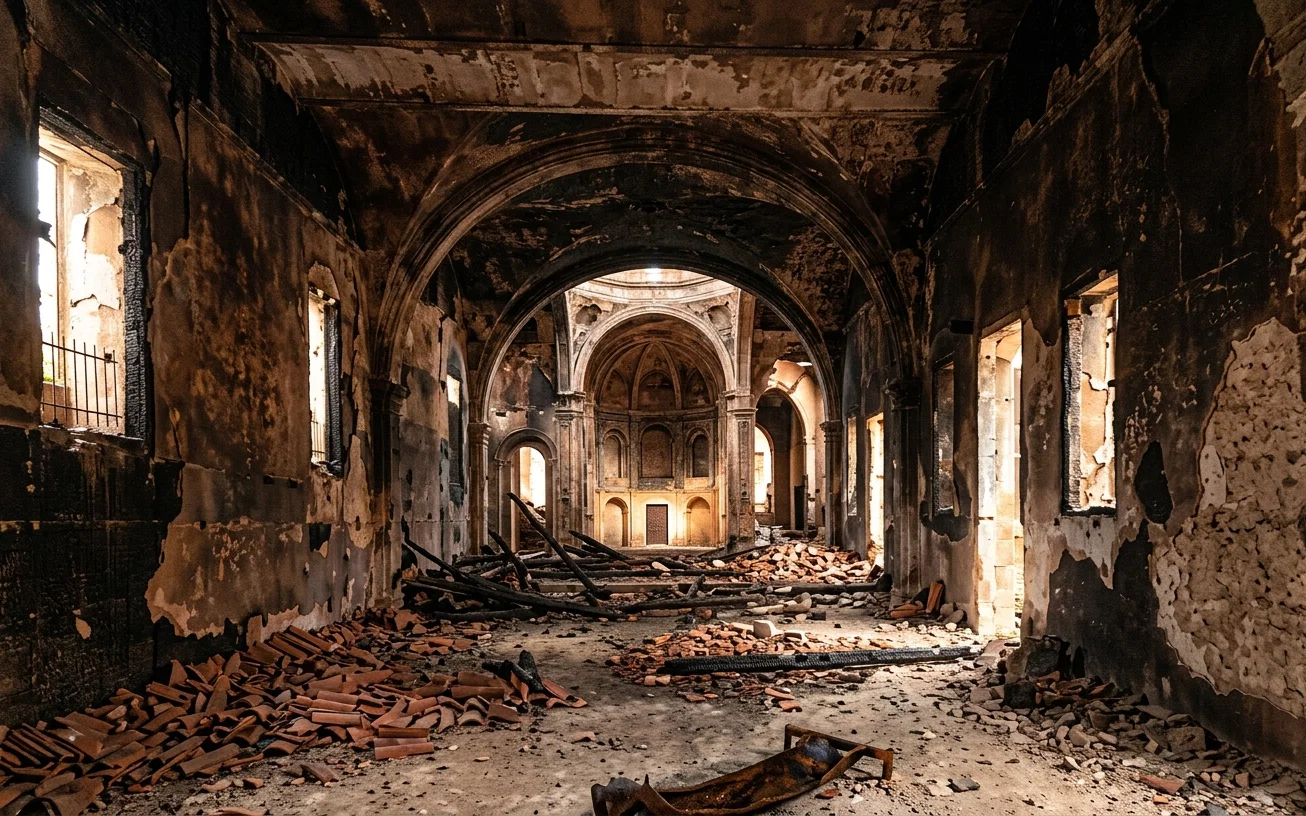
Interior of Barcelona church swept by fire; 47 churches and convents were ruined.
As we read the history of those Reformers, it is very evident to us that God exercised a special care over them and the work they carried forward. But under the despotic reigns of Charles V, Philip II, and their successors, Protestantism was almost stamped out of existence, as far as Spain was concerned. In this fair land, in most parts all that remains to remind one of its former greatness in material things, is an occasional fallen watch-tower, or the ruins of once great cities.
Much less remains to remind one of the influence exerted by God’s Word upon the Spanish people during the Reformation of the sixteenth century.
About 1870 Protestant missionaries began once more to enter this land, whose inhabitants have for so many centuries been denied the light of the Word of life. The darkness here is almost impenetrable; but some headway has been made, the darkness of some hearts has been dispelled by the glowing rays of the eternal truths of God’s Word.
The British and Foreign Bible Society has had a goodly number of colporters in the field for years, and thousands of copies of the Bible have been scattered throughout the land. Thus God has prepared the way for the heralding of His closing message to this benighted people. A greater reformation than that of the sixteenth century is in progress throughout the nations of earth to-day.
The Spanish government has been unsettled of late. In local uprisings, hundreds of citizens have lost their lives. During the latter part of July and the first of August, the streets of Barcelona were converted into a veritable battle-field. The immediate cause of the Barcelona revolution was the war with Morocco. The citizens protested against sending so many soldiers to take part in what appeared to be a needless and unjust war.
We are thankful to announce that witnesses are arising in different parts of Spain to testify to the saving power of God’s truth when received in its fulness into the life.
FRANK S. BOND.
Paterna (Valencia), Spain.
Interior of Barcelona church destroyed by fire during recent uprising.
A Pushing Periodical
OUR Chinese paper, the Shi Chao Yuch Pao, which, Englished, is the “Signs of the Times,” is getting out a special number for the new year. It will bear the date of February, 1910. The coming Chinese new year begins February 10; but the Chinese New Year’s special will be ready for circulation Jan. 1, 1910. Some of the special features are as follows: The Chinese flag in three colors will be used to decorate the cover. There will be a large number of photographs, including one of the emperor of China, and others of prominent viceroys and leading statesmen of China. Every effort will be made to give the great threefold message in its clearness and there will appear well-written articles on the various phases of that message. There will also be that which will make it valuable for the coming year.
The paper will contain the insertion of a calendar with both Chinese and foreign reckoning, the week being clearly designated. The Chinese New Year’s special will contain 32 pages, prices as follows: 5 to 25 copies, 4 cents a copy; 25 copies and over, 3 cents a copy; 1,000 copies or over to one address, 2½ cents a copy. It seems as tho this would offer a fine opportunity for the people in the United States who live near Chinese settlements. The Chinese would read papers from the home land. Surely a large number could be circulated in America among the Chinese here.
These facts we gather from a letter from Brother B. A. Roberts, who also tells us that their facilities are very meager. Their press now is only provided with hand power; but he assures us that orders will receive prompt attention.
May the Lord bless the little paper, and make it a mighty help in the great, needy field of China.
What Christ Said
By George Macdonald
I SAID, “Let me walk in the fields.”
He said, “No; walk in the town.”
I said, “There are no flowers there.”
He said, “No flowers, but a crown!”
I said, “But the skies are black;
There is nothing but noise and din.”
And He wept as He sent me back—
“There is more,” He said; “there is sin.”
I said, “But the air is thick,
And fogs are veiling the sun.”
He answered, “Yet souls are sick,
And souls in the dark undone!”
I said, “I shall miss the light,
And friends will miss me, they say.”
He answered, “Choose to-night,
If I am to miss you, or they.”
I pleaded for time to be given.
He said, “Is it hard to decide?
It will not seem hard in heaven
To have followed the steps of your Guide!”
— George Macdonald.
Notice of the Annual Meeting of the Stockholders of the Pacific Press Publishing Company
By H. W. Cottrell; H. G. Childs
Notice is hereby given to all whom it may concern, that the annual meeting of the stockholders of the Pacific Press Publishing Company, a corporation, organized and existing under, and by virtue of, the laws of the state of California, will be held at the office of the Company, Mountain View, county of Santa Clara, state of California, on Monday, the 24th day of January, A. D. 1910, at 10 o’clock A. M.
H. W. COTTRELL, President,
H. G. CHILDS, Secretary.
Notice of the Annual Meeting of the Members of the Pacific Press Publishing Association
By H. W. Cottrell; H. G. Childs
Notice is hereby given to all whom it may concern, that the annual meeting of the members of the Pacific Press Publishing Association, a corporation, organized and existing under, and by virtue of, the laws of the state of California, will be held at the office of the Association on Villa Street, in the town of Mountain View, county of Santa Clara, state of California, on Monday, the 24th day of January, A. D. 1910, at 10 o'clock A. M.
The election of directors for the ensuing year, the advisability of amending, repealing, or adopting new by-laws, and such other business as may be necessary or proper to be transacted, will come before the meeting.
By order of the directors.
H. W. COTTRELL, President,
H. G. CHILDS, Secretary.
Mail for Dr. A. L. Gregory
ALL mail addressed to Dr. A. L. Gregory should be sent to Mountain View, Cal., care of Elder J. O. Corliss.