It is not gold alone that worths the coin;
The rightful, legal stamp the gold must join.
'Tis not the figured note which is of worth,
Which value gives it thru the wide, wide earth;
It is the governmental sign and seal
Which makes it potent for the civil weal.
It is the silver's trace which tempers steel,
It is the life in blood that makes it heal.
So life, dear heart, is not of years alone,
Howe'er so many to the past have flown.
True living is not made of years, but deeds;
Of earnest prayer, not counting of the beads;
Of humble trust, not flight on fancy's wing;
Of toil and task which burdened years e'er bring;
Oft wrinkled brows, and weary, lagging brain;
Oft sleepless nights and anxious care and pain:
'Tis these write wrinkles on the fairest brow,
And bring the past and future into now,
And bow the form and silver o'er the hair,
And strengthen noble hearts, or bring despair.
But God, the Life, the Lord, the Hope of all,
Shapes up the task, lifts up the ones who fall;
Remolds the life; to character gives form,
And writes upon the heart His blessed norm
Of life; and makes the care-worn, wrinkled face
A blest expression of His own love's trace.
And so, dear heart, let courage come with years,
And rest in God; to Him give all thy fears,
And go thy way with blest and sweet content,
And know in Him are all our years well spent.
And as His life ne'er ends, no "finis" page,
So shall the years bring youth instead of age.
Immortal youth true characters contain,
Victorious over labor, strife, and pain,
Till past the years of earth by mortal trod,
Our life shall measure with the years of God.
With Our Inquirers
By Editor
``If ye will inquire, inquire ye.''
[All questions to this department will be answered which to the editors will seem to minister to the good of the readers and to the mission of the paper. The same question can not be answered repeatedly in the same volume. The name and address must accompany question, not for publication, but as an evidence of good faith, and that answer may be made by letter if deemed advisable. It is well always to enclose a stamp for reply.]
2330.—The Bride of Christ.
I had supposed that the saints, clothed in the robes of Christ's righteousness, would be the bride of Christ, whom He would take home to heaven and present to His Father. Isa. 61:10; Rev. 19:7, 8; 22: 17, first and last part. If the New Jerusalem is Christ's bride, how can something inanimate make itself ready, as stated in Rev. 19:7, or say to Christ's people, ``Come, take of the water of life freely,'' as in Rev. 22:17?
We see noinharmony in these texts at all. The New Jerusalem stands for the kingdom of Christ; He is the King, the new earth the kingdom, the New Jerusalem the capital of that kingdom. In Gal. 4:25 the earthly Jerusalem is represented as being the mother of the children who are in bondage. Verse 26 declares that the ``Jerusalem which is above is free, which is the mother of us all.'' Isa. 54:1 represents her as being barren at that time, longing for her children. Revelation 21 reveals the time when that longing is satisfied and the children all come home; and the figure is carried out in the 19th chapter as the bride of Christ making herself ready, in other words, being prepared for the grand coronation of Christ.
There are three things which may be called the bride of Christ. In Rom. 7:4 the individual believer is said to be married to Him. Paul writes in 2 Cor. 11:2 to the Corinthian church, I `present you as a pure virgin to Christ.'' In Jer. 3:14 the Lord says to His children, I am a husband unto you.'' But in Revelation 21 another is called the bride which includes all the others. In verse 2 the prophet declares that he saw the New Jerusalem come down from God out of heaven, made ready as a bride adorned for her husband. The ninth verse, Come hither, I will show thee the bride, the wife of the Lamb;'' and verse 10, he `showed me the holy city Jerusalem, coming down out of heaven from God.'' There certainly is no question as to the application of that scripture to Jerusalem; and this also is plainly taught in Isa. 54:1-8 and 62:1-5. Surely, what could call louder to the poor wayfaring pilgrims of earth than the glorious city prepared for their eternal home? Every joy and blessing there is in it calls for the children of God to come.
Will you please explain, ``In the gardens behind one tree in the midst,'' of Isa. 66: 17, the abomination being so plainly forbidden, as in Leviticus 11, for example? Do you think in the light of this it is wrong to dig and sell clams to the stranger and the alien?
H. M. H.
Isaiah 66 presents before us conditions which existed among God's people anciently, and which would evidently exist among them in later ages, and especially down in the very last days of which this is a prophecy. The contrast is drawn between the humble who tremble at God's word and those who have no regard for God's word: `He that killeth an ox is as if he slew a man; he that sacrificeth a lamb, as if he cut off a dog's neck; he that offereth an oblation, as if he offered swine's blood; he that burneth incense, as if he blessed an idol.'' No difference is made between their own way and God's way, `and their soul delighteth in their abominations;'' and therefore the Lord gives them up to delusions.
In the fifth verse and onward the Lord again encourages those who `tremble at His word.'' There will come a time when they will rejoice, while those who cast them out will be in sorrow. The fifteenth and sixteenth verses refer to the coming of Christ, and the execution of judgment. It mentions among the classes that will be recipients of those judgments, those that sanctify themselves, belonging evidently to various classes and cults, `behind one
tree in the midst,'' or as the marginal reading of the Revised Version gives, `one tree, or Asherah,'' a symbol of idolatry; having no regard to the health laws of God, `eating swine's flesh, and the abomination, and the mouse, they shall come to an end together.'' That is, the obstinate among God's people shall be classed with the lowest among the heathen who have rejected His will.
Four times over in Lev. 11:9-12 are we told that various sorts of shell-fish are an abomination. As to handling them and selling them to others, the only rule we could give would be the golden rule given by Christ, ``Whatsoever ye would that men should do to you, do ye even so to them.''
2332.—Polygamy.
If David, Jacob, and others did not transgress the seventh commandment by having more than one wife, how is it that the Mormons are considered as transgressors now?
H. M. H.
David, Abraham, Jacob, and Solomon, and all the others transgressed God's commandments when they multiplied wives to themselves. God did not make man male and females, but male and female, the one man with the one wife. All that we can say of the men named is that they allowed the customs of the times in which they lived to blind them, and while the Lord winked at their ignorance, He did not accept them as His children because of their transgressions, but in spite of them, because their heart was to do right. Just what such a course as that meant to them is seen in the trouble that Jacob and David and others had who had their plural wives, when the seed-sowing was followed by a harvest of bitterness, jealousy, strife, and trouble. Living in the age that they did, they did not seem to feel condemned for these transgressions; but to make their failures an excuse for our wrong-doing is to endeavor to call evil good.
In the first place, verses 44 and 46, which are identical with 48, are omitted by the best Greek authorities. Secondly, the instruction is to those who would truly be children of God, but who might have in their own lives or natures that which was a hindrance in the spiritual life, dear perhaps as the right hand or the right eye, and that if these things did thus hinder or were stumbling-blocks, it were better to have them cut off than to have the whole being destroyed or corrupted by their influence. The passage would have as true an application in matters of church membership.
We gather, however, that the thing desired to be explained above everything else is the reference to hell, `Rather than having thy two hands to go into hell, into the unquenchable fire.'' Verse 43. Where their worm dieth not, and the fire is not quenched.'' Verse 48. Quotations from A.R.V. The word hell in the New Testament comes from two words, with one exception; (1) *hades*, meaning the abode of the dead whether righteous or wicked, and (2) *gehenna*, the place of punishment at the time of the judgment. It comes from this latter word here. Gehenna comes from the Valley of the Son of Hinnom, an Old Testament term applied to a valley just outside of Jerusalem where the refuse of the city, bodies of dead animals and dead malefactors were cast. Upon these the worms ceaselessly preyed. To avert pestilence, constant fires were kept burning to consume that which was not eaten by the worms. Gehenna'' therefore became a symbol of complete and utter destruction. Isa. 51:6-8 refers to the same thing, where the worm shall eat them like wool;'' and Isa. 66:24, where the worm is said to prey upon the car-casses'' of the dead. The figure of `unquenchable
fire'' is also borrowed from the Old Testament. In Jer. 17:27 the Lord declares that if the Sabbath were not kept He would kindle a fire in the gates of Jerusalem, `and it shall devour the palaces of Jerusalem, and it shall not be quenched.'' This is fully as strong as the expression, un-quenchable fire.'' A fulfilment of this is recorded in 2 Chron. 36:19-21, `And they burned the house of God, and brake down the walls of Jerusalem, and burnt all the palaces thereof with fire, . . . to fulfil the word of Jehovah by the mouth of Jeremiah, until the land had enjoyed its Sabbaths.'' These striking figures, familiar to the Jews, and which to them meant complete and utter destruction, Jesus used to symbolize the fate of the wicked.
2334.—Proper Foods.
Please explain 1 Tim. 4:4; Rom. 14:14, 20. Does this not say that any meal is good to eat if we are thankful for it?
E. E. V.
Hardly. Our inquirer would hardly wish to see the logic of such a statement to its ultimate, for every abominable thing that is eaten by the nations of the world would fall under that. The Chinese are thankful for rat soup, some nations eat snails, lizards, snakes; every conceivable thing almost is eaten by some of the nations of earth, and we suppose they are thankful for them all. To Christians they would be loathsome. To refer to the texts themselves: 1 Tim. 4:4, 5 limits the food there mentioned, ``for it is sanctified thru the word of God and prayer.'' God has told us in the very beginning chapters of the Bible the food that was designed for His people then, the fruits, the grains; later were added the vegetables, and later still, as the people departed more and more, they were permitted to eat animal food; but here also God made a distinction, showing that which was utterly unfit for food and that which was permitted. See Leviticus 11 and Deuteronomy 14. Surely the Lord did not make this for any arbitrary reason. The connection shows why it was; He desired His people to be a holy people, a people which would not be corrupted in blood; and the Jews are a testimony to their better living to this day in the far greater average of life.
Romans 14 is not a chapter on meats and drinks, giving dietary instructions; it rises to a plane far above that, and that is that we are not judges of our brother. He may eat meat, we may not; we may eat herbs; his diet may be a more generous one; but we are not to condemn him; God is his judge. Men are not to eat for men, or drink for men; that is, man is not to be the judge as to what another shall eat or drink, for `we shall all stand before the judgment-seat of Christ.'' And yet it is an important thing that we are not to place a stumbling-block in the way of the weak; so the very conclusion to which the apostle comes is this, Let us not therefore judge one another any more; but judge ye this rather, that no man put a stumbling-block in his brother's way, or an occasion of falling;'' and in the twenty-first verse, It is good not to eat flesh, nor to drink wine, nor to do anything whereby thy brother stumbleth;'' and then the twenty-second verse, Hast thou faith? have it to thyself before God.'' But faith is not based on human customs or practises or conceptions, but on God's word. There is something underlying the diet question which is above all mere extraneous rules. The great principle which ought to control every Christian is stated in 1 Cor. 10:31, `Whether therefore ye eat, or drink, or whatsoever ye do, do all to the glory of God.'' We believe that the united testimony of all would be that all who have lived sparingly, those who have for Christ's sake adopted a clean, strong dietary, according to His word, have, all other things being equal, made themselves better servants of God than those who have lived for the gratification of their stomachs.
The leviathan is generally considered as being identical with the crocodile, of which there may have been much larger types in the days of Job.
Christ the Teacher and Healer
By Ellen G. White
Power to Forgive Sins
By Mrs. E. G. White
MANY of those who came to Christ for help had brought disease upon themselves; yet He did not refuse to heal them. And when virtue from Him entered into these souls, they were convicted of sin, and many were healed of their spiritual disease as well as of their physical maladies.
Among these was the paralytic at Capernaum. He had lost all hope of recovery. His disease was the result of a sinful life, and his sufferings were embittered by remorse. In vain he had appealed to the Pharisees and doctors for relief; they pronounced him incurable, they denounced him as a sinner and declared that he would die under the wrath of God.
The palsied man had sunk into despair. Then he heard of the works of Jesus. Others, as sinful and helpless as he, had been healed, and he was encouraged to believe that he too might be cured if he could be carried to the Saviour. But hope fell as he remembered the cause of his malady, yet he could not cast away the possibility of healing.
His great desire was relief from the burden of sin. He longed to see Jesus, and receive the assurance of forgiveness and peace with heaven. Then he would be content to live or to die, according to God's will.
There was no time to lose; already his wasted flesh bore signs of death. He besought his friends to carry him on his bed to Jesus, and this they gladly undertook to do. But so dense was the crowd that had assembled in and about the house where the Saviour was, that it was impossible for the sick man and his friends to reach Him, or even to come within hearing of His voice. Jesus was teaching in the home of Peter. According to their custom, His disciples sat close about Him, and "there were Pharisees and doctors of the law sitting by, who were come out of every village of Galilee and Judea and Jerusalem." Many of these had come as spies, seeking an accusation against Jesus. Beyond these thronged the promiscuous multitude: the eager, the reverent, the curious, and the unbelieving. Different nationalities and all grades of society were represented. "And the power of the Lord was present to heal." The Spirit of life
brooded over the assembly, but Pharisees and doctors did not discern His presence. They felt no sense of their need, and the healing was not for them. "He hath filled the hungry with good things; and the rich He hath sent empty away."
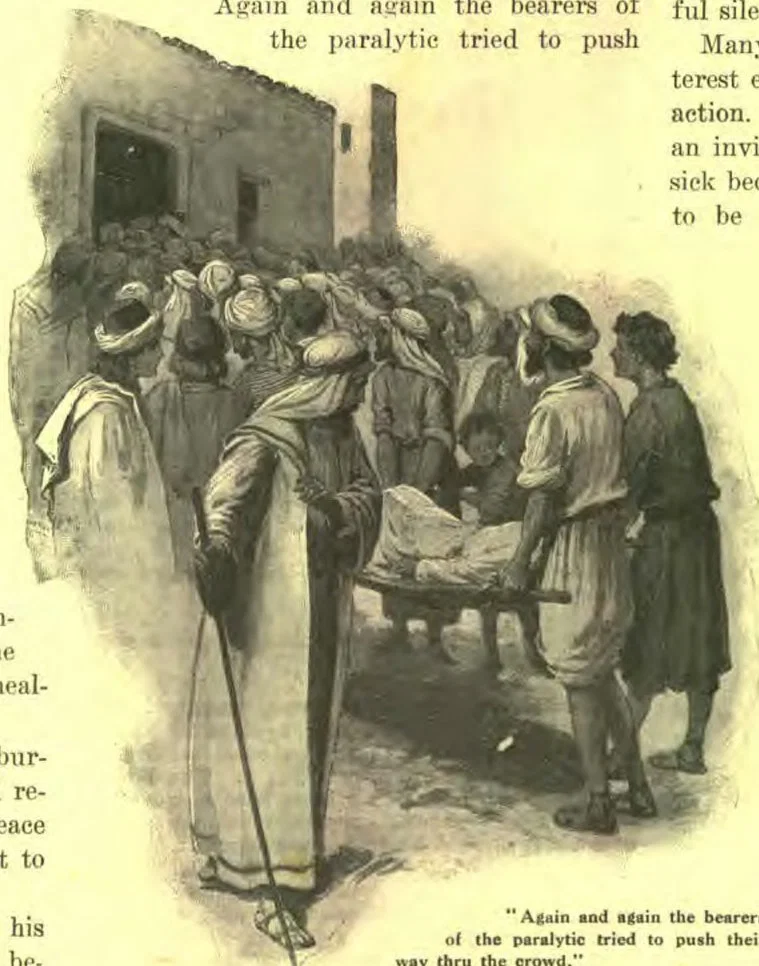
"Again and again the bearers of the paralytic tried to push their way thru the crowd."
Again and again the bearers of the paralytic tried to push their way thru the crowd, but in vain. The sick man looked about him in unutterable anguish. How could he relinquish hope, when the longed-for help was so near? At his suggestion his friends bore him to the top of the house, and breaking up the roof, let him down at the feet of Jesus.
Convicted of Sin.
The discourse was interrupted. The Saviour looked upon the mournful countenance, and saw the pleading eyes fixed upon Him. Well He knew the longing of that burdened soul. It was Christ who had brought conviction to his conscience when he was yet at home. When he repented of his sins, and believed in the power of Jesus to make him whole, the mercy of the Saviour had blessed his heart. Jesus had watched the first glimmer of faith grow into a conviction that He
was the sinner's only helper, and had seen it grow stronger with every effort to come into His presence. It was Christ who had drawn the sufferer to Himself. Now, in words that fell like music on the listener's ear, the Saviour said, "Son, be of good cheer; thy sins be forgiven thee."
The burden of4gilt rolls from the sick man's soul. He can not doubt. Christ's words reveal His power to read the heart. Who can deny His power to forgive sins? Hope takes the place of despair, and joy of oppressive gloom. The man's physical pain is gone, and his whole being is transformed. Making no further request, he lay in peaceful silence, too happy for words.
Many were watching with breathless interest every movement in this strange transaction. Many felt that Christ's words were an invitation to them. Were they not soul-sick because of sin? Were they not anxious to be freed from this burden?
But the Pharisees, fearful of losing their influence with the multitude, said in their hearts, "He blasphemeth; who can forgive sins but One, even God?"
Fixing His glance upon them, beneath which they cowered, and drew back, Jesus said, "Wherefore think ye evil in your hearts? For whether is easier to say, Thy sins be forgiven thee; or to say, Arise, and walk? But that ye may know that the Son of Man hath power on earth to forgive sins," He said, turning to the paralytic, "Arise, take up thy bed, and go unto thine house."
Then he who had been borne on a litter to Jesus rose to his feet with the elasticity and strength of youth. And immediately he "took up the bed, and went forth
before them all; insomuch that they were all amazed, and glorified God, saying, We never saw it on this fashion."
Creative Power.
It required nothing less than creative power to restore health to that decaying body. The same voice that spoke life to man created from the dust of the earth, had spoken life to the dying paralytic. And the same power that gave life to the body, had renewed the heart. He who at creation "spake, and it was," who "commanded, and it stood fast," had spoken life to the soul dead in trespasses and sins. The healing of the body was an evidence of the power that had renewed the heart. Christ bade the paralytic arise and walk, "that ye may know," He said, "that the Son of Man hath power on earth to forgive sins."
The paralytic found in Christ healing for both the soul and the body. He needed health of soul before he could appreciate health of body. Before the physical malady could be healed, Christ must bring relief to the mind, and cleanse the soul from sin. This lesson should not be overlooked. There are to-day thousands suffering from physical disease, who, like the paralytic, are longing for the message, "Thy sins be forgiven." The burden of sin, with its unrest and unsatisfied desires, is the foundation of their maladies. They can find no relief until they come to the Healer of the soul. The peace which He alone can impart, would restore vigor to the mind, and health to the body.
The effect produced upon the people by the healing of the paralytic was as if heaven had opened, and revealed the glories of the better world. As the man who had been cured passed thru the throng, blessing God at every step and bearing his burden as if it were a feather's weight, the people fell back to give him room, and with awestrieken faces gazed upon him, whispering softly
among themselves, "We have seen strange things to-day."
In the home of the paralytic there was great rejoicing when he returned to his family, carrying with ease the couch upon which he had been slowly borne from their presence but a short time before. They gathered round with tears of joy, hardly daring to believe their eyes. He stood before them in the full vigor of manhood. Those arms that they had seen lifeless were quick to obey his will. The flesh that had been shrunken and leaden-hued was now fresh and ruddy. He walked with a firm, free step. Joy and hope were written in every lineament of his countenance; and an expression of purity and peace had taken the place of the marks of sin and suffering. Glad thanksgiving went up from that home, and God was glorified thru His Son, who had restored hope to the hopeless, and strength to the stricken one. This man and his family were ready to lay down their lives for Jesus. No doubt dimmed their faith, no unbelief marred their fealty to Him who had brought light into their darkened home.
Christian Science in the Light of Reason and Revelation
By R. A. Underwood
By R. A. Underwood
II. Christian Science and Pantheism.
The basis of the doctrine which Christian Science is promulgating as the Gospel rests upon the assumption that matter has no existence, and further, that nothing exists but mind. Mrs. Eddy defines mind as God. Man is said to be mind, and man is also said to be God. Mind—that is, God—can not sin; hence there is no sin. God can not die nor suffer. Hence there is no sickness, pain, decay, or death. This is all an illusion of mortal mind.
Mortal mind is defined to be simply the illusion or deception that sin, pain, sickness, death, and matter have a reality. This mortal mind, or the deception about the reality of material things, must give way to mind. Then all that will be left of man will be a beautiful thought.
This is the theory Christian Science presents to do away with all the evils of a sin-cursed earth. This is accepted by the followers of Mrs. Eddy as a new revelation to man, first announced by the author of "Science and Health with Key to the Scriptures," as she claims in her book. But this is not a new doctrine discovered by Mrs. Eddy. She is not its founder or author, as she claims to be. The fact is that Mrs. Eddy has only revived the old spiritualistic and pantheistic doctrine of ages past, with slight modifications or additions under the false name of "Christian Science."
The reader will readily recognize that Christian Science is practically the same doctrine as pantheism, revived under a more taking name than the old doctrine of the Hindu, as the following definitions and statements of pantheism clearly show:
The Doctrine of Pantheism Defined.
"Pantheism is absolute monism, maintaining that the entire phenomenal universe is the ever-changing existence—form of the one single universal substance, which is God. Thus God is all, and all is God."—"Hodges' Outlines of Theology," quoted in "Standard Dictionary."
The New International Encyclopedia says in part:
"Pantheism, the name given, usually by its opponents, . . . to any system of speculation which identifies the universe with God, or God with the universe, . . . The Hindu thinker regards man as born into a world of illusions and entanglements, from which his great aim should be to deliver himself." And further, the hope is entertained that man is finally to become "emancipated from the deceptive influence of phenomena and fit to apprehend that he and they are alike but evanescent modes of existence assumed by that infinite, eternal, and unchangeable being who is all in all."
Chambers' Encyclopedia says in part:
"Pantheism, the name given to that system of speculation which in its spiritual form identifies the universe with God, or God with the universe, . . . a profound and mystic religiosity. The antiquity of pantheism is undoubtedly great, for it is prevalent in the oldest known civilization in the world, the Hindu. . . . The Hindu thinker regards man as born into a world of illusions and entanglements, from which his great aim should be to deliver himself. Neither sense nor reason, however, is capable of helping him. . . . He becomes emancipated from the deceptive influence of phenomena, and fit to apprehend that he and they are alike but evanescent modes of existence assumed by that infinite, eternal, and unchangeable spirit who is all in all. . . . Denying the possibility of creation, he argues that there exists only an eternal, infinite one or all, of which individual objects and existences are merely illusory modes of representation. . . . To see God everywhere, to realize that He alone is, and that all else is but a perishable phenomenon or passing illusion."
To substantiate further this view of Christian Science, I quote an extract as reported by Rev. A. C. Dixon, D.D., of a statement made by Pandita Ramabai, a native of India, who says:
"On my arrival in New York, I was told that a new philosophy was being taught in the United States, and that it had won many disciples. The philosophy was called Christian Science, and when I asked what its teaching was, I recognized it as being the same philosophy that has been taught among my people four thousand years. It has wrecked millions of lives, caused immeasurable suffering and sorrow in my land, for it is based on selfishness, and knows no sympathy or compassion. It means just this, the philosophy of nothingness. You are to view the whole universe as nothing but falsehood. You are to think it does not exist. You do not exist. I do not exist. The birds and the beasts that you see do not exist. When you realize that you have no personality whatever, then you will have attained the highest perfection of what is called 'Yoga,' and that gives you liberation, and you are liberated from your body, and you become like him, without any personality."
As I shall continue to compare statements in Mrs. Eddy's book, "Science and Health with Key to the Scriptures," edition 1905, the reader must judge as to the correctness of the statement that this cult is the revival of pantheism under a more taking name.
7. The Gospel of Christ affirms the material man.
"And the Lord God formed man of the dust of the ground, and breathed into his nostrils the breath of life, and man became a living soul." Gen. 2:7.
"Dust thou art, and unto dust shalt thou return." Gen. 3:19.
"He [Christ] was in the world, and the world was made by Him, and the world knew Him not." John 1:10.
"What, know ye not that your body is the temple of the Holy Ghost which is in you, which ye have of God, and ye are not your own? For ye are bought with a price; therefore glorify God in your body, and in your spirit, which are God's." 1 Cor. 6:19, 20.5
7. Christian Science denies the existence of matter.
"Matter and death are mortal illusions." Page 289.
"Spirit and matter can not coexist or cooperate." Page 279.
"Matter is unknown in the infinitude of mind." Page 280.
"Spirit and matter no more commingle than light and darkness. . . . The mind supposed to exist in matter, or beneath a skull-bone is a myth, a misconceived sense, a false conception of man and mind." Page 281.
"All must be mind, or else all must be matter." Page 551.
"Question.—What is the scientific statement of being? Answer.—There is no life, truth, intelligence, nor substance in matter. All is infinite mind and its infinite manifestation, for God is all in all." Page 468.
8. The Gospel of Christ recognizes the fact of sickness and suffering.
"And He healed many that were sick of divers diseases, and cast out many devils; and suffered not the devils to speak, because they knew Him." Mark 1:34.
"For unto you it is given in the behalf of Christ, not only to believe on Him, but also to suffer for His sake." Phil. 1:29.
"The prayer of faith shall save the sick, and the Lord shall raise him up; and if he have committed sins, they shall be forgiven him." James 5:15.
8. Christian Science denies the existence of sickness or suffering.
"Man is never sick, for mind is not sick, and matter can not be." Page 393.
"The only reality of sin, sickness, or death is the awful fact that unrealities seem real to human belief until God strips off their disguise. They are not true." Page 472.
"Decrepitude is not according to law, nor is it a necessity of nature, but an illusion which may be avoided." Page 245.
9. The Gospel of Christ acknowledges that men are born and that they grow old.
"Man that is born of a woman is of few days, and full of trouble. He cometh forth like a flower, and is cut down; he fleeth also as a shadow, and continueth not." Job 14:1, 2.
"Now also when I am old and gray-headed, O God, forsake me not." Ps. 71:18.
"The days of our years are threescore and ten; and if by reason of strength they be fourscore years, yet is their strength labor and sorrow; for it is soon cut off, and we fly away." Ps. 90:10.
"Thou shalt rise up before the hoary head, and honor the face of the old man, and fear thy God: I am the Lord." Lev. 19:32.
"The hoary head is a crown of glory, if it be found in the way of righteousness." Prov. 16:31.
9. Christian Science denies birth or old age.
"Man in science is neither young nor old. He has neither birth nor death." Page 244.
"Decrepitude is not according to law, nor is it a necessity of nature, but an illusion which may be avoided." Page 245. (Notwithstanding the above statement, Mrs. Eddy, Aug. 17, 1907, when she was before the Federal court, and questioned by the Hon. J. E. Aldridge, made this acknowledgment, as reported in the daily papers: "I beg pardon, my only difficulty is a slight deafness. I can see to read common pica, but I can't hear distinctly without some difficulty." This was injected into her testimony after saying, "What did you say?" several times. Possibly Mrs. Eddy's old "belief" is troubling her.)
10. The Gospel of Christ presents man as mortal, in contrast with God as the one who only has immortality.
"Shall mortal man be more just than God? shall a man be more pure than his Maker?" Job 4:17.
"Man is like to vanity; his days are as a shadow that passeth away." Ps. 144:4.
"Which in His times He shall show, who is the blessed and only Potentate, the King of Kings, and Lord of Lords; who only hath immortality, dwelling in the light which no man can approach unto; whom no man hath seen, nor can see; to whom be honor and power everlasting." 1 Tim. 6:15, 16.
10. Christian Science presents the astounding claim that man is God.
"Continuing our definition of man, let us remember that the harmonious and immortal man has existed forever. . . . This statement is based on fact, not fable. The science of being reveals man as perfect, even as the Father is perfect, because the soul, or mind, of man is God." Page 302.
11. The Gospel of Christ is authority for a future judgment.
"As it is appointed unto men once to die, but after this the judgment." Heb. 9:27.
"Because He hath appointed a day in the which He will judge the world in righteousness by that Man whom He hath ordained; whereof He hath given assurance unto all men, in that He hath raised Him from the dead." Acts 17:31.
11. Christian Science denies the future judgment.
"No final judgment awaits mortals." Page 291.
The above statements in Mrs. Eddy's book are so contrary to human experience, revelation, and all the facts of science, that it is astonishing that any person of sane mind could be led to accept such views as true.
Christian Science disposes of sin by denying its existence. It makes void the Bible doctrine of repentance and conversion. It removes all responsibility from the individual, and makes him responsible to no tribunal or judgment. It relieves man of all moral responsibility, and makes him amenable to no being higher than himself. It seeks to destroy in the mind of man any conviction of sin or wrong-doing by denying its verity. It repudiates the record of creation and the fall of man. But, saddest of all, Christian Science is a religion without a Saviour. It takes away our Lord, and presents etherealized nothing in His place.
The fact that all this is offered under the name "Christian Science" ought to open the eyes of the people to the falsity of its claims, and lead them to see that it is only the old doctrine of pantheism under a new garb more pleasing to modern society.
The Sabbath.
By W. H. Armstrong
THE Sabbath is one question that is much agitated among nearly all classes of people in this present day. Some believe that the seventh day is the Sabbath; some believe that the first day is the Sabbath. It is treated somewhat like a pain in some part of the body. Men try to relieve the pain without removing the cause of the pain. In treating it in this way the pain is liable to return again at any time. So to discuss this question without going to the foundation leaves it still unsettled.
The only knowledge that we have of a Sabbath and how a Sabbath was made is that found in the Holy Scriptures. Outside of the Scriptures we find no record of a Sabbath made by the God of heaven. In the Scriptures, however, we read that in the beginning God made the Sabbath out of the seventh day; and that it required Him to rest upon that day; to bless the day, after He had rested on it; and to sanctify it. It took all of this work to make the Sabbath out of the seventh day. And God considered it of sufficient importance to place on record how He had made the Sabbath, and of which day He made it.
When man sinned he transgressed God's law. He fell by that transgression, because man can not sin without transgressing God's law; "for sin is the transgression of the law." The law of God is as eternal as God Himself. God is "from everlasting to everlasting." So is His law. "God is love," and love on our part is the fulfilling of that law. As God is eternal, because He is love, so, as the law of God is love, it is eternal also. And as the Sabbath is a part of that law it is as eternal as the law is. And God tells us that in the new earth it is to be kept. Isa. 66:22. And when we enter into that kingdom it is for eternity. When God spoke His law at Mount Sinai it was only a repetition of the law that all of His prophets had been keeping all the way down to the days of Moses. God said of Abraham that he had kept His laws and His statutes and His commandments; and we also find in the sixteenth chapter of Exodus that Moses told the children of Israel as they gathered the manna on the sixth day, that the morrow was the Sabbath day. They were to gather on the sixth day twice as much; for on the seventh day, which was the Sabbath, there would be none. This was about a month before the law was spoken from the mount.
Again, the Scriptures tell us that Christ was the Creator of this world. As the Creator of the world, He also was the One who made the Sabbath. And He said that He made it for man, not for the Jew-man only; for if He had made it for the Jews only, then the Gentiles would not have had a Sabbath to keep. Why?—Because if the seventh day was to be kept by the Jews only, and not by the Gentiles, there can not be found in Holy Writ another weekly sabbath. And no Christian is under any obligation to observe any day or law or any institution that is not fully recognized and sanctioned by the Holy Scriptures. The word of God is what we will all have to meet in the judgment; and as that is so, let us live as that word tells us to live. By so doing we will be able to stand in the judgment. It will not do to try to pass the judgment by what men say.
W. H. ARMSTRONG.
Sunbeams.
By Nelia Snow
THE sky was dark and cloudy,
The snow-blown fields were drear;
And trees stood like gaunt specters,
No bird-song gave us cheer.
But struggling thru the shadows,
The sun at last made way;
And rolled his wreath of splendor
Across the darkened day.
The fields were plains of glory,
Adorned with jewels bright,
The scene was changed to beauty
By one grand wave of light.
The burdens I was bearing
Seemed like a crushing load,
The life that lay before me,
A long and weary road.
Then, cheering words were spoken
In hope and faith sincere;
A hand clasped mine in greeting
From fellow trav'lers near.
And, lo, my cares were lightened,
The dark thoughts fled away
As tho, they too, were scattered
By sunshine's brightest ray.
Nelia Snow.Blaine, Me.
Sensitive to a Fault.
By Max Hill
So often we hear such remarks as these: "He is sensitive to a fault;" "She is so easily hurt;" "I know I am thin-skinned;" "He is so quick to take offense." Sometimes these remarks come from and about Christians. Christians, that means Christlike. Let us note the parallel. Of Him we read, "He was oppressed, and He was afflicted, yet He opened not His mouth." He taught, "Love your enemies, bless them that curse you, do good to them that hate you, and pray for them which despitefully use you, and persecute you." In the last agonizing hour of the Saviour's life on earth, as He suffered the tortures of His persecutors, no thought of His own rights or privileges, no thought of His own pain and insult, no thought of retaliation or revenge, came to Him. Instead that great heart of love went out to the very ones who took His life, "Father, forgive them; for they know not what they do."
And Christians, Christ-followers, are "thin-skinned," "easily offended," "hurt"! Where is the parallel? Professing to follow His example, they fail in the real test. It is no credit to a man that he does not fall when no temptations come; it is no credit to him that he is sweet and pleasant when not a cross or unkind or untrue word has been said to him or about him; it is no credit to him that he is meek and lowly when no one has abused him; indeed, all these virtues are virtues only when the trials come. Then is the time to be Christlike.
It is weak, babyish, to whine because some one has mistreated you. Think of Paul as complaining of the injustice of his fellows, and then read his beautiful words on the charity which "beareth all things, believeth all things, hopeth all things, endureth all things." No real martyr ever poses as such.