1. Cf what was the ancient sanctuary with its holy places and priests (described last week) a type?
"Now of the things which we have spoken this is the sum: We have such an HIGH PRIEST, who is set on the right hand of the throne of the Majesty in the heavens; a MINISTER OF THE SANCTUARY, AND OF THE TRUE TABERNACLE, which the Lord PITCHED, and not man." Heb. 8:1, 2.
2. After what was the earthly sanctuary made?
"See, saith He, that thou make all things according to the PATTERN SHOWED TO THEE IN THE MOUNT." Heb. 8:5; Ex. 25:40.
3. What was this pattern which was showed to Moses in the mount?
"For Christ is not entered into the HOLY PLACES MADE WITH HANDS, which are the FIGURES of the TRUE; but INTO HEAVEN ITSELF, now to appear in the presence of God for us." Heb. 9:24.
NOTE.—There were two holy places in the earthly sanctuary. These are expressly declared to be the "patterns of things in the heavens" the "holy places" of earth, "the figures [plural] of the true." Heb. 9:24. The same thought is expressed in the original of verse 8 and 12, and of 10:19, where they should read "holy places." The holy places of the earthly sanctuary are typical of the HOLY PLACES of the heavenly sanctuary.
4. What furniture was found in the earthly sanctuary?
The candlestick, the table of showbread, the altar of incense; and in the most holy place, the ark of the covenant, testament, or testimony.
NOTE.—See last week's Bible study and the scriptures referred to, also Heb. 9:1-5.
5. Which of these did John see in heaven?
"A door was opened in heaven; . . . and there were SEVEN LAMPS OF FIRE burning before the throne, which are the seven spirits of God." Rev. 4:1-5.
"And another angel came and stood at THE ALTAR, having a golden censer; and there was given unto him much incense, that he should offer it with the prayers of all saints upon the golden altar which was before the throne." Rev. 8:3.
6. At a later time in earth's history, after the opening of a door in the heavenly temple, what did John see?
"And the temple of God was opened in heaven, and there was seen in His temple THE ARK OF HIS TESTAMENT." Rev. 11:19.
7. To what then did the earthly priests serve in the earthly sanctuary?
"Who serve unto the EXAMPLE AND SHADOW OF HEAVENLY THINGS." Heb. 8:5.
8. Why were they many priests?
"They were not suffered to continue by reason of DEATH." Heb. 7:23.
9. How does Christ's priesthood differ?
"But this Man, because He CONTINUETH EVER, hath an UNCHANGEABLE PRIESTHOOD." Verse 24.
10. How often did they officiate in their round of service?
NOTE.—"The priests went always [continually, daily] into the first tabernacle," or holy place (Heb. 9:6), relates to their regular, daily service, of one lamb in the morning and one in the evening, with such other offerings as individuals and special times might call for. The regular daily offerings and Sabbath offerings are described in Num. 28:3-10. These were offered daily throughout the year in the holy place.
11. How often did the priest minister in the most holy place?
"Into the second [apartment, the most holy] went the high priest alone ONCE EVERY YEAR." Heb. 9:7.
12. What was the character of this yearly service?
To cleanse the sanctuary "because of the uncleanness of the children of Israel, and because of their transgressions in all their sins." Lev. 16:16.
13. Why was this necessary? and how was it carried out?
See the following note.
NOTE.—Every individual offering (described in the first seven chapters of Leviticus) offered in faith by the sinner, together with the daily offering, transferred in figure thru the blood of the sacrifice or the person of the priest the sins of the penitent to the sanctuary. When the priest sprinkled the blood upon the altar before the ark, he there left, so to speak, in figure, the forgiven sins of the people of God. This work went on for the year. On the last day of that year, the tenth day of the seventh month, the high priest, after offering for himself, took two goats, over which he cast lots, one for Jehovah, one for the scape-goat, or better, the proper Hebrew noun Azazel, "the strong one who revolted," or Satan. See Lev. 16:8, margin. The Lord's goat was slain, its blood taken into the most holy place and sprinkled upon the mercy-seat, all the sins of Israel were confessed, taken by the priest, brought out, and laid upon the head of the goat "for Azazel," confessing "over him ALL THE INIQUITIES OF THE CHILDREN OF ISRAEL and all their transgressions in all their sins." Then this scape-goat was sent away by a fit man into the wilderness, and tradition tells us was there destroyed with all the sins. Israel then stood free from sin. Every soul who in faith availed himself of these provisions of the Lord for putting away of sin stood free before God; but every person who did not afflict his soul was "cut off from among his people." Lev. 23:29. That day, therefore, the tenth day of the seventh month, became a day of judgment to that people, the completion of a round of service, typical of Christ's entire priesthood.
714. When and where did Christ enter upon His work?
"For the law [the ceremonial law of priesthood] maketh men high priests which have infirmity; but the WORD OF THE OATH, WHICH WAS SINCE THE LAW, maketh the Son, who is consecrated forevermore." Heb. 7:28.
"Which He wrought in Christ, WHEN HE RAISED HIM FROM THE DEAD, AND SET HIM AT HIS OWN RIGHT HAND in the heavenly places." Eph. 1:20.
"Neither by the blood of goats and calves, but by His own blood He entered in once ["for all," A.R.V.] into the holy place [literally, holy places], having obtained eternal redemption for us." Heb. 9:12.
NOTE.—All of Christ's ministry was ever with the ultimate view of putting away sin. When He began His ministry in the heavenly places, that sanctuary and priesthood were consecrated for the good of His creatures to that work, even as was the first sanctuary, the "figure of the true." This dedication included both places. Ex. 40:9-15; Dan. 9:24; Heb. 1:9. As the priest in the earthly sanctuary ministered ever in view of the day of atonement, the yearly judgment, so Christ has ministered in the holy place above in view of the work of judgment in the end of His ministry. He began in the sanctuary above where are the seven lamps and altar of incense (Rev. 4:5; 8:3), in the end of His ministry He will enter the most holy place before the ark for his last act of service in the judgment (Rev. 11:19).
17. What will be done in His closing work and why?
"It was therefore necessary that the patterns of things in the heavens [the earthly sanctuary] should be purified with these; but the HEAVENLY THINGS THEMSELVES with better sacrifices than these." Heb. 9:23.
NOTE.—This purification, or cleansing, is not from physical defilement, but from the remembrance of sin. During the centuries since Jesus entered upon His priesthood the sins of those who have professed His name have been recorded on high. In the end of His ministry, the time of the judgment, all cases will come before the throne for examination and judgment.
18. What will then take place for those who have been faithful?
"Repent ye therefore, and be converted, THAT YOUR SINS MAY BE BLOTTED OUT, when the times of refreshing shall come from the presence of the Lord; and HE SHALL SEND JESUS CHRIST." Acts 3:19, 20.
NOTE.—The blotting out of sin, the purification of the heavenly sanctuary, will occur during the time of the outpouring of the Spirit, just before Jesus shall come.
19. What will take place concerning those who have been unfaithful?
Their names will evidently be blotted out of the book of life, and their sins retained, inasmuch as the Lord declares of the overcomer, "I will NOT blot out his name out of the book of life." Rev. 3:5.
20. What sad statement will be made in heaven when Christ's work is finished for all who will receive Him?
"He that is unjust, let him be unjust still; and he which is filthy, let him be filthy still; and he that is righteous, let him be righteous still; and he that is holy, let him be holy still." Rev. 22:11.
21. What is the next great event?
"And, behold, I [Jesus] come quickly; and My reward is with Me, to give every man according as his work shall be." Verse 12.
[See also books advertised in other columns on this subject. The next reading will be on the TIME OF THE CLOSING WORK OF CHRIST AND THE JUDGMENT.]
The seven-branched candlestick, a symbol of the fulness of the Spirit of God. Rev. 4:5; Isa. 11:2.
The table of showbread, or bread of the Presence, typical of the word of God, thru Christ, upon which the believers feed. Jer. 15:16; John 6:33, 63.
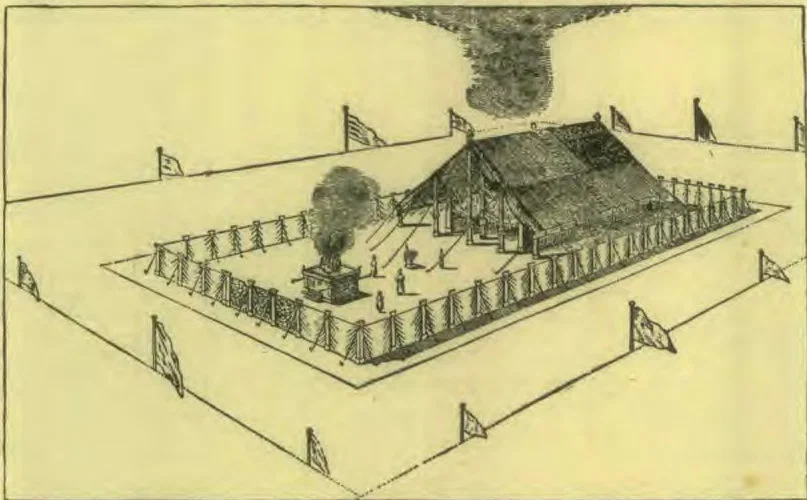
Diagram of the sanctuary and its tent, the court, and the standards of the tribes, whose tents were pitched around the tabernacle. The four larger, central standards represent those of Judah, Rochon, Ephraim and Dan. See Numbers 2. In front of the tabernacle note the altar of burnt-offering where the sacrifices were slain, and the lever where the priests washed.
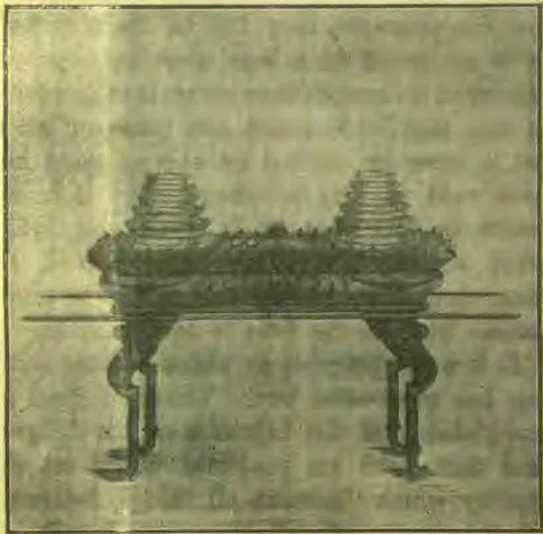
Altar of incense, the incense representing God's effectual grace, making acceptable the prayers of imperfect mortals. Rev. 8: 3.
Our Bible Band.
IN order to bring our readings to the even week we give eleven days' reading for the first instalment, after this giving the scriptures for the even week following.
Two historical chapters are given for each week day, four for each Sabbath, and a psalm for more purely devotional reading every day.
The first five divisions of the Bible are called the Pentateuch, a Greek word meaning five volumes. They are also called "the books of Moses," and "the Law," because it is believed that Moses wrote or compiled them. They were written in Hebrew, and are also found in the ancient Greek (Septuagint), Samaritan, Syriac, and Latin versions.
Genesis, the name of the first book of the Bible, is so-called from its first words "In the beginning." It presents before us the story of Creation, the fitting of the earth for man's home, the Fall, the promise of the Seed, the Deluge, the repeopling of the world, and God's providential dealing with His children for more than 2,500 years.
It is not a book of law, tho it can clearly be seen that God's law was in force. It is not a gospel message, tho it shines with Gospel promises and prophecies which God made to His chosen. It is (1) a history of the beginning of things; and (2) a story of God's dealing with the Seed, and the attempts of the enemy to thwart God's plan. It is important to keep these thoughts in mind, not only as we read this book, but in reading all subsequent books; for the great facts of Creation, the Fall, the Seed, the Deluge, run all thru the Bible, and if disregarded the rest of the Bible becomes a tangled mass of sinful humanity, precept, and promise.
From Gen. 1: 1 to 2: 3 we have a general account of creation, the fitting of the earth for man's home, the creation of man upon it, and the institution of the week and the Sabbath. In chapter 2 we have a more particular account of the creation of the first pair, the institution of marriage, the Eden home. These accounts are different, but not contradictory.
Then follow the Fall, the promise of the Seed, Satan's efforts to destroy the seed (in Abel), to corrupt (as with the mingling of the seed of godly men with women of the world); the destruction of the nation of the Seed (as in Egypt). Chapters 6 to 9 give an account of the Deluge; 10 and 11 the scattering of the people and the descendants of Noah; 12 to 26, God's providential dealings with the family of Abraham, the chosen progenitor of the Seed.
The psalms to be read will sing for themselves of every phase of human experience and of God's goodness, love, power, and watchcare.
If any of our Bible-Band members have no objection we shall sign to each of the questions they may ask, their card numbers.
Now that we start with the year let us persevere to the end; let none fall out by the way. May God bless to each one the reading of His word.
Enlist in God’s Service
There is no time better than just now to enlist in the service of God. He is waiting to receive you.
Greater Reformation to Come.
Our fathers did in their due time acknowledge there were many defects and imperfections in our way, and yet we believe they did as much as could be expected from learned and godly men in their circumstances, and we, their successors, are far short of them in many respects. . . . And yet in the multitude of our thoughts and fears the consolations of God refresh our souls, that all those that in simplicity and godly sincerity do serve the Lord and His people in their generation (tho they should miss it in some things), they shall deliver their own souls, they are accepted of the Lord, and their reward is with Him; and in the APPROACHING DAYS OF A BETTER REFORMATION, the sincere, the weak, endeavors of the servants of God who went before them, will be also accepted of the saints in those times of greater light and holiness that are to come.
—Mather in his Magnalia, Vol. 1.
1907–1908.
1907.
WHEN this article reaches the eyes of our readers the last few sands of 1907 will be swiftly running out, and the year will be gone forever. Yet not wholly so. The year will forever live with many in the seeds they have sown, in the habits they have formed, in the purposes wrought into their lives. Its golden moments are gone, never to return; yet Memory will recall them again and again. We will mourn again its sorrows and weep by its buried dead. We will regret its mistakes and bemoan its failures. We shall long for a continuance of its blessings and joys, and rejoice over its triumphs.
To many indeed who stood upon the threshold of the opening year twelve months ago, endeavoring to pierce the clouds which veiled its unfolding portals and read its yet hidden secrets, the year has not been a happy one. They saw in their dreams many bright visions of glory. They painted on the clouds in rainbow hues magnificent palaces, filled with rare and costly creations of ingenious mind and deft hand, of factory and mill and loom; they wove into the misty haze which overhung the open portals bright visions of prosperity and great wealth and happiness. All this and more they saw in the changing, hazy twilight of the New Year's morning.
But their bright dreams changed to dark and impenetrable clouds which the eye could not pierce. The visions of glory fell in tears of sorrow. The stately palaces of hoped-for repose and enjoyment crumbled to ashes, or revealed in their cold and cheerless rooms the ghastly skeletons of unhappiness and misery. Many homes have lost sunshine by the vacant chair. Sickness and death have blasted high hopes, removed loved ones, and written deep lines of care and sorrow on the faces of those left behind. The year 1907 will to them never bring pleasant memories.
To others the year has been beautiful. New associations have brought happiness. Prosperity in business has brought joy to him who seeks the gold that perishes. Well has it been for him if the sordid gold has not hardened his heart against the miseries and wants of others to whom each day of the year brought barely sufficient means to maintain existence. Others have found in other spheres the growing fame and applause for which their hearts have hungered. The world's many-sided picture presents sad contrasts of poverty and riches, of age and youth, of misery and happiness, of sorrow and joy. It is an earth-year—filled with its mighty burdens of human wo.
Among the nations it has been a year of perplexity, developing in its closing month into an almost financial panic, the suffering from which will be felt by the poor. Greed still feeds fat at the public cribs, while honesty and frugality barely exist. Disintegration of government still goes on. Europe slumbers on a volcano of war, which may break out at any time. Famine in China and Russia has left millions pinched and pale. Earthquakes have destroyed millions in property and thousands of lives; and thousands more have perished in famine and flood, in war and pestilence.
The wave of "liberalism" in religion has rolled on in ever-increasing volume, undermining the faith of many and sweeping them out into the great sea of doubt or infidelity. As the churches have lost faith in God, they have sought the power of civil authority to enforce religious dogmas, and, more and more, as in the fourth century, the governments are yielding to ecclesiastical influence. The end will be the persecution of man for conscience' sake and the ruin of both church and state. Even so has the more sure word of prophecy predicted, and this paper has proclaimed the warning message for more than thirty years.
1908.
with its fair and white pages, lies before. The old world will go on much the same. It is the lesson of all history that no people or nation ever reformed itself from sources of power within itself. Thruout the world, there are many portions of the church seeking reform; but they will never find it where they are seeking it; and the tide of evil will roll on, as God has declared, to the night of despair and utter darkness.
Yet the year 1908 has within its unrolling days happiness for every soul. That happiness will come in seeking God's glory and others' good. There is no other way. Seeking happiness for ourselves, we shall never find it. The selfishness in the seeking will corrupt all we grasp and poison the cup of pleasure we press to our lips. But forgetting self in seeking others' good, finding and doing duty to God, our hearts will enlarge, and every blessing we bestow upon others will bring greater gladness to our own lives. Such happiness as this—the only true happiness—we wish our readers in the year 1908.
IN the study in Romans last week it was seen from the words of the apostle that the “judgment of God” is “righteous,” and, furthermore, when His final judgment decision is rendered mankind will concur in the rightfulness of it; and this regardless of whether the man is a lost sinner or one of the redeemed in glory. And in that judgment the righteous God “will render to every man according to his works.” Following the verses that formed the basis of study last week, the apostle proceeds to show what will be the reward of those who do well. And in order to get the connection, it will be well to quote again a few of the verses that were presented a week ago, together with the verses that contain the promises to those who stand for the right.
“And reckonest thou this, O man, who judgest them that practise such things, and doest the same, that thou shalt escape the judgment of God? Or despisest thou the riches of His goodness and forbearance and long-suffering, not knowing that the goodness of God leadeth thee to repentance? but after thy hardness and impenitent heart treasurest up for thyself wrath in the day of wrath and revelation of the righteous judgment of God; who will render to every man according to his works: to them that by patience in well-doing seek for glory and honor and incorruption, eternal life: but unto them that are factious, and obey not the truth, but obey unrighteousness, shall be wrath and indignation, tribulation and anguish, upon every soul of man that worketh evil, of the Jew first, and also of the Greek; but glory and honor and peace to every man that worketh good, to the Jew first, and also to the Greek: for there is no respect of persons with God.” Rom. 2:3-11, A.R.V.
The Lord “will render to every man according to his works.” When the judgment sentence is passed it will be based on what the man himself has done. It will not be on what some one led him to do, or on what his ancestors may have done, but it will be on what he has done. The Lord has given light to each one, and he is judged according to the use he has made of that light.
“To them that by patience in well-doing seek for glory and honor and incorruption” the reward is “eternal life.” “Eternal life,” then, according to this text, is given as a reward to those who “seek” for it. And since it comes to those who seek for it, in the very nature of things it could not be given to those who do not seek for it; it could not come to those who, as presented in the first chapter of Romans, “refused to have God in their knowledge;” “unto them that are factious, and obey not the truth, but obey unrighteousness, shall be wrath and indignation, tribulation and anguish, upon every soul of man that worketh evil.”
Thus do we see that the clear teaching of this text is that man does not possess eternal life naturally. If he desires to come in possession of the great gift of immortality he must “seek” for it. Another very clear scripture upon this point is the following:
“If we receive the witness of men, the witness of God is greater: for the witness of God is this, that He hath borne witness concerning His Son. He that believeth on the Son of God hath the witness in him: he that believeth not God hath made Him a liar; because he hath not believed in the witness that God hath borne concerning His Son. And the witness is this, that God gave unto us eternal life, and this life is in His Son. He that hath the Son hath life; he that hath not the Son of God hath not life.” 1 John 5:9-12.
“God gave unto us eternal life,” but do not fail to observe that “this life is in His Son.” And, furthermore, “he that hath the Son hath the life.” But “he that hath not the Son of God hath not the life.” Nothing could be made plainer than the words of9this scripture. Life, eternal life, belongs only to those who have the Son of God. And those who do not have the Son of God do not have the life. In harmony with the foregoing is the statement elsewhere made by Paul:
“If then ye were raised together with Christ, seek the things that are above, where Christ is, seated on the right hand of God. Set your mind on the things that are above, not on the things that are upon the earth. For ye died, and your life is hid with Christ in God. When Christ, who is our life, shall be manifested, then shall ye also with Him be manifested in glory.” Col. 3:1-4.
The Christian has life given to him; but that life “is hid with Christ in God.” It is not till Christ is manifested, it is not till Christ is seen coming again in the clouds of heaven at His second advent that the child of God is fully manifested. In this life his connection with Christ fills him with the power of an endless life. This power of the endless life, of the life eternal, is in Christ and therefore is sure. It comes into the life of the individual thru that individual allowing Christ to enter his life. This is the secret of the power that the Christian has to overcome sin. And when he finds this overcoming power acting and working in his life he has an evidence for himself that outweighs all the cavils that carping men can invent to the contrary. He knows that the very powers of eternity have laid hold upon him, else he could not successfully resist the sins that are so natural to his human fleshly life.
Then following this life of the successful overcoming of sin is the glorious climax presented by Paul in his letter to the Corinthians:
“Behold, I tell you a mystery: We all shall not sleep, but we shall all be changed, in a moment, in the twinkling of an eye, at the last trump: for the trumpet shall sound, and the dead shall be raised incorruptible, and we shall be changed. For this corruptible must put on incorruption, and this mortal must put on immortality.” 1 Cor. 15:51-53.
The trumpet sounds and raises the dead, and then the apostle assures us that “this corruptible” shall put on “incorruption;” then it is that “this mortal must put on immortality.”
Thus do the Scriptures unite in teaching that man does not by nature possess an “immortal soul that can not die.” The man must first seek for glory and honor thru patience in well-doing, and in thus seeking he must have in his life the infinite power of the Christ in order to overcome. Then at the end of the journey he receives immortality as the finishing, crowning touch to the work that has been wrought.
Men in all the ages have tried “to solve the problem of immortality.” Men in all times have tried to prove that by nature we are possessed of immortal souls. But none of the theories ever evolved have brought satisfaction to the soul. None of these theories make the individual perfectly happy and content in the assurance of an eternal existence beyond this life. Degenerate mankind would like to be assured that it is in natural possession of immortality, and therefore it can get on without God. But no matter how much men may be taught and assured in such a theory, yet they will always speak of the time after death as the “dark beyond.” The tomb is dark to them; the future is a mystery. But it is not so with the one who knows the Lord in his own experience.
The one who has actually tasted of the real experiences of the Gospel’s saving power knows “our Saviour Christ Jesus, who abolished death, and brought life and immortality to light thru the Gospel.” 2 Tim. 1:10. The “light” of immortality is in the Gospel, as every one knows who has tasted of the real experiences of the Christian. The Christian knows that he will receive immortality from his Lord and Master. There is no doubt about it. He knows it for himself and he knows it for sure.
Reader, are you seeking for the glory and the honor and the incorruption that the apostle tells us will bring the prize of immortality from the hand of the infinite Father?