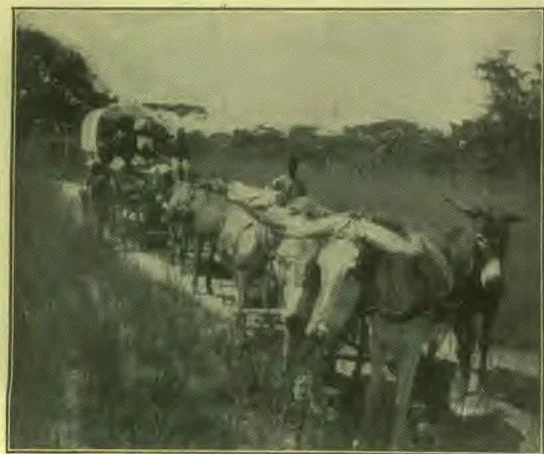
THIS mission is now nearly six years old. Elder F. B. Armitage had been at the old Matabele Mission, now called Solusi Station, four years. He desired to open another mission farther north, so he obtained ten donkeys, and a big emigrant wagon. Then, like Abraham, he took his journey toward a land which the Lord would show him. After eight days of steady travel, partly by day and partly by night, over sand and stones, often with no roads, or but a cow-path, a suitable place was found among kraals of the Shuna tribe. The mission site is 150 miles northeast of Solusi, in the Somabula Forest. Gwelo, on the Beira-Mashonaland Railway, thirty miles away, is the nearest station and post-office. Gwelo resembles one of the frontier towns of the West, set in the open country, and bounded only by space. Its people number about fifty white and two hundred black.
The "forest" mentioned above is so unlike those of the States you would not recognize it as such. The average height of the trees is twenty feet. One scarcely ever reaches thirty feet. Eighteen inches is the maximum diameter, and many of the trees have flat, spreading tops. The soil is sandy, and very little underbrush grows here, so with the trees growing far apart, the forest looks considerably like an orchard when seen from a distance. Most trees here are deciduous, the leaves falling in June. The boards used for seats in the school are sawn by hand from the mletindaba tree. These boards are one foot wide, fourteen feet long, and one inch thick. The wood is hard, very heavy, and resembles walnut somewhat. The impaca is a more common tree, the wood of which is very hard, and is used for repairing wagons and things requiring great strength. The mangwe tree is used for making ox-yokes.
No land is sold here, so Elder Armitage rents as much as he desires to cultivate. The rental is fifty cents an acre a year. This Somabula district is a native reserve, which is the reason land will not be sold. The British South Africa Company governs the vast territory named Rhodesia under charter from the king of England. This company reserves certain regions where minerals are supposed to exist in which mining rights are sold for revenue, besides the native and game reserves.
Much complaint is heard from all classes against government injustice. You will notice on the stamp of this letter the motto, "Justice, Commerce, Freedom." The people of the country would render the motto thus: "Injustice, Extortion in Trade, Bondage." One complaint of the natives is against the poll-tax. Each man and each boy above a certain size must pay five dollars tax yearly. The size of boys is the standard, because neither the boy nor his parents know his age. No record is kept of the time of birth nor of any event whatever. The tax is excessive, being double that in most parts of South Africa. Besides this poll-tax on men, those having more than one wife must pay $2.50 on each one besides the first. So a man having ten wives and ten boys over about twelve years of age must pay $77.50 taxes.
District
## CERTIFICATE OF NATIVE MARRIAGE.
Under Ordinance No. 2, 1901.
No. 84. Date 16th August, 1905.
Name of Husband Warbaga
Kraal Warbaga's
Chief Mpabangi
Name of Wife Malalu
Wife's Father or Guardian Movelepi
Chief Washiya
No. of Wife Fifth
Name of Deputed Headman (if any) Goboba
No. of cattle or other consideration paid Three head of cattle.
Whether wife freely consented to marriage Yes
Signature—
Native Commissioner or Marriage Officer.
Few men here are able to afford more than five wives, and the average is probably three. Girls are practically auctioned off to the highest bidder. When a girl arrives at a marriageable age,—which is very young, only fourteen or fifteen, and often younger,—a man who wants her goes to her father and offers what he can afford, called lobolo. It may be three cows, worth $25 each. The father puts him off. Soon another suitor comes with an offer of four cows, and the girl becomes his property. Usually the girl is agreeable to the arrangement, but if not, the father's will rules. It is the ruling desire among native girls to marry at the earliest possible age. Many native young men find it quite a hardship to get means for even one wife. A man can earn only $3.50 to $5.00 and food a month for his work. A young man must pay his taxes, clothe himself, buy wedding-clothes for his bride (in case they wear clothes), build a house, buy pots, etc., besides paying lobolo. One maiden at this mission objects to being sold. Her intended has a house built and all is ready for the marriage when some relative
of the girl informs them that lobolo must be paid. I am told the government has a law requiring its payment. So the couple are waiting.
The writer knows the chief named herein and saw the original legal certificate of which the above is an exact copy. But the natives seldom report marriages until discovered by infrequent visits of the police, thus avoiding the wife's tax.
Marriage customs in this country tend toward degeneracy of the race. As a rule, agreement of the parties is the only ceremony required, civil or moral. It is thought by some writers that since tribal wars and the slave trade have been stopped by European influence, there will be a great increase in population. While this may be the case, with the increase of population comes an increase of physical and moral weakness. Morality is at a low ebb and chastity almost unknown.
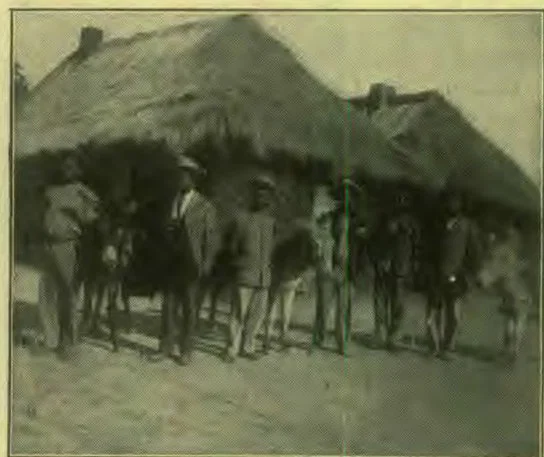
In the Somabula (Rhodesia) Mission, there are seven or eight young men who are to go out as teachers. I want to tell you the conditions under which they must work. The native kraals where they start schools are altogether heathen. Nearly all the people are unclothed. They know almost nothing of God and His salvation. They do not even know enough about education to understand the value of a school. I was greatly surprised to learn that these teachers sent out from our mission must provide their own food, buy school supplies, and teach for nothing. They receive no pay whatever from the natives. They even put up their own schoolhouses. Fortunately, this is not a very difficult or expensive affair, as it is a building of poles. It is made of "mud and wattle," with a thatch roof and no floor. So you see that our native teachers have very little to encourage them. They are paid a small wage by our mission, which is just enough to supply them with clothing; their food is also furnished by the mission, the teachers themselves being obliged to grind this grain for their own use while out teaching. I am told that the natives in some places provide the food for the teachers. You see, we must first teach these native people the value of learning to read the13Bible. They can not appreciate what learning will do for them. It is our plan to train a few young men in the common branches and the Bible, and send them out to teach their own people. These teachers are taught to read English, so they may read our books, and thus be learning more and more of the truth.
Yet out of these unpromising conditions some bright, beautiful characters are formed. The transformation seen in some boys and girls is marvelous. Within a mile of this mission are many kraals where unclothed natives live in all the degradation of heathenism. Beer drinks, with drunken quarrels, are periodical. Killing of infants is a common practise. But from these same kraals boys and girls are now in the mission, clothed plainly but cleanly. They read and speak English, in which they are rapidly improving. And best of all, they are converted members of the church. Some have already held successful schools in the native kraals, and after further training they are to be sent out as evangelists. Native young men conduct regular services here at the mission and preach creditably in their language. This is our hope of quickly carrying the message to Africa—to train native evangelists in our mission schools. But carrying this everlasting Gospel to the heathen world is a mighty problem to be solved. It will exhaust all our resources, and happy we are in having the resources of the Infinite at our demand. Shall we bend to the task, and put our all into accomplishing our God-given commission?
Cholo, B. C. A., July 15, 1907.
On the Move in Rhodesia, Africa. Pastor Armitage Driving.
Mission Houses. Teachers Starting to Their Village Schools with Mules Laden with Supplies.
Christ Our Advocate
A clear, [the] brief setting forth of the Bible types and symbols, the services in connection with
## CHRIST OUR ADVOCATE
the earthly sanctuary, the effectual sacrifice and priesthood of our Lord, to which all these types pointed, and the great prophetic period of Dan. 8:14.
Contains 112 pages and is illustrated. Price ten cents.
PACIFIC PRESS
Mountain View, Cal.
Drunkenness and Crime
Drunkenness and Crime.—What are the reasons for such an alarming increase in the nation's drink bill? 'The relation of crime to intemperance is well understood by men who have to deal with those who transgress the laws of the land. In the words of a Philadelphia judge, 'Rum and blood, I mean the shedding of blood, go hand in hand.''
'A district attorney in the city of Boston is reported as declaring that 'Ninety-nine out of every hundred of the crimes in our commonwealth are produced by intoxicating liquors.''
'Let those in positions of public trust take heed lest thru wine and strong drink they forget the law, and pervert judgment.'
'Wo unto him that buildeth his house by unrighteousness, and his chambers by wrong.' 'Behind the liquor-dealer stands the mighty destroyer of souls.'
'Often he is forbidden to sell intoxicants to one who is drunk, or who is known to be a confirmed drunkard; but the work of making drunkards of the youth goes steadily forward. Upon the creating of the liquor appetite in the youth the very life of the traffic depends.'
'Should not the liquor-saloons that have wrought so much evil, be entirely abolished?'
'Let the voices of the nation demand of its lawmakers that a stop be put to this infamous traffic.'
These startling sentences have been selected from a new sixteen-page tract just received from the press. They call attention in a marked way to the evils of the liquor traffic; and the responsibility for the continuance of this awful crime-producing agency is clearly indicated.
We believe that our readers will be well repaid for a careful perusal of this tract. And you have friends who should receive the light contained in its truth-filled pages. Bible Students' Library, No. 196, price only $1.00 per 100.
Order from the Pacific Press Publishing Co., Mountain View, Cal.; 285 Salmon St., Portland, Ore.; 1109 E. 12th St., Kansas City, Mo.; or from your local tract society.
Colds
By Editor
Colds.—By G. H. Heald, M.D. A treatise on the causes, prevention, and cure of colds. White leatherette binding. 58 pages, 25c.
Address this office.
The Model Husband
By Mrs. L. D. Avery-Stuttle
By Mrs. L. D. Avery-Stuttle
O WHERE are the husbands, as good as gold,
Who will carry the baby and never scold?
Who find no fault with the food they eat,
Whether the sauce is too sour or sweet,
And who never yet were known to say
Their mother cooked in a different way?
O where are the husbands, as good as gold,
Be they rich or poor, be they young or old,
Who never forget the vow they took,
Nor count the change in the pocket-book
In selfish fear lest a single cent
By the brave little, good little wife be spent?
O where are the husbands, as good as gold,
Who smile all day, and who never scold,
Whose own dear girls are their pride and joy,
And who play ''all fours'' with the baby boy?
Who keep a bridle on lip and tongue,
And never forget that they were young?
O where are these husbands—tell me where,
Whose lives are pure as the morning air?
Whose eyes are bright as the twinkling star,
And whose breath smells not of the foul cigar;
Who join the boys in their childish mirth
And who think their wives are the best on earth?
There is plenty of room for men like this,
Who know the joy of a loving kiss;
Who do not wait till the heart's at rest
To tell the love that was never guessed.
I care not a whit, be they young or old,—
God bless these men, they are good as gold.
The Building of a Home
By Mrs. L. D. Avery-Stuttle
By Mrs. L. D. Avery-Stuttle
The Part of the Husband.
HAVING laid the foundations of a happy and true marriage, perhaps it will do to venture further, and name at least some of the more prominent duties of the husband.
It is quite obvious that no man should assume the duties and responsibilities of married life until he is old enough not only to comprehend what these responsibilities mean, but to be able, physically, mentally, and spiritually, to accept them.
It seems to have been the Creator's plan from the beginning that man should go before and ahead of woman in the matter of aggressiveness,—for Adam was first formed, then Eve.
From time immemorial, custom has assigned him the right of first choice in the business of securing a life partner. But having done this, upon him must fall at least the greater share of the responsibility of supporting his household. Indeed, this could not justly fall to the lot of the woman, who is generally fully occupied with the thousand and one duties and cares of the home, and the necessary training of the little ones.
Then, the part of the husband is, first, to provide liberally for his household. But this can not be done, under ordinary circumstances, unless every selfish and expensive habit be entirely abandoned; and so this implies a clean life. It implies a closed purse to the tobacconist and liquor dealer and an open purse to the miller and the grocer. It implies a strict attention to business, and little knowledge of the ball game, the horse-race, the vaudeville, or the theater.
"But," says some young benedict whose conscience is already at work, "you don't expect a man to give up all the little pleasures of life, do you, just because he is married?"
Indeed I would have you dispense with all those so-called "pleasures" of life which may not be shared and enjoyed by wife and children.
"But Mary doesn't care for the theater, and,—well, a man must have some recreation. She doesn't care for the ball games nor the races either,—she can't take the children, so she says," you add, with an injured air.
Yes, and if you were one-half as loyal as she, you would invent some form of recreation in which she could participate, and the children, too, instead of selfishly going away alone, or in questionable company.
A few years ago you thought yourself very happy in her society. In fact, you seemed not to care very much for any other. Strange, isn't it?—Yes, it is strange indeed that some men seem so soon to tire of those very joys which so lately appeared to make up the sum total of their happiness.
But let us be devoutly thankful that this state of things is by no means universal. Some men are so constituted that a quiet evening at home after the rush and worry of the day is very grateful. Some men can find more music in the soft and gentle tones of wife or daughter at the piano, or singing a lullaby to the baby, or reading some interesting volume, while they stretch their weary limbs on the sofa, after a hard day's work, than in the noisy shouts of the ball game or in the clamorous encores of the theater.
Some husbands there are, who, tho the years have left their mark on brow and form, have still the same tender, loving hearts as when they wooed and won the simple maiden who has only grown dearer as the years have passed by,—there are a few left, God bless them!
"But," you say, "I think these women are queer creatures; awfully unreasonable, you see. Now, there's my Mollie,—sensible about most things, but she acts as if she expected me to play the lover, same as I used to. Why, she puts her lips up for a kiss every morning when I leave the house. Now this seems extremely childish and downright silly to me. As long as a woman is well provided for, that ought to be enough; and just because I ventured to say so in plain words, that foolish woman actually turned away with tears in her eyes; and I found out afterward that she cried about it all day. Now I don't know why, but that only just made me sort of angry."
I dare say. Tears affect some men that way—after marriage! But, my friend, you have seen the day, and not so very long ago, either, when those very tears would have gratified your vanity more than they anger you now. You would have read their true meaning. You would have seen love in those tears,—love tender, pure, sincere.
O how blind you are! "Blind?"—Yes, sir; selfishness has made you so blind that it will require a greater miracle of divine grace to restore your sight than it did to heal blind Bartimeus. Ah, providing for the daily physical needs of your wife is not all,—this does not comprise your whole duty. Your wife has a soul as well as a body. She has spiritual needs. She has a tender and loving nature that must starve and die unless it receives nourishment,—and there is no other such pathetic and pitiable sight as a dead soul in a living body,—a woman whose tender and loving nature has been killed, murdered by him who has sworn to love, to cherish, and to protect.
O, if there is on earth a man to be shunned and dreaded, it is he who doles out his love and his kindly words and his tender smiles as grudgingly as a miser does his gold!
I tell you I know many a woman who would much prefer a loving kiss from her husband to a new dress or a pair of gloves. O, this old world would be a brighter place if all the men who have taken upon themselves the marriage vow would read and forever heed the Scriptural injunction: "Husbands, love your wives, and be not bitter against them."
Do It Now.
DO NOT keep the alabaster boxes of your love and tenderness sealed up until your friends are dead. Fill their lives with sweetness. Speak approving, cheering words while their ears can hear them, and while their hearts can be thrilled and made happier by them; the kind things you mean to say when they are gone, say before they go. The flowers you mean to send for their coffin, send to brighten and sweeten their homes before they leave them.
If my friends have alabaster boxes laid away, full of fragrant perfumes of sympathy and affection, which they intend to break over my dead body, I would rather they would bring them out in my weary and troubled hours, and open them, that I may be15refreshed and cheered by them while I need them. I would rather have a plain coffin without a flower, a funeral without a eulogy, than a life without the sweetness of love and sympathy.
Let us learn to anoint our friends beforehand for their burial. Post-mortem kindness does not cheer the troubled spirit. Flowers on the coffin cast no fragrance backward over life's weary way.—Boyce.
The Samoan Volcano.
By J. E. Fulton
While making a missionary tour of the South Pacific, I was privileged to behold the active volcano on Savaii, an island of the Samoan group. Before obtaining a near-by view, we were at anchor at Apia, some thirty miles distant from the crater, but even so far away the heavens were lighted up at night with a singular hue by the burning mountain. It was nearest like a red sunset. But on the last night spent in the group, our steamer passed close by the island where the burning mountain is, giving us a good view of the volcano. The scene was awful, weird, and picturesque. The mountain under description is ten miles inland from the sea, yet the burning lava rushes all those miles a raging river till it reaches the mighty billows of the sea. It is like the meeting of two mighty foes. Altho the molten mass belched from the distant mountain had come so far, it was still red hot, and our steamer passing near shore, we could see it madly rushing to meet the mighty billows of the deep, into which it plunged, hissing and boiling, causing the vapor and smoke to arise in a mighty column till lost in the clouds above. Never have I seen anything like it, and to me it was a picture of the great day which shall "burn as an oven." As we rounded the island the wind wafted to us a strong sulfurous smell. I thought of the text which says, "The streams thereof shall be turned into pitch, and the dust thereof into brimstone, and the land thereof shall become burning pitch." Isa. 34:9.
As we passed along in the steamer, the distant lava flowing into the sea gave the appearance of a burning city, and as the volcano has been active for nearly two years, the smoke seems to be ascending "forever and ever," and the fire to "never be quenched." It was awful in the extreme. A bright gleam shone on the dark waters and came against our ship. Shafts of fiery red pierced the darkness of the night and flung their radiance o'er both land and sea. To me the effect was strangely solemnizing. Long into the night the awful glare of the unearthly light could be seen on the eastern horizon as our ship was on her westward course.
It all speaks of an eternal strength, and in no uncertain tone tells of the mighty arsenal from which God will some day draw forth His weapons of wrath with which to punish a disobedient and ungodly world. What a terrible day that will be! The terror of that day will be multiplied ten thousand times ten thousand over the scene I describe, which after all was but a faint picture of that awful day.
As we neared the island, a passing storm arose and for a few moments obscured our view. Upon the mountain-top near the crater, the shafts of lightning played and the thunder crashed, revealing another weapon in His hand. The scene mingled with an occasional view of the volcano was one of exceptional grandeur. This was just before sunset. And as for a few minutes the rain descended, a rainbow appeared as a reminder of the covenant-keeping God. It spoke of the "world that then was" which was overthrown by a flood, but which would not again take place, while this engulfing lava which had destroyed a village seemed to say in awful tones "the heavens and the earth which are now" will be overthrown in a mighty lake of fire.
J. E. FULTON.
A GREAT WINTER RESORT.
Do you know that Colorado, and especially the valley in which is situated the Boulder-Colorado Sanitarium, is a most delightful winter climate, equal in every respect to that of California or the sunny South?
The Boulder-Colorado Sanitarium is a well-equipped medical institution, employing the very best and most approved methods of treatment.
The medical staff comprises four physicians — two men and two women — graduates of leading medical schools, together with a large corps of nurses of both sexes.
No tubercular or consumptive patients received. Special reduced rates are afforded during the winter months. Write to-day for large illustrated catalog, with card of rates. Address, Boulder-Colorado Sanitarium, Boulder, Colorado.
Wanted
Wanted.—A man who wants a good home, with small pay, to assist in milking cows, etc. Swedish or Danish bachelor preferred, as we have several of that class as company. Address Garden City Sanitarium, San Jose, Cal.
DATE OF EXPIRATION.
The SIGNS wrapper bears date of last issue due on your subscription. Unless renewed in advance, paper stops with expiration date.
If herewith is an order-blank, you will know you have overlooked sending renewal. You will not wish to miss a single issue. Back numbers often can not be furnished.
Story of Pitcairn Island
“Story of Pitcairn Island.”—By Rosalind Amelia Young, a native daughter. Pitcairn Island, one of the volcanic gems of the Pacific, has been heard of wherever the English language has been spoken.
The story of the working out of the problem of human life on its limited territory reads stranger and more thrilling in many respects than a romance.
But most, if not all, of the tales told and the books printed have been too fragmentary, or incorrect and misleading.
It will be interesting to the friends of that miniature world to know that an authentic history has been written, and that by a native of the island, one to the manor born.
Miss Rosa Young is one of the direct descendants of the mutineers of the Bounty.
The book is a plain, unvarnished tale of Pitcairn and its inhabitants from its settlement to the year 1894.
It is written with charming simplicity of style, which refreshes the reader and invites continued perusal.
Illustrated with 26 engravings. Fourth edition, with appendix.
Cloth, $1.00.
Address this office.
Revised Daniel and Revelation
By Uriah Smith
Daniel and the Revelation.—Revised edition.
By U. Smith. A history of the rise and fall of nations, being an exposition, verse by verse, of the important prophecies of Daniel and John, comparing Scripture predictions with historical facts. It follows in the track of no other commentary; but, guided by the obvious rule that the Bible should be its own interpreter, it aims to arrive at the exact meaning of the sacred writers in harmony with the great plan of redemption as presented throught the Scriptures. The author has devoted over thirty years to the study of the Bible, and believes that the prophecies of Daniel and John were written for our admonition, and that the subjects they unfold are the coming themes for the religious world, destined to engage the attention of all thoughtful minds. 754 pages, with illustrations, beautifully bound. Cloth, marbled edges, $2.50.
Address this office.
BOOKS FOR EVERYBODY.
Abiding Spirit, By Mrs. Henry, cloth ......$0.40
Best Stories from the Best Book, board ...... .50
Bible Nature Studies, By M. E. Cady, cloth .. 1.00
Bible Object Lessons for Kindergarten, cloth . 2.00
Bible Readings for the Home Circle, plain, .. 1.00
Bible Text Book, cloth, 30 cents; leather ...... .50
Chinese Shorthand .............................. .50
Christian Patriotism, cloth .................... .50
Christ Our Saviour, board, 50; cloth ........... .75
Colds, Cause and Cure .......................... .25
Coming King, the, cloth, plain ................. 1.00
Daniel and the Revelation, cloth, plain ........ 1.00
Desire of Ages, small type, cloth .............. 1.50
Early Writings of Mrs. E. G. White, cloth .... .75
Education, By Mrs. E. G. White, cloth .......... 1.25
Empires of the Bible, By A. T. Jones ........... 1.50
Empires of Prophecy, By A. T. Jones ............ 2.00
Fathers of the Catholic Church ................. 1.00
Friend in the Kitchen, cook book, cloth ........ .25
Good Form and Etiquette, paper ................. .25
Gospel in Creation, board ...................... .25
Great Second Advent Movement ................... 1.50
Gospel Primer, board, 35; cloth ................ .60
Helps to Bible Study, paper, 25; cloth, ........ .50
Heralds of the Morning ......................... 2.00
Here and Hereafter, Cloth ...................... 1.00
His Glorious Appearing, board, 25; cloth ....... .50
History of the Sabbath, cloth .................. 1.00
House We Live In, cloth ........................ 1.00
How a Little Girl Went to Africa ............... 1.00
Home and Health, cloth ......................... 3.00
New Testament Primer, board, 35; cloth ......... 1.00
Our Paradise Home, board, 25; cloth ............ .50
Left with a Trust, cloth ...................... .50
Looking unto Jesus, paper ...................... .25
Making Home Happy, cloth ...................... .50
The Marvel of Nations, cloth .................. 1.25
Making Home Peaceful, cloth ................... .75
Our Little Folks' Bible Nature, cloth ......... .50
Place of the Bible in Education, paper ........ .25
Power for Witnessing, cloth ................... .75
Prophetic Lights, cloth ....................... 1.00
Steps to Christ, paper, 25; cloth ............. .50
Story of Daniel the Prophet ................... 1.00
Story of the Seer of Patmos ................... 1.00
Story of Joseph, board, 25; cloth ............. .40
Testimonies for the Church, Vols. 7 and 8, each .75
Thoughts from the Mount of Blessing, cloth .. .60
The Vegetarian Cook Book, cloth ............... .75
Uncle Ben's Cobblestones, board ............... 1.00
Webster's Pocket Dictionary, cloth ............ .25
Address your state tract society, or
PACIFIC PRESS PUBLISHING CO.
Mountain View - - - California
Next Week—The Religious Situation
Next Week—The Religious Situation
The Name of the Church.
A LITTLE tract comes to us the writer of which is greatly troubled because some one does not agree with him as to the name of a religious body; therefore it condemns the name Seventh-day Adventist and tells us that the only name whatsoever that is at all legitimate is the Church of God. The term church of God, in the singular and plural, occurs something like ten times in the New Testament. The word church or churches occurs a great many times, half a hundred or more. We read of the church of the first-born, the church of Ephesus, of Smyrna, of Pergamos, churches of the Gentiles, churches of Christ, churches of Asia, and simply the church. We do not know that there is a single place in the New Testament where it can be regarded as a name of God's people. God's people are referred to as to their character rather than as belonging to any particular organization.
If the Greek word had been properly translated from the very beginning we would not have the discussion now on the part of some who pride themselves upon what they call the Scriptural name. The word "church" is from the Greek word ekklesia, which means "the called-out ones," those legitimately called out. Therefore His children are called the church of God and the churches of God simply and solely because they are those whom God has called out, just as it is said to be the churches of Macedonia because they were the ones who were called out who lived in Macedonia. The term is used to designate who it is that are called out, but is not designed as a title.
If there is any name which should cling to God's children at all, it is the name indicative of their faith and power, and that is Israel. Israel existed from the beginning. The true Israel of God continues to the end, and it will be the Israel of God who will enter the holy city at last.
To condemn a denomination because they call themselves by some other name, and to arrogate to one's self greater superiority and piety because he belongs to a body self-designated the Church of God is ridiculous on the face of it. There are three or four organizations of that kind in America at the present time. One of them lives largely on negatives; its chief capital stock is opposing the body out of which many of its members came. Another is a follower of one whose chief distinction was that he led men after himself. Another, a sect sometimes called Winebrennerians. The main thing above all to be troubled about is not as to what mere religious name we may be called, but are we honoring God and doing His will?
THE longest prophetic period in the Bible is the 2300 days of Dan. 8:14. It is but little understood, and yet there is none more important. Our next Bible-reading will be a study with special diagram of that great period: “Unto two thousand and three hundred days; then shall the sanctuary be cleansed.”
We have learned the meaning of the sanctuary on high where Christ ministers. We have learned that its cleansing—a work of judgment—comes in the very close of Christ’s work. In our next we will learn the beginning of that great antitypical day of atonement.
Office Policies and Bible Version
We send no papers from this office to individuals without pay in advance. When persons receive copies without ordering them, they are sent by other parties, and we can give no information in regard to them. Persons thus receiving copies of the SIGNS are not indebted to the office, and will not be called upon to pay for them. Please read the papers you may receive, and hand them to your friends to read.
Our authority is the Bible, the Holy Scriptures of the Old and New Testaments. When the Common ("King James" or "Authorized") Version, or the American Standard Revised Version is used, quotations will not be designated in reference. Any Bible quotation in this paper, therefore, differing from the Common Version, unless otherwise indicated, will be almost invariably from the American Standard edition of the Revised Bible, copyright 1901, by Thomas Nelson & Sons.
Dynamite Explosion at Palermo
A score of persons were killed and about 100 wounded in an explosion of dynamite at the military powder magazine at Palermo, Italy, on December 19.
The Gospel Message in 1908
In the year 1908, the SIGNS OF THE TIMES will tell to the world more of the blessed truth of the everlasting Gospel than in any year of its existence. Its message is truth for this time,—God's truth for this time.
Christ Our Advocate
By Editor
We appeal to the students of our Bible-reading department to invest ten cents in “Christ Our Advocate,” advertised in another column, and study the subject of Christ’s priesthood further.
The God of Now
"The Signs of the Times" believes in the <span style="font-variant: small-caps;">NOW</span>; in the God of the <span style="font-variant: small-caps;">NOW</span>, the great <span style="font-variant: small-caps;">I AM</span> of the Scriptures, whose name is a blessed note in blank to be filled in by every believer in His everlasting promises according to his need; and that note will always be honored at the Bank of Heaven, if lawfully presented.
A Message for Every Age
The God of the Bible is the ever-present God. In every age He had a message for that age. He was the ever-present One then. He is still. To the antediluvian world He sent His message. It was rejected and believed, proving a savor of death and of life. The same sun which ripens the wheat ripens also the tares. He had a message for the Pharaoh of the oppression and for the oppressed. Again the message meant death and life; death to the rejecter, life to the receiver. He had a message for the people to prepare the way for the first advent of Jesus, and He sent it by John the Baptizer. Again its rejection meant death, its acceptance meant life.