FOR three weeks we have had before us the study of the first chapter of Daniel. What is its lesson to us? for in behalf of us it is written. "For whatsoever things were written aforetime were written for our learning, that thru patience and comfort of the Scriptures we might have hope." Rom. 15:4. The facts of the lesson were lived in the days of Daniel; they were recorded for the benefit of those who should come after; for those who live in "the time of the end." Dan. 2:28, 29; 12:4, 9, 10.
But what is the lesson? It was not written as a mere matter of history to satisfy the curious regarding Daniel's early life; of the early life of the great Elijah we know nothing. It is not recorded for the mere temperance lesson and a record of a noble purpose. These are instructive. They are, in fact, about all the instruction which the chapter has yet furnished, and the lesson in this respect is precious.
But the lesson is larger than these. It is, the contrast between the results of two great systems of education. The one system,—the worldly, the Babylonian,—showing at its best in the very height of Babylon's prosperity, with the learning, the opulence, the resources of a mighty empire at its back; the other, God's plan of education,—a life rather than a system,—manifested in seemingly one of the most discouraging times of earth's history. The people who had upheld that system were apostate and in captivity to an imperious, haughty nation; the system (if so we may call it) was handicapped by its perversions in backslidden Israel, and hindered by the limitations and barriers of apostate, rebellious, and ubiquitously idolatrous Babylon. The Babylonian education was manifested under the best conditions. The Biblical education was manifested in what to all human judgment were as low and mean conditions as would be possible in order that it exist at all.
But behold the results: Four youth, whose early years were spent in war-ravaged and famine-stricken and utterly-defeated Judah, surrounded on every hand by corruption and forbidden idolatry, yet doubtless having godly mothers and hearing the prophet Jeremiah, are placed in competition, so to speak, with the brightest and best young men from Babylon and surrounding countries. The Babylonian youths, many in number, were fed at the king's table, cared for by the king's most trusted servants. The young Hebrews lived in a strange land, were environed by the most untoward circumstances, cared for themselves, subsisted on a simple vegetarian fare of pulse and water ("starvation diet," it would be called by many), yet they surpassed all other students in knowledge and learning, and excelled all the king's counselors in wisdom and understanding. Is there not in this a lesson for the present?
Education To-day.
For what is the worldly educational system of to-day but Babylonian in principle? Let us note some of its most striking defects, recognized by many of the world's best and most earnest educators.
1. It is a one-sided education, in that it aims largely to develop the mental at the expense (not purposely or objectively) of the physical and spiritual. The "cramming" process is in vogue everywhere. Said Mr. Edward Bok, editor of the Ladies' Home Journal, after careful investigation:
"Do American men and women realize that in five cities of our country alone, there were, during the last school term, over sixteen thousand children between the ages of eight and fourteen taken out of the public schools because their nervous systems were wrecked, and their minds were incapable of going any further in the infernal cramming system which exists to-day in our schools? And these sixteen thousand helpless little wrecks are simply the children we know about. Conservative medical men who have given their lives to the study of children, place the number whose health is shattered by overstudy at more than fifty thousand each year. It is putting the truth mildly to state that of all American institutions, that which deals with the public education of our children is at once the most faulty, the most unintelligent, and the most cruel."—Ladies' Home Journal, January, 1900.
Dr. George H. Martin, of San Francisco, appeared before a joint session committee of the Senate and Assembly Committees on Education, Jan. 23, 1900, and spoke emphatically against the evils of home study. Among other things he said:
"Every physician has many children under his care, and how many times little ones are brought to us who are beginning to have restless nights, are losing their appetites, growing haggard and old in appearance, with loss of energy and ambition. Upon investigation10we find that they go to school at nine in the morning, stay there until 2:30 or 3:00 in the afternoon, have numberless exercises and recitations, go home, and at once go to their books and study a good part of the afternoon, then eat their dinner and have more study at night until bedtime. By that time they are feverish and excited; and when they go to sleep they are muttering over their lessons, showing very plainly the trouble that is on their minds. Is it any wonder that they soon break down and have to be taken from school, when they can not sleep or eat properly, and have no time for play? This is all during the formative period of life, when the child is growing, and should be storing up energy, instead of using up all that it gains, and even more."—S. F. "Examiner," Jan. 24, 1900.
Many others—physicians, teachers, and parents—could be quoted to the same effect.
2. It is, to a great extent, an unwise education from a purely worldly point of view. Of what earthly use, to mention but one item, is the effort to fill a child's mind with the tales of myths? Children labor for years to obtain a knowledge of that which is of no benefit in youth, and which at a later date, if it were ever needed, could be learned in a short time from a cyclopedia or a dictionary. Frequently the myths themselves are greatly perverted in adapting them to the child-mind and in omitting the salaciousness and obscenity of their characters; and even then the little one gets very deformed ideas of what is left. Fiction falls in the same category, perverting the judgment of the child with distorted and false views of life, unfitting him to discriminate between the false and the true, and fitting him to be one of those who make up the army of the worthless or to fall among life's pitiful tragedies.
It is conceded that there are many who think that the study of fiction with other things of use will assist in developing imagination and discriminating judgment on the part of the child, but the conception is false. The same ones would not, in educating their children in art, continually keep before them a mixture or blending of the beautiful and ugly. They would not, in their musical education, continually have sounded into their ears a jargon of concord and discord. Eye and ear in such an education would lose the power to discriminate. Even so the child-mind, with its fertile imagination (which needs no feeder), needs to be educated in absolute truthfulness, as far as its parents or guardians can conceive. Let the standards of judgment, of taste, and of morals, be of the highest. The man who discerns the counterfeit is the one who knows the ring and the features of the genuine.
3. The education of the day is wrong in that it does not develop the individual. As Harold E. Gorst expresses it in the "Nineteenth Century and After:"
Babylonian Vase and Drinking Vessels.
"Thousands of young men and women are turned out every year by our schools and universities upon an exact pattern, like sausages from a Chicago factory. Each is provided with precisely the same stock of knowledge, and consequently the market becomes overcrowded with an enormous number of workers, all trained to perform the same set of functions."
Mr. Gorst speaks truly; and the effects of the education are seen in the multitude of graduates from one school or another who are utter failures. But in God's method of education there will be developed in the individual all the possibilities of his received talents and ability. The boy will not be considered as a fraction of a class, but an individual soul, having before himself alone in this sphere the complex problem of life to solve—not alone for the present, but for eternity. And the educational effort will be, not to pass "courses," not to obtain certain meaningless letters to attach to one's name, but to develop men and women, sons and daughters of the Most High, here and hereafter.
4. The worldly system of education leaves the moral and religious side of the child's nature untrained. We presume that the great majority of the readers of this article believe in a hereafter. This life is temporal. Beyond it lies eternity. Whatever that eternity is to be to us depends on the characters we form here. The majority of those who will read this are doubtless believers in the Bible as containing the revealed will of God, the Guide-book to the better world. And yet the sad fact is that almost no attention is given in present-day education to the training for that life that measures with the life of God; and ignorance of the Bible is well-nigh universal. The child's body is fed and clothed. His mind is crammed with every dish of the mental menu of our wonderful school system; but the spiritual faculties, which equally need and demand instruction, are left to starve and die; and the result is the present conscienceless immorality of commercialism and the wide-spread skepticism of the day.
[This article will conclude next week. It gives some strong recognition of the needs in public education and presents the only true remedy to meet the existing ills.]
The Great Voyage of a Great Battle-ship Fleet
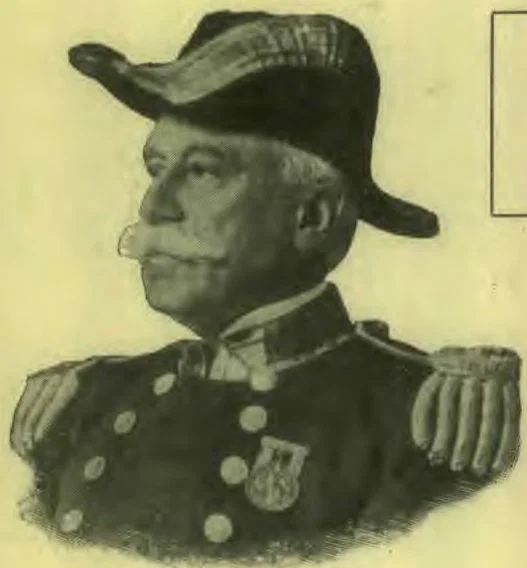
Admiral George Dewey.
D ECEMBER 16 the greatest and most powerful fleet of battle-ships ever assembled under one command left Hampton Roads, Va., on its long cruise to the Pacific Coast. There has been and still is a great deal of speculation in regard to the possible meaning of this maneuver of the battle-ship squadron of the American navy. But the administration affirms that the only purpose is to test the strength of the war-ships and to give the men the needed drill in maneuvering and the general duties incident to the sea voyage.
President Roosevelt has the very strong personal opinion that the only way to keep the peace is to keep the nation in constant readiness for the most vigorous war; this being done, the other nations will be more than likely to let you alone. And in harmony with this view he thinks it necessary to give the officers and men of the navy the great test of bringing the battle-ship squadron to the Pacific Coast, and immediately on arriving here to go into target practise. If the men are able to perform this feat they will be able to show that they could go from the Atlantic to the Pacific to meet an enemy. Any defects in the strength of the ships or in the skill or abilities of the men will thus be brought out and can be corrected. From the statesman's standpoint it would be hard to combat, successfully, the theories of the President.
It was while President Roosevelt was Assistant Secretary of the Navy that he made his demands upon Congress for a large appropriation with which the navy could engage in target practice. And while at the time no one had any intimation that the nation would later go to war with Spain, yet the marksmanship of the naval gunners that was developed under Mr. Roosevelt's leadership made itself very manifest and effective in the two brief engagements with the Spanish navy in Manila Bay and at Santiago. It is probable that the lesson thus learned is what has led the President to disregard the criticisms that so many are making and send the fleet on this long and expensive voyage.
The foregoing are simple facts and suggestions that any one can glean who is following what the papers are saying. But there is another side to this question that should be of interest to every one. Men have claimed that we have reached an era of peace. They have also affirmed that this era of peace is to grow more and more peaceful until there will be no further use for any of the implements of war. The same men have also told us that this is a "Christian nation," and yet we find this same nation sending out one of the most powerful battle-ship fleets that the world has ever seen assembled.
There is another interesting thing in connection with this fleet and that is that all of these ships have been built since the close of the Spanish-American War less than ten years ago. When the war with Spain closed, the United States had but four first-class battle-ships: the Oregon, Indiana, Massachusetts, and Idaho. When war was declared with Spain the Oregon was in San Francisco Bay, and was ordered to proceed at once to the Atlantic Coast to assist in the battle with Admiral Cevera's fleet. The vessel made herself famous by the work she did in passing clear around South America and reaching Santiago in time to do some of the hardest fighting in the battle that destroyed and captured the Spanish ships.
But the last seven years have placed the Oregon, with all her glorious record, where she is only considered worthy to act as a "coast defense" ship. She is too antiquated to go out to battle with her modern sisters that have just left the East on their cruise to the Pacific. The Oregon was in the very front ranks of battle-ships seven years ago, but the furious pace at which the war-gods are driving men have in this brief span of time put her in the museum of antiquity. And altho she is a great ship, and could work awful havoc, yet the ships of recent days are so much more powerful that she is completely outclassed.
FLAG-SHIP OF REAR-ADMIRAL ROBLEY D. EVANS, COMMANDER OF THE FLEET.
The efficiency of these battle-ships that have just started for the Pacific may be judged from the results of a recent target practise of the flag-ship of the squadron, the Connecticut. Steaming at ten knots an hour, she commenced firing at two targets, both of the same size, thirty feet high and fifty feet long, when she was distant four and one-half miles. She kept up her fire for eight minutes, firing at one of the targets for the first part of the time and then turned her guns on the other one. Her last shots were fired at a distance of five and one-half miles. When the targets were examined it was found that in the brief space of the eight minutes she had put thru them four 12-inch, nine 8-inch, and seventeen 7-inch shells. The targets were only about one-eighth the length of a modern battle-ship. This gives an idea of what modern battles will mean.
It is true that men have been talking about the coming peace of the world. But while men have been talking thus the prophecies of the Bible have been telling of what we may expect. They tell of the peace that men will be talking and at the same time they tell us of the great preparation for war that will be going on. The culmination of this war tragedy will be on the most bloody battle-field of which the world has ever dreamed. The like of it has never been seen.
Viewing this time the prophet exclaims:
"My anguish, my anguish! I am pained at my very heart; my heart is disquieted in me; I can not hold my peace; because thou hast heard, O my soul, the sound of the trumpet, the alarm of war. Destruction upon destruction is cried; for the whole land is laid waste." Jer. 4:19, 20.
In harmony with the foregoing striking prophecy the apostle John speaks of his vision of the great war of the "great day" in the following words:
"And I saw coming out of the mouth of the dragon, and out of the mouth of the beast, and out of the mouth of the false prophet, three unclean spirits, as it were frogs: for they are spirits of demons, working signs; which go forth unto the kings of the whole world, to gather them together unto the war11of the great day of God, the Almighty." Rev. 16: 13, 14.
The "great day of God" is to be marked by a most furious war. The elements are preparing for it in the world to-day. Are you a careful student of these prophecies? Are you watching the trend of events in the world and do you know what they signify?
T.
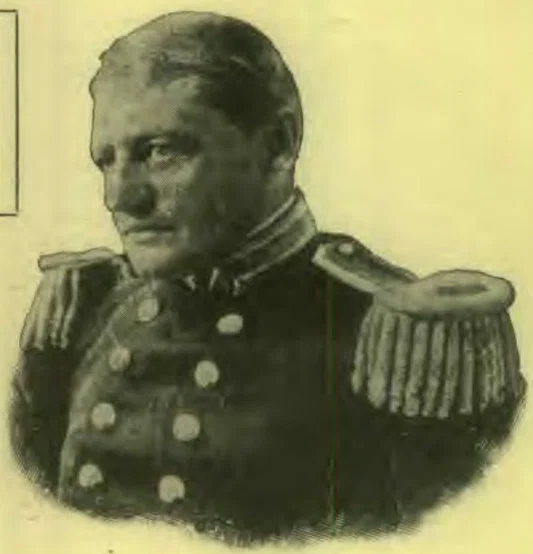
Rear-Admiral Robley D. Evans.
Sunday Laws and Religious Liberty
On Sunday, December 8, all the theaters and other places of amusement in New York City were closed. A decision of United States Justice O’Gorman was the occasion for so rigidly enforcing a law that has been carried as a dead letter among the ordinances of the city. It is stated that the aldermen have called a meeting, and will do what they can to abrogate the law so that they will not have to do without their theaters again on Sunday. The history of Sunday closing of places of amusement is that the first step is to shut out the amusements on Sunday; and then the next step is to get a law compelling everybody to attend church on that day. The Lord does not attempt to compel men to observe the forms of religion, then why should men undertake what the Lord does not assume to do? The activity of those who would compel the observance of Sunday by law should be closely watched.
For no matter how impossible it may seem to us, yet it is nevertheless a truth that one of the clearest prophecies of the book of Revelation foretells the fact that there will be a universal movement in favor of Sunday to secure its observance under the pains and penalties of civil law. This movement will bring about world-wide persecution against those who refuse to surrender their right to worship God without any such intervention from the state. We may have nursed the hope that the days of religious bigotry and religious intolerance are in the past; but the prophecy puts a contrary view upon the subject.
The Peanut Fad.
By Editor
The newspapers for some weeks have been giving more or less attention to claims that have been made by certain "professors" and "chemists" as to the wonderful food values of the peanut. Some of them claim that it is a perfect food, and that a person can live indefinitely on the peanut alone. A college professor in Illinois, so the papers say, has gone so far in meeting the challenges against the "goober," as it is called thru the South, as to start in for a three-months' diet on the peanut. The professor claims that he will come forth from the test stronger and in better flesh than when he started in. Another in Illinois has just completed a forty-day diet on peanuts and others in different places are following the same diet for various lengths of time.
Sensible people will not run off after fads. They will not indulge extremes that can only result from unbalanced minds, neither will they jump into things without giving them consideration. Therefore sensible people will certainly not be guilty of making the mistake of trying to depend on any one article of diet. To try to live for a long period on just one article of food is enough to give a sane person dyspepsia just to think of it. God has given infinite variety in this world, and it is plainly His design that man shall properly and lawfully enjoy the multitude of good things bestowed by the Father rather than try to find some one food and confine himself to the monotony of that.
And besides, there can be no disputing the fact that to use the peanut in large quantities is injurious to the system, no matter how some professor may have figured it out in his laboratory. A few years ago some of the scientific men claimed to have discovered that they could make a butter out of peanuts that was not only cheaper than the dairy product, but it was much more wholesome. Thereafter this butter was manufactured and placed on the market, and many people were led to use it. In a little while they began to have trouble with their stomachs, and especially with their kidneys. And this trouble was traced directly to the peanut products that were being eaten by them; for those who discontinued the use of the stuff before permanently undermining their constitutions were soon back to their normal selves again.
We give our readers the foregoing bit of personal experience and observation in regard to the peanut as an article of diet with the suggestion that no one allow any of these statements that are going the rounds of the press to influence them in making the peanut a very large part of their diet, nor that it be used for any prolonged period of time. A few peanuts, if properly prepared, may be harmless, and possibly wholesome, but their extensive and continuous use should be avoided. T.
Wireless Telegraphy and Gospel Truth
When about one hundred miles out to sea the steamer Kroonland broke her shaft. The fact was immediately telegraphed back to England by the wireless instrument that she had on board. One of the great wonders of this time is the development of wireless telegraphy to the point where any ship at sea may make known her position, and if she is in distress let that matter be known also. There is a time just before the world when the vital truths of the Gospel for this age will be brought to the front and become the theme of rigid and scrutinizing observation. These truths will be made an issue the same as great national or international questions of state have been so often made issues, and thus become the theme of world-wide discussion. God is preparing against that time, so that even the mariner at sea will not be shut out from the privilege of having the burning truth for this day so that he can study it as closely as his fellow man who is on the land. When that time arrives, the discussion will be keen, and soon men will range themselves on one side or the other, the great Gospel of the kingdom will do its work in all the world, and then, according to the promise of the Master, the end will come.
Heart Disease and Fast Living
One hundred and sixty-four persons died from heart disease during a recent week in New York City. It is explained by some that the remarkable death-rate from this one malady is greatly accentuated by the financial panic thru which the country is passing. But people would not have so much heart disease if they were not living so fast. The stimulants and drugs that are being used in such large quantities, and the unnatural demands of society place so much extra work upon the heart that it can not stand the strain when extra burdens are thrown upon the system, and this is especially true if the extra burdens come particularly upon the nerves.
Fresh-Air Treatment for Consumption
Chicago has three thousand three hundred deaths a year from the "great white plague," consumption. That city has recently provided hospital accommodations at which all who have the disease may have the benefit of the most modern fresh-air treatments. The poorest as well as the most wealthy can have the very best that medical skill has to offer. Such philanthropies are among the bright things that are left in this old, selfish, and sin-cursed earth to chase away the gloom that would otherwise settle over it completely.
Storms at Sea and Ashore
Reports tell of heavy storms that are sweeping various parts of the East. And not only is the eastern part of this country being visited, but steamships crossing the Atlantic report very heavy storms at sea. Gales of hurricane violence have raged along the shores of France and considerable damage has been done to ships.
Police Weapons Cast Into the Sea
The police department of New York recently took five thousand revolvers and eight hundred dirks, daggers, knives, and poniards on a boat, went out to the deep water of the ocean, and threw them overboard. The weapons are the accumulation of what has been taken from the criminals they have arrested.
Black Sea Storms and Shipwreck
The recent storms on the Black Sea have resulted in great loss of life and property. The steamship Kaplan was among the vessels to go down, and all of her passengers and crew were lost. There were known to be 110 souls on board.
Nineveh, and Other Poems
“Nineveh, and Other Poems.” By George Sylvester Viereck. Moffat, Yard & Co., New York.
There is real poetical genius in the author. The sad thing is that it has been put to so depraved a use. The chief poem is New York presented as Nineveh in all her wild wickedness, but the very wickedness in which the author has seemed to revel has debased his own morals, and recalls a stanza from Whittier—
“For whoso strives with wrong may find
Its touch pollute, its darkness blind!”
The author seems not so much to have striven with wrong as to have joined its ranks, “heel and wimple.”
One stanza of his poem on the modern Nineveh is—
“Sit not too proudly on thy throne;
Think on thy sisters, them that fell;
Not all the host of Babylon
Could save thee from the jaws of hell.”
It is a sad thing that the gift of poesy should be used for so base a purpose.
The Physical Basis of Mind and Morals
By M. H. Fitch
“The Physical Basis of Mind and Morals.”
By M. H. Fitch, International Library of Social Science; ten chapters, 266 pages, with index. Chas. H. Kerr & Co., Chicago.
The author presents “phenomonism” as “the relation all things hold to each other;” he does not seem to “know the real meaning” of things which come to our consciousness, as “they can not be comprehended by the human brain;” and “wisdom teaches us to waste no time in conjecture about the ultimate reality.” The book is entirely based on evolution, and presents no more hope to the poor sinner of this world than any other evolutionary idea. It extols Darwinism, and yet of what benefit has Darwinism been to the race? How much more does the race know of righteousness or helpfulness in moral life since Darwin gave his products to the world?
Redemption Completed
By Editor
"Redemption Completed." A treatise on the work of redemption, by Rev. Jasper Abraham Huffman. Fifth edition, revised, published by the J. A. Huffman Book and Bible House, New Carlyle, Ohio.
The book is written with the earnest, loyal plea for Bible religion. We frankly state that we can not agree with the author in regard to belief in the immortality of the soul which creeps in, a doctrine which has no support in the Bible, nor his view of the millennium, and what he sets forth as sanctification. And yet we are in sympathy with the plea for the integrity of the Old Book, the redemption of the earth, the redemption of the body, the restoration of man's inheritance, the earth made new, and the plea for a religion which grasps by faith character-perfection. But this religion must ever result in obedience to all the commandments of God.
Of Such Is the Kingdom; and Other Stories from Life
"Of Such Is the Kingdom; and Other Stories from Life." By Richard L. Metcalfe, second edition. 210 pages; cloth, price $1.00. The Woodruff-Collins Press. Address William B. Metcalfe, Box 28, Lincoln, Neb.
The whole thought of the book is the lessons that we can get from the lives of children, the sweet simplicity of the childlike faith of the little ones. There are some excellent things in the little book, many of which will lighten hearts and bring good thoughts to those who read. One may not agree with all of it, nor with all of its theology, but it has many little touches of nature that make the whole world kin and will help the reader.
The Ministry of Beauty
By Stanton Davis Kirkham
"The Ministry of Beauty." By Stanton Davis Kirkham. Paul Elder & Co., San Francisco and New York.
A beautifully made, beautifully printed book, and it is, too, filled with beautiful language. It is, however, a New Thought production, almost at times reaching the source of truth, but falling short, and hoping to find in man his own salvation.
Literary Notices.
*
By Edward L. Wilson, 150 illustrations from photographs by the author, 386 pages, price $1.50. Chas. Scribner's Sons, New York.
This book was the outcome of a very earnest desire on the part of the author to see these places himself as they were; therefore with the Bible as his guide-book, with careful art training, love of nature, splendid health, and well-fitted camera, he began the work. It certainly is a book of real worth to the student of Biblical lands. The popular edition is not as fine as the one first issued by the author, but contains all the matter, and its illustrations are helpful.