The Saviour manifested divine compassion toward the Syro-Phenician woman. His heart was touched with pitying tenderness, as he saw her woe and grief. He longed to give her an immediate assurance that her prayer was heard, and her request fulfilled; but he desired to teach his disciples a lesson; and for a short period of time he seemed to act out the feelings that prompted them, and neglected the cry of her heart. He acted towards her in the same manner as the Pharisees taught the people to act toward all such so-called heathen. Christ even repulsed her. He knew the heart of the woman. He knew what sorrow pressed upon her soul, and understood her persistent determination not to be driven away until her request was granted. When she made known her request to Christ, he said, “It is not meet to take the children’s bread, and to cast it unto dogs.” But she had an answer ready, and said, “The dogs eat of the crumbs which fall from the master’s table.” This is all I ask. Give me the privilege of eating the crumbs that fall from the table. Did she go away empty and discouraged?—No, she received her request. The Lord commended her for her great faith, and sent her away with the precious boon she had asked. He then turned to his disciples and said, “I have not found so great faith, no, not in Israel.” Did the disciples ever forget this lesson?—No. This case is placed on record to show what is the result of persevering in presenting our needs to the Hearer of prayer. Of Christ it was written, “The bruised reed shall he not break, the smoking flax shall he not quench.” No soul will be left to perish who asks in faith for the help of Christ. The weakest, the most struggling soul, may live, and find hope and sufficiency in God. When Jesus comes into the storm and the darkness, midnight is as bright as noonday. The faith that recognizes Christ leads the soul to rest implicitly upon the promises, because God is behind them. There is hope for the most desponding. Those who take Christ at his word, who surrender their souls to his keeping, their lives to his ordering, will find peace, quietude, and rest. He will impart grace to the needy soul.
The Lord calls attention to the words of the judge, saying: “Hear what the unjust judge saith. And shall not God avenge his own elect, which cry day and night unto him?” He so presents the unjust judge and himself as to show that it is an impossibility that God shall fail his people in a time of necessity. Just before the Lord is near to come, the proving of God will be upon his people. The church will be tried until the time when the Lord shall appear in the clouds of heaven. Those who receive answers to their prayers are those who walk in the light of God’s commandments. But let not that man who walks contrary to the expressed5will of God, expect that he will receive anything of the Lord. The Lord says: “And whatsoever ye shall ask in my name, that will I do, that the Father may be glorified in the Son. If ye shall ask anything in my name, I will do it. If ye love me, keep my commandments. And I will pray the Father, and he shall give you another Comforter; that he may abide with you forever; even the Spirit of truth; whom the world can not receive, because it seeth him not, neither knoweth him; but ye know him; for he dwelleth with you, and shall be in you. . . . He that hath my commandments, and keepeth them, he it is that loveth me; and he that loveth me shall be loved of my Father, and I will love him, and will manifest myself to him.” Again the Lord assures us: “If a man love me, he will keep my words; and my Father will love him, and we will come unto him, and make our abode with him. He that loveth me not keepeth not my sayings; and the word which ye hear is not mine, but the Father’s which sent me.”
In order to receive the precious gifts of God, we must meet him upon the platform of his own devising, complying with the conditions that he has laid down in his word.
There is much turning aside from the word of God. Because iniquity abounds, the love of many waxes cold. When a trial of faith comes upon those that profess to be the children of God, they do not perseveringly present their petitions before the throne of mercy, depending upon the Holy Spirit, waiting and watching, and continuing to present their requests, searching the Scriptures at the same time to know what is the mind of God. Place your feet in the path of God’s commandments, and be assured that your prayers will be answered.
There is a great lack of earnestness, a great lack of vital interest in prayer. Yet we are exhorted to be “instant in prayer,” “to pray without ceasing.” We are to keep a spirit of intercession, and present all our wants to God. We are to tell him about the smallest things of life,—our cares, our business, our desires and needs. You can never weary the Lord by your importuning. It is by beholding Jesus that you become changed into the divine similitude. We may behold him by continuing in prayer, until we are not aware that we are praying; for our souls turn to the Sun of Righteousness as a flower turns to the light.
We should study the prayer of Christ that has been given to us in the seventeenth chapter of John. In living out that prayer, we may be lifted day after day into a pure, holy atmosphere, and thus have faith to believe that we receive that thing we ask of God. The Saviour said: “Neither pray I for these alone, but for them also which shall believe on me through their word; that they all may be one; as thou, Father, art in me, and I in thee, that they also may be one in us; that the world may believe that thou hast sent me. And the glory which thou gavest me I have given them; that they may be one, even as we are one; I in them, and thou in me; that they may be made perfect in one; and that the world may know that thou hast sent me, and hast loved them, as thou hast loved me.”
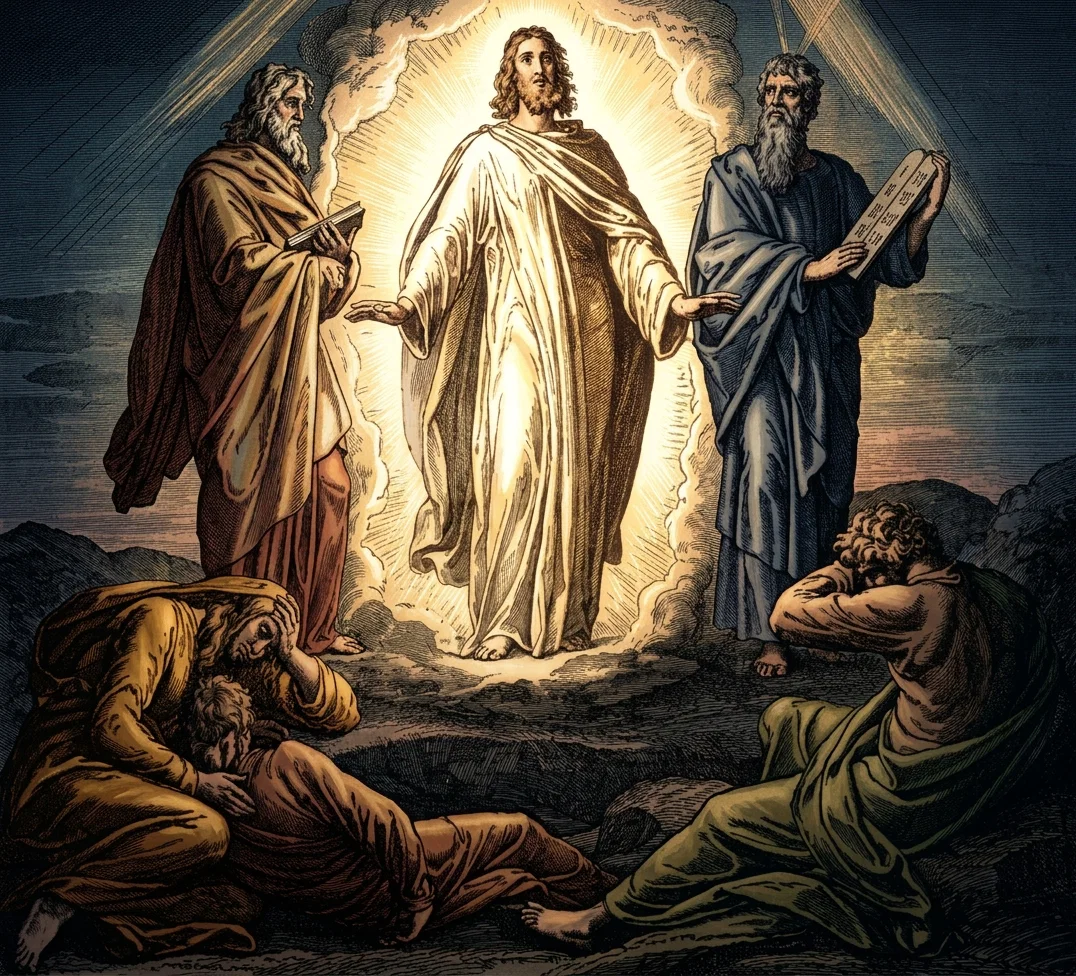
THE TRANSFIGURATION.
What a statement is this! How can the finite man grasp it? Man may become elevated, ennobled through obedience to the commandments of God, and become loyal and true subjects of his kingdom. We may become one with Christ in spirit and character, and testify to the world that God loves us as he loves his Son. What possibilities are there before the fallen human agent! Let perfect obedience be rendered to God through the imputed righteousness of Christ, and we shall reveal to the world the fact that God loves us as he loves Jesus. It will be made evident that “he that spared not his own Son, but delivered him up for us all, how shall he not with him also freely give us all things?”
Why is it that we are so disposed to distrust God? Why do we as a church doubt his love? Let faith increase by exercise. Let it be sustained by works of righteousness. It is sin that darkens the reason of man, and clouds the understanding. Let the affections be given to God in order that his law may be written in the heart, and the whole man will become a new creature, born again of the Spirit. Then it will be made manifest that the law of God “is perfect, converting the soul.” The Lord Jesus has revealed to us the value of the human soul. He says: “O righteous Father, the world hath not known thee; but I have known thee, and these have known that thou hast sent me. And I have declared unto them thy name, and will declare it; that the love wherewith thou hast loved me may be in them, and I in them.” Again the promise is made, “I will make a man more precious than fine gold; even a man than the golden wedge of Ophir.” Shall we co-operate with God, and possess the faith that works by love and purifies the soul?
BEAR YE ONE ANOTHER’S BURDENS.
By Paulina M. A. Anderson
BY PAULINA M. A. ANDERSON.
Bear ye one another’s burdens,
Stand not idly by and say:
“There’s no service I can render
In the labor of to-day.
I’ve no time for burden bearing,
’Tis imagination rare,
I would tell of victories glorious,
And a life all free from care.”
If thy neighbor with oppression
Seems all heavy burdened down,
Say not, “He makes high profession,
There’s no use for him to frown;
’Tis all nonsense to be gloomy
And grow thin and pale with care;
If he only trusted Jesus,
He a sunny smile might wear.”
Ah! methinks this is the lesson
That our Saviour taught while here.
Spake he not with deep compassion
Words of comfort, love, and cheer,
Ever ministering to others,
And more anxious to do good
Than to gain his needed slumber
Or partake of daily food?
Some must bear the heavy burdens,
Cheerful oft, yet sad of heart,
Just because the other neighbor
Does not do his rightful part.
Blessed Saviour, give us wisdom
All our duty well to know,
So to follow in thy footsteps
As we journey here below.
Let us help the weary brother,
Lift and aid him with our might;
By unselfish love and duty
Our own burden will grow light;
Then, while leaning on the Saviour,
All our life shall useful be,
And a crown of life supernal
We will wear eternally.
ZION AND BABYLON. NO. 6.
By I. E. Kimball
BY I. E. KIMBALL.
The final work reveals Babylon in a threefold division. We have found two of them: Paganism and the new paganism of the fifth century,—Romanism. The pagan world for a time seemed no longer to exist. The dragon gave to the beast “his power and his seat and great authority.” A threefold division of the great city Babylon is seen in the time of her judgment.
The beast once ridden by the woman, the apostatical “mother” of the Revelation, is understood to represent the kingdoms as ruled over by the popes, the fifth head of the Satanic beast, but the Babylon which asserts herself over these kingdoms, we understand to be the religion which governs them. Thus paganism and Catholicism, as embraced in the Roman and Greek persuasions, must be two of the divisions spoken of. But what is the third?
Another beast was seen coming up apart from the soil of the first beast, and, necessarily then, in this hemisphere, and at the time of the collapse of the papal power, which was in 1798. See Rev. 13:10, 11. A Protestant nation and a republic; for they are not worshipers of the beast, and are democrat in the making of their laws—such a nation was to arise and to transform herself finally into an image of the papal kingdom. Henceforth this power is mentioned as the false prophet, who by his signs and wonders deceives the people, and enforces laws repugnant to true Christianity—compelling disobedience to God, and obedience to the Papacy. Hence, here is union of religion and state.
Now it will be readily apprehended that the United States of America has fulfilled, or is fulfilling, every specification of this prophecy, and that an evolution is in progress here. Church and state principles that are now recognized; purely religious laws are formulated and enjoined by godless politicians. What the result will be is forecast in the prophecy. The final issue comes in the showing of miracles and mighty wonders, which wholly deceive the people. Rev. 13:13, 14. I have before shown that the spirits of demons wrought in the elder world and deceived the people utterly, hence they were called pagans. I have also shown that when the church of the fifth century had so far departed from God that the hard-heartedness and selfishness of the world was fully seen in her, then God allowed these selfsame demons to come in and utterly deceive the church also, in the exact way they had deceived former apostates from God; hence the church was swallowed up in the same delusions, and became a part of Babylon; and now “the spirits of demons working miracles” are allowed to deceive this nation, immersed in selfishness and sin, and it becomes henceforth a “false prophet.” It is needless to say that here, too, the Babylonish scepter is stretched out, and Babylonism rules through her potent ruler—Satan.6
The papal beast, which seemed to receive a deadly wound, is to reappear (Rev. 13:3; 17:11), and the nations of Europe once again come under her hand, yea, “the whole world wonders after the beast.”
Protestant America is no longer protesting against Babylon, as the true Protestant must do, and the final climax of her separation from God is at hand, when religion and the state become married, one and indivisible; for then she will be cast off by the Jehovah of hosts forever. For since first God’s people were dispersed to Babylon, they have from henceforth been a remnant among all nations of earth. So, as corn is sifted in a sieve, have they been sifted among all the nations, lights amid the darkness; but in a general way the world has lain in wickedness. Now when apostasy so far comes into the church, and her standard is so lowered, that the nation as a whole comes under the visible authority of the church, and the church is the nation and the national church, we may well know that a terrible misconception and deception is upon the minds of the people. Further: Satan has not been content to merely deceive the people, but he has fixed his deception upon them by statute law. Babylon has even been connected with the state, and exercised a godlike authority through her pontiffs. So in Babylon witness Nebuchadnezzar’s claim to spiritual authority, as also amongst the Medes and Persians and the Grecians, and we know full well how Rome set up the gods for the people to worship. Whosoever worshiped a god not recognized by the state was a son of death. Such divine authority has been claimed by the pope.
Satan would fix his votaries by laws with all the authority of God, but, that he may hide himself, he must needs set up human authority as divine.
Satan has ever wedded his religion to the state, and delivered over offenders to the sword of the state, but when man thus assumes to teach concerning God, and enforce his teachings with the sword, it must needs be antichristian; for Christ says, “Judge not,” “Condemn not.” God alone is to judge and execute. When we see church and state fully united, we may well know that Satan has control of affairs; for it is for the express purpose of enforcing dogmas upon the consciences of men, and implies divine authority, putting man or government in the place of God. Well, this the United States will do when Protestantism has sunk to the common level of the world in morals, as she has now nearly done.
Spirits of devils also deceive the people, and then by one spirit they are all baptized into one body with heathenism—spiritual Babel. This work is so far under way that human knowledge apart from revelation would reveal all this for the future here. The churches have been arraigned for their desperate condition, filled up with the covetous, boasters, proud, high-minded, lovers of pleasure, praise, and authority. Such unclean men are fast filling the churches with unclean spirits—the spirits of devils.
Spiritual manifestations purporting to be from God through departed saints are now witnessed commonly. Trances in churches by laymen and pastors, tell of a time soon to come when the multitudes will be deceived. Signs of miraculous powers are on every hand. They are not the spirits of the dead, but “the spirits of devils, working miracles, which go forth unto the kings of the earth and of the whole world, to gather them to the battle of that great day of God Almighty.” Rev. 15:14.
Protestantism is surely going the way of Catholicism, the enemy of the church of Christ before the Reformation. Even now covetous, worldly, unprincipled men are freely allowed in her communion. The days of mourning over sin seem to have passed. God will surely allow Satan’s deceptions to come, as in past ages of the world, and Satan will here work with “all power and signs and lying wonders,” whereby strong delusion will be fully believed by those who have not received the love of the truth. This is even now being fulfilled. And he who knows the history of the church in the past can but forecast the final result.
In Revelation 18 a work, manifestly unprecedented in the history of the church, is brought to view. A mighty messenger warns the world in no uncertain way. He lightens the world with God’s glory, and cries “mightily with a strong voice, saying, Babylon the great is fallen, is fallen, and is become the habitation of devils, and the hold of every foul spirit, and a cage of every unclean and hateful bird. For all nations have drunk of the wine of the wrath of her fornication, and the kings of the earth have committed fornication with her [and note that when kings become pontiffs, when the church falls into the hand of the state, it is spiritual adultery; the church is wedded to another than Christ], and the merchants of the earth are waxed rich through the abundance of her delicacies. . . . Come out of her, my people, that ye be not partakers of her sins, and that ye receive not of her plagues. For her sins have reached unto heaven, and God hath remembered her iniquities.” This last voice seems to echo out of the clouds from God himself.
This time is at hand, and the plagues of God’s wrath will soon be manifest. In his sight the defection of the church of our times is very great. There is about as much sin committed in the church as outside of it, and as much of all evil is seen in this professedly enlightened land as in heathen countries. The day hasteth greatly for the final separation, and this is the supreme hour when the marriage of the Lamb will come, and his bride make herself ready. Zion is taken to God in a covenant of everlasting mercies. Rev. 18; 19:1-7.
All nations and classes of religionists must hear their cry; for paganism, Catholicism, and Protestantism, fallen to the low standard of Catholicism and heathenism, I have shown to be the three divisions of Babylon against which this warning is given.
God in the Heart
“The head is never regenerated until God gets into the heart.”
A Word of Approval
“THERE is many a wife hungering for an occasional word of approval, who will be buried in a rosewood casket.”
ABYSSINIAN SABBATH-KEEPERS.
It has been known to all historians, who have cared to chronicle the fact, that the Abyssinian Christians have never ceased to observe the Sabbath. More than fifty years ago the Seventh-day Baptists in America planned to open a mission in Abyssinia, in order to come into closer touch with these ancient Christians. It was found, however, that communication between the coast and the interior was so uncertain and difficult at that time, that the project was reluctantly abandoned, and the enterprise was transferred to Shanghai, China, where the mission is now being vigorously carried on.
The appearance of the following from the king of the Abyssinians recalls much that is of deep interest in connection with that people:—
[From the Paris Figaro.]
[Negus Menelik, of Abyssinia, addressed the following remarkable letter to Mr. F. S. R. Clarke, an English missionary, on February 3.]
You are mistaken in believing that I do not care for your prayers. All prayers of believers are dear to me, even when they come from the children of Europe. Not all are aggressors in my kingdom; not all commit the iniquity of attacking those whom they hope to find weaker than themselves; not all have bent the knee before Baal, the god of destruction and the slaughter of brothers. Many, I am sure, still truly adore the God of the cross, the God of justice and of peace. With them I feel in perfect communion of faith, and I am happy that they pray for me, for my household and my people.
I only wish that they would make truth dwell in the sanctuary, and that, instead of a mutilated Gospel, which explains the confusion and the infidelity of the people of Europe, they would return and lead others back to the true Gospel, which began with the creation of the world.
By what right do they efface the whole portion of it which precedes the coming of Jesus Christ, and have they done away with what God established for all time?
What you call the Old Testament is as true as the New, and what is contained in it must be respected and observed by those who follow Jesus and the apostles, announced by the prophets.
Never did Jesus abolish the distinctive mark of his race, since he was subjected to it by his holy mother on the eighth day. To suppress thus what God established “from age to age and from forever to forever,” is to weaken the faith, is to furnish the same spectacle shown by the Christians of Europe. It is not only without that they use violence, but also within, against the Jews, who are, nevertheless, Christian souls, and to whom we owe our Saviour. There are more than 300,000 of them in my kingdom, and, tho they enjoy almost complete independence, they are obedient and industrious subjects. They never conspire, pay all tributes, and respect our Abuna as much as do the Christians. If they are worse in Europe, it is because the Christians, too, are worse. Our Lord Jesus forgave them on the cross. Why should we persecute them? You, at least, do not persecute them. May the other Christians of Europe imitate you.
What you need is to return to our God, to observe all his ordinances, and to no longer separate Moses and the prophets from the apostles, or St. Peter from St. Paul. Whoever wishes to serve God must humble himself and obey. You know that, envoy of God. Teach it in Europe and Asia. I am having it taught in Africa.
May the grace of our Lord Jesus Christ be with you. MENELIK.
The just and trenchant criticism of the7king upon the “mutilated Gospel” of European Christians is as keen as it is deserved. No-Sabbathism and Sunday observance do indeed mutilate the Gospel in a fundamental and most destructive way. Study what this dark-skinned king of the mountains says.—Evangel and Sabbath Outlook.
OUT OF HARMONY WITH GOD.
By Frederick A. Noble
We fail to realize what an unspeakable disaster it is to be out of harmony with God. The exceeding sinfulness of sin grows out of the fact that sin is a violation of the will of God. But the mischief of sin, so far as we are concerned, is that it takes us out of harmony with God. It puts us in misadjustment to the laws and aims and wishes of God. The moment a man sins, it begins to effect a separation between his own life and the life of God; and the longer he continues in sin, the wider the separation becomes.
It is sin which has made the whole creation groan and travail in pain together until now. Poverty, sickness, distress, disappointment, pain, are evils to be mitigated as far as may be; or if they can not be much softened, to be borne with resignation and patience; but sin is a calamity from which every man is bound to make good his escape. Hence, there is no exigency so pressing as this which grows out of wrong-doing; and no peril so near and appalling as this which hangs over one in virtue of alienation from the Father; and no need so imperative as the need of reconciliation to God. Not to be God's children is to be the saddest of orphans.
—Frederick A. Noble, D.D.
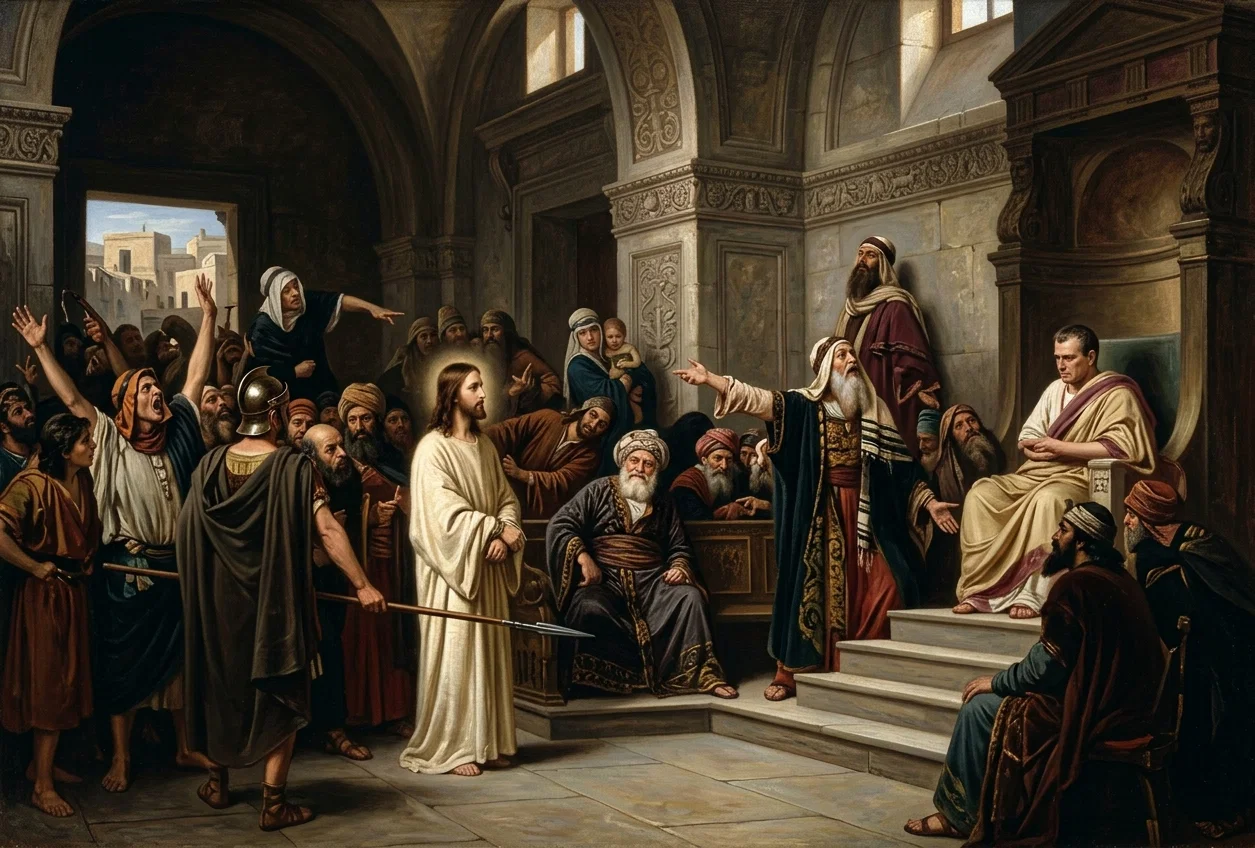
“WHAT SHALL I DO THEN WITH JESUS WHICH IS CALLED CHRIST?”
By E. Hilliard
BY E. HILLIARD.
This great question which confronted Pilate at the crucifixion is that which confronts every individual in this world, whether a professed follower of Christ or not. Our Saviour said, “And I, if I be lifted up from the earth, will draw all men unto me.” John 12:32. Every one sometime in his life feels the wooing of the Spirit drawing him toward Christ and heaven. When under its influence, each one is called upon to decide whether he will yield or reject. This is deciding the question, What shall I do then with Christ?
If we reject him, we as truly sanction his crucifixion as did Pilate when he permitted him to be scourged and crucified. Many think if they had lived in the time of Christ, they would not have rejected him. When we refuse to obey his written word, we reject him as verily as did they who lived when he was upon earth in the flesh. Some of those who crucified Christ, did it blindly; for Jesus prayed, while dying on the cross, “Father, forgive them; for they know not what they do.” He patiently bore with them, and after he arose from the dead and ascended, he sent down his Spirit on the day of Pentecost, and his prayer was answered. On that day Peter charged them with crucifying Jesus. This pricked them to the heart, and they repented and were baptized. Acts 2:36-41. Then came the crucifixion of self. They had to be baptized in the name of the One they had helped to crucify. Verse 38.
All of the requirements of God are most emphatically against our carnal nature; hence every advanced step will be contrary to us. When any of the commands of God’s word are made known to us, there comes a struggle between self and Christ. Then comes the searching question, Shall I yield my will to the will of Christ, or shall I have my own way? What shall I do then with Jesus which is called the Christ? Shall I, by disobeying him, decide with Pilate to crucify him? or shall I, by obeying him, decide with Paul to be crucified with him? Said the noble apostle, “I am crucified with Christ; nevertheless I live; yet not I, but Christ liveth in me; and the life which I now live in the flesh I live by the faith of the Son of God, who loved me, and gave himself for me.” Gal. 2:20.
It is painful to be crucified, but the command that places us on trial, will serve to crucify self, and prepare us not only to live with Christ and by him, on earth, but to dwell with him in his kingdom. If we reject the trial, by murmuring and complaining, we reject Him who sends the trial, self lives within us instead of Christ, and the life which we live from that time on is one of selfishness, instead of Christ’s life by the faith of the Son of God. The reason why so many reject Christ is because to accept him is to crucify self. But, dear reader, the death of self means life eternal, and the living of self means death eternal. Let us submit to the crucifixion of self, and this will bring peace; but if self lives, we can not live lives of happiness; for there can be no true happiness out of Christ.
Tonga, Friendly Islands, South Pacific Ocean.
HINTS FOR CHURCH ATTENDANTS.
1. PREPARE for divine service in your closet, not at your toilet.
2. Be early at church, and occupy the moments before service with meditation and prayer.
3. Consider the sermon, no matter who may be the preacher, as a message from God, not as an effort of man.
4. Pray before, during, and after the service, for the minister and your fellow-worshipers.
5. In God's house all should be “kindly affectioned one to another with brotherly love, in honor preferring one another.” Greet cordially those around you; welcome strangers into your pews; but let all be done reverently and for the glory of God.
6. Give according to your means. If you spend money for dress and luxuries, do not stint your offerings for God's house. Always begin to economize with self first, and with God last.
7. Carry your religion into your daily life.
—Selected.
SONS OF GOD.
By J. E. Evans
BY J. E. EVANS.
(Concluded.)*
Perfect through Suffering.
To LEAD us to trust his wisdom is so great a work that God gave his Son “in the likeness of sinful flesh,” and permitted him to be “tempted in all points like as we are, yet without sin.” “Forasmuch then as the children are partakers of flesh and blood, he also himself likewise took part of the same. . . . That he might be a merciful and faithful High Priest in things pertaining to God. . . . For in that he himself hath suffered being tempted, he is able to succor them that are tempted.” “For it became Him, for whom are all things, and by whom are all things, in bringing many sons unto glory, to make the Captain of their salvation perfect through sufferings.” Heb. 2:14–18, 10.
“Tho he were a son, yet learned he obedience by the things which he suffered.” Chapter 5, verse 8. He was made perfect through suffering. Shall we not gladly accept the conditions? He learned obedience by the things which he suffered. Must we have an easier way?
The Son of God was sent. He was given that those who did not know his Father’s love might be brought to know its power—sent with a message to a dying world—given a sacrifice for mankind. No less is required of us upon our being adopted into the heavenly family. He was an Ambassador; so is each son and daughter of adoption to show “that the Father sent the Son to be the Saviour of the world.” 1 John 4:14. He was the light of the world; so are we.
In refining silver a great and prolonged heat is necessary to bring the liquid metal to the point where it will reflect the image of the refiner fully. That which is used to reflect must be bright, and this state is not secured without patient labor on the part of the workman, and a passive attitude on the part of that which is to be thus used. The “Son” became the “Sun.” “But unto you that fear My name shall the Sun of Righteousness arise with healing in his wings.” Mal. 4:2. The character of God is given us in Christ, and we, by beholding his face, “are changed into the same image”—“the image of his Son.” 2 Cor. 3:18; Rom. 8:29. “That ye may be blameless and harmless, the sons of God, without rebuke, in the midst8of a crooked and perverse nation, among whom ye shine as lights in the world.” Phil. 2:15.
Are we his children? He knows what is best for us, and will ask us to bear only that which is for our good. Like a true earthly parent he delights to bear our burdens, and become responsible for us, and would gladly give us all the comforts of this life, and the joys of the world to come, without calling us to suffer for his name, if it could be done.
The question is often asked, Why are the children of God called upon to endure trials and affliction, when those who seem to have no thought of him go free? This thought troubled the mind of David for a time; but as soon as he went into the sanctuary, and saw their end, he was satisfied. He was there led to see the principles which govern the family of earth and the family of heaven. Wherever self is permitted to rule, there Satan is the head. Where love prevails, there Christ rules. Truly, then, we can say: “Blessed is the man whom thou chastenest, O Lord.” Ps. 94:12. “Before I was afflicted I went astray.” “It is good for me that I have been afflicted; that I might learn thy statutes.” Ps. 119:67, 71. “For he doth not afflict willingly, nor grieve the children of men.” Lam. 3:33. “For unto you it is given in the behalf of Christ, not only to believe on him, but also to suffer for his sake.” Phil. 1:29. “If we suffer, we shall also reign with him.” 2 Tim. 2:12. “Beloved, think it not strange concerning the fiery trial which is to try you, as tho some strange thing happened unto you; but rejoice, inasmuch as ye are partakers of Christ’s sufferings; that, when his glory shall be revealed, ye may be glad also with exceeding joy.” 1 Peter 4:12, 13. God has also promised to “make you perfect, stablish, strengthen, settle you,” “after that ye have suffered awhile.” 1 Peter 5:10. Therefore the exhortation is given: “My son, despise not thou the chastening of the Lord, nor faint when thou art rebuked of him; for whom the Lord loveth he chasteneth, and scourgeth every son whom he receiveth. If ye endure chastening, God dealeth with you as with sons; for what son is he whom the Father chasteneth not? But if ye be without chastisement, whereof all are partakers, then are ye bastards, and not sons.” Heb. 12:5–8.
This lesson is also taught in the second chapter of Hosea, where the Lord through the prophet speaks of his dealings with ancient Israel. After reproving them for a wrong use of the blessings given them in Canaan, he says, “Therefore, behold, I will allure her, and bring her into the wilderness, and speak comfortably [friendly, or to the heart] unto her; and I will give her her vineyards from thence, and the valley of Achor for a door of hope.” By referring to the margin of Josh. 7:26 the force of this expression will be seen. The word “Achor” means trouble, and the valley of trouble was to be given them for a door of hope; that is, trouble would bring about what temporal prosperity failed to produce. “And it shall be at that day, saith the Lord, that thou shalt call me Ishi [my husband]; and shalt call me no more Baali [my lord].” Hosea 2:14–16. “God is love.” He does not, as the lords of earth, utter arbitrary commands, but seeks continually the good of his creatures; yet some consider the cords of divine love as the restraint of arbitrary will.
The above scripture tells why we are chosen “in the furnace of affliction”—why “we must through much tribulation enter the kingdom of God.” This kingdom will be enjoyed by all who are prepared for it, but can be earned by none. The servant works for wages, and it is expected that he will give the value of his money in time; but the faithful son thinks not of the wages, but of the inheritance to which he is heir. “Wherefore thou art no more a servant, but a son; and if a son, then an heir of God through Christ.” Gal. 4:7. In this family there is manifested that love and confidence which are characteristic of any kind and well-regulated family on earth. The Master says, “Henceforth I call you not servants; for the servant knoweth not what his lord doeth; but I have called you friends; for all things that I have heard of my Father I have made known unto you.” John 15:15. Being joint-heirs, the children of God have no fears concerning what they are to receive, but enter cheerfully upon doing the Father’s will, and yield willingly to the necessary discipline, knowing that “the servant abideth not in the house forever; but the son abideth ever.” John 8:35. God has given us his only Son, and “how shall he not with him also freely give us all things?” Rom. 8:32. “No good thing will he withhold from them that walk uprightly.” Ps. 84:11.