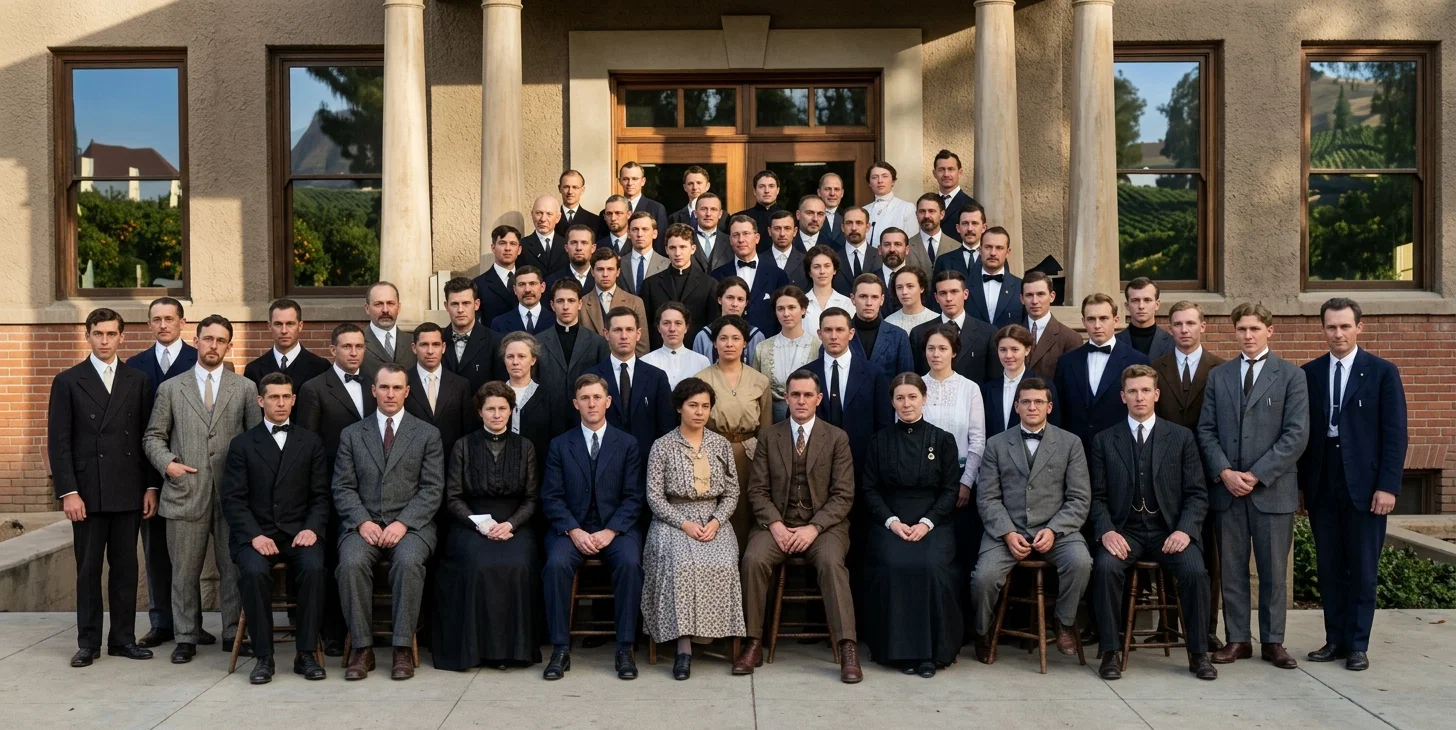
We have spent the last week at the Loma Linda Sanitarium and College of Medical Evangelists. This enterprise has several times been presented to the readers of the Review during the last few months. We have felt greatly interested in becoming acquainted with the college and with the work it is doing. This is our first visit, and it is a surprise to see so large and progressive a work built up here.
The location is unique. Erected on a lofty eminence overlooking the San Bernardino Valley, the institution has a most beautiful situation. In every direction stretch beautiful vineyards and orange groves. In the distance are seen the little cities of Colton, San Bernardino, and Redlands; while forming a background on every side are the mountain peaks of the San Bernardino range, snow-capped, and towering six thousand feet above sea-level.
About three hundred acres of fertile land is controlled by the institution. This has been brought to a good state of cultivation and fruit production, and contributes in no small degree to the support of the enterprise.
The main building is a wooden structure five stories high. This, with a dozen cottages adjoining, furnishes accommodations for one hundred guests. During the last year there has been erected near the main building a commodious chapel, with a seating capacity of four hundred; a nurses’ dormitory, with accommodations for 116 nurses; and also a laboratory building, for the benefit of the medical school. The facilities afforded by this laboratory are most excellent, and are considered the best possessed by any medical school on the Pacific Coast.
These buildings are all situated on a hill overlooking the valley. In the valley below, about two blocks distant, is the railroad station of the Southern Pacific, a general store operated by the institution, a food factory, a laundry, and other buildings, while in the field beyond is the barn for the accommodation of the sanitarium dairy, which supplies milk and cream to the institution.
The work of the sanitarium has been especially blessed. From the beginning, it has enjoyed an excellent and growing patronage. Last year’s work resulted in a net gain of several thousand dollars. Guests are found here from the North, East, and South, and a good spirit is felt in the social and religious life of the family.
LOMA LINDA SANITARIUM
In addition to the regular sanitarium work carried on here, there is likewise conducted an extensive educational work; namely, the school for the education of physicians and medical evangelists, and the nurses’ training class. Fifty-six are engaged in medical studies, sixty are enrolled as nurses in the sanitarium training-school, while thirty-five others are doing special preparatory work, making, in all, a school of more than one hundred fifty. This has brought together a large number of earnest and consecrated young men and women.
For the carrying forward of this enterprise a large and responsible faculty has been assembled. Here are men and women who have occupied positions of responsibility and have borne heavy burdens in connection with other institutions in years gone by. These brethren and sisters feel that the providence of God has particularly led in the development of this work thus far; and as we listened to the relation of some of the experiences passed through, and read the instruction that has come through the spirit of prophecy regarding the work to be established here, we saw in this enterprise one of more than ordinary importance, and we believe that here has been established a base for a very extensive work, far-reaching in its influence in coming years.
The great need of the work which is being done in the education of medical evangelists and missionary physicians has many times been emphasized. Years ago the instruction through the servant of the Lord to this denomination was that a school should be established for the education of physicians, that our young men and women should not be compelled to attend worldly institutions to obtain an education in medical science.
An effort was made to provide a school of this character. The circumstances which arose and the events which culminated in the separation of that school from denominational work, and in its final abandonment on the part of its promoters, are events of recent history, and need not be recited here. Suffice to say that the instruction that applied to the establishment and development of that school applies with equal force to the school at Loma Linda. The need is even greater, and the demand which exists for devoted medical workers is every year increasing.
The work which has been established at Loma Linda is an effort to meet as fully as possible the spirit of the instruction that has been given. Our brethren and sisters in Loma Linda and in other parts of California have recognized this demand, and have liberally responded to the appeals that have been made for funds for the upbuilding of this work.
We are able to note no evidence of extravagance in the work that has been built up. We believe that the money invested in the enterprise has been economically expended, and that those in7charge of the work have used good judgment and labored in the fear of God in the promotion of the enterprise. Worthy of special mention is the spirit that has actuated the local workers connected with the sanitarium and school in the contribution of their own means to the support of the work. Nearly one third of all the donations given to the Loma Linda enterprise have come from the physicians, nurses, and students connected with the work. This amounts in the aggregate, since the work started, to nearly $22,000; and this liberality on the part of these brethren and sisters toward the work in which they are directly interested, has by no means lessened their contributions to other enterprises. Since Jan. 1, 1906, there has been paid
by the workers gathered here over $26,000 in tithe, and over $10,000 in offerings to missions and other general denominational enterprises. A spirit of devotion and self-sacrifice has been faithfully manifested by this family of laborers.
The advantages afforded by this school to our young men and women desiring medical education should be considered by them before they decide to attend the medical schools of the world. This school has been established to provide as thorough instruction as may be obtained elsewhere, and at the same time to save our young men and women from the many demoralizing influences confronting them in their associations in the schools of the world. Surely those who, without sufficient reason, pass by opportunities of this kind provided in our own work, and choose their own way in matters of educational advantages, can not expect to be safeguarded from the temptations that will confront them. We earnestly urge our young people contemplating the medical course, to consider the instruction that has come to us as a people with reference to these subjects, and to avail themselves of the schools of the denomination. Not alone should those seeking a medical education do this, but all others as well. There are scores of Seventh-day Adventist young men and women who are attending high schools and colleges in the world who should be in the colleges and academies conducted by the denomination.
FACULTY AND STUDENTS IN THE COLLEGE OF MEDICAL EVANGELISTS
During the last week there has been held the constituency meeting of the institution. This has brought together a large number of representative brethren, members of the General Conference Committee, of the Pacific Union Conference Committee, and of the Southern California Conference Committee, as well as other friends of the institution. Trustees have been elected to fill vacancies on the board. Resolutions have been adopted shaping the future plans and policies of the work. Of special importance has been the decision to raise fifteen thousand dollars for the purpose of establishing a central heating plant, which is sadly needed. It was voted to raise another fifteen thousand dollars for the establishment of a hospital, which will be needed in connection with the medical school next year. These features of the work will no doubt be presented before our people more fully in the near future.
The establishment and maintenance of a medical school by Seventh-day Adventists, with their membership and resources, is a stupendous undertaking. Already many perplexities attend the work. These are the result of a lack of ready and necessary means to provide the facilities required, and the difficulty in securing a staff of workers who, fully understanding the principles that should govern such an undertaking and their relationship thereto, will labor unitedly, and not as independent factors, for its development. Upon the workers assembled at Loma Linda rests a great responsibility, the chief responsibility of making the work a success through God’s grace.
We feel great confidence in the work that is being carried forward here. We believe that its establishment is in the order and providence of God. As we view its future, it seems to us that three important essentials are necessary to its highest success: (1) The maintenance of its simplicity and the careful, consistent regard of the principles that have called it into existence, and of the instruction that has been given by the servant of the Lord with reference to its operation; (2) the hearty, united effort of the large number of workers who have been called to bear responsibilities in this place. If the faculty assembled here, with the young men and women in training, can constitute a band of workers whose hearts God has touched, and who will walk humbly before him, a mighty work will be accomplished through their efforts in spreading abroad a knowledge of the message for these last days; (3) the prayers, sympathetic interest, and hearty cooperation of our people throughout the field. These prayers, this interest, this cooperation, we bespeak for the enterprise from our people everywhere. The work here is one of God’s instrumentalities. Our brethren and sisters who are laboring here are worthy of our confi-8dence. Honestly and humbly and earnestly they are laboring with God’s help to do the best they know. Let us be faithful in holding up their hands, promoting the interests of the work in which they are engaged, and thus become co-laborers with God and with our brethren in work for the salvation of our fellow men.
F. M. W.
The President, the Pope, and the Cardinals
By William Warren Prescott
IN the three years and a little more during which the Hon. William H. Taft has occupied the position of the chief executive of this nation, he has in several instances shown his readiness to yield to the skilful diplomacy of the representatives of the Roman Church, and his conduct in this respect is being severely criticized by a large number of journals which stand for the separation of church and state in the United States. In view of these facts, it is not surprising that the recent visit of Maj. Archibald Butt, the President's aide, to Pope Pius X at the Vatican has awakened much interest, and has been the subject of much surmising. It was reported, on apparently good authority, that Major Butt conveyed a personal letter from President Taft to the Pope, and that he was entrusted with a personal reply from the pontiff, but nothing very definite was stated concerning the nature of the correspondence until an article appeared in the New York Times of April 14, 1912, which will doubtless attract much attention. The first paragraph of this article runs thus:—
That President Taft has made up his mind to follow the custom of the non-Catholic courts and governments in Europe, on the subject of the precedence to be accorded to cardinals in the United States, no matter whether foreign or native, has been strikingly shown by the fact that he despatched his principal aide-de-camp, Maj. Archibald Butt, to Rome, entrusted with purely private letters to Pius X and King Victor Emmanuel.
The subject-matter of the President's letter to the Pope, and the further purpose of Major Butt's visit to the Vatican, are discussed in the following paragraphs:—
It is generally understood that the letter from President Taft to the Pope was for the purpose of expressing to him the satisfaction felt in all parts of the United States over the recent elevation of three distinguished American citizens to the sacred college, and also to recall his pleasant intercourse with the Holy Father at the time when he visited Rome while he was still Secretary of War, in order to settle, in a manner satisfactory alike to the church and to the American government, the difficult and troublesome questions regarding the friars' lands in the Philippines, a problem involving a large amount of money.
It is also known that Maj. Archibald Butt, while at the Vatican, was directed by Taft to discuss, unofficially and privately, with the papal Secretary of State Merry del Val, and other leading members of the sacred college and of the pontifical court, the problem of precedence which had arisen in connection with the official rank and status of cardinals in the United States.
It is plainly intimated in this article that the cardinals of the Roman Catholic Church will hereafter take precedence in this country, as they do in the Old World, over all representatives of foreign powers, over all cabinet officers, over the Speaker of the House, and over the Vice-President. According to the new order of things, if a cardinal of the Roman Church should visit an American man-of-war, he would be entitled to salutes and naval honors reserved for a foreign royal personage. To quote:—
There has never been any difficulty about the status of cardinals in Italy, and whenever any foreign or Italian member of the sacred college has visited an Italian man-of-war, he has been received and welcomed on board with all the naval honors reserved for royalty.
So it will undoubtedly have to be in the United States, which now, in matters of international comity, feels itself under the necessity of complying not only with the demands, but also with the ethics of jus gentium.
The question of discrimination in favor of one church over another is treated plainly if not satisfactorily:—
The point raised about discrimination in favor of one church at the expense of another, can not be said to apply to the case of cardinals. They are something beyond ministers of the gospel and ecclesiastics. Indeed, a cardinal is not necessarily a priest; for instance, old Cardinal Mertel, who was the principal legal counsel of the sacred college, and indeed of the Papacy. With his short-cropped, reddish-gray whiskers, he presented a striking contrast to the other members of the sacred college at great ecclesiastical pageants.
But a cardinal is, from a purely secular point of view, a very great personage, who is regarded and treated everywhere abroad not as a dignitary of the church, but as a foreign prince of the blood.
Reference is made to the clash between Governor Foss of Massachusetts and Cardinal O'Connell at the dinner in Boston on St. Patrick's day, and the way is prepared for a cardinal to be accorded the first place in Washington:—
Here in America, where we now have four cardinals who are citizens of the United States, a somewhat unique difficulty has arisen in connection with the precedence of cardinals, attention to which was called the other day by the attitude of the governor of Massachusetts at the St. Patrick's day dinner, at which the President of the United States, and also Cardinal O'Connell, archbishop of Massachusetts, were among the guests of honor.
At Washington the President would probably have quickly settled the status of Cardinal O'Connell in accordance with the rules that prevail at the court of St. James's and in other non-Catholic capitals, that is to say, he would have conceded to Cardinal O'Connell, as also to Cardinals Farley, Gibbons, and Falconio, the “pas” over the foreign ambassadors, who precede every one else, even the Vice-President of the United States and the Speaker of the House, also all the judiciary.
But as this St. Patrick's day dinner took place, not at Washington, but at Boston, the position of the governor of the State came into consideration. The governor complained that he had not been given a place at the table superior to Cardinal O'Connell, which he considered his due on the ground that he was the sovereign executive of Massachusetts, with powers of life and death in that State, and with all the attributes of rulership. Strictly speaking, he regarded himself as the first personage in the State, but yielded the “pas” as a matter of courtesy to the chief magistrate of all the States, namely, President Taft. He insisted on ranking next to the President and before the cardinal, and when this was denied to him by the organizers of the St. Patrick's day banquet, he remained away.
An article of similar import, written by a correspondent, appeared in the Washington Post of March 25, 1912. The purpose of such articles in the leading papers of this country is unmistakable. The people are thus being educated to expect that the practises of Catholic countries in the Old World will be followed in this country, and that the claims of the Roman Catholic hierarchy to precedence over all other dignitaries will be allowed. It is a part of the well-organized campaign to place the Roman Catholic Church on vantage-ground, and to swing America into the column of Catholic countries. Whether the protests which are now being made will be effective in preventing this official recognition of the Papacy by the government of the United States may be regarded as doubtful, and it seems more than likely that this republic will be betrayed into the hands of Rome, and that the Church of Rome “may make of the United States, according to a dream that is no longer merely visionary, the first Catholic nation of the world.” The prophecies are being fulfilled.
W. W. P.
The Governor and the Cardinal
By C. M. S.
THE press of the country, daily and weekly, has had much to say concerning the attempt of Cardinal O'Connell to exalt himself above the governor of Massachusetts, mention of which incident is made in another column. We give on the next page some of these utterances which will doubtless be of interest. Zion's Herald, of Boston, in its issue of March 27, says:—9
There was no personal feeling in the governor's refusal to accept the place assigned him. He simply felt that he could not permit the commonwealth which he represents, to be thus slighted; and we believe the people of the States as a whole, including many Catholics, will give his action their unqualified approval. . . . There is frequent complaint, on the part of Catholics, that they are unjustly discriminated against in public affairs, that an unreasonable prejudice against them exists. Such prejudice, if there is any, is founded on the feeling that the loyal Catholic, if called to choose between the two, would place allegiance to his church before allegiance to the state. Such incidents as the attempt to secure the participation of a regiment of militia in the welcome to the cardinal on his return home, and the placing of the cardinal before the governor at the banquet of the Charitable Irish Society, will tend only to strengthen that feeling. Cardinal O'Connell may be a prince in the Roman Catholic Church, but in the United States he is only a plain citizen, . . . most emphatically not entitled to precedence over the governor of a sovereign State.
Concerning the same incident the Christian Register (Unitarian) of March 28 says:—
Governor Foss deserves praise for maintaining the dignity of his office. At a recent banquet in Boston the President of the United States, Cardinal O'Connell, Mr. Denis McCarthy, and Governor Foss were to appear in that order. Governor Foss very properly objected, on the ground that his place was next to the President. The explanation given, and, so far as we know, never contradicted, was that the cardinal had commanded the committee to arrange the speakers in this order. As obedient Catholics, of course they could not disregard this command. Efforts were made to induce the governor to take the place assigned to him, and the explanation given was that the State was represented by the President, and therefore there was no slur cast upon it if the church came next. But in Massachusetts the explanation does not serve, for we do not recognize foreign princes as having higher rank than the chief magistrate of the commonwealth, and certainly no church of any creed or class is entitled to take precedence on such occasions. We believe that the governor's decision will be approved, not only by all Protestants, but by a majority of the members of the Catholic Church in this country. The Independent has cited a list of Catholic journals that look with disfavor upon the absurd pretensions of the new-made “princes” of the church.
In another column of the same issue of the Christian Register appears the following:—
A defender of Cardinal O'Connell says that the dinner at which the governor of Massachusetts was asked to take fourth place was an ecclesiastical dinner, at which the cardinal properly took precedence. This raises the question, How did it happen that an ecclesiastical dinner was arranged to commemorate the evacuation of Boston, which was certainly not an incident in the history of the Roman Church? The explanation makes the matter worse.
The demand of the cardinal that he be given the highest seat on this occasion is in direct antagonism to the specific instruction of the One whom the cardinal professes to represent. Our Lord instructed his followers thus, when bidden to a feast:—
“Sit not down in the chief seat. . . . But when thou art bidden, go and sit down in the lowest place. . . . For every one that exalteth himself shall be humbled; and he that humbleth himself shall be exalted.” Luke 14: 8-11.
Our Lord also warns men to “beware” of those who desire the “chief places at feasts.” See Luke 20: 46, 47. That warning is always timely, and is particularly fitting just now, for such incidents as these referred to are full of meaning, and bode ill for the dearly bought liberties of American citizens. The spirit or the organization that would insist upon placing an ecclesiastical functionary above the governor of the State would just as quickly place its will and its commands above the law of the land, and trample upon the dearest liberties of the people, both civil and religious.
C. M. S.
The Medieval Spirit of the Papacy
By William Warren Prescott
The new American cardinals, Farley and O’Connell, have already expressed their own estimate of the dignity which belongs to a so-called prince of the Roman Catholic Church. They have already given to the American people an exhibition of that intolerant spirit and of that haughty disregard of the feelings and rights of others which have for centuries characterized the Roman hierarchy. The justification of these statements follows.
When H. R. H., the Duke of Connaught, governor-general of Canada, a prince of England’s reigning house, visited the United States in January, Cardinal Farley was invited to two of the festivities given in New York City in the duke’s honor, but he declined to attend. A third invitation was not extended to him, when inquiry established the fact that he would not accept. The explanation of the cardinal’s refusal, as given in the public press, is that he objected to the custom of submitting to royalty the names of all prospective guests at functions which royalty is to grace. As a spiritual prince, Cardinal Farley declined to concede that his presence at the festivities should be made the subject of approval or disapproval of an English temporal prince. So much for Cardinal Farley’s dignity.
The other circumstance relates to Cardinal O’Connell. The Charitable Irish Society of Boston gave a banquet on the eve of St. Patrick’s day, to which President Taft, Governor Foss of Massachusetts, and Cardinal O’Connell were invited. In making the arrangements for seating the distinguished guests, it had been decided to give President Taft the first place, Governor Foss second, and Cardinal O’Connell third place; but when this fact became known, the cardinal demanded that he should be subordinate only to the President of the United States, and that he should precede Governor Foss in honor both at the table and in the list of speakers. As no Roman Catholic would dare to disobey the command of a cardinal, the change was made; but when Governor Foss learned of the fact, he declined to attend the banquet, on the ground that higher honor should not be paid to the representative of a foreign power than to the chief executive of the commonwealth.
There has been of late so much truckling to the Roman Catholic Church on the part of politicians of all parties and ranks that the action of Governor Foss stands out in marked contrast with the course taken by other public officials, and his refusal to sacrifice the dignity of the state to the demands of a so-called prince of the Roman Catholic Church is worthy of the highest commendation.
One can hardly read the facts here set forth without calling to mind the statement of Pope Gregory VII “that all princes should kiss his [the Pope’s] feet only,” and without meditating upon those little episodes of history, such as the humbling of Henry IV at Canossa, the excommunication of various kings and princes, and the interference of popes in the affairs of state when they were able to dictate to rulers. The Papacy has never abated one jot of her claims to be above the state, and whenever and wherever it has been possible to do so, these claims have been asserted.
Will the medieval spirit of the Papacy triumph over the republicanism of America?
W. W. P.
Notes on Important Eras of Fulfilling Prophecy
By W. A. S.
The Hand of God in History—No. 7
Notes on Important Eras of Fulfilling Prophecy
Witness of Astronomy to History and Prophecy
The combined testimony of Scripture and the canon of Ptolemy to the years of Artaxerxes is clear. Of the assurance that the canon has been correctly copied and preserved, Hales says:—
“As to the authenticity of these copies of the canon, the strongest testimony is given by their exact agreement throughout with above twenty dates and computations of eclipses in Ptolemy’s ‘Almagest.’”—“Chronology,” Vol. I, page 450.
Thus the accuracy of the astronomical record witnesses to the historic. An English writer on chronology, Jas. B. Lindsay, said long ago of Ptolemy’s Canon and “Almagest”:—10
The astronomic and historic can not be separated, and they must both stand or fall together. The astronomic can be rigidly verified.—“Chrono - Astrolabe,” London, 1858.
And he adds: “A foundation is laid for chronology sure as the stars.”
Take one illustration. Ptolemy’s “Almagest” preserves the record of an eclipse of the moon observed at Babylon on the night of the seventeenth of the month Phamenoth, in the seventh year of Cambyses, king of Persia. According to the canon, it was on the night following July 16, B. C. 523. The modern astronomer works away with pencil and paper, and tells us that on that very night an eclipse would be observable in Babylon. It is a fascinating topic. Speaking of the accuracy with which dates of eclipses may be verified, an American writer, Sylvester Bliss, quotes from Professor Mitchell the following paragraph:—
Go back three thousand years, stand upon that mighty watch-tower, the temple of Belus, in old Babylon, and look out. The sun is sinking in eclipse, and great is the dismay of the terror-stricken inhabitants. We have the fact and circumstances recorded. But how shall we prove that the record is correct? The astronomer unravels the devious movements of the sun, the earth, and the moon, through the whole period of three thousand years; with the power of intellect, he goes backward through the cycles of thirty long centuries, and announces that at such an hour, on such a day—as the Chaldean has written—that eclipse did take place.—“Sacred Chronology,” chap. 8.
The infinite precision of the movements of the heavenly bodies bears testimony to history that means much to the student of prophecy. “The heavens declare the glory of God” not only in their shining testimony to his creative and sustaining power, but in the witness they bear to his fulfilling word. How infinite the wisdom and the power of God!
“O thou eternal One, whose presence bright
All space doth occupy, all motion guide!
“A million torches lighted by thy hand
Wander unwearied through the blue abyss.
“Thy chains the unmeasured universe surround,
Upheld by thee, by thee inspired with breath!”
A divine hand moves the clock of the universe. There is no slipping of the wheels, no weakening of the springs of motion. This earth of ours completes “its spiral journey round the sun”—six hundred million miles every year, the astronomers tell us—in exactly 365 days, 5 hours, 48 minutes, and 46 seconds. Never a second is lost. The Lord bringeth out the host of heaven by number, “he calleth them all by names by the greatness of his might, for that he is strong in power; not one faileth.” Isa. 40:26.
And this is the God who says: “I am God, and there is none like me, declaring the end from the beginning, and from ancient times the things that are not yet done.” Isa. 46:9, 10. And “this God is our God forever and ever: he will be our guide even unto death.” Ps. 48:14.
In one of the trying hours of the Reformation, when the way was dark and the cause of reform seemed ready to perish, Luther went out under the starry sky and read in it the message of courage: “He who holds up all that, can hold up all this.” W. A. S.
W. T. KNOX
By W. T. Knox
The $300,000 Fund
The report of receipts on the $300,000 Fund for the month of March is herewith submitted, showing receipts to date of $168,213.82. During the closing months of 1911 a great many pledges were made to this fund, with the understanding that it was to be closed up the present year. There remain now but three months before the fund will be closed. It is earnestly desired that those who have obligated themselves to this enterprise will be able to meet their pledges before July 1.
W. T. KNOX
Statement of $300,000 Fund, March 31, 1912
Atlantic Union Conference
Central New England ........$ 3799.79
Greater New York .......... 3395.10
Maine ..................... 516.61
New York .................. 1899.58
Northern New England ..... 1167.03
Southern New England ..... 635.69
Western New York .......... 2021.90
Total ..................... 13435.70
Colorado .................. 2189.04
East Kansas ............... 1846.10
Nebraska .................. 12120.95
North Missouri ............ 1117.82
South Missouri ............ 549.45
Western Colorado .......... 891.26
West Kansas ............... 2150.61
Wyoming ................... 1679.85
St. Louis Mission ......... 118.50
Total ..................... 22663.58
Columbia Union Conference
Chesapeake ................ 1190.49
District of Columbia ..... 1573.37
Eastern Pennsylvania ..... 2395.85
New Jersey ................ 1931.85
Ohio ...................... 5458.59
Virginia .................. 480.85
West Pennsylvania ......... 1359.11
West Kansas ............... 2150.61
Total ..................... 14880.61
Lake Union Conference
East Michigan ............$ 5235.86
Indiana ................... 4615.85
Northern Illinois ......... 2769.76
North Michigan ............ 838.82
Southern Illinois ......... 2248.54
West Michigan ............. 6456.79
Wisconsin ................. 2447.39
Total ..................... 24613.01
Northern Union Conference
Iowa ...................... 6583.03
Minnesota ................. 4309.94
North Dakota .............. 2397.37
South Dakota .............. 3194.77
Total ..................... 16485.11
North Pacific Union Conference
Montana ................... 1649.44
Southern Idaho ............ 2043.76
Southern Oregon ........... 1117.25
Upper Columbia ............ 3610.67
Western Oregon ............ 4277.85
Western Washington ........ 3886.62
Alaska .................... 7.15
Total ..................... 16601.74
Pacific Union Conference
Arizona ................... 773.11
California ................ 10160.23
Southern California ....... 6870.14
Utah ...................... 217.65
Central California ........ 2630.14
N. California-Nevada ...... 3029.01
Total ..................... 23680.28
Southeastern Union Conference
Southeastern Union Conf.... 70.66
Cumberland ................ 1844.24
Florida ................... 1933.35
Georgia ................... 891.32
North Carolina ............ 538.70
South Carolina ............ 453.25
Asheville ................. 1.00
Total ..................... 5732.52
Southern Union Conference
Alabama ................... 234.81
Kentucky .................. 333.70
Louisiana ................. 539.82
Mississippi ............... 723.53
Tennessee River ........... 913.11
Southern Union Mission .... 6.15
Total ..................... 2751.12
Southwestern Union Conference
Arkansas .................. 361.46
New Mexico ................ 248.85
North Texas ............... 1336.27
Oklahoma .................. 2486.31
South Texas ............... 294.21
West Texas ................ 184.20
Southwestern Union Mission 3.05
Total ..................... 4914.35
Western Canadian Union Conference
Alberta ................... 785.20
British Columbia .......... 887.98
Manitoba .................. 1043.60
Saskatchewan .............. 1060.00
Total ..................... 3776.78
Miscellaneous ............. 15916.68
Grand total ...............$168,213.82
W. T. Knox, Treasurer.
Worship and Service
“Don’t forget that there can be no bending in worship without stooping in service.”
Burma
By R. B. THURBER
R. B. THURBER
While China is struggling in the throes of a revolution, and there is much unrest and excitement in India, Burma remains comparatively quiet. The great Eastern question with us now is how to get the message to more of these people more quickly.
In Meiktila our method is especially school work, and it is not without its results. We are rejoicing in the first-fruits of our labor. Three of the school-boys were recently baptized in the lake. The prospect is that others will be ready soon.
During our six weeks' vacation, which begins in April, some of the boys will go out to sell copies of the first edition of our Burmese quarterly magazine. Others will stay to help erect buildings.
We are still receiving liberal responses from the people in the way of donations for the school, having received nearly two hundred dollars recently from the American drillers in the Burma oil-fields. We are about to install a water-plant to irrigate the land, and with the opening of the rainy season will have many seeds in the ground. Sufficient money to build a house is in hand from the $300,000 Fund, and we expect soon to begin operations on that building.
Our furniture factory has more than it can do. We have turned away a number of orders. We are now working on a one-hundred-dollar order from the government for some office furniture. A good permanent building is needed for the industries, and we have some money in the treasury toward paying for its erection.
The brush is fast being cleared from the farm; and a team of bullocks and a cart have been added to the school equipment.
We thank God for continued good health; but we shall endeavor to get away to the hills for a time during the hot season just beginning.