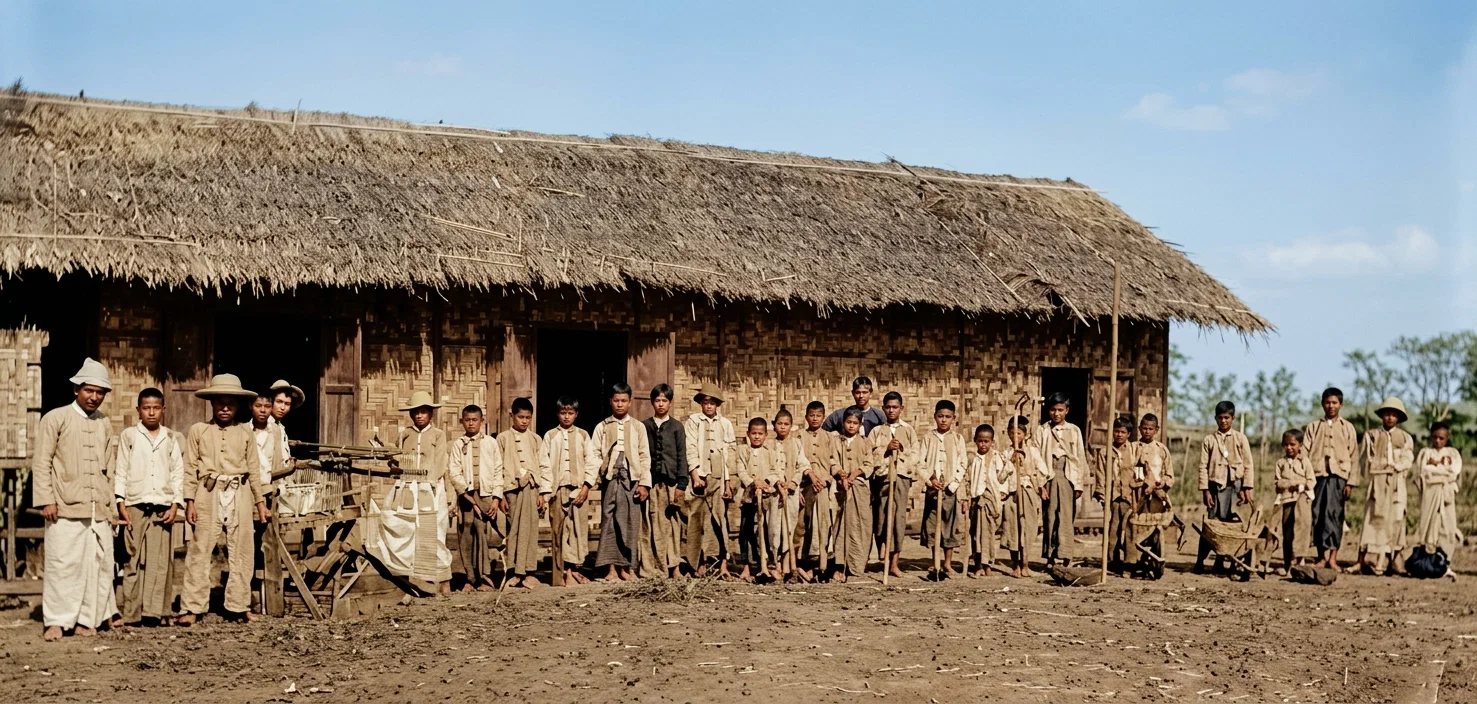
On Thursday last we commenced our teachers' school at Malamulo. We plan to continue it two months before sending our boys out again to teach in the village schools. We believe that during this time the Lord will help us to prepare for the great work that stands like a mountain before us.
A few of the teachers of last year seem to have fallen out by the way, but we hope to have sufficient to occupy all the schools which were in operation last year.
As I look at the mission church record, and, in fact, at everything connected with the mission, I can realize how much hard, faithful work has been done by the workers in this land. I pray that we who are now connected with this mission may have your prayers that the work may be carried on in God's own way.
On the church record there are ninety-seven names. Some of these persons have been connected with the church seven and eight years, and although many have been drawn away into the world's whirlpool, yet we have courage to labor on because we have a good company of faithful native workers, and also because Jesus is the “captain of the host of the Lord.”
Eight persons were baptized in 1905, and five of these are among our most faithful workers. One of these is Moses, who spent his early life in slave-trading. Now he is helping to catch men and women for Christ. One of the eight reports a class of twenty-five persons who have been in the candidates' class for baptism for three years. We hope to have them ready for baptism when Pastor Porter visits us in May.
Our Sabbath meetings are well attended, and all listen with much interest to the instruction. Brethren S. M. Konigmacher and G. A. Ellingworth, and I take turns in preaching at the after-meetings. Brother Ellingworth and I have to use an interpreter, but Brother Konigmacher is very fluent in the Chi-mang’-anja, and preaches without any difficulty.
The farm work is very disappointing this year, as we are so short of labor and can not cultivate all our crops. The work is all done with native hoes, and consequently it is a slow process. We hope to get some farm implements soon, and make use of our oxen another year.
We have recently lost nine head of cattle through the tsetse, and others are sick. We have abandoned the kraal for the present, and have built temporary structures for the cattle on higher ground. These measures will, we hope, prevent any more cattle from being infected. It makes our hearts sore to see the fine cows dying one by one, when we can do nothing for them.
We are all in good health and are enjoying the work. At present the roses and flowering shrubs are in bloom, and as there are plenty of trees all around us, this place is really beautiful. Fruit, too, is plentiful and good.
We are glad that permission has been granted us to enter Portuguese territory, and we would like to open stations both to the east and to the west of Nyassaland. But one condition of entry is that the workers first pass an examination in the Portuguese language, and we have no one here who can do that at present.
MEIKTILA INDUSTRIAL SCHOOL, BURMA
How much we need your prayers for God's help. As we think of these thousands of people living in gross darkness and superstition all around us, and of our slow, feeble efforts to reach them, we exclaim, How can we, by our present methods, finish the work in this generation? and the answer seems to be, God only knows.
And so, while difficulties are ahead, the outlook is encouraging, and by the help of God and your prayers, we mean to press on with the work.
Blantyre.
Syria
By W. C. ISING
W. C. ISING
In July, 1911, Brother Beshir Abo Hasso returned to Mosul (ancient Nineveh), after graduating here in Beirut as a pharmacist, to connect with the mission that sent him to college. His name, Beshir, meaning in the Arabic language, “bearer of good news; evangelist” (from the same root as bushaarat, meaning “gospel”), is very indicative. He was given several opportunities to present the message to the congregation of the church. Here are his words, written January 26:—
“I am not accomplishing very much here because you know that I have not the power of speech. I try, by the help12of God, to use every opportunity as best I can; but how I wish that some brother would come here who is able to explain the prophecies publicly, as you do in Beirut.
“Now I should like to tell you something of my cousin Altoon. When I first accepted the message, I began to pray that my family would also accept it, and I had great confidence that Altoon would accept. When I came to Mosul, he was working in an ice factory, and he used to sleep there as well. He seldom came home. One Sunday he came home, and said that he was obliged to work on Sundays also. I told him that it was not sin to work on Sundays, but on Saturdays. He was surprised to hear this, and began to oppose me. But now he is fully established in the truth, and is willing, with all pleasure, to be baptized. He is keeping the Sabbath under many trying circumstances.
Another brother baptized last summer, Brother Haris (meaning watchman), has just recently gone through an experience that shows God’s kind care for his children. Laboring outside the offices of the Singer Manufacturing Company here in Beirut, where he has a good position, he had been able to arrange his work so as to keep the Sabbath. But of late there arose difficulties, and there was danger that he would both lose the work and get into trouble concerning the truth, since he was somewhat inexperienced. After a straight talk with the director of the company here, who himself is a proselyte from the Jews and keeps Sunday, and who told me that other Jews in connection with their work are obliged to labor on Sabbath, our brother was given the Sabbath free. We clearly saw God’s help in this case.
There are other such souls in Syria, but they must earnestly be searched for. I have come in contact with an Armenian family where I have been holding Bible studies. The family lost their property in Adana last year, and came to Beirut. They all eagerly listen to the prophecies. The father was obliged to return to Adana [near ancient Tarsus, where Paul was born] just recently to settle some business matters, and will probably stay away several months. But he has been supplied with a prophetic chart and other material, which he is eager to use in teaching the truth to the people in that region. He says he has for some time been led to study the books of Daniel and the Revelation, but he could never make out the meaning of it all. He was practically loaded with questions, and it seemed that he could not hear enough to satisfy his longings. When touching on the Sabbath, he said he would seriously consider this matter. He has two bright young boys, who know the English quite well. The family consists of six persons, all appearing very promising lovers of the truth. May the Lord, through the loss of their earthly prosperity, lead them to the knowledge and acceptance of that treasure which is laid up in heaven, that will never fail.
Beirut.
We Thank Thee
By D. H. Hammond
We thank Thee for the sunny days
Of summer past and gone;
We thank thee for their cheering ways
And wealth of wild-bird song.
We thank thee for the flowers they brought,
Their butterflies and bees;
We thank thee for the shady spot,
And sweet perfume on breeze.
We thank thee for the pastures green,
The cattle feeding sleek;
We thank thee for each summer scene,
The river and the creek.
We thank thee for the showery time,
And for the warm days grand;
We thank thee for the days of shine
Spread out all o'er the land.
We thank thee for the days all light,
And for the days all dark;
We thank thee for the harvest bright,
And trade on busy mart.
We thank thee for the orchards fine,
And all their wealth of fruit;
We thank thee for all brutish kine,
And food their tastes to suit.
We thank thee for the autumn shower,
And winter's snows 'neath feet;
We thank thee for thy wondrous power
To make all things complete.
We thank thee for our lives still cared,
And for thy love revealed;
We thank thee we have still been spared
Our powers for thee to wield.
We thank thee for thy Word so true,
Its promises oft tried;
We thank thee each day learned anew
Some truth when we have pried.
We thank thee for the joy, the light,
Which comes from thee alone;
We thank thee, Father, that no night
Can reach where is thy throne.
We thank thee for the future still
To peer into each day;
We thank thee thou canst each day fill
With joy upon our way.
We thank thee for thy wisdom grand,
To understand thy ways;
And now we ask thy help to stand
For right throughout the days.
— D. H. Hammond.
Ignoring the Children
By DELTA L. SLOAN
DELTA L. SLOAN
Not long ago an officer of one of our conferences was visiting the churches and isolated members through the conference, and on his way stopped at the home of a certain isolated family. After he had gone on his way, the mother, speaking of him to her seven-year-old child, said, “How do you like him?” Unexpectedly came the rather blunt reply, “O, I don’t care much for him!” “Why?” the mother asked in surprise. “O, because he won’t talk to anybody but you and papa! He didn’t talk at all to me;” and the mother could not remember that the minister had spoken one word to her little one.
Having noticed this tendency on the part of some of our ministers, as well as some of the laity, to ignore the children, it has grieved me much. The members of the family mentioned do not have either Sabbath-school or church-school privileges, and the mother is trying hard in a very worldly community to bring up her child in the fear of the Lord. She had a right to expect that the visiting minister would show a kindly missionary interest in her little one, thus helping her to bind his heart closer to the truth; but the child, apparently passed by unnoticed, felt the seeming indifference. An opportunity was lost of showing to the child the love of the Father, and thus of drawing him nearer to the kingdom.
Let us take time and thought for Jesus’ little lambs. They have so much to meet now, temptations and snares of every description on every hand; and they certainly need all the help they can get from the older members of God’s family. Let us strive in this as in other things to imitate our perfect Pattern, the lowly Jesus, who said, “Suffer the little children to come unto me, and forbid them not: for of such is the kingdom of God.”
Some Sensible Suggestions as to Amusements
A NUMBER of years ago the old Christian Union of New York gave six general principles as a help to the individual, perhaps, in deciding such questions as, Shall I play poker? Is it right to play cards? to go to the theater? to play billiards? to dance? We reprint a portion of this article for the benefit of those who are troubled by the same questions:—
1. When you are in Rome, do not do as the Romans do.
There are questions which majorities must determine; there are questions which each soul must determine for itself. The still, small voice of conscience ought to be louder than the noisy clamor of the multitude. Even rabbis and priests may lead the cry of Crucify him! Crucify him! What everybody does may be right, but is quite as likely to be wrong. That everybody goes to bull-baiting in Spain does not make bull-baiting right; that everybody goes to the theater in New York does not make theatergoing right. Neither does it make either wrong. Majorities do not determine moral questions. There is no presumption in favor and none against what everybody does. Everybody is just about as apt to go wrong as right. Do not follow the flock of sheep over the wall. Look for yourself where you leap. The13whole law is not fulfilled in this one word, Thou shalt not be odd. Because everybody waltzes may be an excellent reason why you should refuse. . . .
3. Keep on the safe side of certainty.
“He that doubteth is condemned if he eateth.” Whatever is doubtful is dangerous; whatever is dangerous it is safe to let alone. Take a piece of paper and write down on it all the amusements that you are doubtful about. You wish that some one would tell you whether these are right or not. The interrogation-point tells you: for you they are wrong. Cross them all off the list of possible recreations so long as the interrogation-point is there. If the interrogation-point is ever removed, still leave them crossed off for at least six months. There are enough amusements that are not doubtful. There is ice enough that is strong; do no skating on thin ice.
4. The pleasure which is more pleasurable than your work is to be taken with caution.
We do not say that it is to be discontinued, nor even that it is doubtful, but that it is to be taken with caution. So long as a man enjoys his work more than he enjoys his pleasure, his pleasure is comparatively safe. The great danger is from a mind given over to pleasure; the great safeguard is a mind consecrated to its work. If the mother enjoys the party more than her children, to her the party is dangerous. Be on your guard against pleasures that are more delightful than duties. “Nonsense! we must then be on guard against all pleasures?” Very well! Be on guard against all pleasures. It will do you no harm. If your work is a dull routine, any pleasure may become a seductive temptation.
5. For “What is the harm?” substitute “What is the good?”
What is the harm of cards, of dancing, of billiards, of the theater? Bury that pernicious question. Never ask it again. Substitute another, What is the good? Life is too short to waste any of it in things that are merely harmless. Devote it, the whole of it, every hour and minute of it, to what will do you or some one else some good. Whatever bears no fruit, cut down; why cumbereth it your little ground? You have none to spare. Does the evening game of cards quicken your faculties for the next day’s work? Does the evening dance give you a better appetite for the next morning’s breakfast? Does the game of billiards send you back to your desk with new zest for your labors? Does the theater purify your imagination, or broaden your sympathies, or quicken your sensibilities? We are asking questions, not answering them. That we leave for you to do. We can readily understand that there is no universal answer to them; that different readers will give different answers. Then let different readers have different practises.
6. Thou shalt love thy neighbor as thyself.
You have no right to consider the effect on others: on your companions, on the community. You must apply all these principles to this larger problem—the public good and the public evil. You will not play with fire if your neighbor will thereby be burned. You will not even warm yourself by a fire, if that fire, once lighted, will set the woods on fire. Is it safe for me? Is it useful to me? Is it safe for the community? Is it useful to the community? Put these questions to every recreation that offers itself to you and to your family.
If you never do what everybody does, because everybody does it; if you never judge your neighbor by yourself, or yourself by your neighbor; if you cross off from your list every amusement that has in your own mind a question-mark after it; if you are always on your guard against pleasures that are more pleasurable than your work; and if you never do anything if there is injury in it to you or your neighbor, nor unless there is benefit in it to you or your neighbor, —you will be able to solve most of the perplexing questions of social life and amusement to your own final satisfaction, though probably not to the satisfaction of all the rest of mankind.
The Bath-Room
CARE of the bath-room is one of the most important details in housekeeping, and if left to the control of the average servant will be neglected. While once a week is sufficient for its thorough cleaning, every part of the bath-room should be cleaned every morning, to insure perfect safety from disease germs. Aside from the convenience of good drainage, the health of the family demands that all waste-pipes be kept as clean as possible.
A zinc-lined bath-tub should be kept scrupulously clean, as the zinc absorbs impurities; and if the zinc has become dark from careless washing, it may be brightened by rubbing with a mixture of fine, sifted ashes and petroleum, but the drain should be stopped before cleaning the metal.
Brighten nickel bath-room fixtures with whiting moistened with ammonia, and polish with a piece of dry flannel. Copper faucets and the like may be cleaned with diluted oxalic acid. Brass which has suffered from neglect may be cleaned with oxalic acid, while rotten-stone made into a paste with kerosene is all that is required for polishing brass that simply needs brightening.
The nickel and brass fixtures in the bath-room may be kept bright, and will not require to be polished so often, if they are washed every morning with a strong pearline suds, and then rubbed dry with a soft flannel cloth. The bowl and tub may be kept beautifully white and clean by washing with hot suds every two or three days, adding now and then a little ammonia or soda to the suds.
Keep a bottle of ammonia in the bath-room, and let it be used freely around the drain-pipes. This will help to carry off any collection that may interfere with the perfect drainage, and the bath-room will never be the starting-point of disease if the waste-pipes are kept perfectly clean.
—Selected.
Why Consumption Is Not Cured
In the spring of the year, Mr. Brown moved into a house in another part of the town from that where he had always lived. By autumn he had contracted tuberculosis. It was learned later that several different families which had occupied this same house in succession, had lost, in turn, several members from tuberculosis. No attempt had ever been made to disinfect the house.
Mr. Brown went at once into the country, pitched his tent on a certain spot, and never made any change from that one spot until his death. Note that fact. As a result, the soil over which he slept night after night became saturated with the accumulated germs which he expelled in coughing, so that he was continually, at night, rebreathing into his system the very “seeds” which caused the disease. He was repoisoning himself nightly, and didn’t know it. His system would have been able to throw off the original germ poison which it contracted, but it was not strong enough to withstand a new dose of the poison every night. Had he daily changed the location of his tent, he could have slept each night in an atmosphere practically germ-free.
There is a lesson in this. The open-air treatment is all right, but it must be14carried out by right methods. All early cases of consumption that have failed to recover by outdoor treatment must lay the blame to faulty treatment. Mr. Jones, who went into the country and recovered, changed his location every day, and in doing so, he avoided Mr. Brown’s fatal mistake.
How about Smith? This case is of the greatest importance. He recovered his health in the country, and returned to his home feeling fine—back to what?—To the very same plague-ridden room in which he had first contracted the disease,—a room reeking with tubercular germ-life, which had been occupied, it was learned later, by five different consumptives at various times. The disease got a hold on him the second time for the simple reason that he came back to the original source of his disease. He should have sought new quarters; or else the house, and particularly the room he occupied, should have been disinfected before being occupied by him or by any one else.
These three cases cited are but typical instances. There are thousands upon thousands of Browns, and Joneses, and Smiths, living and dying this very day, whose story, if told in its true light, would match exactly the simple but pathetic histories of these three men.—Technical World Magazine.
Family Prayers
By Canon Liddon
THERE is one mark of a household in which God is known and loved which is too often wanting in our day; I mean the practise of family prayer. Depend upon it, the worth of a practise of that kind can be measured only by its effects during a long period of time; and family prayers, though occupying only a few minutes, do make a great difference in any household at the end of the year. How, indeed, can it be otherwise, when each morning, and perhaps each evening, too, all the members of the family—the old and the young, the parents and the children, the master and the servants—meet on a footing of perfect equality before the Eternal, in whose presence each is as nothing, yet to whom each is so infinitely dear that he has redeemed by his blood each and all of them? How must not the bad spirits that are the enemies of pure, bright family life flee away,—the spirits of envy and pride and untruthfulness and sloth, and the whole tribe of evil thoughts,—giving place for the Holy Spirit’s presence in the hearts of old and young alike, who, as he brings us one by one nearer to the true end of our existence, so does he alone make us to be “of one mind in a house” here, within the narrow presence of each home circle, and hereafter in that countless family of all nations and tongues, which shall dwell with him, the universal Parent of all eternity.—Canon Liddon.
The Gift All May Give
By Delia Hart Stone
One gave a gift not bought with gold,
For gold he seldom had,—
A precious gift to one most dear,
And who received was glad.
He gave the gift to other friends,
He gave with happy heart.
To each and all it carried joy,
'Twas of himself a part.
Nor wrapped nor sealed, 'twas postage free
Where'er the gift was sent,
And always reached, without delay,
The one for whom 'twas meant.
He gave the gift to those in need,
He gave it more and more,
Yet, though full oft he gave the gift,
It but increased his store.
And many be who need the gift,
And for it daily pine,
For wealth is powerless to bestow
This precious gift divine.
How blest to give, and blessed, too,
Are those who love receive,
And more than gold this pearl of price,
This gift that all may give.
— Delia Hart Stone.
Encouraging Progress in Tennessee
By J. S. WASHBURN
MEMPHIS.— The experiences in the work in this thriving Southern city have been an additional proof to me that God is directly leading this people through the spirit of prophecy. Before coming here my mind was not clear that it was best to come, and circumstances led me to do that which I had never done before, appeal directly to the one to whom God had given the gift of prophecy. The answer was clear and definite, “Go to Memphis.” While there have been difficulties and conflicts in the work, yet we have seen remarkable evidences that that message was from God.
One hundred fifty have signed the covenant to “keep the commandments of God, and the faith of Jesus.” As usual, of course, a few have not proved faithful, and some have moved away from Memphis; but the church, which was very small indeed, has now one hundred members, and others are coming into the light.
Last Sabbath, March 30, we baptized, among other converts, a brother who learned the truth in the far Northwest, though a Southern man by birth. He will, we believe, be a help to the church in Memphis. The marked presence of the Spirit of the Lord at the baptism brought several others to a definite decision, who will also help to strengthen the work here.
Some of our brethren hold important positions in the offices of leading wholesale sale firms and of the great railroad companies. Memphis is one of the greatest railway centers in the South. The wives of some of the leading business men and merchants of Memphis are members of the church here.
An earnest seeker for light and truth, a member of an educated Southern family, found the truth through reading the book “Daniel and the Revelation,” and began to keep the Sabbath before she knew there were any other Sabbath-keepers in Memphis. In a remarkable way she found the church, and rejoiced greatly in the new-found light. Her married daughter and her son thought she had lost her mind, and the son came home from New Orleans to persuade his mother to give up the strange doctrine that he thought had unbalanced her reason. They came to the tent-meetings to get a clue to use against the mother’s strange delusion. They became interested at once, and soon fully accepted the great truth that had so completely taken possession of their mother’s mind and heart.
The transformation wrought in the life of the young man has been truly miraculous. There was a fearful struggle with the drink habit, and especially with the habit of smoking. His brother, a cotton merchant of New Orleans, a worldly man, evidently tested the new “strange notions” of this brother to the utmost. We earnestly prayed that the Lord might keep him from falling, and the prayer was answered. He was more than a conqueror. His brother declared at last that the change in him was wonderful, past all understanding. “He is simply a miracle.”
This young brother has become a successful worker, having been granted a ministerial license by the conference. Among others who have been brought into the truth by his life and his earnest work, are his mother’s sister, for many years a confirmed Christian Scientist; and her married daughter, the wife of one of the business men of Memphis, is now keeping the Sabbath.
His mother, the first of the family to accept the third angel’s message, has brought into the truth another sister; and her husband, an old Confederate veteran, is also keeping the Sabbath. Their son also, one of the respected physicians of Memphis, and his wife have united with the church, and he is now one of its officers. Other members of the family are interested. The sister who first accepted the truth is still working most earnestly for other relatives and friends. For several months last year she was in Manchester, England, on a mission for the truth with relatives there. To give the message is the all-absorbing passion of her life. Ought it not to be so with all our people? Should they not all be workers?
The papers in this city have widely advertised the meetings, and have been15most favorable and friendly, especially the Commercial Appeal, which for months at a time has published brief daily reports of the tent-meetings. The editor of this paper is a Catholic, yet he has always treated us most kindly.
Three years ago it became necessary, against our choice and wish, to hold a ten days’ discussion with J. S. Warlick, a noted no-law and no-Sabbath champion of the Disciple Church. The city was thoroughly stirred, a Catholic reporter writing up flaming head-lines for the daily reports. Two editorials favorable to us also appeared. The Commercial Appeal showed up the tactics and wicked arguments of the no-law theory in such an unfavorable light that Mr. Warlick publicly denounced the editor, and later stated that the reports were written by Adventists, and that the wife of the editor was an Adventist. The no-law advocate made an appointment for a great series of meetings in Memphis, but failed to keep his appointment, and has never been in Memphis since the discussion, to the great disappointment of his friends.
Several excellent persons have united with us as the result of the discussion, one of them being one of the present deacons of the church. The people of the city were favorably impressed with the truth as the result of the discussion. While we believe discussions should be avoided if possible, they may sometimes be necessary, and this is stated by the spirit of prophecy:—
“Whenever it is necessary for the advancement of the cause of truth and the glory of God, that an opponent be met, how carefully and with what humility should they (the advocates of truth), go into the conflict. With heart-searching, confession of sin, and earnest prayer, and often fasting for a time, they should entreat that God would especially help them, and give his saving, precious truth a glorious victory, that error might appear in its true deformity, and its advocates be completely discomfited. . . . If it can not be well avoided, enter the conflict, but enter upon it with firm trust in God, and in the spirit of humility, in the spirit of Jesus, who has bidden you learn of him who is meek and lowly in heart.”—“Gospel Workers,” page 195.
The wife of one who held an important position in the office of the Commercial Appeal is a member of the church. Her husband died last summer fully in the truth, and his funeral was attended by the editor in chief and members of the staff, who listened with apparent deep respect to the Scripture reading and teaching of the blessed hope. This great paper, one of the strongest papers in the South, has helped our work very much. Our people ought to appreciate the great power for good the newspaper can and must be in the closing work of the message. We are thankful to see the General Conference making newspaper reporting one of its regular departments, and giving our city workers training for this important work under the influence and guidance of experienced newspaper men.
Our canvassers and Bible workers have helped greatly in the work in Memphis. Brother F. T. Wales, who died last summer at the advanced age of more than eighty years, has left here bright jewels that will shine in his crown forever and ever.
The church in this city is made up almost entirely of Southern people. There are no people in the world more loyal and firm in the message than our people in the South, and the South is an excellent training-ground for missionaries. From this immediate field one earnest Christian young man and his wife have been laboring with success for some time in southern India, and other Southern workers have gone to other fields. The work in the South is developing in a most encouraging manner; and while there are serious conflicts before us, yet the immediate future looks bright and hopeful. Who will join the army of workers to labor with love and tact and earnestness in this important field to whose needs our minds have so often been called by the spirit of prophecy? J. S. WASHBURN.
Run Away Now; I Am Busy
ONE of the most serious mistakes that scores of mothers make in rearing their children is in allowing them to be lonesome or to have dreary hours at home. Too many mothers by far shut their children off from their personal work instead of teaching them to share it. “Run away now; I am busy” is a familiar mother’s sentence of banishment to a child who is seeking to take part in his mother’s world of work. Perhaps no other sentence in the category of the average mother has sent so many children out to seek wrong affinities with playmates, or to learn some idle form of amusement. Of course, it is true that the child’s part in the mother’s work may be more of a hindrance than a help, if the mother chooses to look at it from that standpoint. But what is the accomplishment of a “big morning’s work” in comparison to an empty hour in a child’s life? The years that our children spend with us are all too few, and no action of ours should banish them from our sides when their natures reach out to us. No mother can afford to let any chance pass to have her child get better acquainted with her. It benefits the child, and educates the mother.— Ladies’ Home Journal.
Faithfulness in Every Duty
“WHATEVER is right to do should be done with our best care, strength, and faithfulness of purpose; we have no scales by which we can weigh our faithfulness to duties or determine their relative importance in God’s eyes. That which seems a trifle to us may be the secret spring which shall move the issues of life and death.”
South Caribbean Conference
By F. G. LANE
THE seventh annual session of the South Caribbean Conference was held in Port of Spain, Trinidad, March 1-7, 1912. It can be truly said that this session of the conference enjoyed a better general representation than any preceding one. Every island in the field, with the exception of St. Lucia, was represented by local delegates. The outside interest was good throughout the entire conference.
Just preceding the conference session, a canvassers' institute was conducted by Brother G. C. Jenks, field missionary secretary of the West Caribbean Conference, assisted by the conference president, Elder J. B. Beckner. A class of sixteen received instruction in this branch of the work, and no doubt when these get into the field, we shall hear some interesting reports. It can be well said that the canvassing work in this conference has received a new impetus, and been placed on a firmer working basis.
Sabbath, March 2, a consecration service was held, in which all realized the presence of the Holy Spirit. A large number, after an interesting discourse on practical godliness, came forward to reconsecrate themselves to the Lord and his service. Thus all were prepared to enter into the business of the conference, the proceedings of which were characterized by a spirit of unity.
The afternoon services, during the early part of the session, were devoted to Sabbath-school and young people's convention work, in which many interesting and instructive papers were read. These departments of the message enter upon the work of the present year with encouraging prospects.
In the midst of the session, Elder N. H. Pool, with his wife and little son, arrived from Indiana, and were heartily welcomed into the conference. Elder Pool comes in response to an urgent call for help from this part of the field.
Among the many good resolutions passed, was one in which it was resolved to put forth every effort possible during the year to place the South Caribbean Conference on the list of self-supporting conferences; and, judging from the work done in this direction during the past year, prospects are fair for accomplishing this purpose.
Elder Beckner was unanimously re-elected president, and with few exceptions the other officers will remain the same as during the past year.
The laborers present from outside the conference were Elder U. Bender, president of the West Indian Union Conference, Brother G. C. Jenks, and the writer.
We were glad of the privilege of attending this meeting, and feel sure that some encouraging experiences await the South Caribbean Conference.
F. G. LANE.
Western Washington
By Daniel Nettleton
PORT TOWNSEND.—The past week has been one of special blessing to the church of God at this place. The membership of the Sabbath-school and church being composed almost wholly of those connected with the Northwestern Sanitarium, makes it a sanitarium church. Like all our institutions, it has had its troubles and trials, as well as its great blessings. We have just passed through a severe trial, and have, we trust, by these trials obtained some of the “patience of the saints.” The Lord has done great things for us, whereof we are glad. It is a great victory for the people of God when brethren put away all differences for the sake of God’s cause and the salvation of souls. With hearts filled with love and hope and with faith for a happy future, we press forward to help finish the work God has given us to do. With gratitude we remember God’s many blessings to us during the year, and the happy adjustment of some of our difficulties fills the hearts of all our family with joy. Our meetings have been seasons of refreshing. God’s Spirit has been impressing hearts that have not known him to learn and obey his truth.
Our tithe and donations have increased during the past year. This little church has sent to the foreign missions over four hundred dollars. Six persons, all adults with families residing at this place, were converted and accepted the truth; five of these were baptized and united with the church here this winter.
A Sabbath-school convention was held at this place April 6, and was attended by all the members of our own church and by a few isolated brethren. Papers and addresses on the following subjects were presented: Organization and Importance of the Sabbath-School Work; Development of the Sabbath-School Work From Organization to the Present Time; Reverence for the House of God; The Sabbath-School as a Factor in Carrying the Third Angel’s Message; What Can I Do to Help the Sabbath-School? Appropriate songs were sung by the children, and solos and quartets by other members of the Sabbath-school. Our chapel was beautifully decorated with living green and with appropriate mottoes. Above the Missionary Map of the World was placed the significant motto “Progress”; and by a study of the field we see that not only in our own local church, but all over the world, progress is being made in our work.
In the afternoon the ordinances of baptism and of humility and the Lord’s Supper were celebrated. Our day of blessing closed with a praise service, in which every one present took part.
The church of the living God is the pillar and ground of the truth in the earth, and the hand of the infinite One is stretched out to bless and to guide it16to final victory. May this little company be a part of that victorious host who erelong shall pass through the pearly gates of the city of God, to dwell forever where the wilderness and the solitary place shall be glad for them, and the desert shall rejoice and blossom as the rose. DANIEL NETTLETON.