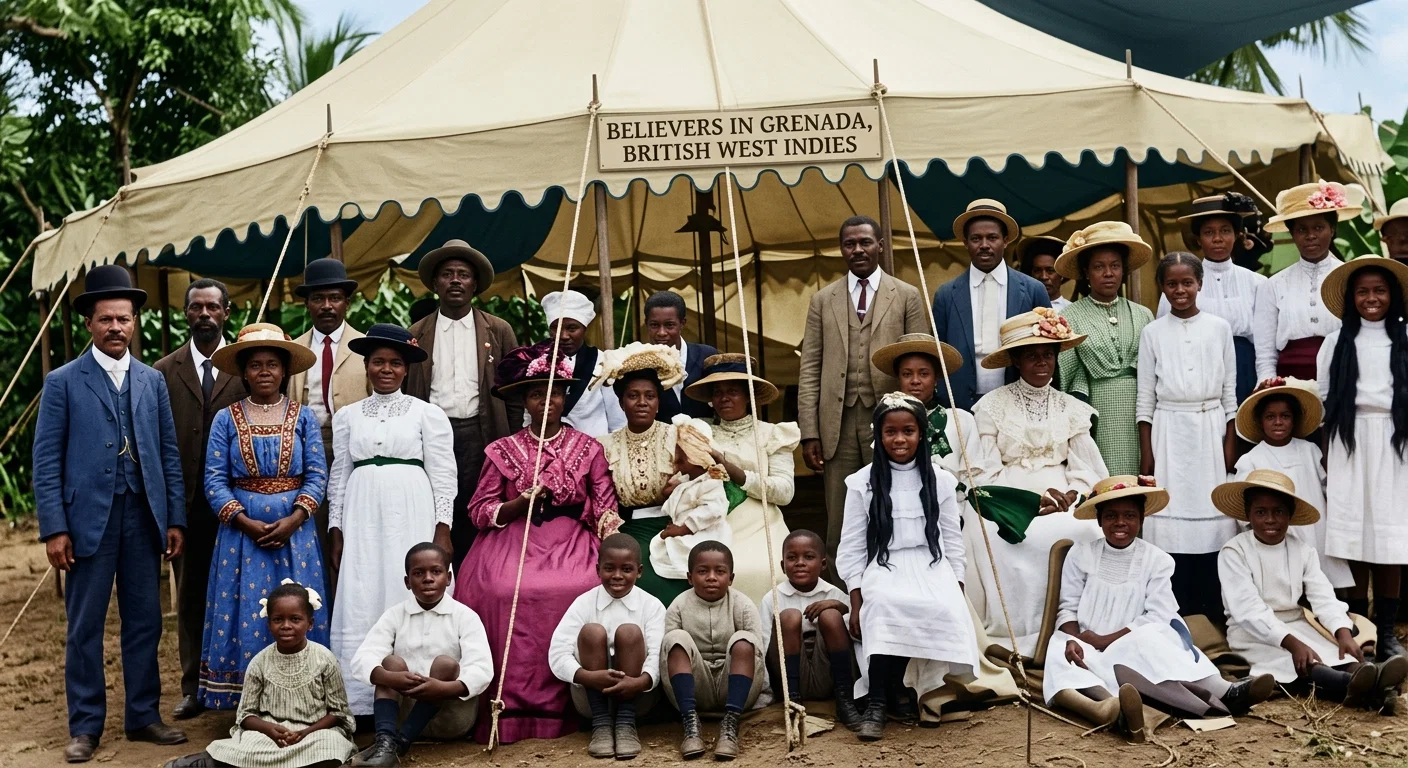
GRENVILLE.—On July 16 last, with the help of our conference Bible worker, we started a series of meetings in this town. Quite an interest was created, but unfortunately sickness in my family compelled me to leave the place for a few weeks. The interest naturally waned some before my return.
On November 22 a tent was pitched one and one-half miles out of the town, and meetings were begun, which were continued into March of this year, against great odds. We have done much visiting and have held meetings, many times, while suffering from the fever. Brother C. D. Adamson, a canvasser, rendered valuable help.
The Roman, Anglican, and Wesleyan churches are represented here. The ministers have opposed us most bitterly. I supplied them with tracts, and called on the Wesleyan minister; but as he does not believe all the Bible, much could not be done with him.
In spite of all, the truth is gaining a foothold. Our Sabbath-school now numbers about thirty. January 28 I baptized eight persons, and on March 23 two others, and some others will follow later. Truly, it can be said of this company that they have "come out of great tribulations." One sister has been beaten severely twice by her husband, for not working on the Sabbath. A young woman who was organist, and also held other positions in the Wesleyan church, has suffered much censure and many trials from those "higher up"; but all are of good courage.
The great need now is a house of worship. Land is scarce, and is sold as high as £100 an acre. Those who have united with us are poor in this world's goods. If help is given from outside, and a neat church building erected here, there is every reason to expect a good church-membership later. Who will help? The president, Elder J. B. Beckner, 31 Dundonald St., Port of Spain, Trinidad, British West Indies, will be happy to receive any donations sent through the regular channels; but please specify that it is for the Paradise (Grenada) church building. "God loveth a cheerful giver." Pray for the work here.
A. N. DURRANT.
Mission Work Among the Negroes in Montgomery, Ala.
By GEO. E. PETERS.
I AM grateful to be able to report progress in every department of the work in this city. The tithe for 1911 amounted to $398.45, about $150 more than for the previous year, and the donations to foreign missions, including our Sabbath-school offerings, amounted to $86.46.
We have torn down our old mission building, which was in quite a dilapidated condition, and have built a modern structure, consisting of rooms for the workers, and an auditorium twenty-two by thirty-eight feet. The building was dedicated March 10. We were glad to have present Elder A. J. Haysmer, secretary of the North American Negro Department, and Elder C. F. McVagh, field secretary of the Southern Union Mission. The dedicatory sermon was preached by Elder McVagh. Elder Haysmer offered the dedicatory prayer and made a very timely address. Several visitors were present. At the close of the service our visitors rendered financial aid to the amount of twenty-eight dollars.
During eighteen months, twenty members have been added to this church by baptism. At present several not of our faith are interested, and we hope to see them come into our ranks soon. We request the special prayers of God's people for the work in the Southern cities.
GEO. E. PETERS.
Times of Refreshing
By A. N. ALLEN
LIMA, PERU.—The visits of our general workers to the mission fields are indeed times of refreshing. Only those who have battled alone against difficulties for long periods, can appreciate the real blessing our general workers bring to those on the battle line. How the days are counted, even the hours, until we can greet those who have been longer in the way, and who we know can give us faithful counsel; how any delay, of even a day, in their arrival is felt.
The few days Elder W. A. Spicer was able to spend with us in Peru gave a most valuable uplift to all our workers, spiritually and practically. May God help us to remember and put in practise all the instruction received.
After a few days with us here in Lima, Elders Spicer and J. W. Westphal, and the writer, visited Brother and Sister F. A. Stahl, among the Indians in the south of Peru. We found twenty-two ready for baptism. We all felt the altitude somewhat. No doubt those who work in such heights will be obliged to arrange to spend part of the year in lower regions.
In view of the fact that our Peruvian workers had never attended a general meeting, and that there would probably not be another on the west coast soon, we decided that all should attend our union meeting in Chile. Seven were enabled to go. In order to do this, we all traveled third class.
The lessons given by Elder Spicer on the exodus and the advent movement were most timely. The Spirit impressed the truths on the hearts of all. Surely God is preparing his people and the world for the loud cry of the third angel's message.
Brother and Sister R. B. Stauffer returned with us to Peru, to take charge of the book work. An institute is now in progress, and several new men are preparing for the field. Brother Cæsar Lopez, who had charge of the book work last year, will go to Ecuador to canvass and do missionary work. The workers are all of good courage, and have returned to their work to push it to the close of time. A. N. ALLEN.
New Zealand Conference and Camp-Meeting
By J. E. FULTON.
AN excellent camp-meeting was still in progress at the time the writer left for the Victorian meeting. The business session of the conference, held during the first few days of the meeting, was harmonious and successful in every way.
We called attention last year to this excellent way of conducting camp-meetings, and we are sure that the plan will commend itself to all our conferences; that is, to have the delegates come a few days early and get all the business out of the way before the first Sabbath.
Those coming from abroad to labor in the interests of the camp were Brethren Johanson and Faulkhead, and the writer. During the early part of the meeting, Pastor B. J. Cady arrived from the islands. His labors were much appreciated. All the local workers of the conference were present, and rendered efficient service.
The attendance at the New Zealand camp-meeting was excellent. It was feared that a camp held so far north as Auckland might not be so large as the meetings held the last few years in cities farther south, and hence more central. But in this we were happily disappointed, there being about sixty family tents pitched, while a goodly number had to get rooms, owing to lack of tent accommodation. This was better than in previous years.
The tents were pitched in a beautiful spot in full view of thousands of people, and the trams came within easy reach of the grounds.
The weather was all that could be desired, and our brethren all felt that God had specially favored his people. A good spirit was manifest, and all joined heartily in the worship.17
The whole camp was arranged in a neat and tasty manner. The dining-tent, ornamented with flowers, and tables spread with white linen with good cutlery and with appropriate dishes, made one enjoy his meals, as well as feel like inviting in strangers. And the food was as good as the arrangement was excellent.
The attractive arrangement of the large tent elicited frequent favorable comment from strangers; and the young people's tent was most tastily arranged. Considering the expense of our camp-meetings, it certainly seems that it would pay to expend a little more effort to make them attractive and inviting to our own people, young and old, and also to the general public.
A later report by the secretary of the conference will give the details of the business.
Pastor J. Pallant was released to the union conference vice-presidency, and Pastor J. M. Cole takes his place in New Zealand, by the unanimous vote of the conference.
J. E. FULTON.
How May We Best Work for Our Young People at Camp-Meeting?
By B. E. HUFFMAN
The success of our efforts for our young people at camp-meeting depends largely upon the way we begin our work. I would, therefore, suggest that we begin by planning definitely for the young people's work, and be sure that the object of the meeting is understood by those chosen to work for the young people. This object, considered from the viewpoint of our young people, “is to attain a higher Christian experience, to advance in the knowledge of God, to become strengthened with spiritual vigor”; and unless this is realized, the meetings will, in a measure, be a failure to our young people. Considered from the viewpoint of our young people's workers, this object is stated as follows: “The ministers should teach the people how to come to the Lord and how to lead others to him. Methods must be adopted, plans must be carried out, whereby the standard shall be uplifted, and the people shall be taught how they may be purified from iniquity and elevated by adherence to pure and holy principles.”
Character of Workers
“Those who teach the word must themselves live in hourly contact, in conscious, living communion with God.” “They should keep in the very atmosphere of the meetings, becoming acquainted with the people as they come in and go out, showing the utmost courtesy and kindness, and tender regard for their souls. They should be ready to speak to them in season, and out of season, watching to win souls.” The young people's workers should become personally acquainted with each young person on the ground, and recognize him whenever he meets him. “It is acquaintance that awakens sympathy, and sympathy is the spring of effective ministry.”
Meetings
As a rule, too many meetings, I believe, are held daily in our camp-meetings, or if not too many meetings, they are often held too long. Our youth are expected to attend all the meetings held for the older people, and one or two others especially for them. Not being used to sitting in meeting all day, they will leave the services, pair off and go to the city, or wander aimlessly about the camp. This opens the door for many evils to creep in which defeat much of the good the camp-meeting should do for our young people. From “Testimonies for the Church,” Vol. VI, we quote: “Do not immediately follow one discourse with another, but let a period of rest intervene, that the truth may be fastened in the mind, and that opportunity for meditation and prayer may be given for both ministers and people.”
A definite program should be followed in all our camp-meeting work, and the services should begin and close on time. Two meetings for our young people should be held each day. The first should be a devotional service, and the second should be given to teaching the young people how to seek the Lord and how to lead others to him. “Every day—the early morning hour is the best time—a praise meeting should be held, a simple service of thanksgiving to God. There would be much more power in our camp-meetings if we had a true sense of the goodness, mercy, and long-suffering of God, and if more praise flowed forth from our lips to the honor and glory of his name.”—Id.
The afternoon young people's meetings should give special attention to teaching the young people how to be soul winners, and those who are Christians should be organized into bands or companies for prayer and for service.
Permanent Results
In this work we should plan for permanent results. We should not work alone to see a large number of young people converted at camp-meeting. If this is the extent of our purpose, we shall fail in a large degree of holding our young people in the truth. Too long have we as ministers been losing the results of our labor by leaving our new converts before they are well established in the truth. Let us no longer serve our own young people in this manner. The instruction given and the plans on which the young people are set to work should be such as they can use not only at camp-meeting but in their home churches. This may necessitate devoting one or two of the afternoon young people's meetings to reports from representative young people from the various societies and churches in the conference, in order that the workers may know the conditions with which our young people are surrounded. In fact, I believe that such reports are as inspiring and helpful to the young people as to those in charge of the meetings.
Our young people should be inspired with a zeal for a place in the Lord's work. They should be made to feel that the Lord has need of them, for he has a definite place for each one in his work. They should be talked with personally about their place in the work, and encouraged to enter upon the work for which they are fitted, or to attend school to receive such further education and training as may be needed.
State Secretaries
Influences should be set to work which will bind our young people to the State young people's secretary and conference president. These influences should be followed up by regular correspondence and other means of communication. Every young person at camp-meeting should be made to feel that the State secretary and conference president are his personal friends, those to whom he can come for encouragement and counsel at any time. Our young people are more anxious than we think, many times, to know the course to follow in order to steer clear of the hidden rocks upon which many are dashed to pieces. Our secretaries should be active in searching for these souls.
Parents' Meetings
I believe that at the same hour we hold our afternoon young people's meeting, a children's meeting and a parents' meeting should be held. If, while our children and youth are being instructed, some good father or mother in Israel who has made a success of rearing a family, should give instruction to our parents, the prevailing influences in many homes might be greatly improved, and the parents would work more intelligently for the education and salvation of their children.
B. E. HUFFMAN.
South Africa
By D. C. Theunissen
WORCESTER.—As the misfortune of sickness visited our home during the week of prayer, that season was not so enjoyable spiritually as it otherwise would have been; but what we then lost the Lord made up to us at our last quarterly meeting. This service was remarkable for the presence of the Master. Twelve of us sat down to the Lord’s table to partake of the emblems of his broken body and spilled blood.
On this occasion we also had an interesting testimony service, and the most remarkable of all the testimonies given was that of Mrs. Theunissen, who was so recently restored from the very brink of the grave. The Spirit of the Lord softened every heart as she testified to the wonderful healing power of her Lord and Saviour. With the psalmist, she could say, “Thou hast delivered my soul from death, mine eyes from tears, and my feet from falling. I will walk on before the Lord in the land of the living. . . . What shall I render unto the Lord for all his benefits toward me? I will take the cup of salvation, and call upon the name of the Lord.” We closed the meeting by singing “Rock of Ages.”
It may not be known to all that Mrs. Theunissen suffered from pneumonia and pleurisy combined, and it was predicted by the physician that quick consumption would set in immediately. But to the praise of the Lord, there is no sign of that dread disease.
Pastor W. S. Hyatt paid us a short visit on New-year’s day. We all enjoyed his few hours’ stay and the earnest address he gave us.
D. C. THEUNISSEN.
Field Notes
Six adults were recently baptized at Chico, Cal., by Elder C. L. Taggart.
ELDER GEORGE L. WEST reports that four have begun to keep the Sabbath as a result of the meetings he has been holding at Waterford, Pa.
ELDER A. O. BURRILL, who has been laboring in Colby, Wash., reports the baptism of six persons. At Paulsbo two have begun to observe the Sabbath.
Young People’s Work
Conducted by the Young People’s Missionary Volunteer Department of the General Conference
M. E. KERN — Secretary
MATILDA ERICKSON — Corresponding Secretary
Prohibition Continues in Maine
By S. B. H.
In harmony with the counsel of the brethren, the writer went to the “Pine Tree State” to assist in a temperance campaign inaugurated as a result of the calling of the legislature in special session to submit a local option amendment to that article of the constitution (Article XXVI) which prohibits the sale and manufacture of alcohol.
The legislature met at Augusta on March 20, the one hundred seventh anniversary of Neal Dow’s birth, and considered four matters contained in the governor’s call, the most important of which was the one concerning the resubmission of the prohibition article to the people for amendment. It required a two-thirds vote in both houses to pass the measure. In the senate the necessary votes were obtained, but in the house the requisite number could not be secured, and the attempt to amend the constitution in the interests of the liquor business ended in failure.
This means that the question becomes an issue between the two dominant parties in this year’s political campaign, one favoring the retention intact of the prohibitory article of the constitution, the other demanding that the saloon business be legalized in the large cities.
In conversing with legislators and public men, we had the privilege of setting before them the principles of true temperance. No public hearing was given, but members in both branches of the legislature made characteristic speeches, those against prohibition meeting the dignified and sensible position of the prohibitionists with sarcasm and non-pertinent witticism.
We prepared articles at different times for twoscore or more of the newspapers of the State, besides attending a Neal Dow meeting in Augusta, under the auspices of Mrs. L. M. N. Stevens and other temperance leaders.
We were privileged to meet with the churches and friends in Richmond, Brunswick, Portland, and in other places on the return trip to Washington. The Lord is blessing the labors of Elder J. F. Piper, the conference president, and also of Elder and Mrs. S. N. Haskell in the work in Portland. Brother George Whitney, of the local conference, assisted us materially, and this, with the hospitable treatment received, made our stay most agreeable.
S. B. H.
Missionary Volunteer Work in South America
BROTHER MAXIMO TRUMMER sends the following report from South America:—
“As we have had our union conference here in Chile, I will write and tell you of some of the plans for our young people’s work. We have tried to do a little for the young people. We have had half a dozen Missionary Volunteer societies in our union, and our experience has given us the evidence that we can do more. So at our recent union conference a resolution was passed to make greater efforts, and we accepted the rules of the General Department for our organization. Consequently the work was more thoroughly organized by electing state secretaries for the young people’s work in each field, and the union chose a secretary in its turn, to care for the work in general and to keep in touch with the General Office.
“In order to reach the isolated ones especially, it was decided to have a larger section in our union paper for the young people. In this we shall endeavor to have a certain line of studies, perhaps two each month, by which we may enlist the interest of those who can not join a society. Besides, we shall get out the Morning Watch Calendar in Spanish with the beginning of 1913, and thus aid the youth in forming the habit of Bible study and daily prayer.
“At present, I am helping in the reorganizing of the societies. Some of them have members who are not baptized. I am glad to say that this work among them has had a good influence, and several have taken a more decided stand for baptism.”
Washington Pastors and the Religious Garb in Indian Schools
By S. B. H.
A MEETING of the pastors of the District of Columbia was called at the Y. M. C. A. rooms, Monday, April 15, to consider the matter of religious garb in the Indian schools, concerning which a hearing was held before the Secretary of the Interior recently. After a few short, pointed speeches, the following resolutions were proposed, and adopted unanimously:—
“The Pastors’ Federation of Washington, in patriotic devotion to our distinctive American principles, views with apprehension the persistent and large encroachment of ecclesiasticism in our national political affairs, and exhorts all our citizens to a loyal and watchful guard against an evil that, unchecked, imperils the life of the republic.
“1. We earnestly protest against the recent revocation by President Taft of the order of Commissioner Valentine whereby the priests and nuns employed in teaching in the Indian public schools were forbidden to wear any distinctive religious garb or insignia while on duty in the public-school room. The action of Commissioner Valentine was the correction of a long-standing abuse against which protest had been earnest and indignant, and was wise, patriotic, and Constitutional. The action of the President is a profound disappointment to the great majority of the Christian citizenship of the republic. It is an un-American and a complete surrender of the essential principles of our national life which ordains the separation of church and state.
“Associated with the fact that the United States Congress annually gives large appropriations of money and often patents in fee for mission lands to the Catholic Bureau of Missions, the President adds the immense influence of his name and office to the work of converting the Indians to Roman Catholicism.
“2. We earnestly protest against the proposed action in Congress to appoint a Columbus day as a national holiday, because the demand for this holiday issues only from a very limited number of our people; and these being connected with one certain ecclesiasticism, we believe19it to be a covert attempt to secure a future saint’s day as a national holiday, and thereby establish a legislative and permanent recognition of this ecclesiasticism in our national life.”
Resolved, That a copy of this preamble and protest No. 1 be sent to the President of the United States, Secretary of the Interior, and the United States Commissioner of Indian Affairs.
That a copy of the preamble and protest No. 2 be sent to the committee on the judiciary of the House of Representatives, and that a copy of the whole paper be sent to Washington papers.
S. B. H.
Your Children
WILL you not read the following paragraph prayerfully? It is drawn from the experience of one of our successful young people's workers. This worker says:—
“I am making a special effort to get in closer touch with the parents this year, because whether the children become Christians or not depends so much upon the parents. The cares of this world keep many of them blind to the need of the children till they go wrong or marry out of the truth, and then they appeal to us to save them. At our last camp-meeting a mother said to me, ‘My boy will be here to-day,’ and I knew that she wanted me to speak to him, as we had been close friends since he was a tiny boy. As I looked at his bloated face, and saw the cigars sticking out of his pockets, I thought how the years since I had seen him had changed the bright-faced, cheery boy, with manly ways and always a helping hand; as I spoke to him of the things so near my heart, he said: ‘It is no use to talk; I know the right way, and would like to walk in it, but it is too hard to give up the things I have learned to love, and the company I keep.’ Tears ran down his face as we talked, and my heart ached for him, for his broken-hearted mother, and for his young wife. Then I remembered that his parents had taken him to the place of entertainment, the local grange, where he had first learned to associate with the outside boys, and had seen them do the things he was now doing. No appeal could break the bands that bound him, and his only sister has married a man who is fast becoming a drunkard.”
Our Young People's Tent
By H. M. Hiatt
We had the following mottoes on cloth, all in colors:— “To every individual of to-day God has assigned a place in his great plan.” “Jesus came to seek and save; but he can not save unless we seek.” “The advent message to all the world in this generation.” “Whatsoever a man soweth, that shall he also reap.” “It is the mission of the whole church to give the whole gospel to the whole world.”
Then we had forty-eight flags, twelve by eighteen inches (muslin), representing forty-eight different nations of the world. All except one had been entered by the third angel's message.
These made it easy to get the young people together and to hold their attention. All we had to do was to announce that there would be a lecture on the flags, and we had all the young people, and often many others. We raised forty-five dollars in one youth's meeting, with not over thirty present, and with the exception of six, all were young people.
H. M. HIATT,M. V. Sec. Southeastern Union.
Christian Liberty
By K. C. RUSSELL; S. B. HORTON
Reports, Notes, and Comments Pertaining to the Current History of the Rights of Conscience
Conducted by the Religious Liberty Bureau
K. C. RUSSELL . . . Secretary
S. B. HORTON . . . Corresponding Secretary
Alberta Industrial Academy
By H. R. S.
PRIN. J. I. BEARDSLEY sends an interesting report of his school in Alberta:—
“We opened October 18, with an enrolment of thirty-four, but this number has increased till now we have one hundred nine, twenty-one of whom are outside this local conference. Eighty-five per cent are in our academy home. This crowds our meager accommodations to their utmost capacity, and we have been compelled to rent rooms outside, and to make other arrangements in our dormitories to accommodate those who have applied for admission. Many were disappointed in the failure of crops in the three provinces from which we have drawn our patronage, or more would have applied.
“We are yet in the building stage, although we have been in operation five years. But the determination of our managing committees to shun debts has contented us to do with crowded quarters, rather than labor under a burden of indebtedness. Our young men’s dormitory, which for the time being is also our school building, is being finished this winter by some of our students during their spare hours from study. We have a class in house painting, under a competent instructor, also a student, which is doing good practical work. Our broom shop has recently shipped its first consignment of brooms, and we hope to make a success of this industry, even though we must bring our raw material such a great distance. We have the two-hour system of domestic work, and find that it gives satisfaction.
“Our primary department has an enrolment of eighteen, included in the above total. This department, by request of the local church, has been placed under the management of the academy.
“God has richly blessed us this year in every way. This was especially noticed during the week of prayer, when he came very near to us, nearly every student taking his stand for the truth.
“A number of our students spent last vacation canvassing, and as a result several are in school on scholarships. One young man earned scholarships for his brother and two sisters, besides a scholarship for himself, and all four are with us this winter. We expect a larger company will go out this year.
“We can see God’s hand leading in the educational work in Alberta, and although many youth should be with us this winter who are not here, yet we know that God will open the way, and will provide them means of securing preparation for the work he has for each of them to do.
“Although the farthest north of any of our schools on this continent, we are blessed with beautiful weather, even in the depth of winter; and during the three years it has been my privilege to be connected with the academy, we have never lost a moment of school-time because of the weather. Some of our girls have walked from one-half to two miles, to reach the school, before eight in the morning, with the mercury from thirty-five to fifty degrees below zero; but we have had but one blizzard this winter, and that lasted only an hour. The Lord blessed us with a fair crop on the farm last season, and we have all our own stock feed and vegetables, besides over twelve hundred quarts of wild fruit20which we canned. We are now considering what we can do to provide for the students who will surely come to us if there is a good crop next year. We are trusting God to lead the way, and we know that he has a care for his own work in the earth.”
From all parts of the field come these encouraging reports, showing that where the truth goes, schools spring up to train laborers to carry it still farther, that the whole world may be enlightened with the glorious light of the third angel’s message.
H. R. S.
It Is Indeed High Time
By S. B. H.
In an address opening the Daughters of the American Revolution Congress in this city, Monday afternoon, April 15, President Taft gave utterance to the following statement:—
“You are here to stimulate the memories of, and the respect for, those men who made this nation possible, and who laid broad its foundation in the Constitution of the United States; and you are here, if I understand, to uphold the principles of that Constitution, and to insist on their preservation as long as this nation shall endure.”
“We have reached a time in the history of politics in this country when we have to take down our copies of the Constitution and our copies of the ‘Federalist,’ and of the history of the growth of our institutions, and renew our vows to the principles that were there embodied in our governmental structure, to insist that they shall not be departed from, but that they shall be maintained in their vitalizing force to continue our pursuit of happiness and the guaranty of our institutions for the maintenance of liberty regulated by law.”
In the light of the well-known position that the Roman Catholic Church sustains toward civil government, namely, an indissoluble connection between it and the church; in the light of the aggressive steps Rome is taking in the field of politics in order to capture this land of liberty, and do for it what she has done for other nations; and in the light of her demand for a share of public revenues for the support of her parochial schools, and her present attitude in attempting to fortify herself against the Valentine religious garb order, these words of the President are very timely, and have an application with reference to the encroachments of the Roman Catholic Church. It is indeed high time that the American people should “take down our copies of the Constitution,” and review the history of the growth of our institutions, and “renew our vows to the principles that were there embodied in our governmental structure, to insist that they shall not be departed from, but that they shall be maintained in their vitalizing force to continue our pursuit of happiness and the guaranty of our institutions for the maintenance of liberty regulated by law.”
It was because of the record of the Roman Church in its doings with other nations, a very unfortunate record of antichristian ecclesiasticism, that our forefathers attempted to construct a government wherein the separation of church and state would be insisted upon then and for all time thereafter. Rome makes her boast that she will yet secure this country's institutions; and if she is to do for America what she has done for other nations, the downfall of the republic is certain. She is combining her forces for a political move in this country.
The Senate adopted a report in the second session of the Twentieth Congress (Jan. 18, 1829) in which was contained the following sentiment regarding religious combinations:—
“Extensive religious combinations to effect a political object are, in the opinion of the committee, always dangerous. This first effort of the kind [a measure committing Congress to Sunday legislation] calls for the establishment of a principle which, in the opinion of the committee, would lay the foundation for dangerous innovations upon the spirit of the Constitution, and upon the religious rights of the citizens. If admitted, it may be justly apprehended that the future measures of the government will be strongly marked, if not eventually controlled, by the same influence. All religious despotism commences by combination and influence; and when that influence begins to operate upon the political institutions of a country, the civil power soon bends under it; and the catastrophe of other nations furnishes an awful warning of the consequence.”
The above should serve as a hint to our public officials, lest they forget.
S. B. H.
Christian Education
By H. R. SALISBURY
Conducted by the Department of Education of the General Conference
H. R. SALISBURY Secretary
A Permanent Canvassers' School
By H. R. S.
In a letter just received from Pastor J. E. Fulton, president of the Australasian Union Conference, concerning the educational work in that field, there is given a description of a school recently established for the training of canvassers. This will be of interest to the readers of the REVIEW:—
“The latest effort along educational lines into which we have entered is a school, or institute, for canvassers. I think you will be interested in this. Although a very unpretentious little school, it has done a great amount of good already. And I believe if similar schools were started in different parts of the world, we should reap great benefits from them. Many young men have taken up canvassing with no particular training for it except what they got under their State agent. But outside of the drill they get in the sale of the book they have taken up, they often need a little instruction of a general character, and some special instruction in English. We have taken up a short course, embracing English, history, Bible, nursing, and, of course, book drill in salesmanship. During the short time the school has been in operation, it has proved of great benefit, and we have decided to make it a permanent feature of our work. It is held at Warburton. Our general agent is spending some time in giving drills. Brother A. W. Anderson, editor of the Signs, gives lessons in English and history. Our sanitarium nurses give some instruction in nursing.”