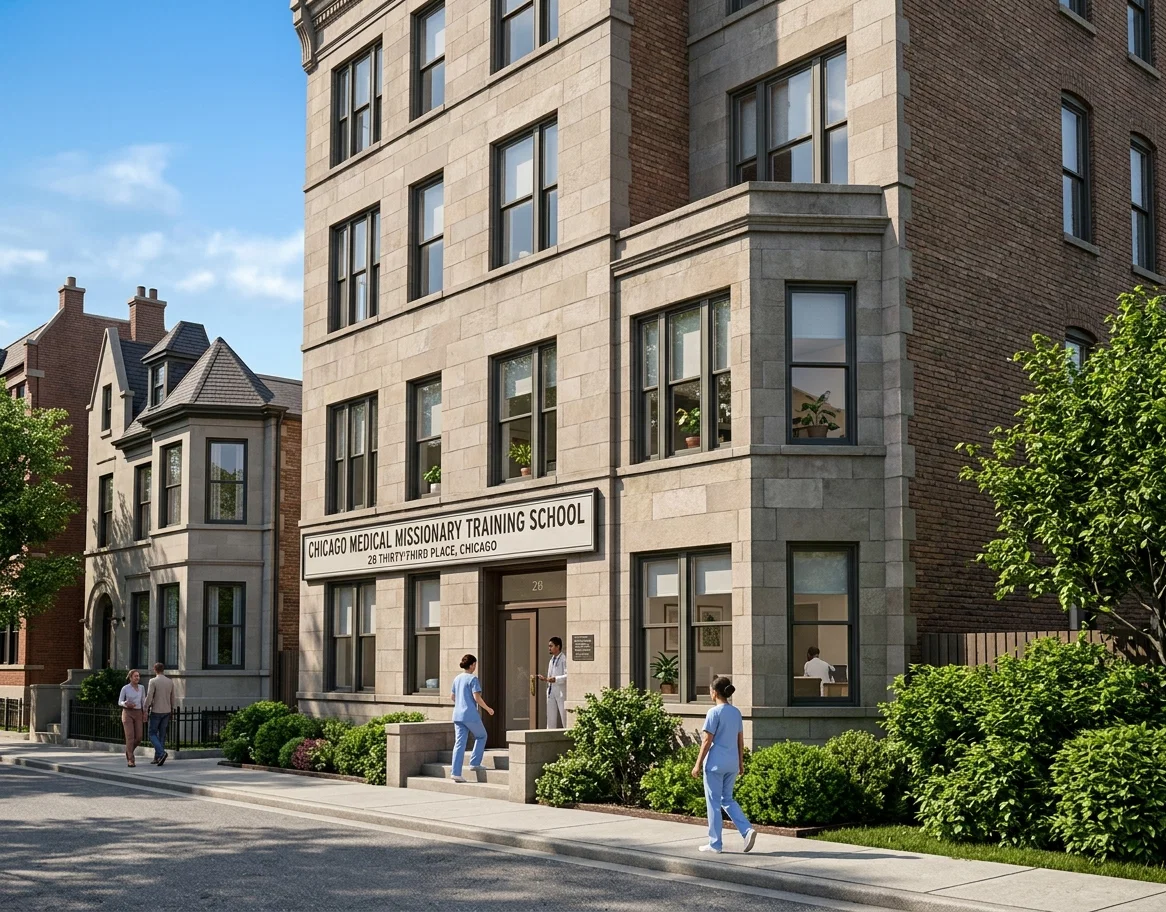
It was evident to us years ago that Chicago would furnish an unparalleled opportunity for trained nurses, if our work there could once become sufficiently developed to have the necessary number of physicians and the facilities.
The following departments of work are now fully organized, and in successful operation in this city: a sanitarium, a hospital, the Workingmen’s Home, the Life Boat Mission, the Life Boat Rest for Girls, and a thoroughly equipped medical missionary dispensary and visiting nurses’ department, and successful hygienic dining rooms at the University of Chicago.
The missionary nurse who had more or less experience in a number of these departments, and in addition thorough class work, has certainly had opportunities for development that are almost unequaled.
Our present class consists of twenty-four members. They are an earnest and appreciative company of young men and women. They realize to a certain extent the important work that is before them, as well as the great opportunities that they will have in life after they completely surrender to the will of God, and allow him to make of them workmen that need not to be ashamed.
There will be excellent opportunities here for many more of this same class of people. Address Chicago Medical Missionary Training School, 28 Thirty-Third Place, Chicago.
Dispensary Work in Darkest Chicago
By M. Clair Hinds
M. CLAIR HINDS
DURING the last two years of our course at the American Medical Missionary College, much time was spent in dispensary work. This work brings the students in close touch with the sick and suffering. One does not need to go to China or India to find a needy missionary field. We have one here in Chicago.
Into our dispensaries come many who need healing, and need Christ. One night a man came in complaining of a severe headache. Examination revealed the fact that his headache was all on the left side of his head, also that his right arm and leg were becoming numb. One eye was losing its sight. As these signs pointed to some serious brain trouble, the man was taken to an “older doctor” at clinic the next day. Here he was carefully examined again, and appropriate treatment was prescribed. The effect was marvelous. Almost from the first day of treatment, the man began to improve. His headache disappeared, the feeling gradually returned to his right side, and in two weeks he was strong and well.
Another man came about the same time. He was well dressed, and gave evidence of culture and education, but he was drunk. He was not so far gone but that he realized his condition, however, and was in deep despair and discouragement on account of having fallen so many times. Careful examination showed his physical condition to be good. This man needed Christ. All his trouble was from drink; this he knew without being told, so we told him of the Son of man, who came to seek and to save that which was lost, who is able to save unto the uttermost, and who is able not only to save, but to keep. Tears stood in this poor man’s eyes as he listened to the simple word of God.
Finally he consented to ask God for help, and if ever a man prayed in earnest, this man did. Then he was taken to the bath rooms and given thorough treatment. He left the dispensary feeling like a new man, and the hand clasp he gave on parting was enough to reward us for a week’s work. Thank God, the full gospel means salvation for both body and soul.
Christ is our great leader in medical missionary work, and he is a leader who is right on the field with his soldiers; not afar off. Before opening the dispensary, I asked God’s guidance in conducting it that evening; and each time this course has been pursued, prayer has been answered. At the Halstead Street Dispensary, the bell rang one morning at half-past four. A man staggered in, his pain being so severe that he caught the door casing for support. But hot fomentations were wonderfully efficacious in relieving his suffering. In less than an hour this patient was able to go away well, saying that the treatment was worth fifty dollars to him.
One great advantage of this medical missionary work is the access it gives to men’s hearts. A great point in canvassing is to gain a hearing. When you succeed in interesting your hearer, your object is attained. So in the medical office, we are sure of an interested hearing, because the patient is there to hear something that will make him well; and having the truth as it is in Christ, we have something that will heal him if he accepts it; for Jesus came that we might have life, and have it more abundantly.
A patient who came recently was a young man, slender, weak, with narrow chest, a bad stomach, and symptoms of a tobacco heart. He had used tobacco ten years, beginning at the age of twelve. When shown that tobacco was the cause of his trouble, he willingly gave it up. Two weeks later he called on us again. He had used no tobacco since his previous17visit, and his eyes were brighter, he felt stronger, and looked better in every way.
One week we were not satisfied with the results of the dispensary work, and hence earnestly sought the Lord for his special blessing. The results of the following week were better than of any previous week in the history of the dispensary. God causes us to work with him; but praise his name, he has also promised to work with us.
The Colorado Sanitarium
By Francis M. Wilcox
FRANCIS M. WILCOX
In answer to the increased demand of more than a decade, for the establishment of a sanitarium in the dry, bracing climate of the Rockies, the Colorado Sanitarium was dedicated in July, 1896. Previously to its erection there had been founded, under the auspices of the Battle Creek Sanitarium, a sanitarium boarding home in the city of Boulder. This had drawn to the city a number who were interested in dietetic reform; and thus was formed the nucleus of the work which has grown to its present proportions.
GOLDRANG SANITARIUM, BOULDER
The situation of the Colorado Sanitarium is unique. Located on the backbone of the continental divide, it enjoys a climate of almost endless sunshine throughout the year, a climate, too, possessing remarkable dryness, and carrying with it the strongly tonic effect of a high, bracing altitude.
Boulder is the university town of the State, has seven thousand inhabitants, and is thirty miles from Denver, the metropolis of the Rocky Mountain region. The sanitarium is situated on the western border of the city, and is crowded close up against the foothills, so that while to the east and north stretches a beautiful, rolling plateau, dotted with thrifty farms and flourishing ranches, to the south and west the mountains rise in majestic grandeur, affording a variety of scenic beauty. A fifteen minutes’ walk from the sanitarium brings one to the center of the town in one direction, while in the opposite direction it brings one into the wildest solitude.
Connected with the main institution there are three cottages owned by the sanitarium, and for its needs the present summer two other cottages have been rented, making five cottages in all, in addition to the main building. Besides these the sanitarium now has a number of separate rooms in different parts of the city, and twelve or more tents.
The history of the Colorado Sanitarium from its inception to the present time has been varied and eventful, like that of all new enterprises. It has seen many dark hours, and has passed through many trying crises. While the patronage every summer has been fair, the winter seasons for the most part have been dull, and the patronage has gone down very low; hence it has taken every available resource during the summer months to meet the depression of business, and consequent increase of expense, during the winter months. These experiences of cloud and sunshine, however, were bravely met, and by the blessing of the Lord and the interposition of his providence, many apparent disasters and difficulties were overcome.
Beginning with the year 1901, the sanitarium seemed to enter upon a new era in its experience, and from that date there has been a steadily increasing patronage during both the summer and the winter season. Last winter fully sixty patients were members of the sanitarium family, as against not more than one half or one fourth of that number for previous winters.
As the influence of our work extends, we are pleased to note the fruit which is being borne as the result of the promulgation of the gospel truth for which it stands. We are receiving many letters from grateful patients, acknowledging, not alone to the sanitarium, but to the Lord, the benefits received physically and spiritually.
The present season bids fair to outrival all preceding ones. We had a full house, and our rush of summer patronage began fully one month earlier than last year; and at the present writing, July 14, there is not a single vacant room in the institution, and only two or three in any of its cottages. This increase of patronage emphasizes the necessity of increased facilities. This is particularly so as regards accommodations for tubercular patients. There has been a great prejudice during the last few years against free association on the part of the ordinary patients with those having tubercular trouble, and this has made absolutely necessary the separation of these two classes of patients in the Colorado Sanitarium, the tubercular patients at the present time occupying our cottages, and taking treatment in one of the cottages where treatment rooms have been improvised. These accommodations, however, are very unsatisfactory, and totally inadequate to meet the demands of the many patients who come to us desirous of better accommodations, and who are willing to pay for the same.
The workers in the Colorado Sanitarium are endeavoring to keep before their minds continually that the sanitarium work is one part of the great closing gospel work for the last days, and that the object of God in sending patients to the institution is not that the institution may receive financial support, nor even that the patients may be healed of their bodily infirmities alone, but above all, that they may be brought to a saving knowledge of the truth for these last days. For this purpose we are laboring, and we believe that the seed that is being sown in this way has borne fruit, and will bear fruit in the coming kingdom. Many rich experiences in gospel labor could be reported, and a number of experiences where souls have been converted and have found a knowledge of the Lord. For the growing influence of our work, and for all that the Lord is doing for us, we ascribe to him the glory.
Medical Missionary Work for the Colored People in Nashville, Tennessee
By L. A. HANSEN
L. A. HANSEN
A LITTLE more than a year ago an effort was begun to open a sanitarium for the colored people. Some means was raised under the auspices of the Southern Missionary Society, a house and lot were secured with part payment, and a few months ago there was opened to the public the first institution of the kind devoted to the colored people. Although there is still much lacking to make it complete in its working, there is now a very creditable establishment, prepared to give various sanitarium treatments, and furnished with beds for house patients.
The work of this institution is carried on under the direction of the Nashville Sanitarium Association, which was organized to meet the requirements of the law in order to hold the property. This association is now a part of the Southern Union Conference, the union conference committee being the constituency. Since the beginning of the work the union conference has added to the money expended in equipping the institution and in meeting the running expenses.
This new effort among colored people could not be expected to find the financial support that a similar work for the white people would meet with. Lack of means and want of appreciation on the part of the public stand in the way of a large patronage. Two months ago it was a serious question as to the advisability of continuing the work, on account of lack of means to support it. At present it is meeting running expenses only because the workers connected with it are drawing no salaries, which condition cannot, of course, always continue. The workers are Brother and Sister F. M. Young, of Illinois, who are acting as steward and matron, and W. P. Creighton and Miss Susan Willis, sanitarium nurses.
A leading object of this work is to afford a training school for colored workers. An effort in this direction is already begun. The facilities for this are excellent. Located in a city that has both the better and the poorer class of people, there is offered a good field. There are leading colored educational institutions located in Nashville, both literary and medical. There is a very large population of the poorer class. The need of medical missionary work18among these people is great. A most practical way to help them is by giving them instruction in their homes, in healthful living, cleanly and practical housekeeping, and in many other things.
Students connected with this work could receive practical training in the modern sanitarium and among the people. A number of our young colored people are desirous of obtaining just such a training, and would then make useful workers for their own people. It is quite evident that it is not the best plan to send these people to our institutions in the North, expecting them to return here for work. The training should be done here. Surely, such a work as this ought to prove one of the best things that could be done for the colored field.
The plan is by no means impracticable. We already have persons qualified for the work of teaching, and an institution fairly well equipped, and we have the field in which to work. What is needed is some assistance in the way of means to support the work, which cannot reasonably be expected to be self-supporting for a while.
The following-named persons are members of the board: C. P. Bollman, President; W. J. Stone, Secretary; L. A. Hansen, Treasurer; Dr. O. M. Hayward and R. M. Kilgore. Money for this work should be sent to the Treasurer, L. A. Hansen, 624 Church St., Nashville, Tenn.
The Los Angeles (Cal.) Sanitarium
By F. B. Moran, M. D.
F. B. MORAN, M. D.
THE work of this institution began a little more than two years ago. A three-story brick building, containing two large stores on the first floor and about forty rooms on the second and third floors, was secured on Third Street, near the heart of the city. A hygienic café was opened on the first floor, medical offices and treatment rooms, together with several rooms for patients and helpers, being situated on the two floors above. From the very beginning, the work grew rapidly, and in a short time the building was altogether inadequate to accommodate the many applications from patients desiring a place in the institution. The work in the café also rapidly increased from a small beginning until it has become the largest institution of its kind in the world, serving, during the busiest season, more than a thousand meals a day. The work started with only a few laborers. At the present time there are more than fifty employees in the institution, including four physicians.
A small bakery plant was started a little more than a year ago, and the demand for its products has so increased that the institution has secured a tract of twenty-four lots in a convenient location, and there is in building a three-story brick food factory, seventy-four by ninety feet, at a cost of fifteen thousand dollars. This building will be ready for use some time during the month of August.
Los Angeles and vicinity is one of the most fruitful fields for medical missionary work in all the world. This section has become one of the greatest tourist resorts upon this continent, from forty to sixty thousand tourists visiting the place every year. The majority of these are seeking health and recuperation, and are greatly in need of just what we should be in a position to give them; and being people of intelligence and means, they are in a position to appreciate and support the work. These tourists coming, as they do, from all parts of the world, there is no better field than this for sowing the seeds of health and temperance reform. A strong effort has been made to educate the public with reference to these principles, not only in our sanitarium, but especially in the work of the vegetarian café, and we feel that our efforts have been crowned with unusual success. The constantly increasing patronage, and the almost universal expression of appreciation of the work, are the best evidences that our efforts have not been in vain.
The great need in this field, at the present time, is increased facilities for properly caring for the thousands and the tens of thousands of invalids who are annually seeking health in the climate of Southern California. Although our work has been unusually successful, we have been able to do but a small fraction of what might have been accomplished had our facilities been sufficient to meet the demand. We trust and pray that the time may soon come when we shall have a thoroughly equipped sanitarium of sufficient size to meet the needs of this important field.
THE GUADALAJARA SANITARIUM
Guadalajara Sanitarium
By J. W. Erkenbeck
J. W. ERKENBECK, M. D.
When we look at the work of education in some of our older sanitariums in the States, at the scores of workers they have sent out, the work of our Guadalajara Sanitarium sinks into insignificance; but when we remember that we are in a nation by ourselves, and where but little has been written to enlighten the people, we take courage, and are assured that much better days are for Mexico.
The Mexican people are a peculiar people, filled with superstition, and ignorant of the laws of health. For instance, a man suffering with a certain disease may be told by his doctor not to wet his hands or drink cold water. To eat fruit when one has a cold, they believe to be harmful. The things God intended for the well-being of man, they hold in fear. To smoke, drink, and eat all sorts of abominable things is the custom during chronic disease. Time and again we have asked them why they did not eat fruit, and they simply replied, “For fear;” but they do not think of questioning the deleterious effect of tobacco, liquors, and condiments.
The Mexican people are of Eastern customs, slow in changing their ideas, and many of their household utensils and most farm implements are such as were in use in Christ’s time. Because of this spirit, education is of slow progress. In the face of all this, I can see many changes within two years and a half. People are more free to investigate our mode of treatment. Physicians have to prescribe baths to satisfy the public demand. Several of the best families of the city have asked for instruction in the kitchen. Many of our friends have left off the use of tobacco and alcoholics. Our time could be doubly occupied in visiting and instructing those who have become interested.
Instruction of native nurses at the Sanitarium has been limited, but few being naturally adapted to nursing. Probably about twelve have received this instruction, and are raising the banner of S. D. A. in other parts.
The work at the mission for the poor has been a great educator to the public. Some of our native brethren are laboring faithfully to penetrate the darkness of superstition and ignorance. Also several native missionaries have been relieved of their physical suffering, and are able to return to their work. Some of the missionaries have stayed with us several weeks, and taken instruction in simple treatments. Better days are before us. Already the dense darkness is becoming morning twilight. Soon the Sun of Righteousness is to shine with healing in his wings, to heal all that are of an open heart, and thus usher in the day of God.
The Missionary Side of Medical School Work in Chicago
By David Paulson
DAVID PAULSON, M. D.
DURING the first and second years of our medical school work the students spend only a few weeks of their time in Chicago, so they are not able to develop many lines of missionary work. They simply step into those that are already established, and assist as the way opens; but during the last two years more than half their time is spent here, and so there is afforded a great opportunity to also engage in missionary work in this great and needy city. Almost every member of the third year19class that has recently left us, in addition to his medical work, was engaged in some special missionary work, and the Lord added his blessing to these efforts. The students not only helped in our regular work here, but some of them assisted in missionary efforts carried on by other denominations, thereby accomplishing a good work, and at the same time becoming acquainted with a number of excellent people, to whom they will have opportunity to do good in days to come.
We wish that all the readers of the REVIEW could have been present at our Sabbath service just preceding the close of the school, and could have heard our medical students testify of the blessing that their Chicago experience had been to them; they would certainly have been convinced that God had gone out before these students, and that here in this sin-cursed city, they, like Moses, had seen him, as it were, face to face.
The Nebraska Sanitarium
By Lyra H. George
LYRA H. GEORGE, M. D.
The Nebraska Sanitarium and Union College are situated in the same campus, on a slight elevation that commands a view of the surrounding country for ten or fifteen miles in every direction. At this season of the year the country presents a most beautiful picture; for sunshine and rain have come to us in abundance, and the waving fields of grain are fast whitening for the harvest, and soon the reapers will be gathering in the sheaves. This splendid scene spread out before us is a constant reminder of the Master's field already white for the harvest, and the aim and purpose of the Nebraska Sanitarium is to reap the grain in the fruitful field about us, and prepare laborers to go out quickly into other fields.
About eight years ago a small, two-story, wooden building was donated for a sanitarium. With this the institution began its career, and under the blessing of the Lord it has steadily grown until it occupies a brick building consisting of one hundred and twenty rooms. This was secured about three years ago. The first building has served as a bakery and a home for the nurses. The bakery was started in connection with the sanitarium about five years ago. It now has several employees, and is doing a good business.
At present there are about fifty helpers in the sanitarium family. Twenty-five of these are in the training classes, while others are preparing to engage in this work soon. The first nurses' class, which consisted of four members, completed this course three years ago. Since that time three other classes have finished, making a total number of twenty-eight nurses who have been graduated from the training classes. Only three of this number are now working in the institution. The others are scattered from the Atlantic to the Pacific coast, and with very few exceptions are all engaged in the medical missionary work. Two of our nurses are now in the foreign field. Another class of eight members held their commencement exercises in the tabernacle here at College View, on the evening of June 30. Their motto is, 'Man's need is God's opportunity, and ours.' One of this class will go to assist in opening the work in Eureka, Cal.; another to labor in the Montana Conference; while another has been invited to connect with the missionary work in New York City. The others will remain at the sanitarium for a while, and as soon as their places can be filled here, they will be ready to answer some of the urgent calls that are coming to us for help.
Two of our nurses are in Wichita, Kan., opening the work there, and plans are now being laid to start treatment rooms in several other large cities. The Lord is now giving us many precious opportunities to open bath rooms and hygienic restaurants in many places, and we are anxious to improve every one of them. We would not, like Israel of old, be 'slack to go to possess the land, which the Lord God . . . hath given' us.
The nurses' course consists of two years' study and practical work, in which the Bible is given a prominent place. There are some advantages to be gained in a small institution; for example, every nurse has abundant opportunity to learn all about the management of the sanitarium in its different departments.
The beginning weeks of the first year are spent in domestic duties during the day, and class work in the evening. The students are taught how to care for the halls, parlors, patients' rooms, dining rooms, and offices. They also spend some time in the laundry, bakery, and kitchen. A thorough course in cooking is given; and when the cook is detained from his work, his place can easily be supplied from the nurses' class.
The girls are required to spend some time in the sewing room, with a competent dressmaker. The practical knowledge thus gained is of great service to the nurses when they find themselves in foreign fields, or in responsible positions in our institutions.
At the close of the first six months the students are usually called to nursing and bath-room work; later on they are sent to the surgical ward, and gain valuable experience in the operating room and in surgical nursing. Our nurses are often sent to the surrounding cities and towns to care for patients under outside physicians. We sometimes have eight nurses out at one time. It seems as if the Lord specially blesses and prospers the work of those who go to the homes of the people, and as the result, seeds of truth are sown in many hearts, and a friendly feeling toward the sanitarium and its work has been left both with the families and with their physicians.
The managers of the sanitarium and the college are endeavoring to unite the work of the two institutions as far as possible. The hydrotherapy classes from the college are invited to the sanitarium bath rooms for their lessons, and here the treatments are demonstrated and discussed, and the students are allowed to treat one another. It often happens that this work can be made practical.
The class during the winter term was unusually large, being composed mostly of special course students. Many of them were canvassers and Bible workers, and the interest taken in the work was indeed gratifying. We trust that much good may result from it.
The interest in medical missionary work is deepening in the Central Union Conference, and earnest efforts are being made to bring our own people into closer touch with our work. It is receiving considerable attention at all the camp meetings in the surrounding States.
The amount of charity work done by the institution has increased to about five thousand dollars a year.
The Lord has richly blessed the Nebraska Sanitarium during the past months. Many of the patients who come are relieved of their physical sufferings, and go away rejoicing in the light and truth they have found here. Kindly interest and mutual sympathy exist among our workers, and many times the Lord comes very near as we seek him together at morning worship, at the Wednesday evening prayer meetings, and in the Sabbath school.