The Importance of a Knowledge of Health Principles
By Ellen G. White
MRS. E. G. WHITE
“Beloved, I wish above all things that thou mayest prosper and be in health, even as thy soul prospereth.”
We have come to a time when every member of the church should take hold of medical missionary work. The world is a lazar house filled with the victims of both physical and spiritual disease. Everywhere people are perishing for lack of a knowledge of the truths that have been committed to us. The members of the church are in need of an awakening, that they may realize their responsibility to impart these truths. Those who have been enlightened by the truth are to be light bearers to the world. To hide our light at this time is to make a terrible mistake. The message to God’s people to-day is, “Arise, shine; for thy light is come, and the glory of the Lord is risen upon thee.”
On every hand we see those who have had much light and knowledge deliberately choosing evil in the place of good. Making no attempt to reform, they are growing worse and worse. But the people of God are not to walk in darkness. They are to walk in the light, for they are reformers.
Before the true reformer, the medical missionary work will open many doors. No one need wait until called to some distant field before beginning to help others. Wherever you are, you can begin at once. Opportunities are within the reach of every one. Take up the work for which you are held responsible, — the work that should be done in your home and in your neighborhood. Wait not for others to urge you to action. In the fear of God, go forward without delay, bearing in mind your individual responsibility to him who gave his life for you. Act as if you heard Christ calling upon you personally to do your utmost in his service. Look not to see who else is ready. If you are truly consecrated, God will, through your instrumentality, bring into the truth others whom he can use as channels to convey light to many who are groping in darkness.
All can do something. In an effort to excuse themselves, some say, “My home duties, my children, claim my time and my means.” Parents, your children should be your helping hand, increasing your power and ability to work for the Master. Children are the younger members of the Lord’s family. They should be led to consecrate themselves to God, whose they are by creation and by redemption. They should be taught that all their powers of body, mind, and soul are his. They should be trained to help in various kinds of unselfish service. Do not allow your children to be hindrances. With you the children should share spiritual as well as physical burdens. By helping others they increase their own happiness and usefulness.
The Home Reading Circle
Let our people show that they have a living interest in medical missionary work. Let them prepare themselves for usefulness by studying the books that have been written for our instruction in these subjects. These books deserve much more attention and appreciation than they have received. Much that is for the benefit of all to understand has been written for the special purpose of instruction in the principles of health. Those who study and practice these principles will be greatly blessed, both physically and spiritually. An understanding of the philosophy of health will be a safeguard against many of the evils that are continually increasing.
Many who desire to obtain knowledge of medical missionary work have home duties that will sometimes prevent them from meeting with others for study. These may learn much in their own homes in regard to the expressed will of God concerning missionary work, thus increasing their ability to help others. Fathers and mothers, obtain all the help you can from the study of our books and publications. Read the Good Health, for it is full of valuable information. Take time to read to your children from the health books, as well as from the books treating more particularly on religious subjects. Teach them the importance of caring for the body, — the house they live in. Form a home reading circle, in which every member of the family shall lay aside the busy cares of the day, and unite in study. Fathers, mothers, brothers, sisters, take up this work heartily, and see if the home church will not be greatly improved.
Especially will the youth who have been accustomed to reading novels and cheap storybooks, receive benefit by joining in the evening family study. Young men and young women, read the literature that will give you true knowledge, and that will be a help to the entire family. Say firmly, I will not spend precious moments in reading that which will be of no profit to me, and which only unfits me to be of service to others. I will devote my time and my thoughts to acquiring a fitness for God’s service. I will close my eyes to frivolous and sinful things. My ears are the Lord’s, and I will not listen to the subtle reasoning of the enemy. My voice shall not in any way be subject to a will that is not under the influence of the Spirit of God. My body is the temple of the Holy Spirit, and every power of my being shall be consecrated to worthy pursuits.
The Lord has appointed the youth to be his helping hand. If in every church they would consecrate themselves to him, if they would practice self-denial in the home, relieving their careworn mother, the mother could find time to make neighborly visits; and when opportunity offered, they could themselves give assistance by doing little errands of mercy and love. Books and papers treating on the subject of health and temperance could be placed in many homes. The circulation of this literature is an important matter; for thus precious knowledge can be imparted in regard to the treatment of disease, — knowledge that would be a great blessing to those who cannot afford to pay for a physician’s visits, or for drugs which, even if obtained, are only an injury.
Duty of Parents to Instruct and Train Their Children
Parents should seek to interest their children in the study of physiology. But few among the youth have any definite knowledge of the mysteries of life. The study of the wonderful human organism, the relation and dependence of its complicated parts, is one in which many, even parents, take little interest. They do not understand the influence of the body upon the mind or of the mind upon the body. Needless trifles occupy their attention, and then they plead a lack of time as an excuse for not obtaining the information necessary to enable them properly to instruct their children.
If all would obtain a knowledge of this subject, and would feel the importance of putting it to practical use, we should see a better condition of things. Parents, teach your children to reason from cause to effect. Show them that if they violate the laws of health, they must pay the penalty by suffering. Show them that recklessness in regard to bodily health tends to recklessness in morals. Your children require patient, faithful care. It is not enough for you to feed and clothe them; you should seek also to develop their mental powers, and to imbue their hearts with right principles. But how often are beauty of character and loveliness of temper lost sight of in the eager desire for outward appearance! Parents, be not governed by the world’s opinion; labor not to reach its standard. Decide for yourselves what is the great aim of life, and8then bend every effort to reach that aim. You cannot with impunity neglect the proper training of your children. Their defective characters will publish your unfaithfulness. The evils that you permit to pass uncorrected—the coarse, rough manners, the disrespect and disobedience, the habits of indolence and inattention—will bring dishonor to your names and bitterness into your lives. The destiny of your children rests to a great extent in your hands. If you fail in duty, you may place them in the ranks of the enemy, and make them his agents in ruining others; on the other hand, if you faithfully instruct them, if in your own lives you set before them a godly example, you may lead them to Christ, and they in turn will influence others, and thus many may be saved through your instrumentality.
Fathers and mothers, do you realize the importance of the responsibility resting upon you? Do you realize the necessity of guarding your children from careless, demoralizing habits? Allow your children to form only such associations as will have a right influence upon their characters. Do not allow them to be out in the evening unless you know where they are, and what they are doing. Instruct them in the principles of moral purity. If you have neglected to teach them line upon line, precept upon precept, here a little and there a little, begin at once to do your duty. Take up your responsibilities, and work for time and for eternity. Let not another day pass without confessing your neglect to your children. Tell them that you mean now to do your God-appointed work. Ask them to take hold with you in the reform. Make diligent efforts to redeem the past. No longer remain in the condition of the Laodicean church. In the name of the Lord I call upon every family to show its true colors. Reform the church in your own home.
As you faithfully do your duty in the home, the father as a priest of the household, the mother as a home missionary, you are multiplying agencies for doing good outside of the home. As you improve your own powers, you are becoming better fitted to labor in the church and in the neighborhood. By binding your children to yourselves and to God, fathers and mothers and children become laborers together with God.
I Shall Not Pass This Way Again
I SHALL not pass this way again!
The thought is full of sorrow;
The good I ought to do to-day
I may not do to-morrow.
If I this moment shall withhold
The help I might be giving,
Some soul may die, and I shall lose
The sweetest joy of living.
Only the present hour is mine —
I may not have another
In which to speak a kindly word,
Or help a fallen brother.
The path of life leads straight ahead;
I can retrace it never;
The daily record which I make
Will stand unchanged forever.
To cheer and comfort other souls,
And make their pathways brighter;
To lift the load from other hearts,
And make their burdens lighter,—
This is the work we have to do —
It must not be neglected.
That we improve each passing hour,
Is of us all expected.
I shall not pass this way again!
O! then with high endeavor
May I my life and service give
To Him who reigns forever.
Then will the failures of the past
No longer bring me sadness,
And his approving smile will fill
My heart with joy and gladness.
— Northwestern Christian Advocate.
Our Health Institutions
THE MEDICAL MISSIONARY COLLEGE
The Work of Our Sanitariums
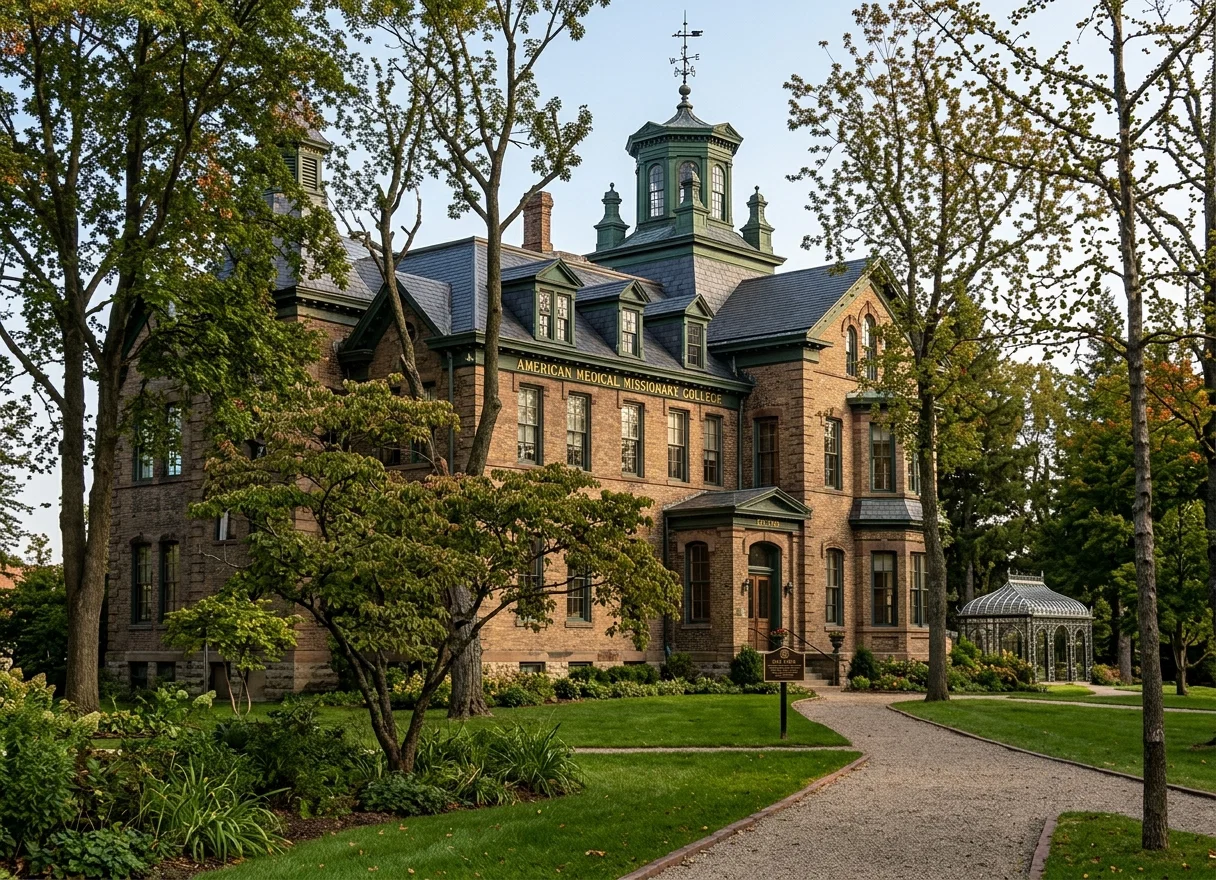
The American Medical Missionary College
MORE than one hundred years ago a Christian gentleman, dying in the West Indies, left a considerable sum of money to be used in the establishment of a college for the education of medical missionaries. The instructions in his will were never carried out, consequently the college was not organized, and the world remained a hundred years without the benefit of an educational institution which might have rendered untold service to humanity, and have done noble work in the advancement of the cause of Christ.
A medical missionary society was organized in Edinburgh over sixty years ago, the London Medical Missionary Association twenty-four years ago; and more than twenty years ago, Dr. George Dowkont organized, in New York City, a medical society on a similar plan. The purpose of all these organizations is apparent, to encourage in the student missionary aspirations, which he is too apt to lose sight of during his medical studies, and to give him more or less training in actual Christian and missionary work.
None of these institutions, however, were incorporated as medical schools, nor did they undertake to give a regular medical education, or to issue medical diplomas. Those who had dedicated their lives to medical missionary work had obtained their medical education at the already established medical schools, and received their missionary training under the auspices of these associations.
The American Medical Missionary College, with a full and thorough course of study in medicine and a corps of efficient instructors, and, being incorporated under the laws of Illinois, prepared to issue diplomas to those who should satisfactorily complete the course, was the first medical missionary college established, and, as far as we know, is the only one at present in existence which has exclusively for its purpose the education of medical missionaries, unless Dr. Valentine’s medical school in North India may be an exception. The beginning of this missionary school may be traced to the organization of the Battle Creek Sanitarium, nearly thirty-six years ago.
At quite an early date in the history of this institution the reasons which made the formation of the various medical missionary associations necessary were recognized as having an even greater bearing upon our young people who were preparing to carry to a world in need not only the gospel as it is generally understood, but also the great principles of physical reform and Christian philanthropy for which the institution stood as a part of the message which was to prepare a people for the coming of the Lord.
Meantime a training school for missionary nurses had been established, and was in successful operation, and the International Medical Missionary and Benevolent Association had been organized and incorporated.
The Sanitarium had sent several classes of students to the best medical colleges of the country for the required medical course, giving them at the same time special training in the principles peculiar to itself. This training consisted, not only of the drill in rational methods of treatment, which they received at the Sanitarium during vacation; but wherever the students were located during the school year, they found more or less work to do for the needy around them, the sick in soul and body. Dispensary work for the poor where opportunity offered, work for children, Christian Help work, visiting among the poor and discouraged, and church work formed part of the duty of the student, and much excellent work was done in spite of the fact, generally acknowledged, that a medical course is the meanest of university courses.
The facilities and scientific equipment of the Sanitarium had grown rapidly, so that in the summer of 1895, when the subject was again broached, it was deemed possible to organize and carry forward a thorough and creditable medical school. A sufficient number of physicians who were qualified to act as teachers were available, and were ready to devote themselves to the work in a self-sacrificing way. The north wing of the Battle Creek College was, through the discontinuance of the Bible school, left vacant, and this provided the school with class rooms and laboratories.
By action of the Sanitarium board, it was agreed that if the physicians employed in the Sanitarium would undertake to fill the position of professors, without salaries, the board would undertake to meet the incidental running expenses, so as to make the school a free school for all who were ready to devote their lives to the relief of suffering humanity, and to the propagation of the principles of9the greater gospel, which offers salvation for the body as well as for the soul.
A portion of the course is given in Battle Creek, including considerable laboratory study, the analysis of the secretions and blood, stomach fluids, etc., an experience which is most necessary to the physician in the scientific treatment of disease. But the college is incorporated in Chicago, and its headquarters are necessarily located there, so that the school may receive the benefit of the clinical advantages afforded by that great city. The special needs of the medical school are also better supplied in Chicago than in a small city like Battle Creek.
It was necessary, therefore, to secure a building of considerable size for the accommodation of the students, for dispensary and hospital work, etc.
The old Home for the Friendless, 1926 Wabash Ave., situated in the heart of one of the most needy parts of the city, was leased for the work of the college, and the Chicago department of the nurses’ training school was carried on here for five years. The difficulties encountered were numerous, as the first class that was graduated can testify; but those five years were filled with blessed experiences in practical missionary work for the needy at their doors, as well as in steady progress in their studies.
Since the expiration of the lease, the college has been domiciled in a building at Thirty-third Place, near the Branch Sanitarium, pending the erection of a suitable building, which the growing importance of its work imperatively demands. Dispensary and other kinds of mission work are still carried on by the students under the supervision of experienced instructors. As facilities have been needed, they have been providentially supplied.
The college is still housed, however, in rented buildings, and the need of better and more permanent quarters is pressing. A fine lot has been secured between the Chicago Branch Sanitarium and the building used by the medical school, on which it is proposed to erect a building when funds can be obtained.
The securing of this lot was one of the marked providences that have attended this branch of the work from the first. A patient who had been greatly benefited at the Sanitarium, and had become interested in missionary work, several months ago deeded to the college a piece of property, valued at ten thousand dollars, which he held on the North Side in Chicago. Several sites had been considered, but none seemed so desirable as the vacant lot adjoining the Branch Sanitarium.
The price of this made it seem unlikely that it could be obtained. Mr. —, the donor of the property on the North Side, not knowing of the preference of the trustees for this special lot, suggested it as an appropriate location for the college, and offered, if desired, to arrange an exchange of the North Side property.
His kind offices were accepted, the trustees feeling that if he succeeded, it would be another evidence that it was the place where the Lord would have the work located. The transfer was made without difficulty, on the basis of an even exchange.
Meantime the class has grown from the original class to about one hundred and twenty students, earnest young men and women, who have decided to dedicate their lives to the Master’s service to labor wherever God may call.
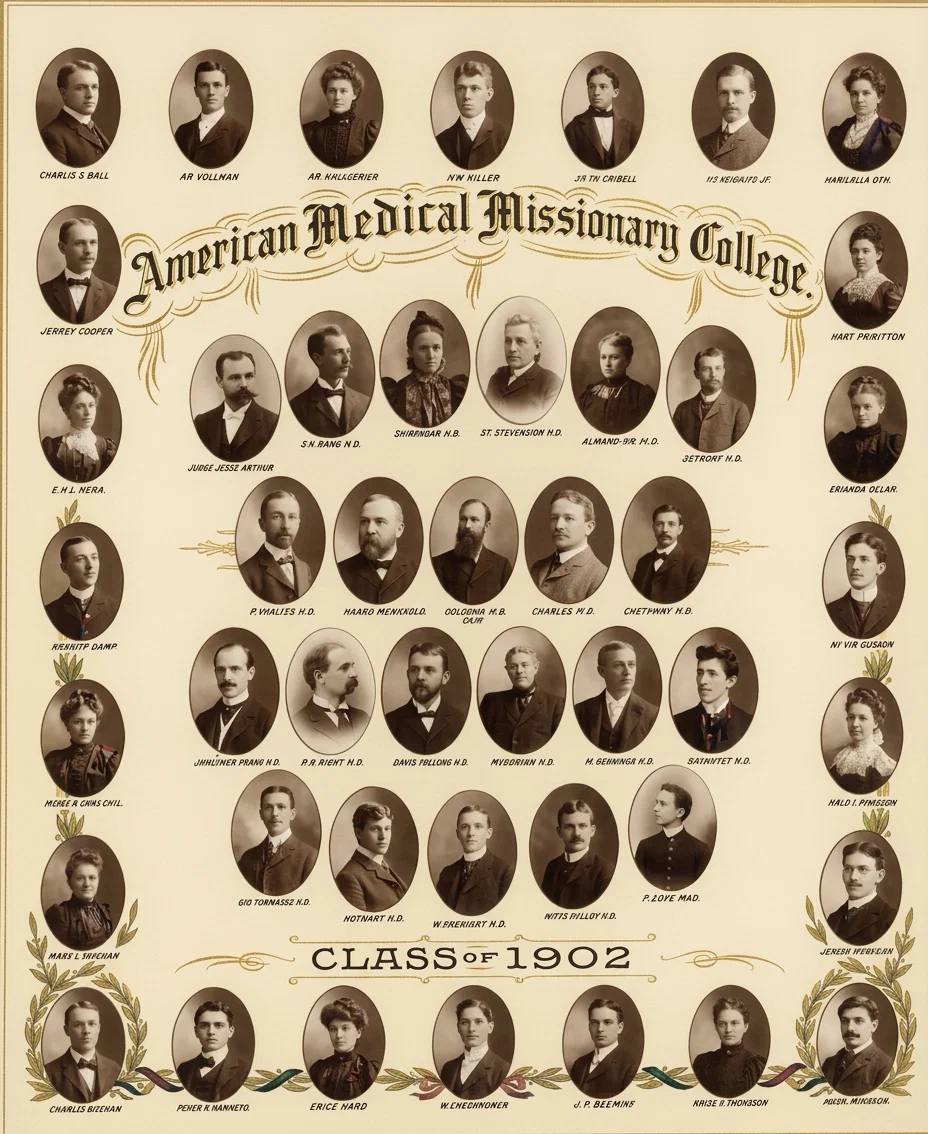
The college has recently graduated its fourth class, making eighty-four who have completed the course, besides a number of others who for various reasons have taken a partial course, or have taken their last year at other colleges. These graduates and their work are referred to elsewhere.
The Bridge We Never Cross
How oft we trouble borrow,
And suffer mental pain,
Conjuring clouds to-morrow,
While yet no signs of rain;
Future gloom foreboding,
At night on pillows toss,
In fear of overloading
The bridge we never cross.
From road there is no turning
That we can see just now,
Trouble ahead discerning,
To avoid we know not how;
And so we roll and tumble
At night, with sleep a loss,
And hear the distant rumble
On the bridge we never cross.
— Selected.
Commencement Exercises of the American Medical Missionary College
The fourth class graduating from the American Medical Missionary College held its closing exercises at the Tabernacle, Monday evening, June 16.
The church was decorated with flowers and the college and class colors, in the midst of which was conspicuous the motto “Reasonable Service,” from Rom. 12:1, and a full house gathered to celebrate the occasion with the class.
Prof. W. W. Prescott, who presided at the exercises, in the absence of the president, Dr. J. H. Kellogg, at present in Europe, Elder Evans, and the speaker of the evening occupied the platform behind the bank of green foliage and white flowers, and the faculty and students sat in the center of the house.
The delegation from the nurses’ class, though not as large this year as on some former occasions, nor as large as we hope to see on future ones, always makes a pleasant adjunct to the medical school, in their fresh uniforms of blue and white, and with their cheerful, interested faces.
The music was furnished by the Germania10Orchestra, which is equivalent to saying that this feature of the program was excellent.
Elder I. H. Evans offered prayer.
The address was given by Dr. William Malcolm, who was for ten years a medical missionary in China, and was driven out by the recent uprising. In introducing him Professor Prescott said that it seemed fitting that at the commencement exercises of this, a distinctively missionary college, the address should be given by a practical missionary. A portion of Dr. Malcolm’s address will be found elsewhere in these columns.
After Dr. Malcolm’s address the class was represented by Mr. A. C. Selmon and Miss Mary E. Britton, each in a brief address.
Professor Prescott presented the diplomas to the class, prefacing the presentation with apt remarks. Among other things, he said: “A diploma or a ‘degree’ in itself confers no power for service. Unless this power is already won, a diploma will not be of use to-morrow. A diploma or a degree simply opens a door, or an opportunity, for service in a legal way. It is the work of years of patient, plodding labor and study that determines whether or not the opportunity can be met.
“The very picture that has been presented to us in the address this evening is an inspiration,—a call to a great field for service,—a most emphatic call for service. Let it be heeded, and the opportunity for service be improved. It is a call for men and women prepared to render to mankind the greatest service, under God, that it is possible for humanity to render,—help for the body, help for the soul,—deliverance from the bondage of physical disease, and deliverance from the greater bondage of sin. That is the call.”
The class of twenty-four then filed across the platform, and passed down the opposite side, receiving their diplomas as they went.
A selection by the orchestra followed, and Elder I. H. Evans dismissed the audience, many of whom lingered for a few words of congratulation to the graduates.
As many of the alumni who attended the commencement were to leave early Tuesday morning, the exercises were followed by an alumni meeting and reception to the members at the home of Dr. May Habenicht, on Champion Street. Dr. E. L. Eggleston, president of the association, was chairman of the meeting. The officers elected for the coming year were as follows: Dr. J. F. Morse, President; Dr. J. M. Keichline and Dr. A. C. Selmon, first and second Vice-Presidents; and Dr. Julia White, Secretary and Treasurer.
Before another day most of the class had scattered, awaiting the completion of the arrangements which will send them to their several fields, home and foreign.
The Practical Medical Missionary
By William Malcolm
WILLIAM MALCOLM, M. D., MISSIONARY OF THE BAPTIST CHURCH TO CHINA
The medical missionary needs no apology. We have very high authority for medical missions. Our beloved Saviour was a medical missionary. Jesus is our model missionary. He came from a far country,—he was a foreign missionary. He went about doing good and healing diseases at home,—he was a home missionary. If the Samaritan had sat down by the man who fell among thieves, and had simply talked to him about his sins and about the law and the prophets, this matchless parable would never have been written; but, instead, he bound up his wounds, pouring in wine and oil, the best antiseptic dressing known at that time, I dare say. He then put him on his own beast, the best ambulance service he could get, and took him to an inn, the best hospital obtainable in those days. This was the true missionary. The medical missionary follows very closely in the footsteps of his Master.
As has been said, and I think truthfully, China has been opened to Christianity at the point of the lancet; that is, the medical missionary has been, and is, the kind of missionary called for in China, to win the hearts of the people. There is something about the surgical work that appeals to the people; for example, a painless operation upon the eye by the use of a few drops of cocaine. The effects of chloroform, ether, and other anæsthetics in surgical operations are perfectly marvelous in the eyes of the Chinese. Imagine a native coming to our dispensary, afflicted with a great tumor—such instances occur time and again. He despairs of life. He has appealed repeatedly to native doctors, but they could not perform the operation. What is he to do? He says, “I can’t trust myself in the hands of these foreign devils.” His friends tell him the same thing. But he is tired of life, and finally asks our doctor if he can cure him.
“Yes,” he answers, “by the help of God we can remove the tumor.”
“But it would hurt me too much.” “You would not feel the least pain during the operation.” “Impossible! Impossible!”
He is assured that it is true, and at last he signs his name to the agreement that no harm or blame shall accrue to the surgeon in case of any unfortunate result of the operation. When he comes out of the anæsthetic, the tumor is gone, and in a few days he is ready to go home. He says, “O doctor, I never believed this! I will now believe anything you say.” Is he then not ready to receive the gospel?—Surely he is; and when he hears it, he believes every word of it.
If the medical part of the work were all that could be done for the Chinese, I do not think I would be willing to go to China. But it is a great means to an end,—it is a preparation for the reception of the gospel. The dispensary is opened in the morning, and the patients throng in, are treated, and then hear the gospel. After coming hundreds of miles, in many instances, to be cured, they willingly wait after treatment upon the words of the doctor,—and they will hear no one else. He gains their interest by telling them of different kinds of machinery, bicycles, electric lights, and other improvements, and then he tells them the gospel story which, though old, is ever fresh and new.
But the missionary doctor has many difficulties to contend with in China. The women are kept in the background there, and when they come for treatment, they think we should be able to make a correct diagnosis from feeling their pulse and hearing their story, often impossible to understand, for they know nothing of anatomy, and do not know how to describe their feelings. I think a veterinary surgeon in our own country has a better chance, because a horse does not tell lies at least.
Our last report shows that one doctor, with three or four native medical assistants, treated in one year over twenty-eight thousand cases, and performed five hundred operations, a large proportion of which were major operations; such as, removal of tumors and cancers, amputations, operations for harelip, stone in the bladder, cataract, and nearly all ills that flesh is heir to,—and I think they have many more of them there than we have here. I might mention a case as a sample: A woman came to our dispensary one morning, suffering pain from the sting of a scorpion. While making her bed the evening before (as the common people are too poor to burn oil, they go to bed at dark and rise at daylight), she was stung by a scorpion among the bedclothes. The pain was instantly relieved by the injection of a few drops of cocaine, and her screams of pain were immediately turned to laughter. This is perfectly miraculous in their eyes.
Our operations for cataracts are numerous and successful. A man comes to the dispensary who has been blind for perhaps twenty years. I remove the opaque lens, and immediately he is able to count my fingers. He sees my face,—the first face he has seen in twenty years. He sees me smiling. He tells me how many fingers I have, and whether I have whiskers or not. One can scarcely hold him on the table, he is so glad. Just think how happy a surgeon must be over such an operation. I performed eighty-six of these operations in one year, and operated for five cataracts in one hour and five minutes.
Do you think these people want to drive us out of the country? They love us,—they can’t help it. The race rebellion and the hatred manifested against missionaries were confined to those who knew nothing about us, and who had listened to false reports. There is plenty of room for medical missionaries in China. They are greatly needed there.
I feel sad to think of the many cases11that come to us for treatment, to whom I have to say, “It is too late; I can do nothing for you now.” I remember a boy eleven years old whose father brought him to us. I told him he was too late in coming. “I am not too late,” he said. “I am not too late, doctor. You are too late in coming here. I have been here all the time. He is my only son, and you must cure him; we have no means of support.” “But I tell you, you are too late; I can’t help you.” “Well, then, if he can’t live, we can’t afford to keep him; we shall have to starve him to death.” And notwithstanding all my pleading, I dare say he did as he had threatened.
In native practice, there is nothing in China worth mentioning. I am sorry for the poor Chinese when in health; but, O! when they get sick, I am ten times more sorry for them! If they get well, it is in spite of their treatment, and not because of it, I assure you. Here, for instance, is a man with a tumor. A native doctor thinks he can get a big sum of money for taking it off. So he gets a barber’s razor, and takes off a slice, and then, if the patient is able to endure it, he takes off another slice. But they have nothing that compares with modern surgery.
The sand storms in China, and numerous other things, combine to produce a great many eye diseases. If the person thus afflicted gets well, there is a contraction of the eyelid, so that the eyelashes are turned inward on the eyeball, causing inflammation at first, and in a short time, blindness. We perform an operation by which we transplant the eyelashes. We had many of these operations, frequently five or six a day, day after day. The medical missionary goes to the heathen with a lancet, so to speak, in one hand, and the gospel in the other, armed with a double power for good.
A man came to the dispensary one day for treatment for stomach trouble. He had been ill for a long time. I found that he had been eating stones for the purpose of curing his dyspepsia; he used to eat a handful of ground-up stones every day. He told me that he had eaten, in all, half a millstone—about sixty pounds. At his second visit he told me that he had eaten forty pounds of cinnamon bark, twenty centipedes, a lot of unborn lambs and dead things, and was no better for this treatment, “but rather grew worse.” I put him upon a simple diet, with a suitable prescription, and he went home. He bought a native Testament, and he used to come to my house and read this Testament by a student lamp, and ask me for explanations of Scripture. Time and time again, he said, “Doctor, I am so glad I am sick! If I had not been sick, I should not have found my precious Saviour, this precious book, and this glorious gospel.” I have learned many lessons of humility, of Christian love and charity, from this man. To hear him pray was a blessing in itself. He was very sick, however. He had waited too long before coming to the dispensary.
The dreadful remedies which he had used had made great inroads upon his strength, and he died just before the war; but his was a beautiful Christian death.
This is a glorious work, and, as I have said, I would not go to China for the medical part of the work alone. Every morning when I go to the dispensary, I find forty or fifty patients with their friends. I tell them some gospel story or some parable, and explain it to them, and O, how thankful they are for the truth, and how gladly they drink it in!
But there are difficulties and dangers. The doctor’s family is constantly exposed to diseases; as, typhus fever, diphtheria, scarlet fever, etc. For example, a native mother with her sick child wishes to find the dispensary, but mistakes the residence compound for it, and before the mother of the family, who is busy with her duties—teaching native missionaries or learning the language—is aware of it, her children are playing with this diseased, scabby child, and are exposed to smallpox. Such a thing often happens. We are asked, “Why don’t you have better sanitary protection?” But if we try to keep the people out, what is the use of going to China? We go there to teach them the gospel, and we must do it. “What is to be done?”—Trust in God, and be sure to be thoroughly vaccinated before you go.
Another difficulty is the bad water. We drink the river water. “Why don’t you drink well water?” you ask. The well water is unspeakable. The wells are all flush with the ground surface, and the people water their cattle, horses, and mules there. Any old bucket from a stable is kept there; for if a good one were left there at night, it would be stolen before morning. They have no pumps,—they know nothing about pump making. About the time the trouble broke out, we saw three corpses floating down the river, and there were any number of animals in the water. The water of the river is so dirty that you cannot see a quarter of an inch below the surface; it is running,—and that is the best we can say of it,—but it is almost too thick to run. And yet it is said that missionaries go out there for romance! Romance? I wish you could see that water—there was almost everything but romance in it.
Members of the graduating class, you are looking forward to making a success of your profession. Just define that word “success.” What does it mean? Is it to be the first surgeon of the country? That is not necessarily success. What did our blessed Saviour say success in life was? Do you remember John the Baptist and his six months’ ministry, which closed in imprisonment and death? What did Christ say of him?—“Among them that are born of women there hath not arisen a greater than John the Baptist.” There is success. His life work won favor in the eyes of God. Keep that point ever before you; that is success in life.
Do you believe in foreign missions? I do, with all my soul. What proof have you that I do? During the ten years in which I have been a missionary, I have recollections of smallpox and cholera that I dare not recite to you; my beloved ones taken away; one hundred and eighty-nine missionaries and their families ruthlessly murdered; and yet I am so in love with the glory there is in the work that I want to go back to those Chinese.
Is it not a testimony for the Chinese work and the Chinese Christianity that forty thousand of them have died rather than trample upon the cross of Christ? Many of them were brought to this test,—the sign of the cross was marked in the sand, and they were bidden to trample upon it, or be thrust through with a sword. They have taken the sword. We think our standard is high, but how many of us would stand that test?
I feel very highly honored in being invited to stand before you to-night, in this capacity, and I wish I could say something that would make you feel as I do, but my faltering tongue cannot give expression to my feelings upon this subject. My only apology for standing before you upon this occasion is just this: I have spent the best part of ten years in China, and I know of what I speak. I want to go back to China. I expect to sail in about two weeks; and I hope that fact will speak more eloquently for me than anything else that I could possibly say.
Preserving the House We Live In
It is the house in which we live that we need to preserve, that we may do honor to God, who has redeemed us.