POLITICS is defined by Webster as (1) "the science of government," (2) "the management of a political party." By the Standard the term is defined: (1) "the branch of civics that treats of the principles of civil government and the conduct of State affairs," (2) "political affairs in a party sense; party intrigues; political contrivance and management," (3) "a person's political sentiments, party preference, etc."
The term is rarely used in the first sense nowadays. The better term for that is "science of government" or "statecraft." The ordinary politician is clearly distinguished from the statesman. The latter is wise in councils of State, sagacious, prudent, and just, and strong in right principles of government. The politician is one who can manage men and events for the sole purpose of success. Politics with him, as with most men at the present time, is the art of getting there and staying in power after one has succeeded. Buying, selling, trading, pawning (it could be written equally true with an initial f), abuse, falsehoods, vituperation, bribery,—these and more of the same origin, enter into the schemes and intrigues of the successful politicians.
Such means it is sad to know are used to elect good men. The city boss and the chairman of the great central party committees in times of party crises are not chosen for their immaculate honor or probity, but solely for their ability to win. Sometimes a politician becomes so notoriously corrupt that his reputation becomes an incubus too heavy for party success; but when set aside he is usually placated if possible, or caught up by an opposite party as a "reformer." It is extremely sad to see the same principles brought into the election of men to responsible positions in religious bodies.
A Christian should have no part in such politics, as a participant, as a beneficiary, or as one who by a policy of silence acquiesces in such methods. His presence will not change the political potpourri; rather he himself will become poisoned. If he be a strong man, he may suppress for a time the most outrageous things, but they are only suppressed; the principles remain dominant in the party, and sooner or later he is affected. The Christian should be molded and characterized by unswerving fidelity to the principles of truth, righteousness, and purity which he finds in God. That is God's purpose for him. Jesus Christ came to this world, lived, and died, that He might win man to a character like that of His Father who sent Him, and that the man thus transformed might be a witness to that Love and Power which could make men righteous and keep them so. That is the business of the Christian here; all else should be subsidiary to that.
Jesus Christ, his Master, did not come to save this world by molding its politics. He might have won a prominent place in the party of Pharisee or Sadducee. He might have gathered around Him the common people who desired to make Him king. Not one of these entered into His plans. He was offered the kingdoms of the world and the glory of them if He would compromise principle, as His professed followers have often done since; but He scorned the offer. He is "not of this world." His kingdom is "not of this world." His true followers, His children, "are not of this world." They have been "born from above." Their "commonwealth is in heaven." Here they are "strangers and pilgrims." They are sent out into this world by Jesus Christ as He was sent of the Father to save men "out of this world." All these things the Word abundantly declares. There can be no blending, no intermixture of the policy, the expediency, of politics and the principles of eternal truth and righteousness.
What then of the orators in our great religious conventions who are pleading with the Christian to enter politics? Would God that they might see, and the Christian whom they would convince might see, that these persuasions are of the same kind that the devil used in order that he might turn aside from His holy mission the Son of God. He resisted then, that His followers might successfully resist in all time to come. In every compromise with the world or worldly principles, or worldly methods, the Christian and the Christian church are the loser. Better the Garden of Gethsemane, the crown of thorns, the cross of Calvary, and the triumphant resurrection.
No-Lawism
By Editor
WE receive, from time to time, copies of "An Open Letter to a Seventh-Day Adventist," by B. H. Barton. The whole object of the letter is to take away from the minds of men all idea of the Sabbath. In a very plausible way it says, "We agree with our Adventist friends that God never authorized any one to change the Sabbath of the Decalogue from the seventh day of the week to the first." But it proceeds to tells us that the Sabbath is nothing, notwithstanding the Decalogue. We would really consider the criminal much more generous who, if he took from us one thing, put something else in its place, that in a way might be equivalent, rather than to take our goods entirely, without leaving a substitute therefor. Apostasy has tried to take away God's Sabbath from the minds of His people.
Why Christ Died
It is thus that a professed minister writes of those who believe in loyalty to the law which was honored by Jesus Christ:
If following a dead law and a false prophet will save people, obedience to a living Christ and a glorious Gospel will save too; and so let us not grow weary in well-doing, for in due season we shall reap if we faint not.
The only power to save the sinner is Christ Jesus our Lord. Acts 4:12. The only law which declares sin and convicts the sinner is the Decalogue. “Nay, I had not known sin, but by the law; for I had not known lust, except the law had said, Thou shalt not covet.” Rom. 7:7.
Jesus Christ died to save from sin and sinning. Matt. 1:21. He therefore is our Saviour, to make disobedient men obedient, obedient to what this minister calls “a dead law” He is our Saviour, to write that law in the heart. Titus 2:14; Heb. 8:10. Thank God, therefore, for a living Christ, and for a living, witnessing law.
The Sabbath and the Unchanging Law
It has put in its place the first day of the week, but no-lawism takes away God’s Sabbath from His people without any substitution whatsoever.
If Mr. Barton and others like him could but once obtain a conception of the perfect, stable, mighty government of the regnant God, they would never talk in the childish way they do. “I am Jehovah; I change not;” “with whom is no variableness, neither shadow of turning.” The same law which was transformed into the character of Jesus Christ, can never be changed. That very law is itself a reflection of the character of God. Because of sin God has given us many object-lessons, many shadows pointing to the substance; but the seventh-day Sabbath antedates sin, is needed by the very nature of man himself, has been repeatedly approved of God, and exemplified in the character of Christ Jesus our Lord. Mr. Barton, like many others, declares, “The law written and engraven on stones was to be done away,” but we never read it in God’s Word. The glory of condemnation which that law brought was to be done away in the righteousness, or justification, of Christ Jesus; but not the law. That was to be written in the heart.
The Sabbath Commandment and Sunday Laws
By Editor
We wish to keep this one point before our readers continually, because there is continual effort to blind them to the facts: The Sabbath commandment is just as sacred regarding the day as the proportion of time. Divine wisdom was manifest in giving the proportion of time—one seventh. Divine wisdom is not less manifest in setting apart the very day on which that time shall fall, in order to avoid confusion and continually to bring before His creatures the badge of His Creatorship. Yet before us is a report of a sermon from Neh. 13:19, preached by Dr. Charles Edward Locke, of the First Methodist Episcopal Church in Los Angeles, not long ago, in favor of Sunday and a Sunday rest law; and he quotes in support of that text in Nehemiah, which pertains only to the seventh day, the Sabbath commandment of Ex. 20:8-11, which also pertains only to the seventh day. No one can keep a Sabbath day holy which God has not made holy, for He only can impart holiness; and no one can keep the day holy which He has made holy unless he himself is a holy man, unless God dwells in him. Therefore the utter futility of a Sabbath law in order that men shall keep sacred the Sabbath day. He declares that three things are necessary to the Sunday law—agitation, education, organization. Let the agitation go on; we will do our part to bring to men’s minds the true source of the Sabbath. Let the education go on; it will help men to see that the only standard book of education there is on the Sabbath question is the Bible, and that declares for the seventh-day Sabbath. But as to organization, any organization whatsoever that stands for compulsory Sabbath observance is contrary to God’s Word, and to every element of Christianity. California is unique in this, that it has no Sunday law, no Sabbath law made by man. Let California stand there. She represents in that very thing the truest idea of what government ought to be, according to the Author of Christianity. Just as soon as she breaks over and admits religious legislation, in that very thing she helps to pave the path back to the Dark Ages.
—★—
The True Meaning of Life
A Theosophical journal declares: "One of the greatest barriers to Western progress, in all lines, is the utter lack of faith in the existence of a knowledge of the true meaning of life. The prevailing idea is that no such knowledge ever has been attained and is quite unattainable, both now and forever. . . . This, Theosophy teaches, is a huge mistake." And then, of course, the only place where we can find that knowledge is in Theosophy. But in those lands where Theosophy has given the longest tutelage, where it has been dominant for centuries, what a condition of things exists among the masses! There is one religion, and only one, which does give that knowledge. In the words of our Lord, "And this is life eternal, that they might know Thee the only true God, and Jesus Christ, whom Thou hast sent." And it gives us the true meaning of life, the service of love for those who are in need.
A Discounted Bible
By C. L. Taylor
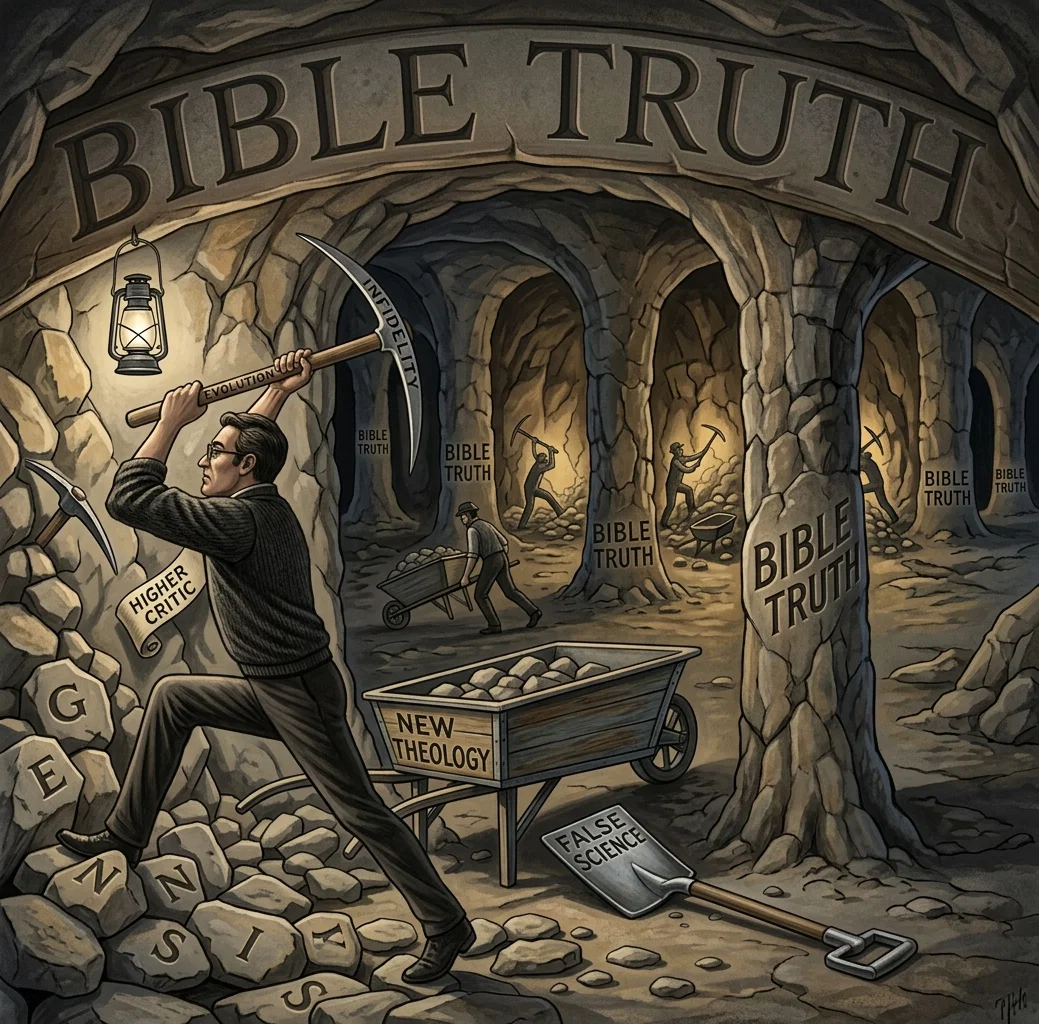
STRIKING and significant indeed is the tremendous fact that the great Protestant religious world of to-day has largely — yes, almost universally — departed from its old position of faith and trust in an inspired and authoritative Word of God.
Few indeed, comparatively speaking, are the preachers and teachers who now present to their auditors the unmodified statement of the apostle that "all Scripture is given by inspiration of God, and is profitable for doctrine, for reproof, for correction, for instruction in righteousness."
UNDERMINING THE FOUNDATIONS
It is but little more than a year now since Harold Bolce, in the "Cosmopolitan," brought the charge that in our great universities and colleges our leading educators in many instances were instilling into the minds of their pupils principles of infidelity that completely undermined their faith in all those truths which have proved the very safeguards of morals, the absolute foundations of righteousness and life. Of course, a multitude of apologists at once rushed into print to register their denials, and to make it appear that Mr. Bolce had entirely misjudged the situation. But the evidence given in many instances was unimpeachable, and only those who refused to see could for a single moment believe that the truth had not been told.
And who does not know that the younger men who to-day occupy the pulpits of our leading churches, have come from these very universities whose theological departments are honeycombed with this same infidelity of which Mr. Bolce wrote? And it requires but the slightest effort in the line of inquiry to ascertain that these YOUNGER ministers openly boast of their ability to prove that much of the Bible record is mere literary trash, antiquated and obsolete.
A Note of Warning
The terrible extent to which this infidelity has developed is not appreciated as it should be. Occasionally, however, somebody comes into actual touch with the facts as they are, and immediately sounds a note of warning. Here is one from a Baptist brother, found in "Word and Way," under date of December 29, 1910:
These words of Ruskin's [found in the preceding paragraph] can apply no more pertinently to any phase of modern indifference and criminal complacency in the face of neglected duty and vanishing opportunity than that which has characterized the attitude of our Baptist leaders, preachers, and churches, and which they still maintain toward the awful rising tide of looseness in practise and discipline and heresy in doctrine which now threatens with irresistible force and unimpeded momentum to sweep away the last landmark of Baptist belief and the last vestige of Baptist faith; to leave Baptists without any place of anchorage and without a reason for existence.
If in the last hundred years of Baptist educational zeal and activity, with the millions of consecrated Baptist money that has been put into our schools, colleges, and theological seminaries, we have been able to build nothing better than modern hotbeds of "higher criticism," skepticism, and infidelity that would put Huxley, Darwin, and even Voltaire and Tom Paine, to shame, and that turns out a brand of "theology" that . . . Bob Ingersoll could have swallowed down all at one dose without blinking, then it is high time for Baptist men and women and Baptist churches to stop giving their money and their influence to the support of such schools. . . . Our greatest danger from them lies in retaining them under the Baptist name, giving them Baptist support, sanction, and patronage, until they have saturated our pulpits, our denominational press, our publication societies, and especially our Sunday-school and young people's literature, with the rank poison of their unbelief and infidelity, their scorn and contempt of the Bible, their mocking evasion of the doctrine of the divinity and lordship of Jesus, and their utter repudiation of the personality and work of the Holy Spirit.
Battering at the Citadel of Faith
After the same order speaks the editor of the Baptist "Examiner" (New York):
Some of our pastors and teachers, not satisfied with abrogating, on their own motion, long established usage with respect to the ordinances of the Gospel, are now battering away, with the catapults of argument and ridicule, at the very citadel of our faith as Baptists, the New Testament, repudiating its authority, denying its inspiration, and claiming the right to depart from its teachings when these do not square with their own opinions.
There is unmistakable evidence of a trend toward a denial of the divinity of our Lord, toward the doctrine of universal salvation, a repudiation of the atonement of the cross, and a conception of the kingdom of God as a society, not of men and women redeemed by the blood of Christ, but of all respectable, well-behaved people, whether they believe on the Lord Jesus Christ or not.
Such ideas as these are proclaimed from our pulpits and professional chairs with constantly increasing boldness, and they are having their effect. Our own is not the only denomination infected by them. They are in the air, and are regarded by many as a necessary expression of the spirit of the age. [Bold-face mine.]
It is all too true that the Baptist denomination is not alone in this trend toward infidelity. While "MULTITUDES OF BAPTISTS are mourning to-day over the assaults of their leaders upon the integrity of the Bible," there are multitudes of other churches having the same experience.
The Leaven at Work
"Current Literature" (April, 1910) tells us that "whether for good or for ill, the modernist ferment is working in all the churches." It mentions in particular the Baptist, Congregational, and Methodist bodies as illustrations, and quotes from Dr. William Henry Burns, "for more than twenty-six years either a pastor or presiding elder of the Methodist Episcopal Church in Chicago." Speaking of church conditions generally, Dr. Burns says:
Dr. Crocker [to whose teaching he has just referred] is mistaken. What he calls damnable heresy does not walk. It rides in its ecclesiastical automobile, as did Ahab in his chariot; and when it overhauls some modern orthodox Elijah trudging along the dusty highway on foot, it imagines it can see the moss growing on his bare, bent, Biblical back, and if it does not run over to crush him, it cries out to him, in the spirit of a true "heresy" hunter, "Art thou he that troubleth Israel?"
The Decided Trend
Ah, there is no doubt as to the trend of the times. Higher criticism, the professed friend and defender of Christian truth, has proved itself Christianity's most subtle and able enemy. When men like Harnack and Bousset11and many others of the same stamp, rise up and make open attacks upon the doctrines of the divinity and resurrection of Christ; when they explain away the miracles, and account for them upon purely scientific grounds; when New Testament teachings are so changed that even the most orthodox Jew no longer finds in the Christian faith anything objectionable, — then we may know that the limit has almost been reached.
From the View-Point of the Modern Jew
A prominent Jewish writer, after speaking of Harnack, says:
Already a large percentage of Christian pastors confess that they no longer believe in the divinity of Christ. Only official Christianity still carries the fetters of the dogmatic teachings of the church. Harnack's free and open position is all the more significant from the Christian point of view, because he has removed those very things in Christianity which were a stumbling-block to the Jew. And if this process of elimination continues consistently and logically, there will soon be nothing left in Christianity except what is distinctively Jewish.
One is OFTEN reminded nowadays by "higher critics" and their followers, of the foolishly wretched teachings of Origen, the semi-pagan, Platonic, philosophic "higher critic" of the fourth century. Of the Bible Origen said, "The Scripture interwove in the history some event that did not take place, sometimes what could not have happened; sometimes what could but did not." "Who is so foolish," he wrote, "as to suppose that God, after the manner of a husbandman, planted a paradise in Eden, . . . and placed in it a tree of life?" "Countless instances of a similar kind," he added, were to be found. "Nay, the Gospels themselves are filled with the same kind of narratives." I say we are often reminded of Origen's belittling of the Bible, by present-day teachers. For example, the noted Rev. R. J. Campbell, of London, England, recently gave his audience to understand that Christ's feeding of the multitude was not a literal event, but only symbolic. "The feeding of the multitude," he declared, "was not a feeding of the body, but a feeding of the soul with the bread of life."
The Whole Bible Attacked
Time was, and not many years agone, when but small portions of the Bible were made the objects of attack, and by comparatively few men. The book of Job was a mythological tale, Jonah's prophecy a fish-story. To-day, however, every book from Genesis to Revelation is under the fire, not of the few, but of the many. One is really out of style now who does not know how to insinuate some doubt regarding the reliability of the Word of God.
To close this article, let a few samples of present-day discounting of the Scriptures be offered in evidence. We "accept the Bible," says a recent writer, "as a medium of truth, but insist upon rejecting what is not reasonable in it. . . . We give it high and honored place as the record of religious thought and progress in the past, but not in any sense as an infallible guide in the present."
Prof. Gerald B. Smith, of the divinity department of Chicago University, declares that "in the investigation of the Old Testament religion it has been found that many of its elements were derived from Israel's contact with Babylon." "I am opposed," writes a German professor, "to having schoolboys and girls taught that the narrative about the world being made in seven days is true, or that there is any veracity in the statements that man was made of clay, that life was breathed into his nose, and that woman was made of a man's rib. I object to the tales about the ten patriarchs."
But God's Word still stands sure. To those who regard it only as "the word of men" (1 Thess. 2: 13), it can bring no blessing; but to those who receive it "as it is in truth, the Word of God," it will prove the power of God unto salvation. By the Spirit of our God it is still translated into human experience, and till time is no more it will continue to be man's anchor Rock, his everlasting good hope. C. L. TAYLOR.
The World’s Largest Ocean Liner
The Hamburg-American Steamship Company has placed an order with a firm in Belfast for the largest ocean liner that has yet been built. The White Star line has been taking the lead in large, comfortable, and elegantly equipped vessels, the largest of which, the Titanic, was launched a few weeks ago at Belfast, Ireland. The Titanic is a sister ship of the Olympic, which is just now receiving her finishing touches, and beginning her first voyage from Southampton across the Atlantic. The Mauretania and the Lusitania, each 762 feet long, built by the Cunard line a few years ago, have been the wonders of the age until the launching of the Olympic and the Titanic, the length of each being 882 feet. But the new vessel contracted for by the Hamburg-American line is to be 950 feet long. It will have eleven stories; it will carry 5,000 passengers; it will have engines of 80,000 horse-power, exactly twice as much as those of the new White Star liners; the decks or stories will be connected by three elevators; the first-class saloons on the upper deck will be 300 feet long; in addition to drawing-rooms, smoking-rooms, and a restaurant that will seat 700 at once, there will be a large winter garden, and an immense hall filled with plants, fountains, etc. On the promenade deck will be quiet summer-houses in Old English rustic style. A large marble swimming-bath, modeled after one found in the ruins of Pompeii, will run through two decks. This bath will have a marble promenade and massage rooms, Turkish bathrooms, electric light baths, etc.; while near-by will be a large gymnasium. It may be wondered how so many things can be arranged all in one vessel. But when it is considered that this ship is almost 1,000 feet long and eleven stories high, it will be seen that there is ample room for all that is proposed. The practical side of these great ships lies in the fact that they are so large and heavy that they plow through the waves rather than be tossed about by them, thus ridding the voyage of much of the unpleasant seasickness that is a necessary accompaniment of the smaller boats.
Parcel-Post
By Editor
THERE is still hope that the nation may adopt the parcel-post. The Chicago Tribune points out the utter inconsistency of rural free delivery without the parcel-post. For instance, there are over 40,000 routes. At present the total load of the average wagon on the average trip of 25 miles, reaching 125 families, is about 20 pounds. It could be made 500 pounds with little or no additional expense. It would save the farmers a large amount if the parcel-post were at their service.
The Tribune says, "By our policy our Government charges 1,000 per cent more for parcels carriage than the German government, and besides that, restricts parcels to four pounds and less, while the German post carries up to 110 pounds. By our policy it costs more to send a small parcel to the next town than it costs to send it half around the world."
One measure before Congress looks to the condemnation and purchase of the express companies in America by the Federal Government, and the addition of their business and service to the Post-office Department. Congressman Lewis, of Maryland, who presents this in a bill, declares that the express companies are positive hindrances and obstacles to the business of the country, in fact, in league against the Government. For instance, it is said that an express company will receive from British authorities parcels weighing three pounds, and will carry them from New York to San Francisco for 37 cents, while it would charge $1.76 for transporting a domestic package the same distance.
We have a great mail service, but it might do very much more for the people than it is doing, and still not be a loss. If it were conducted as it should be, we would not hear the constant contention that rates ought to be raised on magazines.
Sugars
Sugars.— There are many kinds of sugar in this world — more than the ordinary person thinks about. There comes into the market of New York and Paris, for instance, rice-sugar, a by-product of the Japanese made from rice-starch. Its native name is mizuame, meaning “liquid sugar,” for it will not commercially crystallize. While it can not be made solid, it is quite readily handled if of a certain consistency, like so much rubber, without leaving the fingers sticky. Then there is the Chinese sorghum-sugar in little slats, sun-dried and sun-cured; the raisin-sugar of Asiatic countries, non-crystallizable; melon-sugar; maize-sugar, made from our ordinary maize, or corn, used largely in confectionery trades, known as glucose, and sometimes called “grape-sugar”—an utterly misleading term, which ought never to be employed. Real grape-sugar is made solely in Iberia, direct from the grapes, not raisins, and is rarely exported. Then there is the cane-sugar and the beet-sugar and the maple-sugar, sugar from palm-trees, date, and cocoa, and in Deutschland is made a potato-sugar as sweet as maize-sugar.
The International Sunday-School Convention
By Editor
The recent great International Sunday-school Convention recommended that the Bible be placed in the public schools of North America, a thing neither wise nor Christian. It also voted for international arbitration, and for placing marriage and divorce regulations in the hands of the Federal Government. The following officers were elected: president, W. N. Hartshorn; general secretary, Marion F. Lawrance; assistant general secretary, Hugh Cork; superintendent adult department, W. C. Pearce; superintendent teacher training department, Franklin McElfresh, D.D.; superintendent missionary department, W. A. Brown, D.D.; superintendent elementary division, Mrs. Mary Foster Bryner; field worker for the Northwest, W. C. Merritt, D.D.; field worker for the West Indies and Central America, Aquila Lucas, D.D.; superintendent home and visitation department, J. Shreve Durham; field worker for Mexico, E. M. Sein, D.D. Chicago was selected for the next convention, in 1914.
Tibet Opening to the Gospel
Mr. Wm. T. Ellis, the editor of "Field of the Continent," interviewed the great Dalai Lama of Tibet. He has a very great title, but is said to be an insignificant personage in physical, mental, and spiritual make-up, and is described as having a pock-marked face, a bullet head, pointed ears, and waxed mustache. The lama declared that it was his plan to return to Tibet and open the closed land to foreigners, and send some of the young Tibetans to Europe and America for education. He expressed regret that Buddhism had declined in purity, but still predicted that in 400 years all the world would be Buddhists. It will be a blessing if Tibet is opened freely to the foreigners. Of course sooner or later it is bound to come. Every country in the world will be swung wide open to God's Gospel of the kingdom, and the world will be left without excuse.
The Great Aviation Meeting
The recent great aviation meeting at Liege, Belgium, shows how sport-mad the world has gone. It is said that there were one million people in attendance. Various accidents attended the great meet at the first, but these do not stay the sport. Among the saddest has been the burning of an aviator in the air.
California’s Population Possibilities
According to the Annual Report of the California Development Board, entitled "California Resources and Possibilities," if California were as densely populated as New York, it would have a population of over 29,000,000; as Illinois, a population of over 15,000,000; as Rhode Island, over 79,000,000.
Southern Pacific Double-Tracking Plans
Julius Kruttschnitt, director of maintenance and operation for the Southern Pacific railroad, states that definite plans are well under way to have his road double-tracked all the way between San Francisco and Chicago before the time of the Panama-Pacific Exposition in 1915.