HERE is no truth of the blessed Gospel which is more clearly taught than that our Redeemer will return the second time. Before this awful event all others pale. It is the sublimest spectacle and most matchless display of transcendent glory connected with the scheme of redemption. When the Lord spoke the eternal principles of His own perfection from the flaming top of Sinai, and traced them in stone with His own finger, the whole earth trembled, and the glory of God was revealed in mighty majesty. But this divine exhibition of heavenly glory will be surpassed when the Redeemer comes to take to Himself the people whom He has saved from the terrible thralldom of sin.
At His first advent He came in weakness. He came as a helpless babe to show the frailties of our frame. As a lamb He came to bear the burdens of a weak and degenerate race. But how different the scene when He appears the second time to overturn the proud and stately empires of earth and scatter them like chaff driven by the wind! We may think of the glorious event, and it is well to let the picture linger in the mind, yet we can never take it in. The human mind can never comprehend in its fulness the hour when, crowned King of all kings, the Saviour comes to reap the harvest of the earth.
How He Will Come
The coming of our Lord is a real thing. It is no phantom. It is the advent of a real personal being. Jesus left the earth a real person, bearing in His body the marks of His humiliation. "And while they [the disciples] looked steadfastly toward heaven as He went up, behold, two men stood by them in white apparel; which also said, Ye men of Galilee, why stand ye gazing up into heaven? this same Jesus, which is taken up from you into heaven, shall so come in like manner as ye have seen Him go into heaven." Acts 1: 10, 11. An angelic cloud received Him into glory; and when He appears the second time, He is seated upon a "white cloud," "having on His head a golden crown, and in His hand a sharp sickle." Rev. 14: 14.
When He comes He will be escorted, like the victorious conqueror which He is, by "all the holy angels." Matt. 25: 31. When one angel came to the sealed tomb to call the Redeemer as He lay locked in the fixed embrace of death, the glory which attended the celestial messenger struck to the earth the guard of Roman soldiers who were watching the sepulcher. How much glory, think you, will be revealed when the unnumbered millions of mighty angels come with the Redeemer? They come as reapers to gather the sheaves into the heavenly garner. But this is only a little of the glory which is to be seen. The King comes in the most supernal glory, "the glory of His Father." Matt. 16: 27. He will come in "His own glory, and in His Father's, and of the holy angels." Luke 9: 26.
In the past, kings, emperors, and potentates of earth have sought to show the glory of their empires. In triumphant splendor and overweening pride they have exhibited all their regal pomp and glory. But they have perished, and their glory is no more. But the consuming majesty and glory which attends the coming of Jesus overshadows theirs as the sun shining in its zenith power eclipses the rays of a candle, and His glory will endure throughout all ages. Its luster will not be dimmed by passing cycles.
When He Is Coming
And now, as in ages in the past, the Lord will warn the world of the event which is approaching. He warned the antediluvians; He warned Sodom; He also warned Nineveh; and when His first advent was impending, He sent His forerunner with a special message for the time. And when we reach the closing days of the world's history, we read that there will be "signs in the sun, and in the moon, and in the stars; and upon the earth distress of nations, with perplexity; the sea and the waves roaring; men's hearts failing them for fear, and for looking after those things which are coming on the earth: for the powers of heaven shall be shaken. And then shall they see the Son of Man coming in a cloud with power and great glory." Luke 21: 25-27.
Reader, this glorious day draws near; it will soon be ushered in. Prepared or unprepared, its stern realities will soon be upon us. For the righteous it is a day of greatest joy, when they can look up and rejoice; for sinners it is a day of gloominess, desolation, and destruction. While the Life-giver is still on the mercy-seat, offering pardon to the impenitent, shall we not turn to Him with full repentance, that we may find forgiveness, and be numbered among those who can look up and say, "Lo, this is our God; we have waited for Him, and He will save us"? Isa. 25: 9.
The Importance of Self-Control
AMONG the minor virtues, probably the habit of self-control in speech holds the most important place in the life of a woman. The acquirement of this habit must begin early or it will never be attained save with great difficulty. It must be formed in girlhood if it is not well started in childhood. I have seen the happiness of many a fair life ruined by the want of power to suppress the word of bitterness, contempt, and anger, even under what might be called “reasonable provocation.” There are times when one’s only duty is to keep from talking. There are times when keeping still is wisdom, love, Christianity.— Anon.
Prayer
By Hugh Miller
PRAYER is so mighty an instrument that no one ever thoroly mastered all its keys. They sweep over the infinite scale of man’s wants and of God’s goodness.—Hugh Miller.
The Old-Fashioned Bible
By Albert Carey
By Albert Carey
The old-fashioned Bible, with its old-fashioned lore,
Its Maker eternal, and its Christ to adore,
Its sin and its Saviour, aye, its cross and
its crown,
Is the Bible forever, sin never can drown.
Its tale of creation, of the Deluge and
tower,
Its Sinai thunder, its miraculous power,
The beginnings of nations, their story fore-
told,—
All this is a treasure not to reckon with
gold.
And when the fierce fighters have their
last battle fought
Against the great storehouse of the In-
finite thought,
It o'er the great billows of the tempest and
tide,
In glory and honor, will triumphantly ride.
Then stand by the standard, which for
ages has stood
For all that is holy, truly lifting, and good.
And let its great teachings as your ad-
vocate stand,
And with it you'll triumph in the victory
grand.
Trials That Develop Manhood
"The heaviest burdens, the greatest trials, the severest temptations—these things are the makers of manhood. We must wrestle with propositions larger than ourselves till the strain develops us beyond their proportions. Then when we become bigger than our trials, we see why a benignant Providence permitted the trials to come."
XXXV. The Seventh Head
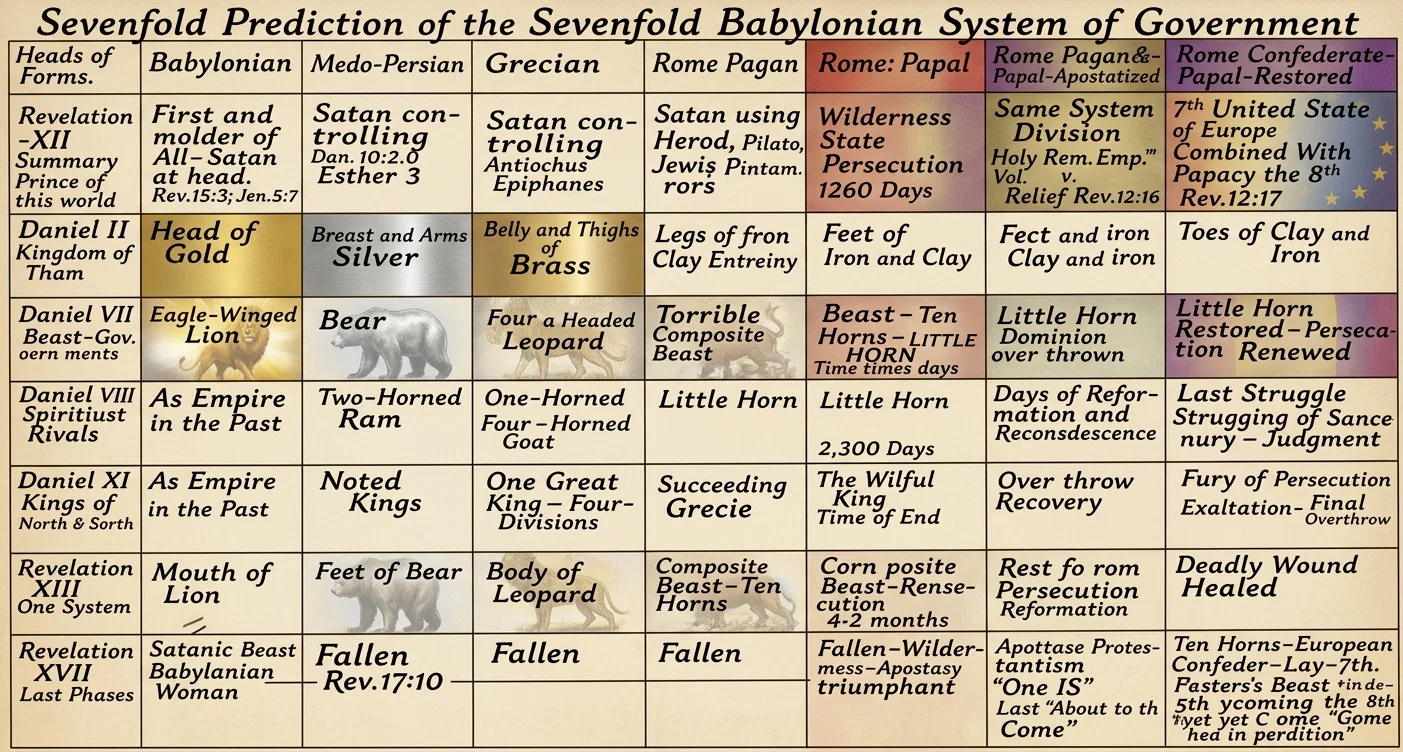
ROME in her various phases is represented by various prophetic symbols. In the second chapter of Daniel the great civil world empires are represented by various parts of a great metallic image: the head of gold, Babylon; the breast and arms of silver, Medo-Persia; the belly and thighs of brass, Grecia; and the legs of iron, and the feet and toes of iron and clay, Rome. The unity of the Roman kingdom is shown by the iron. The DIVISION is shown not by the TOES, but by the MIXTURE of IRON and CLAY; for "whereas thou sawest the feet and toes, PART of potters' CLAY, and PART of IRON, the KINGDOM shall be divided." Dan. 2: 41.
In Daniel 7 Rome is represented by a "dreadful and terrible" beast, with "great iron teeth;" and the divisions in the kingdom are symbolized by ten horns. So also in Revelation 13. It is a noteworthy fact that there did exist just ten divisions of the Roman Empire between the years A.D. 476 and 493. Then the up-pushing of the diverse kingdom of the Papacy overthrew three of these kingdoms — Heruli, Vandals, and Ostrogoths. Following this, for 1,260 years the Papacy held, to a greater or less extent, Spiritual Domination over the kingdoms of Europe; but never was there a specific union among these kingdoms to receive and accept the Papacy as such. She was so regarded generally, but not always of choice. It was oftener through fear or intrigue that she ruled.
The latest phase of this great empire is presented in Revelation 17. It is that phase which exists while the judgment of God is impending, and just before the final destruction of earthly rule. At that time, even as at the beginning, there will be ten divisions; but at that time, as NOT at the beginning, these ten powers will be of "ONE MIND" to elevate the Spiritual Domination of the Papacy. However, there is this difference between the symbols of Daniel 7 and those of Revelation 13 and 17, which it is well to bear in mind: In Daniel each world power is represented by a separate symbol, while in Revelation all are represented by one symbol (a beast), existing under different consecutive heads, showing that the Church-and-State governments (the persecuting elements) were practically ONE SYSTEM throughout, yet manifest in various phases, represented by the heads.
The First Six Heads
The first six of these heads were Babylon, Medo-Persia, Grecia, Pagan Rome, Papal Rome, and the pagan-religious governments of Europe as now existing, embodying the same principles as preceding heads, and opposed to the principles of true religious liberty. We reprint again from the Revised Version of Revelation 17 the explanation of the vision, given by the angel to John:
"[8] The beast that thou sawest was, and is not; and is about to come up out of the abyss, and to go into perdition. And they that dwell on the earth shall wonder, they whose name hath not been written in the Book of Life from the foundation of the world, when they behold the beast, how that he was, and is not, and shall come. [9] Here is the mind that hath wisdom. The seven heads are seven mountains, on which the woman sitteth: [10] and they are seven kings; the five are fallen, the one is, the other is not yet come; and when he cometh, he must continue a little while. [11] And the beast that was, and is not, is himself also an eighth, and is of the seven; and he goeth into perdition. [12] And the ten horns that thou sawest are ten kings, who have received no kingdom as yet; but they receive authority as kings, with the beast, for one hour. [13] These have one mind, and they give their power and authority unto the beast. [14] These shall war against the Lamb, and the Lamb shall overcome them, for He is Lord of Lords, and King of Kings; and they also shall overcome that are with Him, called and chosen and faithful. [15] And he saith unto me, The waters which thou sawest, where the harlot sitteth, are peoples, and multitudes, and nations, and tongues. [16] And the ten horns which thou sawest, and the beast, these shall hate the harlot, and shall make her desolate and naked, and shall eat her flesh, and shall burn her utterly with fire. [17] For God did put in their hearts to do His mind, and to come to one mind, and to give their kingdom unto the beast, until the words of God should be accomplished. [18] And the woman whom thou sawest is the great city, which reigneth over the kings of the earth."
The beast that "WAS, and IS NOT, and is ABOUT TO COME up," we learned last week, as the prophecy clearly shows, is the beast under the papal head. When it comes up again it is called "an eighth" (verse 11), and goes "into perdition," or utter destruction. It is therefore the last phase of the dragonic system, which has oppressed the world for ages. It is "of the seven." It was the fifth head; but as it appears again it is called an eighth. As it is both the fifth and eighth, there must be two intervening heads. One of these (the sixth) we have found to be the present phase of Church-and-State rule in Europe.
What Is the Seventh Head?
Upon this part of the prophecy, which pertains to the future, we have no disposition to dogmatize. As to the past and present of the prophecy, and as to the future, so far as it relates to the FACT of the restoration of the Papacy, it seems to the writer that the position taken is clear, logical, and consistent, tho its setting forth may not be in the happiest style. We believe it is buttressed by Scripture principles of prophetic exposition, and by historical facts. But as to the future, this article can only suggest what seems reasonable and probable.
Whatever the seventh head may be, it is evidently connected with the ten horns; for it is with the horns that the beast is again restored to power (verse 12), horns which, as contemplated by the prophecy, "have received no kingdom as yet."
Present Political Condition of Europe
For the last quarter of a century Europe has been a great seething political caldron, with the "iron" (imperialism) and the "clay" (democracy, Socialism) struggling for the mastery. Discontent reigns everywhere. Lawlessness is rampant. The burden of royal houses with great numbers of dependents, and the still heavier war budgets of the various countries, have galled beyond endurance, and well-nigh broken the backs of an overburdened people. As a result the nihilistic and socialistic propagandas, hidden at times by more prominent public affairs, have in secret grown apace. For a score of years thoughtful and observing men have been talking of a repetition of the French Revolution on a scale before which that of 1793 will pale into insignificance, in which not only a "tenth part of the city," but the whole European camp, shall be given over to the red hand of a great international mob, goaded to madness by long years of oppression and injustice — fancied and real.
Present Religious Condition of Europe
A century ago France gave the deadly wound to the Spiritual Domination of the Papacy, which had been gradually weakening since the Reformation. Whatever may be said of the means by which it was accomplished, the result was a long step in the way of progress, while the means, the atheistic revolution of France, was but the logical result of a law-bound, yet lawLESS, religion,—a religion bound about by human tradition, and civil and priestly laws, in its smallest detail, but through which the law and Word and worship of God were made of none effect. It was called Christianity. It was simply a part of the old dragonic system, which began with Babylon. But the people, believing it to be Christianity, and not knowing what Christianity was, logically were swept into infidelity — the logic always of a disregard of God's law.
Just here Protestantism would have helped France, but France had cast Protestantism out; and it is a sad fact to record that in those nations where two centuries before it was such a power, it had been false to the principles which gave it life, and followed in the way of the Roman Church by uniting with the State, and itself inciting to lawlessness and contempt of God's authority by making void His Word through legalized traditions. Religion has been kept alive in Europe by the non-conformist religious bodies — called by the State churches, as by Rome, "sects" — and by devoted members in the State churches, despite the system with which they are connected. It is now a still sadder fact that these non-conformist bodies are uniting with the State churches, and demanding more stringent legal regulations to support church dogmas, notably the Sunday, — an ages-long mark of apostasy, "the wild solar holiday of all pagan times." Thus are all the great religious bodies making void the law of God through the tradition of men, and thus breeding contempt of all law among the masses. Whether or not it is true, millions among the masses feel that the religious people, who to them represent Christianity, look down upon them, or utterly ignore them in the just demands they are making of rulers. And by this means is disregard of God and religion fostered. Sometime the tension will reach its utmost strain, and will break. The trodden worm will turn. The century-oppressed and patient people will rise, throw off all restraint, and the thrones of Europe will totter and fall, and anarchy and red-republicanism will be enthroned.
Roman Catholic Policy
When triumphant, the Papacy has ruled arbitrarily, merciful only to those who submit without reserve. She believes this course to be her duty. Admit her premises, and her conclusion is inevitable: "The end justifies the means." Since her domination was destroyed, she has played the double game of stirring up the nations, arousing strife and discord secretly, if we may believe such men as Lord Robert Montague, while in public she is pointing back to what she calls the golden days of7her rule, but which history calls the Dark Ages, during which time, she tells the nations, there were no paupers, labor difficulties, Socialists, Nihilists, and internal troubles; and that if the Papacy is again restored, all these things will cease, and the blessing of God will rest upon the nations. It was only a few years ago that the late Cardinal Manning, of England, declared, "If governments will not obey him [the supreme pontiff], the people will;" that is, the people will obey the pope, and rebel against the constituted authorities.
But such rebellion would overstep, in all probability, Rome's desire, and anarchy would be upon the nations. Is not this what is meant by the "abyss," the chaos, of Rev. 17:8, above? Such the earth was previous to God's calling it into order. (Gen. 1:2.) The same word is applied evidently to the place from which came the unorganized hordes of Arabia, and to the infidelity and red-republicanism of France. (See Rev. 9:1, 2; 11:7.) It seems to us that some such condition will succeed the restoration of the Papal domination; and that out of it will arise the ten horns, symbolizing ten "United States of Europe," of which we already hear. These United States of Europe (Rev. 17:12) will form the seventh head in embryo of the dragonic system.
Sevenfold Prediction of the Sevenfold Babylonian System of Government
But as France found infidelity a poor basis for a submissive government, so will these united powers speedily find it. The Vatican, the Roman curia, the ecclesiastical body of the Roman Church, still exist. While the turbulence and the rebellion are the direct result of the system she has fostered, she emphatically disowns them all, and in dulcet tones pleads with the rulers of men. She says in effect: "Make me the supreme arbiter; restore me to my rightful place as head over all religion and corrector of heretics; honor the bride of Christ by exalting her as His representative. I can control the masses. These dissensions among the people, these judgments in the earth, are manifestations of God's wrath against the nations because they have cast off God's rule by rejecting me, His vicar. You have tried Protestantism, and that has failed; you have tried infidelity, and that has failed, and the judgments of God are increasing. Reinstate me, the true 'mistress of the kingdoms' of earth, and your laws will be respected, heresy will be extirpated, the Sunday will be honored by law, and the judgments of God will cease."
This ten-divisioned empire, arising out of the abyss, continues as such but "a short space." (Rev. 17:10.) The powers composing it see their authority shaking as they shook the powers that preceded. Unable to discern the causes of the difficulties and dangers that menace their rule, they are persuaded to listen to the Babylonian harlot. They pause; they are pleased; they are persuaded; they take her to their hearts; they reinstate her in power; and the now restored Babylon sings in her short-lived triumph, "I sit a queen, and am no widow, and shall see no sorrow." Rev. 18:7.
The Eighth Head
And now the deadly wound is healed. The apostate church receives again what she lost. The two essentials to a persecuting power exist once more, seen by the children of God in its true light as a bane, but seen by the blindness of the world as a blessing. The papal church, uniting with the ten kings, forms the eighth head, which is of the seven, and that goes into perdition. The National Reformers of the earth are jubilant. The heathen nations of the earth, like heathen nations of old, having accepted of Christ by law, the following scriptures will be fulfilled: "And they that dwell on the earth shall wonder [admire], whose names were not written in the Book of Life from the foundation of the world, when they behold the beast that was, and is not, and shall come." Rev. 17:8. "And his deadly wound was healed: and ALL THE WORLD WONDERED after the beast. . . . And they worshiped the beast, saying, Who is like unto the beast? who is able to make war with him?" "And all that dwell upon the earth shall worship him, whose names are not written in the Book of Life." Rev. 13:3, 4, 8.
The One Hour
These ten divisions receive power as kings one hour with the beast. (Rev. 17:12.) "These have ONE MIND, and shall give their power and strength unto the beast." "For God hath put in their hearts to fulfil His will, and to AGREE, and give their kingdom unto the beast, until the WORDS of God shall be fulfilled." Verses 13, 17. For ONE HOUR,
A numerical adjective modifying a noun, denoting definite quantity as one of its meanings, would have a definite meaning. We use "day" and "hour" in an indefinite way, as "day of salvation," "hour of action;" yet in such cases we never preface the term with a definite adjective. ONE day, or ONE hour is definite. Dean Alford says: "One hour (during the space of one hour, just as the corresponding term in chapter 8:1 means during the space of an hour). Some, e. g., Vitringa and Elliott, have upheld the meaning of 'at one and the same time with.' But I venture to say that but for a preconceived opinion, no one would ever have thought of any other meaning for these words than the ordinary one, 'for the space of one hour.' And thus, accordingly, we will take them as signifying some definite space . . . thus designated."—Notes on Revelation.
The "one hour," therefore, is definite prophetic time. A day in prophecy is a year; an hour is one twenty-fourth part of a year, or fifteen days. It begins when the law reinstating the Papacy goes into effect. These fifteen pregnant days are the period of papal triumph. The apostate church again rules supreme; it is her crowning, dying glory. The daughter of Babylon once more says: "I am, and there is none else besides me." (Isa. 47:10, R.V.) "I sit a queen, and am no widow, and shall in no wise see mourning." But God says, "Therefore in one day shall her plagues come, death, and mourning, and famine; and she shall be utterly burned with fire; for strong is the Lord God who judged her." (Rev. 18:7, 8, R.V.)
Thus the promises of the apostate church to the ten kingdoms are proved false; and the kingdoms, enraged at the deception and avarice of the church, turn upon the siren, and rend her to pieces, fulfilling the following: "These shall hate the harlot, and shall make her desolate and naked, and shall eat her flesh, and shall burn her utterly with fire." Rev. 17:16. The very system which is the outgrowth of her fornication, unites in her destruction. She falls in the nets which she herself spread. Her scheme of self-exaltation has proved her destruction. This destruction, at the close of this HOUR of her triumph, is pointed out in Rev. 18:10, 17, 19.
Her destruction is eternity's condemnation of all man-made religion. It sets the seal of8eternal infamy upon the mystery of iniquity, which has exalted itself in the place of the mystery of godliness — Jesus Christ and His Word supreme in the heart and in the church. Simple faith in God eternally triumphs.
The Time Is Short
It may be said that this view of the prophecy calls for so much to be performed that it puts the Lord's coming far away. But who knows how long it will take to accomplish all this and more in this paramount age of rapid development? and who knows if the greater part of it, the molding of character, is not already performed? When Jesus died upon the cross, there was but one penitent thief to do Him homage. Less than threescore days later, three thousand had acknowledged His claims as the Christ.
When Moses went up into Mount Sinai to talk with God, all the people were professedly loyal to the great Jehovah; but in less than forty days they had turned from Him to the Egyptian sun-worship.
The French Revolution was comparatively a short work of itself; the seeds of infidelity had, however, been sown by Rome through her inconsistent example, her self-laudatory creed, and her terrible oppression.
July 3, 1870, not a breath of war stirred the political atmosphere of Europe. Less than one month later, France was fighting for her place among the nations; and another month witnessed the victorious German army at the gates of Paris. The revolution in Brazil, November 15, 1889, took place in a day, and the world was startled by the news that an empire had become a republic; and two days later the Emperor and his family had sailed for the Old World. Witness also the recent revolution in Portugal.
And so with the last revolution among the governments of earth. The seeds of discord, lawlessness, socialism, and anarchy have been sown by governments and churches for centuries, have been breaking down all respect for government, law, and order, by breaking God's law; and dire revolution will be the result. It can all occur in a very brief space of time. The nations are becoming angry, and God's power alone restrains the devilish passions raging in the hearts of multitudes today. Let Him but withdraw His restraining power, let the angels of God but remove their restraining hand from the winds of strife (Rev. 7: 1-3), let the work of God's Gospel be finished among men, and no one can foretell how soon will all the prophecies of God's Word pertaining to the nations be fulfilled. Let those who believe in the 'sure word,' awake.
[The study of the last part of Revelation 13 will be continued in our next.]
Ten Thoughts on Tithing
1. It costs a good deal to pay the tithe to the Lord, but it costs a good deal more not to pay it.— Whalon.
2. The Christian church has fallen below even the Jewish low-water mark of a single tithe.— George Sherwood Eddy.
3. "All the tithe of the land is the Lord's," and not to pay it is robbing Him; and that is a sure way to bring down His displeasure.— Bailey.
4. To dedicate the tenth of what we have is mere duty; charity begins beyond it; free-will offerings beyond that again.— Frances Ridley Havergal.
5. We may safely take the tenth as a starting-point, for there are few who would care to give less than the heathen and the Jews.— William H. Salimon.
6. In the sight of Christ's teaching, the "whole tithe" for us may be more than a tenth. Jacob had no church to support.— George Sherwood Eddy.
7. The man who prays, "Thy kingdom come," and does not give some just proportion of his income to promote His kingdom, is a conscious or unconscious hypocrite.— F. E. Clark, D.D.
8. Christians should regard money as a trust. They are stewards of Jesus Christ for everything they have; and they ought to see His image and superscription on every dollar they possess.— T. L. Cuyler, D.D.
9. A tenth of his income was required of the Jew to be set apart and sacredly devoted to God's treasury. And this was the first tenth, and not the last tenth; the "first-fruits," and not the dregs and leavings.— A. J. Gordon, D.D.
10. Some of us could tell of such sweet and singular lessons of trust in this matter of tithing that they are written in golden letters of love in our memory. Of course there will be trials of our faith in this, as in all else.— Frances Ridley Havergal.
Our Bible Reading
Man's Hope in the Resurrection
1. What earnest question of humanity did Job ask?
If a man die, shall he live again? Job 14: 14.
2. What have we learned is man's condition in death?
His breath goeth forth, he returneth to his earth; in that very day his thoughts perish. Ps. 146: 4.
3. In whom only is hope?
For God so loved the world, that He gave His only-begotten Son, that whosoever believeth in Him should not perish, but have everlasting life. John 3: 16.
For as in Adam all die, even so in Christ shall all be made alive. 1 Cor. 15: 22.
4. In what lies the hope of the resurrection?
For I delivered unto you first of all that which I also received, how that Christ died for our sins according to the Scriptures; and that He was buried, and that He rose again the third day according to the Scriptures. 1 Cor. 15: 3, 4.
5. What does the rising of Christ mean for us?
And if Christ be not risen, then is our preaching vain, and your faith is also vain. . . . For if the dead rise not, then is not Christ raised: and if Christ be not raised, your faith is vain; ye are yet in your sins. Then they also which are fallen asleep in Christ are perished. . . . But now is Christ risen from the dead, and become the first-fruits of them that slept. For since by man came death, by man came also the resurrection of the dead. 1 Cor. 15: 14-21.
6. How many general resurrections are there?
All that are in the graves shall hear His voice, and shall come forth; they that have done good, unto the resurrection of life; and they that have done evil, unto the resurrection of damnation. John 5: 28, 29.
And have hope toward God, which they themselves also allow, that there shall be a resurrection of the dead, both of the just and unjust. Acts 24: 15.
7. How far apart are these resurrections?
Blessed and holy is he that hath part in the first resurrection: on such the second death hath no power, but they shall be priests of God and of Christ, and shall reign with Him a thousand years. Rev. 20: 6.
But the rest of the dead lived not again until the thousand years were finished. Rev. 20: 5.
8. In what words did Job and Daniel express their thought of the resurrection?
For I know that my Redeemer liveth, and that He shall stand at the latter day upon the earth: and tho after my skin worms destroy this body, yet in my flesh shall I see God: whom I shall see for myself, and mine eyes shall behold, and not another. Job 19: 25-27.
And many of them that sleep in the dust of the earth shall awake, some to everlasting life, and some to shame and everlasting contempt. Dan. 12: 2.
9. How do Isaiah and Hosea express their hope?
Thy dead men shall live, together with my dead body shall they arise. Awake and sing, ye that dwell in dust: for thy dew is as the dew of herbs, and the earth shall cast out her dead. Isa. 26: 19.
I will ransom them from the power of the grave; I will redeem them from death: O death, I will be thy plagues; O grave, I will be thy destruction. Hosea 13: 14.
10. What words of comfort are given to those who mourn for the dead?
But I would not have you to be ignorant, brethren, concerning them which are asleep, that ye sorrow not, even as others which have no hope. . . . For the Lord Himself shall descend from heaven with a shout, with the voice of the Archangel, and with the trump of God: and the dead in Christ shall rise first: then we which are alive and remain shall be caught up together with them in the clouds, to meet the Lord in the air: and so shall we ever be with the Lord. Wherefore comfort one another with these words. 1 Thess. 4: 13-18.
When thou makest a feast, call the poor, the maimed, the lame, the blind: and thou shalt be blessed; for they can not recompense thee: for thou shalt be recompensed at the resurrection of the just. Luke 14: 13, 14.
Christ in the Storm
“It is no argument that Christ is not in the ship because tempests and storms arise.”
Salvation and the Created Self
"SALVATION does not destroy the created self, it only destroys that which in our nature was depraved. We will never get rid of our humanity in this life; but through grace, we get rid of our depravity, and we can learn more and more of how to keep our humanity under self-denial and self-sacrifice toward God. The only safe place for our natural self is under the hand of God. 'Humble yourself therefore under the mighty hand of God.'"
Man’s God-Ward Side
By James B. Remensnyder
MAN has a God-ward side. He thirsts for the eternal and the infinite. And it is in the proportion that religion keeps to her sphere of ministering to this want with her unique, divine, and mysterious truths, that she will be a trusted and worthy guide to lead the soul to its everlasting home.— Rev. James B. Remensnyder.
Higher Powers of Duty and Happiness
By John Ruskin
I WILL strive to raise my own body and soul daily into higher powers of duty and happiness—not in rivalry or contention with others, but for the help, delight, honor of others, and for the joy and peace of my own life.— John Ruskin.