VI. Religious Convictions or Conventions?—What Religion Means
By L. P.
—The Bible—Attitude
My dear Robert,—
Your letter gave me real joy; not that I am glad you are troubled with religious doubts, but rather that these doubts are of a nature to show that you are doing a little real thinking on your own account, and also because you have written me so freely concerning them. The saddest thing about many young Christians of to-day, is that their religion sits so lightly upon them. They are not troubled with doubts, but neither are they strengthened and supported by convictions. At most their religion is a sort of convention, the proper observance of which includes refraining from ordinary labor on one day in seven, attendance on public worship on that day, the avoidance of outcrying sins, and a decent regard for various other proprieties expected of the nominal Christian. But of religion as an inner experience, a something which shall penetrate and transform the life, and set a man all on fire for God and righteousness, they know nothing. Neither do they know the deep comfort of religion, for they have never experienced real heart mourning over sin and evil.
Doubt may be an encouraging omen at a certain stage in a young man's mental and spiritual development; not the doubt that one rests in, but the one that precedes certainty. To rest supinely in a state of doubt and uncertainty, is to resign one's manhood, to say farewell to that generous courage with which the young man should attack every obstacle that presents itself to his progress onward and upward. No; doubt must be fought and conquered, but it must be in honorable warfare. Intellectual honesty is a first requisite to a growing Christian experience. Look your doubts squarely in the face, fight them in broad daylight, and with God's help, liberally promised to every struggling, aspiring soul, overcome them.
Remember, however, that spiritual problems must be worked out under the conditions of actual life, not merely thought out in the closet. Religion is nothing if it does not embrace the whole life of a man,—body, soul, and spirit. When it takes hold of a man, it makes him do things. And it is in helping him to do things, that it proves to him its worth. The philosopher in his study may spend days and weeks in fruitless inquiry into the power and efficacy of the Christian religion; the humble washerwoman solved the question long ago by putting it to the actual test of every-day life, and has been drawing, ever since, that blessed comfort and help which has made her move in a little heaven of her own. Let me illustrate further what I mean, by a very homely example. The question is as to the efficiency of a certain kind of rifle. One man takes it all to pieces, studies the form and structure of the various parts, and tries to arrive at a conclusion as to whether it ought to work or not. Another man pulls the trigger, and notes the result. The first man may know a good many things about the gun, but the second man knows the all-important thing, what it will do.
There is another sense in which the active man is superior to the contemplative man. The mere putting oneself into active, helpful relations with one's fellow men, strengthens the foundations of character, and enlarges and deepens the powers of reflection. Even if Christianity offered only intellectual problems, it would be worth while for the philosopher to devote himself to practical benevolence in order thus to sharpen the reasoning powers and inform the conscience. Perhaps you will think I am wide of the mark in comparing the doubts you express to those of a philosopher; but there are thousands wholly innocent of knowledge of philosophy, who yet contemplate religious problems with much the same detachment as the university professor. Hence the idea can not be too insistently put forward that Christianity lives or dies by the results of a practical test. Either it substantiates its claim to lift man above temporal and material things and satisfy the cravings of his soul for the divine, or it does not. This large question is the main issue. Once answered in the affirmative, the lesser things may be taken up in their order. The man who is sure of God and a future life, is on vantage-ground to fight his doubts.
The Bible, like Christianity, is to be judged by its fruits, and judged as a whole. Coleridge found it divine in that it touched him at greater depths of his being than any other book. Is not the same thing true of you and me? And if the Bible is acknowledged to be a divine revelation, then it naturally follows that the proper attitude for one who would understand it, is that of humility and reverence. "The scorner seeketh knowledge and findeth it not, but with the lowly is wisdom." The Bible, while it is much more than literature, has this in common with all great literature, that it must be approached in the attitude of a disciple. The flippant, worldly spirit is death to the understanding of any truly great poet; much more is it to an understanding of the sacred mysteries of that divine book, which surely should be approached only on bended knee.
This reverent view of the Bible grows out of the nature of its divine message. If we can not fully understand God, how can we expect to understand His book? Is it not enough that we get sufficient light from it to live holy lives? nay, more, that we receive from it comfort in the hour of grief and bereavement, knowing that all things work together for good, and there is a brighter time coming when this great fact will become clear as noonday to us? Is it not enough that the Bible helps us to feel after God and find Him very near to us, even at the door of our hearts? How could a book dealing with great and solemn mysteries, sounding the very depths of human life, and mounting into the highest heavens, be otherwise than difficult of complete comprehension? Why should we expect to understand with our unaided intellects that which was written by inspiration of the Holy Spirit? Nevertheless, this attitude of reverence toward the Bible should not lead us to the worship of the letter; neither should it cause us to gloss over real difficulties of an intellectual character. Our own reason tells us that there are things pertaining to the spiritual life which are not susceptible of demonstration; these things are to be experienced by us through faith. There are other things, again, which frankly belong to the intellectual life, and here it should be allowed to have full sway within proper limits. When one is dealing, for instance, with portions of the Bible that have to do with history and the fulfilment of prophecy, it is proper to apply rigid intellectual tests to any position that we may wish to put forward ourselves, or that others may offer us. In such matters, piety can not take the place of knowledge, tho it will always conduce thereto, and reverence is always fitting when dealing with anything so great and powerful as the Word of God.
Intellect has its place, however, and we should manfully grapple with the problems that present themselves, not only with a view to understanding them for ourselves, but also in order to explain them to others. It must be recognized that many other well-meaning persons have explained some of these prophecies in different ways; and it behooves us, when we put forth a certain view, to back it up with as strong arguments as the nature of the case will permit. If it is a matter that can not be finally decided, then the position taken should be the one which is least open to objection. Moreover, in dealing with such a matter one should be as careful to define one's terms, lay down one's premises, and soberly draw conclusions, as if one were engaged in a legal argument. Not that the bare anatomy of the argument should necessarily be prominent, but in spirit all these conditions should be fully met.
The trouble with much of the popular Bible teaching is that the line is not properly drawn between that which concerns the intellect and that which is primarily concerned with the life of the spirit; and13sometimes loose statements are made just because it is assumed that we have the truth anyway, and need not be careful to fortify our position by those sound arguments that, in the Bible phraseology, will confound our adversaries.
Now I have not dealt with the scientific doubts that you propose, but have laid down certain general principles which I believe will be of some little help to you. In my next letter I shall take up the question of science and the Bible. Meanwhile let me admonish you to seek God in prayer that He may grant you the illumination of His Spirit. It is well to remember that many things that are hidden from the wise and prudent are revealed to babes. There is a childlike humility that is compatible at once with the deepest spirituality and with the most thorough knowledge of scientific methods of proof. We must have it if we would make progress in the way of truth.
Ever yours,
L. P.
The Sure Foundation
By Mrs. S. E. Lowell
Build firm and sure, O soul,
Upon the Rock that can not fail!
The storm is raging, and the gale
Shrieks round thee, fierce and wild and high,
The tempest mocks thy anguished cry.
Build firm and sure!
Build deep and strong, O soul!
Then shall no storm or jar or shock
Sway thee from the unswaying Rock,
For deeper than earth's mightiest tide
Thy sure Foundation shall abide.
Build deep and strong!
Build broad and high, O soul!
Thy temple shall be pure and fair,
And prayer and praise shall echo there.
The songs of faith shall upward rise
Like perfumed airs from Paradise.
Build broad and high!
Build bravely on, O soul!
The Master's eye is on thee still,
Noting each triumph of His will,
As step by step, and round by round,
Thou reachest higher, holier ground.
Build bravely on!
—Mrs. S. E. Lowell.
Heights and Depths
By Grace Agnes Timmerman
[Grace Agnes Timmerman, in “Christian Advocate”]
Far inland, where the hills are green and low,
My lines are fallen, and I may not see
Great ocean, or the peerless majesty
Of snowy peaks uplifted. Yet I know
Some measure of their vast sublimity,
Light-crowned with glory, dominant in gloom,
Forever on my soul the mountains loom;
And in my heart, unfathomed, rolls the sea.
So may the quickened spirit apprehend
Supernal beauty, truth beyond the bar
Of mortal limitation — from afar
May view the holy mount, or may ascend
On wings of adoration to the height
Of heaven's floor, discern the swelling sea
Of love whose fount is God's infinity,
And life that centers at the Throne of Light!
Story of Pitcairn Island
"Story of Pitcairn Island."-By Rosalind Amelia Young, a native daughter. Pitcairn Island, one of the volcanic gems of the Pacific, has been heard of wherever the English language has been spoken. The story of the working out of the problem of human life on its limited territory reads stranger and more thrilling in many respects than a romance. But most, if not all, of the tales told and the books printed have been too fragmentary, or incorrect and misleading. It will be interesting to the friends of that miniature world to know that an authentic history has been written, and that by a native of the island, one to the manor born.
Miss Rosa Young is one of the direct descendants of the mutineers of the Bounty. The book is a plain, unvarnished tale of Pitcairn and its inhabitants from its settlement to the year 1894. It is written with charming simplicity of style, which refreshes the reader and invites continued perusal. Illustrated with 26 engravings. Fourth edition, with appendix. Cloth, $1.00. Address this office.
LIBERTY
By Editor
THE OFFICIAL ORGAN OF
THE RELIGIOUS LIBERTY BUREAU
An illustrated, 48-page, quarterly magazine, published as an exponent and advocate of true religious liberty; defending Christianity and the rights of conscience; upholding the Bible as the infallible word of God; recognizing the church and state as ordained of Heaven for specific and distinct purposes, but vigorously protesting against the alliance of the church with the state in the attempt to advance religion and to promote the state.
Price 25 cents per year. Liberal terms to agents.
Address, LIBERTY, Takoma Park, D. C.
Life and Health
By Editor
A PRACTICAL health journal, published with a view of meeting hygienic needs in every home; teaching how to care for the health and how to preserve life; prescribing simple home treatments to assist nature in throwing off diseases rather than adding more poison by using drugs or unnatural stimulants as remedies; teaching how to avoid disease as far as possible, how to manage in the home when sickness does come, and how to combat the disease by simple remedies which nature provides.
Send for sample copy and special rates to agents. Price 10 cents per copy or $1.00 per year.
Address, LIFE & HEALTH, Takoma Park, D.C.
Getting People to Church
By Woodrow Wilson
WHEN we say that the way to get young people to the church is to make the church interesting, I am afraid that we too often mean that the way to do is to make it entertaining. Did you ever know the theater to be a successful means of governing conduct? Did you ever know the most excellent concert, or series of concerts, to be the means of revolutionizing a life? Did you ever know any amount of entertainment to go farther than hold for the hour that it lasted?
If you mean to draw young people by entertainment, you have only one excuse for it, and that is to follow up the entertainment with something that is not entertaining, but which grips the heart like the touch of a hand. I dare say that there is some excuse for alluring persons to a place where good will be done to them, but I think it would be a good deal franker not to allure them. I think it would be a great deal better to simply let them understand that that is the place where life is dispensed, and if they want life, they must come to that place.—Woodrow Wilson.
Christianity Is a Life
CHRISTIANITY is more than a belief, it is a life. It furnishes not only truth to be believed, but things to be done, and the doing of them is by no means a secondary consideration. The truth which we believe is to be exemplified in our life. The life that we live is to be “by the faith of the Son of God,” who hath loved us and given Himself for us.—The Pulpit.
Foreign Magazines
By Editor
“Zeichen der Zeit”
(German)
“Tidens Tecken”
(Swedish)
“Lys over Landet”
(Danish-Norwegian)
“La Sentinelle”
(French)
A list of magazines which are recommended to our readers who would like to secure good reading in any of the above languages. These magazines are published quarterly. Send for a sample copy to the publishers —
College View, Neb.
“Timely Production”
By Editor
“I am in receipt of your book ‘Questions and Answers.’ . . . While I have read much of the matter contained in this volume through the columns of the ‘Signs,’ I consider it a very timely production, as the questions are such as every worker meets daily. I also believe that it will be a real help to our lay brethren who have not an abundance of time to study. I appreciate our pioneer missionary paper, the ‘Signs of the Times.’ Have been a supporter of it for many years, and trust by the help of God to be able to do more in the future.”
“Was very much pleased with it. Not infrequently do I hear individuals say, The first that I read in the ‘Signs’ is the ‘Questions and Answer Department.’ Now that we have these classified, it will be more convenient. The ‘Signs of the Times’ is appreciated by our people, and this year we are using a goodly number in our missionary work. I rarely make a trip over the State without taking several subscriptions.”
“I think it is indeed a valuable book. I have wondered more than once why the splendid answers to these various puzzling questions which have been printed in the ‘Signs’ from time to time have not been put out in convenient reference form, and I am sure our people everywhere will welcome it as just what they have been looking for. You may be sure that I will do all in my power to extend its circulation.”
“I think I know what a good book is, and I can say that in my opinion this book answers a long-felt want expressed by the readers of the ‘Signs of the Times,’ and I most heartily recommend it as a help in Bible study. . . . I assure you of my help in securing orders for the ‘Signs’ and for this book.”
“I received copy of your book ‘Questions and Answers.’ . . . I have not had time to give it careful study; but from the questions and answers found in the ‘Signs of the Times’ every week, I am sure it will prove a great benefit to those who receive it. . . . Will take pleasure in doing anything I can in behalf of the ‘Signs of the Times.’”
“A great benefit to those who receive it”
Bibles
Bibles.—Remember that we are headquarters for anything in the Bible line. We shall be pleased to send you our catalog of Bible selections on application. Pacific Press, Mountain View, Cal.
ELO THE EAGLE
AND OTHER STORIES
BY FLOYD BRALLIAR
THIS new animal book for young folks is receiving an eager welcome by all nature lovers. ELO THE EAGLE is the first of a series of ten interesting stories of animals, wild and otherwise; being, with one exception, the life histories of boyhood friends of the author. Many strange and laughable anecdotes are related by Mr. Bralliar, all of which are strictly true and vouched for by reliable witnesses.
The book is lavishly illustrated by special drawings, with a full-page half-tone design printed in Luxotype at the beginning of each chapter. Two hundred pages, printed on egg-shell paper, beautifully bound in red cloth. Price, post-paid, $1.00.
Easily sold by young people. Agents wanted.
Pacific Press Publishing Assn.
Mountain View, California
Portland, Ore. Calgary, Alberta Kansas City, Mo.
Burma—The Land of the Pagoda
By H. H. Votaw
ACCORDING to the theory held by most ethnologists, Burma has been peopled by successive migrations of tribes from the north. It is even supposed that the Siamese were originally dwellers in this country, but that they were forced farther south by the more hardy tribes that followed them. Whether a tribe of the Karens or the Talaings, also known formerly as the Mons, were the next emigrants, it is difficult to say. Without attempting to prove that the theory advanced concerning these things is true in all particulars, it will suffice to say that there is much that seems to give evidence confirmatory of it.
Among those now to be found in the land Burmese, these predominate: Shans, Chins, Kachins, Talaings, and at least three distinct tribes of Karens. All these tribes are related racially, yet they are so different in some respects that one needs to live here but a short time before being able to distinguish between them easily. I shall not try to describe all the tribes in detail, contenting myself with a few general remarks that will help the reader to understand better what is written concerning the Karens, of which nation I wish to write particularly.
After the Siamese had been pushed over what is now Burma's border by the next migration, the Talaings were the first to establish a real kingdom. If the Karens preceded them, they offered little resistance to the Talaings, being content to withdraw to the hill tracts along the Salwin River. Probably another tribe of Karens came next, and occupied the territory to the north of the kingdom of the Talaings. These were soon dislodged by the conquering Burmans, and driven into the mountains that border the rich delta regions and the fertile river valleys. Then the Shans came; and failing to overcome the Burmese, they took territory contiguous to China, in the central and northeastern part of the country. The Chins and Kachins are to be found in the extreme north. They are devil-worshipers pure and simple. They are not civilized at all. It is but a short time since they engaged in head-hunting. Even now a strong military force is kept in or near their territory. Punitive expeditions are necessary occasionally to chastise them for some raid made upon a peaceful village.
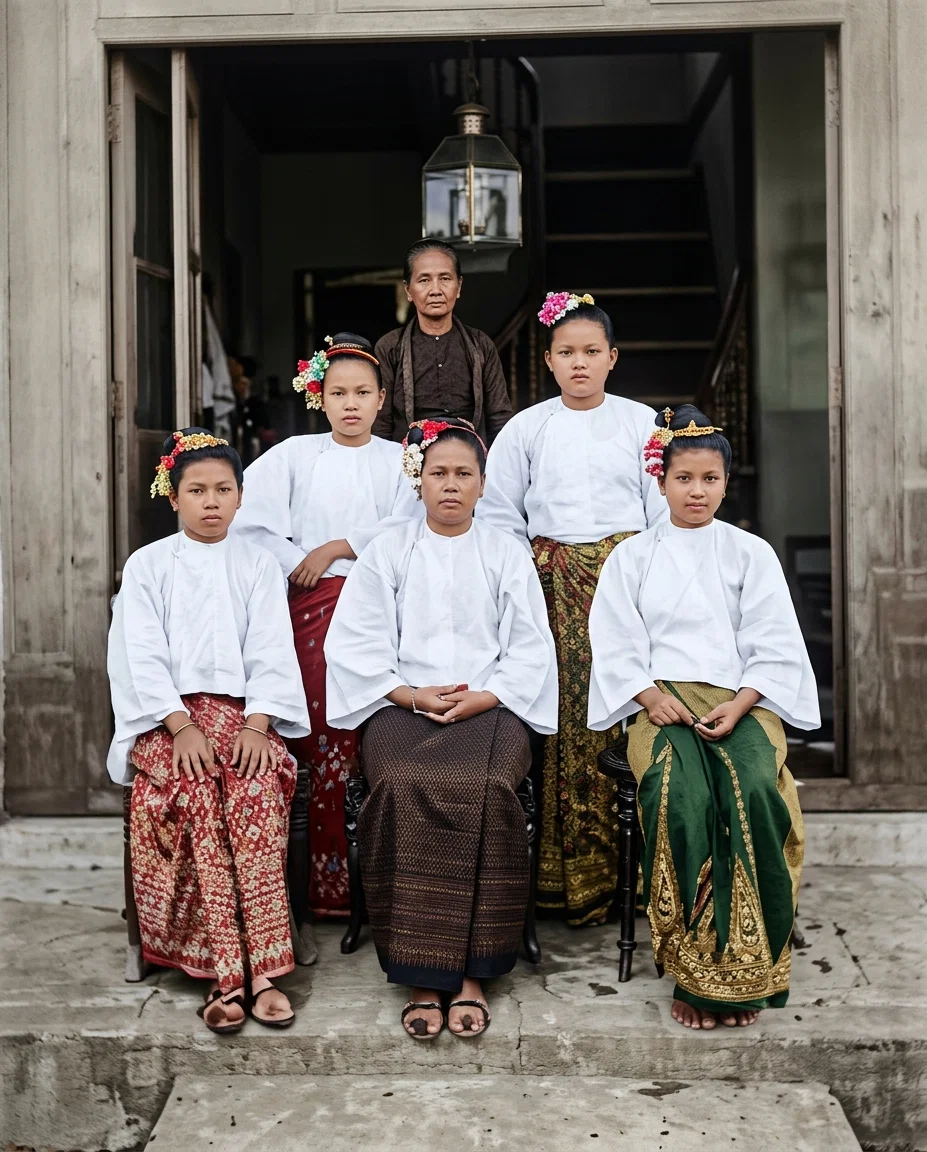
Karen Girls at Home
Burmese Girls
Prior to the acceptance of Christianity, the Karen would fly at the sight of a Burman. For centuries the Burmese rulers had plundered their fields and granaries. This led them to clear a little plot on the hillside, by burning, plant their grain, harvest it as soon as possible, and move to some new location. Thus they were semi-nomadic, returning only once in three or four years to their old fields and again cultivating them. Since British occupation has given them security, many have settled in the plains, but still large numbers are found in the hills.
One tribe, the red Karens, seemed possessed of a more warlike spirit than the rest of their brethren. These successfully withstood their enemies, and maintained their independence in their mountain fastnesses.
Perhaps because he has been living in the cooler air of the mountains so long, perhaps because he is closer kin to the fairer Chinaman, the Karen is lighter complexioned than the Burman. There is also more red in the cheeks of the Karens. And there is a different expression of the face, and a vague something, hard to define, about the shape of the head, back, and hips, that distinguishes them. The difference is most marked among the women, the veriest novice being able to see the difference between the women of the two nations.
As I remarked, the Chins and Kachins have remained outright pagans, excepting the very few who have embraced Christianity and Buddhism. The Talaings, Shans, and Burmans all accepted Buddhism centuries ago, and this land is known as the home of the purest Buddhism of the "northern school." But the history of the Karens is different, and to students of missions it is most interesting. In some respects it is without parallel in all the records of missionary endeavor.
The Karens
In Judson's day, the Karens first came into contact with the missionary. When first discovered, it was found that their traditions told them of creation, a sinless pair in the garden, the fall, the Flood, and other things of which the Scriptures speak. In all essentials, the account they have is in agreement with the Word.
Added to this they say that the knowledge of the true God was lost to them through disobedience and a failure to prize His revelation as its worth demands. They say that the Lord offered the Bible to the other nations, but that it was refused by the natives of India,—by the Burmese, and by the rest. At last it was offered to the Karens, the "younger brother" among the tribes. It was accepted, but not heeded and followed. Finally, God took the knowledge of Himself from them, but not until He had promised that He would again visit them and restore what had been taken away. His agent was to be "white men from the west."
During the time of their darkness and ignorance, they became animists. This is not strange, for it seems that all Mongolian races are especially given to devil-worship. But the Karens said that they did thus because of fear only, until the Great God should again reveal Himself. They illustrated their position thus: A father with his children was traveling up the mountainside. It was necessary for the parent to leave the children for a time. Giving into their charge the domestic animals that he owned, he bade them wait for him on a projecting ledge of the mountain. During his absence, a tiger approaches by the path over which they had come. Filled with fear, they push one of the animals over the cliff. This appeases the brute, and they are spared.
"So," they say, "we offer sacrifices to these malign spirits only because we fear them; but when our Father returns we will worship Him because of love." And by the thousands they have accepted the Gospel of Jesus Christ. The Baptists alone have fifty thousand converts. Other missions have also seen marked results for the labor put forth. Further, they seem to grasp the spirit of Christianity. It is often said in these lands, that it takes three generations to make a Christian; but with the Karens it does not seem so. They have their failings. If they did not, they would hardly be mortals. Some things are trying for the worker. Like other people of the tropics, they seem to be lacking in ambition, and to be smitten with the same "tired feeling." They have a saying that is about as follows: "If you go to school and work hard and get an education, you eat rice; if you stay in the jungle and cut wood, you eat rice."15Still they seem different from most heathen people. Even writers that have but scant sympathy for missionary effort as a whole, admit that in the case of the Karens the results seem to have justified the efforts put forth.
Some six or seven years ago, a missionary of the Baptist Church reported the discovery of another branch of the Karen people. These are located on the Burmo-China frontier. Their language is different from that of the people of the lower part of this province, but the dissimilarity is only as much as would be expected to exist among tribes without a written language, that have been separated for some centuries. The likeness is such that a person who knows one, very readily acquires the other. This last discovered branch holds the same traditions that their brethren have, to which reference has been made. They have eagerly accepted the Gospel. From a distance of many days' journey each way, they have come to the mission compound seeking for light. As many as two hundred inquirers have been at the station at one time, I am told.
Who Will Come?
Ever since we first learned of this intensely interesting people, we have pleaded for some one to come and bear to them the knowledge of the Lord's return. Repeatedly we have mentioned them in the articles prepared for publication. Again and again we have presented them before the Mission Board. During a furlough in the home land, we spoke of them whenever opportunity presented. Yet after all these years we have no one who can speak to the Karens in their own tongue.
Some time ago, a Karen man came to the home of our worker in Maulmain, and said that he had been observing the Sabbath for several months. He begged to be instructed further.
After our last biennial conference, Miss Gibbs came to Burma, and has begun the study of Karen. She is making encouraging progress; but some one should come, for it will not be possible for this sister to pioneer alone in the villages. We need a consecrated young man and his wife to help. Who will be the apostle of this message to the Karens? The harvest of souls will be a bountiful one. O that the Lord might lay the burden on some one! How long must the Karens wait?
H. H. VOTAW.
The Answer
By Jessie Brown Pounds
[Jessie Brown Pounds, in S. S. Times]
God set a task. I whispered, "Why?
I needed not an added care;
O'erburdened even now am I,
And thou hast given another's share."
God spoke not. To my work I bent,
But ah! it was too great for me;
And down upon my knees I went,
My utter need my only plea.
"God, give me strength," I cried aloud;
"Give me Thy strength, or I shall die!"
He smiled upon me as I bowed,
And said, "Now, child, thou knowest
'Why.'"
— ★★ —
Questions
By Editor
and
Answers
The Question Corner
of this paper is a feature of ever increasing interest, and is greatly appreciated by our readers.
The following is only one of many testimonials that might be presented:
"I have received, and I am still receiving, so many consistent answers to puzzling questions through the SIGNS, that I always peruse the Question Corner of your valuable paper the first thing I do when I open it."
How is it with you?
How would you like to see these questions and answers in book form?
That is just what we have. The most important of the matter that has appeared in this department for the past seventeen years has now been compiled into a book, very carefully selected, and arranged according to subject.
The book is—
Questions and Answers
and contains over 250 pages and almost 300 questions and answers, with textual and topical indexes, substantially bound in cloth, and is worth about $1.25.
It is not for sale, tho, but is a premium of this paper, and is certainly making a host of friends.
The first edition of 3,000 has now been passed through the bindery, and is going out rapidly,—from 50 to 90 each week.
Have you secured a copy?
The premium offer is an extremely liberal one, and you should lose no time in taking advantage of it.
For $2.00 we will send you this paper one year and one copy of the book.
For example—
The paper, one year ....$1.75
Value of book .... 1.25
Total ....................$3.00
Special, the paper and book, $2.00
Or for $3.50 we will send you the paper for two years and one copy of the book free.
Or for $3.50 we will send the paper one year to two addresses, and one copy of the book to you free.
Papers and books may be sent to separate addresses.
Send your orders at once to our nearest depository, or to—
Signs of the Times
Mountain View, Cal.
For Sale
A number of conditional pledges to the $300,000 Fund were made at the Tulare camp-meeting on the sale of properties. Included in these are ten and twenty-acre ranches in California, a 160-acre ranch in North Dakota, a lot in Hinsdale, Illinois, also one in Los Angeles. Full description of these can be obtained by addressing Elder J. H. Behrens, Box 1304, Fresno, California.
Land for Sale
On very easy terms, in beautiful Sonoma Valley, in one, two, three, and six-acre tracts. This property adjoins land that has been donated for church and church school buildings, soon to be erected. For further information, address G. Ritz, Sonoma, California.
IN THREE DAYS
SAN FRANCISCO
Overland Limited
TAKES YOU
To Chicago
ACROSS GREAT SALT LAKE
AND
HIGH SIERRA BY DAYLIGHT
Luxurious High-class Equipment
Electric Lighted Throughout
Pullman Drawing-room
Stateroom
Vestibuled Sleeping-cars
Careful and Attentive Dining
Service
Parlor Observation-car with
Library and Cafe
Ladies' Reading-room
Gentlemen's Smoking-room
Daily News Bulletins
Latest Papers and Magazines