"And he came out, and went, as he was wont, to the Mount of Olives; and his disciples also followed him." "And they came to a place which was named Gethsemane; and he saith to his disciples, Sit ye here, while I shall pray." As Christ left the disciples, bidding them pray for themselves and for him, he selected three, Peter, James, and John, and went still further into the seclusion of the garden. These three disciples had been with him at his transfiguration; they had seen the heavenly visitors, Moses and Elias, talking with Jesus, and Christ desired their presence on this occasion also. And he "began to be sorrowful and very heavy. Then saith he unto them, My soul is exceeding sorrowful, even unto death; tarry ye here, and watch with me."
Christ expressed his desire for human sympathy, and then withdrew himself from them about a stone's cast. Falling upon his face he prayed, saying, "O my Father, if it be possible, let this cup pass from me; nevertheless, not as I will, but as thou wilt."
At the end of an hour, Jesus, feeling the need of human sympathy, rose from the ground, and staggered to the place where he had left his three disciples. He longed to see them. His human nature yearned for human sympathy. He longed to hear from them words that would bring him some relief in his suffering. But he was disappointed. They did not bring to him the help he craved. Instead, he "findeth them sleeping."
Just before he bent his footsteps to the garden, Jesus had said to his disciples, "All ye shall be offended because of me this night;" and they had given Christ the strongest assurances that they would never forsake their Lord, that they would go to prison with him, and if need be would suffer and die with him. And poor, self-sufficient Peter had added, "Altho all shall be offended, yet will not I." But the disciples trusted in their own strength; they did not look to the mighty Helper, as Christ had counseled them to do. Thus at the most critical moment, when the Son of God was in need of their sympathy and heart-felt prayers, they were found asleep. Even the ardent Peter, who, only a few hours before had declared that he would die with his Lord, was sleeping.
Addressing Peter, Jesus said: "Simon, sleepest thou? couldest not thou watch one hour? Watch ye and pray, lest ye enter into temptation. The spirit truly is ready, but the flesh is weak." Even in his great agony he was willing to excuse the weakness of his disciples. "The spirit truly is ready," he said, "but the flesh is weak."
Again the Son of God was seized with superhuman agony, and, fainting and exhausted, he staggered back to the place of his former struggle. His suffering was even greater than before. Only a short time before Christ had poured out his soul in songs of praise in unfaltering accents, as one who was conscious of his Sonship to God. He had spoken to his disciples in words of tenderness and love. Now his voice came to them on the still evening air, not in tones of triumph, but full of human anguish. So lately he had been serene in his majesty, he had been like a mighty cedar; now he was as a broken reed. The words of the Saviour were borne to the ears of the drowsy disciples, "O my Father, if this cup may not pass away from me, except I drink it, thy will be done." Their first impulse was to go to him; but he had bidden them tarry there, watching unto prayer lest they should enter into temptation. But when Jesus came to them again, he found them sleeping; "for their eyes were heavy." "And he left them, and went away again, and prayed the third time, saying the same words." "And being in an agony he prayed more earnestly; and his sweat was as it were great drops of blood falling down to the ground."
Hear that agonized prayer of Christ in the garden of Gethsemane! While the disciples were sleeping beneath the spreading branches of the olive trees, the Son of man,—a man of sorrows and acquainted with grief,—was prostrate upon the cold earth. As the agony of soul came upon him, large blood drops were forced from his pores, and with the falling dew moistened the sods of Gethsemane, while from the pale and quivering lips came the words, "O my Father, if this cup may not pass away from me, except I drink it, thy will be done."
Christ was now standing in a different attitude from that in which he had ever stood before. Hitherto he had been as an intercessor for others; now he longs for an intercessor for himself. In his soul anguish he lay prostrate upon the cold earth. Christ had suffered insult at the hands of the men whom he came to bless and save; he had been charged with being linked with Beelzebub, that his miracles of healing were wrought through Satanic agencies; but these things did not cause him the intense agony of soul he was now suffering. He was bearing the penalty of transgression for a sinful world. This proceeded not from Satan nor from man. It is best described in the words of the prophet, "Awake, O sword, against my Shepherd, and against the Man that is my fellow, saith the Lord of hosts."
Christ was realizing his Father's frown. He was now suffering under divine justice. He saw what justice meant. He felt that as man's substitute and surety he must be bound to the altar. He had taken the cup of suffering from the lips of guilty men, and proposed to drink it himself, and in its place give to men the cup of blessing.
Satan urged upon Christ all the force of his temptations. He presented before him that the sin of the world, so offensive to God, was chastisement too great. He would never again be looked upon as pure and holy and undefiled, as God's only-begotten Son. He had himself become a sinner, and would suffer the penalty of sin. The wrath that would have fallen upon man, was now to fall upon him.
It was here that the mysterious cup trembled in his hand. It was here the destiny of a lost world was hanging in the balance. Would his human nature bear the strain? Would the sins of an apostate world, since Adam's transgression to the close of time, be laid upon him? Would he drink the cup? Or would he wipe the blood drops from his brow, and cast from his soul the guilt of a perishing world, which was placing him, all innocent, all undeserving, under the penalty of a just law? Would he refuse to become man's substitute and surety, refuse to give him another trial, another probation? It was not yet too late to refuse to drink that awful cup of suffering, the wrath of his Father against transgression. He might have said, "Let the wilful transgressor receive the penalty of his sin, and I will go back to my Father." But no; he did not make this choice. Altho sin was the awful thing that had opened the flood-gates of wo upon the world, he would become the propitiation of a race that had willed to sin.
MRS. E. G. WHITE.
(Concluded next week.)
THE SOUNDING OF THE MESSAGE.
By Clyde Scott Chase
WITH a clear voice like a trumpet
Sounds the message from on high,
"Lo! the solemn judgment hour is at hand!"
Like a storm of wind and thunder,
O'er the world the tidings fly,
While commotion stirs the hearts of every land,
And the faithful ones of Jesus,
Sad of heart and dim of eye,
Seem to grasp anew His mighty, loving hand.
Then—a whir of shining pinions,
And a radiance like the sun,
As a second angel to the earth descends
Lo! an exodus from Babylon
Where rules the evil one,
Whose kingdom soon must reach its fearful end;
While the glory of the Father,
And the glory of the Son,
Shines from the throne to light the paths of men.
Now, a third and mighty angel,
Holding high God's sacred law,
Trails his robe of shining beauty o'er the east,
Utters loud his fearful warning,
All men's hearts and minds to draw
From the worship of their false and evil beast;
While the seal of God is blazoned
On the foreheads of His flock,
From the greatest and the strongest to the least.
Ho, ye humble! heed the message,
That your soul with Christ may live.
Heed the last great warning message
That the Lord will ever give!
Lo! the promised morn is bright'ning;
Soon the Saviour will appear;
And His sickle like the lightning
Will entwine the harvest sear!
He who longs to reign with Jesus,
He who has an earnest ear,
Let him heed the last great message,
Let him hear!
CLYDE SCOTT CHASE.
The Most High Ruleth
By W. N. G.
"THE MOST HIGH RULETH." NO. 6.
WHEN it is said that "the Most High ruleth in the kingdom of men," we are not to infer that he inspires the prevalent wickedness of sinful rulers, or the evils that exist among the people. God has an "eternal purpose," and the adversary is continually working to thwart that purpose. His influence often corrupts even those whom God in his providence has placed in responsible places, and turns them away from God. If they persist in going that way, they are permitted to go. But God is able to rule and overrule in spite of all these obstacles, and therefore he "removeth kings and setteth up kings" as the exigencies of the case may require. The reason that he bears so long with wicked men is because of his long-suffering mercy. "The Lord is not slack concerning his promise, as some men count slackness; but is long-suffering to usward, not willing that any should perish, but that all should come to repentance." 2 Peter 3:9.
The rise and fall of empire in this world is the process of God's continual overruling to defeat the devices of the enemy of all righteousness. In the economy of his grace, God sees fit to reveal to his people in advance important matters that are to take place. "Surely the Lord God will do nothing, but he revealeth his secret unto his servants the prophets." Amos 3:7. The prophet Daniel was a special instrument in the hand of God through whom he would reveal his future dealings with the kingdom of men, even down to the setting up of his own everlasting kingdom.
"In the second year of the reign of Nebuchadnezzar Nebuchadnezzar dreamed dreams, wherewith his spirit was troubled, and his sleep brake from him." Dan. 2:1.
According to Jewish reckoning it was the fourth year of his reign, as they counted in the two years in which he reigned conjointly with his father. In the first year of that joint reign Nebuchadnezzar attacked Jerusalem, and carried away part of the golden and silver vessels of the temple and a number of prisoners. Among these were Daniel, Hananiah, Mishael, and Azariah. They were sent to school three years, and it was after this that Nebuchadnezzar had the dreams mentioned above; for, as we see further on in the chapter, these four persons were reckoned among the "wise men" of Babylon. The statement that the occurrence referred to was in the second year of Nebuchadnezzar's reign is based on the Chaldean reckoning, which counted from the beginning of his sole reign after the death of his father. It is worthy of note here that Daniel and his companions were still young men.
"Then the king commanded to call the magicians, and the astrologers, and the sorcerers, and the Chaldeans, for to show the king his dreams. So they came and stood before the king. And the king said unto them, I have dreamed a dream, and my spirit was troubled to know the dream." Verses 2, 3.
The Chaldeans asked the king to tell them the dream, promising that they would then show the interpretation. But this was an old game, and at last the king had awakened to the fact that they were impostors. So he put them to the test by requiring that they tell the dream themselves. This was not an unreasonable requirement, as they claimed to be guided in such matters by supernatural wisdom. With such a claim, there was no reason why they could not tell the dream as well as its meaning. He reasoned correctly when he said, "Tell me the dream, and I shall know that ye can show me the interpretation thereof." The king promised them great rewards and honor if they would tell the dream and the interpretation;
but if they could not do so, they were to be cut in pieces and their houses destroyed. And he gave as the reason,—"for ye have prepared lying and corrupt words to speak before me, till the time be changed."
But the Chaldean "wise men" failed to tell the dream, and not only failed, but declared that there was not a man upon the earth that could do so. Then the king could brook them no longer; he became very angry, and the decree went forth that all the wise men of Babylon should be slain; "and they sought Daniel and his fellows to be slain." When Arioch, the king's captain, had made the matter known to Daniel, the young prophet "went in, and desired of the king that he would give him time, and that he would show the king the interpretation." This proposition was so different from that of the Chaldeans that an extension of time was granted. Daniel
immediately went to his companions, and together they sought the God of heaven, the great Teacher and Revealer, under whose providence they had been so graciously favored in former trials.
"Then was the secret revealed unto Daniel in a night vision. Then Daniel blessed the God of heaven. Daniel answered and said, Blessed be the name of God forever and ever; for wisdom and might are his; and he changeth the times and the seasons; he removeth kings, and setteth up kings; he giveth wisdom unto the wise and knowledge to them that know understanding." Verses 19-21.
Daniel then asked Arioch not to destroy the wise men, but to take him before the king, and he would show the king the interpretation of his dream. On arriving in the presence of the king, Daniel gave all the credit to the God of heaven, disclaiming any wisdom of his own. This was far different from the course of those pretended "wise men" who claimed to interpret dreams but could do nothing more than to prepare "lying and corrupt words." And7Daniel, unpretentious as he was, was enabled to tell the king even more than his dream; he went back to the king's thoughts upon his bed, on account of which the dream had been given.
"As for thee, O king, thy thoughts came into thy mind upon thy bed, what should come to pass hereafter; and He that revealeth secrets maketh known to thee what shall come to pass." Verse 29.
After telling the king's thoughts upon his bed, Daniel did not stop to inquire if he had guessed correctly; the secret had been revealed to him (verse 19), and he knew the truth of what he was saying. So he proceeded, without waiting for affirmation, to tell the dream:—
"Thou, O king, sawest, and behold a great image. This great image, whose brightness was excellent, stood before thee; and the form thereof was terrible. This image's head was of fine gold, his breast and his arms of silver, his belly and his thighs of brass, his legs of iron, his feet part of iron and part of clay. Thou sawest till that a stone was cut out without hands, which smote the image upon his feet that were of iron and clay, and brake them to pieces. Then was the iron, the clay, the brass, the silver, and the gold, broken to pieces together, and became like the chaff of the summer threshing-floors; and the wind carried them away, that no place was found for them; and the stone that smote the image became a great mountain, and filled the whole earth." Verses 31-35.
The interpretation of the dream will be considered in another article. W. N. G.
Little Sins, Great Judgment
By P. C. Curwick
THERE are few great sinners in the world, but multitudes of little sinners. But in God's sight all sins are great, and they all will be punished. Society often winks at little sins, and receives with open arms the respectable sinner, but the justice and holiness of God will take these little sins into account, and bring these respectable sinners to judgment.—Rev. P. C. Curwick, Methodist, Cincinnati.
Jottings from Russia
By H. P. Holser
JOTTINGS FROM RUSSIA. NO. 2.
UNLIKE the Roman Catholic Church the Greek or Eastern Church has not passed through the experiences of a reformation; in many respects, it is in the same condition as the Roman Church in the days of Luther,—on the eve of a reformation. This is especially so in Russia. With permission of the church authorities, the British Bible Society has circulated large numbers of the Bible in Russia; the people seem hungry for the Word, and enlightened by it they are fast breaking loose from the darkness and superstition in which they are bound. With no visible leader to head the movement, a great work is going on in the Russian Church. With no leader or outward organization, it can not readily be taken in hand by the priests; it is quite uncontrollable and is constantly spreading.
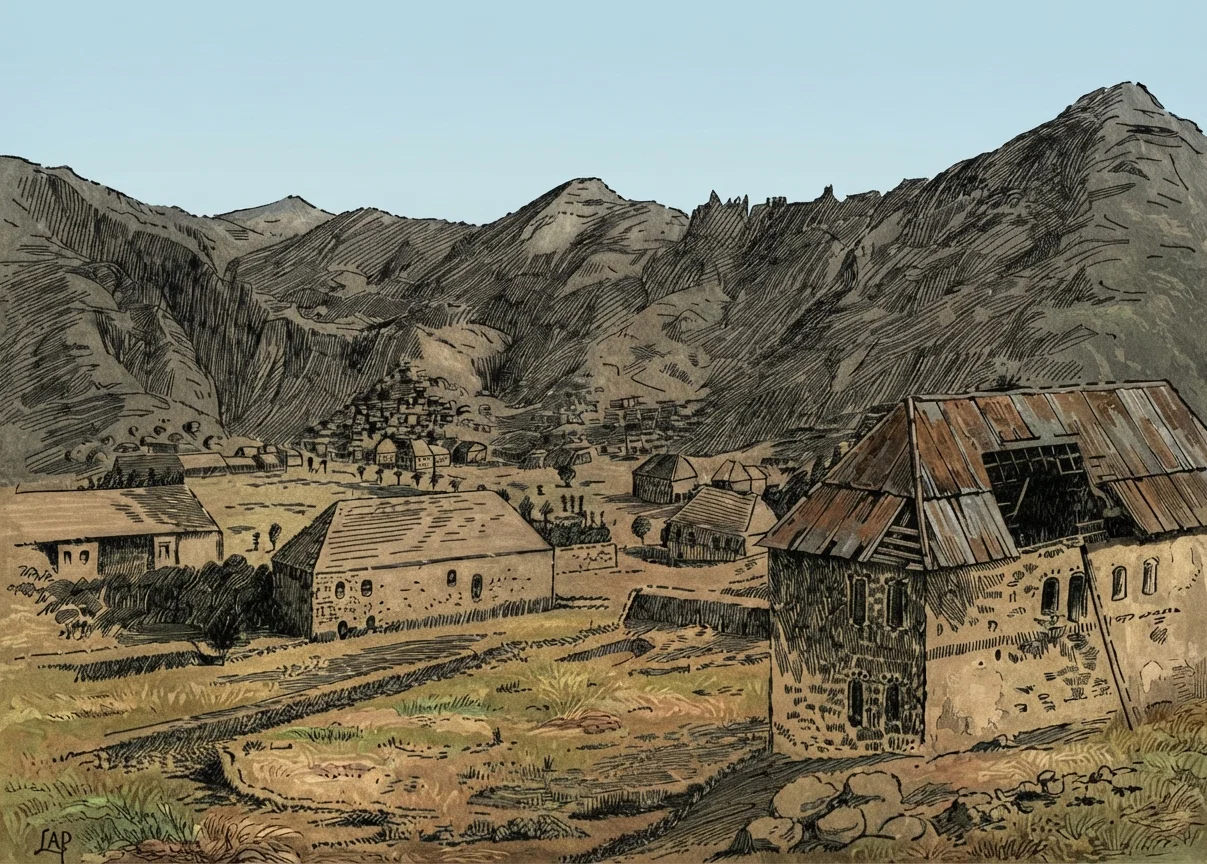
GERUSI, AN EXILE SETTLEMENT IN THE TRANSCAUCASUS.
We have watched this movement with much interest, wondering if it were not the prelude to the work of the Third Angel's Message among this people; and now it is with special joy that we see the truth taking root among them. It first began among those in banishment in the Caucasus, near the Caspian Sea; from these it has spread to the vicinity of Kiev, to the Crimea, and to the borders of Persia.
From the first, Russian Sabbath-keepers have been diligently hunted down by the authorities, and quite a number are now in banishment; but the truth continues to spread, the work of banishment usually serving to plant it in new places. Besides the power of the State, the church uses other means of bringing dissenters back to the State church. Missionaries are specially trained for this purpose. These attend the meetings of Stundists and Sabbatarians, and try by kindness and argument to bring them back to the fold. But they have a difficult task in hand, and often hear some very plain things about the mother church.
These missionaries printed two pamphlets in Russian against the sect of Sabbath-keepers, and, among other places, circulated these pamphlets at the great fair of Nijni Novgorod, far in the interior, northeast of Moscow. In these pamphlets they carefully note the Russian publications of this sect, and give the address of the Hamburg publishing house, thus advertising the truth to those who desire it. One man, reading these pamphlets, sent at once for our tracts and was thereby converted to the truth.
The Russian Stundists and Sabbath-keepers are permitted to hold their meetings, but they are not allowed to perform the marriage ceremony or baptize. Any one convicted of baptizing a Russian is a subject of banishment. Usually, baptism takes place in the night and sometimes the candidate does not know the administrator, hence it is impossible for him to tell who baptized him.
A recent case serves as illustration of the diligence with which our elders are ferreted out. A Russian woman saw him baptize, but did not know his name nor where he lived; but she observed that the administrator had a wart on the end of his index finger. She informed the police, who searched till they found the man with a wart on his index finger. Without further evidence he was imprisoned, and after eight months was banished. Meanwhile the woman who betrayed him accepted the truth and attends the meetings, and weeps bitterly that she was the cause of the elder's banishment. This also shows how the truth is working among this people.
The work among the Germans who are extensively scattered in Russia, is no less encouraging. The past year has witnessed decided advancement and extension. The truth has now entered St. Petersburg, where a goodly number are rejoicing in its light. These claim that five years ago they were ready to keep the Sabbath, but did not know of a people observing it or how to begin. They were specially exercised on the subjects of the Sabbath and baptism.
In the vicinity of Orenburg, north of the Ural Mountains, a German pastor began preaching that he believed there was more light for the church; for this he was expelled, and forty families left the church with him. When one of our workers met with him and told him about the truth, his wife said with tears she believed that these were the truths they had been searching for. A short time before our laborers came to this district, the authorities passed a vote to open the schoolhouses to any one who preaches Christ. In this district, there are thirty-two villages.
There are also favorable openings in Russian Poland; calls came from the Ural Mountains and Siberia; at Vladivostok on the Pacific, five have embraced the truth and call for a laborer. Near the Persian border, over thirty-five Russian families have begun the observance of the Sabbath, and call for some one to come and teach them the truth more fully. Near Tiflis, in ancient Georgia, there are thirty families keeping the Sabbath. Thus from north to south and west to east, fires are being kindled all through this vast empire, and present indications are that a great work will here be done in the great Reformation which is now preparing a people for the Lord's coming.
H. P. H.
In the Caucasus, Russia, October 22.
STRANGE ALLIANCES.
By M. E. K.
NATIONAL jealousies and interests, like local politics, sometimes make strange bed-fellows. A few weeks ago the world was surprised to learn that Bulgaria had formed a close alliance with the sultan of Turkey. The Bulgarians, through the assistance of the powers, especially of Russia, have become partially independent of Turkey, and they have hoped for entire freedom, and a restoration of their nation to a place among the independent nations of Europe. Lately becoming convinced that they were being deceived by Russia and Austria, they suddenly changed front, and formed the present alliance with Turkey. M. Stoiloff, the Bulgarian premier, explained the change of policy by saying that he would kiss the hand of the sultan before he would abase himself before Europe.
Now there is a rumor of a more remarkable alliance than the one between Turkey and Bulgaria, even an alliance between Greece and Turkey. Greece is moved thereto by similar reasons to those which affected Bulgaria. She has lost faith in the powers, and well she may. She has learned that their boasted interest in her is measured by their own selfishness—"only this, and nothing more." An eminent Greek politician states the grievances of his people thus:—
"I openly accuse England of having reopened the Cretan question, of having enticed the Cretans to revolt, and of enticing Greece to send an expedition to the island. It was England that influenced the Ethnike Hetaira, using that society to threaten war to King George and the sultan. It was England, again, that prevented the execution of the measures suggested to prevent the war. It was England who encouraged us to fight, and treated us as if we were insane when the chances of war turned against us. . . . King George is a man of experience. He has steered Greece clear of all difficulties during thirty years. Would he have gone to war had he not counted upon England's aid? He knew that Russia opposed him, that France declared herself powerless to help him, that Germany and her emperor openly favored the Turk, and that it was foolish8to count upon the assistance of Austria and Italy, the allies of Germany."
Feeling ill-treated and deserted by England, who has always posed as the champion of liberty, Greece would be friendly with Turkey, and if Turkey would give up the war indemnity exacted from Greece, the latter country would enter into an alliance with Turkey, and place her fine fleet at the sultan's service to defend the Dardanelles should England attempt at any time to force a passage. Mohammedan Turkey with an allied Christian power upon each flank would 'certainly present a curious spectacle to the world.' But England and France have in the past both been in alliance with Turkey, and how could they complain?
The moral of all this is that each nation looks out for itself, and humanitarian and religious principles are invariably subordinated to the earthly and selfish desires which all nations, no matter what religion they profess, possess in common. But I ought to except one nation,—'the righteous nation which keepeth the truth.' Those who compose this nation are always true to principle, and make no alliances for selfish purposes. They have entered into a covenant agreement to 'fear God and keep his commandments,'—to serve and obey him. They have 'no fellowship with the unfruitful works of darkness, but rather reprove them.' Reader, do you belong to this nation? M. E. K.
Question Corner
By C. J. C.
"Enquire, and make search, and ask diligently."
No. 668. When Was the Bible Compiled?
THE Old Testament canon was compiled by Ezra and Nehemiah. Of the New Testament it may be said that from the days of the apostles the Gospels and Epistles were read in the churches, and generally received. "We possess in the Latin Fragment, published by Muratori in 1740, something like a full list of the New Testament Scriptures from a writer who describes himself as contemporary with Pius, bishop of Rome about A.D. 150. A similar list may be made out from the Syriac Version, which can hardly be later than the second century. . . . The great Athanasius [A.D. 296-373] enumerates unhesitatingly all the Scriptures of the New Testament as we have them now; and so do the Latin fathers Augustine and Jerome."—S. S. Teacher's Combination Bible, Helps, sec. XIV, p. 34. In the Sinaitic MS. of the fourth century, the New Testament is entire.
Bible Readings.
"Seek ye out of the Book of the Lord, and read."—Isaiah.
"Whoso readeth, let him understand."—Jesus.
SPIRITUAL DECLENSION—A SIGN OF CHRIST'S COMING.
1. WHAT is the condition of the world apart from Christ?
"The whole world lieth in wickedness." 1 John 5 : 19.
2. What is said of the continuance of this evil?
"Evil men and seducers shall wax worse and worse, deceiving, and being deceived." 2 Tim. 3 : 13.
3. How will deception affect the church?
"And many false prophets shall rise, and shall deceive many." Matt. 24 : 11, 24.
4. How will the abounding wickedness affect those who have loved God?
"And because iniquity shall abound, the love of many shall wax cold." Verse 12.
5. Who only will be saved?
"But he that shall endure unto the end, the same shall be saved." Verse 14.
6. How does the apostle speak of this backsliding in the church in the last days?
"This know also, that in the last days perilous times shall come. For men shall be lovers of their own selves, covetous, boasters, proud, blasphemers, disobedient to parents, unthankful, unholy, without natural affection, truce-breakers, false accusers, incontinent, fierce, despisers of those that are good, traitors, heady, high-minded, lovers of pleasures more than lovers of God." 2 Tim. 3 : 1-4.
7. Among what class do we find these sins?
"Having a form of godliness, but denying the power thereof; from such turn away." Verse 5.
8. How will such regard the coming of the Lord and kindred truth?
"These also resist the truth." Verse 8.
"Knowing this first, that there shall come in the last days scoffers, walking after their own lusts, and saying, Where is the promise of His coming? for since the fathers fell asleep, all things continue as they were from the beginning." 2 Peter 3 : 3, 4.
NOTE.—The fact that scoffers will ask such a question shows that in the last days there will be those preaching about the Lord's coming, and asking of the question is in itself a promise in that it fulfils the prophecy the Lord has given.
9. Of what may we be assured?
"But the day of the Lord will come as a thief in the night." Verse 10.
10. Upon whom will it come as a thief?
"For yourselves [the brethren] know perfectly that the day of the Lord so cometh as a thief in the night. For when they [the scoffers] shall say, Peace and safety; then sudden destruction cometh upon them; . . . and they shall not escape. But ye, brethren, are not in darkness, that that day should overtake you as a thief." 1 Thess. 5 : 1-4. See also Rev. 3 : 3.
Spirit and Wind
No. 670. Spirit and Wind.
PLEASE explain John 3:8: "The wind bloweth where it listeth, and thou hearest the sound thereof, but canst not tell whence it cometh, and whither it goeth; so is every one that is born of the Spirit."
Young's translation of John 3:8 is as follows: "The Spirit where he willeth doth blow, and his voice thou dost hear, but thou hast not known whence he cometh, and whither he goeth; thus is every one who hath been born of the Spirit." The margin of the Revised Version reads, "The Spirit breatheth where it listeth, and thou hearest the voice thereof," etc. The original word for "Spirit" is pneuma. The word "wind" in the New Testament comes from the word anemos, in every instance except John 3:8; Acts 2:2 and 27:40. In the first two texts it comes from pneuma, and in the latter from pneo, a primitive word. The word "Spirit" in every case in the New Testament, in both singular and plural, comes from pneuma, except Matt. 14:26; Mark 6:49, where it comes from phantasma, a phantom. In John 3:3 and onward our Lord is discussing the nature of things. He who is born of the Spirit is in nature like that Spirit, not dependent upon earthly birth or earthly things. He is born from above. The world hears the voice of that Spirit in prophet, teacher, apostle, and word; but it knows it not, nor its origin. Christ was born of that Spirit, was speaking by that Spirit, and yet Nicodemus knew him not because he did not know the Spirit. If his heart had been submitted to God, if he had been in harmony with God, he would have known the voice of the Spirit speaking through Jesus Christ. God's Law and Gospel and Spirit, are all in perfect harmony.
The Outlook
By Editor
“I will stand upon my watch, and set me upon the tower, and will look forth to see what He will speak with me.”
WHAT DOES IT MEAN?
It would naturally be supposed that ministers of the Gospel would be most interested in that which would directly help them in their legitimate work, that of preaching the Gospel. It would be also a natural supposition that a popular publishing company would know what would interest ministers most.
With these two suppositions in mind we may be interested to consider what inducements the publishers of a popular magazine lay before ministers to induce them to become subscribers, or at the least purchase the November issue of the magazine in question. Here are the inducements quoted from an advance circular:—
“This November number contains an article on Hallam Tennyson's biography of the great poet, his father, clearly the book of the month—a book whose high price places it out of the reach of most clergymen. But every reading man will wish to have a clear presentation of the content of such a notable biography. An account also appears of the free organ recitals that have been given with such marked success in Boston—a very suggestive article for yourself; and another musical feature is an excellently illustrated account of the Bayreuth plays, by a visitor who carefully studied them during the last season, with pictures showing the scenery characteristic of these Bayreuth performances. More important contributions appear in a well-illustrated series of notes on the late premier of Spain, Canovas, together with a further essay by Mr. Stephen Bonsal on Sagasta and the general political situation in that country; in a long, thoroughly-illustrated article by Carl Snyder on the great ship canal about to be opened from the Great Lakes to the Atlantic, and in a character sketch of Henry George by Arthur McEwen.”
We do not note this to criticise the publishers of the magazine in question. They doubtless believe that this is a good business proposition, and that it will take well with clergymen, and therefore it is put forth in all seriousness. Yet it would seem like satire, especially in view of the fact that the magazine in question contains so much other matter of interest9and profit, in fact, a fairly good review of the political world. But, turning aside from these, the publishers present the review of a life of a popular, but by no means evangelical poet, some organ recitals, certain plays, notes on Canovas and Sagasta, article on a ship canal, and a sketch of Henry George, most of which are matters of ordinary interest, and which have been sufficiently treated in newspapers. Of what earthly value can a special study of these things be to a minister in his work of preaching the Gospel of Jesus Christ and the salvation of souls.
What does such an offer mean?—It means that, in the view of these shrewd, observing business men, the professed ministers of Christ are especially interested in “current topics,” in poetry, politics, art, and the drama. And does not much of the preaching of the day reveal that the Gospel of God, the words of Jesus Christ, in which is the wisdom of the ages, is, on the part of many, a secondary matter of study, an incidental consideration? If the Word, the Gospel, Christ Jesus, alone was generally preached, it is safe to say that no magazine publishers would ever present such inducements to beguile the clergy to subscribe for their publication.
The Week Between
By Editor
No. 669. The Week Between.
PLEASE explain Acts 13:42, last part. The margin reads, "In the week between, or in the Sabbath between." Now did the Jews have the original Sabbath that belonged to the moral law of God and the Gentiles a sabbath of their own which came between the two Jewish Sabbaths, on Sunday?
It simply means "the next Sabbath," the Sabbath of the Bible, the only weekly Sabbath the Bible knows, the seventh day. The Revised Version reads, "They besought that these words might be spoken to them the next Sabbath." Verse 42. "And the next Sabbath almost the whole city was gathered together to hear the Word of God." Verse 44, R. V. Young's translation reads, "the next Sabbath" (verse 42), "the coming Sabbath" (verse 44). The Syriac reads, "the next Sabbath day" (verse 42), "the next Sabbath" (verse 44). And so all other translations of authority so far as we know. The Gentiles knew no Sabbath. Sunday was to them a great holiday, and has been aptly styled "the wild solar holiday of all pagan times."
DOES Jer. 51 : 39, a "perpetual sleep," mean that those who are not worthy will not have a resurrection? J. M.
It means that their end shall be everlasting destruction. The prophet looks beyond any temporary death to the ultimate punishment of the wicked, the second death, from which there is no resurrection. Rev. 20 : 14. As far as the city and the political organization of Babylon were concerned, the judgment will be true this side of the thousand years. Babylon as a city or a system or organization will be utterly destroyed. The wicked men as men will receive their full reward after the second resurrection. See Revelation 20. Isa. 28 : 15-18 doubtless refers to all those classes who, transgressing God's laws, expect to be saved by the various devices of their own, the most of whom build upon the first falsehood of the serpent, "Thou shalt not surely die."
Resurrection of the Wicked
By Editor
No. 672. Resurrection of the Wicked.
ARE there any texts in the Old Testament besides Dan. 12:2 which prove that there will be a resurrection of the wicked?