Your ShelfYour Projects

Signs of the Times, Vol. 23, No. 47.

Editorial
Earlier text: IN GETHSEMANE

“COUNT UP YER MARCIES, ‘ZEKEL.”

It must be confessed that Deacon Lawson was in an unusual frame of mind this Thanksgiving morning. He had started the fire at four o’clock, a full hour earlier than usual, and bustled about until quiet Mrs. Lawson caught his uneasiness and hastened her preparations for breakfast. But the deacon could not eat.
“Can’t ye put up a basket o’ pies an’ fixin’s fur the Ellises?” he asked, pushing back from the breakfast table. “I’m actooly a-feared they hain’t much in the house fur dinner.”
Mrs. Lawson looked at the deacon in wide-eyed wonder. Was he sick? She never knew him to change his mind before. She had wanted to send some things over yesterday, but the deacon had peremptorily forbidden it. Crops had been smaller than usual, and the deacon felt proportionally poorer. He stood by the table and watched his wife as she packed the basket.
“Guess ye might as well put in that chicken pie—we sha’n’t need it overmuch with turkey; and fill up the chinks with yer seed cakes, now.”
“It must be ‘cause Deacon Elkins is away, and he’s got to lead the meetin’,” thought Mrs. Lawson, as she watched her husband drive out of the yard. Then she returned to her morning work, singing one of her favorite hymns. A load was taken from her mind with the heavily laden basket. She had not finished her preparations for dinner when the deacon returned.
“Be ye going to the sarvice?” he inquired anxiously.
“Of course I am,” replied Mrs. Lawson. “What would folks say not to see me, the deacon’s wife, there? It’s few enough chances we have for worship, anyhow.”
“I wish Deacon Elkins had stayed to hum. I do, sartin!” exclaimed the deacon, fidgeting uneasily in his chair. “I don’t feel equal to it, nohow.”
“Then why don’t you hunt up some one to preach regular?” inquired his wife.
The deacon could endure it no longer. He jumped up and left the room, slamming the door behind him, and strode off to the barn. An hour passed by, then another. Mrs. Lawson had finished her work and had dressed for the day. The huge turkey was roasting in the oven. Ten o’clock, half past ten, quarter of eleven, and no deacon appeared. It was well that Mrs. Lawson was acquainted with his eccentricities, having patiently borne with them for the last thirty years. She put on her bonnet and shawl and sat down by the window.
Five minutes of eleven; at that instant the deacon drove up to the door. Mrs. Lawson hurried out; the deacon snapped his whip, and they were off.
The service was to be held in the schoolhouse, a half mile distant. There had been a flourishing church here years before; but the leading members had moved away, some had died, and it became almost impossible to support a pastor. Finally, as a climax to their misfortunes, the church and parsonage had been destroyed by fire. The two deacons had regarded this as a final catastrophe, and had not tried to revive the interest of the people. Fast day and Thanksgiving were always observed, and occasionally a traveling minister would speak to them upon the Sabbath.
This Thanksgiving service was a special trial to our good deacon. His friend and co-worker had gone away for a week, leaving him with all the responsibility. Yet even this did not account for his uneasiness of the morning. This had disappeared before he reached the schoolhouse door.
The room was almost full. Mrs. Lawson slipped into a seat by the door between two of her neighbors. The deacon, looking neither to the right nor left, marched down to the platform. He gave out a hymn, which was sung with a will, after which he called on another brother to lead in prayer.
Just then Mrs. Lawson started in alarm. She had forgotten to bring the volume of sermons from which they had, the evening before, selected an appropriate one. What a predicament they were in! She was sure the deacon couldn’t think of a thing to say. She wondered if she ought to send little Salma Tucker back to the house for it. At that moment the deacon arose, and began to speak. His face was pale, his eyes were flashing with suppressed excitement.
“Brethren and friends,” he began, his voice trembling with emotion, “I meant to have read ye a first-class sermon to-day, but it’s been borne in on my mind that I’d better tell ye my experience for the last twenty-four hours. The Lord has appeared to me, and showed me what I really was. P’rhaps ye’ll think it’s a queer thing to say Thanksgiving day, but I’ve never felt so small an’ mean in my life as I do to-day. An’ I thank the Lord for it. Ye all know that crops ha’n’t been first rate this year, an’ I thought I must pull in somewhere, an’, of course, I wasn’t going to pinch myself, so I thought I’d give up something else, where I shouldn’t feel it. Wal, I did, no matter what it was, I should be ashamed to tell ye; but when I got down to read over the discourse that I’d chosen fur ye to-day, the words stuck in my throat. I went to bed, but I couldn’t sleep, an’ the Lord seemed to come close an’ hold a reckonin’ with me.
“‘Count up yer marcies, ‘Zekel,’ he seemed to say. ‘Count up yer marcies, ‘Zekel.’ An’ then I thought of the things I had to be thankful fur. Why, what I’d lost in one way was made up in another. What if the oats didn’t more’n half fill, it was made up in the hay; an’ so it went. Then there was some special marcies, only I’d thought I’d kind of earned ‘em.
“The Lord jest opened my eyes, ‘n’ gave me a good lecture. I could see plainly that I’d been shirkin’ my dooty, lettin’ things get so here. We ought to have a church ‘n’ preacher of our own. Why, what does the word ‘thanksgivin’ mean but givin’ thanks? An’ shall we give the Lord what costs us nothin’, just the leavin’s that we can’t use?
“I tell ye, I’ve had my eyes opened. ‘The Lord loveth a cheerful giver,’ the Good Book says. An’ now let’s each of us count up our marcies, an’ then give accordin’. P’rhaps we should get enough to hire a preacher fur a year. Squire Haskell, let’s hear your idees.”
The deacon sat down, and wiped the perspiration from his face. It had been hard for him to speak of his failings. The ball was set rolling, however, and all were willing to give it a push. The usual hour of service lengthened to two—such a service as the little town of Deweysburg had never known. At its close a subscription paper was drawn up. The deacon’s quaintly-put advice, “Count up yer marcies,” headed the paper.
What matter if the turkey was done to a crisp, and dinner itself was an hour later? Not one of the little company would have missed Deacon Lawson’s forceful remarks. All through the village the report of the deacon’s words spread like wild-fire, and aroused an unusual interest.
“Count up yer marcies, ‘Zekel,” came to be their watchword, and each gave as the Lord had prospered him. Those who could not spare money, gave timber or work. Even the children gave their hoarded pennies toward a new church.
When spring came, it did not take long to complete the church. The first Sabbath in July it was dedicated. A young minister offered to stay a year for a very small salary.
“I declare, wife, every time I count up my marcies, I feel like giving more and more,” exclaimed the deacon. “I believe we can do it yet.”
Do it? Of course they could, and did. “Count up yer marcies, ‘Zekel,” with the remembrance of the deacon’s quaint but forceful remarks, tided them over many a hard place, and enabled them to make many improvements.
“An’ it all began with that Thanksgivin’ dinner for the Ellises,” remarked Mrs. Lawson for perhaps the twentieth time.—Willamette J. Preston, in Congregationalist.

WHAT IS BECOMING COMMON.

A DAILY paper of September 28 contains the following paragraph:—
“Charlotte Wittner, a pretty little cigaret maker, aged seventeen years, for ten days was held a prisoner by a party of boys, sons of well-to-do residents of Wilkinsburg, one of Pittsburg’s fashionable suburbs. The girl is now in a Pittsburg hospital on the verge of insanity, as the result of her treatment.”
Instances of this kind are multiplying, it being considered “smart” on the part of young villains like those who have destroyed this poor child, to decoy away one who belongs to what they call “the lower class,” and who “leave her for dead” without a particle of pity or compunction. This very paragraph [quoted above] reflects the same spirit of the ruffians who destroyed a defenseless girl, being careful to give her name, age, and occupation, but as careful to protect theirs from the execrations sure to follow their discovery. Such instances as these are burned into the hearts of the poor, and help to prepare for that great day of account which patriots dread even to think about, because they know that if the “mills of the gods do grind slowly, they grind exceeding small.”—Union Signal.

THE CONDITION OF THE CHURCH.

JOHN G. WOOLLEY declares that there is built into the church because of her "dawdling stoppages," "coarse connective tissue, such as 'the world that lieth in wickedness' is built of." He continues:—
"And so we have a fleshly, earthly, unresponsive, ineffectual church, invalid and on the defensive. But, conscious of her failing health and yearning for power, her enfeebled spirit clutches at every quackery that promises short, impossible cut across the laws of life to life. This explains the 'fair,' the 'bazaar,' the temperance prayer-meetings of Republicans and Democrats; the Anti-Saloon Leagues of men who vote the saloon a jubilee year—one in four."—Voice, Endeavor Lesson, Feb. 14, 1897.
And the same thing explains the "law-and-order leagues," the "Christian citizenship organizations," the "Sabbath unions," etc., etc. There is but one true source of power for the church, and that is the power of the Holy Spirit. There is but one captain, and that is Jesus Christ. There is but one book of orders, and that is the Bible. That church that leaves these for earthly or political organizations is false to her Spouse, Jesus Christ, and is guilty of spiritual adultery.
" 'God has a controversy with his people' which must be settled—or settled for. I do not see what cautery he will burn withal, or what wild deluge pour, but out of some furnace of torture, stripped and scathed—down from some Ararat, awed and grateful, a fragment of what she was, she must come, chastened and eager to meet her Lord in honor, truth for truth, and keep her unto him as long as they both shall live."—John G. Woolley. But that will be the remnant church developed by God’s great threefold message of Rev. 14: 6-14.

HOME.

SWEET word that spans all space, that knows no bound, Yet dwells in narrowest compass: welcome word! Dear type of peace though sheltered by the sword, Mid Saxon-speaking races only found. Our earliest recollections all abound With little notes of thee; our years are stored With memories of thee; each spot adored In youth, in age becometh holy ground. Thou clingest in the hand grip of the sire; Thou meltest in the mother’s tender kiss; The wanderer longs to reach thee—guiding star Of all his thoughts; like Israel’s Pillared Fire By night thou leadest him through childhood’s bliss, To that loved home he pictures from afar. —Lord Rosslyn.

THE SABBATH DINNER TABLE.

THE following story, anonymous [to us], is worth repeating. If it is not a picture of your household, brother, in any degree, we are glad. If it is, let it be so no more.
"Didn't we have a good sermon?" inquired the eldest son, with all the zest of his satisfaction in his tone. "Good!" echoed the father scornfully, bristling up as usual when the word "sermon" was uttered. "He took ten minutes to prove something that we knew as well as he does, ten more—"
A shade of distress flitted across Sophy's eyes; the minister had made her feel that she was a sinner. Was not that worth ten minutes?
"And as for the prayer," continued the head of the family, with a gesture of impatience, "it was the driest prayer I ever listened to."
"Perhaps he was not praying to you," suggested the privileged member of the family.
"I think it was the loveliest prayer I ever heard," exclaimed the visitor, with rising color.
The visitor, by the way, did not enjoy the prayers of the head of this family. In her own young opinion, addressing God in long, hard phrases, made him seem high up and away from her.
"Such length! Such diffusiveness and minuteness! Such rambling! It was a talk, not a prayer. He brought in everybody under the sun." The impulsive young visitor kept her lips shut; but she could not keep the indignant flash out of her eyes. The prayer in church that morning had touched her as a prayer had rarely touched her before. At that instant she hotly wished that she might never have to hear the head of the family pray again.
"Prayer is not a thing to be criticised," suggested the eldest son gently. "I never felt so clearly as I did this morning, how Christ is our only hope. Our minister made it so strong and clear."
"After rambling on ten minutes about nature!" commented the argumentative voice of the father. By this time conscientious Sophy had a finger-tip pressed into each ear. That sermon was one of the marked periods in her spiritual growth. "And then the idea of saying—"
The sensitive boy of fourteen, whose mercury rises and falls with every change in the home atmosphere, dropped his eyes and looked troubled. All his delight in the plain, strong sermon had been marred, even while listening to it, by the dread that somebody at home would pick flaws in it at the dinner table. If he might have listened with an untroubled heart, into what ready soil the seed would have been dropped that day! Sometimes I think that Satan takes more delight in the Sabbath dinner table than in any other home gathering during the week. He knows what little winds carry the good seed away.
Somebody, anxious to interrupt the flow of unkind criticism, now made a hurried remark, —"Did you see that lady in front of us? Wasn't her bonnet grotesque? Just the shape and colors to make her look hideous."
A relieved laugh went around the table. Surely this was better than finding fault with the minister. But Sophy's laugh had a touch of uneasiness in it. For several Sabbaths she had been trying to school herself not to look at bonnets at church; and this morning, under the impressive sermon, she had not even noticed the offending bonnet almost within the range of her eyes.
The boy of fourteen looked up brightly. "We have such a good lesson for Sabbath-school to-day."
"I'm glad there's one good one," grumbled his next older brother. "I had come to the conclusion that they had picked out the hardest and driest parts of the Bible for the lessons. Your teacher is such a poke, with his melancholy voice and solemn face, I don't see how you ever like the lessons."
Public opinion again quenched the boy of fourteen. Coming home from church, he had resolved to hurry through dinner that he might give the extra minutes to the study of the lesson; but if it was the driest part of the Bible, and his teacher a "poke," why should he care for the Sabbath-school? Perhaps he ought to be ashamed for staying after Sabbath-school last Sabbath to talk to the "poke" about something in the lesson. Of course the big boys knew!
"He has no sense about asking questions," continued the big boy.
"Your superintendent is a superior man," observed the head of the family. "I noticed in prayer-meeting this morning how uneasy he was under that long prayer. He could not keep his head down through three sentences."
The visitor flushed again. By this time she had almost resolved to be busy elsewhere when the time for family worship should come that night. The listener, who was not a Christian, and who had spent her Sabbath morning in reading "George Eliot," pushed her napkin into her ring with considerable energy.
"I didn't go to church this morning, and I do not intend to go to Sabbath-school. A sermon that does no good, a prayer that irritates, dry parts of the Bible to study, and a poke to teach it, have no attractions for me."
The others, who were Christians,(?) looked blank. A blessing had been asked upon the dinner. What about a blessing upon the dinner-table talk?

TRAINING THE LITTLE ONES FOR SERVICE.

CHILDREN should be taught to find their own greatest happiness in ministering to the happiness and well-being of others. This is a lesson which they can begin to learn very young, and it is one which will be of inestimable value to them in after life. A properly educated child will get far more real enjoyment from taking a basket of food or some needed clothing to a poor family, and seeing how much good it does them, than from a whole day's sport on the playground or in the nursery.
Some parents have misguided opinions with reference to these things, and think that their children must not be allowed to see want or suffering anywhere. This is neglecting a very important part of a child's training. It is leaving him in ignorance of the things which he must know in order to form correct views of life, and develop into a useful member of society.
The world is full of sin and sorrow and trouble. The rising generation should be taught that they are under solemn obligations to God and to their fellow-men to do what is in their power to lessen this tide of wo and sin. They should be taught that it is both a duty and a privilege to comfort the sorrowing, to feed the hungry, to clothe the naked, to share with others all the good things which the Lord has given to them.
Tell the children the story of our Saviour's life, which was spent in just such work, and let them understand that you consider a life devoted to the moral, spiritual, and physical uplifting of fallen humanity as the highest ideal that any one can aspire to. Read to them at an early age from the lives of such missionaries as Livingston, Judson, Williams, Carey, Moffat, etc. Make them acquainted with the work being done in our own missions as related in the Medical Missionary and other journals. Draw out their sympathy for the children in the various orphan homes. Take them along to your missionary meetings, where they will learn to sing missionary songs, help wrap papers, etc. But be sure that they are actively engaged in helping the poor and needy, the sick and suffering. This is something that readily appeals to their sensitive natures, and with only a little encouragement, they will teach themselves valuable lessons in self-sacrifice, and will be all the time getting real enjoyment out of it.
You will be surprised to see how quickly the hearts of your children will respond to this kind of teaching, and it will be your rich privilege day by day to see your boys and girls growing up into noble manhood and womanhood.
M. E. OLSEN.
Sanitarium, Battle Creek, Mich.

ALL THINGS WORK TOGETHER FOR GOOD.

If the angels, encamping around us, Deliver when danger is near, Why falter when evils surround us? But rather press on without fear.
Shall we stop with the Red Sea before us, Or follow the Word of God through? If the pillar of cloud is still o'er us, The Jordan will open up, too.
In case we are sold by our brothers, God with us to Egypt will go. If thrown in the fire with two others, The "Form of the Fourth" we shall know.
If the night we must spend with the lions, By angels their mouths will be sealed; If in faith we refuse the king's viands, Better food has our Father revealed.
Tho feeling alone and forsaken, We pillow our heads on a stone, He, who knows of the course we have taken, Will show us the way to His throne.
Tho hunger severe may appal us, The ravens can bring us our food; Let us know that, whate'er may befall us, "All things work together for good." MINNIE EMBREE.

FROM CHICAGO TO PASADENA.

ON Thursday evening, August 12, I took leave of my friends in Chicago, and started on my long homeward journey to Australia. The few days spent in Chicago during this and a previous visit had been busily and profitably spent in studying the various phases of work carried on there by the Medical Missionary Association, and in looking up school furniture and bakery machinery in the interests of Australia. I received much assistance in business matters from Brother H. W. Kellogg, of the Review and Herald Publishing Association.
Reaching Kansas City Friday, I spent Sabbath and Sunday there, speaking twice to the church, and on Sunday enjoying profitable seasons of counsel with Brother Nordyke, of the book depository, and Elder Hyatt, president of the Kansas Conference. In the various parts of Kansas City and adjacent towns, there are several congregations of our people. Some are getting a good experience in Christian help work, and we trust that they will unite their energies for the building up and prosecution of a well-organized, systematic, and efficient work.
Would it not be an excellent investment of means for our brethren of the Missouri and Kansas Conferences to raise a fund sufficient to furnish a home for nurses, and to equip one or two good bath-houses, and then ask the Medical Missionary Board to send a corps of trained laborers? These could do a good work, which would be largely self-supporting. Would it not be a wise and legitimate use of conference funds, to pay the salaries of one or two of these workers, who would give their best energies to work among the poor, and to the training of our people in the city, and in adjacent churches, to engage efficiently in the same work? Such a work, I am sure, would be a great blessing.
Leaving Kansas City Sunday evening, I stopped off two days to visit Denver and Boulder, Colorado, and arrived in southern California in time to spend Sabbath, Sunday, and Monday at the Pasadena camp-meeting. It was a great pleasure here to meet many old friends, and to observe the large accessions to the cause in this locality.
There were nearly five hundred in attendance at this meeting, and, as I saw them flocking to the big tent at the hour of service, I was reminded of the first general meeting which I attended in Los Angeles, during which the ministers slept in the gallery of the little old meeting house, and made their breakfasts of bread and milk and fruit, sitting around the big stove in the chilly mornings. This they preferred that they might have the night to rest and the morning to study, rather than ride several miles to the homes of our hospitable brethren who lived in the country.
Southern California is unique in many of its characteristics. Naturally a most healthy country, it is filling up with invalids, who come to enjoy its salubrious climate. Naturally a country of limited resources, a land where drought and barrenness prevail, it grows fertile and beautiful under irrigation and cultivation, and its wealth is greatly enhanced by the wealthy business men and invalids, who find in it an agreeable and healthful climate.
Many of the sick who go to southern California have exhausted the skill and ingenuity of dosing doctors, and come to receive the benefits of nature's remedial agencies. Still they require the medical supervision of physicians. What a promising field this is for physicians who believe that nature will heal, without the free use of drugs, if we withdraw the hindrances, and give her an opportunity!
On Monday afternoon I endeavored to draw the attention of our people to the advantages of medical missionary work, and to some of the unparalleled opportunities that lie within the reach of the people of California, to build up this work in her principal cities.
W. C. WHITE.
En route to Australia.

OUR WORK AND WORKERS.

THE church in Owosso, Mich., rejoices over seven new members since the last camp-meeting.
ELDER D. T. SHIREMAN reports an addition of five members to the church at Hildebrand, N. C.
ELDER W. ZIEGLER says "half a dozen have taken a stand for the truth" at Golden, Colo.
AT College View, Neb., November 6, eleven persons were baptized, nine of whom were students of Union College.
ELDER E. G. OLSEN, who is laboring for the Scandinavians in Iowa, reports an addition of four to the church at Audubon.
CHRISTIAN help work is receiving special attention in Lansing, Mich., under the direction of Elder H. M. Kenyon and wife.
ELDER P. A. HANSEN reports the addition of four members to the church at Milford, Iowa, and two to the church at Fostoria.
A HOUSE of worship has been erected by the church at Middletown, Ind. Elder I. D. Van Horn preached the dedication sermon.
COLORADO CONFERENCE, at the request of the General Conference, has taken charge of the New Mexico Mission Field, with its workers.
AS A result of tent-meetings held at East Cohoctah, Mich., by Brethren S. E. Wight and L. N. Lane, six heads of families have been added to our ranks.
ON the 7th inst. four persons were baptized at Warren, Minn., by Elder F. Johnson, who is laboring in the interest of the Scandinavian population.
ELDER J. S. HART reports the baptism of four persons at Sioux City, Iowa, and one candidate was obliged to defer the ordinance on account of sickness.
ELDER H. M. J. RICHARDS reports the baptism of three persons at Winterset, Iowa. He also reports fifteen new names to the covenant at Macksburg, and a Sabbath-school of thirty members.
THE Mount Vernon (Ohio) Academy offers a special course for the winter, commencing December 8 and continuing till March 15. Special attention will be given to Bible study and Christian help work.
SEVEN persons have decided to come over on the Lord's side at Nora Springs, Iowa, as a result of meetings held by Brother P. A. Hansen. A Sabbath-school of twenty members has been organized.
THE winter school in Battle Creek (Mich.) College will begin December 8. The object of this special school is to give, in a short time, to those who can not take a longer course, a good drill in the very things which they must need to fit them for work wherever in the field they may be called. The school will continue twelve weeks.
THE brethren of Colorado Conference are taking great interest in their new Medical Mission and Workingmen's Home, in Denver. Echoes from the Field says it is encouraging to note the interest and hear the response to the calls for help, in preparing articles for the home.
THE church at College View, Neb., aided by the State conference, has started a rescue mission in the city of Lincoln. A building has been secured in which to hold Gospel meetings, and the physicians of the College View Sanitarium will give medical treatment to the poor.
MEETINGS are being held in Toronto, Ont., in a public hall. Also parlor meetings in various parts of the city, and the laborers have invitations to speak in some of the city missions. Elder J. H. Durland reports to Field Echoes that good audiences attend the Sunday meetings, three times a day.
ELDER D. E. LINDSEY reports an addition of sixteen to the church at Dayton, Ohio. Five others had covenanted to obey the commandments of God who had not yet united with the church, and many interested ones are said to be scattered through the city. He is now conducting a series of meetings in the new church at Wengerlawn, which was recently dedicated.
THE Minnesota Worker says: "The Minneapolis Missionary Society and Christian Help Bands are doing some good missionary work these cold days, hunting up the poor, and providing food and clothing. . . . Some of the members have been out soliciting clothing from the wealthy homes in this city, and they find many warm hearts ready to respond to the call for help when they find out we are helping every one in need who has been passed by."
WE omitted to note last week that Sister Rosa Young, of Pitcairn Island, sailed from San Francisco on the British ship Hydrabad, November 13, for her island home. She had been sojourning in California several months, where she was a most welcome guest, not only among Adventist people, but wherever she made acquaintance. Many good wishes for her temporal and spiritual welfare accompany her on her ocean voyage. Sister Young came for the purpose of medical treatment about a year ago, Dr. Maxson shortly after removing a tumor weighing about 30 pounds. The Christian boys—Henry and Thomas—who have been at Healdsburg College, accompany her.
UNDER date of October 24, Sister Vesta J. Farnsworth writes from Sydney, N. S. W.: "The camp-meeting at Sydney has just fairly begun, as this is the second day of the meeting. It has been excellent so far. We spent a few days at Cooranbong last week, and were present at the closing exercises of the school, and the dedication of the new meeting-house, which was built in less than two months. [A letter from another source states that the house was dedicated free of debt.] It is a comfortable building, and will seat about four hundred and fifty. It was badly needed, and will be greatly appreciated by the church at that place. The school had an encouraging attendance for the first year. Twenty were baptized, and I understand that this included all who had not previously been baptized before going to the school. Sister White is in fairly good health, and has a testimony of faith and courage. She is here at the camp-meeting; also Elder Haskell, and Elder A. T. Robinson and wife, who have just arrived from South Africa. Elder W. C. White arrived last week from America. The first evening of the meeting, the tent was filled with people from the city, and they stood all around the pavilion during the service, unable to obtain seats. We are expecting 'showers of blessings,' and they have already begun to fall, for which we praise the Lord and take courage."

LITERATURE WANTED.

THE Mission at Fort Worth, Texas, has ten racks to fill. Please send by mail, post-paid, SIGNS, Sentinel, Review, Instructor, Our Little Friend, and tracts, addressed to Present Truth Mission, Fort Worth, Texas, Gen. Del.

FOR SALE.

A FARM of 360 acres of land, one and three-quarters miles from Brinsmade, North Dakota, 225 acres under cultivation. There is on the premises a new five-room frame house, granary, and barn. We desire to sell this place that we may go to some foreign land as self-supporting missionaries. Address Mrs. Fred Reitter, Brinsmade, North Dakota.

The Sabbath School

International Series.

LESSON XII.—SABBATH, DECEMBER 18, 1897.

THE GOSPEL REJECTED BY THE JEWS.

Lesson Scripture, Acts 13:34-52, R. V.
34 "And as concerning that he raised him up from the dead, now no more to return to corruption, he hath spoken on this wise, I will give you the holy and sure blessings of David. 35 Because he saith also in another psalm, Thou wilt not give thy 36 Holy One to see corruption. For David, after he had in his own generation served the counsel of God, fell on sleep, and 37 was laid unto his fathers, and saw corruption; but he whom 38 God raised up saw no corruption. Be it known unto you therefore, brethren, that through this man is proclaimed unto you 39 remission of sins; and by him every one that believeth is justified from all things, from which ye could not be justified by the 40 law of Moses. Beware therefore, lest that come upon you, which is spoken in the prophets: 41 "Behold, ye despisers, and wonder, and perish; For I work a work in your days, A work which ye shall in nowise believe, if one declare it unto you. 42 "And as they went out, they besought that these words 43 might be spoken to them the next Sabbath. Now when the synagog broke up, many of the Jews and of the devout proselytes followed Paul and Barnabas; who, speaking to them, urged them to continue in the grace of God. 44 "And the next Sabbath almost the whole city was gathered 45 together to hear the Word of God. But when the Jews saw the multitudes, they were filled with jealousy, and contradicted the things which were spoken by Paul, and blasphemed. 46 And Paul and Barnabas spake out boldly, and said, It was necessary that the Word of God should first be spoken to you. Seeing ye thrust it from you, and judge yourselves unworthy of eternal life, lo, we turn to 47 the Gentiles. For so hath the Lord commanded us, saying, I have set thee for a light of the Gentiles, That thou shouldest be for salvation unto the uttermost part of the earth. 48 And as the Gentiles heard this, they were glad, and glorified the Word of God; and as many as were ordained to 49 eternal life believed. And the Word of the Lord was spread abroad 50 throughout all the region. But the Jews urged on the devout women of honorable estate, and the chief men of the city, and stirred up a persecution against Paul and Barnabas, and cast 51 them out of their borders. But they shook off the dust of their feet against 52 them, and came unto Iconium. And the disciples were filled with joy and with the Holy Ghost."

QUESTIONS.

  1. Trace on the map the journey of Paul from Antioch in Syria to Antioch in Pisidia.
  2. Tell how Paul began his work in the latter place.
  3. Give an outline of his discourse as far as we have studied it.
  4. What did he say was fulfilled in the resurrection of Jesus from the dead?
  5. What quotation did he make from the second psalm? For what purpose?
  6. How complete was Christ's deliverance from the grave?
  7. What did Paul say was fulfilled by the fact that Christ was raised to live forevermore?
  8. Where is this scripture found?
  9. What other scripture did it also fulfil? In what psalm does this occur?
  10. How can it be known that it does not refer to David himself?
  11. What contrast is noted between David and Jesus?
  12. What did Paul exhort his hearers to be assured of?
  13. Who did he say could be justified?
  14. From what can believers be justified?
  15. Of what did Paul warn his hearers to beware?
  16. What did he quote from the prophets? From what place?
  17. When the Jews left the house, who came to Paul? What did they request?
  18. What took place when the congregation finally broke up? What did Paul and Barnabas say to them?
  19. What took place the next Sabbath?
  20. How did this affect the Jews? What did they do?
  21. How did their rage affect Paul and Barnabas? What did they say had been necessary? How had the Jews treated the Word? In so doing what had they decreed for themselves? What did Paul say he would therefore do?
  22. What was he thus fulfilling? What prophecy did he quote? From whom? Of whom were these words spoken?
  23. How did these words affect the Gentiles? How did they treat the Word? How many believed?
  24. How extensively was the Word of the Lord published?
  25. What did the Jews do? Whom did they succeed in stirring up against Paul and Barnabas? What did they do to them?
  26. What did the apostles do? Who had told them to do this? Where do you find it? To what place did they go?
  27. What was the condition of the disciples in the midst of all this tumult?

SUGGESTIVE QUESTIONS.

  1. How can man glorify the Word of the Lord?
  2. What class of people were stirred up against Paul and Barnabas? What connection can you see between this and 1 Cor. 4:13?
Go MAKE thy garden fair as thou canst, Thou workest never alone; Perchance he whose plot is next to thine Will see it and mend his own. —Robert Collyer.
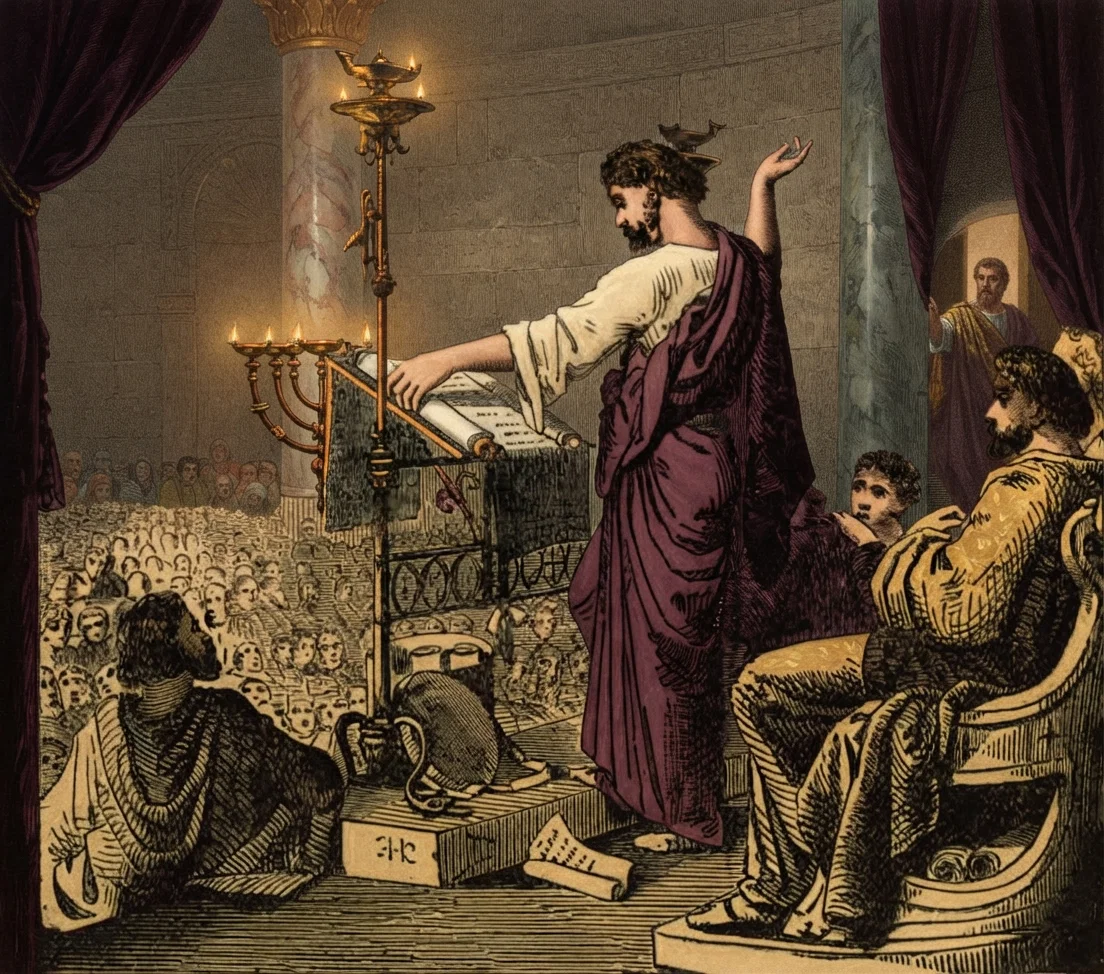
PAUL PREACHING TO THE GENTILES.
Continue reading: The Sunday School