The Youth’s Instructor, Vol. L, No. 43

The Scarlet Tanager
Earlier text: The Scarlet Tanager

November Study of the Field

Suggestive Program for Young People's Meeting
(November 2–5)
1. OPENING SONG.
2. Scripture reading and prayer.
3. Study of the Philippines:—
(a) Geographical. (b) Religions.
4. The Burmese. (A paper.)
5. Geographical study of Newfoundland.
6. Three-minute reports:— European General Conference. India. Japan. Trinidad. Bermuda. St. Kitts. Summary of Sabbath-keepers reported during the month, churches organized, and fields from which reports are received.
7. Closing exercises:— Prayer season for definite fields.
NOTE.— There is such an abundance of material this month that we have chosen only a few of the fields for the Suggestive Program. In some of the societies the entire hour might be profitably spent on one field,—the Philippines or the European General Conference, for instance. Ofttimes more real knowledge will be gained by focusing our research on one field than by considering so many only briefly. Make it a point always to gain some definite knowledge as a result of your missionary meeting. Enlist as many in the exercises as possible. Give every one something to do.
E. H.

William Carey, Father of Modern Missions

WILLIAM CAREY is called the father of modern missions. About the year 1792 he offered to go to India, but met with much opposition from his Christian brethren and others.
Speaking in a meeting at one time on the duty of Christians to the heathen, an old minister said to him: “Young man, sit down. When God wishes to convert the heathen, he will do it without your help or mine.” Sidney Smith sneeringly called him “the consecrated cobbler,” but the saintly Andrew Fuller encouraged and helped him. Fuller said: “There is a gold mine in India as deep as the center of the earth. Who will venture to explore it?”
“I will,” said Carey, “but you must hold the ropes.” His watchwords through life were: “Attempt great things for God; expect great things from God.”
Carey was especially gifted in the ability to acquire new languages, and was an untiring worker. He translated the Scriptures into several Indian languages. He died triumphantly in India, June 9, 1834, aged seventy-three years. At his death all the flags in India were hung at half-mast.

Getting as We Give

A LITTLE fellow, who had noticed that his mother put only five cents into the contribution box on Sunday, said to her, on the way home, as she was finding fault with the sermon, “Why, mama, what could you expect for a nickel?” There was sound philosophy in the criticism, too; for it is a pretty well established fact that we get out of things in this life just what we put into them.
The degree of profit is determined by the degree of investment. One who contributes ten cents, from the same income, toward the preaching of the gospel, is pretty sure to get twice as much good out of the same sermon as the one who contributes a nickel. The size of the contribution, or what is apt to be the same thing, the measure of the sacrifice, determines the measure of spiritual expectancy and receptivity. One actually gets more of the same gospel for ten cents than he would for five.
In filling a vessel with water in a given time, quite as much must be allowed for the size of the neck of the bottle as for the size of the stream in which it is immersed. On the human side of the analogy, receptivity represents the neck of the bottle; and receptivity can hardly be more accurately measured than by-the spirit of sacrifice that lies back of it. We get according as we give, and this is true whether we go to the shop, the school, the place of business, or the house of God.—Selected.

Bible Circulation in the Philippines Increases

The circulation of the Bible in the Philippines during the first six months of this year shows an increase of fourteen thousand copies over the circulation during the corresponding period of last year.

Bible Colporteurs Sell Scriptures Despite Opposition in Bolivia

BIBLE colporteurs in Bolivia have recently sold during six weeks, although subjected to keen opposition and threatenings of imprisonment, eight hundred and fifty-two copies of the Scriptures or portions of the Scriptures.

I LOVE THE DARNING-NEEDLE’S DASH! DASH!

Water-Ways
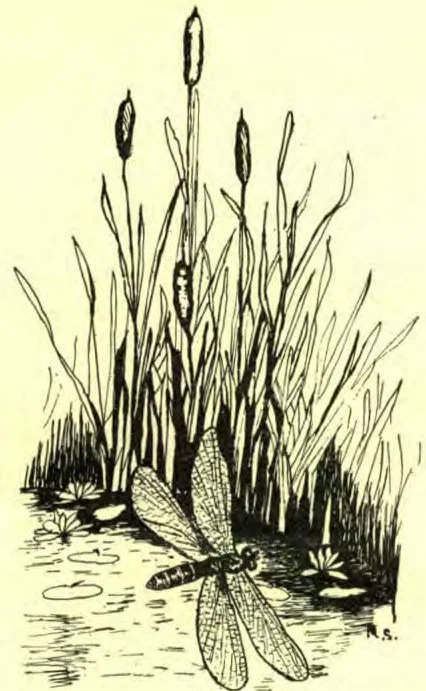
I LIKE to hear the waters Splash, splash; And I love the “darning-needle’s” Dash, dash; And the cat-o-nine tails growing In the marshy current, flowing Where the water-lilies, glowing, Flash, flash.
Lily-pads, in fancy forming Boats, boats, While from each a green-stem “painter” Floats, floats, Moored to arrowheads, low bending, Where the dreamy current, wending, Lifts its voice in softly blending Notes, notes.

I LOVE THE DARNING-NEEDLE’S DASH! DASH!

And I like to hear the green frogs’ “Quirk! quirk!” While behind his leaps the grasses Jerk, jerk; And I love the sunfish, gliding, Where, by slimy log, down sliding, Wary crabs and turtles, hiding, Lurk, lurk.
But I love the red-winged blackbird Best, best; And the fisher-bird’s blue-mottled Crest, crest; Or the wild-fowls’ lonely sighing In the reeds, when day is dying, Mingled with killdee’s weird crying, “Rest, rest.”
MINNIE ROSILLA STEVENS.

A Strange Messenger

WHEN James Townsend was all at once discovered to have been defaulter in the bank where he had been for years a trusted employee, when he had been tried and convicted in a court of justice, and when he had saved himself from the penitentiary only by going out of the world by the terrible path of suicide, the earthly consequences of his crime were by no means covered with his poor body in the grave. They fell with crushing weight upon the wife and children who had loved and trusted him, and cast over the threshold of the once happy home a dark shadow never to be wholly lifted in this world.
Harry Townsend was in his seventeenth year at the time of the dreadful tragedy which left him worse than fatherless. He was the eldest child and only son of the family, there being, besides him, his two young sisters, Margaret and Dorothy. He was a bright, manly boy, more than usually quick at his books, and known as the best scholar in the preparatory school where he was fitting himself to enter college the following year. Now, alas! all his cherished plans for the future must be given up. With the burden of a helpless household thrown upon his young shoulders, there could be no further thought of school.
He sought employment in vain from one business house to another. Some dismissed him with cool politeness, others treated him more kindly, but none gave him any tangible encouragement beyond mere good wishes. He began to realize, with a bitter sense of humiliation and injustice, that his father’s disgrace stood a barrier between him and any honest work.
Almost in despair, he confided his troubles to Miss Lawton, his Bible-class teacher, and it was through her influence that he was at length given a situation by the firm of which her own father was the senior member. His duties were not particularly defined; but it was understood that he was to be a sort of general assistant in the office, turning his hand to whatever might be required of him, according to the needs of each day. He was kept very busy, but he was quite too grateful for work to feel any questionings as to the kind or amount of it. His highest ambition was to perform his tasks as faithfully as possible, and so prove himself worthy of confidence.
All went well until a fateful day when the cashier found his accounts short by the sum of two dollars, and—to preclude the possibility of a mistaken entry—a two-dollar note which he had particularly noticed on account of certain marks upon it, was discovered to be missing from the cash-drawer. He was in a quandary. Among those who had access to the drawer, it was impossible to harbor suspicion of any except—could it be young Townsend? The cashier asked himself the question only mentally, but it was echoed aloud by the bookkeeper, to whom he confided his perplexity. The two agreed to say nothing for the present, but to keep a sharp lookout.
Three days passed with no solution of the mystery, while unsuspecting Harry went in and out as usual. At the end of that time a second discrepancy appeared. The cashier consulted the manager, ending his account of the loss with:—
“I hate to think it, Mr. Marlow, but really I can’t help fearing that young Townsend is at the bottom of this.”
“Not a doubt of it!” quickly answered Mr. Marlow, who was less disposed to take a hopeful view of human nature than the cashier.
“But he has seemed such a fine boy. I was growing quite fond of him.”
“I know—I know! But it’s in the blood. I tell you, Kane, I’m a strong believer in blood. Like father, like son.”
“What shall we do?”
“Best to keep quiet a little longer. Give him his rope, and he’ll be sure to hang himself with it. You’ve no proof yet, you know.”
But when, after about the same interval as before, a third note was lost from the till, both Kane and Marlow went at once to Mr. Lawton, who had been confined at home by a slight illness. They found the old gentleman sitting with his daughter in his library, and at once laid the case before him, strongly recommending Harry’s arrest on suspicion of the theft.
Indignant tears sprang to Miss Lawton’s eyes as she listened.
“Gentlemen,” said she, “you must be mistaken. I am as sure of Harry’s innocence as of my own.”
“Your sympathy does you credit,” answered Mr. Marlow, smiling, “but the facts remain to be accounted for. This money has been systematically subtracted. It is impossible to suspect any one else.”
“Yet I know there must be some other explanation!” she persisted. “Dear father, for my sake, do not consent to blast the future of this boy who has already been made to suffer so cruelly through no fault of his own!”
“I will not, Mary,” answered Mr. Lawton, gently; then turning, he said: “I think, gentlemen, we must wait. It is a most troublesome mystery, but I shall still hope for some other solution of it.”
“I beg your pardon, Mr. Lawton,” said Marlow, “but I fear you are making a mistake.”
“Then I must risk the consequences of it,” rejoined the old gentleman, with quiet decision.
There are other ways of accusation than by means of spoken words, and Harry, rendered over-sensitive by his previous experience, began to feel, without understanding why, the chill atmosphere of distrust which enveloped him. It seemed to him that his orders were given in a constrained manner; that even while bending over his work, he could feel the stab of cold and critical glances.
At length, when he could bear it no longer, he went to the manager.
“Mr. Marlow,” he said, “will you kindly tell me if I have offended you in any way?”
Mr. Marlow looked at him keenly in the face for a moment without replying. Then he said: “Your own conscience should be able to answer that question, Townsend,” and turned again to his ledger.
More perplexed and distressed than before, Harry determined to speak to Miss Lawton. Very gently, though with much reluctance, she told him the story of the missing money. The boy listened in perfect silence, and when she had done, he asked: “Do you think I took the notes, Miss Lawton?”
“Harry, I know you did not.”
Then, for the first time, Harry burst into a tempest of sobbing and tears.
“My dear boy,” said Miss Lawton, when he could again hear her, “this is a cruel trial, but you must bear it as you have already endured so much. Do your work faithfully, and trust God that, sooner or later, your innocence may be proved. Remember that my confidence in you has never once faltered. And remember, too, Who it was that blessed those of whom ‘all manner of evil’ should be said ‘falsely’!”
“I will try,” said Harry.
But, with all his resolution, the high-spirited boy found his life bitter beyond expression. The slow days passed, with no clew to the lost money. Only the thought of his mother and sisters held him from throwing up his situation, and seeking to lose himself somewhere out in the wide world.
It was one of his regular duties to remain in the building every evening until ten o’clock, when the night-watchman came to take charge. Some of his saddest hours of discouragement were those spent in the loneliness of the half-lighted office, whose dark corners seemed peopled with shadows such as overhung his own young life.
One evening, as he sat motionless at the desk, he heard a tiny rustling sound, and, looking down, saw a little mouse emerge from a corner, and run here and there over the floor. His first impulse was to spring up, close the door, and hunt the small intruder to its death. But with the thought came another as swiftly: Is not the mouse like me? God made us both, and gave us room in his world to live happy. Shall I, who feel myself crushed by unjust suspicion, set my own foot on the innocent little creature? He remained perfectly still, and the mouse, gradually gaining confidence, ventured to gather up some crumbs only a few feet from his chair. At the step of the watchman, however, it scurried quickly away.
Next evening the mouse reappeared with increased boldness. It scanned the silent figure at the desk with its small, bright eyes, and, apparently convinced of its peaceful intentions, gambolled freely about the room. Night after night its visits were repeated, and Harry found himself awaiting them with strange and growing interest.
Remembering to have heard that mice are fond of sweet sounds, he essayed a few soft notes on a harmonica which he chanced to carry. The effect was almost magical. The mouse assumed a listening attitude, gradually approaching nearer and nearer, as if under a charm. Harry grew oddly fond of his little guest, and the nightly musical entertainment grew to be a welcome recreation after a long and trying day.
Having observed that the mouse always disappeared behind an old chest filled with papers and seldom disturbed, it occurred to Harry that it might, perhaps, have a nest there. Accordingly, while waiting, one evening, for the watchman, he lighted the gas jets above the chest, and softly moved it a few inches from the wall. The mouse sprang out in a fright, and Harry was just reproaching himself for having indulged his curiosity at the expense of his little friend’s peace of mind, when his quick eye caught sight of a fluffy mass of lint and tattered paper.
“It is the nest, sure enough!” said he to himself.
He stooped low over the chest, intending to push it carefully back. The bright light illuminated the aperture, and the boy started with a cry! Again he bent low, the veins throbbing in his forehead, and his eyes almost bursting from their sockets. He was not mistaken—the soft outer envelope which the little mouse mother had prepared for her babies was made of bits of bank-note paper!
It was a strangely excited boy whom the manager found waiting for him next morning.
“Will you please, Mr. Kane, please step this way, Mr. Marlow?” asked Harry. “I have something to show you.”
The surprise, the congratulations, the hand-shakings which followed, can better be imagined than described.
The three lost bills were there, plainly to be distinguished by their fragments, but when Mr. Marlow proposed fitting the bits together with a view to their redemption, Harry cried, earnestly: “Must the nest be spoiled, sir?”
“We can’t afford to raise more till robbers,” was the smiling answer.
The boy’s face fell.
“That’s true,” he said, “but—the mouse trusted me!”
Low as the words were spoken, they reached the ear of the sharp, stern man of business, and for a moment an unaccustomed moisture dimmed his eyes.
“Dear Harry,” said Miss Lawton, when he told her the wonderful story, “God sent you deliverance by a strange messenger. Your impulse of kindness toward one of the most insignificant of our Father’s dumb children, brought a marvelous reward.”—Weekly Magnet.

First Lessons in Geography

Lesson V

The earth was now a beautiful place. Great trees, much larger and more beautiful than any we have now, waved their bright leaves and cast a pleasant shade. Flowers of every variety and color grew in countless numbers, making the air like a perfumed garden. Lovely fruits and sweet nuts grew in abundance. Everywhere the ground was carpeted with richest green. Thus you see the earth was all ready, like a beautiful house, for some one to live in it.
On the fifth day God made fish to live in the water, and birds to live in the trees, and fly in the air. On the sixth day he made all kinds of animals. Many of them were much larger than any that now live on the earth. Along the banks of the rivers, and on the shores of the seas, lived animals from fifty to sixty feet long, some of them having the power of flight. All these great animals were very gentle. There were lions, elephants, and all the principal kinds of animals we have now; but they were all to live on the grass and the herbs of the field. The earth then was free from any curse of sin, and produced many times more food than at present; and in time the woods, the fields, the air, and the water were to be filled with multitudes of living beings, all of which were to live happily together, and be an honor to their Creator.
Finally the crowning work of all creation was made—God created man in his own image. As man came from his Creator, he was tall and beautiful. His face shone with the light of God, and he was clothed with a garment of light. He was very intelligent, and was to talk with the angels and with God. He was to be king over the fish of the sea, the beasts of the field, and the birds of the air. He was to train them, and they would love and obey him. They would all have worked for him, as the dog and the horse do now, yet not because they were afraid of him, nor because he had trained them so to do, but because they loved him. All the animals were brought to him, and he named them.
When man sinned, all this changed. The trees began to die, and the earth did not produce so much food as before. Animals that had lived on grass and herbs now began to eat other animals. Wicked men also began to kill the animals and eat them. As sin increased, and men went deeper into wickedness, its effects were seen on the animals. They changed in nature and appearance, and some of them began to eat others. At the end of two thousand years, men had become so sinful that God destroyed the earth by the flood. We will next study the flood, and its effects on the earth.
QUESTIONS.—What was the condition of the earth at the close of the fourth day? What was created on the fifth day? On the sixth day what other animals were created? Who else was made on the sixth day? Who was to train and rule the animals? Were they all to obey him? When did the animals learn to eat meat? Why was the flood brought on the earth?

Lesson VI

The earth itself had been placed under man; but when man sinned, Satan took this power, and though God has never allowed him to use it as he wishes, man no longer rules the earth.
The first thing that Adam and Eve noticed after they had sinned was that the light that had clothed them was taken away, and the air grew chilly. This made it necessary for them to have clothes. God gave them coats of skin, thus teaching them that now their very life was dependent on death.
As we have already learned, the axis of the earth pointed north and south. The whole universe is made on a definite plan, and the directions are not man-made devices, but were made by God himself when he made the universe.
We can tell directions by the stars. There is a star called the North Star that is directly north. We can find this star by the Big Dipper. The two stars that form the outside of the bowl of the dipper always point toward the north star. (Notice the picture.) Ask your teacher to show you the north star. In the woods most of the moss grows on the north side of the trees. On the western prairies grows a weed called the “northern pointer” because its leaves mostly point north and south. But we usually tell directions by the sun or by the compass. The compass is a magnetic needle so balanced on a pivot that it moves freely in every direction. No matter which way the compass is placed, it always points north.
THE BIG DIPPER AND THE NORTH STAR
When the earth was created, its directions were the same as those of the rest of the universe. The sun shone on all parts of the earth for twelve hours every day, so there was no winter. There was neither snow nor ice, but tropical plants grew in all parts of the world. A tropical plant is one that will not live if the frost strikes it.
After man’s sin the earth began to grow old; and when he became so very wicked, God determined to destroy it with a flood. Then God changed the axis of the earth so that now it does not point exactly north and south, compared with the universe. “All the foundations of the earth are out of course.” The air grew cooler, and the water that had always been in the air condensed, and fell as rain, pouring down in torrents for forty days and forty nights. The water that had been on the inside of the earth broke out; for the “fountains of the great deep were broken up.” The waters covered the whole earth till the mountains were out of sight, and the soil was washed from the rocks, and many of them were carried far from where they had been.
When the water flowed out from the interior of the earth, the weight of the water on its crust caused it to be crushed in places; and as great masses of the earth’s crust fell inward, they filled in this opening. About the edges of these breaks the earth was pushed up in great wrinkles, or folds, that we call Mountain Chains. The water rushed into the lowest places, and filled them up, and formed the oceans. Ps. 104: 6-9, margin. An Ocean is a very large body of water. There are five oceans—the Atlantic, the Pacific, the Indian, the Arctic, and the Antarctic. They are all connected into one great ocean, and most of our mountain chains lie parallel to their coasts and near to them.
QUESTIONS.—Who was to have ruled the earth? Why does he not rule it now? Why did the earth grow old? Did man make the directions? Name them? How can we tell directions? When was the earth thrown out of joint with the rest of the universe? What followed? What are the oceans? Name them. What is a mountain chain? How were most of them formed? Where are most of them found?
FLOYD BRALLIAR.

THE INTERMEDIATE LESSON

VI — Joseph in Egypt

(November 8)
LESSON SCRIPTURE: Genesis 39.
MEMORY VERSE: “I will bless thee, . . . and thou shalt be a blessing.” Gen. 12:2.
(The chapter given as the Lesson Scripture is the lesson to be studied. Read this every day, and think over it until you know just what it teaches. Then the following notes, which should be read several times, will help to a fuller understanding of the lesson. Lastly, go over the questions carefully, and be sure that you can answer each in the words of Scripture.)
In our last lesson we learned that Joseph was sold by the Ishmaelites to Potiphar, one of the officers of Pharaoh, king of Egypt. He did not waste his time mourning, though it was a bitter trial to him to be separated from his father, knowing how Jacob would grieve for him. But he put his trust in the God of his fathers, and did with his might all that his hands found to do.
God was with Joseph, and made everything that he did to prosper, and blessed the house of Potiphar for his sake. Potiphar saw this, and gave him charge over all that he had. So Joseph was a witness to the true God in that dark, heathen land. He was doing the work that God intended Abraham and his seed to do when he called him out. His promise was, “In thy seed shall all the nations of the earth be blessed.” This was seen in the history of Joseph, who was an object-lesson of Christ, the true Seed.
But Potiphar’s wife was angry with Joseph, because she could not get him to do wrong. He never forgot that God was with him, and when he was tempted, he said, “How then can I do this great wickedness, and sin against God?” So Potiphar’s wife told a falsehood to her husband about Joseph, and he was put into prison and kept in hard bondage. “Whose feet they hurt with fetters: he was laid in irons.” Ps. 105:18.
But God was with Joseph in the prison, and the keeper soon saw that he was not like one of the common prisoners. Here, just as in Potiphar’s household, he did with his might whatever work he found to do, and soon he was put over all the prisoners, “and whatsoever they did there, he was the doer of it.”
God was preparing Joseph for a very great and important work, and the training that he received as a slave and a prisoner was the very best he could have to fit him for it. Joseph did not see all this at the time, but he trusted that God was leading him, and worked at whatever came to hand, without murmuring at his hard lot. No doubt he sometimes thought of his dreams, and wondered how they could ever be fulfilled.
Joseph was not wrapped up in his own troubles. All that he had suffered had given him tender sympathy for others, instead of making him selfish. He was quick to see when others were in trouble, and to try to help them, as we see by the way he spoke to the butler and the baker. He did not know that this kind action would open the door of his prison, and set him over all the land of Egypt.
Joseph pointed Pharaoh’s servants to the true God, the only one who could help them in their trouble. The Spirit of the Lord was upon him, and this is what gave him wisdom to interpret their dreams. In all this God was working for the good of Joseph and all the children of Israel, as our next lesson will show us.

Questions

1. To whom was Joseph sold by the Ishmaelites? Gen. 39:1. What did Joseph bring to Potiphar’s house? What was God’s promise to Abraham and his seed? See memory verse. What position did Potiphar give to Joseph because of this? Verse 6.
2. Who tempted Joseph to do wrong? How did Joseph meet temptation? What did she do because he refused?
3. How was Joseph at first treated in the prison? Ps. 105:18. What did God do for him there? Verses 21–23.
4. What did Joseph do in the prison? How did he show his kind interest in the prisoners under him? Gen. 40:6, 7.
5. Why were Pharaoh’s officers so sad? What did Joseph say to them?
6. Tell the butler’s dream. Verses 9–11. How did Joseph interpret it? Verses 12, 13. What did Joseph ask the butler to do when his dream should come true? Verse 14.
7. What was the baker’s dream? Verses 16, 17. Tell the meaning of it. Verses 18, 19.
8. When and how did both these dreams come true? How did the chief butler show his gratitude to Joseph?

VI—The Kingdom of Antichrist

  • (November 8)
LESSON SCRIPTURE: Inserted in synopsis.
MEMORY VERSE: “Hereby know ye the Spirit of God: Every spirit that confesseth that Jesus Christ is come in the flesh is of God.” 1 John 4:2.

Synopsis

We have already learned that the little horn of Dan. 7:25 represents the papacy. By comparing this text with 2 Thess. 2:3, we find that both refer to the same system. One exalts itself above all that is called God or is worshiped, while the other, showing the same self-exaltation, seeks to change the law of Jehovah. No power would attempt to change the law of another, without assuming authority over the power whose laws he would change; and this the papacy has done, as we shall see in our later lessons. The entire vision of the seventh chapter of Daniel is a prophecy of the work of the little horn, the man of sin, who attempts to establish a kingdom with himself as king, while pretending to be loyal to the kingdom of God.
Last week we saw that the papacy does not acknowledge that Jesus is come in the flesh, but puts itself (humanity), in the place of God (divinity). 2 Thess. 2:4. This is the spirit of antichrist. 1 John 4:3. The religion of ancient Babylon taught the same thing. Dan. 2:11. But they made no attempt to hide their opposition to the God of heaven. Shadrach, Meshach, and Abed-nego, the three Hebrews, were urged to worship the gods of Nebuchadnezzar, and the golden image which he had set up in defiance of the true God. In modern Babylon the real character of their false doctrine is hid under the cloak of religion. The head of this system of iniquity sits in the temple of God, receiving the homage due to God. 2 Thess. 2:3, 4. He is called “the vicegerent of the Son of God;” “King of kings, and Lord of lords;” “Another God upon earth,” etc. By carefully reading Rev. 13:2 with Rev. 12:9, you will see whom he really represents in his deceptive work. The dragon gives his seat to the papacy, and this dragon is “that old serpent, called the Devil, and Satan.”
This system of iniquity is called the “mystery of iniquity” (2 Thess. 2:7), in contrast with the “mystery of godliness” (1 Tim. 3:16), which is “Christ in you, the hope of glory.” Col. 1:27.

Note How These Two Mysteries Differ

The “mystery of godliness” is The “mystery of iniquity” is
The revelation of Christ in the flesh. The revelation of self (which is in reality the revelation of Satan) in the flesh.
The exaltation of Christ. Christianity. The exaltation of self. Paganism.
A belief in God. A belief in self.
The one is based upon the doctrine of justification by faith, while the other is based upon the doctrine of justification by works.

Questions

  1. What is represented by the little horn of Dan. 7:25?
  2. What name does the apostle Paul apply to this system of iniquity?
  3. Give some of the characteristics which identify this “man of sin” with the little horn of Daniel’s vision.
  4. What is the real object of the vision of the seventh chapter of Daniel?
  5. How do you know that the term “antichrist” refers to the same system of worship?
  6. In what essential feature did the creed of Babylon differ from the true religion? Dan. 2:11.
  7. How complete was the distinction between the religion of ancient Babylon and the true religion? Give proof of this.
  8. How does modern Babylon attempt to deceive the world?
  9. What does the pope claim to be?
  10. Show from the Scriptures what he is in reality.
  11. What term does inspiration apply to this system of wickedness?
  12. With what is it in direct contrast?
  13. Show how it differs from the “mystery of godliness.”
  14. Upon what experience does each one depend?

A Book for Children to Read and Sell
In our teaching of the word, we question whether there is any better order than that of the Bible. We do not believe there is a better arrangement for it, and we fully recommend a graded, connected, Biblical order in our teaching of the Holy Scriptures to the young.
“Easy Steps in the Bible Story” is the only book we have for children that gives the story of the Bible in the order of inspiration. The stories of the Bible from creation to Sinai are given in the same order of the Bible, but told in a simple, interesting way, that impresses the children. As the child grows up, and reads the same Scriptures in the Bible, the order is not disturbed, and the facts are not confused. The Biblical association of facts and subjects is of more importance than many appreciate. “Easy Steps” is a book on the right line, and one that lays a good foundation for a thorough, connected knowledge of the Scriptures. It is the best Bible book for children,—a child’s Bible in simple form. The children themselves like it. This is its best recommendation. It ought to be in every home where there are children. The prices, 25 and 50 cents, place it within the reach of all.
Order of any of the State tract societies, or the Review and Herald Pub. Co., Battle Creek, Mich. D. W. R.

BABY'S RECORD BOOK FREE

With every new annual subscription to

The American Mother

A monthly magazine devoted to the mother and the baby. Edited by a mother,— Dr. Mary Wood-Allen. Its 68 pages are full of help for the mother, not alone regarding the baby, but all other matters pertaining to the home and its management.
SEND $1.00 FOR A YEAR'S SUBSCRIPTION and receive a copy of the beautiful BABY'S RECORD BOOK FREE.
This dainty volume 5½ x 8 inches, with place for baby's photo, birth record, parentage, description of birthday, weight at different ages, gifts, first smile, first tooth, first outing and other interesting data will be of priceless value. Sample copies of magazine, 10c.
THE AMERICAN MOTHER CO., Ltd., Box 70 BATTLE CREEK, MICH.
Continue reading: SOLID THROUGH TRAINS OF