The Youth’s Instructor, Vol. L, No. 43

The Scarlet Tanager
Earlier text: November Study of the Field

SOLID THROUGH TRAINS OF

WIDE VESTIBULE COACHES and PULLMAN SLEEPING CARS BETWEEN
Battle Creek and Chicago, Buffalo, New York, Philadelphia, Toronto, Montreal, Boston
For time-tables, descriptive matter, and information, apply to any representative of the company.

Bookkeeping at Home!

THE QUICKEST; THE BEST!

A full course in “Fireside Accounting and Business Training” by correspondence, $3.00.
One valuable feature, given in the examination set, is a Special Column Journal illustrating how the transactions common to any family may be accurately and easily recorded by the Double Entry method of bookkeeping.
Upon completion of the course, the student receives a Certificate.
Solicitors engaged on commission or salary.
“Your ‘Fireside Accounting and Business Training’ is the most complete thing I have yet seen.”—Prof. F. M. Wright, Principal Tilsonburg Business College, Tilsonburg, Ont.
For particulars address:—
FIRESIDE ACCOUNTING INSTITUTE, Battle Creek, Mich.

The Story of Our Matabele Mission

Customs and Religion of the Matabeles
BEFORE following the story of our workers in Matabeleland further, let us make a brief visit to this newly opened country, and learn something of the customs of this people to whom missionaries were soon to be sent. Of course contact with the white man has made conspicuous changes, and we would not to-day recognize them by many of the characteristics that marked them when our brethren went there eight years ago.
The Matabele tribe is an offshoot of the Zulus, and the Zulus are as fine specimens of humanity as are found in all South Africa. Their physical structure is perfect. They are tall, strong, erect, and well-proportioned in every respect. They speak the Kafir language, which is generally spoken by the natives of South Africa. The term “Kafir” is derived from the Arabic word, kāfir, meaning “infidel.” It was applied to these tribes by the Mohammedans, because they did not accept Islam.
Filthiness of person is one of the first things that will be noticed among the Matabeles. They never bathe their faces, except to wash out their mouths and around their lips, nor any other part of their person, save hands and feet.
Although flesh is not their regular bill of fare, it constitutes the entire meal when they can get it; and, as our missionaries reported, every part of the animal, save horns, hoofs, and hide, is devoured. They eat that which dies of itself, without any reference to the nature of the disease that caused its death, or the length of time that has passed since it occurred.
Soon after Elder G. W. Reaser arrived at the mission farm in Rhodesia on his recent visit, about thirty native indunas, or chiefs, came to pay their respects, and hold an indoba, or interview. After a cordial greeting, they unitedly raised an objection to the treatment which they were receiving at the hands of our missionaries. Imagine the astonishment of our brethren! How had they mistreated the natives? It was this: When any of the cattle died on the farm, they were buried, instead of given to the chiefs and their families for a feast.
In eating flesh, one person serves the rest. With a sort of assagai, which answers the purpose of a knife, he cuts strips of the meat about three inches wide, and from two to three feet in length. The natives hold these strips over the fire, and when they become warm, devour them while standing. A traveler, writing of a visit to Lobengula, the last chief of the Matabeles, says that for his evening meal each day three oxen, and sometimes sheep and goats, were slaughtered; but the poor people did not enjoy such “delicacies” every day. This meat was usually well cooked in immense earthenware jars more than four feet in height. As a rule it was prepared in the morning, and allowed to steam over a slow fire all day.
The main article of diet is “Kafir corn,” which is much like the seed of the sugar-cane, or the Egyptian corn. Indian corn, or “mealies,” and millet, are also cultivated. Besides these, different kinds of ground nuts, such as peanuts, are eaten; but cultivated root vegetables were not known before the arrival of the missionaries. In all their agriculture their mode of cultivation is very simple.
Their bread corn is bruised in a kind of mortar, and then rolled between two stones. In making their staple dish, porridge, a large kettle of water is placed over the fire. When it comes to a boil, a quantity of meal is poured in, and stirred rapidly for a moment with a stick having a number of prongs, the stick being rolled in the hands of the native holding it. The dish is removed from the fire, and then, without spoon or knife or fork, each one uses his hand, doubling up the forefinger, and in this way carrying the food to his mouth from the kettle—and they do not always wash their hands before eating, either.
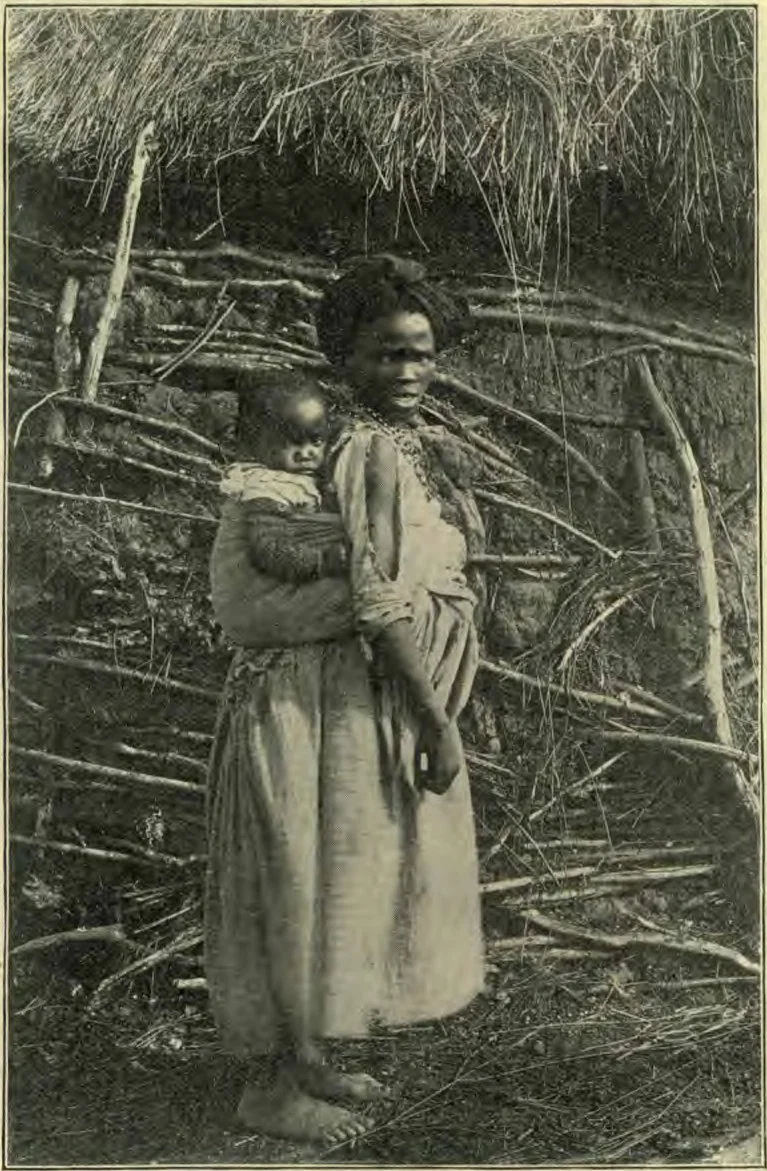
The clothing of these natives consists chiefly of the loin cloth; but they are willing and anxious to pattern after the white man in both eating and dressing. They learn very quickly, and are ready to imitate whatever they see, whether good or bad.
A KAFIR MOTHER AND CHILD
Before the Matabeles were conquered by the Chartered Company, they were accustomed to making provision for time of war and famine by storing up food in various ways. One method was to make large clay cisterns, six or more feet deep, with small openings near the top. In these they placed their provisions, covering them with grass, so that summer rains would not affect them, and they would not be so easily discovered. Sometimes they made baskets of various sizes and shapes. These were hidden among the rocks, and in such places as they were most unlikely to be discovered. Some of these baskets were so curiously woven that they would hold water, and were used for milk-pails. Water was sometimes carried six miles to a village, and stored in large clay tanks, for the use of the villagers. Everything these people make or build, even their huts, is circular in shape.
There are customs among them that reveal the fact that sometime in the past they have had a knowledge of both the Jewish and the Christian religions. A missionary who had labored among them before they knew anything of present civilization, relates the following incident: On a certain occasion when visiting a chief, a hut was given him for himself and friends to stop in while he remained. He saw a native singularly dressed, walking around in the village. He told the missionary that he was the medical man of the town. Later, while sitting in his hut, the missionary felt a spray of water directly in his face. He at once went outside to investigate the cause. He learned that this guardian of the village, the doctor, was going the rounds with a dish of water, and the blood of a goat or bullock, and with a bunch of genuine hyssop was sprinkling the doors and door-posts to keep off death. There is a tradition that if water and blood are sprinkled on the door and posts of the door, the dwellers in that home will be preserved from any form of death, either by violence or disease. In case of severe illness, when recovery is beyond hope, they sprinkle the person with the blood of a live goat, afterward setting the goat free in the wilderness.
These people also have a legend that once they had a God, but now they do not know what has become of him. Some think he has died, while others think he has left the country, never to return. In teaching them the gospel, that which seemed to appeal to them first was the fact that the sun and moon and stars must have been made by some one. By pointing this out to them, their attention is called to the Creator. One significant phase of working among the Matabeles was the fact that they would listen for a while to the teacher, and then go quietly away and meditate on what they had heard. Then they would return to hear more. In process of time those whose hearts had been touched by the word of God would come and say that they had received the God of the missionary; and later, in more than one instance, the lives of these natives would show that they had really accepted Christ as their Saviour.
ESTELLA HOUSER.

Bible Translations Spread Across Four Hundred Languages

It is a significant sign of the times that at the opening of the nineteenth century the Bible was printed in only thirty-five living languages. At the opening of the twentieth century some portion of it could be read in more than four hundred languages and dialects.

You have reached the end of this edition.

The Youth’s Instructor · Oct 30, 1902