The Youth’s Instructor, Vol. L, No. 43

The Scarlet Tanager

The Youth’s Instructor

Oct 30, 1902

Review and Herald Publishing Company · Battle Creek, Michigan · Oct 30, 1902

The Scarlet Tanager
WHERE shines the water-lily, like a star at eventide, Upon the slough’s dark water, with the lotus at its side,— Where the cypress trees, like Trappists, stand silently all day, And the boles of giant oaks uplift in colonnades of gray— There often with his flute-song, when the dew is on the leaves, The tanager, a scarlet flame, his web of beauty weaves.
The Scarlet Tanager
The Scarlet Tanager
O, the deep woods know his coming; all still, all still to hear, And the lily and the lotus breathe, softly, “He is near,” As he glows, a splendid flower, on a golden-dappled screen, With his image in the water like a ruby set in green, Ah, then his magic, crystal flute is blown among the leaves Until my heart is captive in the web of song he weaves.
— Selected.

The Wild Canary

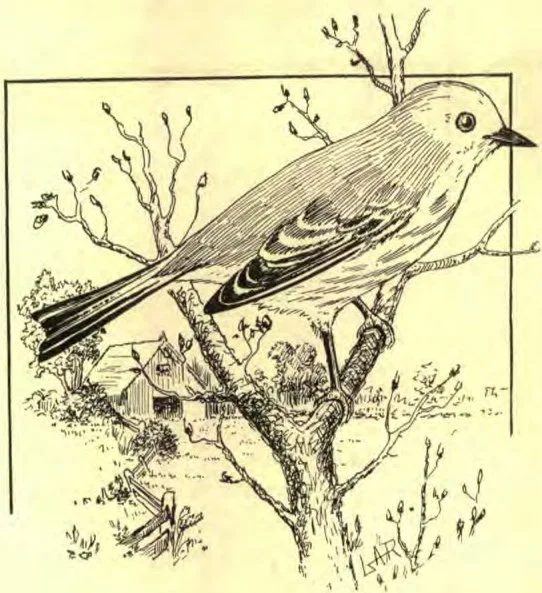
THE two birds often called “wild canaries” are not really canaries at all. One is the Yellow Warbler, and the other is the Goldfinch. There is considerable difference between the two birds, but both have a great deal of brilliant yellow in their plumage.
The Yellow Warbler, as it flies, seems to be all over yellow; but at closer range is found to have on its breast many fine reddish-brown stripes; its mate is olive-yellow.
There is a large bird, in appearance somewhat like the blackbird, that is too lazy to build a nest of its own, and so lays an egg or two in any nest it finds convenient. But the Yellow Warbler is one of the few birds that does not believe in bringing up Cowbirds, for that is the name of the lazy bird. If a mother Cowbird lays an egg in the Warbler’s nest, since he is too small to throw out so large an egg, the Warbler simply builds another nest over the first one, and thus covers the intruder. And if another cowbird egg is laid, in the new nest, the Warbler builds a third story.
A bird-lover once found a Warbler’s nest which had been half overturned by a storm. As it had become partly torn from its fastenings, the parent birds had abandoned it and the eggs that were in it, and built another nest a little distance away. The bird-lover straightened the nest back into place, secured it firmly, and then watched to see what the birds would do. They looked at the nest and the eggs therein,—their own nest and their own eggs. They seemed much excited about the matter, and chattered over it considerably. The mother bird could not sit in two places at the same time, so finally the father took his place on the other nest. The two birds sat on the two nests until all the birds had hatched, and it was a large family that they then had to care for.
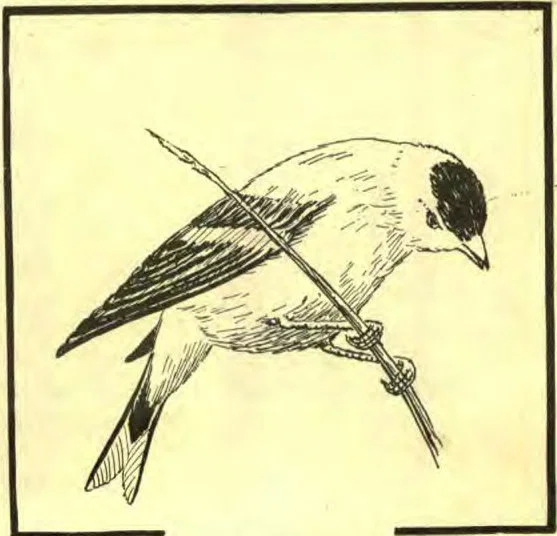
The other yellow bird, the Goldfinch, is also called Thistle-bird and Lettuce-bird. Besides his plumage of yellow, he has black wings, tail, and cap. His mate is olive-brown.
The Goldfinch is a delightful singer. He flies in waves up and down, and gives forth a cheery little warble as he goes over each airy little wave.
It is not until late July, or even August, that these birds build their nests. At that time they are on the lookout for any soft lining materials, and will frankly accept any bits of colored worsted or string you may care to give. The Goldfinch puts thistle-down in the nest an inch deep, and so makes for his little ones a fine feather bed.
THE YELLOW WARBLER
THE YELLOW WARBLER
L. A. REED.

When the Hunters Were Hunted

About thirty years ago a notion had gained belief that turtle oil was a potent remedy for rheumatism; and a self-styled doctor, living in my native town, who knew how to trim his sails to catch the popular breeze, had offered a number of the boys of the village a dollar a quart for all the turtle oil that they could procure for him.
As boys, we did not trouble ourselves with the medical question. It was an attractive offer, and our undivided attention was fixed on the dollar.
The only drawback was that the offer came in November, so late in the fall that the turtles at the lake had all gone into winter quarters in the mud of the bog, and could no longer be captured sunning on the logs, or by night upon the long sand-bank where they laid their eggs.
We had a homely knowledge of their habits, however, and knew about how deep they burrowed while hibernating; and on the afternoon of my story three of us had gone to the lake, or rather to the wide, muddy bog that bordered it, bent on capturing a boat-load of big turtles. An old bayonet affixed to the end of a short pole, and a spade with a long handle made up my equipment for turtle-hunting; but in addition to spades, my two fellow hunters, Alfred and Willis, were provided, one with a strong hay-fork, the other with a grapnel hook lashed to the end of a stout ash sapling.
For safety’s sake, too, we had each an old pair of snow-shoes. For although the mud of the bog was now slightly frozen over, the deep sloughs beneath were still dangerous. The lake itself had not yet frozen. We were therefore able to cross over from our shore to the bog in a boat—an old craft that had long been common property among the boys for fishing excursions.
Our modus operandi can be conjectured from our outfit. Having put on our snow-shoes, we began searching for turtle signs, and prodding deep into the mud with the bayonet. When touched with the point of the sharp weapon, under such circumstances, the burrowing turtle would stir slightly, thus differentiating itself from a sunken log or root. When the reptile was located, the task of unearthing it was begun with spade and grapnel.
But afternoons are short in November. We had secured no more than three turtles, if I remember right,—big, muddy, semitorpid creatures that lay on their backs like flat stones in the bottom of the boat, hardly stirring,—when the approach of sunset warned us to set off for home. We were rowing back across the upper reach of the lake, when directly in front of us we saw a flock of four loons, which we had already noticed, sailing to and fro, several times that afternoon.
“It’s queer they haven’t gone yet,” said Alfred. “They always leave here earlier, before it gets so cold.”
THE GOLDFINCH
THE GOLDFINCH
All four of the loons were swimming down across our course,—great, handsome birds,—and one of them, turning its head toward us, uttered the short, singular laugh characteristic of loons. We noticed, however, that two of them were much smaller than the others, and that one of the two lagged about fifty feet behind the rest as they swam.
“Those two are this year’s young ones,” said Willis. “Perhaps they were late hatched, and aren’t large enough to fly far yet.”
“Oh, yes, they are!” said Alfred. “A loon can fly, if only there is room to rise from the water, by the time it is half-grown.”
We had come up quite near the lagging one by this time, and wondered why it did not dive. Instead, it seemed to be making frantic attempts to swim, yet did not progress fast, and the others were as evidently swimming slowly to allow it to keep near them.
“Why, I believe something’s the matter with that young loon!” said Willis. “He can not swim much. Let’s catch him.”
Thereupon Alfred and I plied the oars smartly, while Willis steered the boat, and after pulling for two or three hundred yards we came close upon the lagging loon, wondering all the while that it did not dive.
It continued struggling ahead on the surface till Willis steered the boat close alongside, calling out to Alfred to catch it. The young loon then made a great effort to rise, but Alfred, dropping his oar, seized it by one wing, and pulled it into the boat.
We then saw that something was wrong with its feet. They were not properly webbed, but looked like clubfeet, little deformed masses of red flesh and bone.
The instant it felt Alfred’s grip, it uttered a wild, harsh cry; and that cry of distress affected deeply the two old loons. They were fully fifty yards ahead, but they turned instantly, with similar wild cries, and seeming to stand erect in the water, they flapped their powerful wings, and came directly toward the boat.
So far from being alarmed, however, we thought it a rather good joke at first, and made ready to strike them. But the loons had a mode of attack which we had not reckoned on. They came near the boat, and with their wings threw water over us and straight in our faces, as boys, while swimming, sometimes dash water at one another, striking it with the palms of their hands. One who has never seen loons throw water with their wings can have little idea of the force with which they propel it, or the quantity they can throw. We were quite blinded and drenched by it, and they kept a constant stream of it coming, making the whole lake resound to their outcries.
On a warm summer day this would have been a mere lark; but on that cold November night such a drenching was really a serious matter. To add to our discomfort, too, while dodging about in the boat, trying to fend the cold douches from our faces, Alfred had his foot gripped by one of our captives. The reptile held fast, despite vigorous kicks, and altogether we were in a bad way.
Willis and I had seized hay-fork and bayonet to repel the attack, but the loons seemed to know their advantage. They did not come within reach, but continued drenching us, driving whole bucketfuls of that cold water over us.
I do not believe there remained a dry thread in the clothing of any one of us, and our assailants kept bombarding us till Alfred threw the young loon out on the lake. Then he had all that he could do to free his boot toe from the turtle. Willis and I secured the oars and paddled away. We had been fairly worsted; and I remember that we were so cold and our teeth chattered so badly that we left our turtles in the boat overnight, and ran home as fast as we could to get warm.
These four loons remained in the lake that fall till the evening of the first day of December. On the morning of the next day the club-footed young loon was seen in a small mill-pond a quarter of a mile south of the lake. The other three loons had gone. The lake froze over for the winter that night.—C. A. Stephens, in Youth’s Companion.

The Magnolia Family

THOUGH this family of plants is not a large one, its members are by no means small or unimportant, all of them being either trees or shrubs, and some even giants of the forest. In this respect, they differ widely from the members of the Crowfoot Family, which we have been studying for several months past, and among which we found not a single tree nor shrub.
We love the small plants for their delicate beauty, their fragrance, and many of them for their usefulness in various ways, but in the trees we find qualities not possessed by the tender herbs. We admire them for their majestic stature and enduring qualities. We love them for their dense, spreading foliage, in whose cooling shade we may find shelter from the burning rays of the sun, as well as for their practical value in providing us with fuel, shelter, furniture, and other necessaries of life.
To this small family of plants, botanists have given the long scientific name Mag-no'li-a'ce-a. They all have bitter, aromatic bark, alternate, simple, mostly entire leaves, and usually large, showy flowers. Some are highly prized as ornamental trees, not only for their flowers, but for their foliage as well.
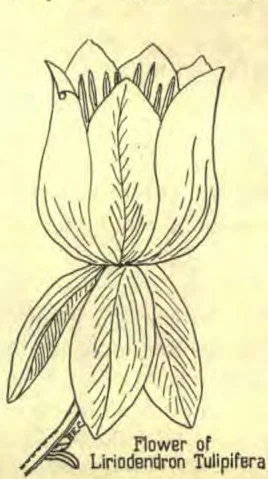
Flower of Liriodendron Tulipifera
The flowers are solitary, and the sepals and petals of a similar color. The stamens are numerous, and the pistils two or more. In fruit the carpels cover an elongated receptacle, forming a sort of cone, with only one or two seeds in each carpel. As stated in a previous lesson, a carpel is a simple pistil; that is, a pistil having but one cell, or cavity, in which the seeds are produced.
Among the most interesting members of the family are the many species of Magnolias. Some of these are called “umbrella trees,” because of the manner in which the leaves are crowded in umbrella-like clusters at the ends of the branches. Others are called cucumber trees, from the resemblance of the young fruit to a cucumber.
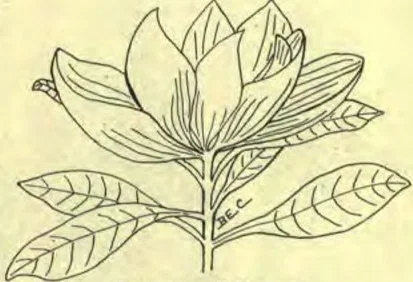
Magnolia grandiflora, the Great-flowered Magnolia of the South, is perhaps one of the best known and most highly prized species. It is a splendid tree, with coriaceous (leathery), oblong or obovate, evergreen leaves, shining above, and usually of a rusty cast below. The flowers, which appear in spring, are white, from six to nine inches across, and very fragrant. The Magnolia is said to be the only perfectly evergreen species.
Flower and Leaves of Magnolia Grandiflora
The wood is soft, spongy, and of little value.
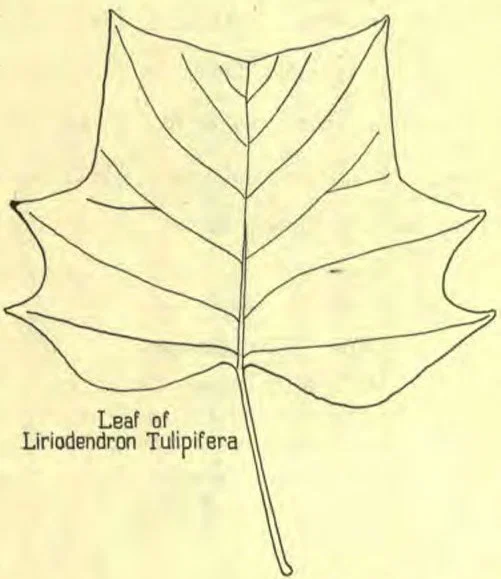
Another interesting member of the group is the Tulip Tree (Liriodendron Tulipifera), a tall, handsome tree growing in rich soil, more abundant in the West than in the East. It is often planted for ornament, and is probably the most widely distributed member of the Magnolia Family.
Leaf of
Liriodendron Tulipifera
Leaf of Liriodendron Tulipifera
The leaves are of a peculiar shape, appearing as if cut off at the end, and cordate, or heart-shaped, at the base. The flowers are green, yellow, and orange, fragrant and very showy, in shape closely resembling the common garden tulip flower. The sepals are three in number, the same as in the Magnolias, but they are reflexed, as will be seen from the illustration. The blossoms appear late in spring.
The tulip tree is much valued for its timber, from which is produced a white, soft lumber, much used for inside work and for cabinet making. The tree itself and the lumber made from it, are called “whitewood,” and sometimes, but erroneously, “poplar” or “white poplar.”
B. E. CRAWFORD.

Nothing Venture, Nothing Have

SAID little Morning Glory, “I'm sure I see a string! I wonder where ’twill lead me If I should climb and cling. I can not see its ending, But I can reach the top, I'm sure, if I keep climbing, And never tire or stop!”
Said Morning Glory’s brother, “You foolish little thing, To risk your life by trusting To such a slender string! You’d better come with me, dear, And twine around this jar; You’ll not get tired and dizzy If down so low you are.
“’T is better far and safer Than climbing up so high; You’ll never reach the top, Meg, No matter how you try!” But little Morning Glory Just shook her dainty head At such advice, and bravely Climbed up the string, instead.
Up, up she went, till, presto! She reached a shining nail And twined all round about it. So, when there came a gale, She weathered it quite safely, As back and forth she swayed, Unharmed by all the tumult, And not at all afraid.
Alack! Her timid brother Lay prone upon the ground Beside the jar so slippery That he had twined around! “I see,” he moaned, “’tis wisest To start out with a zest, E’en though the task looks dangerous, And always do one’s best!” —Selected.

Kindness: Why We Are Not All Kinder

I WONDER why it is that we are not all kinder than we are. How much the world needs it! How easily it is done! How instantaneously it acts! How infallibly it is remembered!—How superabundantly it pays itself back!—Henry Drummond.

How Pins Are Made

The familiar expression, “Oh, it is not worth a pin,” gives an idea of the small value commonly attached to this useful little article. Yet it is of so much actual worth that much study has been put upon it by men of inventive genius to make machinery for its improvement and manufacture, and even the time and talent of grave legislators have been given to it.
The almost universal use of pins, in some form, may be traced to the most remote antiquity. The earliest shape was probably that of the natural thorn, the same as is now used by the people of upper Egypt in fastening their clothing.
Later, bone and wood were made to serve the same purpose, by being whittled into the form of a meat-skewer. Very early, however, bronze pins without heads were in use by civilized nations. But as late as the sixteenth century, the ordinary domestic pin was of so crude a nature that the English Parliament passed a law requiring those imported for English use to be “double-headed, and have the heads soldered fast to the shank,” and the “shank to be well shapen, the points to be well and round filed, canted, and sharpened.” From this we learn that the pins of that day were not so fine as those now in common use. It appears that they consisted of a shank with a separate head of fine wire twisted round and secured to it. All this required much work, and made pins so expensive that they were purchased for Christmas and New-year’s gifts. But sometimes the stock ran low at the stores, and they were not obtainable. Then a sum of money with which to buy them, when they could be purchased, was presented instead, and was known as “pin-money.”
This finally grew into the custom of requiring a young man to settle upon the lady he intended to marry the yearly amount of pin-money she was to be allowed after marriage. Many allusions to this strange custom are still to be seen in old English documents. This custom, however, created a difficulty; for the pin-makers took advantage of the popular demand to raise the price of pins, when the ladies made loud complaints that the pin-money did not go as far as it ought in purchasing pins. Therefore, in 1543, Parliament interfered, and made a law that pins should not be sold for more than six shillings and eight pence for a thousand. At the present value of money, that would be about one dollar and sixty cents; but at that day it was nearly twice this amount.
For some reason, however, the price of pins was again raised, and we read of Abigail Adams’ stating, in “Familiar Letters,” June 15, 1715: “The cry for pins is so great that what I used to buy for seven shillings and sixpence are now twenty shillings, and not to be had for that.”
When we think of the slow process by which pins were made at that time, the high price is not so great a wonder. Then, one man drew out the wire by hand, another straightened it, a third cut it, a fourth pointed it, and a fifth ground it at the top for receiving the head, which was made by one man, and put on and soldered by a second, while a third whitened the pins, and a fourth stuck them into papers.
All this work, except the whitening, is now done almost as quickly as one can wink his eye. The ingenuity of man has brought into use machinery by which brass wire of suitable size is passed from a reel into a little steel aperture, where it is seized and straightened, as it moves along to be cut into proper lengths. It is here caught between jaws, with enough of the end protruding to form the head. Against this, a steel concave punch is driven with sufficient force to shape the head. The pin then passes on, and drops, point first, into a small slit, where it hangs with many others by the head. Here a revolving steel roller with file-like teeth works against the points, rounding, pointing, and polishing them very neatly. As each point is finished, the pin is pushed on out of the way, and falls into a vessel standing under the machine.
But it is not yet as “bright as a new pin;” the silvery look that new pins have is lacking. So the “cleaning,” or “coloring,” process must be performed. The pins are first boiled in weak beer, which removes all the grease and dirt. They are then arranged in layers in a copper pan, alternating with layers of grained tin. The whole is covered with water, sprinkled with bitartrate of potash (cream of tartar), and boiled for several hours.
By this process the brass pins become coated with a thin deposit of tin, which gives them their bright appearance. They are then washed in clear water, and put in a barrel containing dry bran or fine sawdust, and the barrel is revolved until the pins are completely dry. After winnowing, the pins are finished, and ready for the papers in which they are sold. The pins are now dropped into a hopper, which passes them to a steel plate with as many slits in it as there are to be pins in a row. The pins drop through the slits, and hang by the heads, the same as when they were to be pointed. The machine then presents the folded and crimped paper in which the pins take their places in straight rows.
This seems like a long process for the production of so small a body as a pin. But the work is all done much more quickly than it can be told. There are mills in different parts of the world, some making ten millions of pins a day, others seventeen millions, and from that up to twenty, and even thirty millions of pins daily. It will be readily seen that except much study had been given to the invention of pin machinery, these useful little articles would have cost a great deal, and would not have been as common as they now are, nor would a common comfort have been brought within the reach of the poorest of people. This is but another illustration of the proverb, “There is no excellence without labor,” and it applies in small things as well as in greater. MRS. J. A. CORLISS.

Acrostic of Scripture Texts on Wisdom and Duty

Acrostic

The fear of the Lord is the beginning of wisdom. Prov. 9:10.
Honor thy father and thy mother: that thy days may be long upon the land which the Lord thy God giveth thee. Ex. 20:12.
Enter not into the path of the wicked, and go not in the way of evil men. Prov. 4:14.
Ye shall keep my Sabbaths, and reverence my sanctuary: I am the Lord. Lev. 19:30.
Owe no man anything, but to love one another. Rom. 13:8.
Understanding is a wellspring of life unto him that hath it: but the instruction of fools is folly. Prov. 16:22.
Thou shalt rise up before the hoary head, and honor the face of the old man, and fear thy God: I am the Lord. Lev. 19:32.
Honor the Lord with thy substance, and with the firstfruits of all thine increase. Prov. 3:9.
Strive to enter in at the strait gate: for many, I say unto you, will seek to enter in, and shall not be able. Luke 13:24.
If ye love me, keep my commandments. John 14:15.
Not every one that saith unto me, Lord, Lord, shall enter into the kingdom of heaven; but he that doeth the will of my Father which is in heaven. Matt. 7:21.
Submit yourselves therefore to God. Resist the devil, and he will flee from you. James 4:7.
Thou shalt not go up and down as a tablebearer among thy people.” Lev. 19:16.
Rejoice not when thine enemy falleth, and let not thine heart be glad when he stumbleth.
Use hospitality one to another without grudging. 1 Peter 4:9.
Come unto me, all ye that labor and are heavy laden, and I will give you rest. Matt. 11:28.
Take my yoke upon you, and learn of me; for I am meek and lowly in heart: and ye shall find rest unto your souls. Matt. 11:29.
O magnify the Lord with me, and let us exalt his name together. Ps. 34:3.
Remember now thy Creator in the days of thy youth, while the evil days come not, nor the years draw nigh, when thou shalt say, I have no pleasure in them. Eccl. 12:1.

Jonah — Ancient and Modern

THERE was a man named Jonah, many centuries ago; To Nineveh God called him, on a mission sad to go,— To warn the wicked city, its impending doom to teach,— But, instead, he went to Joppa, for he didn’t want to preach.
He paid his fare to Tarshish, in the boat lay down to sleep; But because his heart was evil, a great storm rose on the deep, And Jonah was cast overboard, amid the angry waves; A great fish swallowed him, and thus preserved him for three days.
Poor Jonah there repented, and he prayed with pleadings sore; And soon he found himself released upon a friendly shore. At God’s command he went and preached; the truth was unalloyed— “Yet forty days, and Nineveh shall surely be destroyed!”
But Nineveh repented, the death angel went his way. Then Jonah became angry,—for what would the people say? He made a booth, in which he sat, and wished his life were done. A friendly gourd crept over it, to shield him from the sun.
A worm destroyed the gourd, which Jonah scarcely could forgive; He wished all Nineveh were dead, but that the gourd might live. “Dost thou do well thus, Jonah, to be angry for the gourd? Are not the souls of Nineveh more precious to the Lord?”
But Jonah counted o’er and o’er his trials, one and all; The problem he found easy, for the number was so small. Had he sought to count his blessings, he’d have found, ere they were solved, Arithmetical progression which infinity involved.
How many modern Jonahs from the call to duty flee, Then chafe at rising storms they cause on life’s tempestuous sea. Or, after doing duty, they for hope can find no room, Although their efforts may have saved a city from her doom.
They seek their booth disheartened, there to count their trials o’er; And they truly find more comfort in the gourd about the door Than they do in trusting God to save the souls so deep in sin. Are you a modern Jonah? Work, and leave results to him. MRS. M. A. LOPER.

All the Way from New Zealand

GOD is moving upon the hearts of the children and youth in other lands to band together for service. A very cheering letter comes from New Zealand, telling of the work of a faithful young man, who probably knew nothing of the organized movement of the young people in this country. He wrote the following letter to Sister J. H. Baker, the Sabbath-school secretary of that conference. Personally, I feel very grateful for the privilege of reading this letter, and I feel sure that the young people in this country will enjoy sharing it with me:—
“For some time I have felt that I have not been living as good a Christian life as I wished to do, and in order to do better work for the Master myself, and to try to encourage some of the older children to give themselves more fully to Jesus, I proposed to them that we should make a kind of Sunshine Band, and try, with God’s help, each week to be loving and kind to our brothers and sisters; to be prompt in obeying our parents; to try to speak pleasantly to all we meet; always be ready to do a good act; and always try to be cheerful and uncomplaining; in short, to make everybody around us as happy as we can. After I had explained all this, I asked all who wished to join in, to try and carry out these resolutions, to hold up their right hand; and all but five or six of the smaller ones held up their hands at once.”
“We report each Sunday to one another. I must say that I have had some very encouraging reports from the children. Some found their work a pleasure instead of otherwise, as they used to think it. And with some the work that used to take a long time to do, they can do in very much less time. The first time I called on them for their report, of course they were a bit awkward at telling how they got on. In fact, they were rather too shy, until I led out with my report. The first week I must say was a blessed week to me. I felt that Jesus was with me all day long, and I must say that I could praise the Lord for his tender care over me. It was really good to see the children’s faces,—they were beaming with happiness. I am sure that they received a blessing as well as myself.”
“I believe that the Sunshine Band is proving a blessing to me already; for I am anxious to have a good report to take to the children every Sunday. One girl said last Sunday that whenever she thought of the Sunshine Band, nothing seemed a trouble to her. Of course that is just a name I picked out to call it by. I have heard of Sunshine Bands, but what they are I do not know. I do hope that we may shine more brightly, so that we may bring more sunshine into the homes of the people in this place, and wherever we may go.”
It is the simplicity of this work that is most commendable, and appeals to me most strongly. Formality was so lightly regarded. It was simply a banding together for mutual encouragement in every good work. How genuine were the efforts to “carry out” the resolutions! How genuine were the blessings received!
What this brother has done can be done by many of our young people scattered throughout our churches. Gather together the young people and the children. Plan for a week of Christian service, in which each one shall have a part. Encourage one another with a report of the work done, the victories gained, and the blessings received. Plan together, pray together, work together; and the whole problem of the Young People’s work is solved.
MRS. L. FLORA PLUMMER.

Young People's Society Organized in Roden, Manitoba

From Roden, Manitoba

WE organized a Young People’s Society in February, with a membership of twelve; two others have been added since, so we now have fourteen members. We hold our meetings every Sabbath evening, using the lesson which is found in the YOUTH’S INSTRUCTOR. Each member takes part in the study. We are all trying to do what we can to get the truth to our neighbors. Some of our members have given away books and papers, and have had some good talks with the people. Most of the members intend to take their number of “Christ’s Object Lessons,” and sell them. We have used our missionary map, and think it makes the study of the fields much plainer. We can go to our map, and see just where our workers are.
JEANIE RAMSAY, Sec.

Lord, Teach Us the Lesson of Giving

Lord, teach us the lesson of giving, For this is the very next thing; Our love ought always be showing What offerings and fruit it can bring. There are many who know not thy mercy, There are millions in darkness and woe; Our prayers and our gifts all are needed, And all can do something, we know. — Selected.

Definite Prayer for Missions

THE regular second Sabbath service to-day is a call to definite prayer for our mission fields, and the workers who are bravely struggling alone in the dark corners of the earth, waiting for reenforcements, which we must soon send them. It is a call also for prayer to the Lord of the harvest, that he will send forth laborers into his harvest. We who remain at home are called just as much to give our all to this service as are our missionaries who stand at the front. The work is one. Those who go into the fields give their lives to this great work, and we who remain at home must do the same, that our brethren at the front may be sustained by our prayers and by our gifts.
If this is the attitude we take toward this closing work, very quickly the sound of the message will be heard in every quarter of the earth. The appeals from our brethren, and the needs with which we are familiar, are the calls to prayer.
May the young people appreciate their privilege of co-operating with the Master in supplying this great need. E. H.
Continue reading: November Study of the Field