A FOUR days’ run from Suva, Fiji, brought us to Auckland, New Zealand, on the last day of June. As we sailed down Hauraki Gulf to the Auckland harbor, my wife and I reviewed our mingled feelings of fear and hope the first time we came down that gulf. It was the evening of Nov. 13, 1886. At that time we were alone, and we did not know any one in New Zealand. We were young and inexperienced, and had never labored outside of the United States. Whether we should understand the British people, and whether we should succeed in our new field without a single experienced laborer to counsel us, was a serious matter with us. But we had come in response to what we felt sure was our duty, and we hoped in God and prayed for help. And now on returning, our hearts were filled with gratitude as we reviewed the marvelous work the Lord has wrought through his people during the years that have intervened.
Arriving at the wharf, we found a company of brethren and sisters waiting to welcome us. Among them were Pastor J. M. Cole, the president of the New Zealand11Conference; Pastor Westerman, in charge of the work in the city of Auckland; Dr. P. M. Keller; and some of the first believers to accept the truth under our labors twenty-eight years ago.
Our first call after being located was on Brother Edward Hare, to whose house we went direct from the steamer when we came out in 1886. We were glad to find Brother and Sister Hare still rejoicing in the message.
Arrangements had been made for a stay of one week in Auckland. The brethren in all the surrounding towns had been invited to spend the week together in the city, and many came. The meetings were held in the Ponsonby church, which we erected in 1887 at the close of our first series of tent meetings. This was the first church building erected by Seventh-day Adventists south of the equator. It is still a good, clean, creditable building. Through the faithful labors of others who have come to Auckland from time to time, this building has not only been kept in good repair, and enlarged by an extension at the rear for Sabbath school and quarterly meeting purposes, but the membership has been more than maintained. There were a hundred or more members when we left twenty-six years ago to open a new field a few hundred miles south, but now there are many more. And in addition to this there has been established in another part of the city a company of live, active members, with a very neat church building of their own.
Under these circumstances it was a great pleasure to visit this city, which we entered with so much trepidation more than a quarter of a century ago. When we began our work there, we were called Seventh-day "Adventurers" by some of the ministers who opposed us, and the people were advised to pay no attention to our teaching, for when the winter rains came on we would pack our calico church for fresh pastures, and leave them stranded. Time has proved that we were not "adventurers," and that when the winter rains came, instead of moving to new pastures we moved into a substantial building erected by the believers who accepted the message. Instead of our cause proving to be a short-lived, transient affair, it took deep root, remained, and grew. Now it stretches from the North Cape, throughout the whole length of the country, to the Bluff in the extreme south. Thus it has demonstrated its great vitality and its splendid staying qualities. To him whose mighty hand guides and guards his own cause be all the praise and all the glory.
During our stay in Auckland we made our home with Drs. P. M. and Florence Keller. They have been in this city eight or ten years, and in the Australasian field fourteen years. Since coming to Auckland they have built up a large practice. They now have more work than they are really able to carry. Dr. Florence is a member of the city hospital board, and also a member of the public schools board. She was elected to these positions by a large vote of the citizens.
Brother and Sister Keller are known throughout the city as earnest, out-and-out Seventh-day Adventists. They are active in church work of all kinds. This makes them a great blessing to the church and to the cause generally in New Zealand. Brother Keller is one of the elders of the Auckland church, and Dr. Florence works earnestly for the advancement of all lines of missionary interests. The brethren and sisters love them, and feel that the church would sustain a great loss should they leave Auckland. Why should not all our physicians and nurses become strong factors for the advancement and the finishing of our work in the communities where they live?
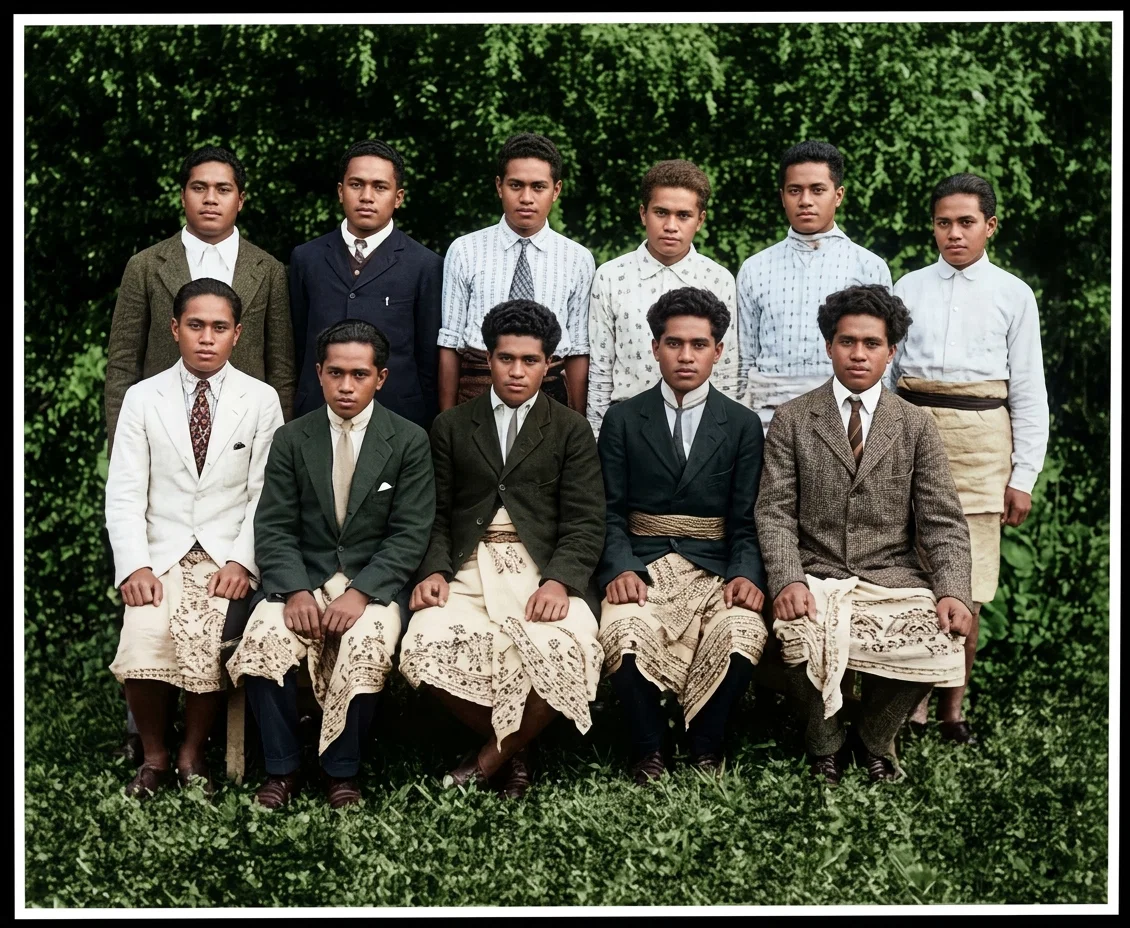
BOYS AT OUR SCHOOL IN FIJI
From Auckland we journeyed south, visiting our churches at Cambridge, Napier, Hastings, Palmerston North, Wellington, and Christchurch. We had traveled over all this territory during the four years we were in New Zealand. At Napier we had labored a year and a half, holding meetings in the tent and in public halls until a church was erected. During this time we organized and directed the canvassing work in the central part of New Zealand. We also organized the New Zealand Conference and established the headquarters at Wellington, the capital.
PONSONBY CHURCH, AUCKLAND, N. Z.
It was a great pleasure to visit these places after so many years, and to meet so many brethren and sisters who had embraced the truth in those early days. And it was just as pleasing and cheering to have the privilege of forming the acquaintance of hundreds of new believers who have united with the church under the labors of those who succeeded us.
The New Zealand Conference has established at Palmerston North an excellent school for the education of their young people. It is not a large school, but all things considered, it is one of the most perfect plants we have in our entire list of educational institutions. It is four miles from the clean, prosperous, growing town of Palmerston North. The soil of the farm is rich. In material and workmanship the building gives evidence of wise planning and thoroughness in its construction.
Brother Joseph Mills, who spent several years at the Australasian Missionary College in its early history, has been in charge of the New Zealand school since the location was fixed at Palmerston North. At the union conference session just held in Sydney, Brother Mills was elected principal of the Australasian Missionary College, and Brother Leonard Paap was chosen principal of the New Zealand school. Both of these young men were but lads when their parents embraced the message. They have grown up in this cause, and have dedicated their lives to its advancement.
Leaving Palmerston North, we went to Christchurch, in South Island. Here we found the church membership larger and stronger than it was at the time of our last visit fifteen years ago. The brethren had just bought and fitted up a very neat building centrally located, for their church school. We had the privilege of dedicating this plant to the noble work for which it was prepared. The school was dedicated free from debt.
Our New Zealand sanitarium is located in an attractive suburb of Christchurch. It was established there about fifteen years ago. Brother Brandstater, who is now both manager and head bath man, has been connected with the institution the most of this time. Its patronage, though small, is steady, and the income I understand is sufficient to meet expenses. The manager told me with much satisfaction that quite a large number of the patients who have come to the institution have left rejoicing in the truth.12
Our work in New Zealand closed with a two days’ visit to Wellington, the headquarters of the conference. Brother Cole, the president, who met us at Auckland, remained with us, rendering greatly appreciated service until we sailed for Sydney. This gave us opportunity to talk over leisurely and thoroughly the needs of the field and the most important steps to take to hasten on the work. We were glad to learn that the brethren had practically decided to organize a second conference. This will be located in South Island, with headquarters at Christchurch. The membership on each island is about the same, and the amount of tithe paid is about equally divided between the two fields. The arrangement will probably be effected at the camp meeting to be held next January.
Naturally this visit to New Zealand was of much deeper interest to us than this report of it can possibly be to those who read it. It revived memories of early struggles and revealed anew the divine leadership at the head of this cause. The work started in great weakness in this field. It met with strong opposition. It received but little financial support from the homeland. Only one draft was ever sent to us from the General Conference treasury—that was for three hundred dollars. With that exception, the mission was entirely self-supporting after our arrival. The leading members of the Hare family, who had embraced the message during Brother Haskell’s visit to New Zealand in 1885, gave the mission generous support from the time we reached the field. It was a great pleasure to meet these dear friends once more. Others who have accepted the message since that time have rallied to its support. Thus the Lord has kept his cause alive and growing.
At the present time the conference has seventeen ministers and Bible workers, and a good staff of canvassers. Besides its evangelical work, it operates a school, a sanitarium, and two vegetarian cafés. Every department is self-supporting, and the treasury carries a good cash balance as a working capital. This field has all the possibilities which make for the steady growth of the cause.
Brother and Sister Cole are in good health, and are greatly enjoying their work. They have the confidence of their fellow workers and of the brethren and sisters throughout the field. Nowhere in our travels have we found our people more active and courageous. They give evidence of enjoying a good spiritual experience. Our stay of eighteen days was altogether too short, but we were obliged to hasten on; so we bade them farewell, rejoicing because the work in New Zealand is onward.
A. G. DANIELLS.
Tsungwesi Mission, South Africa
By M. C. STURDEVANT
M. C. STURDEVANT
On the night of October 15 our little church came together for a business meeting for the third quarter, 1914. A careful report of the tithes and offerings was read, giving the names of all who had paid into the treasury during this time. It was found that, out of a membership of forty-four, nineteen had paid nothing, while others had not been so faithful as they might have been. The elder took some time to present the importance of returning to the Lord that which belongs to him. Apparently a deep impression was made upon the minds of all, and we look for a reformation to take place.
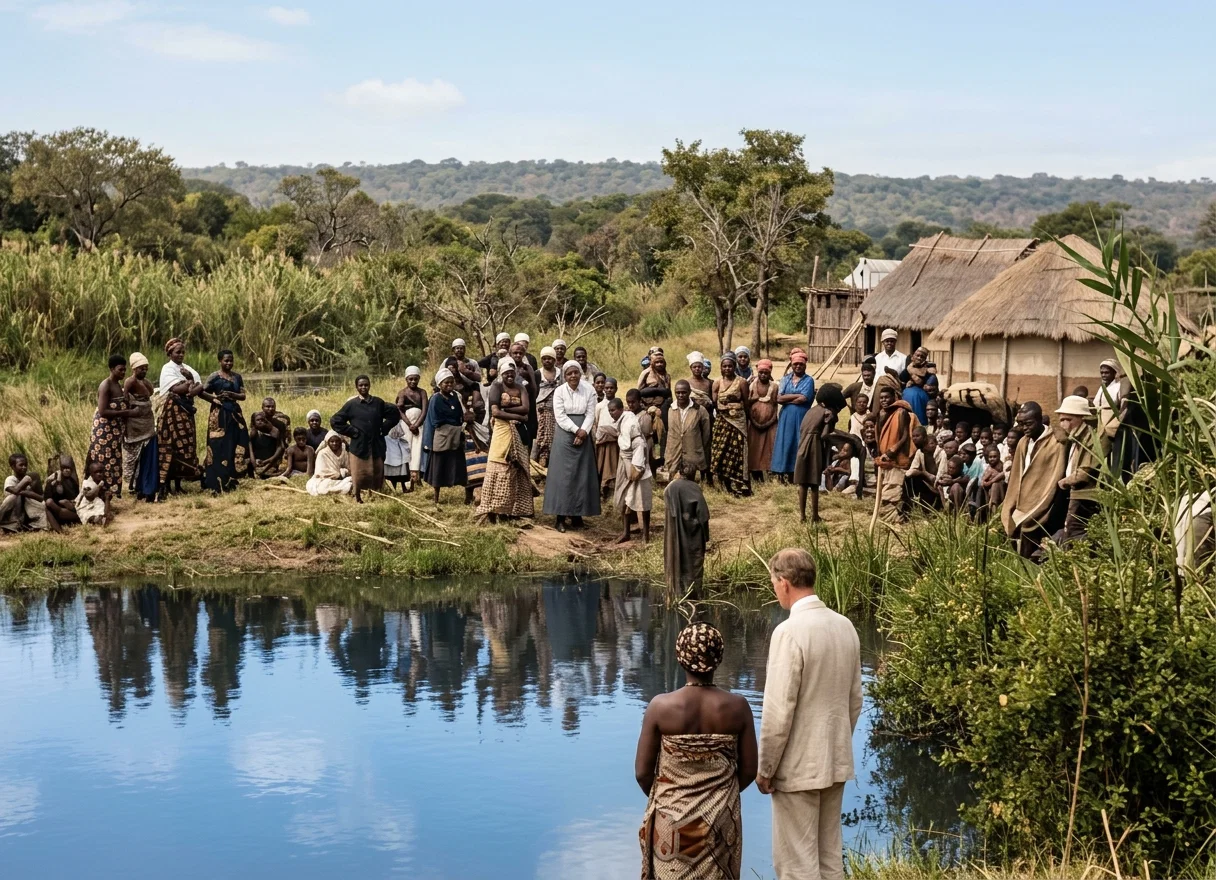
BAPTISMAL SCENE AT TSUNGWESI MISSION
The next evening, as the setting sun brought in the hours of the Sabbath, the little church again came together. The house was crowded. After a song, prayer, and a short reading from the Word, the writer examined a class of twenty-four who were to be baptized the next day. Because of certain conditions four were advised to wait a little longer, that a more thorough work of the Spirit of God might be wrought in their hearts.
It was a solemn time. Deep impressions were made. It would have done any one good to hear the reasons given why these poor natives wanted to be baptized. Surely a wonderful work has been accomplished in their lives. Among those to be baptized were eight adults who had come in from near-by kraals. It gives us courage to see the older people take hold. The members of this baptismal class were of a more advanced age than others we have baptized in the past.
Sabbath morning we all came forth to enjoy a full day of feasting with the Lord. Mrs. Sturdevant had been called away for a few days to help a neighbor woman who was very sick with fever, so the work of preparation had to rest upon other members of the mission family. At 10:30 A. M. we all came together for the Sabbath school. The house could not hold the crowd that came. After the usual exercises and study of the lesson, we all retired to the Tsungwesi River, one mile away, to experience the blessings awaiting us there.
In the shade of the trees on the banks of the lonely river we listened to short discourses from the two native teachers, Elijah and Jeal, in which they exhorted all to repent and turn to the Lord while mercy lingers. Hearts were tendered, and a good impression was made upon those who had come to witness the baptismal scene, a company of over two hundred persons. We then went down to the water, where twenty were buried with their Lord in watery graves. Five chiefs were present. One came very near that he might see and hear. His heart was greatly moved as he witnessed one after another confess his belief in the “Great God.” Two were baptized from his kraal, one being his own son, a married man.
As we were coming up out of the water, a headman came to me and thanked me for baptizing his children. Four out of his family of five children have now been baptized at our mission school. It did my heart good to have this heathen man come and thank me for baptizing his children, two boys and two girls. The latter are now married to two of our mission boys.
In the afternoon we all met together again to celebrate the ordinances of the Lord’s house. It was a refreshing season, and we trust a good work has been done for eternity.
The work here is onward. Brother and Sister Jewell have charge of our school, which now numbers over one hundred. Seventy are regular boarding students. Brother Harry Jennings is helping me in the brickmaking and building work. An addition 18 x 20 ft. has been given our dining hall. We are just completing a dormitory, 20 x 40 ft. A new school and a church are also much13needed. The dreadful war in Europe is affecting our country. We are cut short of means to complete our buildings, which are so greatly needed. The time for our planting has now come, and we shall be very busy indeed. But we are all of good courage, and are doing all we can to finish the work in this part of the field.
We greatly desire the prayers of the loved ones in the homeland. Let us press on. The end is in sight. In a little while we shall rest from our labors.
Simla, India
By W. A. Barlow
W. A. BARLOW
DURING the past two hot seasons, special Bible lectures have been given by Elders H. H. Votaw, S. A. Wellman, Dr. H. C. Menkel, and Brethren W. S. Mead and L. G. Mookerjee, in Simla, North India. I have attended many of these lectures this season, and have been much encouraged and cheered to see the honest in heart attending the meetings. Each season, both last year and this, some have been won for God and present truth and baptized, uniting with the Simla church. The church was first organized last year.
Only a few days ago four persons were baptized by Dr. Menkel and received into church fellowship. The government officers are leaving now, at least a large number of them, for the plains of India, where they will remain until March. Dr. Menkel will remain here nearly all winter and prepare for his medical work, which we hope may be well organized by next season. I have reference to the new treatment rooms. The doctor has been doing much real medical missionary work since he arrived in Simla from Bombay. God has been with us, and will continue to bless the work begun here.
We have a number of earnest, working members in the church and Sabbath school. They are doing their very best in winning souls for the Lord. Quite a stir on the Sabbath question has been made here by a Calcutta Baptist missionary, who, on coming to this place for a change, used his pen freely in one of the weekly papers of Simla. Dr. Menkel, Brother Mead, and also others were allowed to publish articles on this and other important subjects, doing so in a courteous and Christlike way, and these articles have been freely circulated throughout the station. The rich and poor alike have had their attention drawn to the Sabbath, the second coming of Christ, and other important subjects for this time, as never before. Literature has been circulated freely,—tracts and papers on the signs of the end, the great war in Europe,—and I feel certain that God’s Spirit is working in the hearts of many in this place. Let me give you a few lines just in hand from an anxious inquirer, who is head master of the Collegiate School, Serampur (Carey’s college):—
“Please do not forget to let me know when you go down to Calcutta, for I want to have a free and full talk with you about some of your doctrines—observance of the Sabbath, etc. Could you not send me a small treatise on these doctrines? I wish to study the question and know the truth.”
This is the kind of letters some of us receive in these days from the honest-hearted among the people of India. Pray for these inquiring ones.
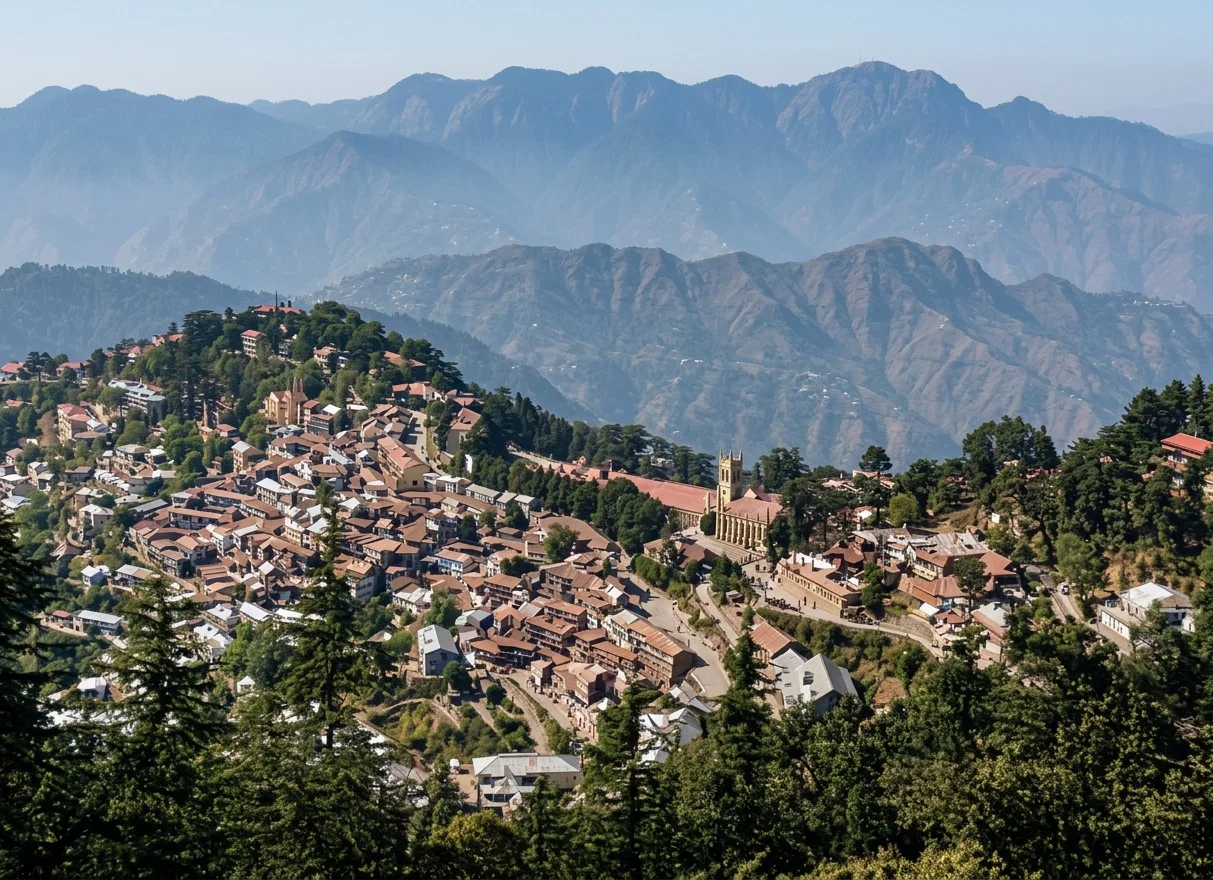
A GENERAL VIEW OF SIMLA, THE SUMMER SEAT OF THE GOVERNMENT OF INDIA
owing to financial conditions, but we desire to be ready to go forward as soon as the means will allow.
This is the rainy season, and rivers and streams are much swollen. Sometimes we had to strip and go through water to our armpits; at other places we were carried on men’s shoulders; and the wide rivers we crossed in dugout canoes. At one of these rivers there
West Africa
By R. S. Greaves
R. S. GREAVES
A FEW weeks ago I started out to visit some of our stations, and made my first acquaintance with the African interior. Brother Myers and two boys met me at the railway, and after a walk of three hours we arrived at our new Timni station. Sister Myers is the first white woman that many of the natives ever saw; and when she first arrived, people came from other villages to look at her. The chief is quite friendly, and in the evening caused the big native drum to be beaten, and the people gathered to listen to the blessed gospel, seeming much interested.
Our mission compound runs to the edge of what is called the Devil’s Bush, and they gave us to understand that we must not go there. This is the place where they perform certain rites, and, after a fashion, worship the devil. One poor woman carried her sick baby there, and a man’s voice could be heard repeating the words, “You gave it to her, don’t take it from her again, don’t take it from her again.”
From this place I visited two outstations, and found the brethren of good courage. My next trip was to our Gbambgama station, where Brother Harding, a native brother, is doing good work. I baptized four dear believers here,—three women and one young man,—all from rank heathenism.
At the nearest railway Brother Myers again joined me, and we had a long tramp together, visiting many villages to try to find a suitable place for a main station. We cannot open this at present, were six of us to cross, and the canoe was so dilapidated and rotten that only two could be taken at a time. After seeing how the strong current dashed the first boatload against an old log, I thought it safer to strip when it came my turn, and be ready to swim in the case of accident.
We were wet to the skin with perspiration and rain nearly the whole time, and the damp weather caused our clothes to mildew and mold in our valises, but the dear Lord gave us excellent health all the journey. As for appetites, for my part I was ready for as big a bowl of rice as I had marveled at when I first saw our schoolboys eating.
At one place a woman had just been bitten by a snake, and Brother Myers gave her some treatment, which probably saved her life. At another village, where things were as crude and primitive as could well be imagined, I was surprised to see a man sitting outside his hut using a Singer sewing machine. Afterwards I saw several of them. Civilization is surely advancing, and probably it is difficult to find a place where traces have not sifted through. Who knows but that some seeds of truth may find their way, along with other things, to places we have never visited, and some day we may see the third angel’s message where we hardly expected it?
Altogether I walked about two hundred miles, and we were very glad when we came to the railway, for our feet were sore.
In the interior we have a mixture of Mohammedans, devil worshipers, and all kinds of heathen, but we know our Heavenly14Father will lead the honest ones to the light of the blessed gospel. We found what we believe to be a splendid place to start a new station, and we are now anxious to open it. Remember Africa in your prayers.
Elder B. C. Haak
By J. W. Westphal
WITH feelings of deep sadness we report the death of Elder B. C. Haak, the second death of a foreign missionary in our field. For many months we had earnestly called for a man to come to Argentina who could take the presidency of the conference. Just one year ago Elder Haak received the notice of a call to this field, and this he accepted. Anxiously we awaited his arrival, which occurred March 24. Within two weeks the writer resigned, and Elder Haak was chosen president. During the nearly eight months up to the time of his death, he faithfully carried the responsibilities of his office. All, both laborers and lay members, and also others who had heard him preach the gospel message, loved him. Although he had to learn to know the people and the field, and he was not yet able to use to advantage the Spanish language, he did excellent work for the conference. He fitted into the place exceptionally well. With his knowledge of the German language, he could begin his work without delay, for many of our brethren speak German. He was a good preacher, and with his experience in city work, was able to give good instruction and help in a work that was promising great things for us. He had a deep interest in home missionary work, and considerable practical experience as a home missionary secretary, which proved a great help to him and to us. In his hours of delirium this was the burden of his exhortation to our brethren. He was careful and conservative in the expenditure of means, and yet very progressive in pushing on in his work. He was a laborer whom we could ill afford to lose, and whose loss we all feel most deeply.
Elder Haak was born in Winona, Minn., Sept. 8, 1884, and died Nov. 25, 1914, aged 30 years, 2 months, and 17 days. He was converted at the age of sixteen years, and was united in marriage with Miss Elva Hickok in June, 1907. A few weeks later he entered the work as a tent master. During the following winter he had charge of the Portage Plains Academy, in Manitoba. During the summer he again served as tent master. After this he was educational, young people's, and missionary secretary for one year in the North Dakota Conference. After spending another year as business manager and Bible teacher of the Sheyenne River Academy, he was occupied for three and one-half years in ministerial work in the Minnesota Conference, from which place he was called to the presidency of the Argentine Conference.
Elder Haak died of typhoid fever. As another of the workers, a nurse, who also attended the recent conference held in Rosario, was taken with the same disease, it is supposed that Elder Haak's sickness was contracted there. When stricken, he was, with his family, visiting one of our churches. It was at first supposed that he had the grippe, but on the second visit of the physician he pronounced it a very serious case of typhoid fever. Knowing this, he himself had little hope of recovery. A nurse was sent from the sanitarium to care for him. For nearly a week before his demise he was delirious, and was often preaching to our brethren, exhorting them to earnest work in view of the Lord's coming being near at hand. He leaves a much-loved companion and two children to mourn, the latter being too young to realize their loss. The Argentine Conference has suffered an inestimable loss, which again makes the future of the work look discouraging. But we sorrow not as others who have no hope, and we are assured that, though it is yet hidden from human eyes, the Lord will bring deliverance to his suffering cause.
J. W. WESTPHAL.
Argentine Annual Conference
By J. W. WESTPHAL
J. W. WESTPHAL
THIS conference was held Oct. 8-18, 1914, in the city of Rosario, the second city of the republic, containing a population of 350,000. The conference was preceded by a workers’ meeting of a week. Brother Nicholas Hansen and others had been laboring in the city about nine months, with some results. The meetings were held in a good location on a principal street, and here also the conference convened. All the union conference employees in Argentina, and Elder F. L. Perry and one of the Bible workers of Uruguay, besides all the laborers of the Argentine Conference, were present. The attendance was upward of one hundred and fifty.
The workers’ meeting was very profitable. Each forenoon was occupied in giving lessons on the Spirit of God, prayer, and the ministry. In the afternoon, in round-table talks, methods of work and kindred subjects were discussed. All the meetings were very practical. In the afternoon, some time was devoted to selling the Atalaya war specials, in which practically all the workers took part, disposing of nearly three thousand copies. Regular evening preaching services were held during both the workers’ meetings and the conference, which were well advertised and well attended. Reports of the sermons were given to the two daily papers of the place, one of which published them entire. Through this means many learned of the Seventh-day Adventists and their faith and work. A goodly force of workers remained to follow up the interest. The agent of the American Bible Society in the city, and his wife, both natives of Spain, began to obey the truth as far as it was presented. Many others, after the law, the Sabbath, and the change of the Sabbath had been presented, indicated their determination to obey. According to all appearances, it was by far the most promising and fruitful effort we have ever had in connection with any conference. Indeed, the people seem to be ready to listen to the truth as never before.
In the conference sessions all passed off harmoniously. The Lord greatly blessed the gathering. The principal topic was how we may all unite, laborers and lay brethren, in completing the work. To this there was a hearty response. Our brethren had taken an active part in circulating the war specials, and are anxious to do more in proclaiming the truth. Although money is very scarce, owing to the crisis and two crop failures, over one thousand dollars was promised toward a tent, the work in Buenos Aires, and to help out in the European Division. Elder B. C. Haak was elected president; Guillemeo Eumeneger, secretary and treasurer, and secretary of the tract society department; and Sister Elva Haak, secretary of the Sabbath school department. The young people’s and home missionary secretaries remain to be supplied. We look forward to a speedy finishing of the work.
Diamante, Entre Rios.
Our Small Part
The fact that the little we can do to make the world better is small indeed is often our excuse for doing nothing, but it is a very poor excuse. In reality it should be the very reason why we should do our little, and do it up to the limit of our best possible. The world is not made better all at once and by the big achievements of one or two; it is a slow process, and the little goodnesses of a multitude of people combine to make it possible.
If it came easily and suddenly and through individual effort, we might easily shoulder our responsibility on some one else; but when it is such a slow business at which a multitude must work, then to neglect our part is a sin and a crime. Because it is so little that the best of us can do, it is all the more important that the little be done after the best fashion, lest the whole process, so slow and laborious at best, still stay and linger for want of us. No, we ought not to stop the procession.—The Christian Guardian.
The Gate of Heaven
By Charles R. Brown
An Eastern legend said that the gate of heaven was so narrow that one man walking alone could not pass through; two men walking side by side, one of whom had helped the other, found easy entrance; and when ten men came, who had all been serving one another in love, they found the gate so wide that they saw no post on either side.—Charles R. Brown.
The Unfathomable Love of Christ
“The love of Christ is like the blue sky, into which you may see clearly, but the real vastness of which you cannot measure. It is like the sea, into whose bosom you can look a little way, but its depths are unfathomable.”
“Father, Take My Hand”
By HENRY N. COBB
HENRY N. COBB
The way is dark, my Father! Cloud on cloud
Is gathering thickly o’er my head, and loud
The thunders roar above me. See! I stand
Like one bewildered. Father, take my hand,
And through the gloom
Lead safely home
Thy child.
The day goes fast, my Father! and the night
Is drawing darkly down. My faithless sight
Sees ghostly visions. Fears, a spectral band,
Encompass me. O Father! take my hand,
And from the night
Lead up to light
Thy child.
The way is long, my Father! and my soul
Longs for the rest and quiet of the goal;
Yet while I journey through this weary land,
Keep me from wandering. Father, take my hand;
Quickly and straight
Lead to heaven’s gate
Thy child.
The path is rough, my Father! Many a thorn
Has pierced me; and my weary feet, all torn
And bleeding, mark the way. Yet thy command
Bids me press forward. Father, take my hand;
Then safe and blest,
Lead up to rest
Thy child.
The throng is great, my Father! Many a doubt
And fear and danger compass me about
And foes oppress me sore. I cannot stand
Nor go alone. O Father! take my hand,
And through the throng
Lead safe along
Thy child.
The cross is heavy, Father! I have borne
It long, and still do bear it. Let my worn
And fainting spirit rise to that blest land
Where crowns are given. Father, take my hand,
And reaching down,
Lead to the crown
Thy child.
The Gracious Answer
The way is dark, my child! but leads to light.
I would not always have thee walk by sight.
My dealings now thou canst not understand.
I meant it so; but I will take thy hand,
And through the gloom
Lead safely home
My child.
The day goes fast, my child! But is the night
Darker to me than day? In me is light.
Keep close to me, and every spectral band
Of fears shall vanish. I will take thy hand,
And through the night
Lead up to light
My child.
The way is long, my child! But it shall be
Not one step longer than is best for thee;
And thou shalt know, at last, when thou shalt stand
Safe at the goal, how I did take thy hand,
And quick and straight
Lead to heaven’s gate
My child.
The path is rough, my child! But O, how sweet
Will be the rest, for weary pilgrims meet,
When thou shalt reach the borders of that land
To which I lead thee, as I take thy hand,
And safe and blest
With me shall rest,
My child.
The throng is great, my child! But at thy side
Thy Father walks. Then be not terrified;
For I am with thee, will thy foes command
To let thee freely pass, will take thy hand,
And through the throng
Lead safe along
My child.
The cross is heavy, child! Yet there was One
Who bore a heavier for thee — my Son,
My well-beloved. For him bear thine;
And stand
With him at last; and, from thy Father’s hand,
Thy cross laid down,
Receive a crown,
My child.