"HE Sabbath was made for man." Mark 2:27. We may inquire with profit, Who is the maker of the Sabbath? When was it made? For what purpose was it made? And how long is it to endure?
In answer to these questions, we can assure the reader that the Sabbath was made not in vain. It was made for man, to be co-existent with man through time and eternity.
There is only one weekly Sabbath brought to view in the Bible. Its origin dates from creation's week. Of its Author and Maker the apostle John bears record:
ALL THINGS WERE MADE BY HIM; and without Him was not anything made that was made. In Him was life; and the life was the light of men. . . . That was the true Light, which lighteth every man that cometh into the world. He was in the world, and THE WORLD WAS MADE BY HIM, and the world knew Him not. He came unto His own, and His own received Him not. But as many as received Him, to them gave He power to become the sons of God, even to them that believe on His name. John 1:3, 4, 9-12.
To Christ was delegated, by the Father, almighty, creative, life-giving, lawmaking power and authority. It is by Him and through Him that all things were created and are upheld.
And to make all men see what is the fellowship of the mystery, which from the beginning of the world hath been hid in God, who created all things by Jesus Christ. Eph. 3:9.
In whom we have redemption through His blood, even the forgiveness of sins: who is the image of the invisible God, the first-born of every creature: for BY HIM WERE ALL THINGS CREATED, THAT ARE IN HEAVEN, AND THAT ARE IN EARTH, visible and invisible, whether they be thrones, or dominions, or principalities, or powers: all things were created by Him, and for Him: and He is before all things, and by Him all things consist. Col. 1:14-17.
The Law of the Sabbath
In the light of these scriptures the Sabbath law reveals Christ as its Maker:
Remember the Sabbath day, to keep it holy. Six days shalt thou labor, and do all thy work: but the seventh day is the Sabbath of the Lord thy God: in it thou shalt not do any work, thou, nor thy son, nor thy daughter, thy man servant, nor thy maid servant, nor thy cattle, nor thy stranger that is within thy gates: FOR IN SIX DAYS THE LORD [Christ] MADE heaven and earth, the sea, and all that in them is, and rested the seventh day: wherefore the Lord [Christ] blessed the Sabbath day, and hallowed it. Ex. 20: 8-11.
The Sabbath law of Exodus 20 is the foundation of all Biblical weekly Sabbath observance. This law cites to the creation of this world as the base upon which the Sabbath institution rests. It is the memorial of the Creator's authority and power, showing God's right to govern man and all His creative works.
Let us turn to the inspired record when the Sabbath was made. Genesis 1 gives the statement of creation, followed in the second chapter by the steps in making the Sabbath.
Thus the heavens and the earth were finished, and all the host of them. And on the seventh day God ended His work which He had made; and He rested on the seventh day from all His work which He had made. And God blessed the seventh day, and sanctified it: because that in it He had rested from all His work which God created and made. Gen. 2: 1-3.
Steps in Making the Sabbath
Let us note what the record shows. First, Christ wrought in creating this world in six days. Second, God (Christ) rested on the seventh day, or literally sabbatized the seventh day. In this act of Christ the seventh day became the rest-day, or Sabbath day, of Jesus Christ. Third, God (Christ) blessed the seventh day. Thus the seventh day became the "rest," "blessed" day of no less a personage than Jesus Christ, the One who says, "I am Alpha and Omega, the beginning and the end, the first and the last." Rev. 22:13. The fourth step was to sanctify it.
The primary meaning of the word "sanctify" is to make holy. The secondary meaning is to set apart to a sacred and holy purpose. Both definitions are included in the act of Christ sanctifying the Sabbath. God has put His own presence and holiness into the Sabbath as He has into no other day. He calls it "My holy day." Isa. 58:13.
The secondary act of sanctifying the Sabbath was to set the day apart for man as an everlasting reminder of man's dependence upon his Creator, and of all the blessings God bestows upon him. Of the Sabbath, David wrote: "He hath made a memorial for His wonderful works! Gracious and merciful is the Lord!" Ps. 111:4, Jewish translation.
The Object in Giving the Sabbath
The object in giving the Sabbath was not primarily for man to have a day of physical rest. As already seen, the Sabbath was given to man in Eden before sin and death entered this world. Again, the Sabbath will remain throughout the eternal ages, when man will know no weariness nor have need of physical rest.
For as the new heavens and the new earth, which I will make, shall remain before Me, saith the Lord, so shall your seed and your name remain. And it shall come to pass, that from one new moon to another, and from one Sabbath to another, shall all flesh come to worship before Me, saith the Lord. Isa. 66: 22, 23.
The real purpose of giving the Sabbath to man is expressed in these words:
Moreover also I gave them My Sabbaths, to be a sign between Me and them, THAT THEY MIGHT KNOW THAT I AM THE LORD THAT SANCTIFY THEM. . . . And hallow My Sabbaths; and they shall be a sign between Me and you, THAT YE MAY KNOW THAT I AM THE LORD YOUR GOD.Eze. 20: 12, 20.
Redemption Is Creation Gone over Again
(See Ps. 51:10; 1 Sam. 10:6, 9; 2 Cor. 5:17; Eph. 2:10; Rev. 21:1, 5.) Hence the Sabbath remains through all eternity, not only a sign of the creation of this world, in the beginning, but it is a sign of the sanctifying, regenerating power of its Author in the redemption of a lost world. It is ever to remain co-existent with man as a memorial of the creative, redeeming power of Jesus Christ, its Maker. Reader, do you remember the Sabbath, to keep it holy, as given by Christ? "Thy name, O Lord, endureth forever; and Thy memorial, O Lord, throughout all generations." Ps. 135:13.
A Dead Enemy
By Ada D. Wellman
By Ada D. Wellman
ONCE I denounced him for his wrong—
Most grievous it appeared to be;
But more offensive now, by far,
My own proud spirit seems to me.
Would I might go to him once more,
From my self-righteousness set free,
And meet him with a little of
The patient love God has shown me.
I have not erred just as he erred;
Yet, I, like him, have erred, I find.
Why should I harshly censure, then,
Who am so weak, who am so blind?
O pitying Father, ne'er again
Would I the judgment-seat ascend;
For 'tis before Thee he — and I —
Must stand — or fall, if we offend.
Enough there are, forsooth, who blame.
I fain would sympathize and cheer.
Dust is so frail, life is so brief;
Not long we walk together here.
The Day of Judgment
WRITING from Beyrout, Syria, to the Sunday School Times on Matt. 25: 32, George M. Mackie, D.D., says:
The thought of the great assemblage for judgment and its reversal of human decisions and dignities, and of the time and place appointed for that assemblage, enters deeply into the religious life of the East. Rabbinical Jews bowed down with age and infirmity come to Jerusalem to die, not merely that their dust may mingle with that of their fathers, but from the traditional belief that the day of judgment will be in the valley of Jehoshaphat beside Jerusalem, and the Jew who is not buried there will have to roll and wrestle his way underground in order to be found in his place and receive his portion on that day! Among the Moslems God is constantly spoken of as the Judge of the worlds—this and the next. Friday is called by them Assembly Day, from a tradition that the completed life of the human race will be judged on the same day on which Adam was created. Time will end on its opening note.
How Guns Are Named
MANY people are puzzled as to the difference between a 12-inch and a 13.5-inch gun. Guns are measured by the bore or caliber, just as motor-car engine cylinders are. A 12-inch gun therefore is a gun that fires a shot which is twelve inches in diameter. The length of a gun is reckoned in calibers. For instance, a 50-caliber 12-inch gun is one fifty times the length of its bore — that is to say, fifty feet long. A 50-caliber 6-inch gun would be twenty-five feet long, and so on.—London Standard.
THE REVELATION OF JESUS CHRIST
By Milton C. Wilcox
Copyright, 1910, by Milton C. Wilcox. "Let the Revelation speak and tell what is truth. . . . Uplift Jesus as the center of all hope."
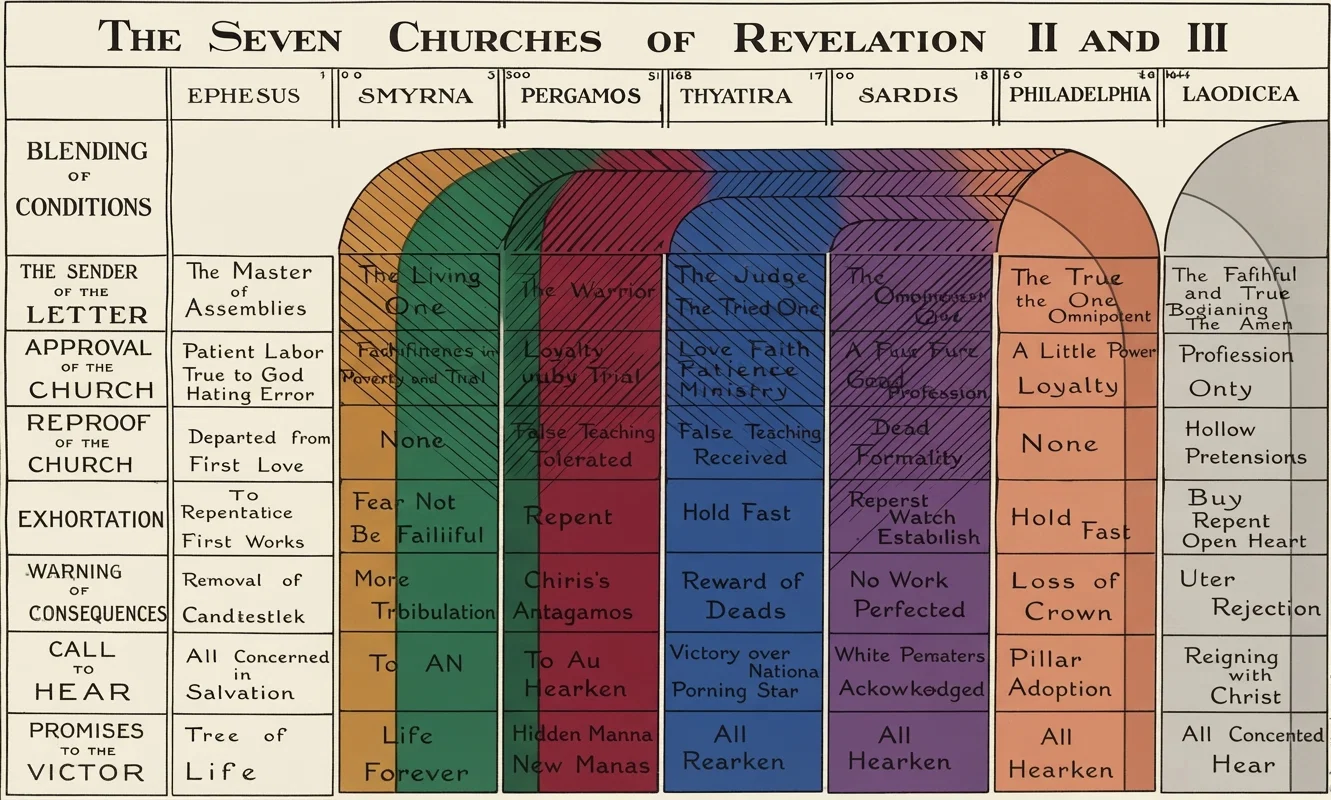
X. Laodicea
HE last of the series, representing the last condition to be developed in the church of the Christian dispensation! There were four cities by the name of Laodicea in ancient times, but the ancient capital of Greater Phrygia is doubtless the one referred to. It lay about forty miles directly east of Ephesus, and but a little way northwest of Colosse. The churches of the two cities are mentioned by Paul, to both of which he addressed epistles, tho the one sent to Laodicea is not now extant. See Col. 2:1; 4:16. The city was once a seat of Roman governors of Asia. It was in part destroyed by earthquakes, and finally abandoned by its inhabitants. In its ruins are a stadium, three theaters, one of which is 450 feet in diameter, and ruins of other buildings.
The name "Laodicea" means "justice of the people," or "the judging of the people." As a type the Laodicean condition brings us to the close of the Christian dispensation, with the judgment pending. This will appear more fully in our study.
The Answer of the Text
[The answers to the questions are from the American Revised Version. Omitting questions, and disregarding sometimes the capital at the beginning and the period at the close of an answer, the text may be read continuously. In notes and comments both versions are used without designation.]
1. How does our Lord address Himself to the church in Laodicea?
And to the angel of the church in Laodicea write: These things saith the Amen, the Faithful and True Witness, the beginning of the creation of God.
2. What sad condition is revealed in the message?
I know thy works, that thou art neither cold nor hot.
3. What did the Master desire?
I would thou wert cold or hot.
4. In what would continuance in Laodicea’s condition result?
So because thou art lukewarm, and neither hot nor cold, I will spew thee out of My mouth.
5. How does He elsewise express her spiritual condition?
Because thou sayest, I am rich, and have gotten riches, and have need of nothing; and knowest not that thou art the wretched one and miserable and poor and blind and naked.
6. What counsel does the Faithful Witness give?
I counsel thee to buy of Me gold refined by fire, that thou mayest become rich; and white garments, that thou mayest clothe thyself, and that the shame of thy nakedness be not made manifest; and eye-salve to anoint thine eyes, that thou mayest see.
7. What assurance of His love does the Master give?
As many as I love, I reprove and chasten.
8. What earnest exhortation does our Lord make?
Be zealous therefore, and repent.
9. How near does the True Witness come to this unconsciously "wretched one," and what gracious invitation does He give?
Behold, I stand at the door and knock: if any man hear My voice and open the door, I will come in to him, and will sup with him, and he with Me.
10. What is the promise to the victor?
He that overcometh, I will give to him to sit down with Me in My throne, as I also overcame, and sat down with My Father in His throne.
11. How is the message emphasized to all?
He that hath an ear, let him hear what the Spirit saith to the churches.
Note and Comment
1. The Amen.—The word is from the Hebrew meaning "truth." See "God of truth," Isa. 65:16, margin of A.R.V. The word is used to express strong confirmation of statement (Deut. 27:15-26), or confirmatory response at the close of a prayer, somewhat equivalent to "May it be as prayed," or "So be it" (Ps. 106:48; 1 Cor. 14:16). "Amen, amen," is often rendered "verily, verily" in John’s Gospel. The term is applied to our Lord as the One through whom all truth is given and in whom and by whom all truth is confirmed. He would have the last of His church know that as His word had been confirmed all through the past, so it would be still. He is the Witness faithful and true ever, in warning, in exhortation, in promise. The title, too, indicates that this is the closing letter of a series. The beginning of the creation of God.—Not that He was the first created, but that God created through Him from the beginning. "For by Him were all things created." He, too, in His Deity is the first and the last.
2. I know thy works.—This is never a sad message to the humble, trusting soul. To the false, the hypocritical, the self-righteous, it is unpleasant and crushing to know that God knows, and to have Him reveal those works. Neither cold nor hot.—Cold and hot are conditions of feeling, and hence of action. "Hot" may denote earnest zeal. "Cold" may indicate a great sense of need. But this church feels neither.
3. I would thou wert.—God does not leave us in our comfortable condition. He does not look with pleasure upon those "at ease in Zion," when there is wickedness rampant everywhere, when souls are falling under the power of sin, when a great world is to be warned. He would have the soul zealous and earnest, or at least bemoaning its own condition, and desiring to better it.
4. Lukewarm is a satisfying condition to the person reclining at ease; but lukewarm drink is nauseous to the one who is thirsty or weary, looking for refreshment. Rotherham reads, and so, too, the Greek, "I am about to vomit thee out of My mouth." O, how sickening to the Master is such a condition!
5. I am rich, and increased with goods.—There has arisen in God’s providence and purpose in these last days, since 1844, a wonderful reform movement, inaugurated by a poor people, with meager resources, few in number, with no human advantages. This movement includes within its scope every true reform, and all down-trodden truth of God’s Word, however unpopular; among these the return to "the old paths" of Bible truth; faith in Christ Jesus as the only Saviour from sin, the only Giver of righteousness and life; the Decalogue as the great moral standard, to cleanse from its transgressions and to restore to the loving obedience of which the Gospel is given; the observance of the seventh-day Sabbath, as taught by the law and the Word, and by precept and example of Jesus Christ, and prophet, and apostle; the outpouring of the [[FIGURE]]7Holy Spirit and the restoration of spiritual gifts; belief in the prophecies of God's Word, and hence the second coming of Christ Jesus to raise to immortality the righteous dead, to immortalize the righteous living, to destroy sin and all identified with the baleful thing, and to restore the sinless earth for the eternal home of man. This movement has especially emphasized the great study of the sanctuary or the priesthood of the Bible, centering in Jesus Christ our Lord, and throwing marvelous light over the great subject of the atonement and our Lord's coming. Health and temperance reform, religious liberty, and the education and training of the whole individual, have been strongly emphasized.
The people, the denomination which bears the burden of this work, is the Seventh-day Adventist, the name setting forth two prominent characteristics of their belief which in their fulness involve all others. Marvelously have they advanced. Numerous schools have been established, publishing houses have been built in many lands, sanitariums have been erected in all parts of the world, and according to the last Federal census this people are doing missionary work in more lands than any other religious denomination. They have established missions in forty-three of all the countries which have been entered by any others, while no other denomination has entered more than ten.
All this is good; but it was to be expected. The truth is of God; it is God's message for this time which they bear (Rev. 14:6-14), and the message in God's plan must be given. Tho men should refuse to herald it abroad, God is able of insensate stones to give it voice. The sad thing is that its great, mighty, consistent, harmonious truth should be held to be the assets of a denomination in which they could boast, or that the spirit of great, numerous, and worldly and wealthy denominations, who boast of their long and honorable history and great numbers, should take possession of any part of a people so small as to be utterly insignificant were it not for the mighty message of God they are bearing to the world. What if membership and conferences have more than trebled in the last two decades? what if educational institutions above the primary grades have been more than multiplied by ten? what if publishing houses have more than quadrupled in the same period, and publications are issued in sixty-two languages instead of three? what if sanitariums have been multiplied by twenty-seven, and mission fields and workers in a far greater ratio? None of these are cause for boasting, nor can we say of the treasuries of God, we are "rich, and increased with goods, and have need of nothing." He who is the most greatly blessed of God, if he take those blessings to himself, or feel satisfied in their possession and the progress they bring despite his selfishness, is the most wretched of all men, tho he know it not,—wretched and poor and blind and miserable and naked.
6. I counsel thee.—God has eternal riches for the lukewarm; but even He, the Infinite One, can not compel their acceptance. They are the riches of faith and hope and love, "the exceeding riches of His grace," without which no character is acceptable in His sight, and with which in possession no soul will boast or be lukewarm. See 1 Cor. 13:1-13; James 2:5; Eph. 2:7. Then will his boast be in Christ Jesus alone. White garments of Christ's righteousness, not that wrought out by human endeavor. Phil. 3:9; Rev. 7:14. He who trusts in his own righteousness, will stand naked in the judgment; he who yields all his own to Christ Jesus and takes by faith the robe woven by Christ in the loom of heaven, will never be seen naked. Every imperfection will be covered by Christ. Eye-salve, the Holy Spirit. God would have us see "visions," or seeings, as He sees. Only the Spirit-anointed eyes can thus see, only the anointing from the Holy One (1 John 2:20) can clear the dull sight of world-blinded eyes. Buy, by giving up all that is worthless to the universe, and worse than worthless, ruinous, and take from Him, "without money and without price." Isa. 55:1-3.
7. Reprove, . . . chasten.—God does not reprove to find fault, but to let us know our true condition. He does not chasten us to please Himself, but to do us good, to correct our ways. Let not the hard heart rebel. Take the reproof as evidence of infinite kindness, take His wise chastening as tokens of His infinite love. See Heb. 12:5-10.
8. Be zealous, . . . repent.—What, the lukewarm?—Yes, the lukewarm, repent, and be zealous in the repenting. The lukewarm soul can not, must not go by feeling. Feeling is not faith. Faith accepts just what God says, and acts upon it whatever the feeling. Turn from the selfishness, the boasting, the self-satisfaction, the sins of ease and deadly apathy; confess these sins before God, and ask for pardon, for a tender heart, for godly sorrow for sin, for love, for Christ Jesus.
9. Behold, I stand at the door and knock.—Behold the love of the Master. Uninviting as Laodicea is, the Master not only admonishes, warns, reproves, entreats, but He comes to the very door, and knocks, and calls to self-imprisoned souls in Laodicea. Knock, knock, knock, O, how many times He knocks. Yet the hearts grown cold and hard do not hear. He calls again and again, but they do not respond.
Behold a Stranger at the door!
He gently knocks, has knocked before,
Has waited long, is waiting still;
You treat no other friend so ill.
If any man hear.—He speaks to you alone, soul. He appeals to each soul in Laodicea. If you will take away the rubbish, and open the door, the very fulness of the Godhead will enter and sit down to your table. He will sup with you. But what have you to set before Him? What have you but your mistakes and blunders, and troubles and sorrows? It is not an inviting board; but the Master's presence will make them glow with beauty. He will share them with you; He died that He might bear them all with you, and you with them. And then He will transform your mean board to the table of a monarch, and pile it high with all the delectable bounties and viands of heaven, seasoned with His own infinite sweetness and love, and bid you to feast with Him. How great are these blessings! It is Jesus Christ, just before He comes, inviting the remnant ones into the anteroom of heaven, where the charmed vision can almost compass the supernal glory. Open the door, and welcome the True Witness.
10. He that overcometh.—The victor by the grace of Christ over himself, over evil, over every lust and sin, shall reign with Christ. "If we endure, we shall also reign with Him." 2 Tim. 2:12. See John 17:24; Rom. 8:17, 18. When Christ overcame in our behalf He took His seat as our High Priest on the right hand of the throne of the Father, the throne of grace. Heb. 8:1; 4:16. When every soul is gathered in, He will leave the8throne of the Father, and take a seat upon His own throne, that of His father David. See Ps. 110:1; Zech. 6:13; Luke 1:32, 33. He will take His throne, at His second coming, in the New Jerusalem above, the capital city of this new earth. Matt. 25:31; Rev. 21:1-7. Thus the apostle states the matter: "Then cometh the end [of Christ's reign as priest upon the Father's throne], when He [Christ] shall deliver up the kingdom [of grace] to God, even the Father; when He [the Father] shall have abolished all rule and all authority and power. For He [Christ] must reign [on the throne of the Father, Ps. 110:1] till He [the Father] hath put all His [Christ's] enemies under His [Christ's] feet. The last enemy that shall be abolished is death." 1 Cor. 15:24-26. Then Christ shall reign forever, in the earth made new; and His regenerated, immortal overcomers shall reign with Him.
14. And unto the angel of the church of the Laodiceans write; These things saith the Amen, the Faithful and True Witness, the beginning of the creation of God;
15. I know thy works, that thou art neither cold nor hot: I would thou wert cold or hot.
16. So then because thou art lukewarm, and neither cold nor hot, I will spew thee out of My mouth.
17. Because thou sayest, I am rich, and increased with goods, and have need of nothing; and knowest not that thou art wretched, and miserable, and poor, and blind, and naked:
18. I counsel thee to buy of Me gold tried in the fire, that thou mayest be rich; and white raiment, that thou mayest be clothed, and that the shame of thy nakedness do not appear; and anoint thine eyes with eye-salve, that thou mayest see.
19. As many as I love, I rebuke and chasten: be zealous therefore, and repent.
20. Behold, I stand at the door, and knock: if any man hear My voice, and open the door, I will come in to him, and will sup with him, and he with Me.
21. To him that overcometh will I grant to sit with Me in My throne, even as I also overcame, and am set down with My Father in His throne.
22. He that hath an ear, let him hear what the Spirit saith unto the churches.
Lessons in Liberty
By W. M. Healey
By W. M. Healey
II. Power of Choice
SATAN came to the earth in chains. 2 Peter 2:4. This was not the chaining spoken of by John in Rev. 20:1-3. The chaining here mentioned is to take place at the coming of Christ, and continue for one thousand years, the time between the resurrection of the righteous and the resurrection of the wicked. At this time Satan will be so chained that he can not deceive the nations of earth, a work which he is now permitted to do.
In heaven Satan had been suffered to make his claim to authority, and demand worship, and attempt to coerce the heavenly hosts by force, contrary to the government of God.
All who chose to go with Satan were permitted to do so. Those who resisted his efforts to compel worship were the subjects of his wrath, and he opened war upon them; but Christ came to their aid. "Resist the devil, and he will flee from you." This is not because he chooses to flee, but because his power is limited, and he can not compel those to worship him who choose to worship God.
Satan, being severed from the Source of life, wisdom, and power, was a helpless being, shorn of strength. His life was continued unto the "judgment of the great day." Jude 6.
Ours to Choose
Tho Adam and Eve were alone in possession of the earth, Satan was too weak to take the kingdom from them by force. He did not attack them as he had the heavenly hosts. He was chained; and his only power was to practise deception, and if possible cause them to choose his way, and yield to his dominion that which God had given to them. To accomplish this he hypnotized the serpent, the most subtle beast of the field, and sent him to eat of the fruit of the tree of knowledge of good and evil, in the sight of Eve, that he might cause her to discredit the word of God that eating of it would produce death. Because the serpent did not fall down dead when he ate the fruit, he argued that God's word was not true. This, like every other argument against God and His word, rested upon a perversion of the word itself, and unsound reasoning. God had not said that instant death would follow the eating, but "in the day that thou eatest thereof thou shalt surely die." Besides, the instruction was not given to the serpent, but to man, who possessed the power of choice.
When Adam saw what Eve had done, thinking she would die and leave him alone, in desperation he ate of the fruit. He should have had before him the great truth God's people are told to "remember," that in six days God created the heaven and the earth. Here he would have found a citadel of strength for trust and courage, and could have readily grasped the truth that if Eve was taken away, she was only a created being, and the Creator was left who could easily give him another companion.
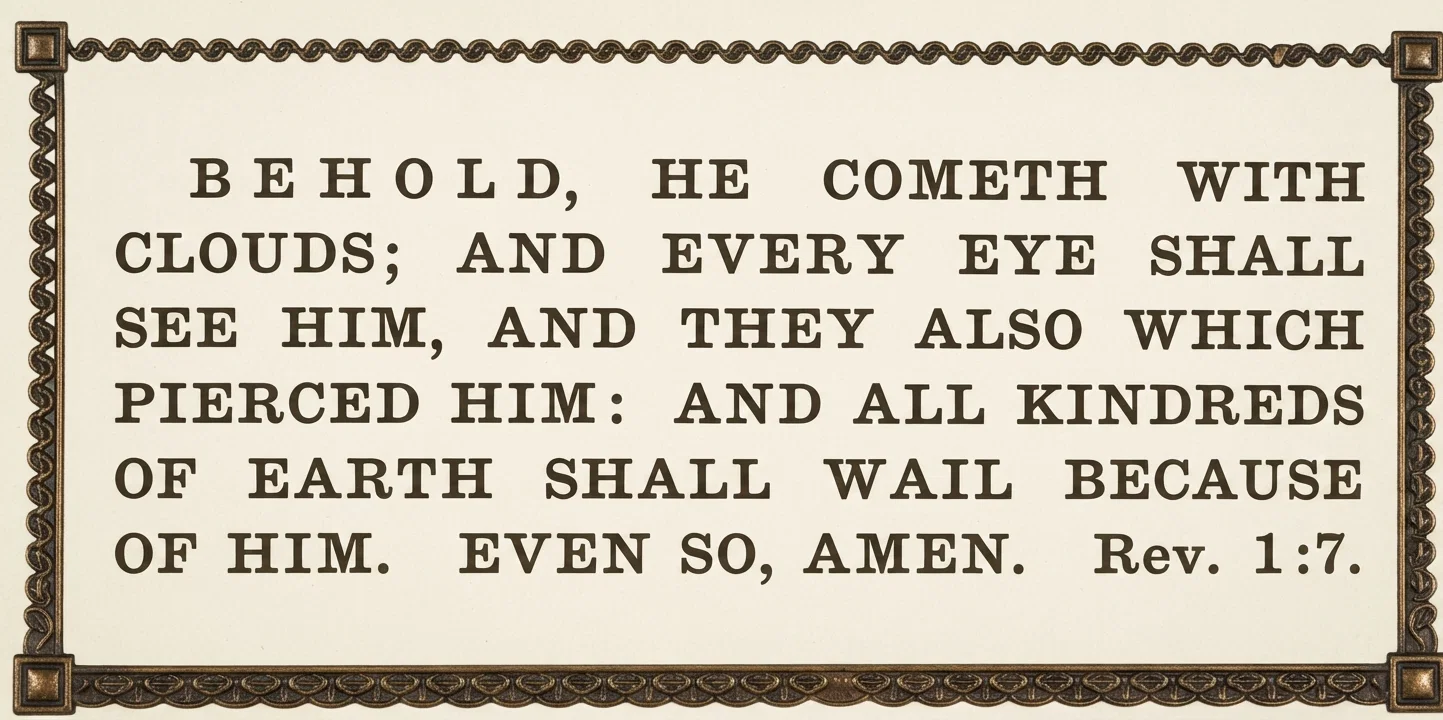
BEHOLD, HE COMETH WITH CLOUDS; AND EVERY EYE SHALL SEE HIM, AND THEY ALSO WHICH PIERCED HIM: AND ALL KINDREDS OF EARTH SHALL WAIL BECAUSE OF HIM. EVEN SO, AMEN. Rev. 1:7.
God has given the Sabbath to His people that they may at all times remember that their God is the Creator of all things; so that when earthly wealth, honor, friends, even life, are taken from them, they have all things left in the Creator, who has power to restore that which has been taken away. Faith in the Creator, shown by the outward sign of keeping the Sabbath, is the saint's strong tower, into which he can run and be safe. For this reason Satan has always hated the Sabbath of Jehovah, and established one of his own, which, according to the principles of his kingdom, he has always tried to force upon man by such customs, laws, and penalties as he has been able to get man to adopt; for he, having no power to compel, can only do that which man will use his power to do for him. Adam, passing under his control by his own choice, took with him all the dominion which he possessed, and all went to the power of the "reform" kingdom. Adam lost his liberty, and became a slave. "Know ye not, that to whom ye yield yourselves servants to obey; his servants ye are to whom ye obey; whether of sin unto death, or of obedience unto righteousness?" Rom. 6:16.
The angels in heaven and man upon the earth could at any time, if they chose, cease to be subjects of God's kingdom; but while they are subjects of it they must obey His law.
Satan used every means to compel his subjects to remain with him in his kingdom, which ignores all moral law, and is founded on the will and caprice of those who can by any means obtain power.
Man could only take with him, as he went into the dominion of Satan, or rather took Satan into his dominion, such power as he already possessed, which had been given him of God. What was the extent of Adam's dominion and authority?
Our Bible Reading
A Literal and Visible Coming
1. Christ's coming is not at death.
Jesus saith unto him, If I will that he tarry till I come, what is that to thee? follow thou Me. Then went this saying abroad among the brethren, that that disciple should not die: yet Jesus said not unto him, He shall not die; but, If I will that he tarry till I come, what is that to thee? John 21: 22, 23.
Then said Martha unto Jesus, Lord, if THOU hadst been HERE, my brother had NOT died. John 11: 21.
2. His second coming is not by His Spirit.
Nevertheless I tell you the truth; It is expedient for you that I go away: for IF I GO NOT AWAY, the COMFORTER will not COME unto you; but IF I DEPART, I will SEND HIM unto you. John 16: 7.
3. When He comes the second time it will be the same Jesus.
And when He had spoken these things, while they beheld, He was taken up; and a cloud received Him out of their sight. And while they looked steadfastly toward heaven as He went up, behold, two men stood by them in white apparel; which also said, Ye men of Galilee, why stand ye gazing up into heaven? THIS SAME JESUS, which is taken up from you into heaven, shall so come in like manner as ye have seen Him go into heaven. Acts 1: 9-11.
4. He will come surrounded by clouds of angels, as He went away.
And then shall they see the Son of Man COMING IN A CLOUD with power and great glory. Luke 21: 27.
5. All who are living upon the earth shall behold Him.
Behold, HE COMETH WITH CLOUDS; and EVERY EYE SHALL SEE HIM, and they also which pierced Him: and all kindreds of the earth shall wail because of Him. Even so, Amen. Rev. 1: 7.
6. His coming will be with mighty display of power and pomp.
For THE LORD HIMSELF shall descend from heaven with a SHOUT, with the VOICE of the ARCHANGEL, and with the TRUMP OF GOD: and the dead in Christ shall rise first: then we which are alive and remain shall be caught up together with them in the clouds, to meet the Lord in the air: and so shall we ever be with the Lord. 1 Thess. 4: 16, 17.
The Effects of Passion
OUR passions are like convulsion fits, which make us stronger for the time, but leave us weaker forever after.—Dean Swift.
Church Fairs and Swindling
"A SWINDLE can not be sanctified by calling it a church fair."