PON my table lies a small volume — a gift to me from a dear friend — entitled “The World Beyond.”
Therein the author takes the position that the organized government, the spiritual dominion, of Christ, named in the Scriptures “the kingdom of Christ,” or “kingdom of God,” is not to be an actual, visible, operative sovereignty established somewhere, sometime, in the future, but is now a veritable kingdom already in operation upon the earth, in the hearts and over the lives of its subjects.
He holds that Christ’s kingly rule, His victorious sway upon the earth, “is a thing of the present,” “is not a thing of the future;” that in the peace-giving “Beatitudes,” Matthew 5, Christ informed of those who are persecuted for righteousness’ sake, “Theirs is the kingdom of heaven;” and of the poor in spirit, “Theirs is the kingdom of heaven.”
Now the subject of the kingdom of God, of Christ, upon the earth, covers a wide field of Scripture, is presented in many phases, and invites very definite study, yet the blessed, inspiring truth in the case is clear.
There is no question but that those who cultivate earnestly the graces of meekness, patience, gentleness, mercy, pureness of heart, and who hunger for likeness to Christ, possess the traits, the qualities, which will render them eligible to citizenship in the actual kingdom of God; for these are the principles, the characteristics, the inherent elements, upon which that great, creation-wide dominion will be founded and reared.
But that these delightful features, existing simply in the hearts of redeemed, regenerated men and women here on earth, constitute the totality, the complete fact, the whole solacing expectation, with reference to the kingdom of Christ, is a conception far out of harmony, it would seem, with many strong assertions made by Christ, by prophets, by apostles, by the divine Father Himself, in reference to that kingdom.
Let us search the Scriptures for light.
As a first step we read the gracious promise made by God to David in 2 Samuel 7:12-16, where the wonderful words have reference secondarily to Solomon, but primarily to Christ, a descendant of the shepherd-king of Israel, as affirmed in Ps. 89:3, 35, and also by the apostle Peter on the Day of Pentecost, Acts 2:30, 32: “I will set up thy seed after thee, . . . and I will establish his kingdom. . . . I will establish the throne of his kingdom forever. . . . I will be his Father, and he shall be My son.”
These powerful promises of God, these mysterious foreshadowings of Christ and His kingdom, are repeated and expanded with great might and emphasis in Ps. 89:3, 4, 27-29, closing, verses 35-37, with these tremendous sentences: “Once have I sworn by My holiness, that I will not lie unto David. His seed shall endure forever, and his throne as the sun before Me. It shall be established forever as the moon, and as a faithful witness in heaven!”
The period of David’s kingdom upon earth was not lengthy, continuing, at the utmost, only until Zedekiah, last king of Judah, was carried captive to Babylon, B.C. 586.
Indeed, the kingdom was actually lost to David before his famous son Solomon had finished his distinguished career. For Solomon, to whom God made most inciting pledges of worldly greatness and blessing both at Gibeon and in Jerusalem, himself grievously forsook the commandments of God, evaded His will immensely, became a weak worshiper of idols, and lost the most significant of all earthly thrones, as narrated in 1 Kings, in terms intense and fearful.
Now, stepping forward to the days of that careful historian Luke, a few years before the date anno Domini, there rings out, chapter 1, verses 30-33, this astounding message, addressed to a woman of Nazareth, in Galilee, and sent from God by the noted angel Gabriel:
“Fear not, Mary. . . . Thou . . . shalt bring forth a Son, and shalt call His name Jesus. He shall be great, and shall be called the Son of the Highest: and the Lord God shall give unto Him the throne of His father DAVID: and He shall reign over the house of Jacob”—the saved by faith of all ages—“forever; and of His kingdom there shall be no end.”
Yet further. Isa. 9:6, 7: “Unto us a Son is given: and the government shall be upon His shoulder. . . . Of the increase of His government and peace there shall be no end, upon the throne of DAVID, and upon his kingdom, to order it, and to establish it with judgment and with justice from henceforth even forever.”
Now a king could hardly occupy the throne of David in all these relations, for all these purposes, achieving all these amazing results, and also be “one chosen out of the people,” except he should act upon the theater occupied by David, be moved by the principles which governed David, and excel in loyalty to God. His realm, his theater, then, would be upon this earth.
But the divine Word portrays still more explicitly the location of this majestic kingdom, this kingdom of august might and power, of genuine justice and judgment, of righteousness and peace unadulterated, this kingdom that shall endure as long as the sun.
From that far-reaching chapter 7, of the book of Daniel, whose reliability is unquestioned, I condense the following strong statements concerning a kingdom vast and all-absorbing yet to be established upon the earth. Daniel says:
“Behold, One like the Son of Man”—in the highest sense, to Christ alone pertains that title—“came with the clouds of heaven”—a convoy of angels probably—“and came to the Ancient of Days. . . . And there was given Him dominion, and glory, and a kingdom, that all people, nations, and languages, should serve Him: His dominion is an everlasting dominion.”
Then Daniel, troubled over the wonderful scenes of his vision of the four beasts, symbolizing four great earthly dynasties, and of the Ancient of Days seated upon His high throne, asked one of those who stood by, the meaning of what he saw.
He was informed: “These great beasts, which are four, are four kings, which shall arise out of the earth. But the saints of the Most High”—the redeemed of the human race—“shall take [receive, inherit] the kingdom, and possess the kingdom forever, even forever and ever.” Verses 17, 18.
His informant continued: “The kingdom and dominion, and the greatness of the kingdom under the whole heaven, shall be given to the people of the saints of the Most High, whose kingdom is an everlasting kingdom, and all [earthly] dominions shall serve and obey Him.”
Now this kingdom of the Most High, which the “one who stood by” affirmed should take the place of the four mighty realms symbolized by the four beasts, must also have its territory on the earth, and must consist of something more tangible than mere motives, principles, traits, qualities, and characteristics, ruling in the hearts of men and women, during this fleeting mundane existence.
There must be a noble life to be lived, blessed laws to be obeyed, exalted service to be rendered, hallowed associations to be enjoyed, perhaps momentous works to be achieved.
Other scriptures, in both Testaments, turn lucid light on this case; but lack of space excludes them.
— ★★ —
We Wait
By George Dickie Gurley
Waiting for the revelation of our Lord Jesus Christ. 1 Cor. 1:7.
UNTIL He come in royal state
Who rose to God from Olivet,
With clouds and angels, glory great,
In hope we wait.
Until the final Easter break,
When all who sleep in Christ awake,
And home the Spouse His bride doth take,
In faith we wait.
Until the judgment’s awful cleft
Mankind asunder far has reft,
And gulf impassable has left,
In awe we wait.
Until new heaven and earth obtain,
Wherein no sorrow, death, or pain,
The church presented without stain,
Trusting we wait.
Until we see Him face to face
In yon foretold, prepared place.
United sing His saving grace,
Yearning we wait.
Through ages long and darkness deep
Christ’s people holy vigil keep;
In faith unfaltering without sleep,
Watching we wait.
While years into millenniums grow,
The church all slumber doth forego;
With love at fervid bridal glow,
The bride doth wait.
—Rev. George Dickie Gurley.
Christ, an Impulse to Truth
“CHRIST is more than an exponent of truth; He is an impulse to truth.”
The World's Christian Citizenship Conference
By J. O. Corliss
Article III
By Our Own Correspondent
What It All Means
IT is a significant fact that many great religious movements are now in progress, and that all these seem to have but one distinctive object in view. Were this single object to secure individual acknowledgment of Christ's reign in the heart, the omen might be more generally satisfactory than it is. But when the drift of the various incidents is analyzed, one feels a creeping dread of what may be concealed behind them all.
But let us briefly enumerate these movements, and study their aim, when we may more readily decide what they stand for. These need not be spoken of in the order of their organization, but rather according to their importance in the study before us. No achievement of modern times can be said to have a greater religious significance than the Inter-Church Federation, which was accomplished in the month of November, 1905. Three hundred delegates were present at the organization, and these represented thirty-two denominations, comprising a membership of nearly twenty millions.
Protestant bishops, college presidents, religious editors, two members of the United States Supreme Court, one judge of the United States Circuit Court, and others of more or less note, were present. In fact, nearly every great religious body of the country was represented except the Roman Catholics. This last named mighty system, tho in perfect harmony with the object sought, preferred not to give its support with those whom it considers enemies, and for well-grounded reasons which will appear later.
The voice of the federated churches was not then to be mistaken, and as time goes on its design is made still clearer by its concerted action. As stated by the Boston "Defender" of October, 1906, the object of the federation is made apparent:
This is an age of federation. At last the different denominations are realizing it, and joining in an offensive and defensive warfare.
The paper then states the supposed need of such a movement:
One very evident need of federated reform is seen in connection with our lawmaking bodies, whether they meet in Washington or in different State capitals. It is the duty of the reform forces to see that men are sent to those places who shall represent the ideas which they hold most important and sacred.
Thus the object of church federation is plainly stated by its own friends. Their prime business is to see that such men obtain political office as will work for the "interests" of the federated churches. In other words, they will see that civil legislation is enacted which will put in force the decrees of the church. This is count number one looking to the union of Church and State.
The National Reform Association has been an organized body since 1863. Its avowed object is to have the name of Christ appear in the Federal Constitution as the ruler of the nation, thus making that national instrument the foundation upon which to place all the "Christian laws, institutions, and usages of our Government on an undeniable legal basis in the fundamental law of the land."
Academy of Music where the great meetings were held
This would indissolubly unite the Church with the State, and make all civil regulations conform to the upbuilding of church power. All religious dissenters would then be made rebels against the civil government, on the mere ground of religious belief. This could not fail to be so, since the Constitution would recognize Christ as ruler of the nation; and inasmuch as He could not or would not reign in person here, civil government would necessarily be administered by a vicegerent, with assumed power, by virtue of membership in a so-called Christian church. This would give the church power to make ANY LAW, and indeed, ALL LAWS according to the tenets of the church.
It may be objected that non-Christians would be able to neutralize such a movement. But could such have been in attendance at the late World's Christian Citizenship Conference held in Philadelphia, and have seen the enthusiasm of that body, backed by governors, judges, and others in high standing, they might feel to revise their decision in the case. At that meeting it was unanimously decided that none but righteous men (meaning church-members) should bear political honors. This result will be achieved if possible, and that very soon. This is count number two looking toward a union of Church and State.
Another Religio-Political Power
Another important convention closed its labors in New Orleans on the very day which saw the opening of the one held in Philadelphia. This was the American Federation of Catholic Societies. Its expressed design is to "make the federation an apostolate of Catholic truth, to aid the church in teaching her children to think as Catholics, to speak as Catholics, to live as Catholics."
This federated body is reaching for the same end as the federated Protestant churches. Hear what they say: "Catholic interests are the interests of our enemies. It takes them a long time to recognize this fact, but honesty compels them to acknowledge that the Catholic Church stands for what they want and need just as much as we do. Just watch their papers and periodicals, and see how they pay tribute to our consistent fight for human liberty as children of God."
This union of sentiment is hailed with delight by the Catholics, because they know that the Protestant movement to unite the civil and the religious forces will inure to the uplift of the Catholic Church. This is plainly revealed by the expression of Cardinal Gibbons in the Baltimore cathedral on the fourth of last December.
Speaking of resolutions adopted by the triennial convention of the Protestant Episcopal Church held shortly before in Cincinnati, in which that body voted to work for church unity, the cardinal said, as reported in the Washington "Star" of Dec. 5, 1910:
My brethren, we praise the members of that church for their action, . . . and I join with them in praying that the day may be hastened when Christ's words, that there shall be one fold and one shepherd, will be fulfilled. . . . There can not be unity of faith, however, if there is to be more than one church, or if there is to be more than one head.
These words of themselves are sufficiently full of meaning, but the cardinal was not willing that HIS MEANING of them should be misunderstood. He therefore added the following:
Where only can this unity be found? My brethren, in the Holy Roman and Catholic Apostolic Church, of which the Pope of Rome, the representative of Christ, is head.
These words not only show what the Roman Church expects to reap from the harvest of church federation, but the strong hopefulness of the expressions shows why the Catholics are willing that Protestants should maintain their federation by themselves. At least the cardinal believes that the Protestant organization is working in behalf of Catholic interests. In fact strong men among Protestants are reported as having expressed a willingness to have the Pope of Rome recognized as the spiritual director of Christendom.11The Catholics, too, seem willing to assist Protestants in their work, but through indirect channels. For instance: At their late federation meeting in New Orleans the following was adopted:
Resolved, That the Congress of the United States be earnestly requested to amend section No. 3893 of the Revised Statutes of the United States, relating to the mailing of "obscene, lewd, and lascivious" literature, so that the same may include the mailing of books, papers, writings, and prints which outrage religious convictions of our citizens, and contain scurrilous and slanderous attacks upon faith.
O, no! These people do not ask for a NEW LAW to prevent printed arguments against "religious convictions," but simply an OLD LAW to be amended so that the world may cease thinking in any new lines of religious sentiment. Enact such innocent appearing legislation, and Protestants, as well as Catholics, will not need to ask for more protective legislation. All power will then be in their hands, and wo betide him who dares to question the ORTHODOXY OF ANY RELIGIOUS FAITH.
Will it be constitutional? one asks. The way for a favorable decision on this point is already being laid. The Chief Justice of the United States Supreme Court is a strong Catholic. Another associate member lately elevated to that rank, is also a Catholic. One of the older members is a Catholic. Other members could easily be induced to agree to decide such a law constitutional on the already established decision of that court that "this is a Christian nation."
We shall soon see what we shall see, but in the meantime it behooves all to keep informed as to the meaning of all these converging religious movements. Sincere tho these religious enthusiasts may be, as were those who put their Lord to death, yet from our standpoint we believe that these, even as those, "know not what they do."
J. O. CORLISS.
Rome the Center
By Editor
The British Ambassador in Rome is quoted with warm approval in an editorial in the London "Times," which thus speaks for a British school —
at Rome as potentially "a great national and imperial center of culture, where the students of the five nations"—the United Kingdom, that is, and Canada, Australia, New Zealand, and South Africa—"should meet and exchange ideas, whence they should carry back to their respective homes and universities a touch of inspiration and enthusiasm acquired at the authentic spring and source from which all modern civilizations are derived."
The "Times" further says:
As all roads lead to Rome, so all the various streams of investigation into the culture, thought, and works of the past ultimately meet in Rome, and thence radiate again with renewed and transmuted fertility of inspiration to all the civilizations of the modern world. "I am," said Sir Rennell Rodd [the British ambassador], "far from depreciating the magnificent work which has of recent years been accomplished in other fields, the unveiling of the lost secrets of early cults and dynasties, and the revelation of the sources of inspiration which contributed to make the grandeur that was Rome. I would not advocate in the student any exclusive loyalty; but I would insist on the fact that no student of archeology, no student of architecture or sculpture, can afford to neglect the lessons that Rome has to teach, and that the last stage in his course of study should be the co-ordination of his experiences in the inspiring atmosphere of the Capital of the Nations."
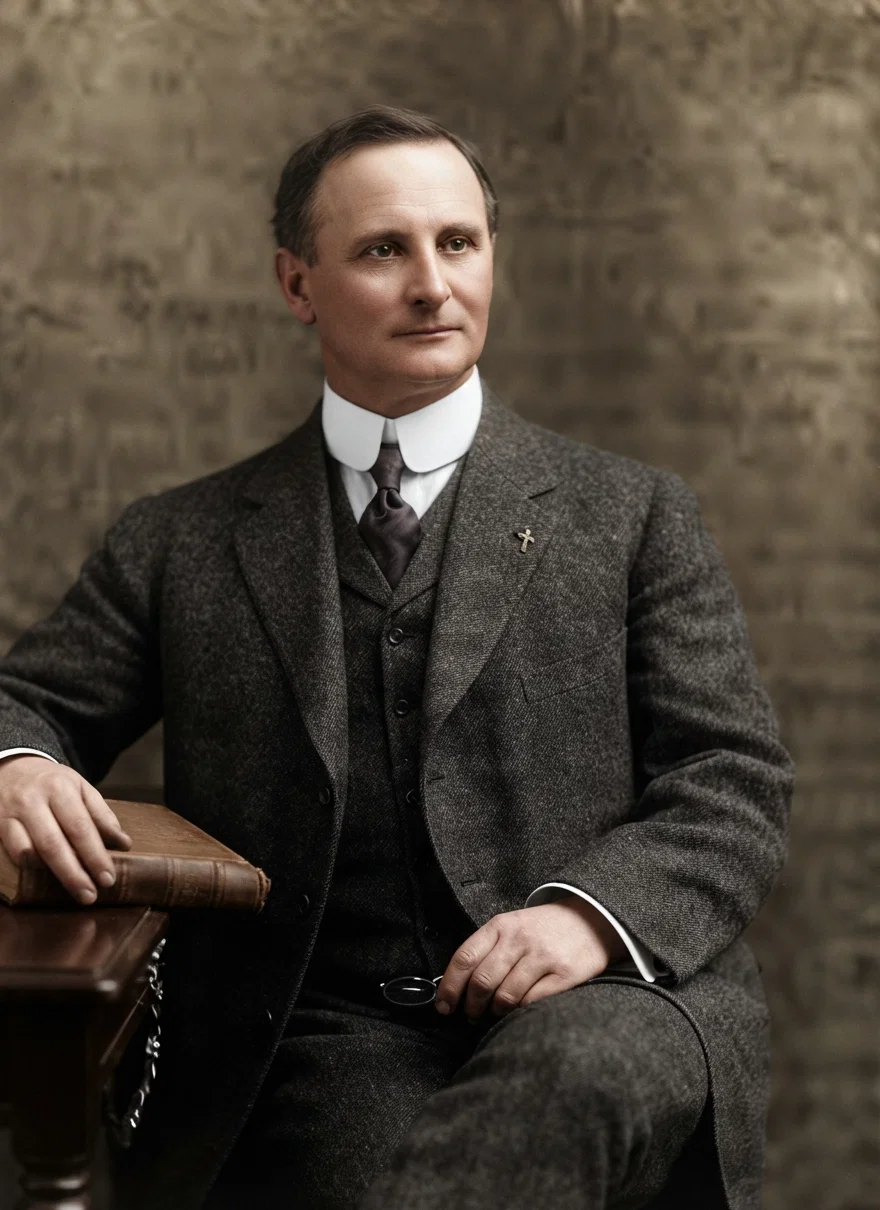
John Duff Gill, nominee of the Prohibition party for governor of Pennsylvania in 1890, for judge of the courts and district attorney at various times, delegate to the World's Christian Citizenship Conference, Philadelphia, November, 1910
The "Times" says again:
That is why we should welcome the lofty and inspiring conception that he sets before us of a British school at Rome which should be worthy of a great empire, all parts of which aspire to unity of civilization in the future, and must also recognize their community of origin in those great civilizations of the past which found their center and consummation in Rome.
(The bold-face is ours.) How the old traditions hold! The "Times" speaks truly; the civilizations of Assyria, Babylonia, and Egypt were consummated in Rome. But not so with the civilization which sprang from the Bible, and which made Great Britain all that is of worth. There are art and architecture in Rome, it is true. But neither the one nor the other has lifted the world a barleycorn toward God. The lifting, elevating, invigorating power of England and her colonies, her over-seas empires, in all that makes for God and good and human betterment, sprang not from Rome, but from a Book, the Bible, an influence which Rome under two civilizations endeavored to suppress.
Rev. A. Pohlman, M.D., a prominent delegate to the Christian Citizenship Conference, chairman of Pulpit Supply Committee, pastor of Temple Lutheran Church, West Philadelphia
England is receiving altogether too much of Roman education religiously now. She would do infinitely better to seek inspiration from another source.
— ★★ —
Remarkable Surgical Work
In an article concerning the remarkable achievements of Dr. Alexis Carrel, of the Rockefeller Institute in New York, a writer in the January Hampton’s Magazine says:12
Remarkable Surgical Work
(Continued from page 11)
The young surgeon — for he is only thirty-seven — does not claim that he has succeeded in the creation of living tissues by the use of the scalpel, but he has succeeded in taking living tissue, even vital organs, from one animal, and causing them to grow and functionate in other animals of the same species. More than this, he has removed glands, cartilage, bone, and other tissue from live animals, and kept it alive and growing for weeks, though removed from any living organism whatever. In this manner the processes of growth can be watched constantly, for in the removal of such tissue it is placed in a plasma of nutritive matter from the animal, and sealed in a glass slide kept constantly at a heat of ninety-eight degrees. A microscope of the same temperature furnishes the means of watching the tissue.
Within a day or two slight granulations appear on the surface of the cut edges of cartilage, or whatever tissue is used, and soon small spindle-shaped or polygonal cells are seen to form. If the tissue be taken from a young animal, it grows rapidly; if from an older animal, its rate of growth is much slower. But it is found by Dr. Carrel that old tissue placed in a plasma of nutritive matter from a young animal will grow as swiftly as younger tissue.
His discovery of a successful and satisfactory method for the transfusion of blood — an operation frequent in cases of anemia — was made through constant experiment with animals; and his present study of cultures of cancer taken from chickens promises to lead to a cure for that malignant disease. He has learned that in the process of growth, tissue scraped by the surgeon’s knife will take on different characteristics than those of the smoothly cut tissue; he has found that bodily tissue will adapt itself to conditions of transplantation, that veins grafted on arteries at once set to work thickening their walls in order to carry the supply of red blood, and that an entire anatomic section may be taken out of one animal and life given back to it in another organism.
A Not Optimistic Report
By Editor
ATTORNEY-GENERAL WICKERSHAM has presented his annual report. The list with which his department has had to deal includes trust operations and alleged trust conspiracies, customs frauds, internal revenue frauds, land frauds, water-power frauds, rebates, bucket-shops, fraudulent use of the mails, bankruptcy frauds, and frauds against Indian tribes. The companies, persons, combines against which convictions have been secured and fines assessed during the year are:
Paper Board Trust, $57,000.
Kentucky Night Riders, $3,500.
Window Glass Trust, $10,000.
Since the Attorney-General's report came from the press the American Naval Stores Company, known as the Turpentine Trust, and six co-defendants, were convicted of violations of the anti-trust law. Two of the individual defendants were sentenced to three months each in jail, and fines aggregating $17,500 were imposed.
Actions are progressing under the Sherman act against the following:
Tobacco Trust.
Standard Oil Trust.
Powder Trust.
Terminal Railway Association of St. Louis.
James A. Patten, Eugene G. Scales, Frank B. Hayne, William P. Brown, and Robert M. Thompson, indicted on a charge of conspiracy to monopolize interstate commerce in available cotton.
Towing Trust of the Great Lakes.
Beef Trust (three separate criminal proceedings).
Wholesale Grocers' Trust.
Butter and Egg Trust.
Brick Trust.
Bath Tub Trust.
Bituminous Coal Trust.
Harriman Lines (suit in equity).
The sum of $3,135,363.88 was recovered from the Sugar Trust for fraudulent weighing. In this we are told there was "a wholesale system of corruption among the Government employees" in New York.
Customs fraud criminals have been forced to pay immense fines, ranging from $500 to $7,500. Goods have been seized to the amount of $50,000. On imports of cheese and figs from Mediterranean ports, suits are under way to recover $700,000.
Twenty-five criminal indictments are pending against railways. Actions are pending against the Oregon and California Railroad Company and forty-five other defendants to recover 2,300,000 acres of land valued at $50,000,000. Twenty-four similar actions are pending against the Central Pacific Railway Company.
As the result of 38 civil and 28 criminal prosecutions more than 400,000 acres of illegally fenced land has been restored to the public domain.
Within the year there have been 15,371 criminal cases in the United States courts, and fines and penalties imposed amount to $1,083,974.
Surely this does not argue for the millennium or a soon reign of righteousness on this earth. Nor can we excuse this sort of crime because it was done in a large part in corporate capacity. For guilt is personal; and the fact that many men were often involved in each crime only augments the darkness of the picture. There is a striking prophecy of these conditions in Isaiah 59. Read it, and profit thereby.