MEANWHILE, into the heart of Judas of Kerioth, there rushes for the hundredth time a horrible thought. But now it comes with tenfold greater force than ever before; and he makes no effort, however feeble, as at other times, to put it from him. He welcomes it; nay, he glories in it. He embraces it. It startles him no longer. It appeals to his spirit of revenge, first, perhaps, almost as strongly as to his love of gold.
Not so very long before, he had protested to his Master a loyalty so deep, so true, so strong, as to voice itself in the words, "Lord, I will follow Thee whithersoever Thou goest!"
But the "busy fiends" have entered his heart. They have captured the citadel of his soul. They beckon to him, even as he sits at the table of Simon, with the intoxicating scent of the spikenard fresh in his nostrils, and the broken alabaster box still lying at the feet of his Master,—they beckon him, and he arises from the table, and follows blindly after them.
Straight to the palace of Joseph Caiaphas, the high priest, he goes.
A council of chief priests and Pharisees had already assembled at the palace, and were in secret session. At a whispered word to the servant Demas, standing guard at the door of the chamber, the man was readily admitted.
"Ho, Judas, thou son of Simon, whence comest thou?" questioned Caiaphas.
"From the feast of Simon of Bethany — him who was the leper — I am come; for behold, this man hath given a dinner to my Master, the Nazarene, and — and I am come to tell thee."
"Of a truth thou doest well, Iscariot; but, behold, thou dost but tell us that which we already know!" interrupted Annas testily, stroking his white beard, "for Shaphan, the rabbi of Nazareth, hath but just departed, and he hath told us; for he also was at the feast."
A shade of disappointed vanity crossed the dark face of the man, as he replied glibly:
"There are also other matters of which I would speak unto thee, O Annas, if thou art so minded, — otherwise I will return to Bethany."
"What is thy message, friend?" questioned Caiaphas fawningly, fearful lest the outspoken words of Annas might close the traitorous lips of the visitor. "What tidings hast thou? for it may hap thou bringest news already of the death of the man Lazarus — one of the troublers of Israel." And the high priest regarded the man anxiously.
"Lazarus? I know naught of the man, save that he surely liveth and eateth meat at the table of Simon."
An expression of deep chagrin flitted over the face of Caiaphas, but he quickly recovered himself.
"Verily, then, thou hast brought word of the Nazarene Carpenter?"
"He also sitteth at the feast. But I am minded to deliver Him unto you!"
As the man spoke these words, his face became ashen and drawn, and the muscles about his bloodless lips twitched painfully.
"Man, art thou mad? Knowest thou not that we fear the people? Thinkest thou to deliver Him to us even in the house of this man Simon, whom He hath healed? If not, why comest thou hither?" demanded Annas.
"Long time thou hast desired me to deliver Him into thine hands, O Annas; but, verily, I have hesitated, as a matter of prudence and policy, as well as of indecision. But how now can I be longer undecided? This day the Man hath sorely tried my soul, which verily ariseth in indignation against Him," responded the visitor, while a frown deep and black gathered upon his face.
"What did He unto thee, O Iscariot? for I perceive," replied Caiaphas, "that this Carpenter hath never given thee the honor that is thy due, nor hath He heeded thy counsel, as thou very well knowest, — and thou a scribe and a man of letters and wisdom! But what sayest thou? Wilt thou betray Him unto us? Art thou able?"
"Verily, I am able; for none knoweth His habits or His haunts better than I."
"Thinkest thou that He will go up to Jerusalem to attend the feast?" queried Annas craftily, "or will He peradventure hide Himself? for it is plain that this Fellow feareth us, albeit we do fear the people."
"Have ye heard," questioned another of the council, "that Marcus, the centurion of Herod, hath captured the robber Barabbas, and that he is now imprisoned in one of the towers of the city? Now this Nazarene Carpenter may be in league with him, — and moreover, I have also heard that He will go up to the feast, that He may be crowned king, at Jerusalem. What thinkest thou, Iscariot?"
"I know not; I only know that to-day the Nazarene hath angered me! And now, verily He shall see that Judas of Kerioth is not a child. What think ye? Listen:"
"Into the banquet room of Simon of Bethany, this day, crept a woman whose body hath been the habitat of seven demons. Now this woman had in some manner secured a box of white alabaster — very precious, for it was filled with pure spikenard. It must have been valued at not less than three hundred denarii. Straight to the Nazarene she went, and breaking the costly box as if it had been but a plaything, began pouring the precious ointment upon the head of the Man. As if this were not enough, she stooped and poured the remainder upon His feet, allowing her maudlin tears to drop fast and faster, and wiping the feet with her long locks."
"When therefore I saw this waste, I cried out against it, when I saw that the Nazarene was silent, because —"
"Thou didst well, Iscariot," interrupted Caiaphas; "for the spikenard should have been sold, and the three hundred denarii given to the treasury of the holy temple."
"Thou hast well said, — or even delivered into mine hand, that I might divide it among the poor. Now, I thought, of a truth, this Nazarene will acknowledge my piety and my wisdom, and I shall receive due honor in presence of these guests."
"What said the Man, thy Master?" interrupted another of the council.
"He rebuked me, — me, Judas of Kerioth, — a scribe and a man of wisdom, — rebuked me in presence of His guests, saying: 'Let her alone, for she hath wrought a good work on Me!' And the eyes of the Nazarene flashed as they looked straight into mine, — flashed and shone as I have never seen them before, until of a truth I could not look into them; for it seemed — it seemed — think ye —" and the man turned distractedly and appealingly toward the high priests; "think ye that this Man, this Nazarene, my Master, indeed knoweth my heart? for as the Lord liveth, I have seen this Man read the very thoughts of the scribes and the Pharisees when they came to tempt Him with hard questions, until they have hurried from His presence." And the speaker sighed.
"Speak no more of the strange power of this Nazarene!" thundered Annas, fiercely smiting the marble table by which he sat. "I will no longer listen to such words in mine house! for we do know that His power is the power of Beelzebub, and by him He doeth miracles. And moreover, if this Judas of Kerioth hath nothing further, let him go again to his Master." And Annas turned toward Iscariot, and waved his hand toward the door.
The traitor rose angrily, and was about to depart, when Caiaphas, blandly begging him to be seated once more, turned to Annas, with whom he held a whispered conversation.
In a few moments he had returned to the side of the visitor, who still halted ruefully, with a fierce scowl of discontent and hatred upon his face.
"Dost thou declare that thou canst deliver this Man unto us, thou son of Simon?" demanded Caiaphas eagerly.
"Of a truth. The Man is in my power. I can deliver Him, and I will, if ye but give me my price!"
"When wilt thou deliver Him? and where? and what is thy price?"
"I will watch the Man; for verily He goeth often alone into the mountains, and also, when He is here in Jerusalem, as He will be to attend the Passover, which beginneth in six days, surely He will go with His disciples into the Garden of Gethsemane. Then ye shall take a band of armed men, and go thither and fetch Him; for behold, I will lead you unto Him." As the traitor spoke the cruel words, faithful memory brought again a vivid picture to his mind. He was in Capernaum, tossing with deadly fever. Again he felt the soft, caressing touch of the cool fingers of the Nazarene upon his brow, and the mysterious thrill which shot through his fevered body.
"That is well!" exclaimed Annas, stroking his flowing beard in token of approval. "If thou wilt do this, then shall we apprehend this Troubler of Israel. But what is thy price?"
A look of cunning crept into the greedy eyes of the man, as he exclaimed:
"Ye shall line my pockets with silver — for ye be well able. Three hundred denarii — even the price of the box of spikenard — surely the Nazarene is worth the price of the ointment which was poured upon Him!"
"The price is too much!" growled Annas.
"Surely," whined Caiaphas, "thou canst lead us to this Nazarene's hiding-place for less money than this. The task is a light one. Why shouldest thou impoverish the high priests of the holy temple?"
"It is well; I will deliver Him unto you for two hundred denarii. Wherefore should this Nazarene escape you?"
"Wilt thou beggar the high priests of the Lord?" roared Annas, his deep eyes flashing ominously. "But now," he whined banteringly, "many a slave hath been bought and sold for thirty shekels! and we will deliver the silver when thou dost deliver the Man. Hear, O Jazer," he continued, addressing the scribe Jazer, who sat, pen and papyrus in hand; "write thou the words of our mouth, that they may be recorded."
"Now," turning again toward the traitor, "if thou wilt do this, well; if not, go thy way; for behold, we have many spies upon the track of this Nazarene. We be not dependent upon thee, Judas of Kerioth! There be many another who will do this thing for thirty shekels!"
Ha! Annas, high priest of the chosen people of Jehovah, expositor of the prophets, dost thou imagine in thy cruel heart, that by thy wisdom and judgment thou hast set the price upon the sacred head of the Shiloh of Israel? Ah, thy cruel words were heard by the prophet centuries before thy birth, and thou hast uttered them as they were heard and as they were written aforetime: "So they weighed for My price thirty pieces of silver."
A few moments longer of bantering, a few hesitating, stammered sentences, a flash of anger, a scowl of greed and bitter hatred, and Judas of Kerioth leaves the palace of the high priest. The die is cast.
Chapter XLVIII. The Story of Bar-jona
IT was the morning of the sixth day after the feast of Simon of Bethany. Events of vast import had been crowding fast upon each other within the last few days. To the Man of Nazareth they had been days of toil and of weariness, of teaching and healing13and blessing. Multitudes had felt the thrill of His saving touch, and many more had listened to the words of life and salvation which fell from His lips like a stream of crystal water in a thirsty desert.
Once again, during these days, He had taken His way up to Jerusalem and entered His "Father's house," that He might drive thence the greedy priests, with their herds of bellowing cattle, and the scheming money-changers with their blatant voices and jingling coins.
To some it had been a week of wonderful blessing, wonderful enlightenment, wonderful spiritual progress, wonderful healing. The past few days had marked the turning-point in many lives; they had been days pregnant with mighty issues. To some, they had been days of deliberate surrender to the prince of darkness; days of bitterness and nights of plotting and violence; days of heart hardening, of envy, of wrangling, and of discontent. During these days, the tender Spirit of love and mercy had been driven from many a heart for the last time.
Across the brook Kidron, at the foot of the Mount of Olives, two men were sitting. It was yet early morning; and the shadows of the gnarled olive-trees of Gethsemane stretched far to the westward their dim, uncertain fingers. Beautiful flowers, rich with the lavish coloring of spring, everywhere lifted their brilliant heads above a carpet of softly shaded green. It was as if Nature had donned her festive robes in honor of her departing Lord.
"Come, come, Bar-jona! now that I have found thee, I will not again leave thee alone. Why should the fiends of darkness tempt thee to destroy thyself? Come, we will seek the Master, for it may be that Pontius Pilate will release Him."
"O Matthias! how can I again endure to look into the face of the Man! for with one glance of His eye, my heart seemed broken, and there is verily no more spirit left in me."
The face of the speaker was drawn and gray, and the pangs of some recent and terrible agony had left their mark upon his forehead, and bent the massive shoulders as with the weight of years. His companion had but just succeeded in arousing and half lifting him from the damp ground, to which he was clinging in an agony of self-reproach and remorse.
"How camest thou here? and when?" continued Matthias; "for verily I have sought thee long before the rising of the sun. See! thy garment is soiled, and thine abba wet with the dews of the night. When I saw that thou wast not with the Master, behold, I sought thee; but why camest thou hither?"
"I will tell thee, Matthias; and then we will seek the Master; for if I hide my sin, how shall I find forgiveness with the Almighty?" And Bar-jona lifted his sad eyes, still swollen with tears, to the sympathetic face of his companion.
"It was but last evening that I, among the twelve, ate the Passover with the Master," he began, pressing his trembling fingers across the broad forehead, as if he would clear his troubled memory; "only a few hours ago — but truly it seemeth a century." And the man sighed deeply as he continued:
"The full moon looked in at the eastern windows of the room where we all sat at table, and I heard the mournful cry of a night-hawk as it circled above the walls of the city. Even while we prepared the Passover, we had disputed as to which should be greatest in the kingdom so soon to be set up. But as we ate, the face of the Master grew very sad, and I was astonished when He said that one of us should betray Him. Then said I unto John the son of Zebedee, who leaned upon His breast, 'Ask thou the Master who it is that shall betray Him.' Then we all cried out, 'Master, is it I?' — all save Judas of Kerioth; and this man, when he saw that we each looked upon him, cried out also, 'Rabbi, is it I?' And He made answer, — and O Matthias, the face of the Master was filled with sadness: 'Thou hast said: the Son of Man goeth as it is written of Him; but wo unto that man by whom He is betrayed. It were better for that man, if he had not been born.' And the man Judas arose and went out. But my own heart was filled with contentment, and my tongue was boastful, and I said, 'Lord, I am ready to follow Thee to prison and to death;' for in my heart I said, 'I am better than this son of Simon of Kerioth, and tho all men should be offended because of Thee, yet will I never be offended.'"
"But He looked pityingly upon me, and sighed as He said, 'The cock shall not crow this night, O Bar-jona, until thou hast thrice denied that thou dost even know Me!'"
"Then, Matthias, was my vain heart grieved at Him, and I boldly declared again, 'Tho I should die with Thee, still will I not deny Thee!' Yet have I denied Him thrice this night, — even with cursing!" And the bowed form of the speaker shook convulsively.
"Speak no more of this, O Bar-jona," pleaded Matthias, "for it but causeth thee sadness of soul. Come, we will seek the palace of Pilate, that we may know what hath been done with the Master, and thou shalt —"
"But I must speak of it; for the withholding of it bursteth my heart!" interrupted Bar-jona, with somewhat of his old-time impulsive manner.
"It is well; but thou shalt speak of it as we journey; for verily we must find the Man."
"Then let us go!" replied the other wearily, as he arose and leaned as if for support upon his companion; "let us go, that we may find Him."
"And then," he continued, speaking softly, as if in a dream, as they turned their steps to leave the garden, "then we came here — to the garden, but none entered save the Master, James, and John, and I. The Master prayed, and I — I slept."
"Surely thou shouldest have watched with Him, Bar-jona. And did the others, thy companions, sleep also?"
"We slept — slept — while the Man wept and prayed — until — until — Matthias, hear me: I saw that His pallid face was stained with bloody sweat. Then, behold, I saw an angel, whose countenance was bright and beautiful, and whose glorious eyes beamed with pity and love; and he stood by the Man's side to strengthen Him. But afterward he departed, for the heavens received him, that I saw him no more. Then came the mob, with their lanterns and their torches and their swords and staves to take Him."
"Now of a truth, Bar-jona, thou dost dream; for verily the rabble knew not where they might find Him."
"But the traitor — the son of Simon — he it is who betrayed Him unto Annas and Caiaphas. But why should I condemn the man Judas, I whose guilty lips have thrice denied that I knew my Lord! Ah, why died I not for Him — my Master! my Master! But thrice, thrice did I deny that I knew Him! But behold, when He had been betrayed, I saw a light come from the heavens, in form like to a dove, and it overshadowed Him. Then the men who were in advance, nearest the Master, Iscariot and the chief priests, fell to the ground like dead men. But when they revived, and I saw that they would take Him," continued Bar-jona, "I grasped my sword, and struck the man nearest me. It was a servant of the high priest. I had meant to give him a mortal blow, but the sword glanced and struck off his ear. Quickly the Master bade me put again my sword into its sheath; and He touched the severed ear, which hung down upon the fellow's shoulder, — and behold, it was whole again."
"Then the man, whose name was Malchus, turned his astonished eyes toward me; but he said nothing."
"At once I saw that the Master would do naught to defend Himself, and a spirit of craven fear seized me, and I said to my companions: 'Why should we also die at the hands of these men? Let us save ourselves.' Then, Matthias, then we all forsook Him and fled. But verily I could not let the Master go; and I followed Him in the way — but I followed Him afar off — until they took Him to the palace of the high priest, even to Caiaphas; and I went in and sat with the servants, that I might see the end."
"What said the high priest unto Him, Bar-jona?"
"Many things; but finally he said, as he arose and stepped haughtily to the side of the Master, 'I adjure Thee by the living God that Thou tell us whether Thou be the Christ, the Son of the Highest! Art Thou the Messiah, the Son of the Blessed!' And He made answer, 'Thou hast said; and ye shall see the Son of Man coming hereafter in the clouds of glory.'"
"As the Man spake these words, the face of Caiaphas became white with passion; and forgetful that it is forbidden an high priest to do so, he laid strong hold of his beautiful robes, and rent them. Matthias! Matthias! man," continued Bar-jona wildly, while his voice shook and his hands trembled as if in an ague, "man, I saw them spit upon Him — Him — my Master, my Lord! O my brother! yet did I not avenge Him; three times did I deny Him — my blessed Master — because I feared to bear His reproach; because I could not endure the ridicule of a simple maid. Thou rememberest, Matthias, that this hath ever been my weakness; for, behold, I am a strong man, but I tremble like a weakling before the finger of scorn."
"As I stood by the fire warming myself, one of the household maid servants regarded me earnestly — it was the daughter of Demas, the servant of the high priest. I felt uneasy and annoyed under her fixed gaze, and made every effort to avoid her. At last she said, in an insolent voice, 'This fellow was also with Him!'"
"At once," continued the speaker, "a spirit of bravado possessed me. I hated the woman in my heart; and I know not why, but I said unto her, 'Woman, I know not the Man!'"
"But O Matthias! I felt the hot blood rush to my guilty cheek as I spake. I supposed, of a truth, that this would be the end of the matter; but almost immediately another accused me. Again I denied. But before the echo of my voice died away, the third accused me, declaring that my very speech betrayed me, for that I was from Galilee."
"Then the demon which possessed me, whispered in my ear: 'Curse thou, and blaspheme, O Bar-jona; so shall they believe the words of thy mouth — that thou followest not this Man. Why should they kill thee also?'"
"Then I opened my mouth, and behold, the words of wickedness and folly came forth out of it. But even as I spake, there came a sound that sent the blood rushing through my bounding heart — it was the loud crowing of a cock! I raised my guilty eyes, that I might know if the Man had heard my folly. He had heard; and it had been even as He had before said. He turned His eyes and looked upon me. Under that sorrowful gaze, O Matthias, I forgot all else on earth, save that I had sinned against Him. Verily the glance of His eye broke my poor heart; for I read therein forgiveness and pity and love, infinite and deep."
"Then I rushed blindly into the street — and on, on; I knew not, cared not whither. I would hide myself from heaven and earth. Finally, I found myself in the garden, where, but a few hours before, I had carelessly slept, while my Master suffered alone. In an agony of bitterest remorse, I threw myself upon the sacred ground that had witnessed His tears and His bloody sweat, and begged Jehovah to forgive me, with strong crying and lamentation." And the voice of the narrator sounded full of tears. "Thinkest thou He will forgive me, O Matthias?"
For answer, Matthias put his arm tenderly about him, and quoted, "For there is forgiveness with Thee, that Thou mayest be feared."
"But see!" continued Matthias, "behold, we be come to the hill Zion, even to the palace of Pontius Pilate; and the multitude surround the house; and the Man, thy Master, standeth before the governor — and behold, the Master is bound!"
(To be continued)
The Desire of Ages
By Editor
We have in our possession a few copies of the original wide-margin edition of that grand book by Mrs. E. G. White, "The Desire of Ages," which we offer while they last, as follows:
These prices are post-paid. A better book gift could not be made than one of these "Desire of Ages." Address, Pacific Press Publishing Assn., 1109 E. 12th Street, Kansas City, Missouri.
BOOK NOTICES
By Editor
"The Companion Bible, Being the Authorized Version of 1611, with the Structures and Notes, Critical, Explanatory, and Suggestive." Price 4 shillings net. Henry Frowde, Oxford University Press, London, New York, Toronto, and Melbourne.
This is the second part of the Companion Bible. The first covered the Pentateuch; this from Joshua to Job inclusive. Uniformly bound in cloth with the first volume the price at the New York house is probably $1.50. Limp leather, dark green or maroon, gold edges, 6 shillings, possibly in America $2.00.
The first part, 374 pages, has 52 appendixes, including chronological charts; the second part, 452 pages, has 10 appendixes; and the pages of text and the appendixes are numbered continuously with volume 1. Most of the appendixes pertain to the entire Scriptures, or present valuable facts to modern students. For instance, Appendix 53 gives a list of the sieges of Jerusalem, with the date and particulars of each. Appendix 54 is a description of the Moabite stone. We can say of this volume, as of the first, that it will prove to the Bible student a most excellent help. We know of no commentary we would prefer. One may not always agree with its conclusions; but he will be continually helped by its suggestions, and encouraged by its supreme loyalty to the Word of God.
— * —
"Roman Catholic and Protestant Bibles Compared." The Gould Prize Essays. Edited by Melancthon Williams Jacobus, D. D., Dean of Hartford Theological Seminary. Cloth, $1.50. Charles Scribner's Sons, New York.
This is the second edition of a work first published in 1905. Out of a correspondence between Miss Helen Miller Gould and a Roman Catholic priest, Father Early, Miss Gould was led to offer prizes for the best essays on the two topics, "The Origin and History of the Bible Approved by the Roman Catholic Church," and "The Origin and History of the American Revised Version." Three prizes were offered for three essays, in order of merit, of $1,000, $500, $250. Two hundred and sixty-five essays were submitted, several by Roman Catholics. Roman Catholics, however, refused to act as judges. The first prize was awarded to William Thomas Whitley, M.A., LL.M., LL.D., of Australia; the second, to Gerald Hamilton Beard, Ph.D.; the third, to Charles B. Dalton.
The book before us is the revised edition to which is added "Appendices Originally Accompanying the Essays, and a Composite Bibliography Covering the General Literature of the Subject." It is a book which ought to be in the library of every Bible student. It clearly shows that the Roman Catholic claim to the only true Bible is unfounded.
— * —
"Pictures of the Apostolic Church: Its Life and Thought." By Sir William M. Ramsay, D.D., D.C.L., LL.D., Litt.D. Cloth, $1.50 net. Sunday School Times Company, Philadelphia, Pennsylvania.
The greater part of the book was first written as comments on the International Sunday School Lessons for the Sunday School Times. Each section is complete in itself, tho all are in a way woven together as a composite picture of the early church. Most of the lessons are upon Acts, tho some of Paul's epistles are brought in, as also James and Hebrews. The book contains some good suggestions, but it is not strong evangelically. While the writer seems to believe in the supernatural, and admits belief in miracles, yet there is a half apologetic spirit manifest throughout the work. The ascension of Christ is made symbolic, regardless of the language; and one feels unedified and disappointed in its perusal.
— * —
"The Steel Square As a Calculating Machine." By Albert Fair. Illustrated. Cloth, price 50 cents. The Industrial Publication Company, New York.
This little book contains simple directions for using the common steel square in solving complicated problems that constantly arise in the work of builders, carpenters, lumber dealers, plumbers, gas-fitters, engineers, electricians, tinsmiths, blacksmiths, masons, stone-cutters, and other mechanicians, illuminated with numerous illustrations. The best of it is that it is prepared for the ordinary workman and for the beginner. The author, too, to make it simple has frequently used the language of the shop.
Current Events
On Christmas night, in the open air at Lotta's Fountain in San Francisco, the famous soprano, Luisa Tetrazzini, sang to the thousands of her charmed listeners who had gathered to hear her. The vast concourse were moved to almost reverential silence as they listened intently to the sweet notes of the singer, singing sweetly to high D with a volume of voice carrying clearly beyond the sound of the orchestra. Madam Tetrazzini says of the occasion:
"This I shall remember always as my night of nights. No setting, no audience, no scene has ever so deeply moved me. I shall carry the memory of it with me always."
The United States Steel Corporation has laid off within the last few months about 46,000 men, and is still laying them off. It is thought that the number of unemployed men will soon number 75,000, one third of the entire working capacity. Ten thousand workmen from the great Pittsburg iron and steel district are going home to Europe or are already on their way. There is little encouragement given to the men to return after the holiday season.
Thirty-nine firemen — some reports say 45 — met their death December 22 in two fires. In both, deaths were caused by falling walls. In Chicago 25 firemen were killed, including Chief Horan, 50 injured, and a property loss of $1,500,000. In Philadelphia 14 were killed, 40 injured; property loss $30,000. The day previous three persons were killed and several injured in a fire in Cincinnati, Ohio, which destroyed property worth $2,250,000.
Rockefeller's last gift to the University of Chicago is $10,000,000, the largest amount donated at any one time to an institution of learning. Since he founded the university in 1889 his gifts have aggregated very close to $35,000,000. His trustees have resigned, and he has withdrawn all connection with the university, turning the institution over to the support of the people of the great middle West to whom the university belongs.
Sixteen firms and thirty-two individuals in the bath tub trust have been indicted by the Federal Grand Jury. The criminal proceedings grew out of a civil suit to dissolve the alleged combination, begun by the Government in the Federal courts at Baltimore. Both suits have been instituted under the Sherman anti-trust law.
The main building of the Llewellyn Iron Works in Los Angeles, California, was wrecked by an explosion, which the police say was caused by dynamite, there being no inflammable materials nor explosives inside the building. Citizens are aroused, and the Grand Jury will be called upon to take special action.
A strike which has been threatening sixty-one western railroads, and which might have been the greatest known, has been averted at the last moment. The settlement provides for a general increase for the employees of 10 1-3 per cent, which on normal service amounts to about forty cents a day.
Three persons were killed at Millstone Junction, New Jersey, in an accident which caused three railroad wrecks. In England near Hawes Junction a wreck of the Scotch express carrying 500 Christmas excursionists, resulted in the death of eight passengers and twenty-five injured.
In Russia the whole Astrakhan coast and provinces have been devastated by floods and storm. It is estimated that 300 persons have drowned. Thousands of horses, cattle, and sheep have perished. Intense cold aggravated the suffering, and many have frozen to death.
The last New York Christmas mail broke all records, when 40,000,000 pieces, it is estimated, were handled. Ocean liners brought 21,690 mail-sacks from abroad. On the Friday preceding Christmas, 428,000 letters were mailed for the East from San Francisco.
The German steamer Palermo is a total wreck off Cape Corrubedo on the west coast of Galicia, Spain. Her five passengers and crew of nineteen were lost.
The worst coal-mine disaster England has ever witnessed occurred recently near Bolton when an explosion caused the death of three hundred workmen.
In a fearful explosion in New York City ten have lost their lives and 108 have been hurt, the result of a runaway New York Central trolley-car.
Forty expectorators on the sidewalk have been arrested as a result of general orders issued by the chief of police in San Francisco.
Through an American syndicate, it is said, China is endeavoring to obtain a fifty million dollar loan.
England now has twelve great battle-ship-cruisers of the new type. "Prepare war."
Eighty-two persons were killed by automobiles in the first eleven months of 1910.
The House of Lords
THE House of Lords, which the present government of England is trying to reform, consists of about 600 members, about 100 of whom attend to their duties. Many of them do not know the way to their seats.
Among them are what are called the Lords spiritual, consisting of two archbishops and twenty-four bishops of the Church of England, and who receive salaries ranging from $15,000 to $75,000.
Many of the ancient peerages have died out or are dying out. None of the Marquises antedate the American Revolution, and less than one third of the Earls. Between 1800 and 1907, 376 peerages were created; and between 1857 and 1907 — fifty years — 123 Tory Peers and 92 Liberal Peers were created, half of whom, it is said, became Tories.
Some of them won their positions through the great ale, stout, and whisky interests. The Rothschilds and other financial houses have many. There are some truly able and eminent men among them; but on the whole the conglomeration of church, whisky interests, sports, entailed land, and immense business interests are not greatly respected, and many in England hold it anomalous and intolerable. Will it be mended or ended?
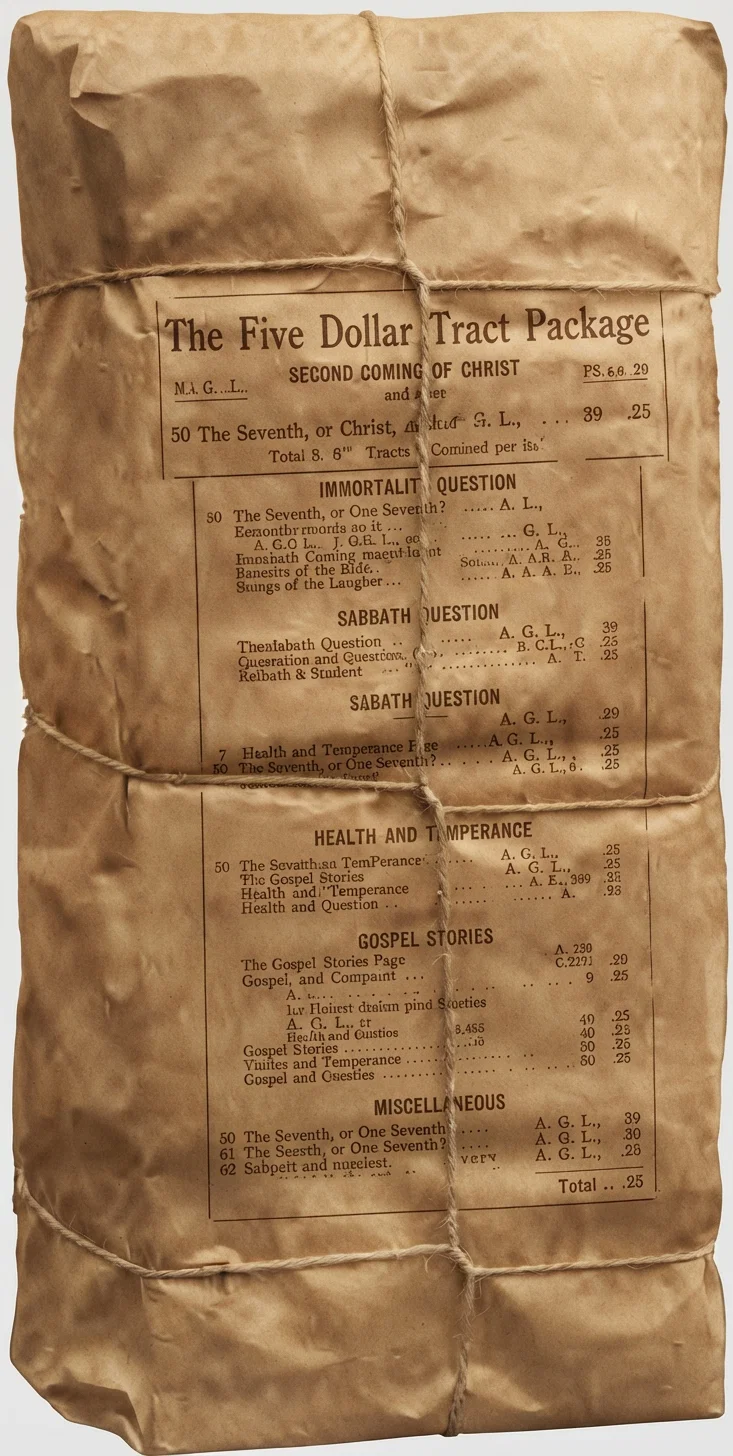
10 Thousand Tract Pages
One Hundred
Printed Envelopes for $5
The Five Dollar Selection
The most convenient as well as the most economical way for a church to supply itself with tracts. Each kind of tract is wrapped by itself, and the whole is strongly wrapped and tied in a package weighing 13½ pounds. These tracts have been selected with a twofold object in mind —
First — To supply a church with the very best tracts we have on the leading points of our faith;
Second — A series that has proved to be well adapted to systematic distribution by the envelope method, for which purpose 100 envelopes are included in the package.
The list is as follows:
Second Coming of Christ
25 We Would See Jesus . . . . . B. S. L., 173 .25
25 Waymarks to the Holy City B. S. L., 189 .25
25 Signs of the End . . . . . . . . B. S. L., 194 .25
25 Heralds of His Coming . . . A. G. L., 85 .37
Immortality Question
50 Thoughts for the Candid . . . B. S. L., 47 .25
25 Rich Man and Lazarus . . . . B. S. L., 146 .25
25 Is Man Immortal? . . . . . . . . A. G. L., 86 .25
Sabbath Question
50 The Seventh, or One Seventh? . . . . . . . . . . . A. G. L., 39 .25
50 Which Day and Why? . . . . . A. G. L., 75 .25
25 Sunday in a Nutshell . . . . . A. G. L., 88 .25
25 New Testament Sabbath . . . B. S. L., 137 .25
25 Who Changed the Sabbath? B. S. L., 187 .25
25 Elihu on the Sabbath . . . . . B. S. L., 192 .25
25 Seal of God . . . . . . . . . . . . . . B. S. L., 130 .50
Health and Temperance
25 The Name . . . . . . . . . . . . . . A. G. L., 72 .25
50 Demons' Council . . . . . . . . . A. G. L., 80 .25
25 It Doesn't Pay . . . . . . . . . . . A. G. L., 82 .25
Gospel Stories
50 How Esther Read Her Bible A. G. L., 7 .25
25 Back to the "Old Paths" . . A. G. L., 44 .25
25 Winning of Margaret . . . . . A. G. L., 53 .25
Miscellaneous
25 Justified by Faith . . . . . . . B. S. L., 104 .25
25 Way to Christ . . . . . . . . . . . B. S. L., 105 .25
25 Topical Bible Studies . . . . . B. S. L., 185 .38
Wrapping and 100 Envelopes . . . . . . . . . . . . . . . . . . . . . . . . . .75
700 $7.00
The special price of $5.00 for this $7.00 package does not include transportation charges, which are about $1.15, if sent by express. It is hoped that it may be sent by freight with other supplies, in which case the cost will be but a few cents.
Pacific Press Publishing Association
Mountain View, California
Portland, Ore. Calgary, Alberta, Canada Kansas City, Mo.
Pianos
Any of our people wishing a good piano for church, school, or home, direct from factory at a saving of nearly one third, freight prepaid, can address for particulars, J. W. Donaldson, 197 Central Avenue, St. Paul, Minnesota. Best conference references.
The confidence felt by farmers and gardeners in Ferry's Seeds to-day would have been impossible to feel in any seeds two score of years ago. We have made a science of seed growing. FERRY'S SEEDS always do exactly what you expect of them. For sale everywhere. FERRY'S 1910 SEED ANNUAL Free on request. D. M. FERRY & CO., Detroit, Mich.
Life and Health
By Editor
A PRACTICAL health journal, published with a view of meeting hygienic needs in every home; teaching how to care for the health and how to preserve life; prescribing simple home treatments to assist nature in throwing off diseases rather than adding more poison by using drugs or unnatural stimulants as remedies: teaching how to avoid disease as far as possible, how to manage in the home when sickness does come, and how to combat the disease by simple remedies which nature provides.
Send for sample copy and special rates to agents. Price 10 cents per copy or $1.00 per year.