The Youth’s Instructor, Vol. L, No. 49

Big and My Duty to

The Youth’s Instructor

December 11, 1902

Review and Herald Publishing Company · Battle Creek, Michigan · December 11, 1902

Big and My Duty to

In order to speak intelligently, one must be thoroughly conversant with his subject. Before being able to distinguish the letter “I,” we were all acquainted with the character it represented. Whether or no it is “King of the Alphabet,” as Carter Helm Jones declares, few use it without an egotistical authority. Of all the letters the “I” occupies the least space; but for fair proportions, enlarged significance, and great pretensions, it is the most important of the six and twenty, holding a claim against the past, and a mortgage on the present.
One can not write a letter, give a note, sign a deed, get married, or even glance in a mirror, without acknowledging its sovereignty. He can not put locomotion or intelligence into any machinery without leaving its trade-mark. Yea, he can not contrive so small an instrument as a needle, which lexicographers spell with two e’s, without having an “I” (eye) in it, to make it perfect.
The letter “I” stands for the same as the Latin word ego,—individuality, or in more familiar usage, self. As an idol of importance, self has no equal. “I” to many is the great pharisaical letter of the alphabet, the most important pronoun of the English language. Its favorite expression is that of Haman’s, “To whom would the king delight to do honor more than to myself?”
To this personality we owe a duty,—not to pet it, honor it, or exalt it, for it is inclined to be conceited, pompous, and despotic; but it must be bridled, muzzled, handcuffed, chained, conquered, if it counts for much in this world.

Self-Examination

First, Examine it. Self-examination is turning one’s eyes inward. “Let a man examine himself,” was Paul’s counsel. When one is afraid to look within, it is plain there is something wrong therein. The reason there is so little self-condemnation is because there is so little self-examination. Plato’s advice was, “Know thyself.” While this is good from a physiological point of view, yet it is a hundred times more so from the moral and spiritual. Just as the traveler saves much wandering by inquiring the way, so he that examines himself saves many after-regrets. As the wise merchant takes stock, balances his books, and endeavors to strike a balance on every day’s transactions, so daily examinations tend to a noble cultivation of character. Barometers were not invented to change, but to tell, the weather. Self-examination is not only to reveal our deficiencies and vices, but to incite us to improvement. Pythagoras went about interrogating himself thus: “Where have I turned aside from rectitude? What have I been doing? What have I left undone which I ought to have done? With such questions,” he says,—
“Salute thyself; see what thy soul doth wear; Dare to look in thy chest, for ’tis thine own; And tumble up and down what thou findst there.”

Self-Preservation

Second, Care for it. Self-preservation is the first law of nature. When life is in jeopardy, “skin for skin, yea, all that a man hath will he give for his life.” Job 2:4. Self-destruction is an unpardonable crime in the face of the law. “Do thyself no harm.” But it is done. By appetite and pleasure, intemperance of dress and time, health is imperiled and disease courted. “Alas for that Paganini who spoils his violin by giving one golden string after another for new pieces of music, until he finds his instrument without strings and himself without means of expression”—a mere skeleton without heart or brains for God.
To take care of the body is a noble and divine work. What is Westminster Abbey compared to it? “Ye are,” said Paul, “the temple of God,” and, “If any man defile the temple of God, him shall God destroy; for the temple of God is holy, which temple ye are.”

Self-Control

Third, Control it. Self-control is one of the most important, yet one of the hardest, things to do. Peter the Great enacted a law which he himself broke. Bursting into tears, he exclaimed: “Alas! I have civilized my own subjects, I have conquered other nations, yet I have not been able to conquer or civilize myself.”
Though hard, yet it is not impossible to control one’s self. Paul declared: “I keep under my body, and bring it into subjection.” The Greek here is very expressive; it means “to smite one’s self between the eyes.” It is only when this is done, that a person can be called free. He who can not govern his thoughts, words, appetites, passions, surrenders his high prerogative, and is worse off than Athens when controlled by her thirty tyrants. He makes his soul a slave to the body, instead of making the body subservient to the soul. But, by the grace of God, every person can have, and should have, the mastery over himself. He should be an autocrat of his physical and mental domain, and when solicited by any of his subjects for license to do wrong, he should emphatically say, “No,” and mean NO. Then will he be able to scatter the forces of evil which would destroy him, muzzle appetite and passion, and crush evil thoughts and habits.

Self-Denial

Fourth, Deny it. Self-denial is frequently a good thing, but it is a heathen rather than a Christian idea of piety. The Christ-established standard is, “If any man will come after me, let him deny himself.” Matt. 16:24. Self-denial and denial of self are in no wise the same. The former, as we use the phrase, signifies some form of personal sacrifice, the giving up of some pleasure or indulgence, the endurance of some privation or suffering. The latter, as Christ used it, implies complete and unconditional self-surrender to the service of the Master. “It is not the giving up of one pleasure, or the occasional sacrifice of some cherished plan or desire; it is laying the whole life upon God’s altar,—all pleasure and ambition, all plans and desires, all powers for service; to be used or to be held in disuse, to be fulfilled or to be curbed, to be developed or to be changed, as he desires.” Self-denial may or may not be praiseworthy. It all depends on the motive. Denial of self is always praiseworthy, for its doctrine is, “He must increase, but I must decrease.” Self is entirely eclipsed that Christ may shine.
Countess Schimmelmann denied self when she left her lovely castle home, gorgeous wardrobe, magnificent state carriage, and her position as lady of honor in the royal palace of Empress Augusta at the court of Berlin, to work among the fishermen on the Isle of Ruen in the Baltic Sea. Here she spent her summers living in a two-room hut, partaking of their coarse food, and living as they lived, in order to minister to them. Her friends opposed her Christian work. She was kidnapped, ill-treated, incarcerated in an insane asylum, and compelled to wear a filthy dress. Being offered freedom on the condition that she would give up her work, she abnegated self by saying: “I will do three times more mission work. I will never tell a lie. I will never change my will.” For her to live was Christ. She could say what we should say:—
“Let my hands perform his bidding, Let my feet run in his ways, Let my eyes see Jesus only, Let my lips speak forth his praise.”

Self-Sacrifice

Fifth, Sacrifice it. Self-sacrifice is the method by which every life and blessing has been evolved. Every ray of the sun is a draft on that planet’s force. Every lump of coal speaks of the majestic trees of the distant past. Every dish of meat, every strip of leather, every woolen garment, tell of the cattle which grazed our fields. By sacrifice we were born into this world; and our salvation, and the salvation of the world, depend on the sacrifice of the Christ. “Hereby perceive we the love of God, because he laid down his life for us: and we ought to lay down our lives for the brethren.”
Self-preservation may be “the first law of nature,” but self-sacrifice is the law of self-preservation. The husbandman preserves his grain by casting it away. To give is to live. “He that findeth his life,” said Jesus, “shall lose it: and he that loseth his life for my sake shall find it.” Self-sacrifice is most pleasing to God, and most desired by God.
Many years ago in Virginia a mission meeting was held. In the large collection of gold and silver coins was a card on which was written, “Myself.” “Who put this in?” asked one of the collectors. “A young man back there,” said a deacon. That young man was John L. Shuck, one of the first American missionaries to China. He made the “I” tell for God, by consecrating it to God.
O my young brother! sister! it is not knowing what to do, but the doing. The humbling of the “I” is the surest way to exalt it; the best thing for its preservation is its sacrifice. “Not as ‘I’ will, but as thou wilt,” are the words of the great Teacher.
“My Jesus, as thou wilt. O, may thy will be mine; Into thy hand of love I would my all resign. Through sorrow or through joy, Conduct me as thine own; And help me still to say, ‘My Lord, thy will be done!’”
Wm. P. Pearce.

MARY MARTIN MORSE

By the Brook

WHEN I was a young child, we lived at the foot of a mountain. A large brook came dashing down through the pastures and woods, on through the fields below the house, and hastened to reach a river that found its way to the Atlantic Ocean. Many happy days of my young life were spent on the banks of this brook. In countless ways it was an inexpressible delight to me; but in one pastime I indulged more than in all others combined,—throwing bits of bark, leaves, or whatever was most convenient, and not of value, into the stream, and watching them drift away, never to return. Sometimes it was a single canoe, again a mimic fleet. In the early springtime, when the poke plant started, I would cut it into small pieces, and set them adrift. Sometimes they would move very slowly, and often revolve in an eddy till a strong current caught them and swept them on. Sometimes after a rain the current would be so strong that it would grasp every object within its reach, and, plunging on, soon carry it out of sight. O the beautiful hours of the beautiful days spent in this way! Their memory is still a pleasure. If you have never tried it, do so. I learned many a lesson at the brook's side, before I had ever heard of Tennyson's “Brook.”
Next to the pleasure of seeing things move on, was the certainty that impressed me that they never came back. It was very hard for me to let go out of my life the things I loved. Perhaps our Father, knowing this, was thus early teaching me a needed lesson. Not only have those fragments never returned, neither have the beautiful days, nor the beautiful years. How important that we should remember that life's opportunities are largely among those things, that, once gone, never return. Are we spending this day so that when we look backward, it will be a satisfaction to us? Spring comes with all its new life unfolding, and gladness seems to fill every living thing. Before we are aware, its wondrous beauty has passed, and midsummer is here. So brief a time—and the goldenrod reminds us that autumn is waiting at the door. Her days are so delicious, so full of fruition, that, busied and dreaming, winter is upon us unaware. All are beautiful in their time and way, but they never come back. Other seasons may come, but past ones, never. I have heard of a philosopher who, amid every sorrow and calamity, consoled himself by saying, “This, too, shall pass away.” How much wiser than to fret and complain of that which can not be avoided!
The coming and going of all earthly things lies in the realm of overruling Providence, and our only anxiety should be, How can we make wisest use of them in the present? How shall we most successfully learn the lessons our Father would teach? It is “to-day” that we should “hear his voice,” in sweetest accents saying, “Come!” And when we come, he has something to say to us each day of our lives.

MARY MARTIN MORSE

A Historical Sketch of the Aborigines of Porto Rico

WHEN Columbus discovered Porto Rico in 1493, he found it inhabited by Indians. As all the natives of the Greater Antilles were supposed to be descendants of the Arawaks of Guiana, South America, this island had her share also.
LAS CASAS, a Spanish historian, gives the number of the Indians inhabiting these islands as six million, but some think this estimate too high. It is claimed that the number in Porto Rico alone, before the coming of the Spaniards, was one million.
Only a few facts can be gleaned concerning this once noble race. The Spaniards themselves tell us that they were docile, intelligent, and cleanly in their personal habits. They differed greatly from the Caribs, who were cannibals, and wore no clothing.
The custom of compressing the heads of infants was practised by all the natives, but the manner in which it was done differed in the different islands. “The Caribs elevated the forehead, making it look like two sides of a square, but the aborigines of Porto Rico and the larger islands compressed the back part of the head, thus causing the crown of the head to become very thick.” This custom afforded the Spanish settlers much cruel sport, and it became quite a practise for them to display their skill in the use of the sword by trying to see which of them could crack open the skull of an Indian, or most nearly take off the top of his head.
The Indians were treated very cruelly. Many of them were burned alive, or roasted over slow fires. They were divided into companies, and compelled to labor in the fields and mines. At first they trusted the Spaniards implicitly; but finally they rebelled against them.
The Spaniards had told the natives that they were immortal, sent from heaven for their edification. This they believed at first, but some of the more observant soon began to doubt. At least, the Indians made up their minds that if the Spanish heaven was to be the abode of the settlers and soldiers, they would have none of it. “One of them, Cazique Agueynaba, resolved to test the alleged immortality of the Spaniards, and so, acting under his orders, two Indians captured a Spanish soldier, and held his head under water for two hours; then they dragged him to the bank, and sat beside him for two days. Having been convinced that they had been deceived, they reported the results to their cacique.”
Soon after this the Indians arose in rebellion. Although brave, their bows and arrows, wooden spears and stone battle-axes, could not compete with the Spanish soldiers’ weapons, and they were badly beaten.
The houses of the natives were built of palm leaves or native wood. Much of their land was cultivated in maize, manioc, and ceiba trees. They had some idea of the Deity, mixed with many false notions. If what an old priest says is true, a heavy collar, often weighing sixty pounds and from nineteen to twenty-three inches long, and from fifteen to seventeen inches in breadth, was placed over the head and on the breast in order to keep the dead fastened securely in his resting-place, so that the devil could not carry him away. Often a whole lifetime was spent in carving and making one of these collars.
Their pottery, and their stone implements of warfare and husbandry, show marked skill, and they are regarded as the most civilized of the island Indians.
In 1508-1509 Ponce de Leon, who discovered Florida, in his search for the fabled “fountain of youth,” settled at San Juan, where he founded Casa Blanca. In 1521 plans were laid to import negroes from Africa as slaves to fill the place of the exterminated Indians,—a practise that was not discontinued till 1870.
Such is the history of conquest. But the time is not distant when kingdoms will be swallowed up in one everlasting kingdom, and instead of races being exterminated, they will live forever under a King who will rule in righteousness.
MRS. IDA M. FISCHER.

The Stars Are Everywhere

THE summer comes, and the summer goes; Falls the leaflet and fades the rose. But summer or winter, in bloom or blight, The sky is above, with its worlds of light,— For the stars are everywhere!
Over the streets of the crowded town, Over the wood and the desolate down, Wherever a foot may chance to fall, The steadfast shining is over all,— For the stars are everywhere!
O lonely pilgrim along life’s road! Through shadow bearing thy weary load, Thou canst not wander so far astray But a light shall brighten about thy way,— For the stars are everywhere!
— Christian Endeavor World.

Oroya Railroad: The World's Highest Railway Completed

The highest railway in the world has recently been completed,—the Oroya railroad, in the Peruvian Andes. It is one hundred and thirty miles long, and cost upward of forty-three million dollars. “At one point it passes through a tunnel 15,665 feet above sea-level. This is nearly 1,500 feet higher than Pike’s Peak, and but little over 100 feet less than the elevation of Mont Blanc.” The Oroya was built by American engineers.

The Story of Our Matabele Mission

After the War
THE year 1896 was an eventful one in the history of our Matabele mission. During the first three months one calamity followed another in quick succession. First came the expedition of Dr. Jameson into the Transvaal, which threw South Africa into a fever heat; then followed drought, which checked the development of the crops; then a cattle plague, carrying off hundreds of cattle in the section of the mission, while many more were killed to prevent the spread of the disease; then swarms of locusts, devouring the few green things that had escaped the drought. It would seem as if all this were sufficient; but these experiences sank into insignificance in the face of a far greater disaster,—the uprising of the natives. On account of this our workers were compelled to leave their homes on the farm, and take refuge in Buluwayo early in April. Indeed, at that time conditions had become so serious that an armed escort was sent from Buluwayo to accompany them to the city, where fortifications had been thrown up for protection.
The natives were very savage in their warfare. Although illy prepared for battle, having few guns and little ammunition, they congregated in such large numbers that the white men were not able to cope with them until reinforcements arrived. The native policemen were well armed, and led their countrymen in this rebellion.
The Lord certainly preserved his servants in a remarkable manner during these trying times. They afterward learned that the very night after they left the farm for Buluwayo, a small company of natives had reached there, planning to kill all the white workers. And once while on the way to Buluwayo, they were compelled to retrace about five miles of their journey, in order to meet the escort that had been sent to conduct them safely. Had they driven forward one hour from the place where they turned back, they would have been surrounded by the hostile forces. After arriving in Buluwayo, they discovered that an army of natives followed them on their way to the city, intending to attack them; but for some reason did not find them. One of the sentinels reported having heard their signal whistles as they passed near where the camp was sleeping, between 2 A. M. and daylight, their usual time of attack.
The farm had been deserted but four days when the Matabeles visited it, carrying away all the cattle, something more than one hundred, and threatening to return later to burn the buildings, and kill the natives who refused to join them against the whites.
Six months passed, and the workers, almost prisoners in Buluwayo, one day hoping to return to their station, and the next day disappointed because of the increasing hostility on the part of the natives, were compelled to wait. But during all this trying experience their faith in God and his power to cause even this experience to bring blessing, did not waver. Early in September they were back at the farm. Peace was now restored, and they went immediately to work to gather together what had been scattered abroad. In all that territory our mission station was the only one that was not burned or completely ruined. All the natives on the farm remained loyal; and although they had to flee from the rebels to save their lives, they kept safely all the mission property that had been intrusted to them.
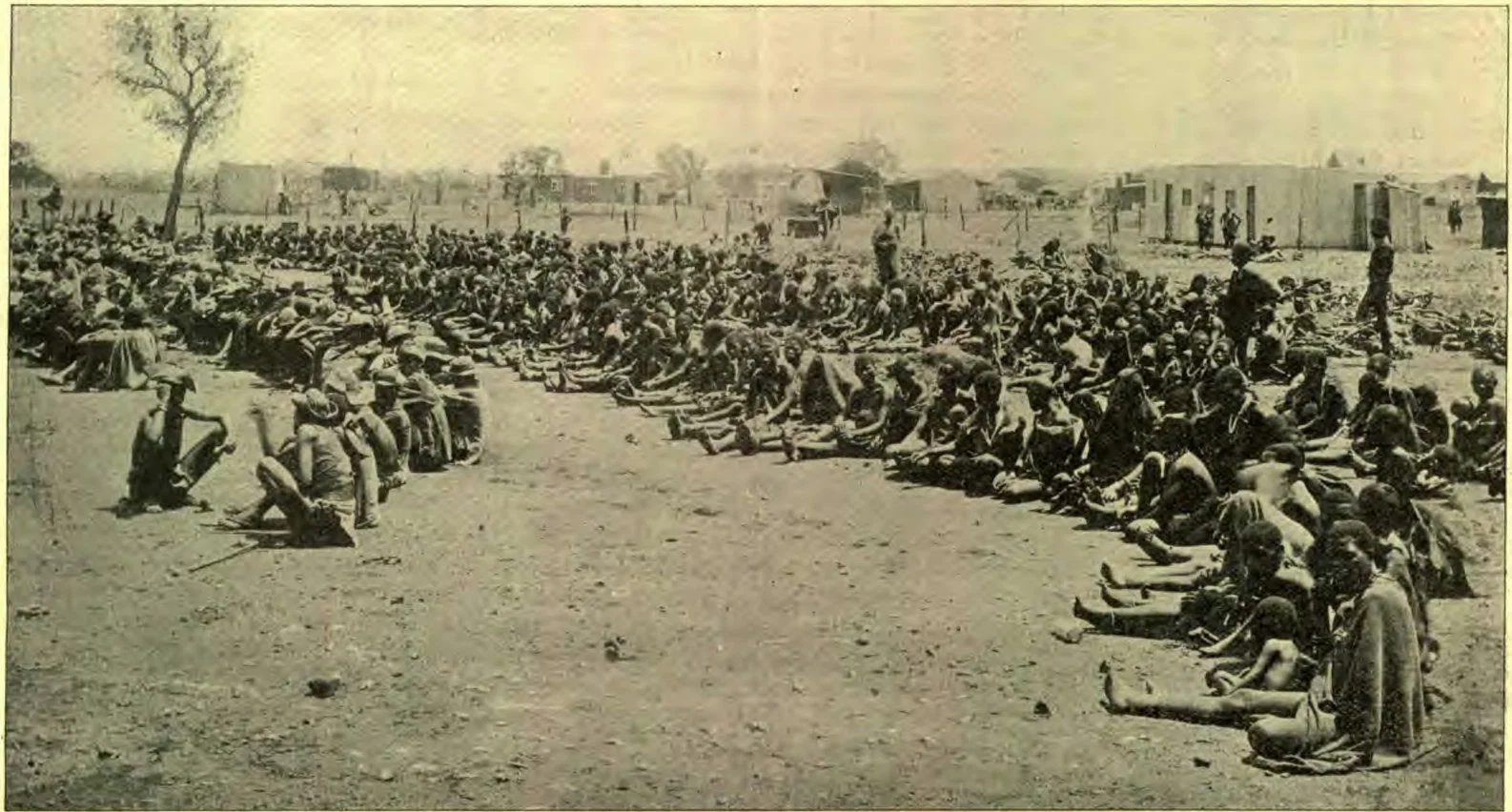
NATIVES WAITING FOR FOOD NEAR BULUWAYO DURING THE FAMINE
Ten oxen and about twenty-five bags of corn was the extent of their wealth when the workers returned to the farm after the close of the war. And very soon these oxen died of rinderpest, so that the mission was without a team for several months. During this time all the soil prepared for crops was cultivated by hand with a hoe. But the evil effects of the war were yet to be felt more seriously. The natives who had taken part in the rebellion not only had had their homes destroyed, but their crops as well, and now starvation faced them. There was no grain for food nor to plant. The mission supplied more than one hundred natives with seed. But this was a trifle, compared to the need. Soon famine, with all its attendant horrors, was rife. The road to Buluwayo was dotted with the bodies of those who had started there in search of food, but, strength failing, had perished by the way. Children and old people especially suffered. For a long time our missionaries had believed that a good work might be wrought for the natives by taking their children and training them, but they made very slow progress when the children were in the school only during the day, returning to their homes at night. Now parents came to the workers, and begged them to take their little ones and save them from starvation. Often children would be found who had been deserted by their parents—not because they were heartless, but because they thought in this way to put an end to their suffering.
Several of these children had been buried alive, but were recovered before death had claimed them. They were gathered in until a company of thirty-six had found a home. Some of these, however, did not live. Others were returned to their parents after the worst of the famine was over, until the family of little ones numbered thirty, ranging in ages from four to eight years. They were bright, quick to learn, and were soon able to express their appreciation for the kindness shown them. At the close of each meal, before leaving the table, they would thank their benefactors for their food. One day Brother Anderson was compelled to leave the table before the family had finished their meal, and about an hour later a little five-year-old came to him and thanked him. He asked him for what he was thanking him, and he said his dinner.
At one time, when breakfast had been finished, there was not enough grain left in the house for the next meal. The children were much concerned to know where more would come from. But together the workers laid the matter before the Lord, and then assured the children that their God would provide. When dinner came, they had three hundred and eighty-five pounds of corn in the house, a gift from the government to the children. Their exclamations of joy were great, and the seeds of faith and trust thus sown in the hearts of these boys and girls have later grown up and borne fruit in their lives.
One year from the time the workers were able to return to the mission farm from Buluwayo, Brother and Sister Armitage joined them. This reinforcement was greatly appreciated, as our missionaries were becoming much worn by the constant strain which the war and famine had brought upon them. But never a word of complaint had come from their lips. All their letters betrayed that grace and Christian fortitude which marks the missionary called of God, standing at his post. E. H.

Alms

THE good old Earl of Devonshire, With Kate, his wife, to him full dear, Had on their headstone carven clear, “That we spent we had, That we kept we lost, That we gave we have.”
Hundreds of years since, yet to-day No lovelier legend tells the way The heavenly price for peace to pay; For that we give we have, through powers Redoubled for what love is ours To spend, as dew returns in showers.
And rich toward God is better worth In that new life, in that new birth, Than all the treasures of the earth! “That we spent we had, That we kept we lost, That we gave we have.” — Harriet Prescott Spofford.

A Call to Service

God calls for workers. His cause needs men who are self-made, who, placing themselves in his hands as humble learners, have proved themselves workers together with him. These are the men that are needed in the work to-day. Let those who have shown themselves to be men, move out and do what they can in the Master's service. Let them step into the ranks, and by patient, continuous effort prove their worth. It is in the water, not on land, that we learn to swim. Let them fill with fidelity the place to which they are called, that they may be qualified for still higher responsibilities. God gives all opportunity to perfect themselves in his service.
He who puts on the armor to war a good warfare will gain greater and still greater ability as he strives to perfect his knowledge of God, working in harmony with the plan that God has given for the perfect development of the physical, mental, and spiritual powers.
Young men and young women, gather a store of knowledge. Do not wait till some human examination pronounces you competent to work, but go out into the highways and hedges, and begin to work for God. Use wisely the knowledge that you have. Exercise your ability with faithfulness, generously imparting the light that God gives you. Study how best to give to others peace, and light, and truth, and the many other rich blessings of heaven. Constantly improve. Keep reaching higher and still higher. It is the ability to put to the tax the powers of mind and body, ever keeping in view eternal realities, that is of value now. Seek the Lord most earnestly, that you may become more and more refined, more spiritually cultured. Then you will have the very best diploma that any one can have,—the indorsement of God.
However large, however small, your talents, remember that what you have is yours only in trust. Thus God is testing and trying you, giving you opportunity to prove yourself true. To him you are indebted for all your capabilities. To him belong your powers of body, mind, and soul, and for him these powers are to be used. Your time, your influence, your capabilities, your skill,—all must be accounted for to him who gives all. He uses his gifts best who seeks by earnest endeavor to carry out the Lord's great plan for the uplifting of humanity, remembering always that he must be a learner as well as a teacher.
MRS. E. G. WHITE.

The Gifts for Missions

REMEMBER, young people, that the little army of workers in the lands abroad will watch to see if the offerings for missions during the week of prayer give promise of a genuine world-wide missionary crusade. Let us be true to our motto and our aim, the love of Christ constraining to the most earnest endeavor, and the grand aim of carrying a message to all the world within this very generation steadying every soul to practical service. Let the old folks know that the youth are not asking for any piling up of worldly possessions to be left when the fathers and mothers are laid away. The glorious work of the third angel’s message is to be accomplished speedily, so that old and young may see together the end of the reign of sin and the coming of the Lord. Will the young people do their utmost to swell this year’s offering to the largest missionary contribution ever made among this people?
W. A. S.

General Notes from Indiana

Mrs. R. W. McMahan, who has charge of the young people's work in Indiana writes: “Our South Bend young people have written for instructions, and desire to organize at once. I am in correspondence with several young people to whom I shall present the Membership Cards, and invite them to become members of our State Society. I feel that our boys and girls have been too long neglected. God has talent among them which must be directed, and used in the cause of present truth. They must be made to realize that there is a definite work for them to do in ushering in the glorious coming of our Lord.”
There are several Societies in Indiana. The one at Kokomo has twenty members. Meetings are held each Sabbath afternoon, and the studies in the INSTRUCTOR carefully followed. The members are supplying reading-matter for the poor farm. They also have a sewing circle.
The membership at Mt. Vernon is reported as eighteen. Weekly meetings are held, at which Bible readings are conducted. Two dollars and twenty-six cents has been contributed for the work of the Society. There is quite an interested outside attendance.
The Society at Anderson is small, ten members, but the secretary writes: “The interest is good. God is blessing.” The members are selling The Life Boat. Meetings are held each Sabbath.
The young people at Indianapolis have been organized for some time, with a membership of twenty-seven. Four new members were added last quarter. The sum of ten dollars has been collected for their work. Most of the members are engaged in distributing tracts and other literature. The leader writes: “The general interest is good. All are willing to do whatever they can to help the cause. The Lord is greatly blessing us as young people.” L. F. P.

The Weekly Study

(December 14-20)
As Sabbath, December 20, is the first Sabbath of the week of prayer, it is recommended that the Young People's Societies join in the regular week of prayer services.

LULU T. WHITE

From Montana

A LARGE Young People’s Society has been organized at Bozeman, and I am very much pleased with the manner in which it is starting out. The older ones are working right in with the young people, and all together are starting out in practical missionary work. They are using the envelope plan of tract distribution, and are also doing quite a bit of practical Christian Help work, gathering garments for the poor, etc. They take a small club of the Signs for missionary correspondence. If they continue as they have started, they will surely accomplish much good.

LULU T. WHITE

Good News from the South

BROTHER B. E. NICOLA, of the Oakwood Industrial School, writes: “We are starting a Young People’s Society at Oakwood. We organized last Sabbath with a charter membership of twenty-five. We hope to make it one of the strong missionary factors of the work in this place.”
Continue reading: JOHN J. BROUSSARD