Our Young People's Society was organized June 28, 1902, with eleven members. We at once began to use the lessons given in the INSTRUCTOR, and have found in them a source of great help in our work. Our meetings are precious seasons of prayer and praise as the Holy Spirit moves us to give ourselves wholly to our blessed Master.
We have sold a few books, and are distributing periodicals as the way opens. While we are few in number, we feel that we are a part of the mighty army of Jesus.
The reports in the INSTRUCTOR are an encouragement to us. We wish there might be more of these words of cheer from all the little companies.
JOHN J. BROUSSARD
A Co-worker
By Dr. Gobin
A WORKMAN who is doing a particular work well is pleased to hear the footsteps of his employer. His appearing may be quite unexpected, but the competent workman is neither frightened nor embarrassed. He has nothing to conceal. He rather enjoys the close scrutiny of his work by his master. The co-worker with God must do thorough work. He can not dally in secret with what he condemns in public. His Employer sees all.—Dr. Gobin.
How to Read the Bible
By C. H. Spurgeon
To some the Bible is uninteresting and unprofitable because they read too fast. Among the insects which subsist on the sweet sap of flowers, there are two very different classes. One is remarkable for its imposing plumage, which shows in the sunbeams like the dust of gems; and as you watch its dance from flower to flower, you can not help admiring its graceful activity, for it is plainly getting over a great deal of ground.
But in the same field there is another worker, whose brown vest and business-like, straightforward flight may not have arrested your eye. His fluttering neighbor darts down here and there, and sips elegantly wherever he can find a drop of ready nectar; but this dingy plodder makes a point of alighting everywhere, and wherever he alights, he either finds honey or makes it. If the flower-cup be deep, he goes down to the bottom; if its dragon-mouth be shut, he thrusts its lips asunder; and if the nectar be peculiar or recondite, he explores all about till he discovers it, and then, having ascertained the knack of it, he joyfully sings his way into its luscious recesses.
His rival of the painted wing has no patience for such dull and long-winded details. But what is the end?—Why, the one died last October along with the flowers; the other is snug and warm in his hive to-night, amid the fragrant stores he gathered so diligently.
To which do you belong, the butterflies or bees? Do you search the Scriptures or skim them? Let me urge you to store your minds carefully with Bible truths while your memory is young and fresh. As the bee lays up a winter store of food for his body, so you must stock your minds and hearts.—C. H. Spurgeon.
Sacred Relics Carried from Siam to Japan
“Some relics thought by Buddhists to be sacred were lately carried from Siam to Japan. When they reached a Japanese city, the whole road over which they were to pass was covered with cotton cloth costing $1,600. The cloth was supposed to become very sacred and to gain great magical power, so that it was afterward sold for a dollar a foot, or $68,000 for the whole.”
The Baby Moses
By Elizabeth Rosser
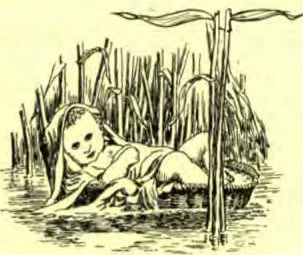
The eyes of gentle
Jochebed were sad
and full of tears,
And her heart was
aching sadly with a
host of untold
fears;
But the baby in the
basket dropped to
slumber with a
smile,—
In the basket by the ancient River Nile.
So the mother left her baby ’mid the reeds and
rushes there,
As she raised her heart to heaven in a swift and
silent prayer,
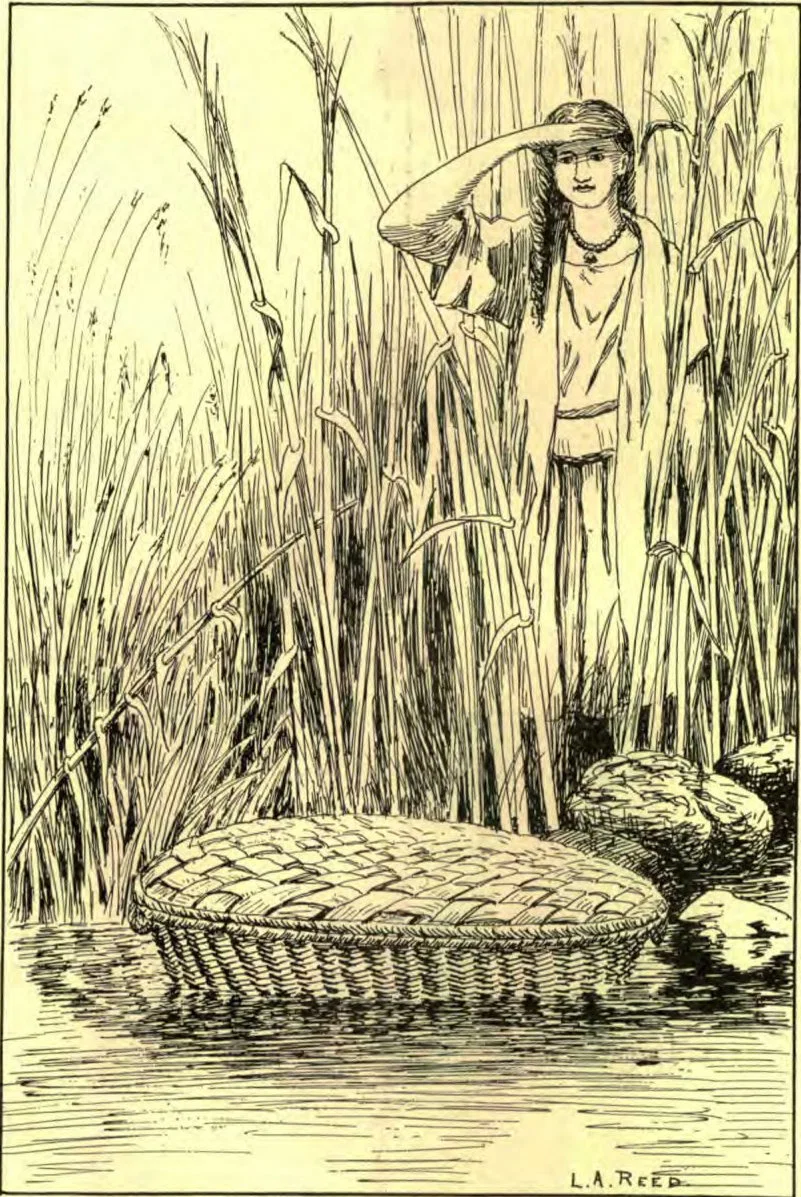
And she bade his sister Miriam watch beside him
for a while
On the grassy bank beside the River Nile.
There were other eyes that watched him; for the
Father from on high
Looked upon the tender baby with a loving, careful eye,—
Kept him safe from creeping serpent, and from
hungry crocodile, In the rushes by the placid River
Nile.
Came the daughter of King Pharaoh walking by the river-side,
And the basket in the rushes in a
moment she espied;
“Bring it hither,” she commanded;
and she opened it, the while
Miriam watched them there, beside
the River Nile.
But the baby in the basket, wakened
from his quiet sleep,
Missed his mother’s face above him,
lifted up his voice to weep.
“’Tis a Hebrew,” said the princess,
with a tender, pitying smile;
“He shall be my son, and reign beside the Nile.”
But his watching sister Miriam, full
of gladness, hastened home,
And called her mother, Jochebed,
with joyful heart to come,
And receive her darling baby, and
to nurse him for a while,
For the princess of the land beside
the Nile.
ELIZABETH ROSSER.
Temperance and Maple Sugar
“It’s easy enough for girls to be temperance,” said Sadie Walters. “Girls don’t want to drink or smoke or swear.”
The brightest faces on the train that Monday morning were the faces of Fred and Sadie Walters. They were going to Vermont, to spend a week on Uncle Hiram’s farm, and it was “maple-sugar-time.” Just think of that! They were going up to the maple grove to eat all the maple sugar they wanted, and have a lot to bring home. No wonder their faces were bright. Sadie and Fred had joined the Crusaders, and they looked often at their fresh ribbon badges.
“It’s easy enough to be a temperance girl,” said Sadie.
“It’s easy enough to be a temperance boy, too, when you know how bad drink and tobacco are,” said Fred. “Who would touch anything that was poison, if he knew it? And I shouldn’t want to swear, anyway, for I shouldn’t want to treat God so mean as that. He’s too good to me!”
Bright and early Tuesday morning Fred and Sadie jumped into the farm sled, each with long wooden spoons in their hands, and a tin pail tied to their belts.
Sadie flew about like an early butterfly when they arrived at the maple grove. She peeped into the log hut where the man slept who watched the sap boiling after it was gathered; she helped pick up the brush for the fire that was built on the ground, and peered into a kettle swung over it in gypsy fashion, between two long poles, all ready for the sap.
Fred tumbled about much like a stupid May bug, getting in everybody’s way, and tumbling over every obstacle in his path. He was used to city pavements, and did not look to see what was before him, and he was so eager to see everything that he could not think about himself.
“AND SHE BADE HIS SISTER MIRIAM WATCH BESIDE HIM FOR A WHILE”
John the hired man swung a big yoke over his shoulder, and Uncle Hiram put a pail on each end, and off they went to the grove. Some of the buckets under the trees were ready to take to the “camp,” as they called it, where the hut and the gypsy fire were. Uncle Hiram took off the empty pails, and put the pails filled with sap on the yoke, and off went John, but not before the butterfly and the beetle had a good taste of the sap.
There was another man in the grove, ready to tap the new trees when Uncle Hiram should come. The children watched the man cut the bark and wait a moment to see if the sap was going to flow freely, place a bucket under the tree, and go on to the next. Fred and Sadie lingered to hold their spoons under and get a taste of the first drops.
“I thought it would be sweet, just like maple sugar,” said Sadie.
“Oh, no!” said Fred, like one very learned, “the sap has to be boiled down to get thick, and the thicker it is, the sweeter it tastes.”
“Why, of course,” said Sadie; “I never thought of that.”
Then they went to the next tree, and tasted of its sweet sap.
“You can take a lot of this because it is not so sweet,” said Fred.
When they had been to four trees, Uncle Hiram called out:— “Don’t take too much, children.” “All right,” said Fred. But they kept tasting because it was not so very sweet,—just sweet enough to make you want a little more, as Sadie remarked. By noontime they could not eat the nice lunch Aunt Elizabeth had put up for them, and they felt so sick that they could hardly look at the big bubbling kettle swinging over the crackling fire. And they would have forgotten to fill their pails with sap if it had not been for John. Aunt Elizabeth had told them they might bring home their pails full, and make some sugar, and have it to take away with them. When they got out at the gate, it seemed as if they never wanted to see any sap again.
“You took too much,” said Aunt Elizabeth. “Hiram said he would see to you.”
“He told us,” said Fred, “but we kept tasting.”
“Never mind,” said the good aunt, “you will be all right to-morrow.”
But they had lost their dinner, and now could not eat any supper. Fred went to bed feeling pretty cross, and Sadie cried a little, but she did not let any one know it.
The next day they tried their snowshoes. They had never had snowshoes on until now, and such a time they had making them work! But it was such fun! Aunt Elizabeth called them three times, but they could not make up their minds to give it up.
“Don’t do too much,” called Aunt Elizabeth.
“Oh, no!” replied Sadie, and off she went for another frolic.
How their muscles did ache after they had gone to bed, but they were ashamed to say anything. The next day they were so stiff they had to stay in the house and rub on liniment. Aunt Elizabeth comforted them all she could, bringing out a pile of magazines and papers. They read and read until aunt said, “Don’t read too much, dears.” But there was nothing else to do, as they did not feel like moving, and so they kept on reading until they both had the headache. Then they were so out of sorts Aunt said she guessed they were a little homesick. Uncle Hiram had noticed their temperance badges, though he had not said anything about them. When he came in at night, and looked at the children, he smiled jovially, and said:— “A good night’s rest will fix you all right, but if you want to enjoy yourselves while you are390here, you must be considerably more temperate.”
Fred and Sadie were silent for some time, each thinking busily. At last Sadie whispered to Fred: “I never thought before how many things temperance means.” “Neither did I,” said Fred.
And the next day the children had such appetites that they felt as if they could eat everything Aunt Elizabeth had cooked; but when she said, “Don’t eat too much, children,” they remembered Uncle Hiram’s words, and they remembered all the rest of the visit, and did not “have a good time too hard,” as Sadie told her mama when they were again at home.—S. S. Times.
First Lessons in Geography
By Floyd Bralliar
Lesson XIV
In making maps it is usually convenient to show only a small part of the world on one map. So it is necessary, in order for us to get an idea of what part of the world a map represents, to have some fixed rules for map-drawing. In drawing maps we always call the top north, the bottom south, the right side east, and the left side west.
But this is not all that is necessary. In order that one may know where he is on the earth, and in order to make it easy to draw maps, men have devised two systems of imaginary lines that divide the earth’s surface into small sections, or parts. Half-way between the poles we mark a line around the earth, dividing it into two equal parts. We call this line the Equator. As lines and circles are not of the same size, we can not measure them by miles or feet or inches; so we divide a circle into three hundred and sixty equal parts, called Degrees. Each degree is, in turn, divided into sixty equal parts, called Minutes; and the minutes are again divided into sixty equal parts, called Seconds.
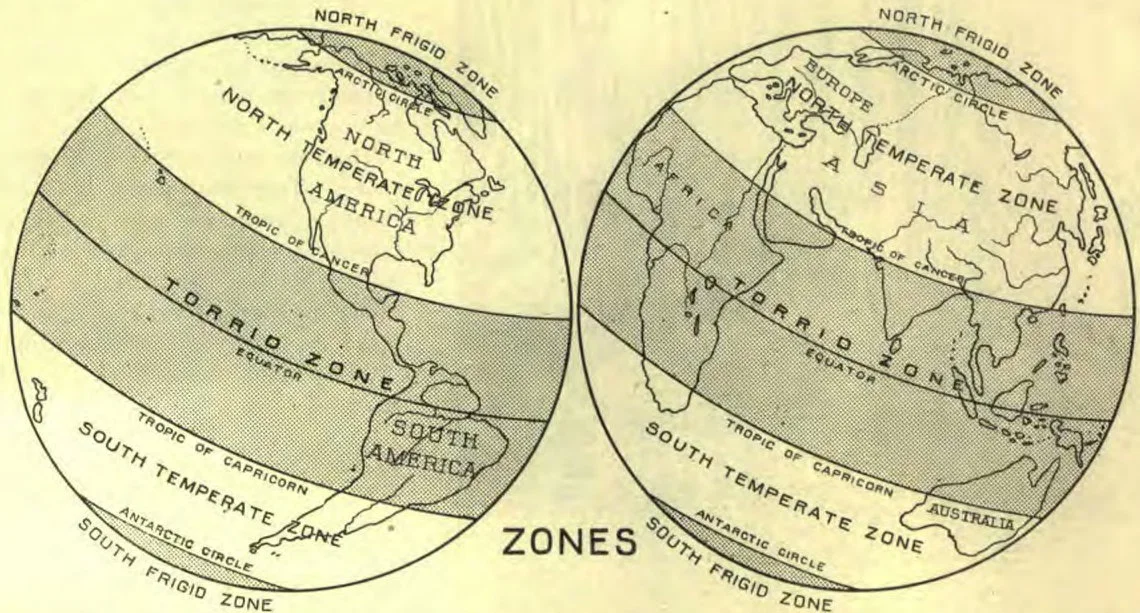
ZONES
Twenty-three and one-half degrees north of the equator we mark another line, passing around the earth, from east to west, exactly parallel with the equator. We call this the Tropic of Cancer. Twenty-three and one-half degrees from the north pole is another line passing around the earth from east to west, parallel to the tropic of cancer. This line is called the Arctic Circle.
South of the equator, twenty-three and one-half degrees, is a line called the Tropic of Capricorn; and twenty-three and one-half degrees from the south pole we have another line, called the Antarctic Circle. Between these lines, we make as many others as we desire, running parallel to them.
These lines, all taken together, are known as Parallels, and mark the distance north or south of the equator. We call the distance north or south of the equator, Latitude, and it is marked on the sides of the map. Latitude is therefore in degrees.
The other system of lines runs around the earth from north to south, passing through both poles. These lines are called Meridians. We draw as many of these as we wish, then we choose one of them as the principal point to begin to reckon from, and call it the Principal Meridian. The distance eastward from that line is called East Longitude, and the distance west from it is called West Longitude.
Longitude is reckoned in degrees, and is marked at the top or bottom of the map. The greatest longitude that a place can have is one hundred and eighty degrees, or one half the distance around the world. The greatest latitude that a place can have is ninety degrees, or one fourth the distance around the world.
There are various meridians chosen from which to reckon longitude. In this country we usually reckon from the meridian of Washington, although sometimes we reckon from the meridian of Greenwich, England.
As we shall soon study the maps of the various continents of the world, it is necessary for us to know something about longitude and latitude. If you will look on the map of the world, you will find the meridian circles, and also some of the parallels.
REVIEW.—How do we tell the directions on a map? What is the equator? Name the tropics, and tell where they are. Where is the arctic circle? the antarctic? What is latitude? What are parallels? How do we reckon latitude? Where is it found on the map? What are meridian circles? What is longitude? What do we mean by the principal meridian? What is the greatest longitude a place can have? What is the greatest latitude a place can have?
NOTE TO TEACHERS.—In teaching this lesson, be sure that the pupil understands what a degree is, and why it is used; also be sure that he knows what the equator is, and knows the difference between longitude and latitude, and where to find each marked on the map. Show him, on the map, how a city is marked, and how we mark a capital city. Show him how rivers and mountain chains are designated. In fact, familiarize him with actual methods, explaining points that he does not understand, so he will have no trouble with the map questions that are to follow.
Lesson XV
“All the foundations of the earth are moved.” “Which removeth the mountains, and they know not: which overturneth them in his anger. Which shaketh the earth out of her place, and the pillars thereof tremble.”
One of the greatest effects of the flood is seen in the changing of the earth’s seasons, so that part of the year it is warm, and part cold.
When the earth was first created, its poles no doubt pointed north and south, and the sun shone on all parts of the earth every day. This made a warm climate over all the earth. In Greenland, where now it is very cold, we find remains of palms and other trees that grow only in a warm country. This shows that at one time it must have been warm there.
During the flood the foundations of the earth were moved, so now the poles do not point exactly north and south. They lack twenty-three and one-half degrees of doing so. This makes it so that the sun does not shine at the north pole for six months at a time, and then it shines all the time for six months. It is the same way at the south pole, only the sun shines there while it is dark at the north pole, and it is dark there while it shines at the north pole.
God says that the daysprings have taken hold of the ends of the earth, that the wicked might be shaken out of it. When it is dark so long at the poles, it gets very cold. When the day comes, the light shines at such a slant that it thaws out only a little of the ice and snow that had formed in the winter. For this reason it is cold and frozen there all the time, so no one can live there.
Around each pole is a broad belt of this kind of country that is called the Frigid, or frozen, Zone. So we have the North Frigid Zone and the South Frigid Zone. On your maps the imaginary line, called the Arctic Circle, marks the border of the north frigid zone, and a line called the Antarctic Circle marks the south frigid zone.
Lying on each side of the equator is a broad belt of country, in some part of which the sun is directly overhead at noon every day, and the days and nights are each about twelve hours long. It is always very warm there; and where there is rain enough, the trees are green all the year. This zone is forty-seven degrees wide, and we call it the Torrid, or hot, Zone. The torrid zone is bordered on the north by the Tropic of Cancer, and on the south by the Tropic of Capricorn.
Between the torrid zone and the north frigid zone is a broad belt of land which is neither so hot as the torrid zone nor so cold as the frigid zone. This we call the North Temperate Zone. Between the torrid zone and the south frigid zone is a similar zone called the South Temperate Zone.
REVIEW.—How does the axis of the earth point? Why? What effect does this have on the earth? Into how many zones does it divide the earth? Why has God thus changed the earth?
MEMORY VERSES: “O Lord, our Lord, how excellent is thy name in all the earth.” Ps. 8: 1. “And they that know thy name will put their trust in thee.” Ps. 9: 10.
While Moses was caring for Jethro’s flocks, he was out among the mountains, seeing the works of God in the beautiful scenes of nature. This must have brought fresh to his mind the early lessons that he had learned from his mother’s lips about the Creator of the heavens and the earth. For forty years he lived the peaceful life of a shepherd, learning of God the truths which he wrote out in the book of Genesis, to teach the world in all coming time. The tender care that he had to give to the sheep of his flock also taught him many lessons, and prepared him to lead God’s people like a flock through that same wilderness.
It was because Moses studied the works of God391in nature that he was so quick to notice a strange sight, and to try to find out the cause of it. It was when God “saw that he turned aside to see,” that he spoke to him out of the midst of the bush.
God was going to lead his people out of Egypt, away from all the false gods that they had worshiped, to bring them to himself. But “he that cometh to God must believe that he is.” So the first message that God sent the people was, “I AM.”
All the false gods of the nations are nothing; they seem to be something, but they are not (read Psalm 115). Therefore they are a lie. “But the Lord is the true God.” His name is “I AM;” and he is the only one who really is. Jesus said that he is the One “which is, and which was, and which is to come.” I AM is present; this is God’s name forever. He is ever present, “the same yesterday, and to-day, and forever.”
But he says also, I AM that I AM,—I AM that which, or what, I AM. So the name of God shows us what he is; it is to teach us his character. Every one of God’s works is to show us something of what he is; so all things are declaring the everlasting name of the Creator. “O Lord our Lord, how excellent is thy name in all the earth!” What a grand, glorious, and almighty name is this everlasting name of our God and Saviour! And from everything that he has made, he is declaring it to us, just as truly as he did to Moses out of the midst of the bush.
God wanted the children of Israel to know him, so that they would trust him and let him lead them through the wilderness, as the sheep follow the kind and gentle shepherd they have learned to know. And so he declared his name to them, for “they that know thy name will put their trust in thee.”
The One who appeared to Moses in the flame of fire was Jesus Christ the Saviour, who had come down to deliver his people from bondage. He subdued his glory so that Moses might look upon it and live, and took a common bush, a lowly shrub, no different from any other, in which to appear. In this he was showing in a figure how he was to veil his glory, and come to dwell in the form of a man, just like any other man, in order to deliver his people from the bondage of sin.
The Lord made it very plain to Moses that he would manifest his power in delivering Israel, and gave him signs by which he was to show both the elders of Israel and Pharaoh that One mightier than the king of Egypt was working for his people. Exodus 4.
Moses pleaded that he was slow of speech. He had been away from Egypt so long that he could not use their language as fluently as he did when he lived there. But the Lord told him that he had created man’s mouth, and he would be with him and teach him what to say. He also told him that Aaron his brother was coming out to meet him, and he should be Moses’ mouthpiece. Angels had instructed Aaron to go to meet his brother. In the strength of the Lord they were able to do the great work to which he had called them. And so are we; for with the Spirit of God abiding in his heart, we can do all that he commands.
Questions
1. What was the work of Moses after he left Egypt? Ex. 3:1. In doing this work, where would most of his time be spent? What was God preparing him to do? What did his work for the flock teach him?
2. Where was Moses one day leading the flock? What is Horeb called?
3. What attracted Moses’ attention? Verses 2, 3. Did God speak to him at once? What did he wait for?
4. What made Moses quick to see, and anxious to understand all that he saw? What did God tell him to do first of all? Verse 5. Why?
5. What did God say that he had seen? Verse 7. What had he come down to do? Verse 8.
6. What call did God then give to Moses? Verse 10. Did Moses want to go? Why not?
7. What question did Moses ask the Lord? Verse 13. By what name did God make himself known to the children of Israel? Tell some of the things that this name teaches us of God.
8. Where is God showing us his glory, and for what reason? What must we do before we can understand the revelation?
9. What evidence did the Lord give Moses that he would manifest his power in delivering Israel? Ex. 4:1-9.
10. How did Moses try to excuse himself? Verse 10.
11. What reply did the Lord make?
12. Who did he then associate with Moses? What practical lesson do you see in this?
The “mystery of godliness,” God manifest in the flesh, is the basis of Christianity. This mystery was revealed when the “Word was made flesh.” John 1:14. During the lifetime of the apostles, who were taught the “mystery of godliness” from the lips of Jesus himself, who was the revelation of this mystery, another mystery began to develop. 2 Thess. 2:3–12. Paul, writing of this to the church at Thessalonica, uses terms that identify it with the prophecies of the little horn in Daniel 7 and 8. Compare 2 Thess. 2:3 with Dan. 8:12, R. V. Paul taught that the man of sin would be revealed in connection with a falling away from righteousness, while Daniel saw in his vision that the little horn was able to manifest its power only “through [or because of] transgression.” Again compare verse 3 with Dan. 7:8. Both refer to a man. Also verse 4, where the man of sin would oppose and exalt himself above all that is called God or is worshiped, sitting even in the temple of God, showing himself that he is God, with Dan. 7:25 and 8:10, R. V., where the prophet saw the little horn not only speaking great words against the Most High, but assuming the power to change his law, and magnifying himself even to the Prince of the host, and taking away the continual.
From these comparisons it is clear that the man of sin of whom Paul wrote is the very one who is the leading subject of the prophecies of the seventh and eighth chapters of Daniel. Of this man of sin it is emphatically stated that he substitutes himself for God in the sanctuary service (2 Thess. 2:4); and the work which culminated in this self-deification, which had already begun to work in Paul’s time, is called the “mystery of iniquity.” Verse 7.
Then the work of the papacy in corrupting the true temple service by taking away the continual, which we studied last week, is accomplished by putting man in the place of God, thus substituting the “mystery of iniquity” for the “mystery of godliness,” justification by works for justification by faith, and the outward and the visible in worship for that which is spiritual.
The tabernacle in the wilderness, and later the temple, was a copy of things in heaven. Ex. 26:30. By the rending of the veil of the temple (Mark 15:38) at the time of the death of Christ, who is the true sacrifice, it was intended to mark the close of the earthly priesthood and ministry. Type had met antitype. “By virtue of his death and resurrection, he [Christ] became the ‘minister of the true tabernacle, which the Lord pitched, and not man.’” Heb. 8:1, 2. By taking upon him our flesh, and offering himself for man, Jesus took away the typical continual service (Dan. 9:27), and established an eternal reality in its place. He became our High Priest, serving continually in the heavenly sanctuary. Acts 2:32, 33; Heb. 8:1, 2; 7:23–25.
In its work of corrupting Christianity, the papacy has taken away the continual, or real presence of Jesus, and has put an earthly service in the place of the heavenly. The papacy has a god of its own, the pope; a saviour of its own, the church; a sacrifice of its own, the mass; a mediator of its own, the priesthood and the Virgin Mary; a justification of its own, justification by works; and a pardon of its own, the confessional. It presents a system for the salvation of man which is false, a grand deception,—the “all deceivableness of unrighteousness.” 2 Thess. 2:10. This is the mystery of iniquity, in contrast with the “mystery of godliness,” which is God manifest in the flesh.
The practical thought in our lesson to-day is, Which mystery shall be allowed to develop in our lives? “Every spirit that confesseth that Jesus Christ is come in the flesh is of God.” 1 John 4:2. “Whosoever therefore shall confess me before men, him will I confess also before my Father which is in heaven.” Matt. 10:32.
Questions
What is the basis of Christianity?
When was this mystery revealed to all the world?
During the lifetime of Him who revealed the “mystery of godliness” to the world, what other mystery began to develop?
How does Paul describe this development?
Give as many evidences as you can, by comparing this description in 2 Thess. 2:3–12 with the prophecies of Daniel 7 and 8, which show that both refer to the development of the same power.
What place does the man of sin take in the sanctuary service?
What is the development of this system of self-deification called? May we expect to see its development in any place outside of the papacy?
Then in what manner has the papacy taken away the “continual”?
After what was the tabernacle, and later, the temple, a copy? What was the significance of the rending of the veil of the temple at the crucifixion of Christ?
In offering himself for man, what did Jesus establish instead of the typical continual service?
What position does he now occupy?
What shows that the papacy does not recognize the continual priesthood of Jesus in the sanctuary above?
How can we open our hearts to the development which it offers?
By what term does inspiration describe this deception?
How can we open our hearts to the development of the “mystery of godliness”? Shall we so open them, now?
SOLID THROUGH TRAINS OF
WIDE VESTIBULE COACHES and PULLMAN SLEEPING CARS BETWEEN
Battle Creek and Chicago, Buffalo, New York, Philadelphia, Toronto, Montreal, Boston
For time-tables, descriptive matter, and information, apply to any representative of the company.
Toronto, Montreal, Boston
SENT ON THREE DAYS' TRIAL FREE! THE CO-RO-NA MEDICATOR CURES CATARRH
By E. J. Worst
TWO-THIRDS ACTUAL SIZE.
Head-Colds, Pains and Roaring in the Head, Partial Deafness, Sore Throat, HEADACHE, La Grippe, and all Diseases of the air passages by inhalation. The most perfect appliance ever offered.
SPECIAL OFFER.
For a short time I will mail to any reader naming this paper, one of my new improved CO-RO-NA MEDICATORS, with medicines for a quick home cure, on three days' trial FREE. If it gives perfect satisfaction, send me $1.00 (half price), if not, return it at the expired time, which will cost you only three cents postage. Could any proposition be fairer? Address,
E. J. WORST, 16 ELMORE BLOCK, ASHLAND, OHIO.
AGENTS WANTED.
EDITORIAL NOTE.—If you have the slightest symptoms of Catarrh, or are easy to take cold, you should send for a Co-Ro-Na on the easy terms offered. In writing be sure to name this paper.
—Henry Van Dyke, in the Outlook
By Henry Van Dyke
Work
LET me but do my work from day to day,
In field or forest, at the desk or loom,
In roaring market-place, or tranquil room;
Let me but find it in my heart to say,
When vagrant wishes beckon me astray:
“This is my work—my blessing, not my doom.
Of all who live, I am the one by whom
This work can best be done, in the right way.”
Then shall I see it not too great, nor small,
To suit my spirit and to prove my powers;
Then shall I cheerful greet the laboring hours,
And cheerful turn, when the long shadows fall
At eventide, to play and love and rest,
Because I know for me my work is best.