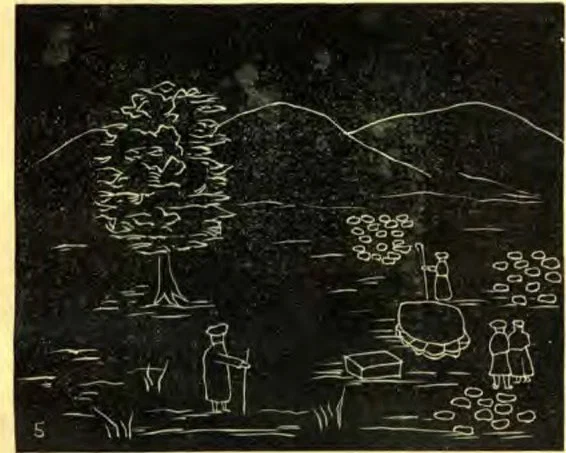
Last month some illustrations were given of the story of Jacob's life, and a few suggestions were offered as to the best method of using the blackboard in teaching the lesson. It may be well to continue the work in this supplement, giving further illustrations of the story.
Having questioned your pupils on the lesson of the previous Sabbath, you now continue the story, perhaps saying:—
“Jacob then went on his journey among mountains, and past green fields and olive orchards and vineyards, and across little brooks, and sometimes a river. At night time he no doubt lay down on the ground and went to sleep, just as he did at Bethel. God watched over Jacob on all this long journey, and did not let any robbers or bad men hurt him, nor any wild beasts tear him in pieces.
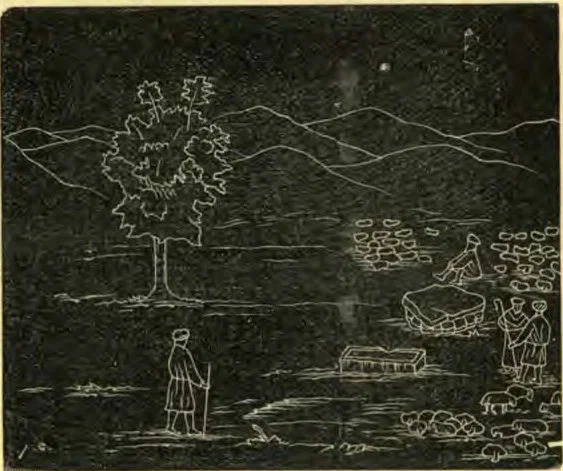
“By and by the road led down to the River Jordan. There was no bridge over the river, but Jacob could see, by the footprints on the bank, where the people and animals crossed over. He waded through this shallow place, or ford, as it was called, and came out into a beautiful country. Sometimes there were rich green pastures, and sometimes wild, rocky places, and desert sands. Day after day he went on his long journey, and night after night he had nothing but the hard ground for a bed. By and by he came to the land of the people of the East—to Haran. This country was a great plain, with sometimes ridges of low hills, and once in awhile a mountain. You remember that a good many years before this, Jacob's grandfather Abraham moved up to Haran and lived in that city a long time; and that when Abraham's father Terah died, Abraham, with his wife Sarai and his nephew Lot, went down into Canaan to live. They must have traveled over very much the same road that Jacob took now in coming to Haran. (While talking about Haran, draw on your blackboard a few rounded hills as a background.)
“Jacob must have been footsore and weary with such a long journey; for he had traveled about five hundred miles since leaving his home at Beersheba. I suspect he walked a good deal slower than he did when he started out on that first day to get away from Esau. (You will have roughly sketched Jacob in the foreground.) I suppose he sometimes sat down under a shady tree to rest and to get away from the hot sun. And the little birds twittered over their nest-building in the branches up above him, and sang just as merrily as they did around his home in far-off Beersheba. (While talking, roughly sketch a tree in the field.)
“As Jacob was going along, he looked up and saw a well in the field. The well was covered up with a great stone, so large that one man could scarcely move it. There were no houses near, so it was necessary to keep the well covered up for fear some person or animal might not see it, and thus fall into the water. I should not wonder if this well was very deep. Water was scarce in this country, and sometimes people had to dig a great way through the hard rocks before they could find any water at all. May be the wells would be several miles apart. Do you remember how Abraham once dug a well in Gerar, and how the herdsmen came, and took it away from him when he had found good water? (You will now have the well finished.)
“Jacob saw near the well three flocks of sheep. Some of them were lying down, and some were nibbling the short, green grass. There were ever and ever so many of them, and they were all waiting for a drink of water from the well. There was a large trough near the well. Most likely it was made of stone, for there was hardly any wood in this country. Probably the men had to go to some rocky place, and peck and peck away day after day until they had hewn out a block large enough for a trough; and then they would have to work at the inside of the block until it was hollowed out. They had to be so careful not to pound too hard, for that would crack the trough, and spoil it. And after it was done, there was a great deal of hard work to get it up by the well. The shepherds drew water out of the well, and poured it into this trough for the sheep to drink. (You will now have made the sheep and the trough.)
“There were three men by the well. These were the shepherds, who spent all their time in taking care of the sheep. For the people in those days did not have farms all fenced off as we do now, but at most they used stones to mark the dividing line between the fields. I do not suppose there were really any farms at all, but the people stayed in one place until the flocks and herds had eaten up all the good grass, and then went somewhere else where there was better pasture land. Nobody seemed to pay money for the land, but the man that had been using it the longest claimed the most right to it. Sometimes the people lived in little towns, as Laban seems to have done, and pastured their flocks out in the fields near by. The shepherds did not always have a pleasant time; for they had to see that the sheep did not stray off and get lost, or that no thief stole them, or no wild beast ate them up. And they had to stay out, no matter if it was cold and rainy, or if the sun shone very hot; and if a sheep strayed away or fell into a pit, it had to be hunted up and brought back to the fold. (By this time you will have made the shepherds, one sitting down by the well, and the other two talking together, as in No. 1.)
“Jacob did not know where to go to find his uncle's house. So when he saw the shepherds, he went up by the well to ask them. ‘My brethren,’ said Jacob, ‘where is your home?’ ‘We dwell in Haran,’ they answered. Then he asked them if they knew Laban, the son of Nahor? ‘Oh, yes;’ the shepherds answered, ‘we know him very well, and away off by those hills is his daughter Rachel, coming with her sheep to water them.’
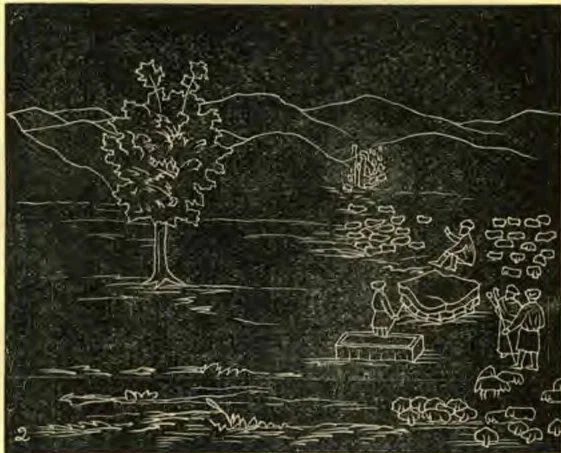
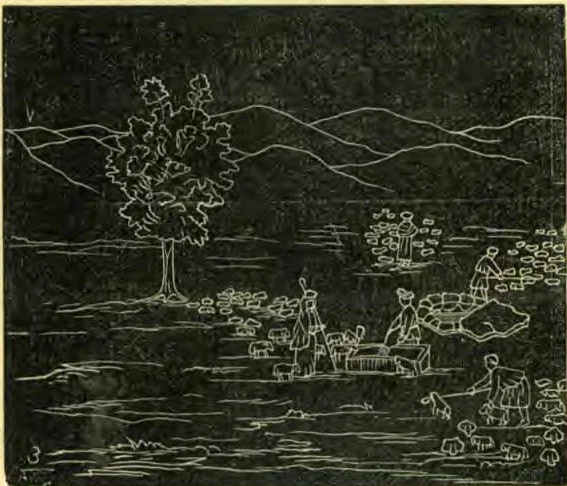
“Jacob looked that way, and saw his cousin coming all alone, with the sheep following close to her. She did not need anybody to help her drive them; for she was so good and kind that they all followed her wherever she went. (Make Rachel in the distance, with the sheep, as in No. 2.) Jacob asked the men why they did not water their sheep, and then go and feed them where the grass was better. They said they had no business to take away the stone from the well until all the shepherds who had a right to use the water had come there with their flocks. So when Rachel drew near with her sheep, Jacob helped the men take off the great stone, and he drew water for her flock. I suppose Rachel had found such nice green grass among the hills that she did not like to take the sheep away from it, down to the well. She must have wondered who the stranger could be that so kindly drew water for her sheep. (By this time you will have made changes in your picture to correspond with No. 3.) When Jacob told her that he was her cousin, her Aunt Rebecca's son, she ran all the way home to tell her folks about it. (Erase Rachel from the picture, leaving Jacob with the sheep.)
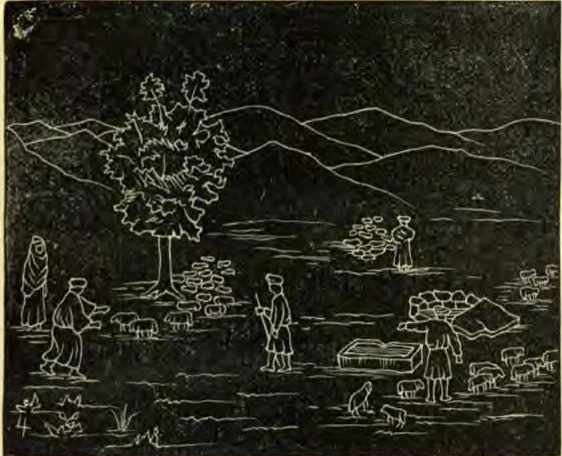
“Laban was very glad when he heard that his sister's son had come to see him, and he ran back with Rachel to the well. He embraced Jacob, and kissed him, and wept; and then he asked how his mother Rebecca was, and how Isaac was, and all the rest of the family. It must have been a long while since Laban had heard from his sister; for there were no swift railway cars to carry letters back and forth, and no postmen to send; and if he made the journey, he would have to be gone a long time from home, and his flocks and herds. I suppose it was often years between the times when he heard from Rebecca. So now he was very glad to see Jacob, and he made him go home with him. (By this time, your picture will be changed as in No. 4.)
“Rachel was very nice looking. Jacob soon found that she was as good as she was handsome, and he wanted to marry her. But it was the fashion in those days for a young man to pay his father-in-law a large sum of money when he married a wife. Jacob was poor, and had no money to pay; so Laban said that he must work for him seven years before he could marry Rachel, and that would do in the place of money. Jacob agreed to this; but at the end of the seven years, Laban cheated him, and made him marry his oldest daughter Leah, who wasn't so good and pretty as Rachel. I should not wonder if Jacob remembered,217when this trouble came upon him, how he had cheated his brother Esau, seven years before. Then Laban said Jacob must marry Rachel also, and thus he had two wives; but he had to work seven years longer. It doesn't seem as if Jacob was much to blame in this matter, but yet he had trouble enough in his family, in one way or another, so that he must have seen very plainly why it is that God has made it a law that a man should have only one wife.”
One thing especially the teacher should bear in mind, and that is that he must not withhold his word picture while making his crayon drawing. The blackboard must be made subordinate to the story. To do this the teacher must tell a fuller story than that found in the Lesson Book. He must tell enough of what is true to Oriental life, and in keeping with the lesson to be taught, as to enable him to get that particular feature of the drawing completed before he ceases to talk about it. For instance, if the objects to be drawn are the three shepherds by the well, enough must be said about rural life, and especially shepherd life, in Palestine, to give the teacher time to sketch the shepherds; if the well, something must be said about the water supply of the country; if a tree, something about the wood; and care must be taken in all this talk, to have the facts true to the life and times under consideration. Fortunately, the manners and customs of the East have changed but little with the passing years; and if we were to visit the country to-day, it would seem as if we were carried back to the days of the patriarchs. A diligent study of some good book of travels in Palestine, and another on Bible manners and customs, together with a careful reading of the Sacred Text, will be necessary to the successful accomplishing of this work. The teacher must know a great deal more than he expects to teach. He must be more conversant with this subject than with the geography of any other country in the world. If this work is carried out as thoroughly as it should be, we shall hear fewer primary teachers say, ‘I wish I could study in the senior division; these lessons are so easy, I don't have anything to do.’ No, indeed; there is study enough to do, and invention enough to be brought into play in the drawing, to satisfy the most active mind. Never think that your work is done well enough so long as there is a possibility of doing it any better. The teacher's work is a progressive one; he should be better informed, exercise better invention, use more tact in presenting the subject and approaching his pupils, this quarter than he could in the one before.
It is an unwise thing to apologize for the poor quality of your picture. Do not begin by saying, ‘I cannot draw a very good picture.’ Children are sharp critics, and as soon as you have called attention to your lack of skill, they will point out defects enough to make the recitation hour a very uncomfortable one, and you will feel as if the lesson story had failed of its effect.
Do not call attention to the picture in any manner. Begin your story, and while talking about the hills, make a few; when speaking about the trees, make one; when talking about Jacob, sketch him; and about the sheep, draw some irregular ovals to represent them. But let it all come in incidentally, as if you were so full of the subject, and each character stood out so vividly in your mind, that you could not help making a few marks on the board, just to show your scholars how it looked.
Be sure to make your drawing keep up with your talking, no matter how poorly you do it. If you cannot draw well, make a poor picture, no matter if it is as rough, or rougher, than No. 5. Believe me, it will be as effective as a more elaborate one, if you only depend mainly upon the word picture, and make that bright and clear. If you cannot get a good tree made while you are talking about one, you must make a rougher one, with scribbles for leaves, and two straight marks for a trunk. The drawing is not so much for illustrating as for holding the eyes of restless pupils. This will be best done, not by the elaborateness and finish of your work, but by the rapidity with which one feature succeeds another. This will keep them all alive to see what you are going to do next.
But you must practice a great deal at home. Plan out your picture, and then go over it again and again, until you can make it without apparent effort. To produce the right effect, care must be taken to have the size of the objects properly related. For instance, if you want to make Rachel rounding the hills, you should make the figure very small and the sheep mere specks, to give the idea that she is a long way off. Jacob you have placed in the foreground, and he must be proportionately larger. If his feet are on a level with those of the shepherds, he must be made the same size; if you want to make him a little nearer and larger than the others, make his figure a trifle larger, thus bringing his feet a little nearer the bottom of the picture. But we cannot in this already lengthy article give any instruction in regard to the actual work of drawing. If nothing prevents, this subject will be taken up at another time.
W. E. L.
HELPS IN BIBLE STUDY.
By G. H. B.
We are quite often asked the question: “What are the best helps for Bible study?” Now we do not propose to give, in this brief article, a complete answer to this question, but merely to give a hint that, if acted upon, will be a help to many.
Some make the mistake of supposing that they need quite a library for this purpose. Well, it is very true that the advanced student is always wanting one more book, no matter how many he already has; but there are a great number of people who do not realize how much good they can get from sources wholly within their reach.
First of all, we will call attention to the marginal references in your Bible. These references are no more infallible than other works of man; they sometimes connect scriptures that you do not think ought to be so related; but after all, they may be a mine of wealth to you. At first it requires considerable patience to study the Bible by marginal references, but perseverance will make it easy and pleasant. Of course you have little need for marginal references, except to point you to other scriptures bearing on the same point as the one you already have before you. The similarity in some of the passages will be more in the wording than in the meaning, while others will seem too remote to be of any use; but keep on through them all, and if you do not then find anything to your mind, look up the secondary references; that is, when you have looked out the passage pointed to in a marginal reference, notice the marginal references to that passage, and so on. An hour spent in this way may not satisfy you; but in many instances it will let in light that you will prize very highly. And if the practice is followed up, the final result will be valuable indeed. It will give you an enlightened breadth of view which you would hardly get in any other way. Some very efficient Bible scholars have gained a large share of their knowledge of the Bible by this means.
Next, you want a Bible Dictionary, if you do not have one in your Bible. This ought not to cost more than about two dollars. Then you want a work on Bible Lands,—such as Barrow’s, “A Ride through Palestine,” or something of that kind. Of course, the more you can have, the better, provided you have time to study them; but the point which we wish especially to make is this,—that one or two books well studied are worth more than a whole library that you have scarcely time to look into, at least they are worth more to the ordinary Sabbath-school worker. That man is deceived who thinks to make himself wise by filling his shelves with books. One book is usually sufficient till you are completely familiar with it; then buy another. Thousands of people fail in the business of life, or in gaining an education, because they are always straining after things beyond their reach, instead of improving present opportunities. Just so it is with those who are more anxious to obtain books than they are to study them. There seems to be a strange infatuation in this matter. One reads over the titles of books, or looks at them in the book-store, and thinks of what a world of wisdom they contain. It seems for the moment that to possess them would be about the same as knowing all that is in them. But alas! how different is the result. And the one who reads too hastily to leave time for reflection is scarcely less deceived. Let me close, then, by asking you to join with me in making the most of what we already have, and adding thereto as fast as we have need, or as our means may warrant.
G. H. B.
NEBRASKA S. S. ASSOCIATION.
By O. A. Johnson; W. D. Chapman
The ninth annual session of this Association was held in connection with the camp-meeting at Grand Island, Nebraska.
FIRST MEETING, 11:50 A. M., SEPT. 8.—The President in the chair. On motion, all members of any Sabbath-school were invited to take part in the deliberations of the meeting. N. H. Droulard was appointed Secretary pro tem.
On motion, the Chair appointed the usual committees, which were as follows: On Nominations, F. Jörg, John Gardner, W. D. Chapman; on Resolutions, J. H. Nicholson, and sisters Hyatt and Droulard.
At the request of the meeting, a question box was placed in the main pavilion, and the President chose two persons to act with himself in preparing answers for the questions.
Meeting adjourned to call of Chair.
SECOND MEETING, 10:15 A. M., SEPT. 15.—The minutes of the last session were read and approved.
The Committee on Resolutions submitted the first of the resolutions given below, and on motion it was adopted.
Eld. Johnson gave a short, forcible address on “The Importance of Studying the Bible Systematically,” and urged the study of the S. S. lessons as one means by which this might be carried out.
Adjourned to call of Chair.
THIRD MEETING.—Half an hour was spent in listening to the questions found in the question box. Some of them drew forth interesting remarks from many of those present.
The minutes of the last meeting were read and approved, following which the Committee on Resolutions presented the following report, and after some discussion it was adopted as here given:—
Whereas, There is among our people, parents and children, a lack of theoretical and practical knowledge of the Scriptures; and—
Whereas, The Sabbath-school is one of the best means of educating old and young in truths relating to our salvation; therefore—
Resolved, That it is the duty of officers, teachers, and scholars to help in this work by studious, careful, and prayerful preparation of the heart and the lesson.
Resolved, That the President and Secretary shall labor with and assist the different schools in the State by means of visits and letters, as much as may be practicable.
Resolved, That we believe it is the duty of S. S. workers to labor more for the spiritual advancement of our youth and children.
Resolved, That during the coming year the President shall hold as many Sabbath-school Institutes in different parts of the State as shall be deemed advisable.
The Committee on Nominations presented the following; each name was acted upon separately, and the218persons duly elected to their respective offices: Executive Committee, D. Nettleton, President; O. A. Johnson, Vice-President; W. D. Chapman, Secretary; George Lessenger, Fredric Jörg.
Meeting adjourned sine die.
During a part of the “Workers’ meeting” and the whole of the camp-meeting, one hour was given each day to Sabbath-school work. At these meetings the “Qualifications of Officers and Teachers,” “The Study of the Lesson,” “Preparing to Teach,” “The Art of Questioning,” etc., were considered; and those present were shown the proper manner of studying the lesson in the family and teaching it in the school. We trust much benefit may be derived from this feature of the meeting.
The collection at the Sabbath-school, amounting to over one hundred dollars, was donated to the African Mission.
O. A. JOHNSON, Pres.
W. D. CHAPMAN, Sec.
BRAIN-FURNISHING FOR FIFTEEN CENTS.
It costs time and work to learn what is worth learning, or to do what is worth doing; yet many who see the results of toil and outlay in another’s achievements, are quite likely to think that the gain has been made through some special advantage in the line of helps to knowledge or skill. At all events, they want to attain to similar results at the smallest cost possible; and, as a rule, the less competent they are to learn or to do, the smaller is the outlay which they deem necessary for the attainment desired. Good Stephen Paxson, the veteran Sunday-school missionary of the West, used to tell of a man who applied to him for a cheap and comprehensive help to Bible knowledge. “I want a book,” he said, “that will explain the Bible from Genesis to Revelation. I don’t want a big book. I want one to cost about fifteen cents. I work hard on my farm all the week, and I don’t have time to read. I want a book that will tell me right off all I want to know about the Sunday-school lesson.” Father Paxson’s frank response in that case was, “My dear sir, you mustn’t expect to buy, with fifteen cents, brains enough to run your Sunday-school class without any trouble or study on your part.” There are a good many teachers, and other workers, who are hoping to get all the helps they need for their special field of service, at a cost of about fifteen cents, and in a shape that they can handle without effort. Father Paxson’s admonition is appropriate to their case also.—S. S. Times.
MICHIGAN SABBATH-SCHOOL ASSOCIATION.
By M. B. Miller; Vesta D. Miller
The tenth annual session of this Association was held in connection with the camp-meeting at Grand Rapids, Sept. 20 to Oct. 4.
FIRST MEETING, SEPT. 23, AT 10:30 A. M.—After the usual opening exercises, the minutes of the last annual session were called for and read. Interesting and encouraging remarks were made by the President concerning the work throughout the State, there having been twelve Sabbath-school Conventions held during the past year besides much work done by way of correspondence.
On motion, the Chair was empowered to appoint the usual committees on nominations, resolutions, and auditing. The Chair was also authorized to appoint a committee of three to consider the matter of adopting a new State Constitution. Subsequently the following committees were named: On Nominations, A. Swedberg, David Malin, J. W. Miner; on Resolutions, G. W. Morse, A. Kunz, D. H. Lamson; on Constitution, G. A. Hare, H. W. Miller, V. H. Lucas; on Auditing, J. Fargo, E. S. Griggs, Winnie E. Loughborough.
Adjourned to call of Chair.
SECOND MEETING, OCT. 3, 2:30 P. M.—After the reading of the minutes of the previous meeting, the Committee on Resolutions presented the following report:—
Whereas, The blessing of God has rested upon the Sabbath-school work in this Association during the past year to a marked extent; therefore—
Resolved, That we hereby express our sincere gratitude to our Heavenly Father for this signal manifestation of his mercy and goodness.
Resolved, That we will increase our devotion to the Sabbath-school work, and will labor with more earnestness than ever for the building up of this cause in our State.
Whereas, The experience of the past year has more fully demonstrated the value and feasibility of Sabbath-school conventions; therefore—
Resolved, That we express it as our firm conviction that this work should not only be continued, but enlarged, both as regards the frequency of the conventions and the scope of the work performed in them.
Whereas, Increased blessings have come to our Sabbath-schools in consequence of devoting a liberal portion of our contributions to the South African Mission, and as a more liberal spirit of giving has thereby been stimulated; therefore—
Resolved, That we recommend the continuance of the plan of having some similar worthy object before us, on which to bestow our surplus contributions.
Whereas, It is desirable to obtain the greatest degree of benefit possible from the record work of our Sabbath-schools; therefore—
Resolved, That as an aid thereto we recommend the adoption and use of a simple system of quarterly reports to be given to pupils, showing their standing as contained in the class record books.
Whereas, With the increase of labor and expense consequent upon the increased growth of the Sabbath-school work, there arises a demand for more means; therefore—
Resolved, That we recommend that our Sabbath-schools pay to the State Association a tithe of their total contributions.
Whereas, The Sabbath-school work should be in every sense a progressive one; and—
Whereas, It is desirable to obtain the most complete development of the moral nature as well as the attainment of the highest degree of education in Biblical learning; therefore—
Resolved, That it is hereby expressed as the sense of this Association, that the arrangement of our Sabbath-school lessons should be such, and the presentation of the truths to be taught thereby so adapted, as to be to the greatest extent possible, logical, natural, and calculated to bring into exercise all of the mental faculties, and permit the application of the most approved methods of teaching.
Resolved, That we urge upon all our Sabbath-school workers the necessity of giving diligent attention to the acquirement of knowledge and skill in approved methods of teaching, especially as regards the application of object-teaching, blackboard and map illustrations.
Interesting remarks were made on the resolutions, and all were unanimously adopted.
The Committee on Constitution recommended that the Constitution for State Associations, which was drawn up at the last session of the General S. S. Association, be adopted as the Constitution of this Association.
The report was accepted and the Constitution adopted.
The committee on Nominations presented the following names for officers for the coming year: For President, M. B. Miller; Vice-President, C. C. Lewis; Secretary and Treasurer, Vesta D. Miller; Executive Committee, M. B. Miller, C. C. Lewis, Vesta D. Miller, G. W. Morse, F. E. Belden.
Meeting adjourned sine die.
Besides the regular meetings of the Association as above reported, several meetings of instruction were held. These were well attended, and seemed to awaken a deeper interest on the part of Sabbath-school officers and teachers present to know of better and more efficient methods of work.