The Youth’s Instructor, Vol. 35, No. 45.

ONE OF THE SOWERS OF MATTHEW THIRTEEN
Earlier text: The Blackboard Again

REPORT OF THE OHIO SABBATH-SCHOOL ASSOCIATION.

The tenth annual session of this Association was held on the camp-ground at Cleveland.
FIRST MEETING, AUG. 14, 1887, AT 10 A. M.—The President in the chair. The report of the ninth session was read and approved. Three new schools,—Cincinnati, Huntsburg, and Bloomington,—were admitted into the Association.
On motion, the Chair appointed the usual committees, which were as follows: On Nominations, R. A. Underwood, E. H. Gates, and W. J. Stone; on Resolutions, D. E. Lindsey, O. J. Mason, and Carrie Lucas; on Auditing, L. T. Dysert, T. Valentiner; Committee to look after the wants of the schools, O. J. Mason, Nellie Beebe, Ida Walters, J. T. Boettcher, H. H. Burkholder; on looking after the wants of the children on the camp-ground, Ida Walters, Carrie Lucas, Nellie Beebe, Nellie Patchen, Mollie McNeal.
Adjourned to call of Chair.
SECOND MEETING, AUG. 15, AT 9 A. M.—After the usual opening exercises, the school at McClure was admitted into the Association. The financial report of the past year was given, showing the total resources of the association to have been $352.36; total expenditures, $314.90, leaving a balance in the treasury of $37.46. The report of the last quarter was also read. The amount donated to the South African Mission during the quarter was $107.70.
Reports of committees being called for, the Committee on Resolutions responded with the following partial report:—
Whereas, We see the necessity of keeping pace with the advance work of the General Association; and—
Whereas, We believe, in harmony with the “Testimonies of the Spirit of God,” that our Sabbath-schools are a grand means for the salvation of our children; therefore—
Resolved, That for the more perfect organization, discipline, and success of the same, we recommend that the State officers see that the schools in this Association be given practical or normal instruction at least twice a year.
Resolved, That this instruction be given as far as practicable in general Sabbath-school meetings at such time and place as will accommodate the greatest possible number of schools.
Resolved, That all schools not able to take advantage of these privileges be visited and instructed by one or more of the State officers.
Before the next resolutions were offered, Eld. Lindsey stated that the late Constitution recommended by the General Association, had never been adopted by this Association. A reading of the old and the new form was then called for, after which the new Constitution was adopted.
The remaining resolutions were then read:—
Resolved, That our State S. S. Constitution be amended in Art. 4 so as to read, “The Officers shall be President, Vice-President, Secretary, Assistant Secretary, and Executive Board of five.”
Resolved, That we recommend that the S. S. supplies be kept in stock at the State Depository, to be forwarded on order to schools as needed, the profit on the sale of the same to be placed to the credit of the State S. S. Association.
On motion, each resolution was considered separately.
It was then moved and supported that the resolution concerning the amendment of Art. 4 in the Constitution be adopted. After some remarks, it carried by unanimous vote. The last resolution was also adopted.
The first resolution was then read, and called out considerable discussion from those most interested in Sabbath-school work. It was finally referred back to the Committee for further consideration.
Adjourned to call of Chair.
THIRD MEETING, AUG. 16, AT 9 A. M.—The Committee on Resolutions reported concerning the resolution which had been referred back to them at a previous meeting, the resolution as revised reading as follows:—
Whereas, We see the necessity of keeping pace with the advance work of the General Association; and—
Whereas, We believe, in harmony with the “Testimonies of the Spirit of God,” that our Sabbath-schools are a grand means for the salvation of our children; therefore—
Resolved, That for the more perfect organization, discipline, and success of the same, we recommend that the State officers of this Association hold two or more series of Sabbath-school meetings during the year, for practical instruction or normal drill in Sabbath-school work, the meetings to be held at such time and place as will accommodate the greatest number possible.
Carried unanimously.
The following resolution was then presented:—
Whereas, The normals and conventions held for the benefit of the schools in different parts of the State involve much expense; and—
Whereas, It is the schools that accrue the benefit of these drills; therefore—
Resolved, That the schools should be willing to bear the expenses, at least of any such normal held for their benefit, thus making these special drills self-sustaining.
After some discussion as to the best manner of raising the means, the resolution was adopted.
The Nominating Committee presented the following-named persons as officers for the ensuing year: President, V. H. Lucas; Vice-President, Eld. O. J. Mason; Secretary, Nellie Beebe; Assistant Secretary, Mrs. V. H. Lucas; Executive Board, V. H. Lucas, O. J. Mason, Harvey Mitchell, H. H. Burkholder, Nellie Beebe.
A kindergarten exercise, illustrating the lesson about Jacob and Esau, was then given, after which meeting adjourned to call of Chair.
A fourth meeting was held August 18, at 9:30 A. M., at which time the kindergarten work was further explained. This was followed by some remarks from the President.
Meeting then adjourned sine die.
V. H. Lucas, Pres.
Nellie Beebe, Sec.

MISSOURI S. S. ASSOCIATION.

The tenth annual session of this Association was held in connection with the camp-meeting at Nevada, Sept. 20-27, 1887.
FIRST MEETING, AT 5 P. M., SEPT. 21.—After the usual opening exercises, the President spoke briefly about the condition of the work in the State, and also in regard to the resolutions passed at the last session. Bro. N. W. Allee made some very interesting remarks upon the importance and sacredness of this work, and we trust all were benefited by the good thoughts expressed.
The Chair was empowered to appoint the usual committees, which were as follows: On Nominations, T. A. Hoover, R. H. Millman, and F. N. Elmore; on Resolutions, R. S. Droulard, N. W. Allee, and J. G. Wood.
SECOND MEETING, AT 5 P. M., SEPT. 25.—The Committee on Resolutions presented the following report, which was accepted:—
Whereas, We recognize the hand of God in the institution of the Sabbath-school as an important means of maintaining spiritual life and interest in our churches; therefore—
Resolved, That we will continue our efforts in sustaining the Sabbath-school interests among us.
Resolved, That we will raise and contribute during this year $150 to the South African Mission, and $150 to the city missions of our own State.
Bro. D. T. Jones offered the following resolutions, which were also accepted:—
Resolved, That we hereby instruct the President of this Association to attend, in the interest of the Sabbath-school work, the camp-meetings and such other general meetings held in the State as the Executive Committee shall think proper.
Resolved, That the expense of this work be paid out of the Sabbath-school donations of these meetings.
The Committee on Nominations reported the following officers: For President, James Klostermyer; Secretary and Treasurer, Florence E. Watts. Executive Committee, James Klostermyer, J. B. Beckner, and N. W. Allee; all of whom were elected.
Meeting adjourned sine die.
N. W. ALLEE, Pres.
VITA MORROW, Sec.

FUEL IN THE DIAMOND-FIELDS.

The cost of fuel in the South African diamond-fields has been at all times very great. The Boers bring the wood a distance of 100 miles or more, and the price has been as high as £30 per load of less than two cords. The prices of wood and coal during 1885 were as follows: Kameelthorn wood, 3s. 6d. per 100 pounds; olive wood, 9s. per 100 pounds; Welch steam coal £11 per ton, delivered at the fields. This included the cost of transportation nearly 100 miles on wagons. During the present year the railroad has been completed to Kimberley, and the cost of all supplies will be greatly reduced.

PRAYER

LESSON 14.—THE RECORDED PRAYERS OF OUR LORD.

1. When Jesus had finished praying on a certain occasion, what request did one of his disciples make? Luke 11:1.
2. Repeat the first sentence of the prayer. V. 2.
3. What does the expression, “our Father,” suggest?—Affection and trust on our part, with protection and tenderness on the part of God.
4. How may the expression, “which art in heaven” be interpreted?—As a recognition of the power and majesty of the Father as the supreme ruler in heaven.
5. What should the words, “hallowed be thy name,” express?—The highest honor and the deepest adoration.
6. Can we sincerely pray for the coming of God’s kingdom, unless we are doing our utmost to prepare for it?
7. Where is that coming brought to view? Dan. 2:44; 7:14, 27.
8. How is the will of God done in heaven? Ps. 103:20, 21.
9. What modest petition are we to make with reference to physical wants? Luke 11:3.
10. How may this prayer be understood?—As asking God to give us what we need for our daily health and comfort. 1 Tim. 6:7, 8.
11. How are we taught to pray for pardon? Matt. 6:12.
12. What promise is found in verse 14?
13. What warning is given in verse 15?
14. What is the last petition? Verse 13.
15. If this is to be our prayer, what must be thought of voluntarily going into temptation, or mixing with the evil?
16. How does the prayer close?—By attributing dominion, power, and glory to the One we worship.

SUPPLEMENTARY QUESTIONS.

1. What may be learned from Gen. 24:12, and from Neh. 1:11, concerning proper objects of prayer?
2. What light is thrown upon the same subject by 1 Chron. 4:10; Ps. 90:17; 118:25?
3. Who prays that all who seek the Lord may rejoice and be glad in him? Ps. 40:16.
4. Where do we find his prayer that God will continue his loving-kindness to the upright in heart? Ps. 36:10.
5. For what class does he especially plead? Ps. 10:12.
6. For whom did Paul pray that they might be filled with the knowledge of God’s will in all wisdom and spiritual understanding? Col. 1:9.
7. For whom did he pray night and day that he might see them, and perfect what was lacking in their faith? 1 Thess. 3:10.
8. In what did he pray that they might increase? Verse 12.
9. What does he say about his prayers for the Philippians? Phil. 1:3–5.
10. How should we pray, and for whom? Eph. 6:18.

COMPENDIUM.

And it came to pass that, as Jesus was praying in a certain place, when he ceased, one of his disciples said unto him, Lord, teach us to pray, as John also taught his disciples. The prayer which our Lord then taught them begins with the words: “Our Father which art in heaven, hallowed be thy name. Thy kingdom come. Thy will be done, as in heaven, so on earth.”
The expression, “our Father,” is very touching. It suggests affection and trust on the part of the petitioner, and an assurance of protection and tenderness on the part of God.
The expression, “which art in heaven,” may be understood as a recognition of the power and majesty of the One who rules in heaven. The words, “hallowed be thy name,” should express the highest honor and the deepest adoration.
Those who pray, “Thy kingdom come,” should be doing their utmost to prepare for the ushering in of that kingdom as brought to view in Dan. 2:44, 7:14, 27. By consulting Ps. 103:20, 21, we shall see that the mighty angels in heaven obey the will of God by doing his commandments, hearkening unto the voice of his word.
With reference to temporal wants, he taught the simple petition, “Give us this day our daily bread.” What a rebuke on covetousness! In 1 Tim. 6:7, 8, we are also taught that having food and raiment we should be content therewith.
The beautiful lesson of forgiveness for injuries is taught in the words: “Forgive us our sins as we also forgive every one that is indebted to us;” and then, that the lesson may not fail to be understood, the explanation is made: “For if ye forgive men their trespasses, your heavenly Father will forgive you; but if ye forgive not men their trespasses, neither will your Father forgive your trespasses.”
Those who pray to be shielded from temptation should avoid it in every possible way.
This wonderful prayer closes by attributing dominion, power, and glory to the Supreme Ruler of heaven and earth, the Being to whom our worship is directed.

CONDENSED ANALYSIS.

1. The disciples ask Jesus to teach them how to pray.
2. The prayer he taught them:—(a) Expressions of affection, trust, and adoration, with a desire for the coming of the kingdom of God. (b) A petition for temporal blessings. (c) Forgiveness implored on condition. (d) Dominion, power, and glory attributed to the Supreme Ruler of heaven and earth.

A SINGULAR PEST.

In the last number of the Chautauquan, Mons. Varigny has an interesting article about Australia. He speaks at length of its rich gold mines and vast sheep-growing industries, and refers to its singular animal and bird life, the climate, decay of the natives, and immigration. Speaking of the luxuries and misfortunes of the colonists, this writer says:—
“To the misfortune of no rain in the district of Wagga-Wagga for fourteen years, there is another with which the colonists must contend. Enriched suddenly by the civil war in the United States, which caused the price of wool to rise enormously on account of the cessation of the American production, many of the colonists found themselves in possession of large revenues. Luxurious and expensive tastes were fostered. Zealous imitators of English customs, they conceived a passion for the chase, and formed in Australia societies for importing from Europe hares and rabbits. This became a veritable rage. Borrowing from English legislation the most rigorous measures, their parliament voted laws against the destruction of these animals, which, introduced in great numbers, multiplied with prodigious rapidity. Every great proprietor seemed to have but one idea—to create for himself a private hunting ground. The soil and the climate so marvelously suited the rabbits that they reproduced much more rapidly than in England. The animal itself underwent transformation—of small size and an average weight of two and one half pounds, it here became enormous and attained to ten pounds. In vain were the warrens enclosed with iron lattices; the rabbits crept through everywhere and gained the open country, to the despair of the proprietors, who redoubled their efforts to increase the number.
“They succeeded so well that to-day the rabbits are a desolating pest. Lands which a few years ago produced seventy-five bushels of barley and thirty-eight or forty of wheat to the acre, appear to be abandoned. All culture in some districts has become impossible. Mr. Crawford cites the example of a large land owner who, after having expended two hundred thousand dollars to rid himself of this pest, was obliged to give up his efforts. The vineyards have been ruined, and up to the present time, the means employed to destroy them have not secured any appreciable results. Rabbits are hunted, killed, poisoned, and still they swarm.
“Mr. B. Williamson relates that in an excursion he made with a government official, the whole district through which they traveled was destitute of herbage. Enormous bands of rabbits scarcely kept out of the way of their carriage. The soil was so undermined by rabbit burrows that they were compelled to proceed with great precaution. The animals are as shy as the Indians when they have once heard the report of a gun. Tracked to one place, they fly to another. A cataclysm of nature seems to be the only thing powerful enough to rid the country of this evil.”
G. W. A.

DELICATE SCALES.

In a Broadway store, which is a branch of a big out-of-town scale factory, are more different kinds of scales than most people imagine there were ever made. There are specimens of every grade of weighing machine, from the big track scales that can weigh a railroad car full of pig lead down to a tiny balance so fine that it is kept in a glass case which could be carried in one's pocket. The smallest scales of all are made for delicate tests in assaying. They are adjusted to milligrammes, and are so sensitive and so fine that an eyelash can be correctly weighed on them. You can write your name on a slip of paper with a lead pencil and then find out just how much your signature weighs. The weights are the mere atoms of aluminum, not half so large as the head of a pin. The machine is so delicate that a little dust blowing in from the street might affect its workings, and it has to be carefully cleaned after each exposure. It is made of aluminum, platinum, and the finest tempered steel, and people do not use it as a plaything, as a general rule. It costs as much as its weight in gold.
A reporter for the Mail and Express happened in the other day while the machine was in operation. The manager weighed a slip of ordinary writing paper and it weighed thirty-eight milligrammes. He then gave it to the visitor, with a lead pencil, and the visitor wrote “John Henry Larned” on it in a full, free hand. Then the manager put the slip back on the scale and fixed the little weights. When he had struck a balance again, he had forty-three milligrammes on the other side. The signature weighed precisely five milligrammes. Then the man pulled a hair out of his head, and the manager found it weighed three milligrammes. An eyelash weighed a little less than one milligramme, and a hair from his whiskers weighed five milligrammes.
The manager showed how to count the hair on a man's head. At the rate of three milligrammes to a hair, there would be 8,000 hairs in an ounce. The man probably had three ounces of hair on his head, and therefore 24,000 hairs.—New York Mail and Express.

THE SKIPPING-ROPE EVIL.

The skipping-rope fever usually begins early in the fall. It attacks indiscriminately girls of all ages. When the thermometer drops from ninety to sixty degrees, there is not one young girl out of a hundred but feels the natural and inherited hunger for the skipping-rope.
Now, there are two ways of jumping the rope. One is for the girl to turn it herself, going forward, as if on a run, instead of jumping always in the same place. This way, in moderation, is healthy, for it is an easy, natural motion, straining no part of the body unduly.
The other way to jump the rope is to get one girl at one end and another at the other, and then jump until tripped or tired out. The latter method is always the favorite—first, because it becomes a game instead of an exercise, and, secondly, because the girl has nothing to occupy her hands and can devote all her energies to jumping.
Here is where the danger comes in. The steps are all up and down, up and down, for three and even four minutes on a stretch. Every time the girl alights after a spring she produces a slight—very slight—brain concussion. The action of the heart is greatly increased. After a full meal, indulgence in rope-skipping, particularly with other girls to turn, means dyspepsia and misery in a few years.
Every one of these dangers is increased tenfold by that momentarily accelerated jumping-jack game of “Salt, vinegar, mustard, pepper,” in which the turner tries to turn faster than the jumper jumps, and the jumper tries to jump as fast as the turner turns, until both are ready to drop from exhaustion.
“How many turns can you jump?” is prolific of more evil to girls than their mothers dream of.—Golden Days.

WOOD WOOL.

“Wood Wool,” is the name given to an improved packing material, a new article recently brought out in France, where it is said to have already come into extensive use. It consists of extremely thin and slender shavings of wood, that are comparable to paper cut for packing purposes. It seems to be a kind of improvement on American excelsior. It weighs about 40 to 50 per cent less than the materials generally used for such a purpose, and its beautiful appearance, fineness, and extreme cleanliness have brought it into great favor. It was also soon found to be well adapted for the manufacture of mattresses, for the filtration of liquids, stuffing horse collars, etc., the most suitable species of wood being selected for each of these uses. Its elasticity causes it to be considered the best material for bedding, after horse hair, and is, in fact, preferable to any other substance when it is derived from resinous wood, since it does not then absorb moisture. In workshops, wood wool is tending to replace cotton waste for cleaning machines, and it has likewise found an application on the rolling-stock of railways for lubricating car axles. While it has the same property that cotton waste has of absorbing oil, its cost is many times less than that material, these various advantages explaining why the use of it has become so extensive in so short a period.—Sel.

READING THE BIBLE.

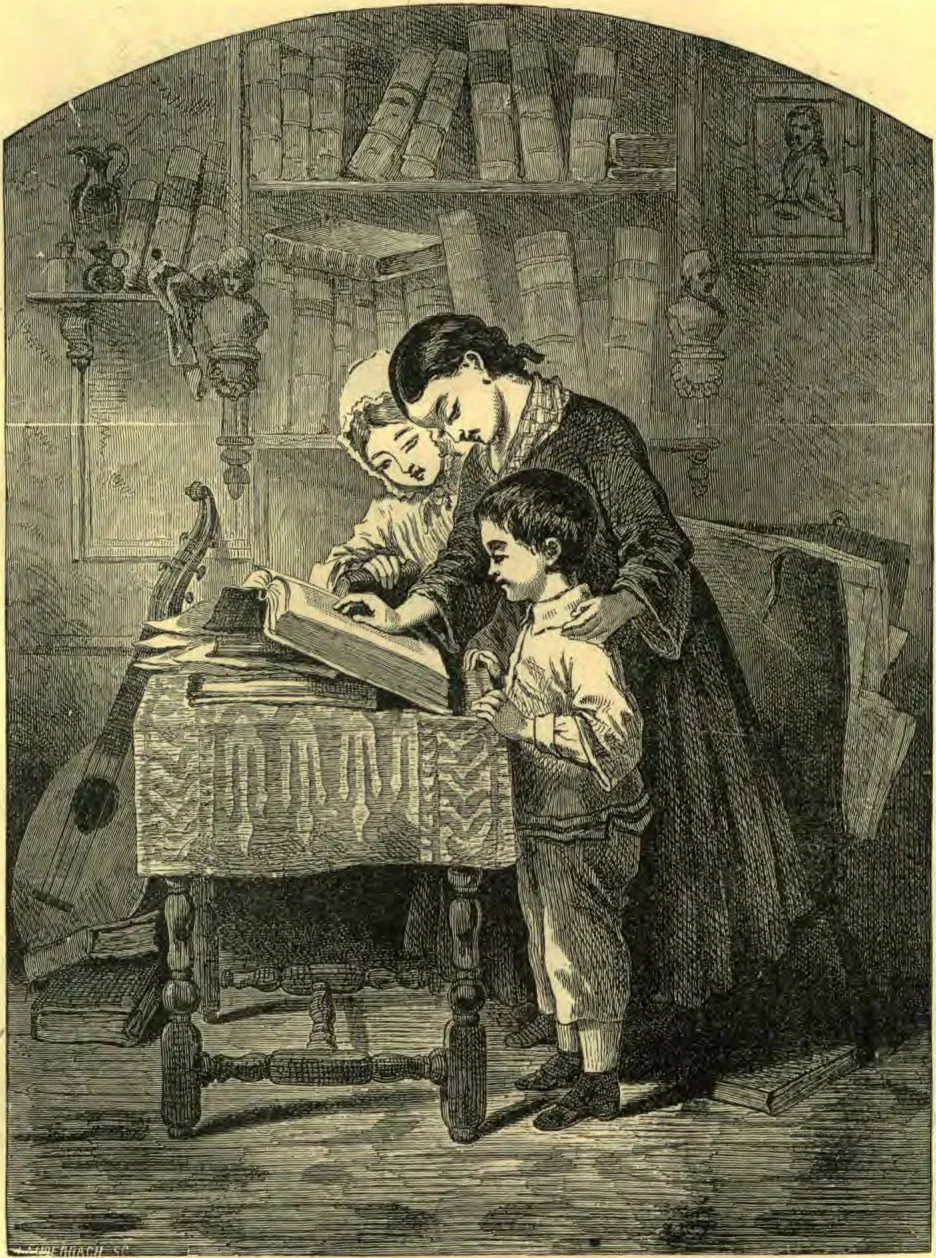
How many of the readers of the INSTRUCTOR are like the children whose faces we see in this pleasing picture? that is, earnest and interested readers of the Bible? We hope that the whole INSTRUCTOR family are of this kind; for the Bible has claims upon us which no other book has. Do you want to know which is the best book in all the world? It is the Bible. Which is the most interesting book? The Bible. Which is the oldest book? The Bible. Which contains the most ancient history? The Bible. Which contains the prettiest and most charming stories for children? The Bible. Which contains the purest precepts, and the plainest rules how to be good and holy? The Bible. What book alone explains about sin, and life, and death, and heaven, and hell? The Bible.
But it is not all this alone which makes the Bible the most important of all books. It is because it is God's book, and tells us what God wants us to do. When we come to feel that this book contains the will of our Maker, then it has charms for us which no other book possesses. It tells us how sin has come into the world, and how we have become defiled with it, and how we may get rid of it, and be saved and happy in his kingdom forever.
The Bible is, in many other respects, the most wonderful volume that was ever written. Many of the writers whose books compose the Bible never saw each other. They lived in different ages, separated by hundreds of years. They lived in different countries, separated by hundreds of miles. They wrote under all kinds of circumstances; in riches, in poverty; at home, in exile; in kings' palaces, and in dungeons; yet they all agree in what they write. It was more than fifteen hundred years after the first book of the Bible was written before the last was finished, the truth being brought out from age to age just as men needed it, and were prepared to receive it. But all this while its testimony is uniform, and one object is kept steadily in view; namely, to make men better, to lead them from sin to holiness, and show them how to gain heaven at last.
All this could not have been the case if the Bible was the work of men. We can account for this harmony and uniform tendency only on the ground that it is the work of God, who saw the end from the beginning, and who is the same in all ages.
The world owes all its progress, refinement, and civilization to the Bible. For in those countries where the Bible is not found, the people are low and degraded, half-civilized or savage; and wherever the Bible is introduced in these heathen lands, civilization and progress at once begin.
Then ought we not to love the Bible, and study it, till we know all about what it teaches? Yes, just as they are doing in the picture. Let our music stand one side, and let other books remain unopened, till we have first learned a good lesson from the precious Bible. Youth is just the time to acquire a love for this good book. Three chapters read on every week day, and five every Sabbath, will take you through the entire Bible in a year.
U. SMITH.

Letter Budget.

LILLIE MASTERS writes a letter from Morrison Co., Minn. She says: “I am nine years old. We do not take the INSTRUCTOR, but it is sent to us from a kind Sabbath-school. I go to Sabbath-school nearly every Sabbath with my brothers and sisters. I pray that my father may study the truth, and that we may all live together in heaven. We must do as the Bible tells us, if we are saved. We live on a farm, and papa works in town. I have three ducks, and I am going to try to raise some to sell, and give part of the money to the Mission. I had a little bird, but it died. I have a little baby sister. Her name is Ada May Annis. I have to get up early in the morning to take care of her. I love to go to school.”
ESSIE LUTHULZ, of Blue Earth Co., Minn., says: “I am a little girl ten years old. I attend Sabbath-school with my parents, and study in Book No. 4. I am interested in my lessons, and try to have them perfect. I also go to day school. Ma says she wants me to get an education so I can canvass for some of our good reading matter. I want to be useful some way. Last week I went to see my grandparents. They live in the house with my uncle. Grandpa is sixty-eight, and grandma is sixty-three years old. Grandpa met with a sad accident on the railroad, by which he lost his right arm; but he tends all his garden with one hand, and does much other work. I have read Testimony No. 31 partly through, and think it is good. I want to keep all God’s commandments, and have a home in the new earth.”
ANNIE C. and ALBERT J. JACOBY send letters from San Diego Co., Cal. Annie says: “As I have never seen a letter from here, I thought I would write while I have the opportunity to do so. I am thirteen years old, and am in the fourth reader. We try to do all we can for mother. I do all the housework, help mamma dress herself, comb her hair, and wash her hands and face. I do all the sewing too. I cannot write very good, because I have been sick. My youngest brother and I were sick with typhoid fever; I was sick two or three months, and so missed school then. There are only four of us to keep the Sabbath. My oldest brother keeps Sunday. We hope he may yet see the truth. We have sixteen little chickens. I want to be a good girl, so I can be saved.”
Albert writes: “I am eleven years old. I have one brother and one sister, both older than myself. We have kept the Sabbath only about a year, with Mrs. Striplin. The nearest Sabbath-school is twelve miles away. I have a kitten, and two hens. We have a dog named Shep. My brother has a colt named Billy. We are very poor. My mother is an invalid, not able to help herself. My brother is working away from home. We have a nice garden. We keep up family prayer. We read the Bible, and I try to be a good boy. We hope to meet the INSTRUCTOR family in the promised land.”
TRUELOVE LIVINGSTON, of Lancaster Co., Neb., writes: “My first letter to the Budget was not printed, and I am going to write the second time. I love to read the INSTRUCTOR, and to write letters for it. I have three brothers and two sisters. We all keep the Sabbath with mamma. We hope papa will keep it before it is too late. There are two in my Sabbath-school class, and we have our lessons perfect every Sabbath, in Book No. 2. We are nearly through the book. I am nine years old. I want to be a good girl, and be saved.”
BERTIE ORR writes from Wichita Co., Kan. He says: “This is a new country. My papa was the first man to take up land in this township. There are wild horses and antelopes here. A herd of nine antelopes came near our house one day. One of our neighbors killed one, and gave papa some of it. It was nice meat. There are no schools here yet, so mamma teaches brother and me at home. We can see a long ways out here when there is no mirage. I am a little boy nine years old, and am left handed. Brother and I are trying to be good boys, and do all God’s commandments.”
ROSCOE T. HILLS, of York Co., Neb., writes: “I take your paper and like it. I am nine years old. I have a married sister living at Ft. Calhoun, a brother twenty years old living at home, and a little adopted sister two years old whom we all love very much. We all keep the Sabbath but pa. I hope you will all pray for him. He has now gone to Colorado to secure land for brother Willie. We live on the prairies of Nebraska. It is now the tenth of March, and the meadow larks and robins are singing merrily. There is no snow here now, and some people are sowing wheat. I am trying to be a good boy; for I do want to meet all of God’s people in his kingdom.”
GEORGE F. NELSON, writing from Freeborn Co., Minn., says: “I am ten years old. I went to the Minneapolis camp-meeting last year, and I hope to go again. I keep the Sabbath with my parents, brothers, and sisters. I go to day school and Sabbath-school.”

THE LITTLE ONES HE BLESSED.

I WONDER if ever the children Who were blessed by the Master of old Forgot he had made them his treasures, The dear little lambs of his fold. I wonder if, angry and willful, They wandered afar and astray, The children whose feet had been guided So safe and so soon in the way.
One would think that the mothers at evening, Soft smoothing the silk-tangled hair, And low leaning down to the murmur Of sweet childish voices in prayer, Oft bade the small pleaders to listen, If haply again they might hear The words of the gentle Redeemer Borne swift to the reverent ear.
And my heart cannot cherish the fancy That ever those children went wrong, And were lost from the peace and the shelter, Shut out from the feast and the song. To the days of gray hairs they remembered, I think, how the hands that were riven Were laid on their heads when He uttered, “Of such is the kingdom of heaven.”
He has said it to you, little darling, Who spell it in God’s Word to-day; You too may be sorry for sinning, You also believe and obey. And ’twill grieve the dear Saviour in heaven If one little child shall go wrong, Be lost from the fold and the shelter, Shut out from the feast and the song.
—Margaret E. Sangster.

You have reached the end of this edition.

The Youth’s Instructor · Nov 9, 1887