S. D. A. Publishing Association · Battle Creek, Mich. · Nov 9, 1887
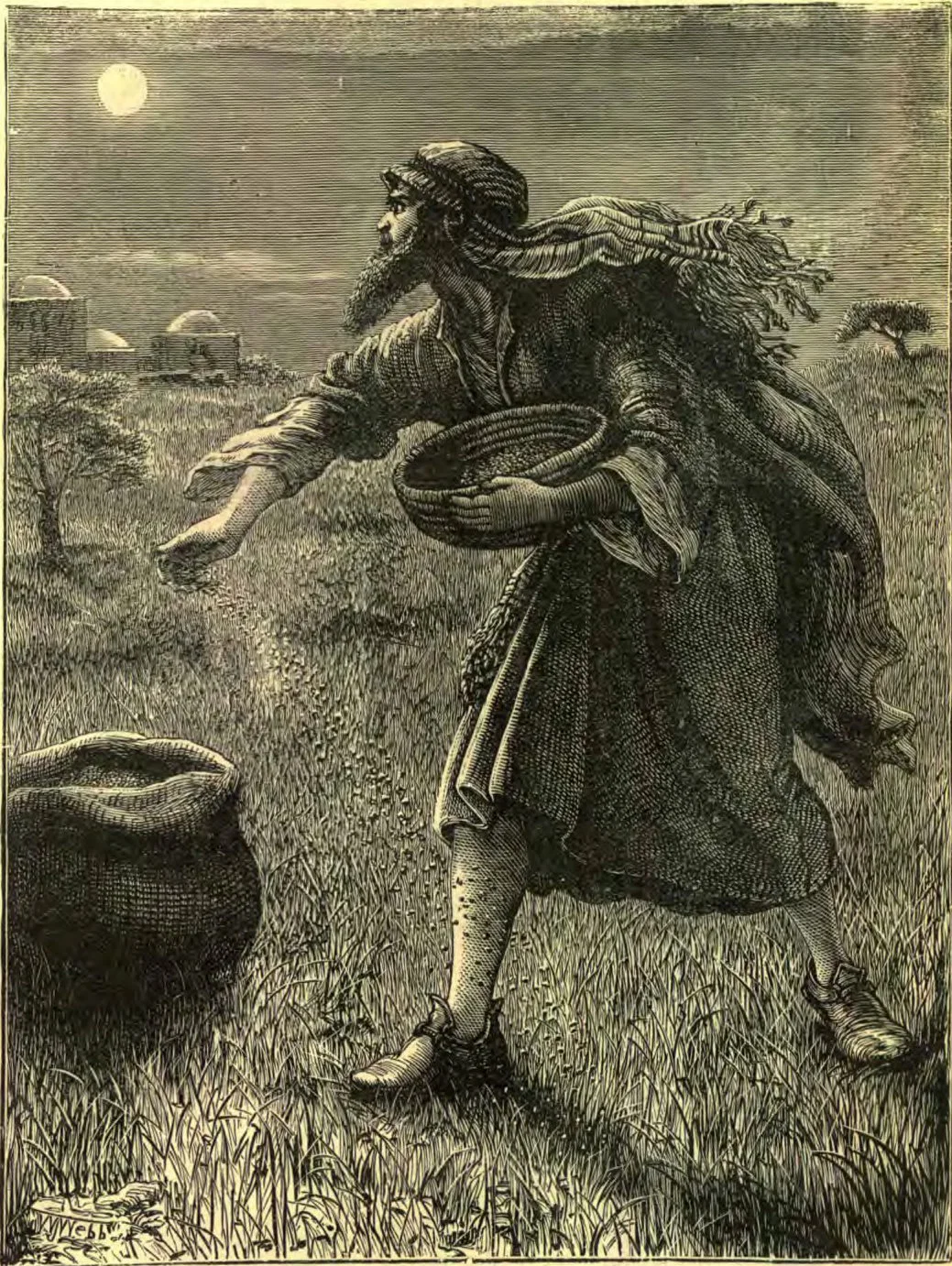
ONE OF THE SOWERS OF MATTHEW THIRTEEN.
By M. J. C.
“THE sower!” is your first thought, as you glance at the engraving on this page; and immediately the parable of Matt. 13:3-8 comes to mind,—“Behold, a sower went forth to sow, and when he sowed, some seeds fell by the wayside,” “some fell upon stony places,” “some fell among thorns,” “other fell into good ground,” etc.
Let us give the picture a closer examination and see if it illustrates this parable. You will observe that the sower in this instance is not casting his seed by the wayside, neither upon stony places, nor yet among thorns; and although the ground may be and probably is good, it was the custom anciently, as now, to sow grain upon bare ground, which had been prepared for its reception; whereas the picture represents this man as sowing seed in a field of sprouted grain; and, contrary to the custom of an orderly husbandman, he is doing the work by moonlight, or in the night time.
But “another parable put he forth,” in the same chapter, verses 24-30, which the illustration evidently portrays. It reads:— “The kingdom of heaven is likened unto a man which sowed good seed in his field; but while he slept, his enemy came and sowed tares among the wheat, and went his way. But when the blade was sprung up, and brought forth fruit, there appeared the tares also. So the servants of the householder came and said unto him, Sir, didst not thou sow good seed in thy field? from whence then hath it tares? He said unto them, An enemy hath done this. The servants said unto him, Wilt thou that we go and gather them up? But he said, Nay; lest while ye gather up the tares, ye root up also the wheat with them. Let both grow together till the harvest,” etc.
Evidently our cut represents a person stealthily scattering the seeds of some kind of deleterious weed among the growing grain, which shall very materially lessen the value of the crop. Roberts states, in his “Oriental Illustrations,” “that the exact counterpart of this nocturnal villainy may be found in India at the present day. A man wishing to do his enemy an injury, watches for the time when he shall have finished plowing his field, and in the night, he goes into the field and scatters pāndinella, or ‘pig-paddy.’ This being of rapid growth, springs up before the good seed, and scatters itself before the other can be reaped, so that it will be some years before the poor owner of the field can rid the soil of the troublesome weed.
“But there is another noisome plant which these wretches cast into the ground of those whom they hate; it is called perum-pirandi, and is more destructive to vegetation than any other plant. Has a man purchased a field which another intended to buy, the disappointed person declares, ‘I will plant the perum-pirandi in his grounds.’”
There are several species of tares, but the kind in this parable most writers and commentators define as the bearded darnel, “a widely distributed grass, and the only kind that has deleterious properties.”214It has a bitter taste, and, eaten in bread, produces dizziness, and sometimes nausea. Before the plant heads out, it so nearly resembles the wheat in appearance, that upon the closest examination one can scarcely detect the difference; and those who weed their fields do not attempt to separate them. But as soon as the heads appear, the tares are easily distinguishable from both wheat and barley, the heads are so dissimilar. Because of this, and for the reason that the roots, when growing together, have a habit of intertwining with each other, the command was to let both wheat and tares grow together until the time of harvest.
But, dear reader, the enemy that sows tares is not confined to India. His field is the world. The Saviour used this parable to illustrate Satan’s underhanded work. Wherever the good seed is sown, there the great arch-enemy follows with his seeds of death. And because it is so hard to remove the roots of his planting, it devolves upon us to be upon the alert to prevent his noisome seed finding a lodging place.
Is the field our own hearts; proportionally as we value a home in the kingdom of God should be our efforts to prevent any but good seed being sown therein. The good seed is the word, or truths of the Bible; and every planting which diverges in the least from these is of Satan, and should be jealously guarded against. Every evil inclination, doubt, or unbelief is his suggestion, which we should firmly resist. The times are perilous; for this enemy is very determined that he will in some way destroy us. We hope and pray that each member of the INSTRUCTOR family may get a firm hold of the hand of the Lord, who is able to deliver from the power of the enemy. M. J. C.
A PLEA FOR AUTUMN.
By J. J. Maxfield, M. D.
O tell me not that beauty dies
When Spring, concealed behind her veil,
Goes tripping over hill and dale,
And whispers back her faint good-byes!
Coquettish Spring must have her day,
But let the radiant Autumn stay.
'Tis then that Nature, matron grown,
Sings ever in a minor key,
And we who bow the reverent knee
Must feel the spell about us thrown;
And thoughts we never can express
Flow on in tides of tenderness.
The hills afar, in still retreats—
With Time forever keeping tryst—
Baptized in clouds of amethyst,
Wait for their snowy winding-sheets;
And hints of a returning Spring
Lie hid beneath their covering.
The violets, grouped on banks of green,
No longer star the paths we tread;
The blue-fringed gentian lifts her head
Where late the adder-tongues were seen;
And oaken banners, red as blood,
Float ghost-like, over field and wood.
Along the sad, still-flowing streams,
The insect hum of life is heard,
Shot through with songs of many a bird
Delayed by Indian summer dreams;
And over all the wold and fen
The spiders spin their gossamers.
The sumacs flame along the copse,
Where hang the clusters of the vine,
And hawthorn apples, red as wine,
Make radiant all the sunny slopes;
Where, nodding in their golden sheen,
The plumy golden-rods are seen.
The kine with slow, uncertain gait,
Wind up the narrow meadow path,
Where springs the fragrant aftermath;
The air is burdened with the weight
Of spicy, aromatic stores,
Blown in from fair Hesperian shores.
The blackbirds in the oaks we hear;
The piping quail in covert hid;
The green-veiled prophet—katy-did—
Foretells the dying of the year,
When Nature, grown morose and dumb,
By signs shall say: "The end is come!"
—J. J. Maxfield, M. D.
OUR GOPHERS.
By Mrs. Ada D. Wellman
Several weeks ago, the INSTRUCTOR “Scrap-book” contained an entertaining paragraph on the habits of gophers, one trait of that curious little animal being that it secludes itself in winter quarters even in the middle of torrid August. At the time when the number of the INSTRUCTOR containing that article was issued, we were assisting in a series of tent meetings in a locality in Michigan where pocket gophers abounded to the great annoyance of the farmers. The description was of especial interest to our tent company, from the fact that we were trying to make friends with the tiny marauders, and remove their fear of human beings.
How well we succeeded you may infer from the fact that two of the gophers, instead of going to their quarters in midsummer, tarried with us during many frosty autumn days; and when, on the eighteenth of September, we were packing our goods preparatory to moving, the most genial of our gopher acquaintances, a little one probably less than a year old, still occasionally appeared about the tent. However on the next day those who remained were unable to find any of them. They evidently understood that the disappearance of the white canvas signified a surcease of their usually bountiful supplies, and they hastened at that tardy date to their underground retreat, where they would doubtless have been ensconced during the chill weather of several weeks past but for the alluring tid-bits which we offered them.
Our acquaintance began on this wise: When we first pitched our tents, we often espied the brisk little creatures as they whisked past on a foraging expedition, or ran from stump to stump in the adjacent field, sometimes pausing and raising themselves on tiptoe to look or listen. One of our company had previously so won the confidence of a wild bird that it would eat from his hand. So we endeavored to gain the favor of the gophers by scattering crumbs as near the tent as the little fellows had been seen to venture, and thence to the tent door. These advances were graciously reciprocated; and soon the gophers would pick up bits of cracker as we tossed them from the tent door, though they would scud away in affright if a bit fell too near them, or if we spoke above an undertone. It was amusing to see one of them stand up and attempt to hold a large square cracker, nearly as tall as itself, while it nibbled the edge. It managed quite ingeniously, and was very persevering.
Closer and closer they came, and before long would caper over the floor of our family tent, occasionally joining us at the dinner hour, and dodging under and about the table in quest of food. The smaller one, from picking up crumbs at our very feet, came to take them from our hands, and later would climb up our arms and perch on our shoulders, picking up the crumbs which had been placed there for it. Cute enough this tiny object looked, standing upright on one’s hand, and holding with its forepaws the piece from which it was eating; and in that position it would remain though carried about. It would jump up on my knee, and run over my lap to pick up nut meats, of which it was very partial; and often springing a foot or two from the floor, it would cling around my fingers while it seized its lunch from my hand.
For a time we were astonished at the quantity which it ate, and we accused it of gormandizing; but closer observation showed that it was not its stomach, but its pockets, which were the receptacles for the food. And when those little pockets at the side of the neck—from which the animal derives the name of “pocket gopher”—were full of food, it gave its owner a very comical appearance. Away it would scamper, but return again immediately, with its cheeks and neck reduced to their normal size, ready for another deposit.
Acquaintances of ours who attempted to tame the little creatures were unable to do so, because they sometimes frightened and even entrapped them. Our little pets were the delight of the children who came to the tent, and little less so of the older persons. But some of them who seemed inclined to tease the tiny creatures learned that their much-coveted friendliness could be gained and kept only by strict care not to annoy them, but to favor them instead—a very successful way of making friends with other beings than gophers.
MRS. ADA D. WELLMAN.
THE REFUGEES
By D. A. Robinson
A PEEP AT AFRICA.—NO. 7.
THE REFUGEES.
We told you in our last something about the people that were driven from France on account of their faith, and how they fled to Holland, and at last found a home in South Africa, through the kindness of the Government of Holland. They were, after a few years, almost compelled to give up their own language and adopt the Dutch, so that in the course of time the Dutch language was all they understood. Abbe la Caille, the French astronomer, who visited the Cape in 1752, says, “I did not meet any person under forty years of age who spoke French, unless he had just arrived from France.” And Le Vaillant, the French naturalist, says that when he visited the Colony, in 1780, “he found but one old man who understood French.”
In process of time, many of these people became tired of the way in which the Government dealt with them. They were not allowed to sell their produce to any but the East India Company, and at such price as the Company saw fit to give. They were excluded from participation in foreign trade, and hindered in all their transactions. They wanted the privilege of free trade along the coast, but this was denied them. The manners and customs of the people at this time were rather more than these “Boers,” or farmers, could endure. One historian, in speaking of them, says: “When the Governor rode out, every one meeting him had to pay him homage, and persons happening to be in a carriage, must stop and get out of it till the Governor rode by. When His Excellency entered church, all persons, both men and women, stood up in token of respect; and his lady received the same honors. . . . Governor Ryk van Tulbagh, in addition to those rules, promulgated, in 1755, certain sumptuary laws, entering into detail as to the rank of those who should or should not use umbrellas, or wear silk dresses, embroidery, or other ornaments; the number of servants and horses that each rank might have; the costume of the coachman and footman; the dresses of brides and their friends at wedding ceremonies; even the style of mourning and of burial; in case of death,—all were minutely laid down, and larger or smaller fines were the penalties attached to the infraction of these regulations.”
In view of all this form and ceremony which prevailed, and of the monopoly of the market, many of the inhabitants left the coast region, and went over the mountains into the interior, where they subsisted after the native manner of life, by killing game and pasturing cattle. For many months in the year, bread was a luxury that could not be secured, the dried flesh of game or oxen taking its place. There was neither church nor school within a hundred miles of them, “but every morning and evening the patriarch of the family offered up prayer and praise, and read from the cherished family Bible, whose simple teachings served to maintain the principles as well as the forms of morality and civilization amongst them.” They suffered much from the natives, especially from the Bushmen, who murdered many of them.
Finally, when the contest between England and her American Colonies came, Holland became an active enemy of England. In 1780 England declared war with Holland, and planned an expedition to seize the Cape of Good Hope. A spy made known this intention to the French, who dispatched a fleet to protect the Dutch Company’s possessions at the Cape. As this French fleet was off Cape Verde, it fell in with the English ships of war which were on their way to capture the Cape. A hard battle was fought between the two fleets, the English ships were disabled, and the French Admiral went on his way to South Africa, landing about two or three thousand troops at Simon’s Bay. “The presence of this force” says the historian, “preserved Cape Town against any attack upon the part of the English fleet, and at the same time prevented the colonists from attempting to imitate the conduct of the Americans in their struggle for independence.”
Finally, however, possession was taken of the Colony by the British in 1795, but it was again restored to Holland in 1803. In less than three years England resolved to recapture the Cape of Good Hope. A strong force was sent out under General Sir David Baird, and after a short, honorable struggle, the Colony was surrendered to the British Crown. At this time the country entered upon a new era.
D. A. ROBINSON.
ROUND THE YEAR.
By George Cooper
AFTER snow,
Do you know
How the springtime days begin?
Grass-blades twinkle;
Showers sprinkle;
New birds pipe a silvery din;
Pink buds peep;
Rills out-leap:
So the springtime days begin.
Did a word
From some bird
Tell how summer days begin?
Meadow sweetness;
Flower's completeness;
Winds that all rich fragrance win;
Drowsy noon-light;
Balmy moonlight:
So the summer days begin.
Has a leaf,
Or a sheaf,
Told how autumn days begin?
“Bob White” calling;
Bright leaves falling;
Cricket's voices; tree-tops thin;
Sumac burning;
Meadows turning:
So the autumn days begin.
Did the blast,
As it passed,
Moan how winter days begin?
Brooks that shiver;
Darkened river;
Skies down which the snow-flakes spin;
Boughs that rattle,
Creak and battle:
So the winter days begin.
—George Cooper, in Golden Days.
THINGS EVERY BOY SHOULD KNOW.
“I BELIEVE,” says a Southern writer, “in schools where boys can learn trades. Peter the Great left his throne, and went to learn how to build a ship; and he learned from stem to stern, from hull to mast, and that was the beginning of his greatness.
“I knew a young man who was poor and smart. A friend sent him to one of those schools up North, where he stayed two years, and came back a mining engineer and bridge builder. Last year he planned and built a cotton factory, and is getting a large salary.
“How many college boys in Georgia can tell what kind of timber will bear the heaviest burden, or why you take white oak for one part of a wagon and ash for another, and what timber will last longer under water, and what out of water?
“How many know sandstone from limestone, or iron from manganese? How many know how to cut a rafter or brace without a pattern? How many know which turns the faster, the top of the wheel or the bottom, as the wagon moves along the ground? How many know how steel is made, or how a snake can climb a tree? How many know that a horse gets up before and a cow behind, and the cow eats grass from her, and the horse to him? How many know that a surveyor’s mark on a tree never gets any higher from the ground, or what tree bears fruit without bloom?”
“There is a power of comfort in knowledge, but a boy is not going to get it unless he wants it badly. And that is the trouble with most college boys. They don’t want it; they are too busy, and haven’t got time. There is more hope of a dull boy who wants knowledge than of a genius, who generally knows it all without study. These close observers are the world’s benefactors.”—Exchange.
False Friends Like Shadows
FALSE friends are like our shadow, keeping close to us while we walk in the sunshine, but leaving us the instant we cross into the shade.
FACTS OR SPECULATION, WHICH?
By G. H. B.
It is admitted on all sides that a Sabbath-school worker ought to know a great deal more than he expects to teach. In no other way can he be prepared for the emergencies that he is liable to meet at any time. It is well to make some special preparation for the teaching of the lesson of the day, but this is not enough. Questions may be answered very differently from what we expect. There is no knowing what turn may be given to a subject by some inquiring mind. Questions are liable to be asked which even the most experienced teacher could not anticipate. How often has the most carefully arranged plan been upset in a moment by the introduction of some such unforeseen element! In how many instances have the best laid schemes for battle been frustrated by some accident, or by some unlooked-for movement on the part of the enemy! Happy is the commander who at such a time has a strong reserve force ready to wheel into the field on double quick at a moment’s notice. Just so it is with a teacher. No military leader needs a reserve force more than he. Indeed, we may say no successful teacher is without it.
Some one has said that a teacher should be filled full to overflowing, in order that he may draw from his abundance to supply the wants of his class. But with what should he be filled?—Certainly not with vain imaginings, as is too often the case. Neither should it be with strange conjectures and wild speculations. Curious and far-fetched interpretations, as well as strained applications of Scripture passages, are entirely out of place in the Sabbath-school. It may be well to study the thoughts of other men on important subjects; but it is not good to be filled too largely with even wise men’s opinions. Men of great learning and high intellectual power are not infrequently bewildered on subjects that are practically plain to the humble yeoman whose simple faith and prompt obedience have given him a rich experience in the things of God. The light of Divine love in his heart is stronger than that of the great scholar’s intellect. The gracious Creator has made the way of eternal life so plain in his revealed Word that common people can understand it; and the question with us on the study of any subject should be, not what this one or that one thinks about it, but what does the Bible say in plain words that cannot easily be misunderstood.
The well-filled teacher, then, should be largely stocked with the clear, practical teachings of the Bible, especially on points oftenest needed in the every-day Christian life and warfare. He need not be able to repeat thousands of texts, verbatim, although the more he has of them the better; but he should be filled with the knowledge and wisdom which they impart.
There are few things that aid a teacher more than a complete knowledge of the history of the race, as set forth in the Bible. The best way of gaining this knowledge is by thoughtful reading of the Old Testament by course, and the New Testament from some well-arranged harmony of the Gospels. Help may be obtained from the Bible histories of good authors, but for every hour devoted to the study of such books, ten should be given to the reading of the Bible. Long dissertations and copious remarks often divert and confuse the reader more than they help him. And besides this, such extended works are liable to contain too many speculations. Let us first know what the Bible says; the nearer we come to the fountain head, the purer will be the draughts of truth which we take in.
But Bible history cannot be thoroughly understood without a knowledge of Bible lands. Every teacher should be more familiar with the country where the seers of old gave forth their flaming words of lofty imagery, and where Christ and the apostles walked and talked, than he is with any other part of the world which he has not seen. This knowledge cannot be gained by reading any one author. Book after book must be read, studied, and compared. Whatever is sustained by all of them may be taken for undoubted truth; the rest must be taken as a matter for further study. It is not enough to study maps and mere geographical descriptions. Accounts of travel in the Holy Land are indispensable, and also all such things as give us a vivid idea, not only of the country and its people, but of the country as inhabited by that people, and of the people as actually engaged in the duties and associations of life. Such a course cannot be accomplished in a few weeks; it is the work of years; but they may be pleasant years. One should read and study till the mind, unbidden, will revert to the scenes described in the sacred record, and dwell upon them, as upon things in which he has actually taken a part. By and by the habit will grow so strong that, when duty permits, one will often find himself witnessing the battles and marches, the journeyings, the meetings and partings, the triumphs and failures, the joys and sorrows, of those days, as though they were really a part of his life, and a present part as well. Such experiences make the events of the Bible appear real, and wonderfully near; and when such a teacher talks to a class, he makes those events appear strangely real to them. His heart is stirred within him as it would be if he were actually beholding those things, and he will carry to a certain degree those same feelings into the hearts of his pupils. This gives him wonderful power as a teacher; for one of the greatest things to accomplish is to make people not only believe that Bible characters lived and did what they are said to have done, but to make them feel as they would if those things were actually taking place now.
A real teacher must be filled with humility, so that he will always be teachable and striving to learn; with the love of God, so that he will point trusting hearts to their Saviour, instead of drawing them to himself; with the love of his fellow men, so that he may work for them unselfishly, and gain their confidence as he could not otherwise do.
These things are realities; they can be comprehended and grasped by every teacher, and are within the reach of all who will patiently toil toward that end. A teacher thus equipped will have no need to resort to novelties, in order to claim the attention of his class, and he will have this advantage, that while novelties soon cease to please, and must inevitably become exhausted, the teacher who brings forth from the bounteous store we have described, will create a deep and abiding interest,—an interest that will not only live, but grow stronger while life lasts. Such an interest does not rest upon fanciful illustrations, or upon vain speculations that lead the mind into the barren regions of doubt and uncertainty, but upon sober facts of faith, the sound experience of ages, the love of the Father and the Son, and the indwelling of the Holy Spirit.
G. H. B.
CHANGE VERSUS IMPROVEMENT.
By M. B. C.
WASHINGTON IRVING says that, as soon as a Yankee becomes of age, he makes up his mind to settle in life, which means to begin his wanderings. If Irving lived now, I wonder what words the great satirist would use to express his contempt for our national characteristic—our mania for change.
There is little about our nation, except the Constitution, which has not radically changed. Indeed, were it not that the Constitution seems almost sacred to American hearts, it would probably have lost much more than it has of the strength and vigor which Jefferson gave it.
We see this restlessness in all the avocations of life; and if it were only confined to secular affairs, we might not regard it with so much alarm. But when the mania for constant improvement—i. e., change—breaks out in our Sabbath-schools, we feel constrained to “cry aloud, and spare not.”
Why, it has reached such a pass that every time I enter a Sabbath-school, I feel on the tip-toe of expectation to find out what wonderful improvement has been taxing the ingenious minds of the officers since they last met. Of course we should not stagnate; we should not get so deeply into a rut that it is impossible to get out. But on the other hand, a school should be very careful to avoid a nervous restlessness, a longing for the stimulus afforded by change. “But we must keep up the interest of the children,” perhaps you say. If the children cannot be made so infatuated with the beautiful stories of the Bible that their interest will remain unabated from week to week, I hardly see what good will come of their attending Sabbath-school at all.
It used to be a very general practice in day schools to offer prizes and rewards of merit for good behavior and diligence in study. But eminent educators, the world over, have cried down the practice as a malevolent evil; for if scholars do not learn from motives of love for study and interest in school work, it will profit them but little; indeed, it will be a positive injury to commit lessons by heart simply for the honor of gaining a prize in the end. If such practices are prolific of pernicious results in day schools, how much more so in Sabbath-schools, where the children should meet for the sole purpose of studying the Sacred Word of God! Everything like emulation should be sedulously avoided. The children should be made to comprehend that a poor lesson, indifferently recited, is a disrespect to God.
All sorts of parade are but so many stumbling-blocks in the way of the children. All popular innovations but bury the original object of the school so deeply beneath the evolutions and maneuverings, that one begins to wonder what the original object of the school was. If you have any real improvement to make, make it, in God’s name; but remember that the Sabbath-school is not a proper place to make experiments, and that improvement is not a synonym for change. M. B. C.
THE TEACHER'S PRIVILEGES.
By Eva Bell Giles
Whoever accepts any place of trust or responsibility, by that act agrees to fulfil the obligations involved. Such is the unwritten covenant of every teacher who accepts a Sabbath-school class. These obligations may be considered as duties or as privileges, according to the way they are looked upon. Truly, “the heart giveth grace unto every art;” and to the teacher whose heart is in the work, are afforded some of the most precious privileges of life. One of these is the opportunity to become personally acquainted with every member of his class. However well his efforts may be put forth in the school, his work by no means ends there. Through all the week there should be in his heart an interest and personal concern for every one of his little flock.
No two pupils are exactly alike in character, and the teacher who would successfully interest and instruct each one, must make the different members of his class a study. This cannot all be done at the Sabbath-school. The scholars should be visited at their homes; there the teacher may get an insight into the character, habits, and peculiarities of each.
It is natural for every teacher to love intelligent, faithful pupils better than dull or bashful ones; but we should be careful to guard against showing our preferences. It is very hard to keep from manifesting these feelings, if we have them; so the best way is to try to avoid having favorites. We are not to love the gentle only,—not Jennie because Jennie's mother is our best friend, or Nellie because she is pretty, or Willie because he has winning ways,—but all, if not for their own sakes, for Christ's sake. The rude, insubordinate, or disagreeable ones need our help more than those who are more tractable, and we have the more to do for them. If for the disagreeable, unlovely ones we work hard, and pray, we shall almost assuredly come to love them. These, of all others, should be visited at their homes, helped with their lessons, and encouraged to regard the teacher as a friend, as well as an instructor. Often a pupil who is stubborn or diffident becomes one of the most faithful and interested in the class, when he finds that his teacher really has a care for him, and is grieved by his negligence. Love begets love, inspires confidence, banishes coldness; puts a new light into the teacher's eye, and a new melody into his voice. If the teacher is thoroughly imbued with the right spirit, it will prevent favoritism, and give him joy in working even for the dullest of his pupils.
We are ourselves made better by all wise and loving doing for others; and the teacher is almost sure to love more dearly and be more dearly loved by a scholar for whom he has much anxiety and has made great efforts. But there is one danger right here which must be guarded against. Some teachers, who really mean well, succeed in winning the confidence of their pupils in such a way as to create for themselves a sort of hero-worship. The result of their efforts is to attract to the teacher's self instead of to the Saviour, or to the Bible and its teachings. The wise teacher will skilfully turn attention from himself to the truths he teaches, and to Him who alone is worthy of our homage. He will try to lead his pupils to obey right principles because they are right, not simply to please their teacher.
If one of your class is absent from the school, make it a point to find out the reason for it before another Sabbath. Sickness may be the cause; and a friendly visit from the teacher will be likely to do much good, and be really appreciated, both by the pupil and his parents. Or the absent one may have become discouraged for some reason, and your visit may be the means of bringing him back to try again. Perhaps some of your class are becoming careless216or indifferent; they are not very punctual in attendance, and their lessons are not well learned. A visit to them is certainly in place, and you may succeed in arousing their interest anew in the work.
How many scholars, in city and in country, the world over, are lost to the Sabbath-school and the good influences it might exert on their whole after life, by the neglect of teachers to follow them up when they first absent themselves from the school! Do we want to be held responsible for souls thus lost?
It is an excellent plan for the teacher to meet with the whole class, of an evening or afternoon, to look over the lesson with them, and show them how to study and become interested in the word of God. Such an informal class-meeting held every week is an invaluable aid to the teacher in his work, though a monthly meeting is much better than none. What opportunities for good such occasions present! Not only do teachers and scholars become acquainted with each other, but an interest is created in the study of the Bible; and the teacher finds opportune moments when a word spoken “in due season,” may lead some unconverted one to God. Some of the most delightful and satisfying friendships of life are those formed between teachers and pupils. We should never look upon the bond as a slight one, but rather let it take hold of the most enduring part of our nature.
Twenty years ago a young lady was given a class of restless children—little girls—by whom she tried faithfully to do her duty, in school and out. Doubtless her work sometimes appeared to her a thankless one; for we did not all want to “be good;” and she must have been many times pained by our careless indifference to her words of love. After a time, she was married, and went to a distant State to live. The years crept on, bringing many changes to the little band. Some laid down to their long sleep before grown to womanhood; others have lived to drink deeply of life's bitter cup, and the careless days of our childhood are become a dim memory.—To-day, I opened my door to a strange lady, and bade her be seated, without having the least idea who it could be. As she remained silent, only looking at me very earnestly, I said, “I do not think I have ever met you before.” “Don't you remember ———?” she replied. Memory struggled for an instant, and then it was all clear. “Know you? yes; my old Sabbath-school teacher!” and neither of us could keep back the tears.
And do you know the very first thought which memory grasped, as it came to me who my visitor was? 'Twas a picture of an old-fashioned parlor, wherein were seated on black hair-cloth chairs six or eight little girls and their teacher. The occasion was a little class-meeting, which I now remember she was in the habit of holding with us almost every week. For a moment I did not see the faded woman before me; but instead, the blue-eyed, round-faced girl, as, after going over our next Sabbath's lesson with us, she talked one by one with her little scholars about being good; and finally kneeled and prayed with us. From time to time some of us yielded to the good Spirit, and joined our broken little prayers with hers. Many times there were tears on her face when we arose, and we wondered why her eyes were so often full as she kissed us each, and bade us good-bye. Ah, faithful teacher, the years had-almost obliterated your face from my memory, but never shall time destroy the remembrance of your loving efforts in our behalf. Since, I have known what I could not then realize,—the anxiety and tenderness which filled your heart for us.
When the great Teacher shall gather his own beside the crystal sea, we cannot doubt there will be many little circles around him, formed of those who loved him here, taught in his name, and have come, bringing their sheaves with them.
EVA BELL GILES.
Sabbath School Department Monthly Notice
This department will appear once a month, specially in the interests of the S. S. work. Contributions to it should be sent to the editors of the Youth’s Instructor.