Tom sat at his little desk the next morning, pen, ink, and paper beside him. He was just beginning a letter to Uncle Ben.
“O Tom!” interrupted his sister; “I had such a happy dream last night; I thought I was trying to cross a deep river in a little boat. The river seemed so wild; and the waves, higher than my head, were just ready to come down upon me. I thought I could never reach the other shore, when there seemed to stand by me a beautiful woman, with wings of light. I thought she took her seat in my boat, smiled lovingly upon me, and with three or four strokes of her oar, landed me safely on the other side.”
“Why, Maggie, that does a fellow good to hear. It makes me think of the time Christ came and joined himself to the disciples’ boat in the midst of the tempest, and immediately it was at the land.”
“Yes, but see, Tom; I didn’t finish telling you. Isn’t it queer? I dreamed that as soon as I was safe on the shore, lo and behold, the lovely woman with the white wings was Aunt Linda. When I went to thank her, I awoke.”
“That’s a very good dream, little sister; now dear, keep real still, so I can finish my letter. Wait, there comes the postman. Just step to the gate, will you, Maggie, and get the paper?”
“Tom Willis, see here!” exclaimed Maggie, hurrying up the steps, with more eagerness and enthusiasm in her manner than her brother had seen for many months. “Look quick! I just do believe we’ve got a letter from Aunt Linda! Anyway it’s postmarked ‘Miles’ Creek.’”
“I declare you’re right, I do believe. Hurry up, Maggie! How you tremble! There! you’d better let me read it for you.” And this is what Tom read;—
MY DEAR NIECE AND NEPHEW: I can imagine your surprise as you open this letter. Wonderful are the ways of the Lord. All things are possible with him. Perhaps you were too young to remember the story of the foolish quarrel between your mother’s family and mine. I shall not need to repeat it. But God has opened my eyes, and I can only praise him. Three months ago the little boy died,—I always think of him as a little boy, though he was nearly fifteen,—whom I adopted when he was but a baby, and who was to289me as my own son. Now the great house seems so empty! I have been wondering if you—Maggie and Tom—would be content to come and live with Uncle Walter and me, and help make our home peaceful and happy. I remember you both before your dear mother died. But in my blind selfishness, I did not love and care for the lonely children of my poor sister as I should. I must tell you that your Uncle Walter is anxious for you to take this offer kindly; and as Tom has had some experience as a clerk, I am sure he can make himself useful to his uncle. I hope you will forgive my past selfishness, even as I believe God has, and write very soon to your affectionate—
AUNT LINDA.
Tom was the first to speak, after the letter had been read. Maggie was silently weeping. “Well, little girl,” he said, with a suspicious huskiness in his voice, “when do you think you and I will learn to trust? Providential, isn’t it, sister? Now I guess I’ll write to Aunt Linda instead of to Uncle Ben. Didn’t I tell you, Maggie, we were doing wrong to worry so?”
“O Tom! to think that we can go together, and need not be separated, after all! You can’t think how I dreaded it,—and besides, maybe Uncle Ben wouldn’t have needed you. This is better even than to have kept on working for Mr. Beardsley. O Tom!”
Better?—Yes. The Lord’s ways are always better than ours—so much better. He is able to do exceeding abundantly above that we can ask or even think. And yet, like Tom and Maggie, we sometimes forget whose are the Almighty Hands that are holding the reins, and guiding us onward over the uneven path of life, with more than an earthly father’s tender care and solicitude. Then, when affairs all at once shape themselves wondrously, and we are delivered from some sorrow which has threatened to overwhelm us, some trouble which has seemed ready to swallow us up, we remember that there is a God in Israel, and in shame and humiliation of heart we lay our hand upon our lips, in silence over our unbelief.
So it came to pass that one dull, cloudy day in October, less than a month after the receipt of Aunt Linda’s letter, Tom Willis and his sister found themselves in the station at Harrisburg, waiting for the train which was to carry them to their new home in the sunny South.
The last few months had been sad ones indeed to them; but they could look back now, and see the Love that had led them, and the Hand that had guided them. Yet when they had stepped out of the little front gate, and latched it behind them for the last time, a feeling of sadness unspeakable rushed over them. They had bidden good-by to each familiar room; the little front chamber, where their mother had died, always seemed associated with tender memories,—memories which were darkened only by the picture of that terrible night when their father, mad with the delirium of strong drink, had breathed out his life upon the little couch in the corner.
Mr. Beardsley had stepped down to the station to see them off; he had never lost his kindly interest in them.
“So you are off for good, Tom! God bless you! I hope you’ll do well,—and—and you will. You have trusted in God, and he will never forsake you.” Then he spoke of Reginald, and of his fears for him, and the sorrow of heart his wayward son had already caused him. “Father talked to me about my boy, before he died; but he said the Lord was mighty, and he trusted that the end would be peace.”
“I trust it will. We will hope for the best,” Tom had answered, as he took his old employer’s hand in a warm grasp, and bade him good-by. One by one, the last familiar objects, the last well-remembered landmarks, had been passed. Already it was getting dark, and they could see the lights twinkling in the little stations as they whirled rapidly past. Grateful tears were shining in Maggie’s eyes as she pressed her brother’s hand, and whispered, softly, “Even the night shall be light about me.”
The darkness shineth as the light;
The day is even as the night
To Him who guides, upholds, protects,
Who all my ways in love directs.
James Beardsley sadly missed the gentle presence of his departed father; for the example of a godly life never ceases, never dies. Like the gleaming stars of heaven, the influence of the just shines on and on, one generation after another. A passing cloud may seemingly obscure the light for a little time; but when the cloud passes, the tiny point of light gleams on, none the less brightly for the passing shadow.
And so, after the sudden death of the old deacon, the godly life which he had lived in so quiet and unostentatious a manner shone forth with added brilliancy. Even Grandmother Sharpe declared that a good man had passed away; and that she always had thought that if ever there was a saint of the Lord, it was Deacon Beardsley.
MRS. L. D. AVERY-STUTTLE.
(To be continued.)
SINGING BY THE WAY.
By Eben E. Rexford
Ho, comrades, heavenward-faring,
Let's sing in cheerful strain
A song to lighten labor,
And soothe the heart of pain,—
A song of God's own gladness
So full of help and cheer,
That weary wayside pilgrims
Will gain new strength to hear.
Life holds for most, my comrades,
More happiness than pain.
God gives a day of sunshine
For every hour of rain.
So, trusting in the wisdom
Of his eternal plan,
Let's face the rain or sunshine,
And do the best we can.
O, let us sing, my comrades,
Of blessings by the way,—
The gleams of light that brighten
The lowering skies of gray;
And as we sing about them,
The shadows break apart,
And all the world's in sunshine,
Because we're light of heart.
— Eben E. Rexford.
Jesus' Gospel Is One of Good Cheer
JESUS’ gospel is one of good cheer.
THE TRUE LOVE.
“Jesus, thou art the sinner’s friend,
As such I look to thee;
Now in the fulness of thy love,
O Lord, remember me.
Be Christ our pattern and our guide,
His image may we bear;
Oh, may we tread his holy steps,
His joy and glory share.”
LOYAL WITNESSES.
For nearly two and one-half years it has been the blessed privilege of the writer to speak each week, through these columns, to the army of children and young people in all parts of the world who constitute the loyal supporters of the YOUTH'S INSTRUCTOR. For this privilege he now feels constrained to acknowledge his indebtedness and sincere gratitude to God. Though writer and reader have come face to face in only a few instances, a strong affection has grown up in the heart of the former for the dear young people for whom he has been laboring. That God's richest blessings may ever abide upon them all is his earnest prayer. Though future labor may not bring him in such close association with the INSTRUCTOR family as heretofore, he will continue to have a most earnest interest in both the temporal and spiritual welfare of each one of its members.
In bidding farewell, may not expression properly be given to a few thoughts that may be regarded as a personal message to each individual reader—a heart-to-heart talk? Our blessed Master says, “Ye are my witnesses.” In a peculiar way this is true of little children; for Jesus also says, “Of such is the kingdom of heaven.” Dear young friends, are you earnestly striving every one, day by day, to be faithful witnesses for your dearest and best Friend, who so loved you that he gave his life for you? You will often be sorely tempted to prove untrue and disloyal. Often will the deceiver come to you, and ask you to think, “O, what's the use. There is —. He makes a lofty profession of righteousness and piety, and proclaims his own supposed moral and spiritual superiority on every possible occasion, but he often commits deeds that outrage every principle of ordinary justice, equity, and right. His life is at utter variance with the high and holy principles taught by Him whose witness he claims to be. If such is Christianity, I'll have nothing whatever to do with it.” But such is not Christianity—only a miserable counterfeit. Shall you, because some one else proves untrue, also be disloyal—a false witness? If a dear friend of yours were on trial before a court of law, would you desert him, and bear false witness to his great injury, because some one else had done so? You all answer most positively No. Can you, then, entertain for a moment the thought of deserting the best and most loving Friend you ever can have—the blessed Saviour, because these, perchance, have proved untrue? Finally, dear young people, “whatsoever things are true, whatsoever things are honest, whatsoever things are just, whatsoever things are pure, whatsoever things are lovely, whatsoever things are of good report; if there be any virtue, and if there be any praise, think on these things.” Make no compromise with error. Be always true to the right, loyal witnesses for Jesus,—“the Way, the Truth, and the Life.”
QUIT YOURSELVES LIKE MEN.
By M.
It is not the material, but the mental and spiritual forces, which are supreme. Knowledge is power, yet the ability to utilize knowledge is that which sets the power in motion, gives it activity, and makes it fruitful. Power may be either a blessing or a curse. So, as there is knowledge of good and evil, there is knowledge which is good and knowledge which is evil. The possession of evil knowledge is a curse to the world and to its possessor. Knowledge of the good, the true, the beautiful, is a blessing to him who possesses it, and to the world as well. The sum of the acquired facts which a man has stored in his mind is the measure of his knowledge. But the ability to use this reservoir of yet inert power is wisdom. Knowledge is the material which wisdom uses. So get knowledge, but always remember that knowledge without wisdom is either useless or dangerous, perhaps both. The only limit to the acquirement of knowledge is that put upon Adam and Eve in the beginning. The spoken, written, and created word of God as it has been, is, and will be, presented to us, gives unlimited opportunity.291That is the field in which they were to exercise their faculties. It is the same which is given us. The words and works of Satan are prohibited now as then. The wise man does not give his strength to the acquirement of satanic knowledge. The knowledge of evil can never be used with wisdom, because it is the part of wisdom never to use such knowledge, and never, indeed, to acquire it. This is also true because while knowledge may be of man, or even of Satan, wisdom is always of God. Solomon desired wisdom of God, and God gave it to him. While he gave his heart to know wisdom, and to gain more, and used that which God granted him to search out all things that God had done under heaven, and to know and understand concerning all creatures that God had made, God blessed him; but when he turned his mind to study the things of Satan, and desired in his heart to know madness and folly, God left him to the results of his unlawful studies.
It has been the desire of the INSTRUCTOR that its young readers should give their hearts to know wisdom, and their minds to acquire all the knowledge which is taught them of God, or which is now or ever has been, taught of him to any man, knowing that all valuable knowledge has its beginning in the fear of the Lord; then, that the wisdom which God granted them should be used in the application of the knowledge which they had acquired. And so, having a practical acquaintance with the power of God through a knowledge of the wonders of his created universe, that they should go forth to conquer in the good fight of faith, and acquit themselves like men and women appointed of God to advance his standard in these last days, and carry it on its final progress across the world. For this great service there are needed men and women furnished with the full armor of God, and with wisdom to wield their weapons with all the power of the widest knowledge which the human mind, aided by the blessing of God, is privileged to attain.
And now we, who have talked with you editorially through the INSTRUCTOR, until we have come to joy in every evidence and hope of your mental and spiritual growth and development, and have hailed you comrades in every lofty thought and high endeavor undertaken in the simplicity of truth and faith, now bid you farewell,—with the parting injunction to quit you like men, and show yourselves approved unto all good works, as becomes those who have been taught of God.
M.
ANNOUNCEMENT
By Editor
WITH this number the present editors of this magazine yield its editorial control into other hands. The warm-hearted interest taken in the INSTRUCTOR by contributors, subscribers, and its readers, and especially their earnest support since it has been published in magazine form, have been very grateful to the editors; and they bespeak the same, and increasing, support for the incoming editor, who has long had an intimate acquaintance with the form and method of its publication, and brings to her work a trained accuracy and literary skill which can not fail of appreciation.
REAL COURAGE.
By B.
DURING the year just past, war and warfare have been the subjects uppermost in the minds of most persons in the United States, as also in Spain. From nearly every hamlet in the land have gone forth to do battle for their country many “boys in blue.” Fathers, mothers, brothers, sisters, and sweethearts have assembled, at hundreds of railway stations and boat-landings, to bid adieu to loved ones, some of whom were never to return. Thousands of columns in newspaper and magazine have been devoted to the most detailed description of every circumstance pertaining to the conflict, and the skill of hundreds of artists has been brought into service more fully to set before the reader the dread realities of war. And now the market is flooded with an almost endless array of war-history books, good, bad, and indifferent. The result is that the war-spirit has been rife everywhere. Nearly every man and boy who has donned the blue, and shouldered a musket, has become some one's hero. Thus fighters have been lionized, and peacemakers and lovers of peace have been unceremoniously slighted, and set aside as of little account. But the Captain of our salvation has said: “Blessed are the peacemakers: for they shall be called the children of God.”
To be sure, it requires courage and daring for any man to take his life in his hand, and deliberately face a cannon’s mouth; but is that the highest order of courage? This is a question well worthy the most careful thought of every young person; for upon its proper answer depends the eternal welfare of every one. He who decides that physical courage exceeds, in importance and value, moral courage, becomes, by reason of such decision, “of the earth, earthy.” His ideals can not be high, inspiring, elevating, or ennobling. The most courageous are they who fear most—fear to do wrong, who dare resolutely to say No to any proposal that compromises truth and right.
Not the field of carnage, but the arena of individual life, is the place where true courage is most needed; and there greatest danger lies. In the course of an address on war, John Ruskin has well said: “Pray, mothers and maidens, for your young soldiers in the bloom of their pride; pray for them, while the only dangers round them are in their own wayward wills; watch you, and pray, when they have to face, not death, but temptation.” May all INSTRUCTOR readers ever and everywhere have the real courage and the true power—the power of the Spirit of God—to meet every temptation; and, meeting, CONQUER. B.
FOUR-HANDED ANIMALS.
By M. E. Cady
While we have spoken of several of the Land Animals, there are many that we shall have to leave without saying much about, further than simply to suggest their names. So far, we have studied the Many-footed Animals, Spiders, Insects Toothless Animals, Gnawing Animals, Flesh-eating Animals, Hoofed Animals. Others that would be interesting to study are the Hand-wing Animals (the bats); the Long-snouted Animals (the elephant and rhinoceros); Milk-givers of the Sea (whale, seal, walrus); but you can read and study about the habits of these animals at your leisure.
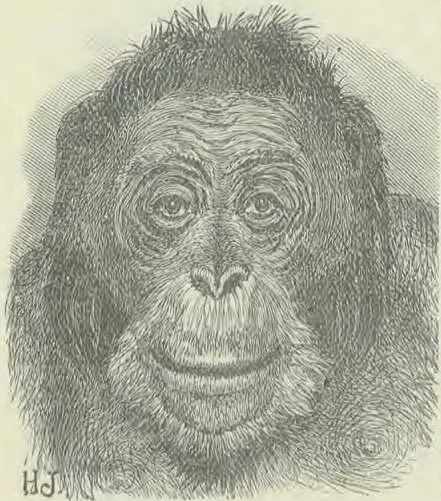
ORANG UTAN.
I must not close the study of the Land Animals without noticing the interesting group called the Four-handed Animals. They include the monkey, ape, gorilla, chimpanzee, orang-utan, etc. All these creatures live in tropical climates; indeed, it is with some difficulty that they can live in the temperate regions. The principal home of the monkeys of the New World is Brazil. It is a land of perpetual summer, with dense, luxuriant forests, which abound with fruit, the favorite diet of the monkey.
The reason this group is called the Four-handed Animals is because it is able to use all four limbs as hands. Not only so, but their feet are formed like a man’s hand, having four fingers and a thumb. The spider monkey is sometimes said to have five hands; for it can use its tail as a hand to grasp a branch, or another monkey’s hand. It is called the “spider monkey” because it looks like a spider going over its web, when, with hands, feet, and tail, it glides swiftly over the network of branches. These monkeys sometimes make a “monkey-rope,” reaching from the limb of a tree to the ground, by hanging by their tails, one beneath another.
Another monkey living in South America is called the “howling monkey;” for every time the sun rises and sets, this boisterous fellow begins to howl. Others take up the cry till often forty or fifty join in with him. These howlers are often caught, but it is impossible to tame them. South America contains the only monkeys that can use their tails for grasping.
The monkeys in the Old World live in Southern Asia, the Malay Islands, and in Africa. They use their tails for balancing as they pass over slender, shaky limbs. They also have pockets, or pouches, in their cheeks, in which they store away their food while gathering it.
The baboon has a head like a dog, and is larger than the monkey; but it has a shorter tail. Apes are larger than baboons, but have no pouches for storing food, or tails for grasping or balancing. Monkeys, apes, and baboons have hands with four fingers, and a thumb that can press directly against any of the fingers. The apes, which include the chimpanzee, gibbon, gorilla, and orang-utan, are more like human beings; for they often go about on two feet in their native homes.
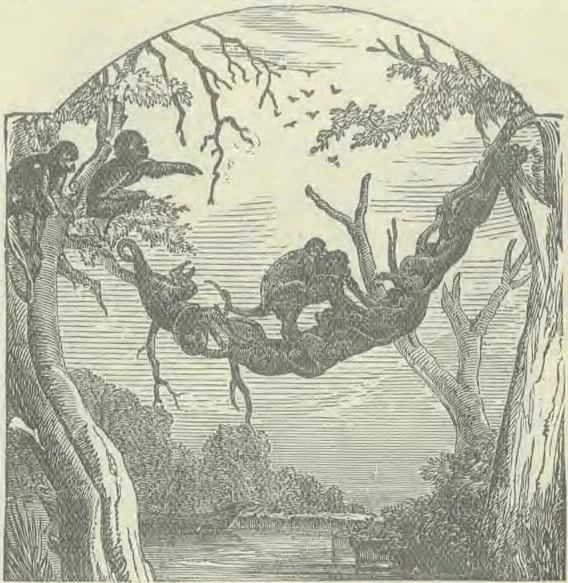
A LIVING BRIDGE.
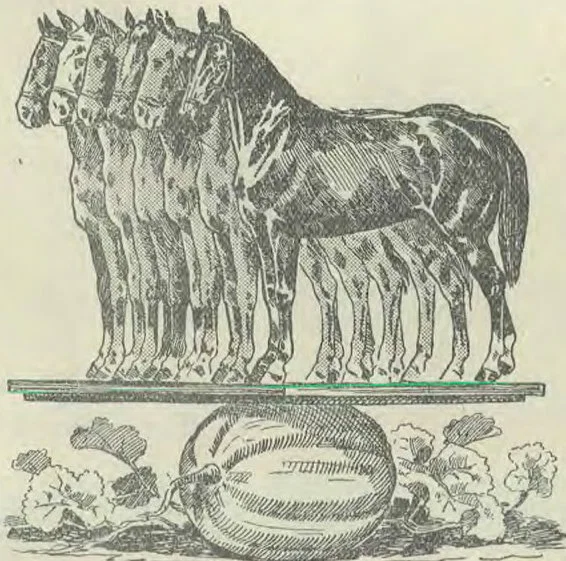
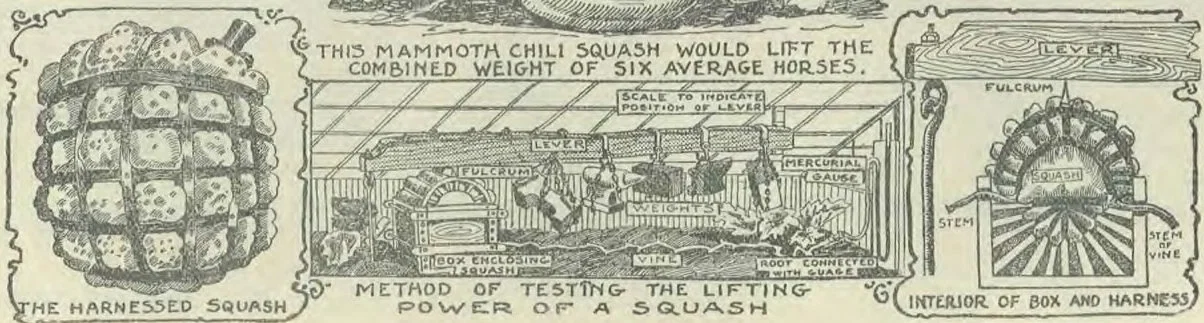
THIS MAMMOTH CHILI SQUASH WOULD LIFT THE COMBINED WEIGHT OF SIX AVERAGE HORSES.
METHOD OF TESTING THE LIFTING POWER OF A SQUASH
The Four-handed Animals are most interesting creatures to watch. They are very curious, mischievous, playful, and very skilful at mimicry. They perform some wonderful feats, one of which I must tell you about. Out of their own bodies the monkeys can form a living bridge across chasms, gorges, and rivers, so that the mothers and children can pass over easily and quickly. This is how it is done: Several of them run up a293large tree near the edge of the stream, then one of them passes out on a strong limb, and taking several turns of his tail about it, slips off, and hangs with his head downward. Then a second one climbs down the body of the first, and fastens his tail about the neck and fore limbs of the first. This is repeated until a long monkey-rope is formed. This living rope starts to swinging, slowly at first, but in a few moments its lower end touches the branches of a tree on the opposite side. The lower one grasps hold of these, and the bridge is made. Sometimes four or five hundred monkeys will pass over this living bridge. The question now arises, How will the monkeys forming the bridge pass over? If number one should let go his tail, he, with several others, would be dashed against the opposite bank, or soused into the water. God has endowed these creatures with intelligence which will help them out in their seeming emergency. Several of the strongest monkeys throw their tails about the last monkey in the bridge, and run up a strong, high limb, thus lifting the bridge into an almost horizontal position. This being done, a screaming signal is given by the last monkey, to the first one forming the bridge, to let go of the limb; then the whole chain swings over. The lowermost animals drop to the ground, while the higher ones leap to the branches, and come down by the trunk.
This completes our study of the Land Animals. While our study of the Four-handed Animals has reminded us of man, there is a wider difference between them than there is between them and other creatures in the whole animal kingdom. Next time we will take up the study of Man, the master-piece of all God’s creation. M. E. CADY.
POWER OF GOD.
By T. E. Bowen
Christians sometimes lament their lack of power. But it is not the lack of power that is the trouble, but their failure to connect with the mighty power which God has placed within their reach. Like the electric car, the power is not in itself. But above is plenty of power. It must keep its connections. Thus it is necessary for us to examine ourselves to see whether we are in the faith—the channel of God’s power. Of Christ it is said: “For though he was crucified through weakness, yet he liveth by the power of God. For we also are weak in [“with,” margin] him, but we shall live with him by the power of God.” The power of God is manifested in everything that lives. In life there is power. We live “by the power of God.” It is true that this living power is not always recognized; and sometimes when it is recognized as power, it is not recognized as the power of God. All power is committed into the hand of Christ. If this were always recognized, it would bring the Lord very near continually to us. “God that made the world and all things therein, seeing that he is Lord of heaven and earth, dwelleth not in temples made with hands; neither is worshiped with men’s hands, as though he needeth anything, seeing he giveth to all life, and breath, and all things; . . . for in him we live, and move, and have our being.”294
The power of life, as manifested in the growing blade of grain, that will lift a clod of earth or a stone, is one manifestation of the power of God. Scientists apply other names; but it is the power of our God manifested in plant-life.
Recently experiments were made by the faculty of the Massachusetts Agricultural College, in Amherst, demonstrating the prodigious strength contained in the growth of the vegetable kingdom. They chose a squash with which to experiment. The seeds of the mammoth yellow Chile variety were planted in the propagating pits of a plant-house, where the temperature and moisture could be easily controlled. Then as the seed germinated and grew, they harnessed it by making strong iron bands into which the squash grew. Then a frame made of seven-inch boards was built; and into this the squash in its iron harness was deposited. To this was attached a lever on which weights were placed for measuring the lifting capacity of the growing plant. The strength was measured during its growth of three full months. When the squash was three months old, it burst its harness, but had at that time indicated its strength to have reached the lifting capacity of five thousand pounds, thus being able easily to raise five or six common horses. Had its iron harness been strong enough to resist its power of growth, it probably would have shown its strength to have been much more than five thousand pounds.
This is wonderful; but everywhere in the Bible the Lord illustrates the spiritual kingdom by the growing vegetable and plant kingdom: “A sower went forth to sow.” Again: “The kingdom of heaven is like to a grain of mustard-seed, which a man took, and sowed in his field: which indeed is the least of all seeds: but when it is grown, it is the greatest among herbs, and becometh a tree, so that the birds of the air come and lodge in the branches thereof.”
If the Sun of Righteousness shines upon us, if the rain of his Spirit descends upon us, if we are rooted and grounded in the love of Christ, we can not but grow,—and grow, too, by the power of God. Nothing that Satan can place in the way can effectively resist this growing power. But of ourselves we can not grow, any more than the plant can grow of itself.
This is the power placed in God’s children. It should continually be recognized as his power. He will then be glorified by making us strong in the power of his might. It pleases him to make us strong while growing; and as we grow, we become stronger and stronger to resist the devices of the devil. “But speaking the truth in love, may grow up into him in all things, which is the head, even Christ.” T. E. BOWEN.
THE CHLOROPHYL CELL.
By W. S. Chapman
I.
If I should ask the reader why we eat, the answer, naturally, would be, “To live;” but if I should carry the query a little further, and ask what was meant by “to live,” it would perhaps puzzle you to reply.
Let us take the answer, “We eat to live,” and study from this point of view. If food keeps the body alive, then to understand fully the reasons we use it for that purpose is to understand, as far as human knowledge can, how it is possible for food to keep an animal alive. This being so, let us begin at the beginning, and learn all we can as to what food is, and where it comes from. We shall then be better able to understand how a living creature can appropriate food, and so sustain life.
Fig. 1.
These two subjects—the creation of food and its consumption by a living organism—are so intimately connected that neither can be studied singly; for food is not only consumed by living creatures, but is also produced by living creatures. This necessitates the study of life as related to these creatures, before the study of the origin of food can be entered upon.
This brings us to the question, What living creature is it that creates food?—Life is a gift from God, and is by his power sustained through the work of a single form of life, and that one of the most minute, and apparently insignificant that exists, but in the creation of which God has made life possible for all other living organisms.
I want you to try to grasp this thought fully, so that you may better realize the wisdom of God. You can readily see that if the creation of food had been left to a highly organized creature, one with high will power, large brain, and broad reasoning faculty, the creature might rise above the Creator, and attempt to perform his work differently from God’s design, or do it carelessly, so affecting the character and quantity of the food295produced, to the detriment and possible destruction of all life. God, therefore, gave but one creature, and that one among the lowest forms of life, the power to create food. All other lives are consumers of food, never producers. But this life, infinitesimal in size, with no desire to do anything but to fulfil the purpose of its creation, manufactures the material which is the food basis of life for all the world.
Of course you want to know what the wonderful little creature is, and where it can be found. To find this low form of life, this atom, we must descend the scale, below any form that is visible to the eye; we must go down the scale until we pass beyond all forms of life that, even under the microscope, show organization; that is, have organs, such as a stomach or mouth.
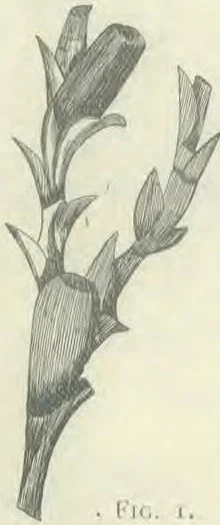
Apparently we shall not be able to find on the earth any form of life low enough in origin to answer to the description of the one we seek. Where else can we go?—Why, the sea is left us. In it we find some exceedingly small yet beautiful creatures; as, for instance, this hydroid, or “water animal.” See Fig. 1.
FIG. 2.
“Why!” you say, “that is a plant! It has no feet, no mouth, no eyes; how can it be an animal?” It is an animal, nevertheless. Among the lower orders of life it is often difficult to distinguish between animal and vegetable life; but in many instances, some of which will be illustrated, the vegetable lives have power to move about, while the animal has not.
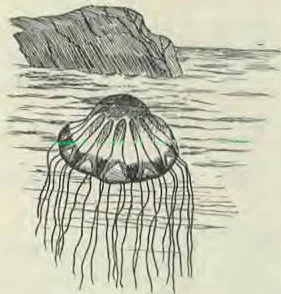
This little hydroid, which is greatly magnified in the illustration, dropping to the bottom of the sea, attaches itself to any projecting surface, such as a rock, barnacle, or mussel; and sending up its beautiful green stems, builds at last, in the junction near the top, a lovely conical-shaped home for its little unborn babe. Here the little one is deposited, nourished, and cared for, by means of an open tube that reaches the entire length of the stems; until the day when the tiny creature, fully matured, climbs to the rim of its beautiful home, shakes out its eight little tentacles, or arms, rises rapidly to the surface of the water, and floats away on the broad surface, a gay little jelly-fish. See Fig. 2. W. S. CHAPMAN.