The Youth’s Instructor, Vol. 47, No. 15.

We Have Made It Easy

The Youth’s Instructor

Apr 13, 1899

Review and Herald Publishing Company · Chicago, Battle Creek, Michigan, Atlanta · Apr 13, 1899

We Have Made It Easy

... FOR YOU TO SECURE THIS $4.00 ...

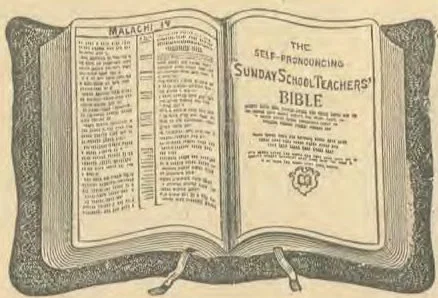
Self-Pronouncing S. S. Teachers' Reference Bible.
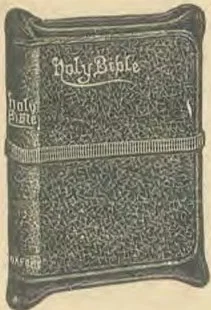
By Offering to Send it Post-paid, and the “Youth’s Instructor” for One Year, to any Address in the United States FOR ONLY $2.50.
If your INSTRUCTOR subscription is about to expire, you may send us the $2.50 for another year’s subscription and the Bible.
Last but not least, we offer to send the Bible, post-paid, to any address in the Postal Union, for only FOUR NEW YEARLY SUBSCRIPTIONS to the INSTRUCTOR, at $1.00, or for EIGHT NEW SIX-MONTHS’ SUBSCRIPTIONS, at 50 cents.
Specimen Page of the S. S. Teachers’ Bible. Size, 5 x 7¾ inches.
They that sealed the covenant. NEHEMIAH, X. The points of the covenant.
gavest before them, neither turned they from their wicked works. 36 Behold, d we are servants this day, and for the land that thou gavest unto our fathers to eat the fruit thereof and the good thereof, behold, we are servants in it: 37 And e it yieldeth much increase unto the kings whom thou hast set over us because of our sins: also they have f dominion over our bodies, and over our cattle, at their pleasure, and we are in great distress.
B. C. 445. d Deut. 28. 48. Ezra 9. 9. e Deut. 28. 33, 51. f Deut. 28. 48. g 2 Kin. 23. 3. 2 Chr. 29. 10; 34. 31.
25 Re’hum, Hā-shāb’nah, Mā-a-gē’-iah, 26 And Ā-hi’jah, Hā’nan, Ā’nan, 27 Māl’uch, Hā’rim, Bā’ā-nah. 28 ¶ e And the rest of the people, the priests, the Lē’vites, the porters, the singers, the Nēth’i-nims, f and all they that had separated themselves from the people of the lands unto the law of God, their wives, their sons, and their daughters, every one having knowledge, and having understanding;
The Text Conforms Exactly to the Oxford Teachers’ Edition. The self-pronouncing feature enables the reader to pronounce all proper names at a glance. Contains the celebrated Oxford Teachers’ Helps, comprising nearly 400 pages. Also a complete series of fifteen new maps.
All the above features render this Bible especially desirable to Teachers and students of the Holy Scriptures.
Send at once for free INSTRUCTOR canvassing outfit. Only FOUR new names, and the Bible is yours.
For 20c. extra we will stamp your name in gold upon the cover.
Send all money by Draft, P. O. or Express Order, or by Registered Letter.

TWO LETTERS.

(Many more might be given.)
The Bible was received two weeks ago. It is a very nice book. My daughter is very much pleased with it.
W. S. MILES, Monte Vista, Colo.
I received the Bible, and find it answers in every respect to the description. I should like very much to get one more just like it. Have you any left? MRS. C. M. LAKE, Orient, Ore.

GRAND TRUNK RAILWAY SYSTEM.

Time Card in Effect February 5, 1899.

C. & G. T. DIVISION.

WEST-BOUND FROM BATTLE CREEK. LEAVE.

No. 11, Mail and Express, to Chicago — 12.00 M. No. 1, Chicago Express, to Chicago — 9.00 A. M. No. 3, Lehigh Valley Express, to Chicago — 3.40 P. M. No. 5, Pacific Express, to Chicago, with sleeper — 12.55 A. M. No. 75, Mixed, to South Bend — 7.30 A. M.
Nos. 11 and 75, daily, except Sunday. Nos. 1, 3, and 5, daily.

EAST-BOUND FROM BATTLE CREEK.

No. 10, Mail & Exp., to Pt. Huron, East, and Detroit — 3.45 P. M. No. 4, Lehigh Express, to Pt. Huron and East — 8.27 P. M. No. 6, Atlantic Exp., to Pt. Huron, East, & Detroit — 2.25 A. M. No. 8, Lehigh Express, to Saginaw, Bay City, Pt. Huron, and East — 6.50 A. M. No. 74, Mixed, to Durand (Starts at Nichols) — 7.35 A. M.
Nos. 10 and 74, daily, except Sunday. Nos. 4, 6, and 8, daily.
E. H. HUGHES, A. G. P. & T. Agt., Chicago, Ill.
A. S. PARKER, Ticket Agent, Battle Creek.

SUBSCRIPTION ORDER

CUT THIS OUT AND RETURN TO US WITH YOUR RENEWAL OR A NEW SUBSCRIPTION.

SUBSCRIPTION ORDER.

REVIEW & HERALD PUBLISHING CO., Battle Creek, Mich.
Enclosed find One Dollar, for which please send THE YOUTH’S INSTRUCTOR for one year to the following address:—
Name
Street
Town
County
Begin Subscription
State

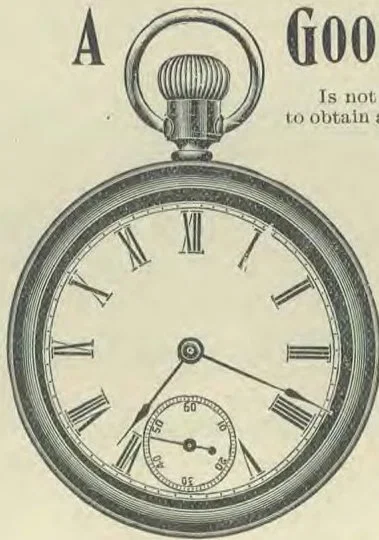
A GOOD WATCH

Is not such a difficult thing to obtain after all. Notice what we now have to offer you. A—

Genuine American Jeweled Watch

with German silver (white metal) case, stem wind and pendant set, small, thin size, enameled dial (not paper), and solid steel cut pinions.
The smallest watch for the money. Just the thing for boys or men. Not a clock in watch shape, but a real watch.

OUR OFFERS.

NUMBER ONE.—We will send this watch and the INSTRUCTOR one year to old or new subscribers sending us only $2.50.
NUMBER TWO.—We will send the watch alone for only FOUR new yearly subscriptions to the INSTRUCTOR, at $1.00 each, the regular rate.
NOTICE.—Your own subscription will not count on the above offers.
Send for free INSTRUCTOR canvassing outfit, and begin work at once. We have only a very few of these watches on hand. Address—
THE YOUTH'S INSTRUCTOR, Dept. “W,” Battle Creek, Mich.

Important.... Announcements!

Beginning with No. 16, the issue for April 20, 1899, THE YOUTH'S INSTRUCTOR will be a 16-page illustrated weekly magazine. It will hereafter be furnished to subscribers and clubs at the following reduced rates:—

New Subscription Rates.

One year, single copy, $ .75
Six months, single copy, .40
Three months, single copy, .20
To foreign countries, single copy, $1.25

New Club Rates.

5-9 copies, one year, $ .55
10-100 copies, one year, .50
Above 100 copies, one year, .45
NOTICE.—Due credit will be given those who have already paid for their subscription at the $1.00 rate. This will be done by proportionately prolonging the term of subscription.

The New Advertising Rate.

Display Advertisements, fifteen cents per Agate line, or $2.10 per inch.
Reading Notices, thirty cents per Brevier line each insertion.
The publishers reserve the right to reject any advertisement which in their judgment it is not proper to insert.
The Youth's Instructor,
Business Department.
Battle Creek, Mich.

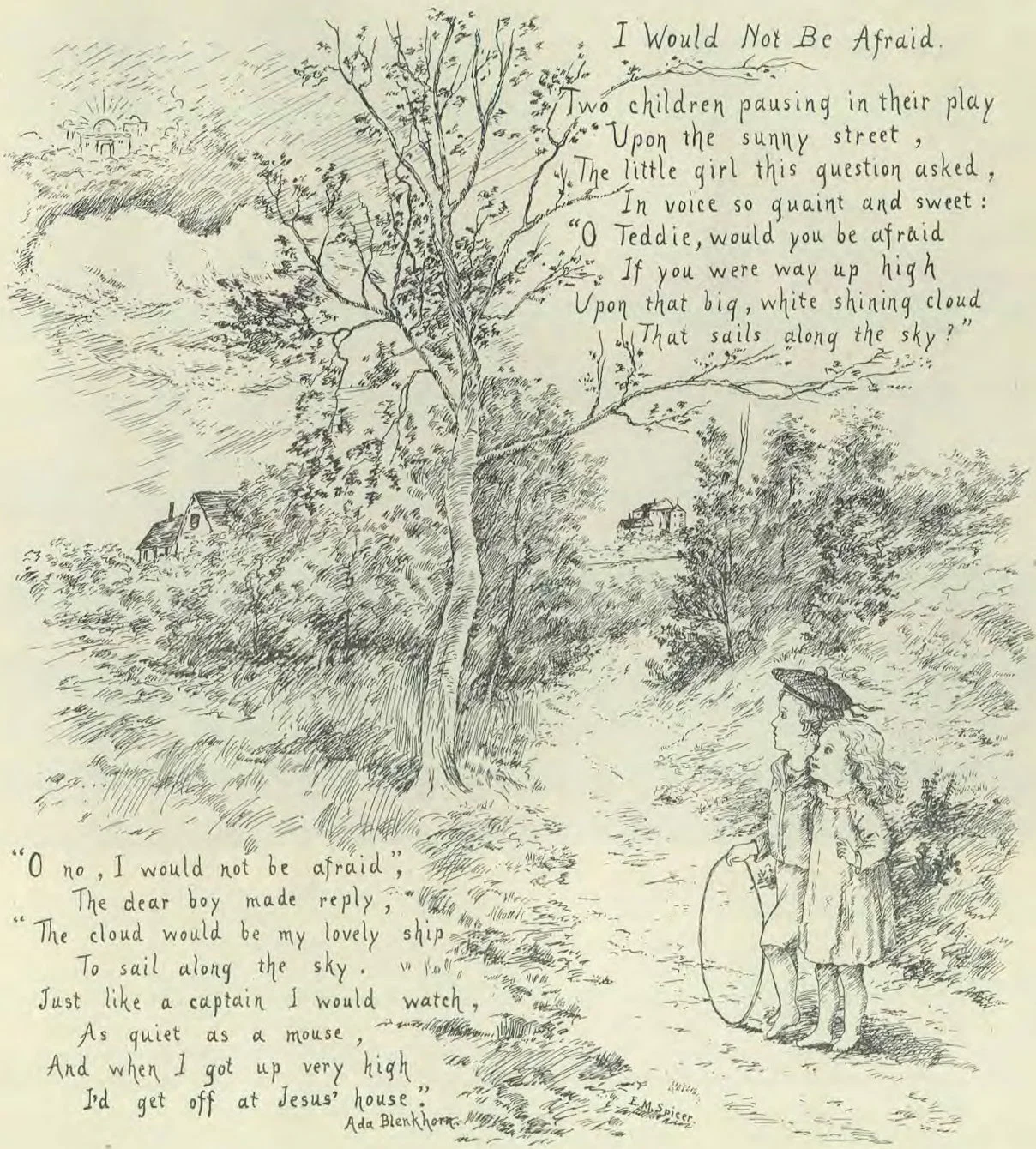
I Would Not Be Afraid.

Two children pausing in their play Upon the sunny street, The little girl this question asked, In voice so quaint and sweet: “O Teddie, would you be afraid If you were way up high Upon that big, white shining cloud That sails along the sky?”
“O no, I would not be afraid,” The dear boy made reply, “The cloud would be my lovely ship To sail along the sky.” Just like a captain I would watch, As quiet as a mouse, And when I got up very high I’d get off at Jesus’ house.”
Ada Blankhorne

GRACELAND CREMATORY.

GRACELAND CHAPEL AND CREMATORY.
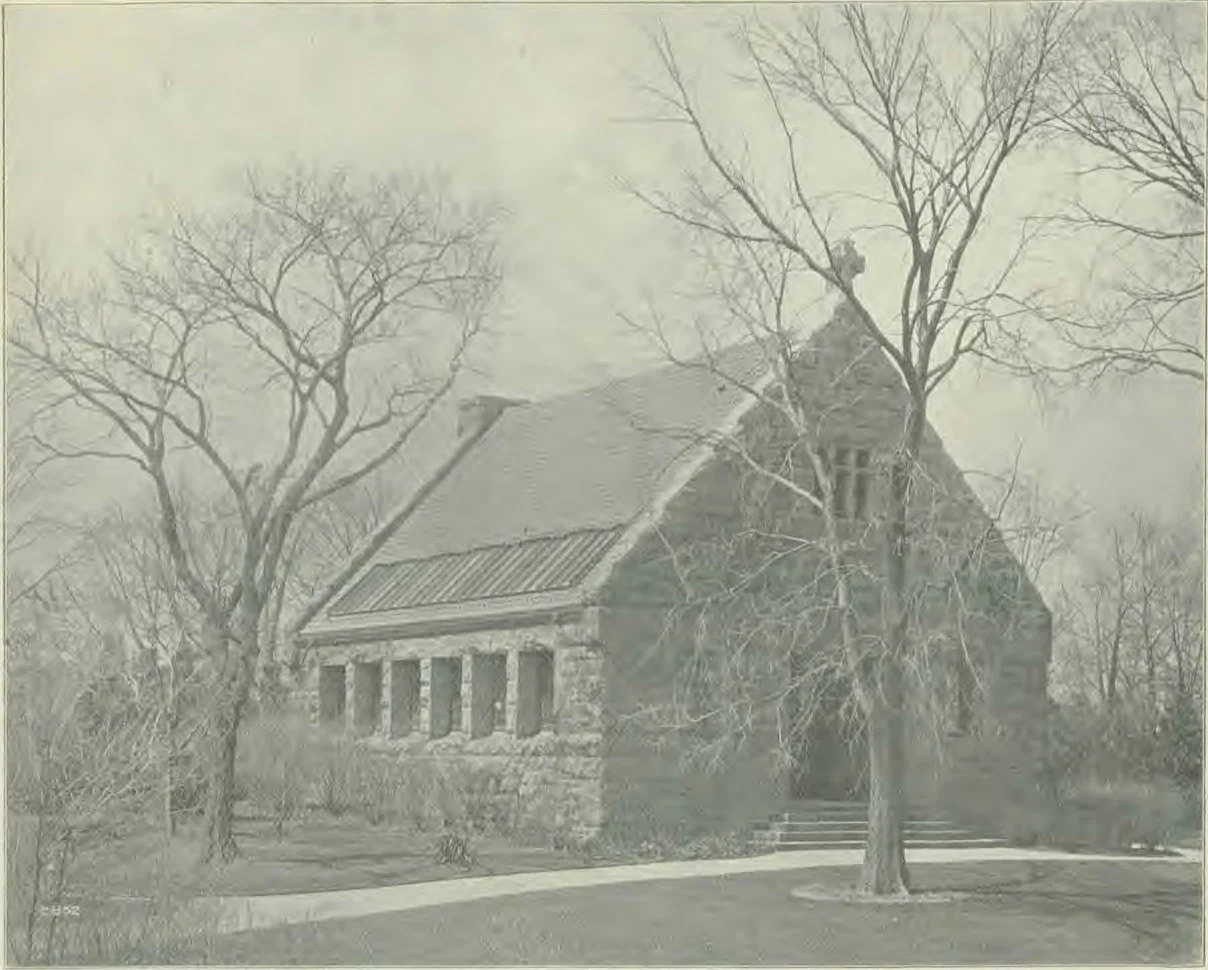
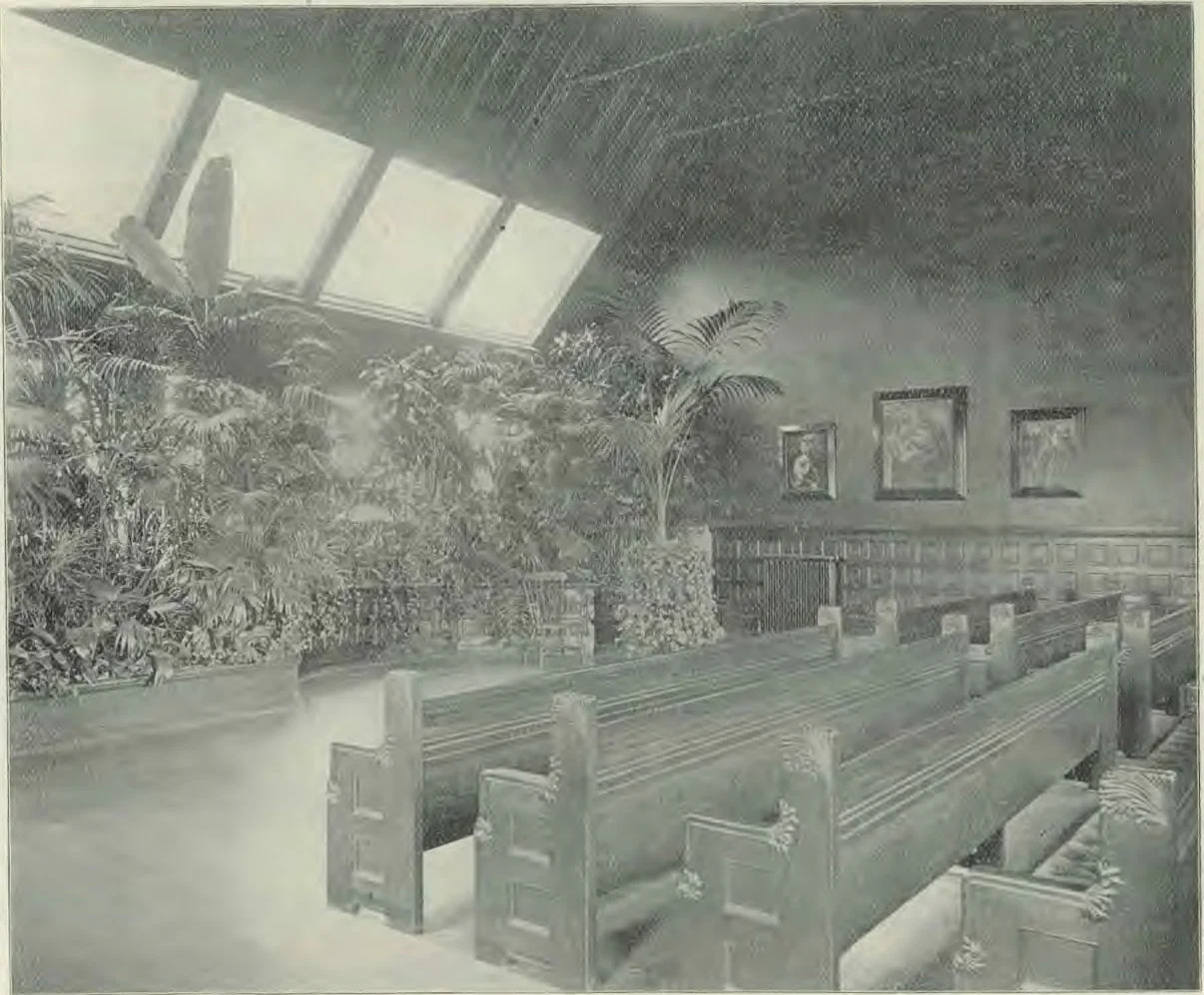
In a charming spot in Graceland Cemetery, Chicago, is a vine-covered, rustic building, made of solid granite, the doorway and steps of which are polished to a high degree; the roof is made of tile. It is situated on a small grassy knoll, which is kept in such good condition that one might think it covered with a carpet of green velvet instead of grass. On either side and in front of the building majestic trees guard the spot. Underneath the trees are beautiful violets in the spring; and in the fall the goldenrod nods its graceful head, thus adding beauty to the already seemingly perfect spot. This structure thus beautifully situated is a crematory and its chapel, a winter view of which is shown in the picture. As we step inside, a veritable Eden of tropical plants greets our eye, as you will see by looking at the accompanying cut. The palms, vines, and banana-trees are all artistically arranged around the front wall and over the door. The back part of the room looks like a church. In front of the cushioned pews is a dais, or raised platform, the size of a coffin, which is nicely draped.
On the morning of Jan. 1, 1898, we might have seen three mourners sitting in those seats; and in the coffin on the dais, the body of our beloved Frances Willard. After a short service, the coffin slowly descended from our view. Finally it entirely disappeared, and was taken below in the basement to the crematory, put into a retort, or oven, and incinerated. In a few hours the ashes, in an urn, were given to the mourners, who took them to Rose Hill Cemetery, two miles farther north, for burial. This incineration was made at Frances Willard’s own request, in this quiet way.
Among the heathen, cremation was once the most general way of disposing of the dead. The Greeks, Romans, Celts, Slavs, and Germans burned their dead; and our Indians, in their crude fashion, practised it hundreds of years ago. Cremation may be regarded as the universal custom of Indo-European races. In the city of the Cæsars to-day are still found the cinerary urns of thousands. Among the Jews, cremation was practised only upon the bodies of royal persons. In Japan many thousands are cremated every year.
INTERIOR OF CHAPEL AT GRACELAND.
Cremation came more and more into disuse as Christianity began to spread, and the theology of the literal resurrection of the body was taught. The ancient funeral pyre, with its smoke, disgusting odors, wailing, incantation, and human sacrifices, willing or unwilling, is surely very revolting compared with modern cremation.
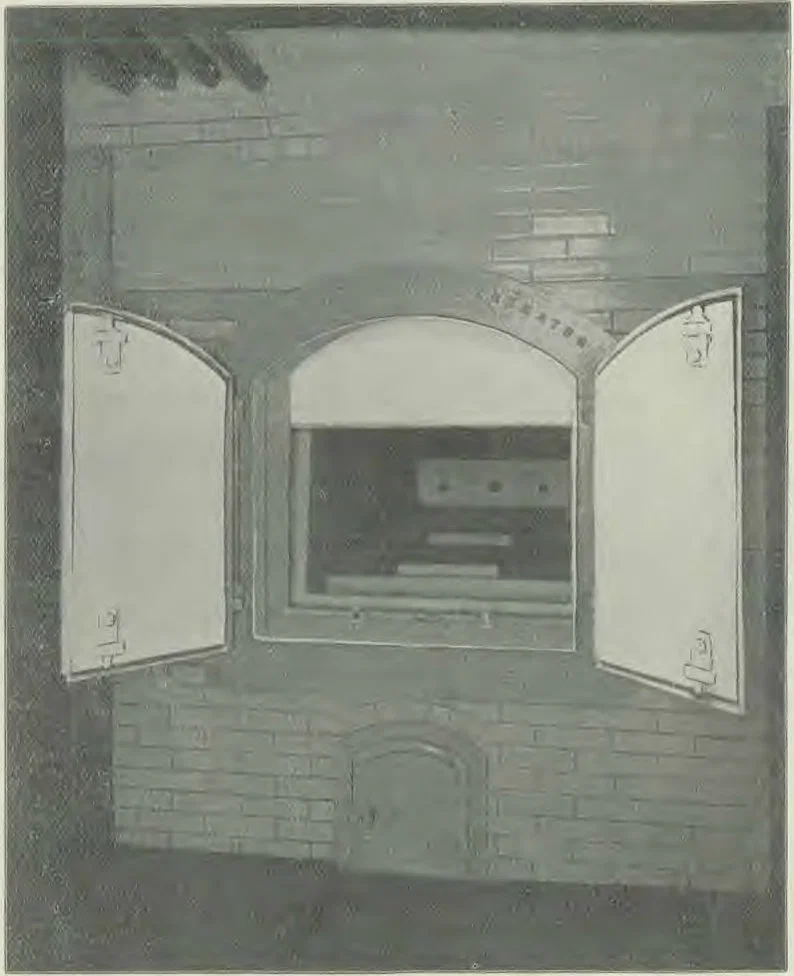
The modern crematory is rectangular in shape; and, outside, is twelve feet long, seven and one-half feet wide, and eight feet high. It is made of fire-clay material, manufactured especially for the purpose. It contains three interior chambers, all of which are lined with specially shaped fire-linings, designed to withstand great heat. These are incased in a fire-clay brick wall, leaving a space of about two inches. The front of this outer incasing, or wall, contains the outside crematory door to the upper chamber, and is enameled in white, to correspond to the white walls of the rest of the basement. The upper chamber, or retort, which you can see in the illustration, is seven by three by three feet; the middle, or gas, chamber is seven by two by three feet; and the lower, or escape, chamber is seven by one by three feet. The draft is from above down, from the retort to the gas-chamber, then to the escape-chamber, and then to the smoke-stack.
The crematory is heated with crude petroleum, which has stood a fire-test of 110° F. It is supplied under pressure from a tank in the rear of the chapel. Each oil-burner is supplied with oxygen by a small air-pipe, which supplies air under pressure. In this way the oil is first atomized as it burns, and then volatilized as the heat increases, thus making a very hot flame, and insuring perfect combustion.
THE RETORT.
THE RETORT.
In operating the crematory, and conducting an incineration, the retort is heated to from sixteen to eighteen hundred degrees F., and the gas-chamber from twenty-two to twenty-four hundred degrees F. To attain this heat, one burner is turned on one hour before the desired time of cremation, and three other burners forty-five minutes before the desired time. At the end of this time, the burners are turned off from the retort; and it is allowed to cool seven or eight minutes, when the door is opened, and the casket, wrapped in a sheet saturated with a solution of alum to prevent the casket from taking fire till after the doors are closed, is rolled in. With daylight or electric light, the glow of the retort is not noticeable, but simply looks a natural gray color. The inner door, which is made of the same material as lines the chambers, and weighs eight hundred pounds, is carefully lowered, and the outside door closed and fastened. After a few minutes the whole bursts into bright flame from the heat of the retort. After from fifteen to twenty-five minutes, the burners are again turned on. The chambers are supplied with air under pressure by twenty tubes which enter the sides of the retort near the bottom. This fans the fire into a clear, bright flame, and greatly hastens combustion. Should there be any gases unburnt escaping from this, they pass down into the gas-burning chamber, where they are consumed, and beyond which nothing passes except the nitrogen and the anhydrides. The heat from these chambers becomes so intense that the ashes from the casket, clothes, etc., are simply dissipated, the same as burning charcoal with an intense flame, under the blow-pipe, and nothing remains except the ashes of the minerals in the human body, together, of course, with the indestructible substances in the casket. These are afterward removed from the ashes. This combustion is brought about by the high degree of heat, and the fresh oxygen contained in the air, which is forced into the chambers during the whole process. During the last stages, the heat is raised from twenty-six hundred to three thousand degrees F., and the bones assume a dazzling white, almost as bright as a calcium light. This continues twenty or thirty minutes, when the heat is turned off. The whole process has taken from sixty to eighty minutes. In from six to twelve hours the crematory has cooled, and the ashes are removed, put in a neat urn, and given to the mourners. The ashes weigh from four to six pounds.
Much of the information regarding the size of the crematory, and the material of which it is built, was kindly furnished me by the builders of the Graceland Crematory, the Engle Sanitary and Cremator Co., Des Moines, Iowa. For the information in regard to the method of conducting incinerations, I am indebted to Mr. James Currie, superintendent of the Forest Home Crematory, Milwaukee, Wis. Mr. Currie is much interested in the subject of cremation, and has made some valuable experiments in this line, by which it was found that by supplying an increased quantity of air under pressure, the oxidation was more perfect, and the time required by the process reduced to from sixty to eighty minutes. The average time of fourteen consecutive cremations at this crematory was one hour and fifteen minutes. The average amount of oil used for these was 45.7 gallons. In most modern crematories not using air under pressure, about two hours are required for a cremation, and in older ones five or six hours.
Cremation is growing in favor in nearly all the European countries as well as in the United States. The Odd-fellows’ Crematory at San Francisco, Cal., was opened June 26, 1895, and during that year there were sixty-six cremations; in 1896 there were one hundred and one; in 1897 there were two hundred and fourteen; and during 1898 the cremations averaged nineteen a month. The crematory at Los Angeles, Cal., was started in June, 1887; and for the first six months there were six, and up to November 1 of last year there were forty-four. Our Graceland Crematory was opened in December, 1893, and had forty-three cremations for the first year, and averaged ten a month last year, notwithstanding the fact that a crematory has since been built in Milwaukee.
Those who request incineration are mostly made up from the broad-minded classes; and many leave requests, or intimate this as their choice of disposal. As to the total number of optional incinerations, the United States ranks first; next come Germany, Italy, France, England, and Switzerland. New York stands first among the cities in its number of cremations.
Kate Field said: “Cremation is not only the healthiest and cleanest, but also the most poetical, way of disposing of the dead.” Especially is cremation of hygienic value in the cities. The damage to the health of those who live near church-yards and cemeteries, from the exhalation of noxious gases and the poisoning of water-supplies, is an indisputable fact. Rev. H. W. Thomas, of Chicago, says: “There can be but little doubt that in the years to come, cremation will take the place of burial.”
EMMA ADAMS.

ENCOURAGEMENT

Have courage, dear sisters, dear brothers, Keep trusting in Jesus, your Friend; For he is far truer than others, He’ll go with you through time, to the end,
And at last he’ll receive you in glory, With him you shall evermore dwell; Blessed truth!—’tis the old, old story. Up! hasten the story to tell.
C. F. Ladd.

THE RESURRECTION OF LAZARUS.

III.

Apparently, Mary and Martha and the dying Lazarus were left alone; but they were not alone. Christ beheld the whole scene; and after the death of Lazarus, the bereaved sisters were upheld by his grace. Did not Jesus witness the sorrow of their rent hearts, as their brother wrestled with his strong foe, death? He saw it all, he felt every pang of anguish; and he said to his disciples, “Lazarus is dead.”
Christ had not only the loved ones at Bethany to think of; he had the training of his disciples to consider. They were to be his representatives to the world, that the Father’s blessing might include all. For their sake he permitted Lazarus to die. Had he restored him from illness to health, the miracle that is the most positive evidence of his divine character would not have been performed.
Had Christ been in the sick-room, Lazarus would not have died; for Satan would have had no power over him. In the presence of the Life-giver, death could not have aimed his dart at Lazarus. Therefore Christ remained away. To a certain extent he suffered the enemy to exercise his power. He permitted him to go a certain length, that by his own life-giving power he might drive back the conquered foe. He permitted Lazarus to pass under the dominion of death, and the suffering sisters saw their brother laid in the grave. Christ knew that as they looked on the face of their dead brother, their faith in their Redeemer would be severely tried. Thus he was pruning the branches, that they might bring forth more fruit. He knew that because of the struggle through which they were now passing, their faith would shine forth with far greater power. He suffered every pang of sorrow that they endured. He loved them no less because he tarried; but he knew that for them, for Lazarus, for himself, and for his disciples, a victory was to be gained. This crowning miracle was to give the seal to his mission and divinity.
“I am glad for your sakes that I was not there.” Not then did the disciples grasp the full meaning of these words; but the Holy Spirit, which Christ was to send to them after his ascension, would bring to their remembrance every word that he had spoken, imprinting his lessons indelibly on their minds, that they might have no misconception of his love or of his human sympathy.
Christ delayed, that by raising Lazarus from the dead, he might give to his stubborn, unbelieving people an evidence that he was indeed “the resurrection, and the life.” He was loath to give up all hope of the Jewish people. They were to him as the poor, wandering sheep of the house of Israel. His heart was breaking because of their impenitence. He knew that by their course of action they would bring upon themselves swift destruction. God would not avert the terrible retribution that was to come upon the Jewish nation because of the treatment of his Son. They were loading the cloud of indignation that was soon to burst upon them with uncontrollable fury, leaving them a scattered people, and a curse in the whole earth. But in his mercy, Christ purposed to give his deceived, deluded countrymen one more evidence that he was the Restorer, the One who alone could bring life and immortality to light through the gospel. This was to be an evidence that the priests could not misinterpret to destroy the faith of all whom they could influence. This was why Christ deferred going to Bethany.
As Christ and his disciples drew near Bethany, a messenger was sent to the sisters, with the tidings of his arrival. Christ did not at once enter the house, but remained in a quiet place by the wayside. Among the Jews great outward display was observed at the death of friends or relatives. The numerous ceremonies were carried through with great precision. This ceremonial was not in harmony with the spirit of Christ. He did not wish to meet the sisters in the scene of confusion. And among the mourners were relatives of the family, some of whom held high positions of responsibility in Jerusalem. Among these were some of Christ’s bitterest enemies. Christ knew their purposes, and therefore he did not at once make himself known.
The message was given to Martha so quietly that the others in the room did not hear. Absorbed in her grief, Mary did not hear the words. Rising at once, Martha went out to meet her Lord; but thinking that she had gone to the place where Lazarus was buried, Mary sat still in her sorrow, making no outcry.
Martha hastened to meet Jesus, her heart agitated by conflicting emotions. In his expressive face she read the same tenderness and love that had always been there. Her confidence in him was unbroken; but she thought of her dearly loved brother, whom Jesus also had loved. Hope was not all dead in her heart; for at last Christ had come. With grief surging in her heart because he had not come before, yet with hope that even now he would do something to comfort them in their grief, she said: “Lord, if thou hadst been here, my brother had not died.” Over and over again, amid the tumult made by the mourners, the sisters had repeated these words.
With human and divine pity, Jesus looked into her sorrowful, care-worn face. Truly the branch is pruned that it may bring forth more fruit. Martha had no inclination to recount the past; all is expressed by the pathetic words, “Lord, if thou hadst been here, my brother had not died.” But looking into the face of love, she said, “But I know, that even now, whatsoever thou wilt ask of God, God will give it thee.”
Christ’s answer was not calculated to inspire faith in any immediate change. Carrying her thoughts forward to the general resurrection, he said, “Thy brother shall rise again.” Martha understood him to mean just what he intended she should. “I know that he shall rise again in the resurrection at the last day,” she answered. Jesus said: “I am the resurrection, and the life: he that believeth in me, though he were dead, yet shall he live.” His death will not be eternal. “And whosoever liveth and believeth on me shall never die.” The saints who are living when Christ comes, will be translated to heaven without seeing death. “Believest thou this?” Christ asked. Martha did not comprehend in all their significance the words spoken by Christ; but she responded, “Yea, Lord: I believe that thou art the Christ, the Son of God, which should come into the world.”
“And when she had so said, she went her way, and called Mary her sister secretly, saying, The Master is come, and calleth for thee.” She delivered her message as quietly as possible; for the priests and rulers were prepared to arrest Jesus when opportunity offered.
MRS. E. G. WHITE.

MAKING A WOOD-SCRAPER.

This week we will make a tool that is very useful in doing good work. It is called a “wood-scraper,” and is used to smooth down work after the wood has been planed. Sometimes lumber is very cross-grained and “eaty,” as we call it. By using a wood-scraper, all such places can be made smooth. If these instructions are followed, you will not have any trouble in making this tool and keeping it in order.
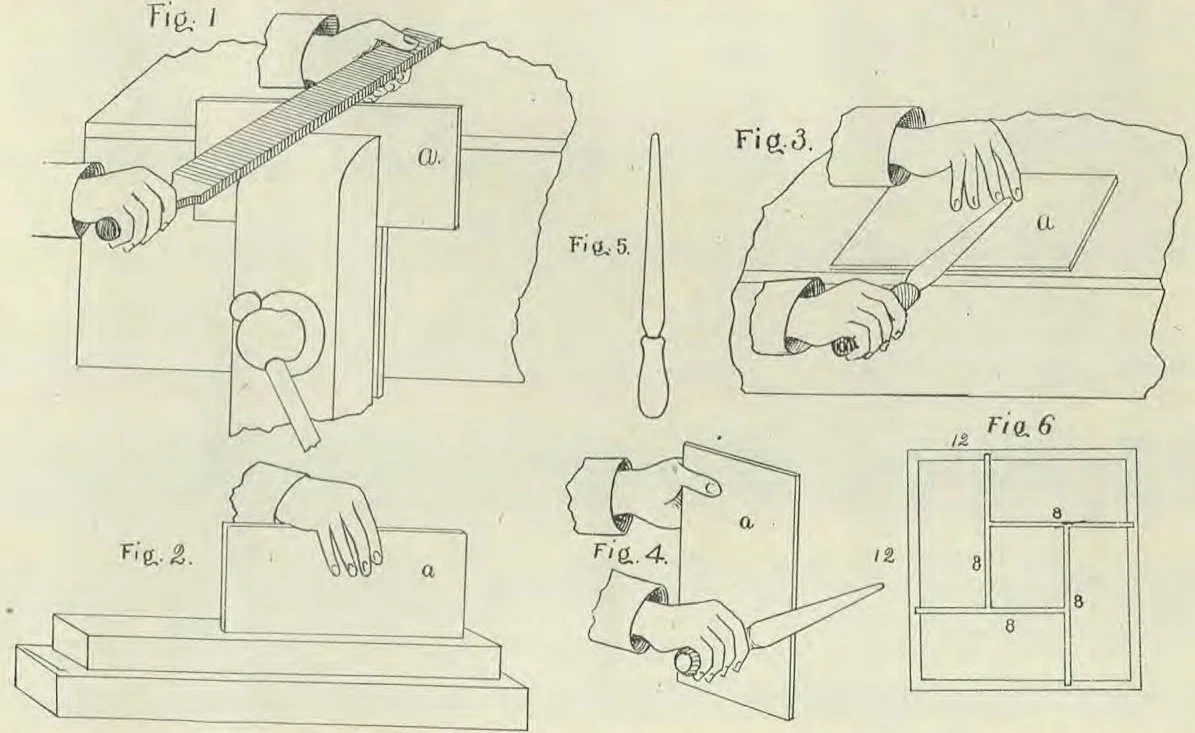
Most all hardware dealers who carry carpenters’ tools keep wood-scrapers. They can be bought for twenty-five cents. I usually make mine. Sometimes a saw gets broken, or becomes so worn that I do not care to keep it any longer. I then work it up into scrapers. A good size is about two and a half or three by five inches. To make one, mark out the size of the scraper on the saw, screw the blade into an iron vise, and with a sharp cold-chisel held close to the jaw of the vise, begin at one edge, and cut out the scraper. Then put it in your vise, as shown in Fig. 1, and file it. Hold the file in the position shown in Fig. 1, the left hand being quite a way ahead of the right one, so that the file rests diagonally on the scraper. Hold the file up level, and shove it from one end to the other of the scraper, or as machinists would say, “draw-file it;” but do not shove it crosswise of the steel. The edge will be straight, smooth, and square.
When this is done, lay the scraper flat upon the oil-stone, and rub it smooth upon each side. Next set it upon the edge, as seen in Fig. 2, and shove it endwise upon the oil-stone until it is smooth. Then you will have two square corners upon each edge.
To keep a scraper sharp, you will need a tool called a burnisher, which is shown in Fig. 5. You can make one. Take an ordinary saw-file that has been worn out, grind it upon a stone or emery-wheel until all the file-marks disappear, grind off the sharp corners so that they will be rounded off, making the tool as smooth as you can. Take some fine sandpaper or emery-paper, put some oil on it, and rub the burnisher smooth. Then put on a handle, and you have a good tool. The burnisher should be made of very hard steel.
Having finished your burnisher, take your scraper, and run it through your lips to wet it, doing the same with the burnisher. This prevents them from sticking when they are rubbed together. Lay the scraper down flat upon the edge of the workbench or a board, as shown in Fig. 3. Hold down the scraper solid with the left hand, and with the right hand rub the burnisher across the scraper a few times, dropping your hand a little, so that in rubbing the burnisher across, it will turn the edge of the scraper down a trifle. Do this upon both sides; then turn your scraper around, and serve the other edge the same way. Wet your scraper in your lips again, and stand it upon the end, as shown in Fig. 4. Put your burnisher down at the bottom of the scraper, and draw it up, drawing it a little toward you all the while, so that you turn the edge over toward you. Now when you use it upon the wood, it will take off a smooth shaving.
Do not be discouraged if you do not get these tools just right the first time, but keep on trying. In my next article I will tell you how to use this tool.
Fig. 6 will show you how to lay the floor joists spoken of in the preceding article.
W. K. LOUGHBOROUGH.
Continue reading: MAKING HOME PEACEFUL